Generative illustration for The End of History




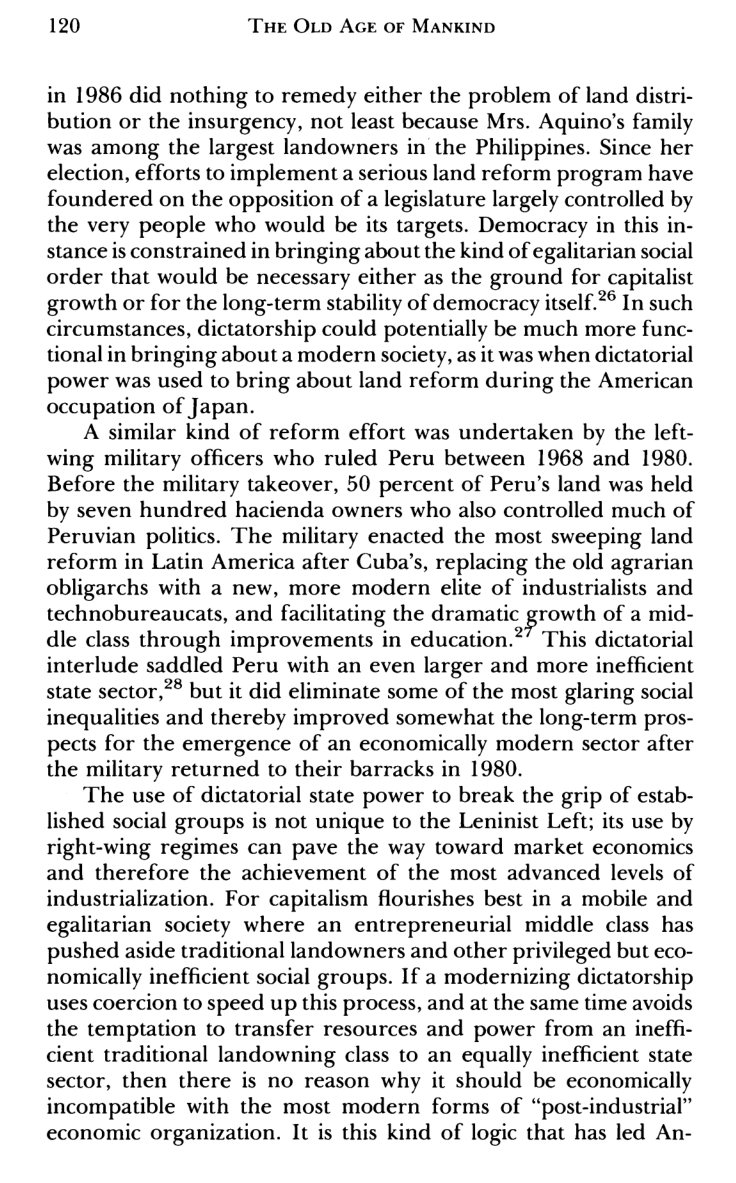
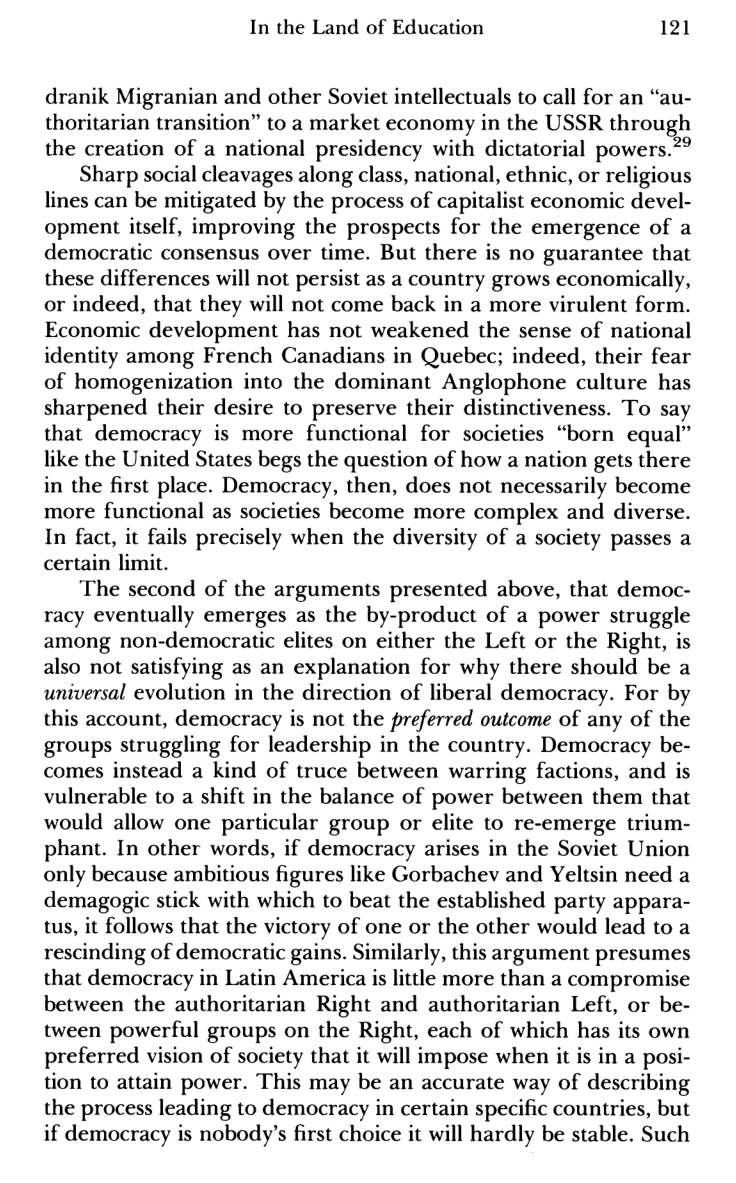
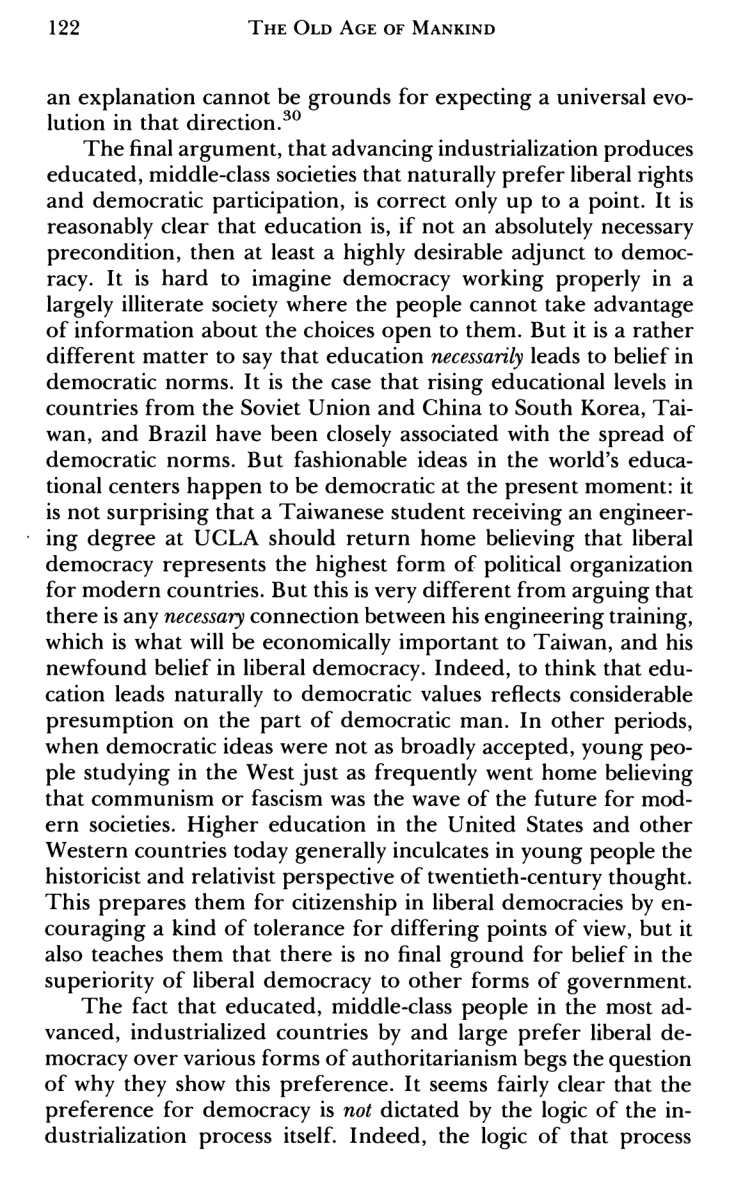







The End of History
Overview unavailable.
Book Overview
- Introduces Francis Fukuyama’s The End of History and the Last Man, a philosophical inquiry into whether human history has a direction and endpoint.
- Presents the book’s central argument: modern science, economic development, and the struggle for recognition push societies toward capitalist liberal democracy.
- Raises the concern that the “last man” in a post-historical liberal order may become spiritually dissatisfied, possibly reviving conflict and instability.
- Includes publication details, copyright information, dedication, table of contents, and Library of Congress cataloging data.
- Contains praise from prominent commentators and acknowledgments of the people and institutions that supported the book’s development.
The End of History
- The author argues that liberal democracy represents the final form of human government and the end point of ideological evolution.
- While specific democracies face social problems, these are viewed as failures of implementation rather than flaws in the underlying principles of liberty and equality.
- The concept of 'History' used here refers to a single, coherent, evolutionary process of human societies rather than the mere occurrence of events.
- This teleological view of history is rooted in the philosophy of Hegel and Marx, who both believed human society evolves toward a final, satisfying state.
- The 'end of history' does not imply the cessation of conflict or significant world events, but rather the exhaustion of viable ideological alternatives to liberalism.
- The original thesis sparked global controversy, often due to a misunderstanding of the distinction between chronological events and philosophical History.
More than that, however, I argued that liberal democracy may constitute the 'end point of mankind's ideological evolution' and the 'final form of human government,' and as such constituted the 'end of history.'
The Directionality of History
- The 'end of history' refers to the final settlement of underlying political principles and institutions rather than the cessation of events.
- The author proposes that human history is a coherent, directional process leading toward liberal democracy.
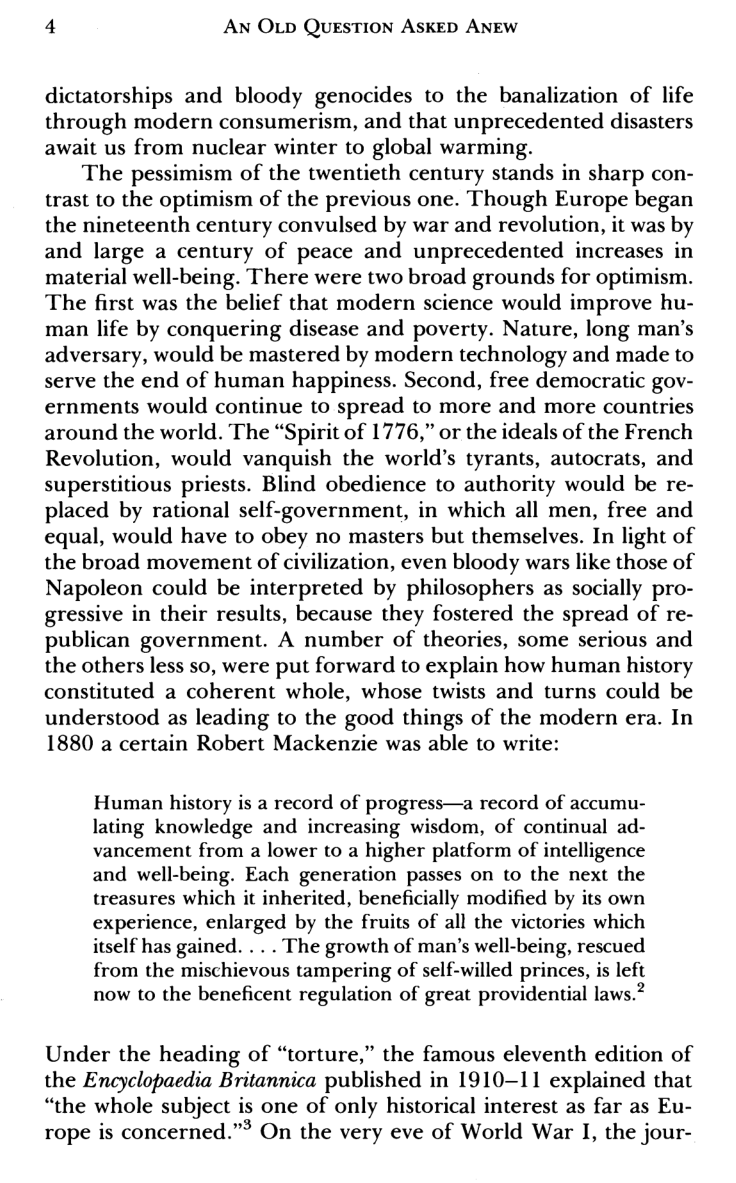
- Twentieth-century pessimism, fueled by world wars and totalitarianism, has made the West skeptical of the possibility of historical progress.
- The collapse of both right-wing and left-wing dictatorships in the late twentieth century reveals a fundamental weakness in authoritarian systems.
- Liberal democracy and free-market economics have emerged as the only globally coherent political and economic aspirations.
- The drive toward this historical endpoint is fueled by two distinct factors: economic logic and the 'struggle for recognition.'
We have become so accustomed by now to expect that the future will contain bad news with respect to the health and security of decent, liberal, democratic political practices that we have problems recognizing good news when it comes.
The Mechanism of Universal History
- The author revives the nineteenth-century quest for a Universal History of mankind, a concept largely abandoned due to the traumatic events of the twentieth century.
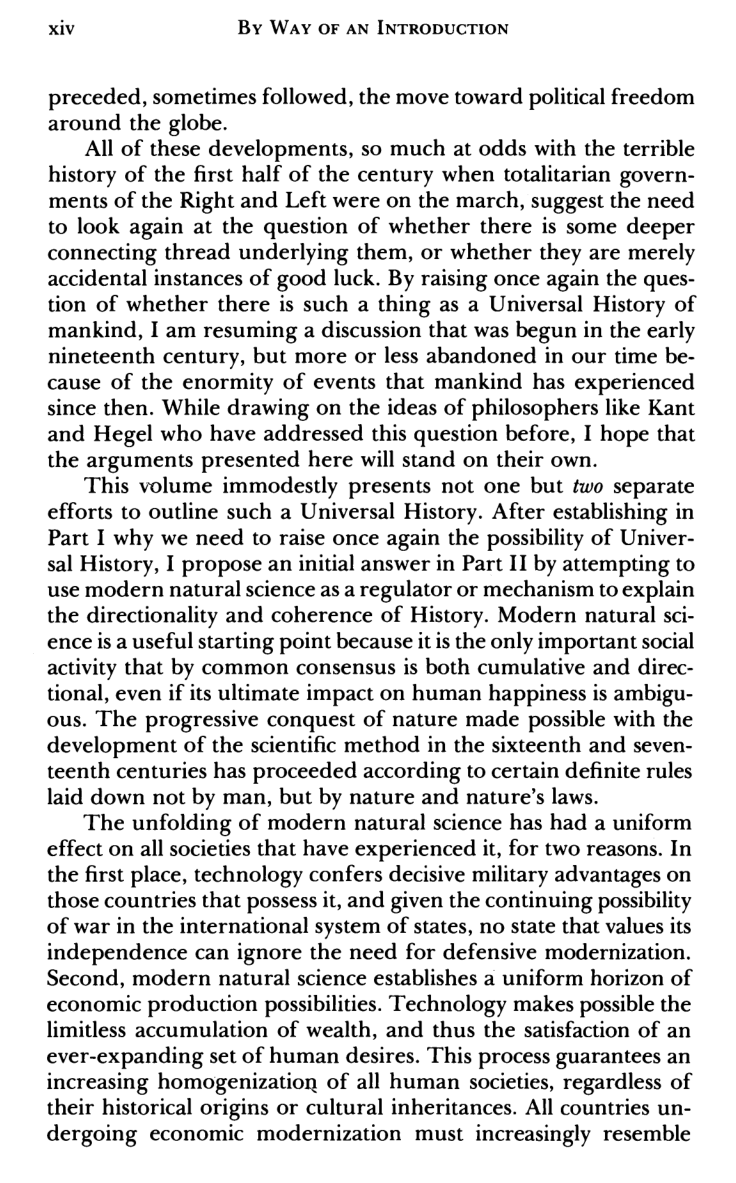
- Modern natural science serves as the primary mechanism for historical directionality because it is the only social activity that is universally cumulative and directional.
- The necessity of military defense forces states to adopt modern technology, leading to a process of 'defensive modernization' to maintain independence.
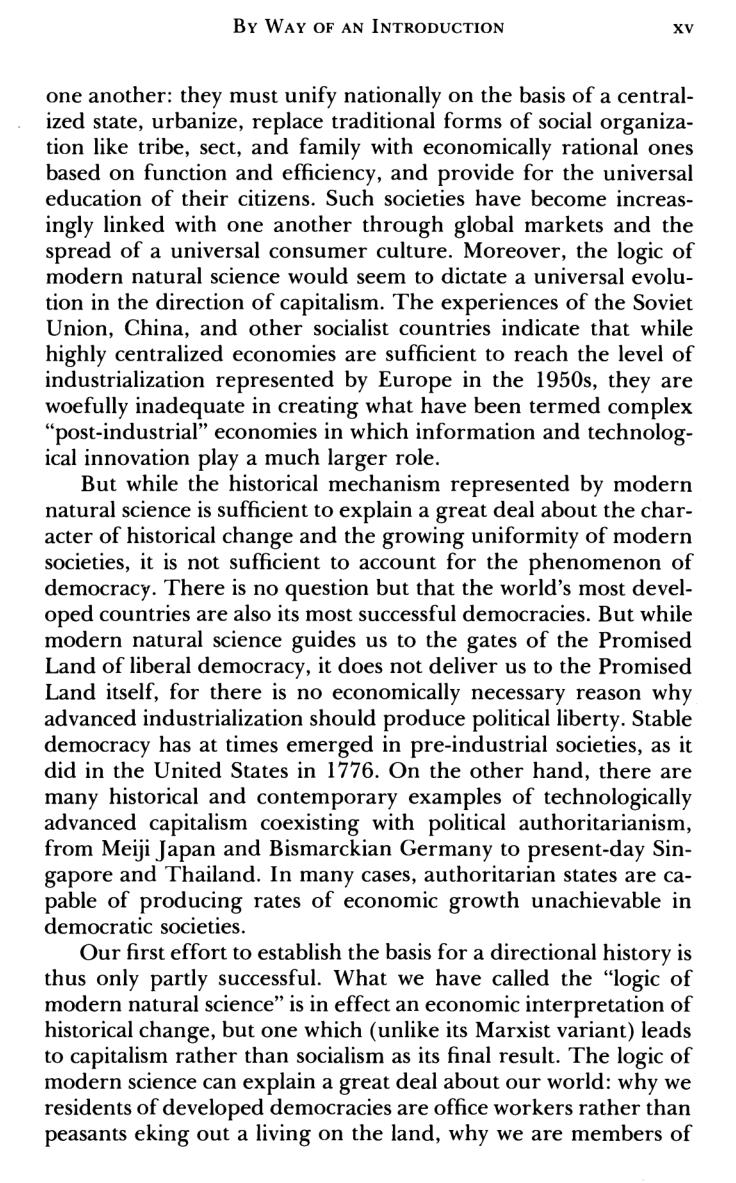
- Economic modernization creates a uniform horizon of production that homogenizes diverse societies, forcing them to adopt centralized states, urbanization, and rational social structures.
- The logic of advanced industrialization and technological innovation appears to favor capitalism over centralized socialist models for post-industrial development.
- While natural science explains the global shift toward capitalism and social homogenization, it does not inherently account for the emergence of political democracy.
Modern natural science is a useful starting point because it is the only important social activity that by common consensus is both cumulative and directional, even if its ultimate impact on human happiness is ambiguous.
The Struggle for Recognition
- Modern natural science explains the economic shift toward capitalism but fails to account for the emergence of democratic values.
- Authoritarian regimes often achieve higher economic growth than democracies, proving that capitalism and political freedom are not inherently linked.
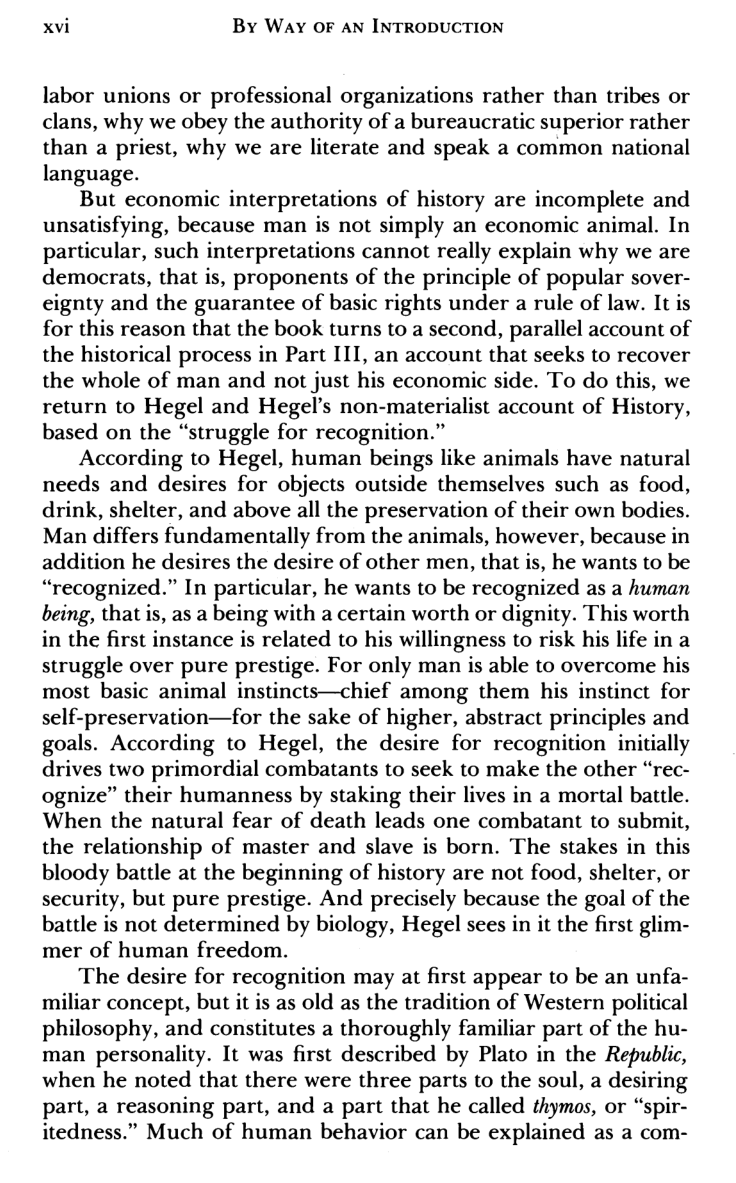
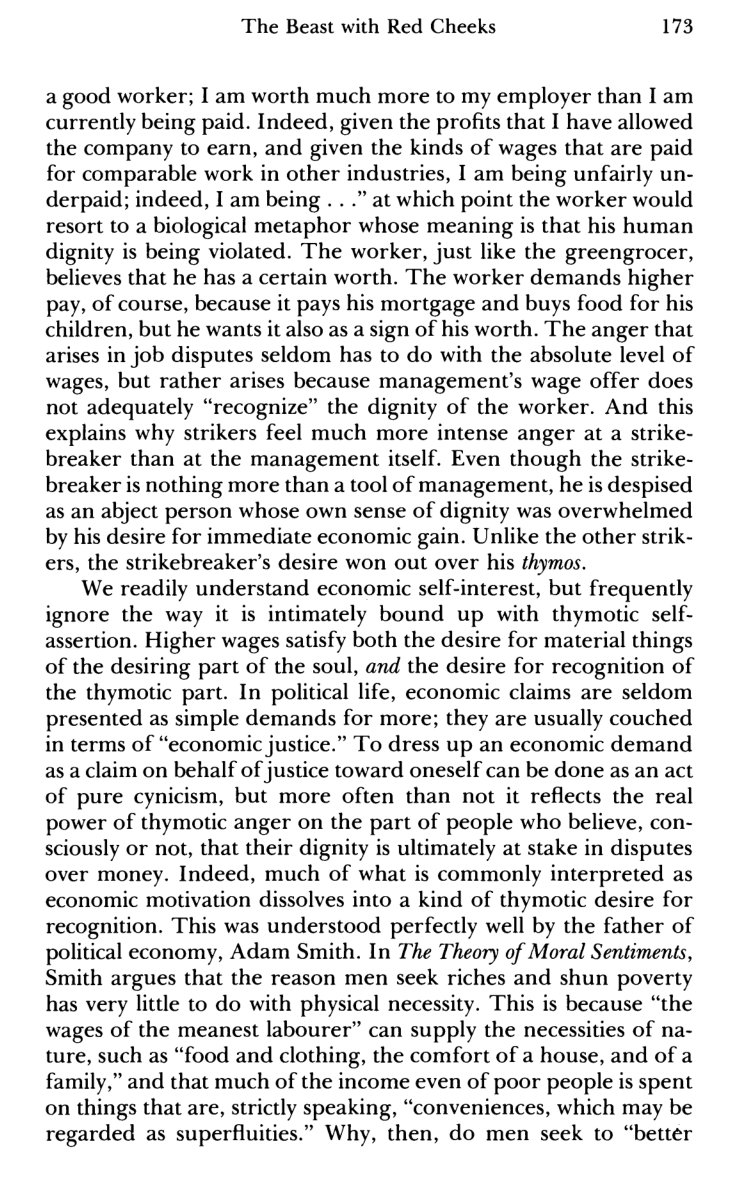
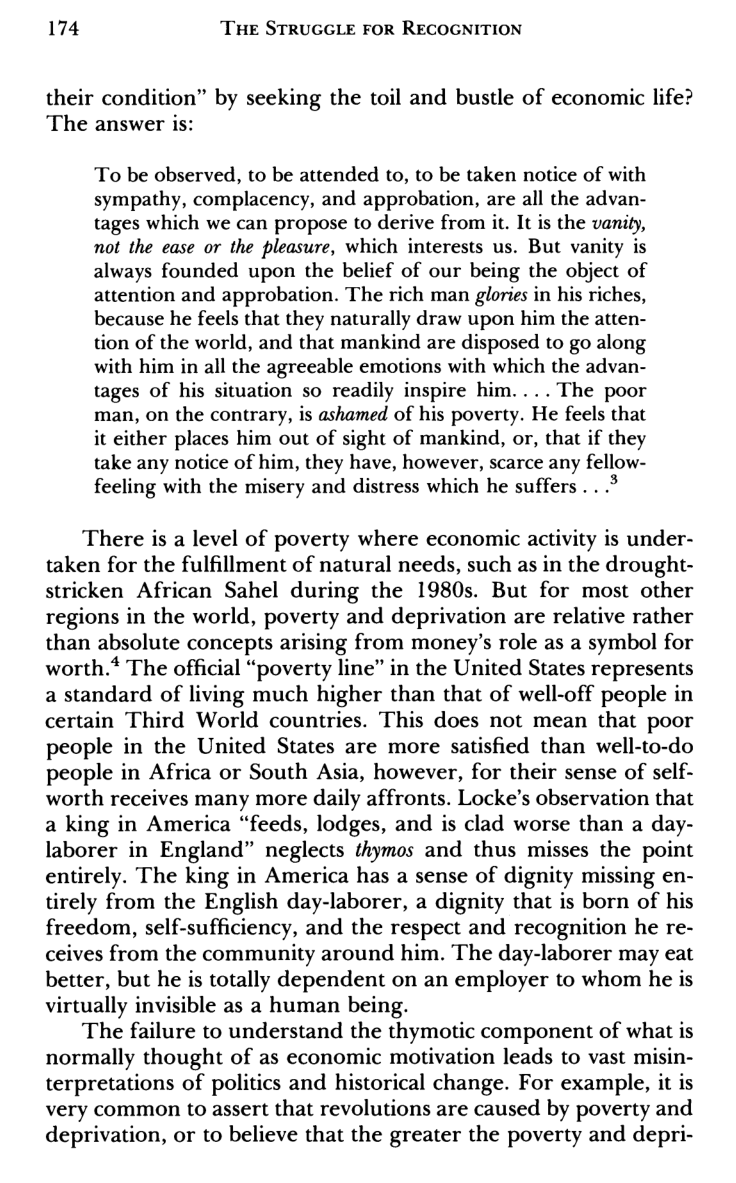
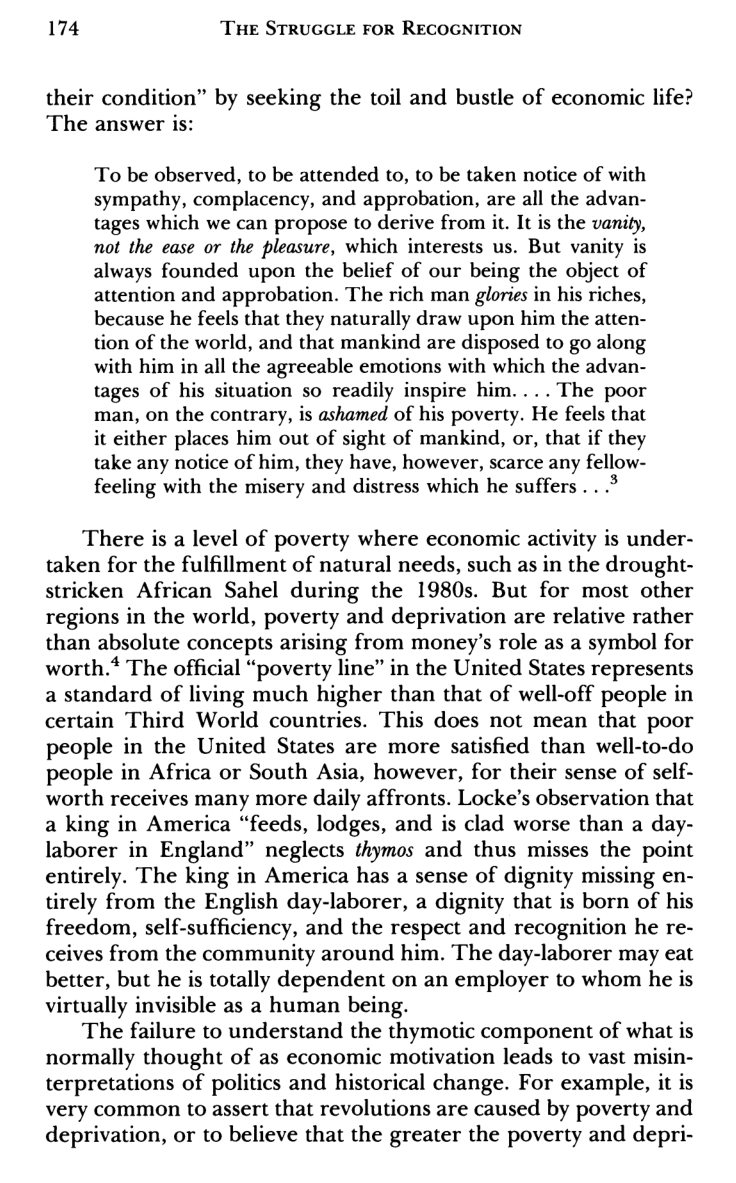
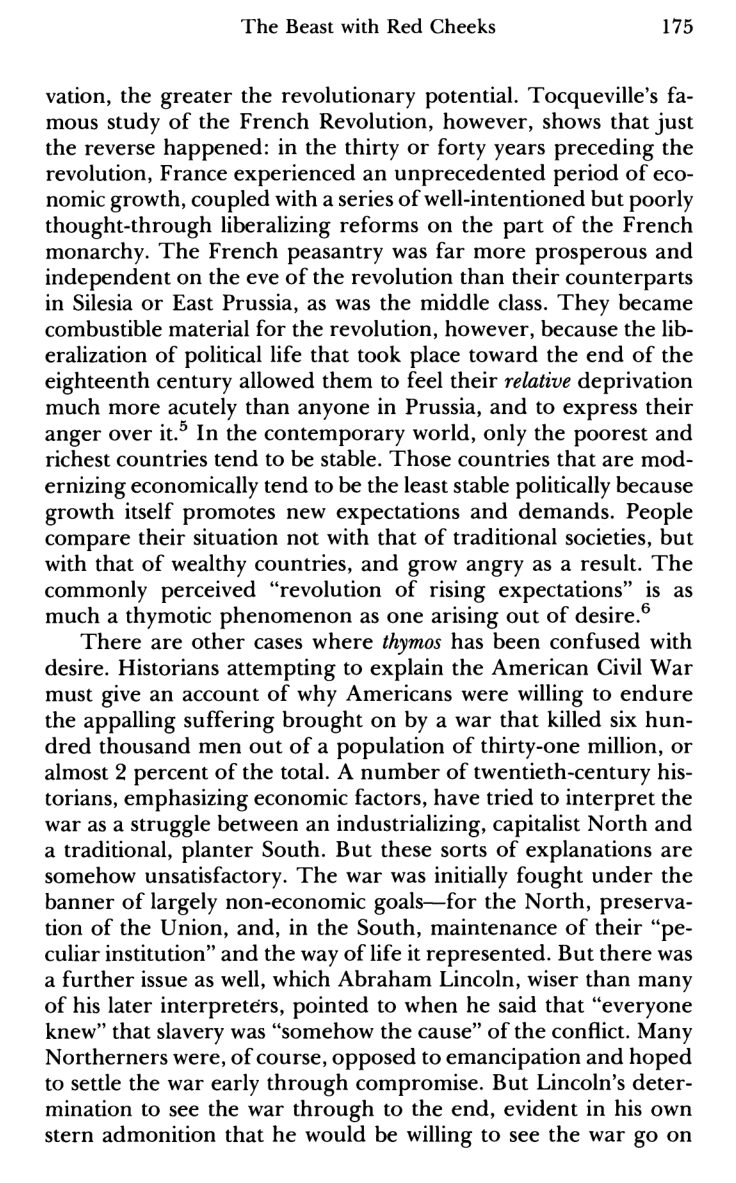
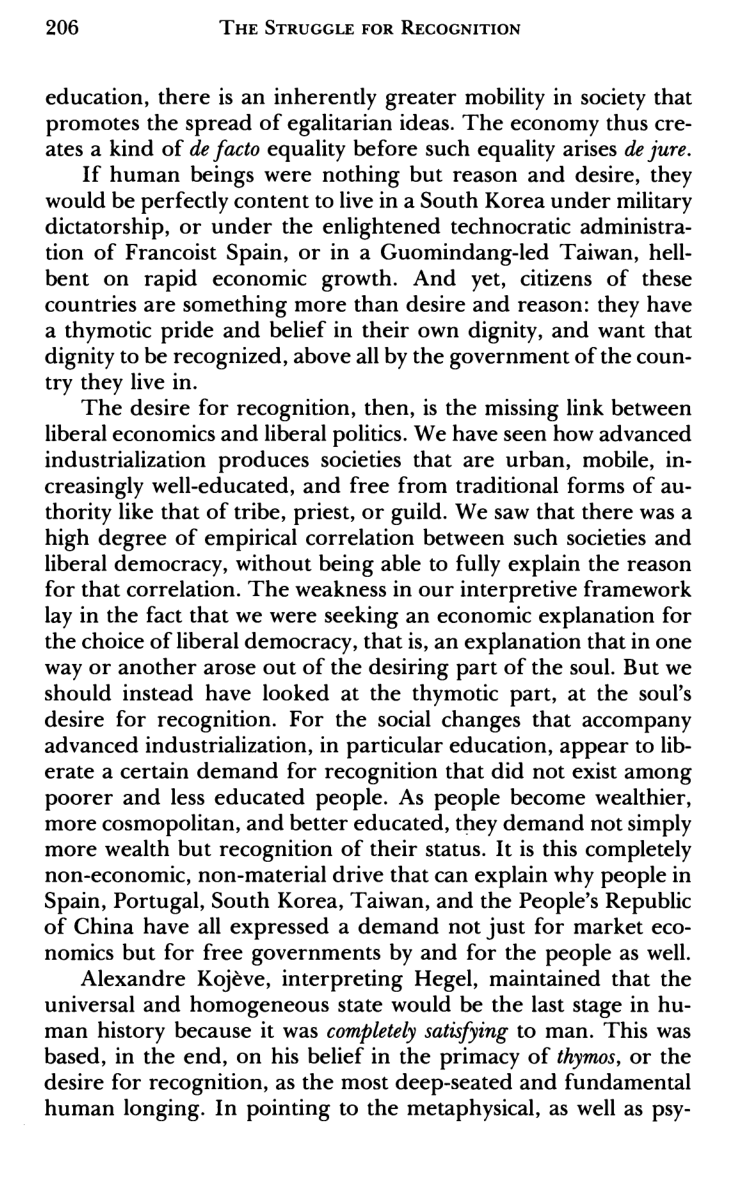
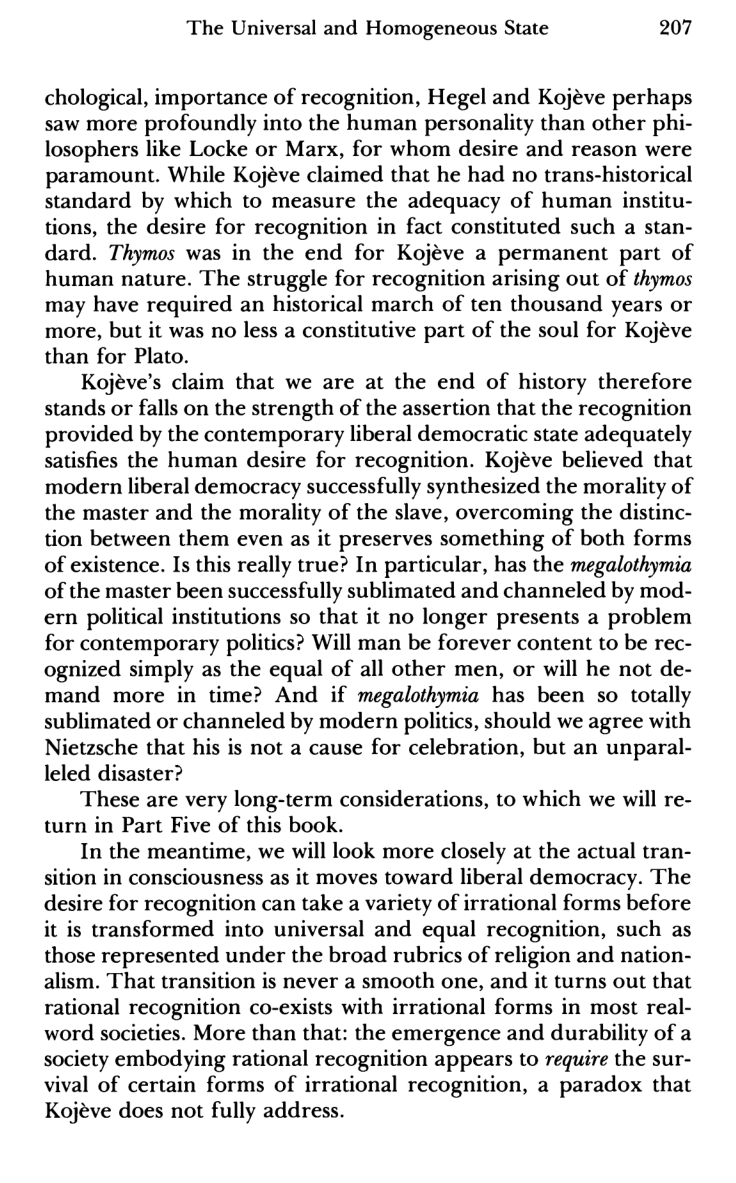
- Human history is driven by more than material needs; it is shaped by the 'struggle for recognition' and the desire for dignity.
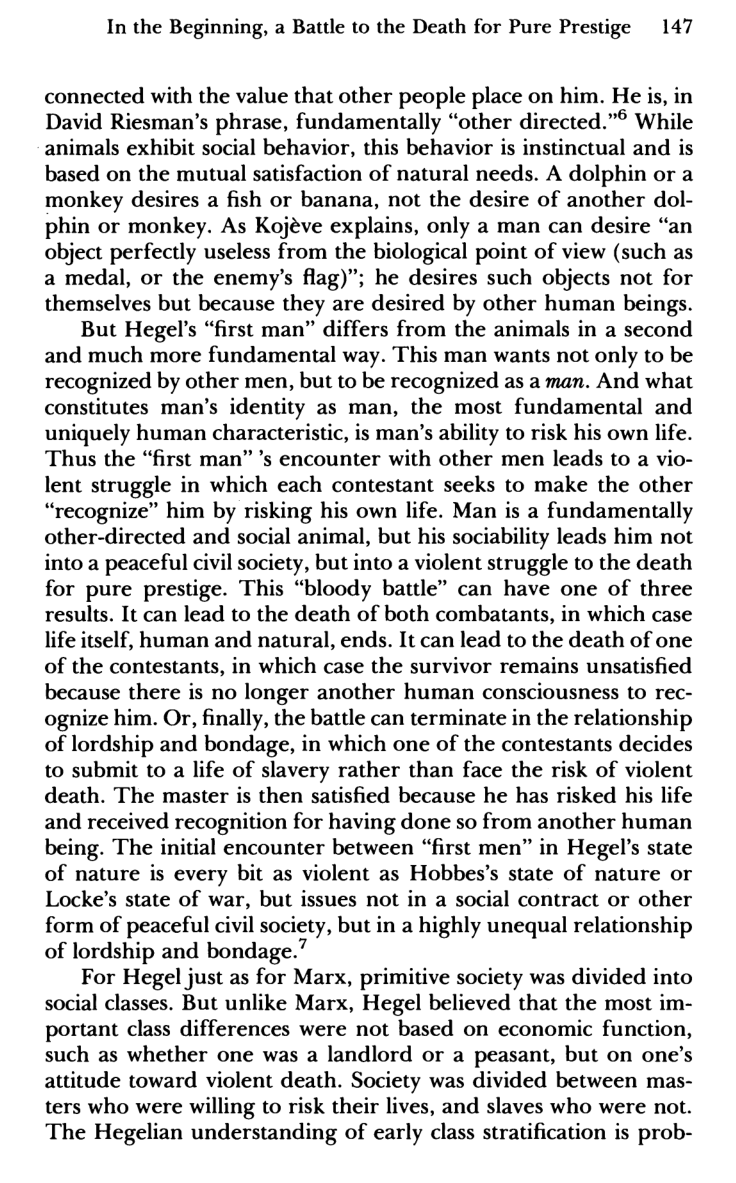
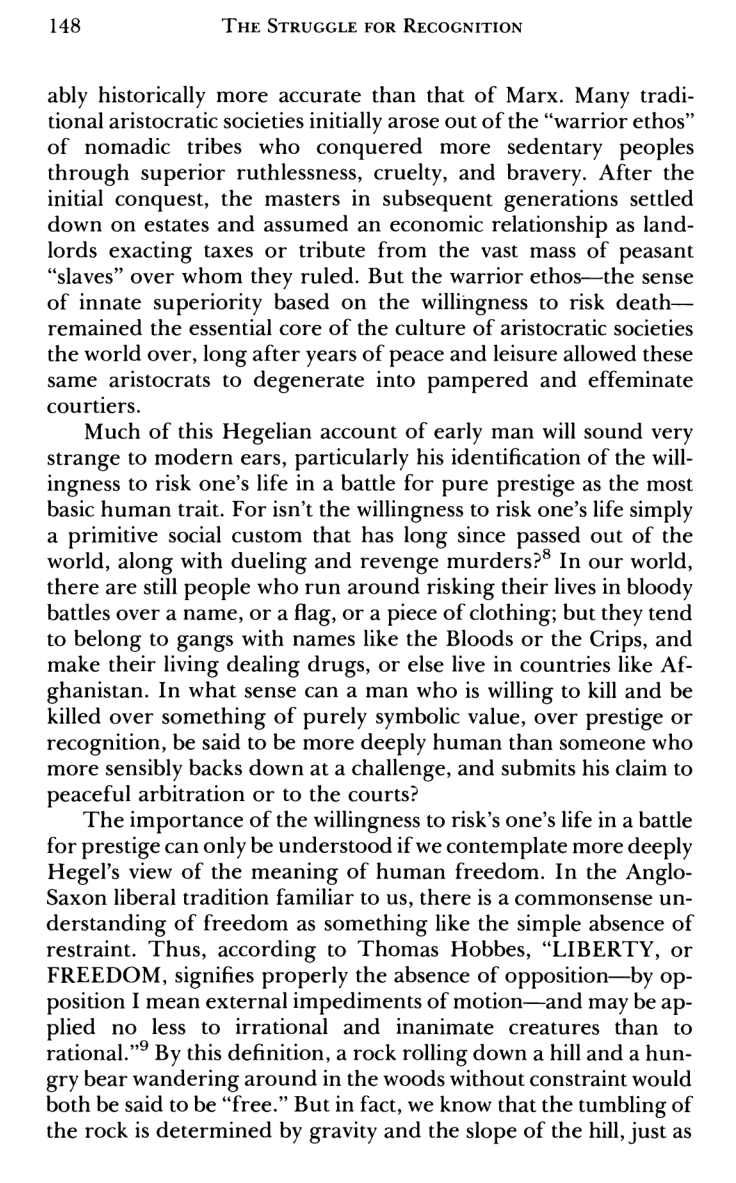
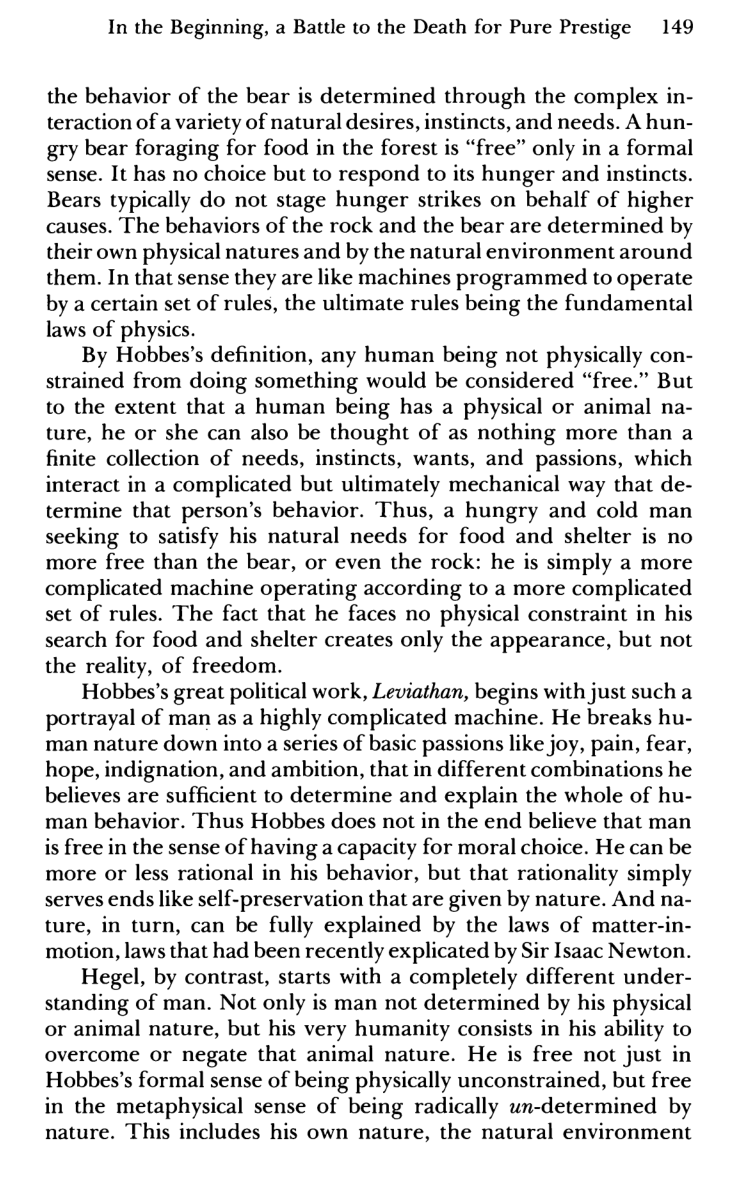
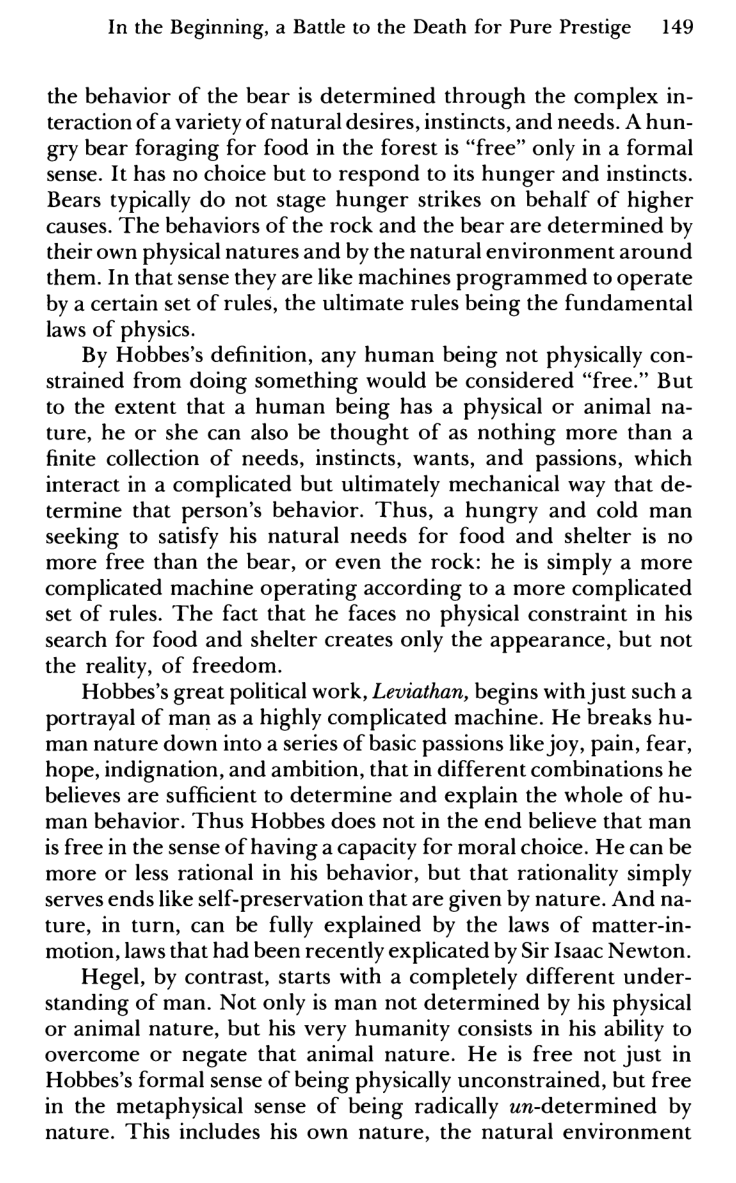
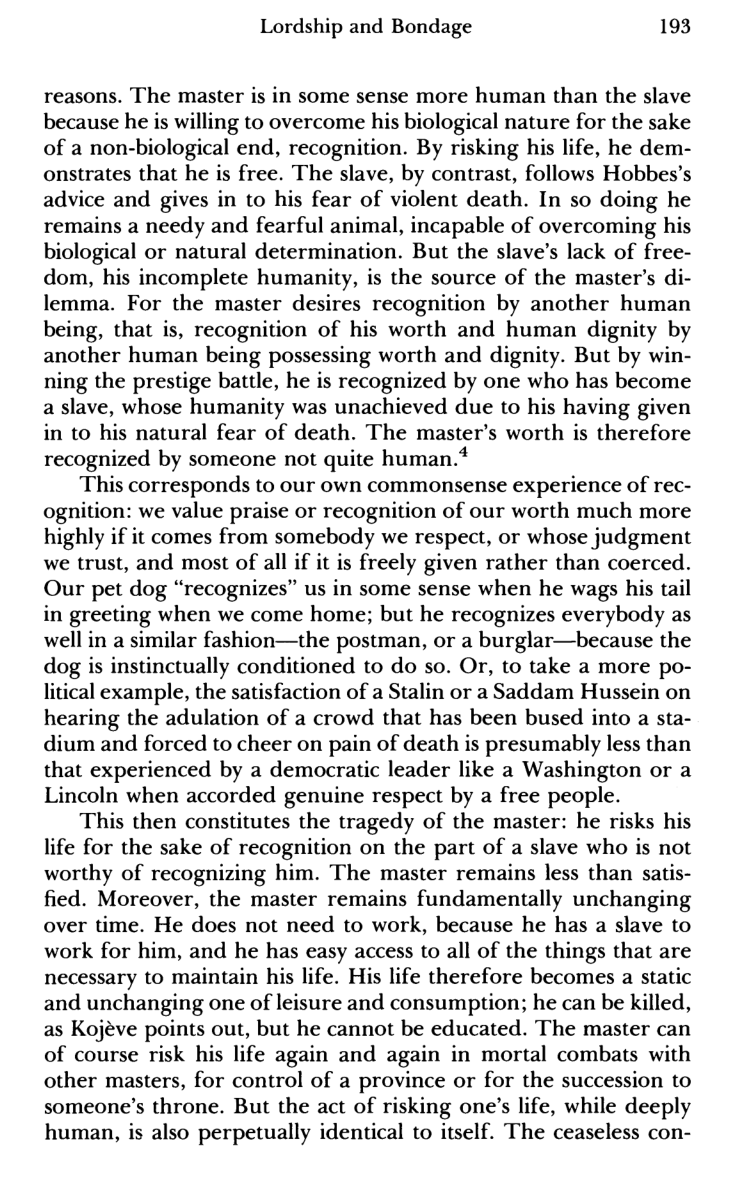
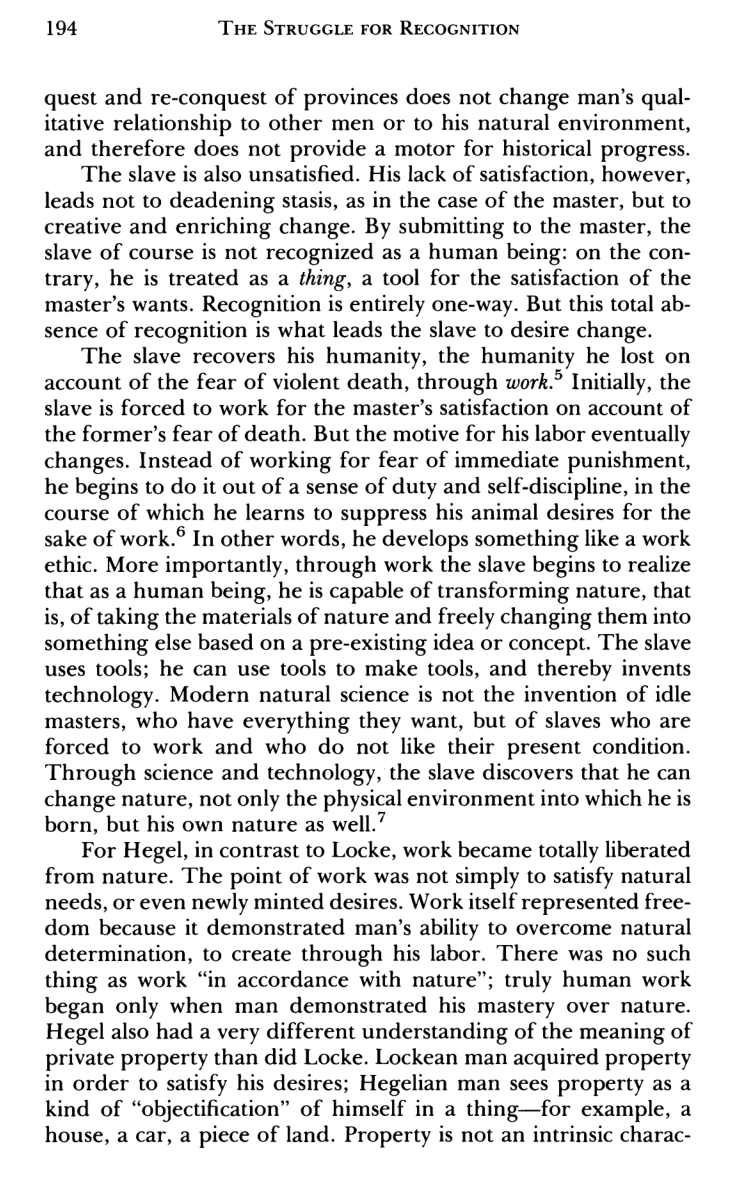
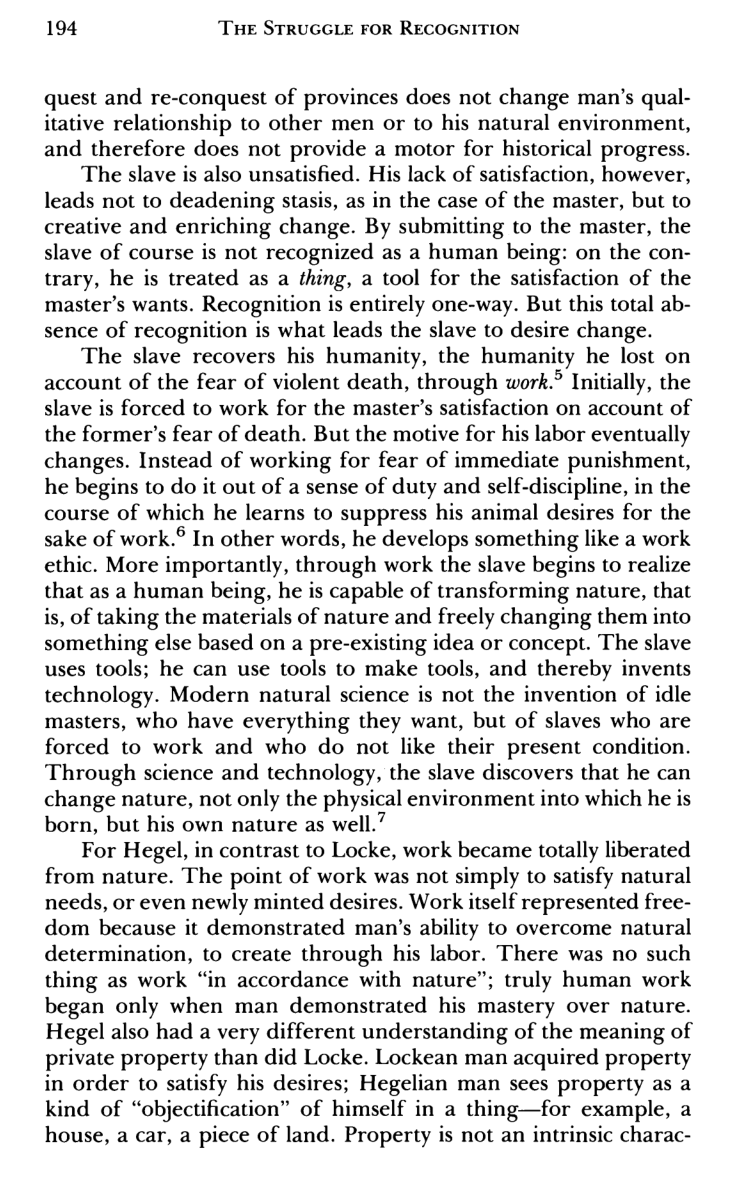
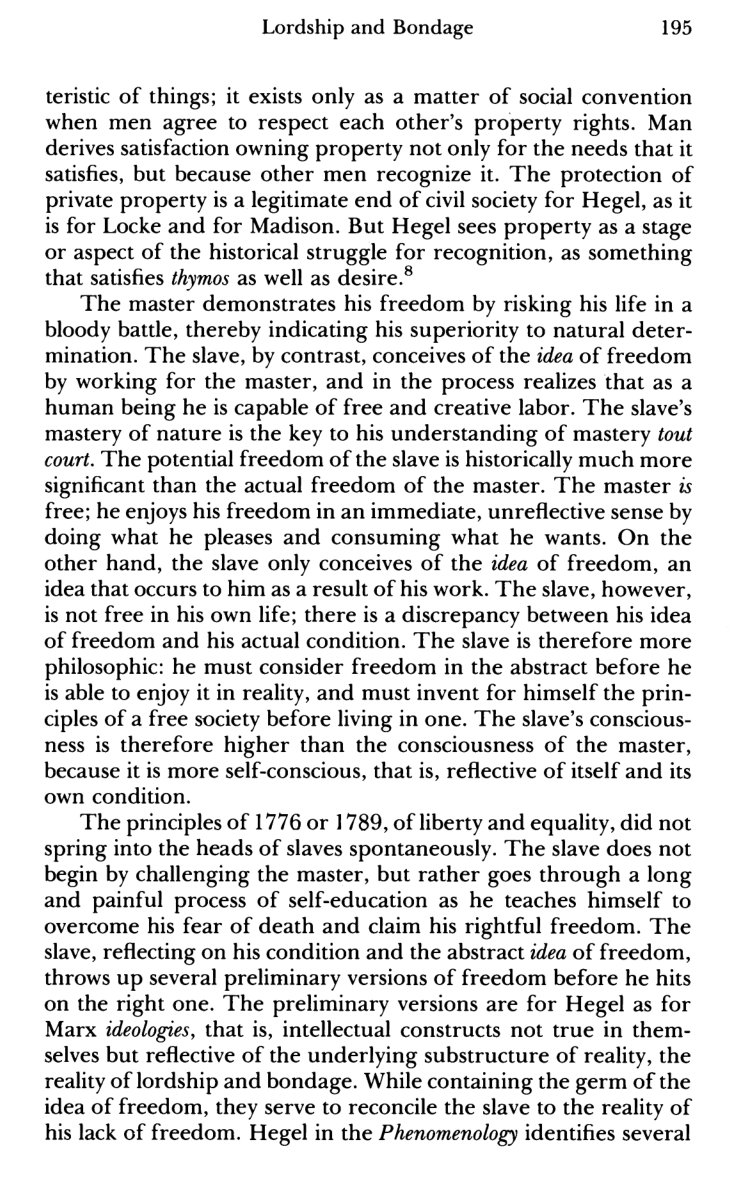
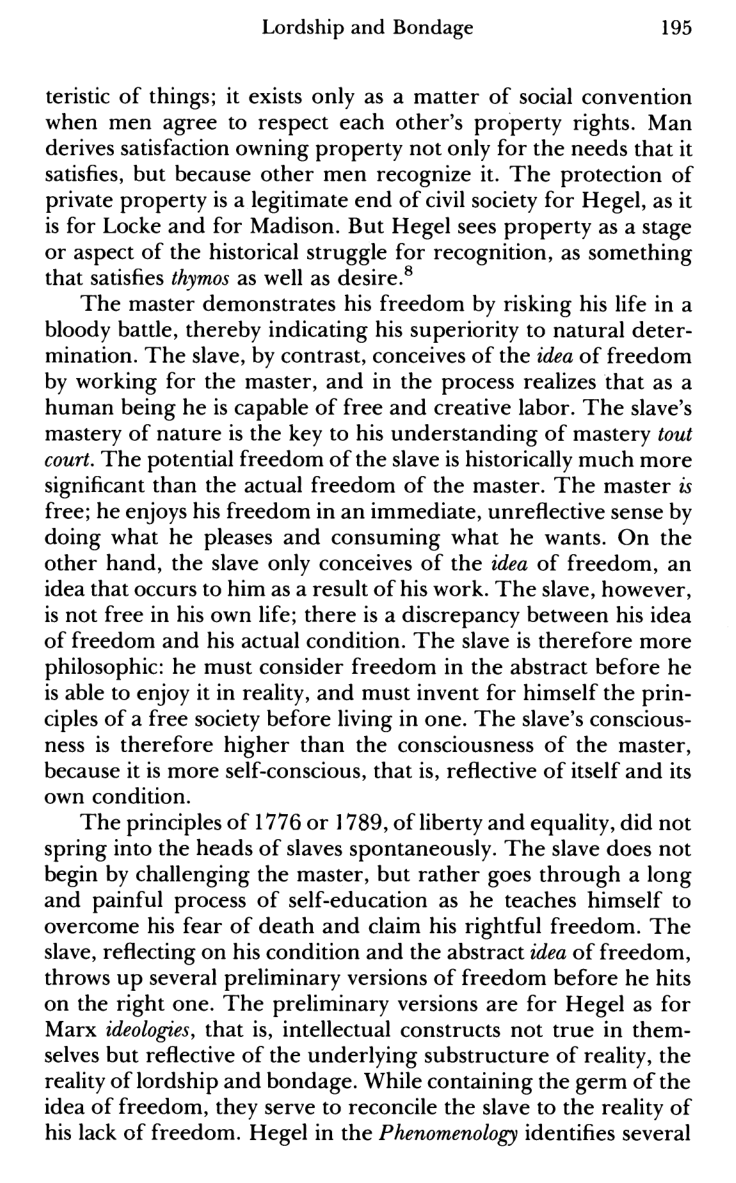
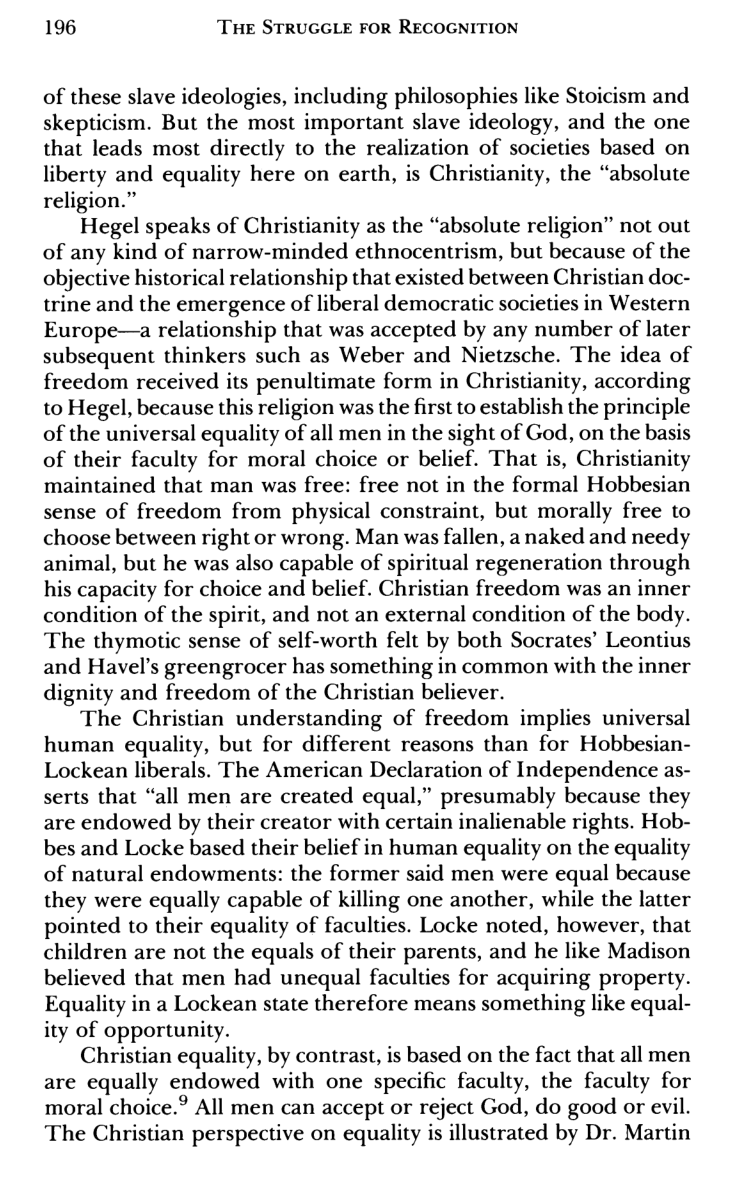
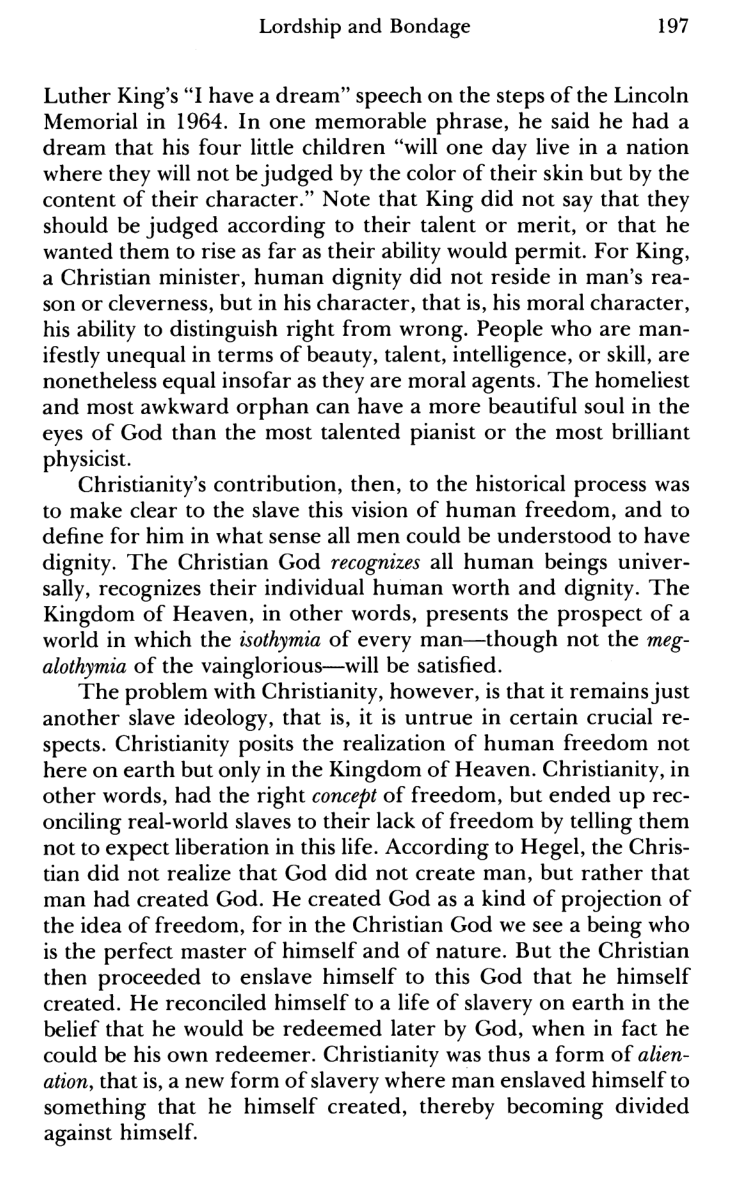
- Hegel argues that human freedom begins when individuals risk their lives for prestige, transcending the animal instinct for self-preservation.
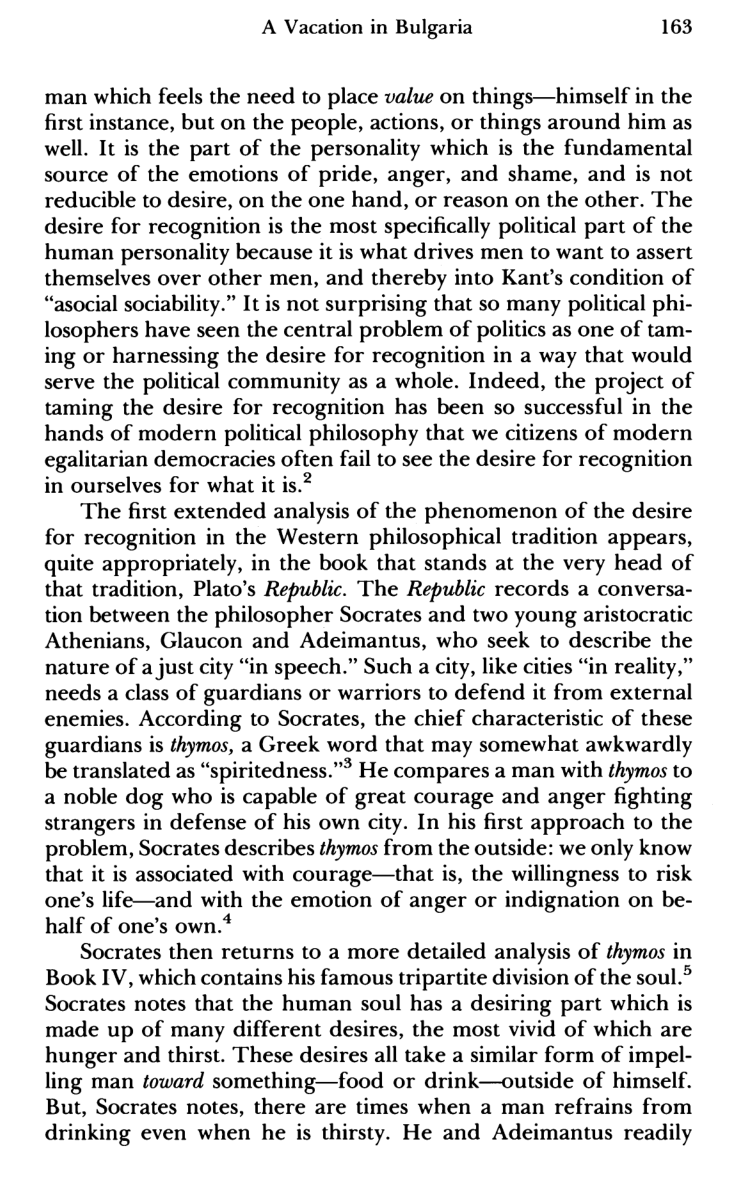
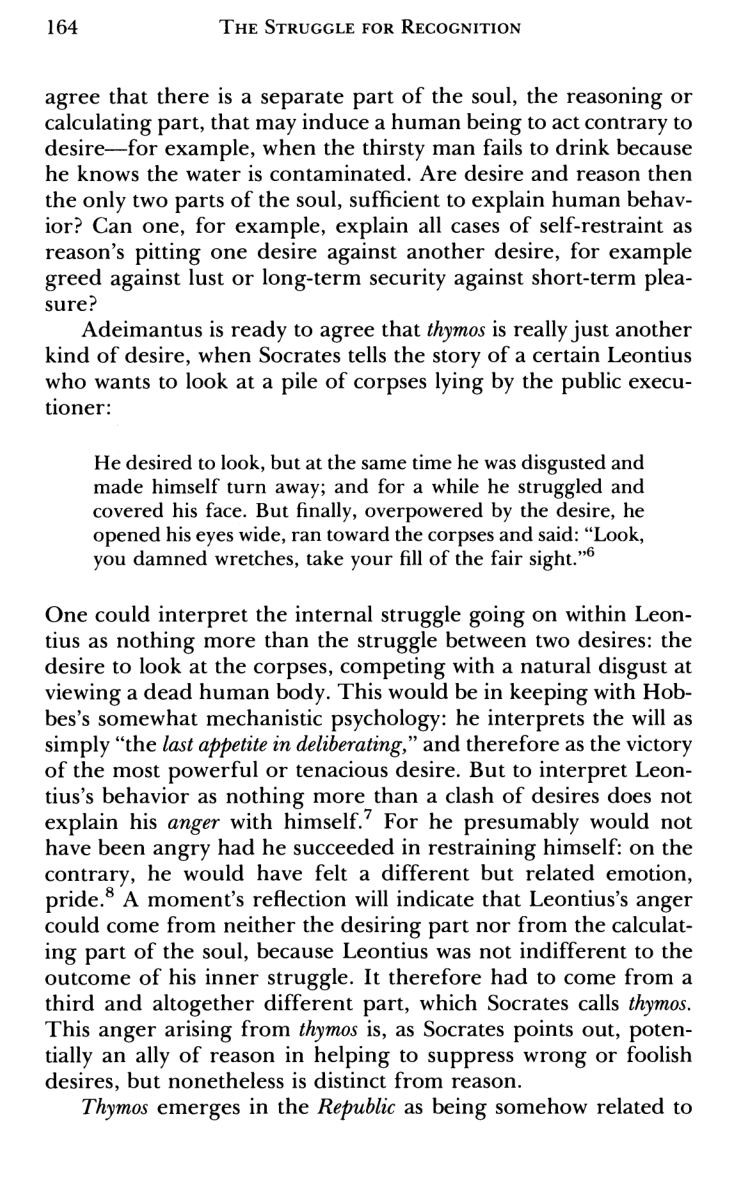
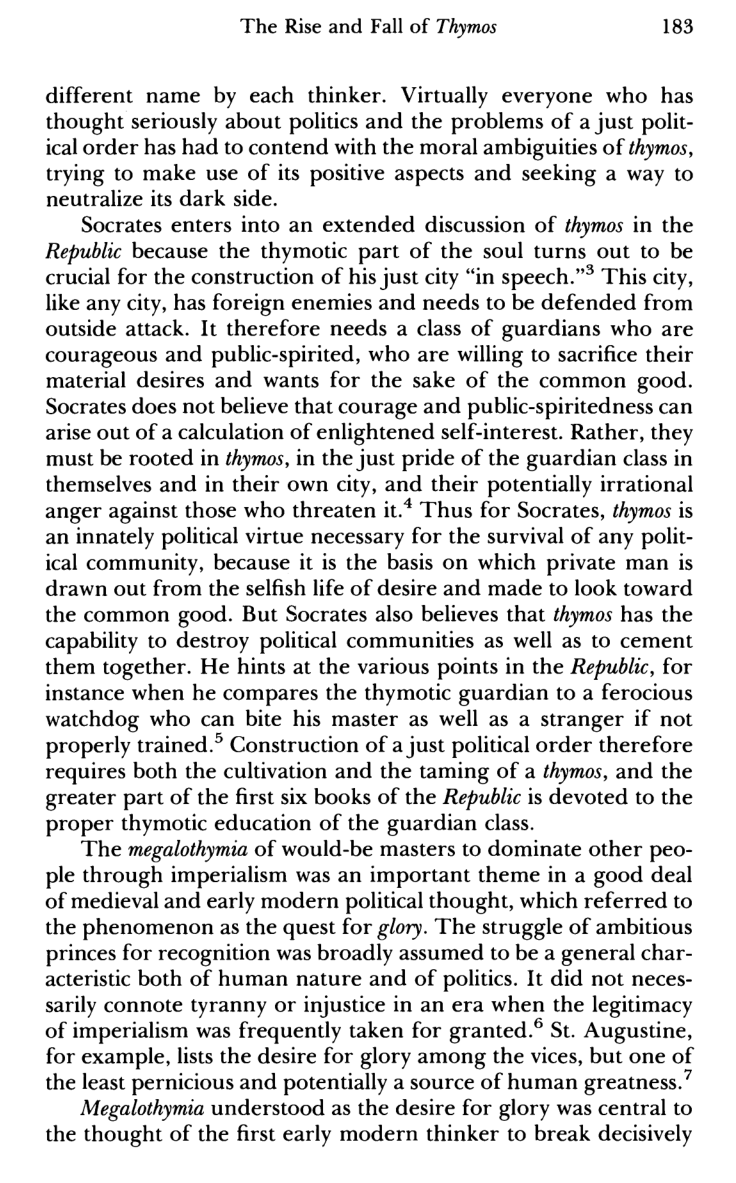
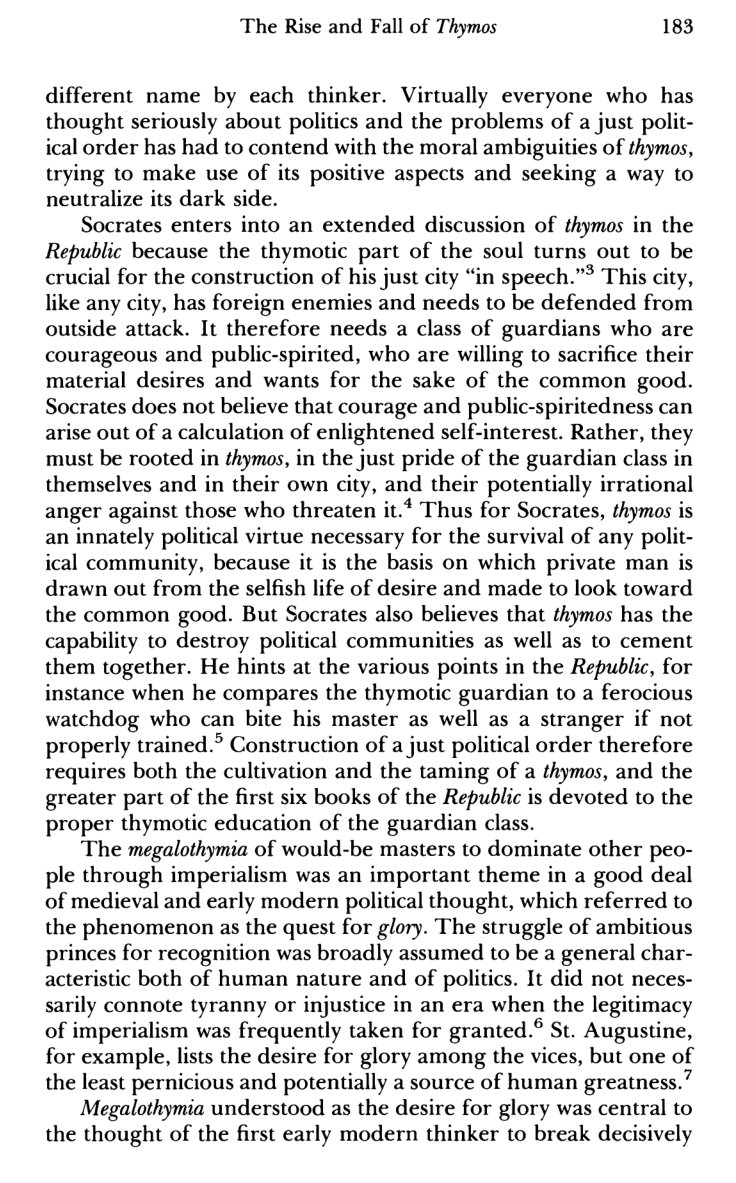
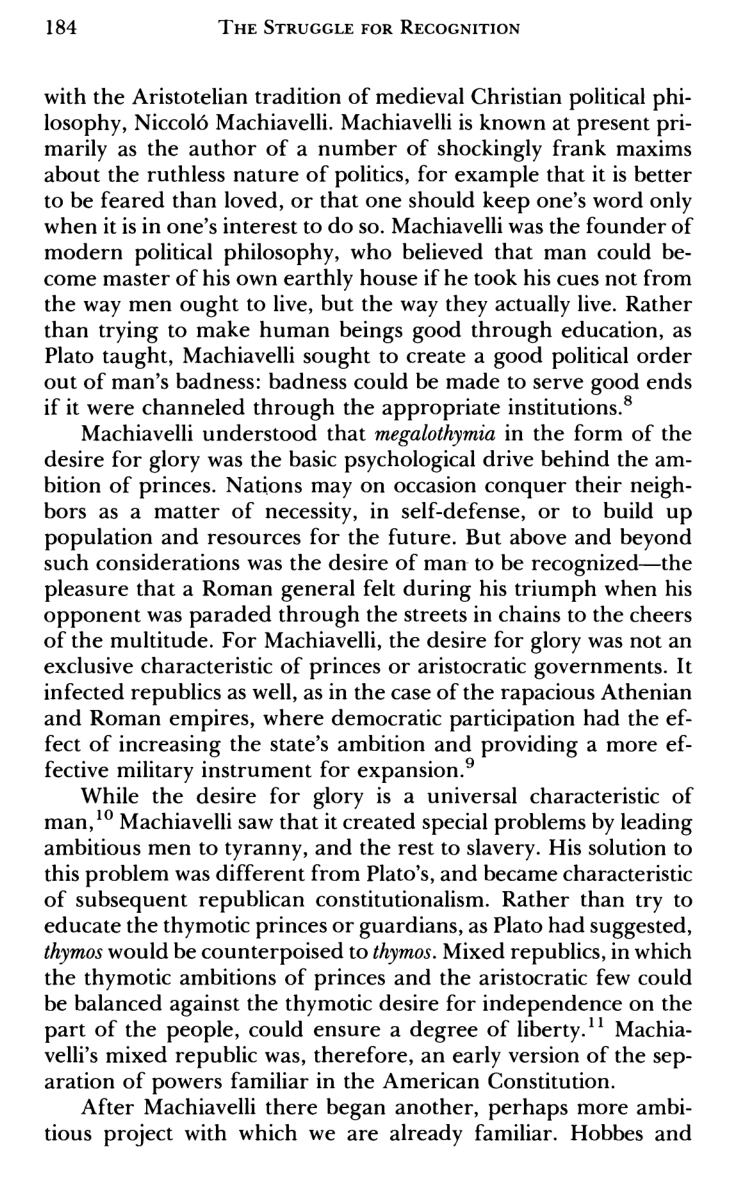
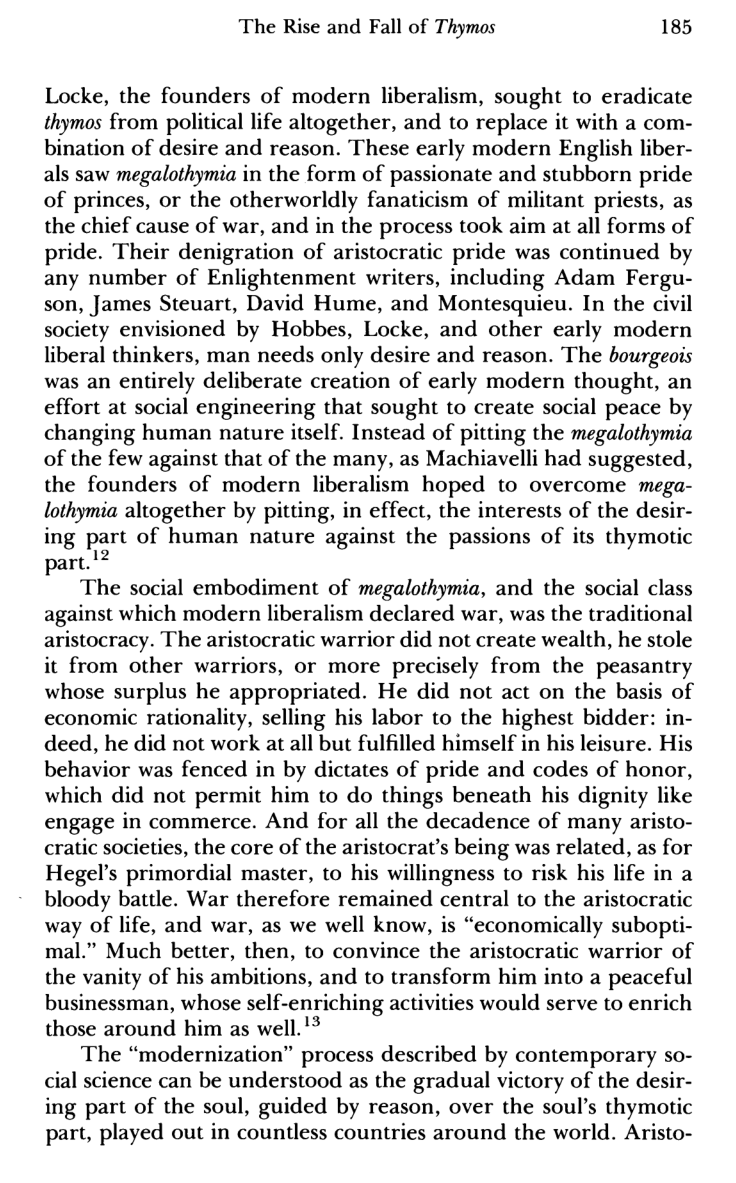
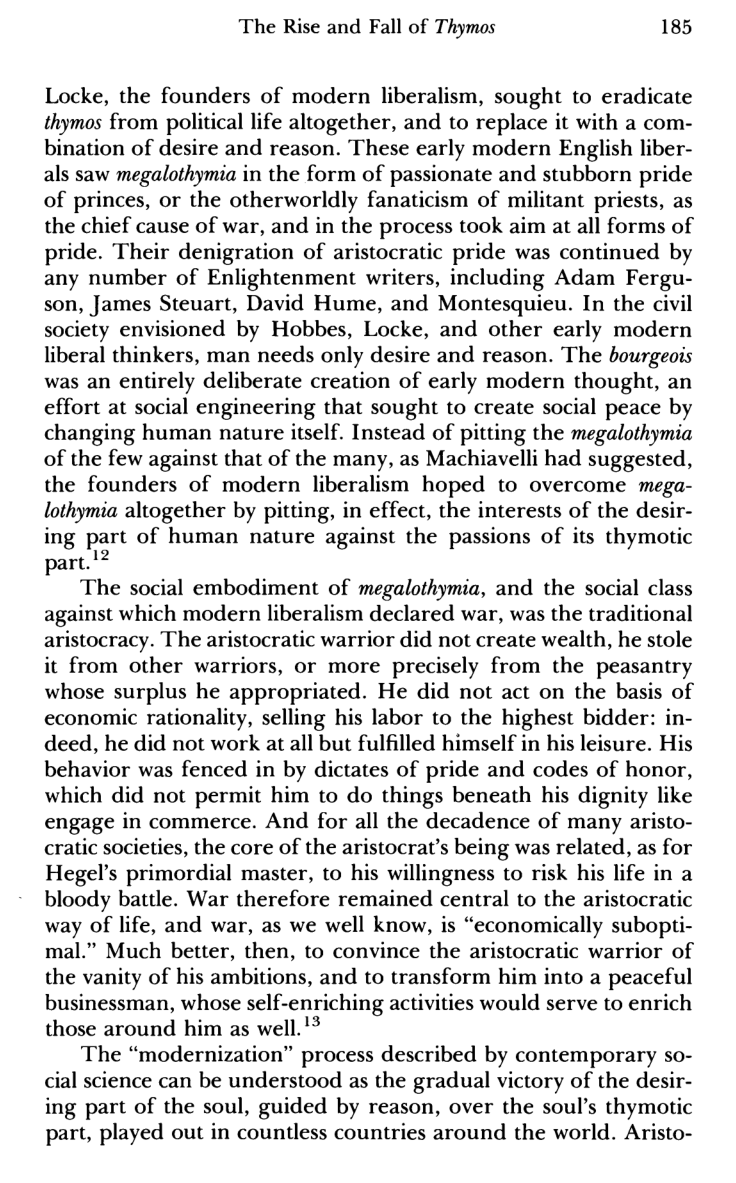
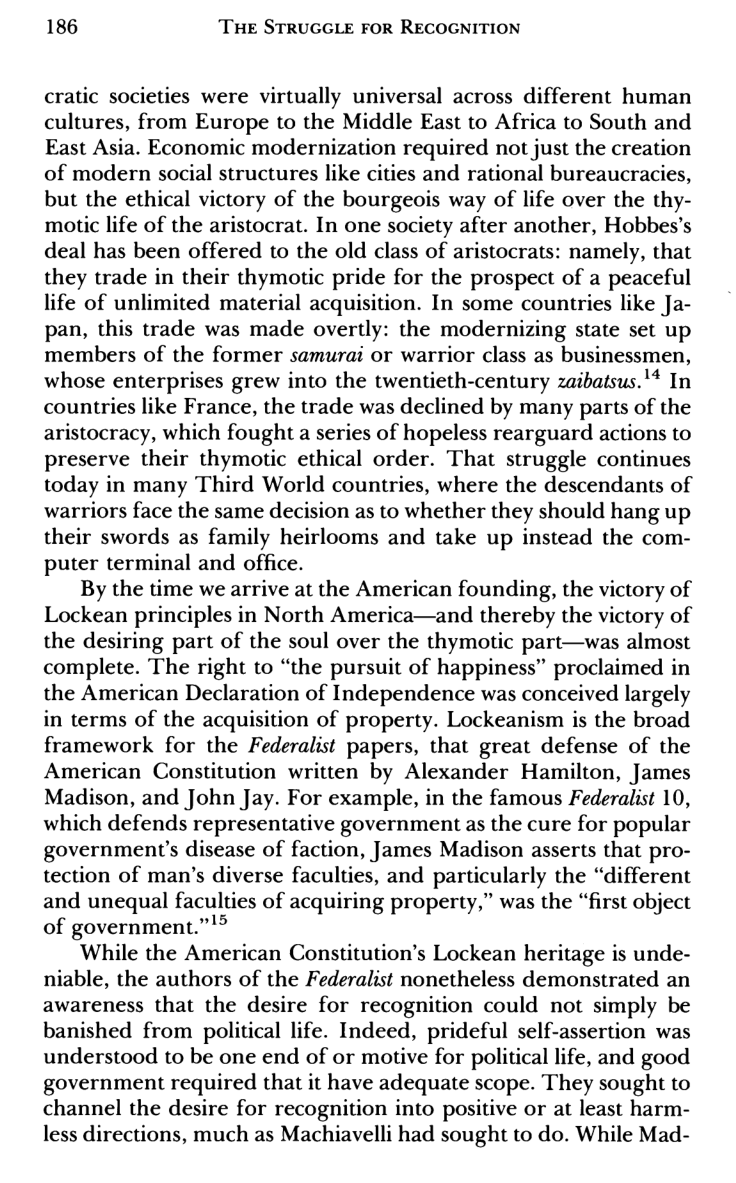
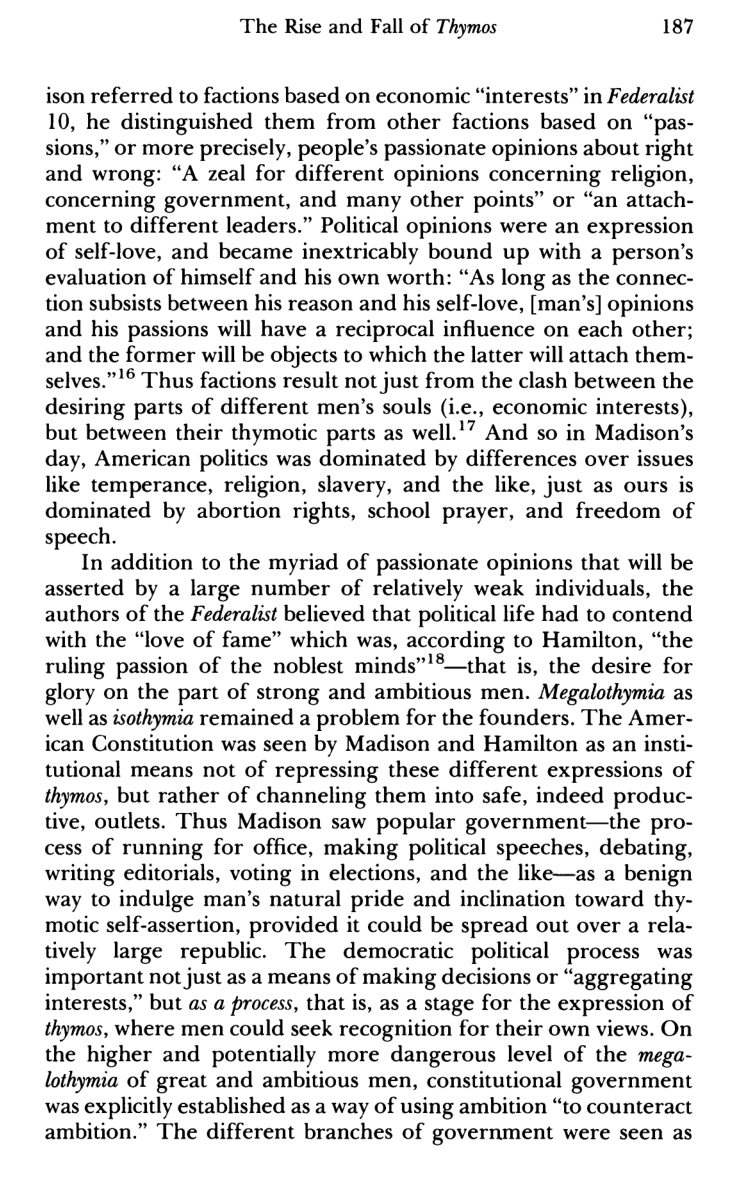
- The concept of 'thymos' or spiritedness represents the part of the human soul that seeks validation and worth beyond mere desire and reason.
- The master-slave relationship originates from a primordial battle where one party values recognition more than their own physical survival.
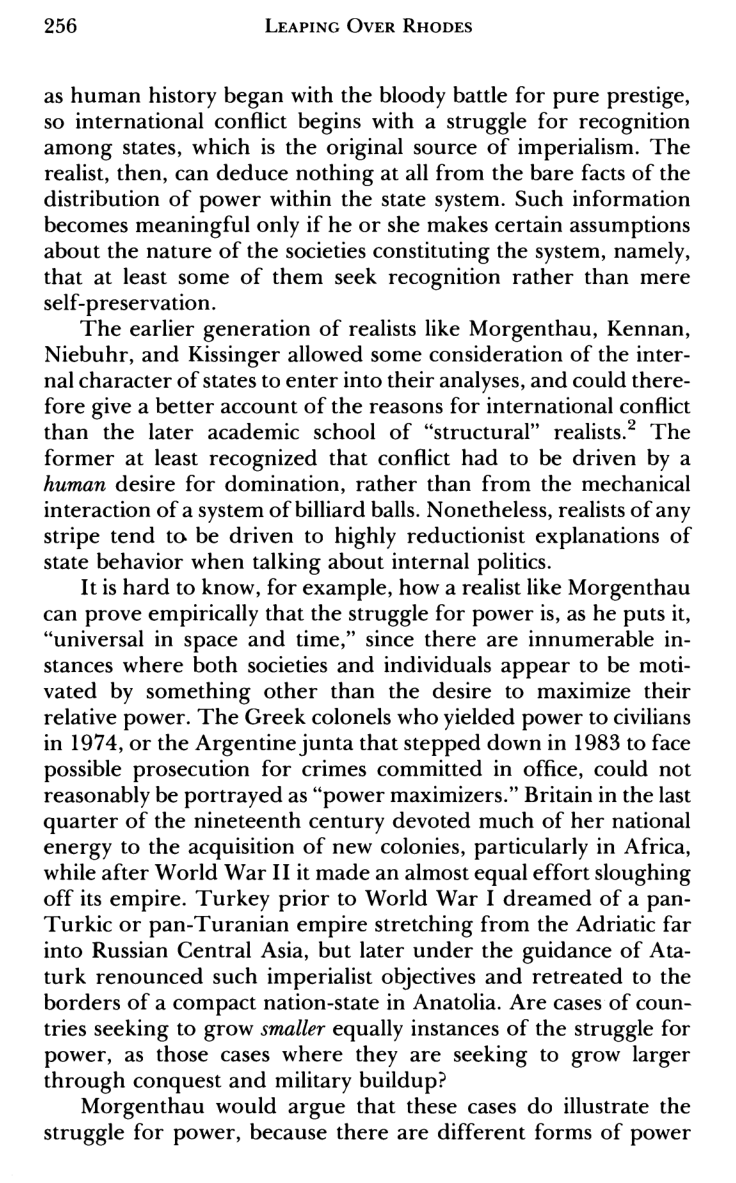
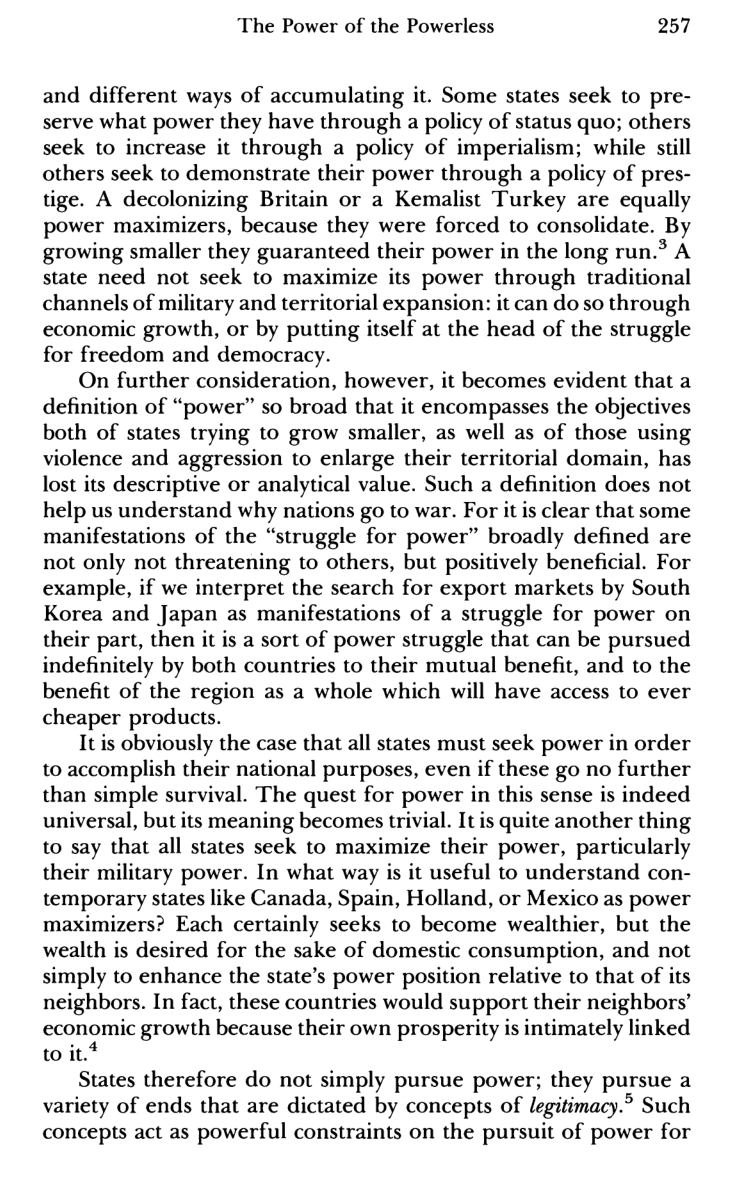
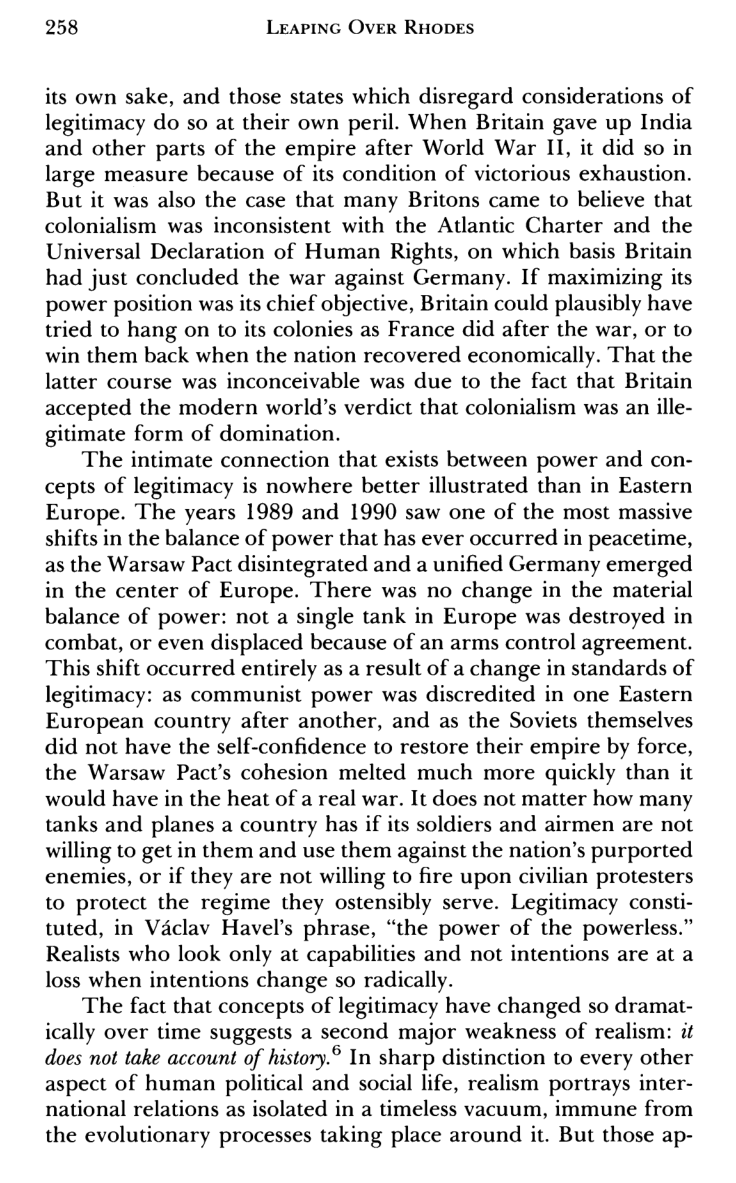
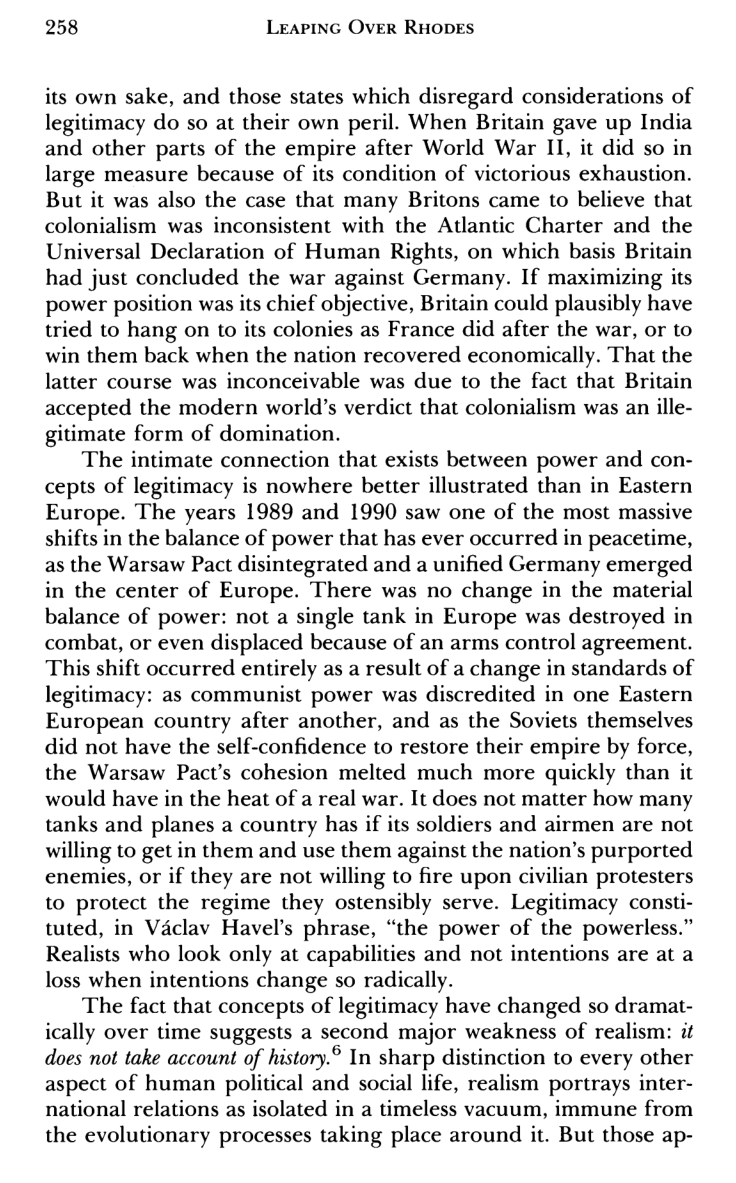
The stakes in this bloody battle at the beginning of history are not food, shelter, or security, but pure prestige.
The Struggle for Recognition
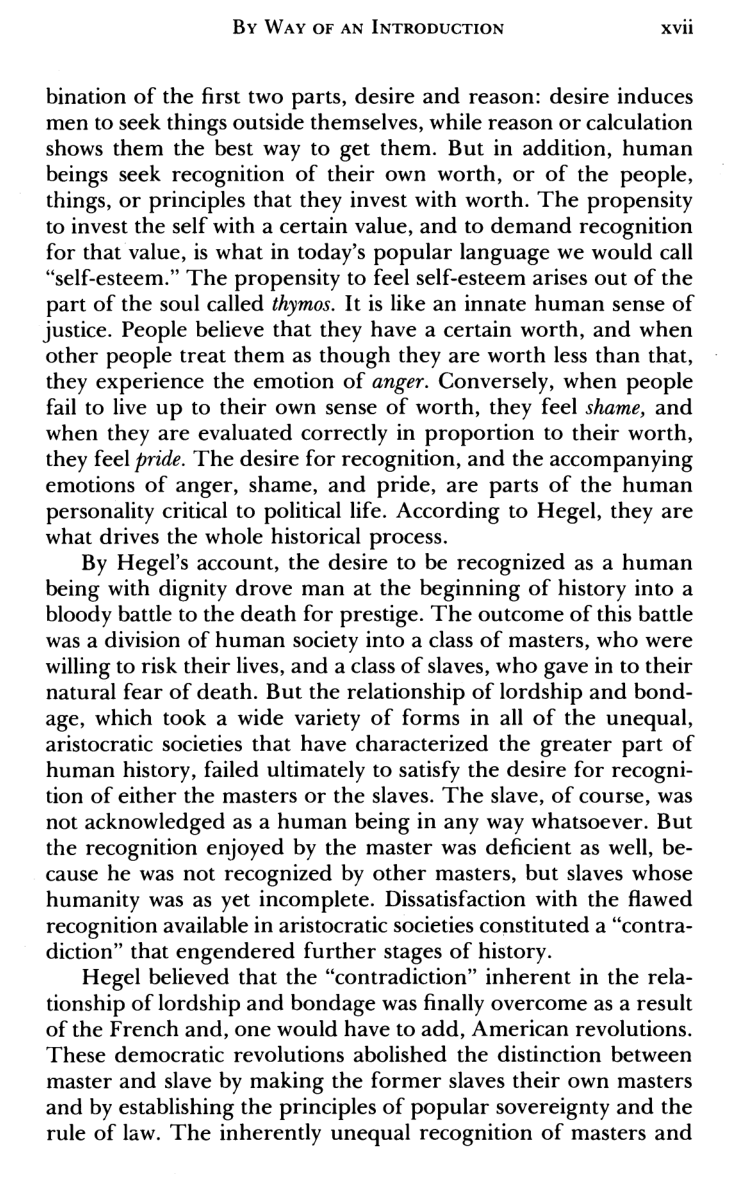
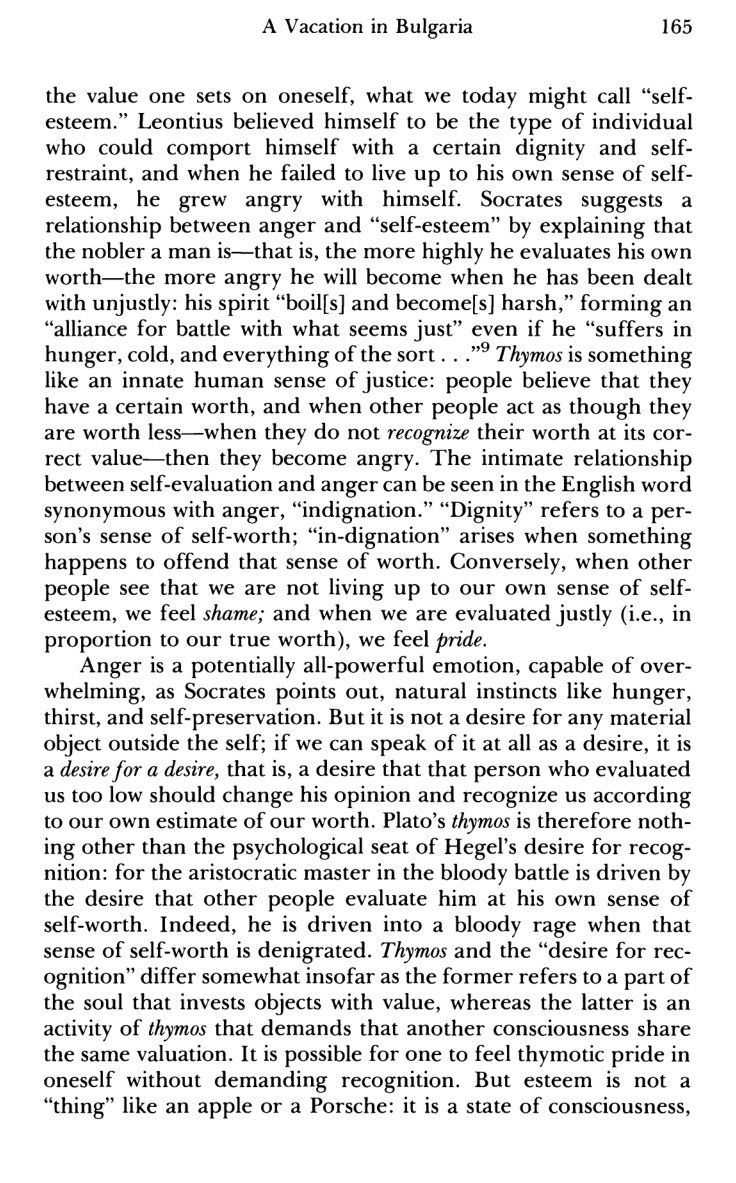
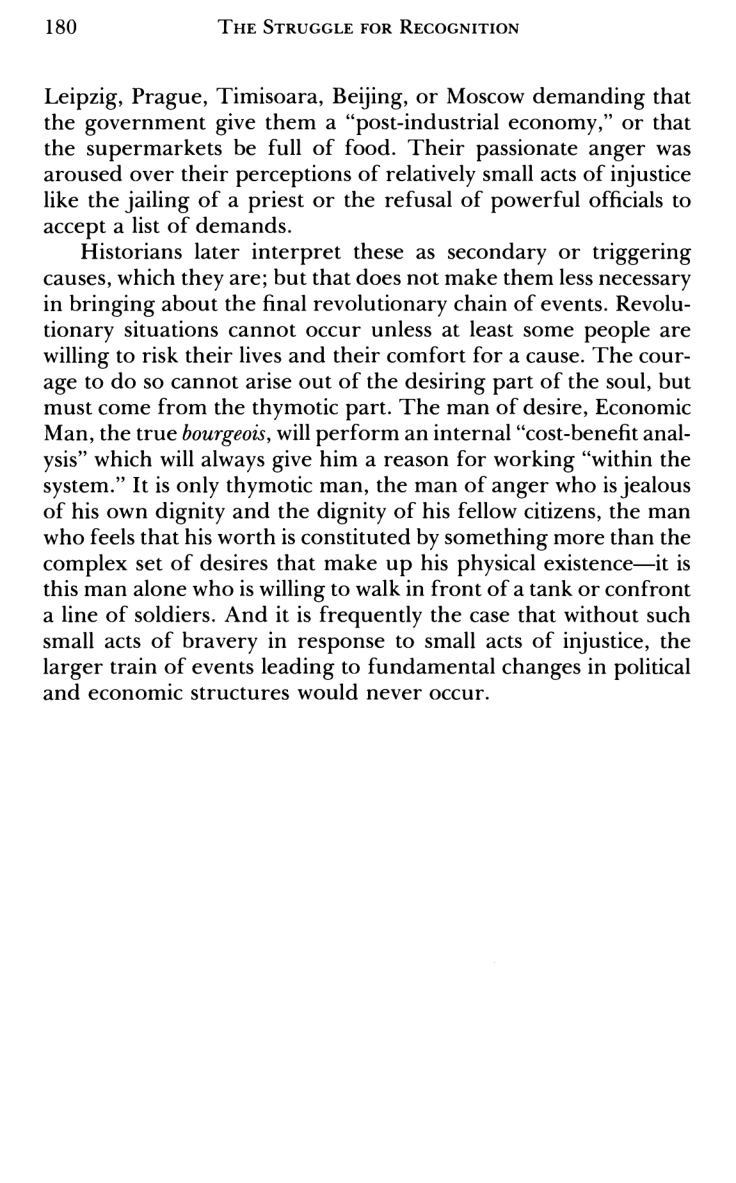
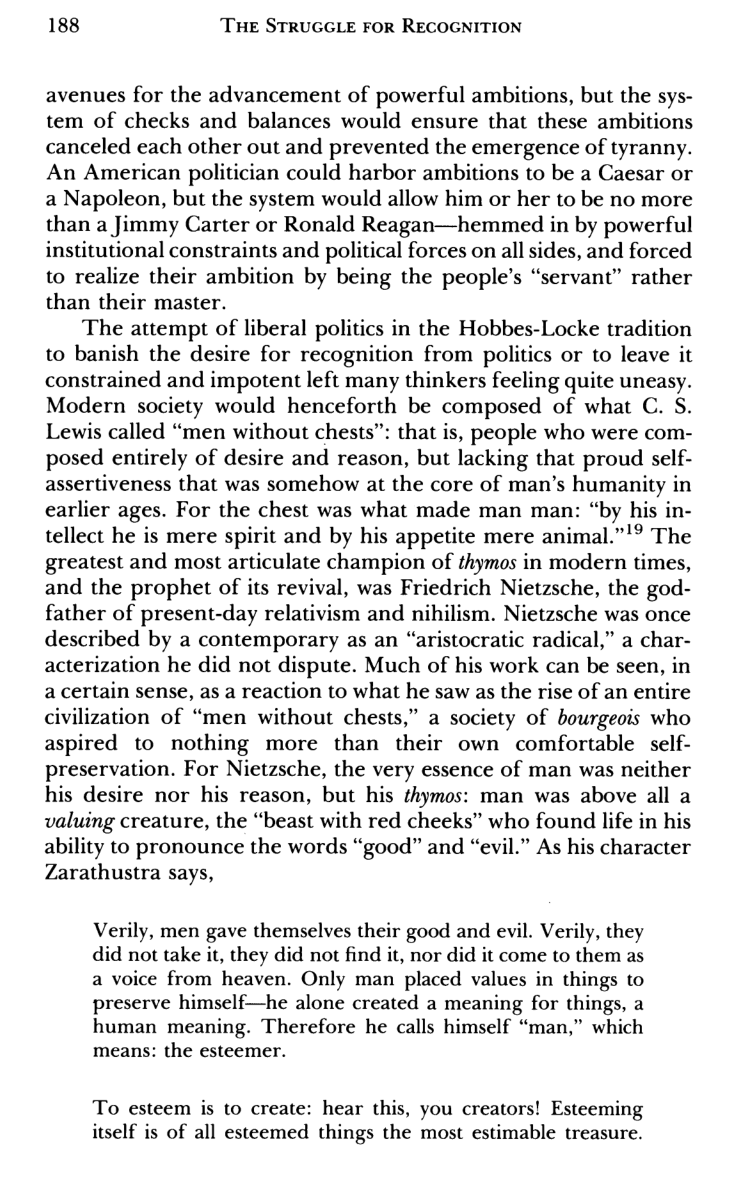
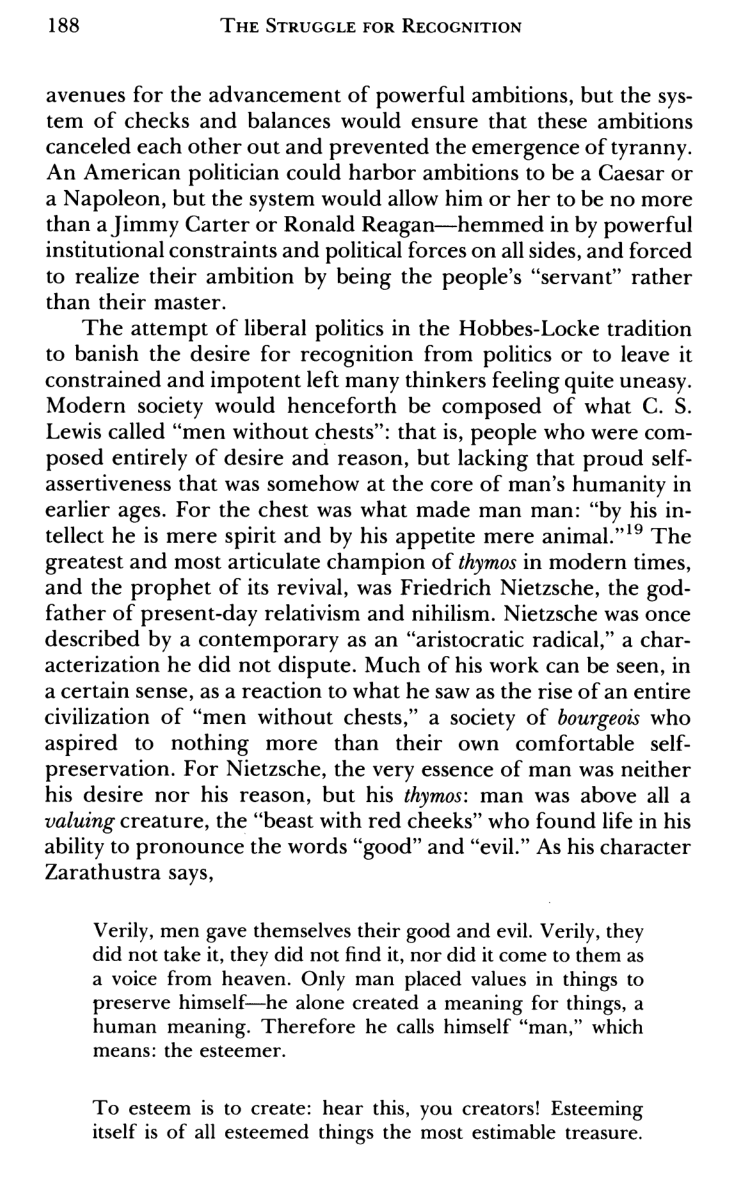
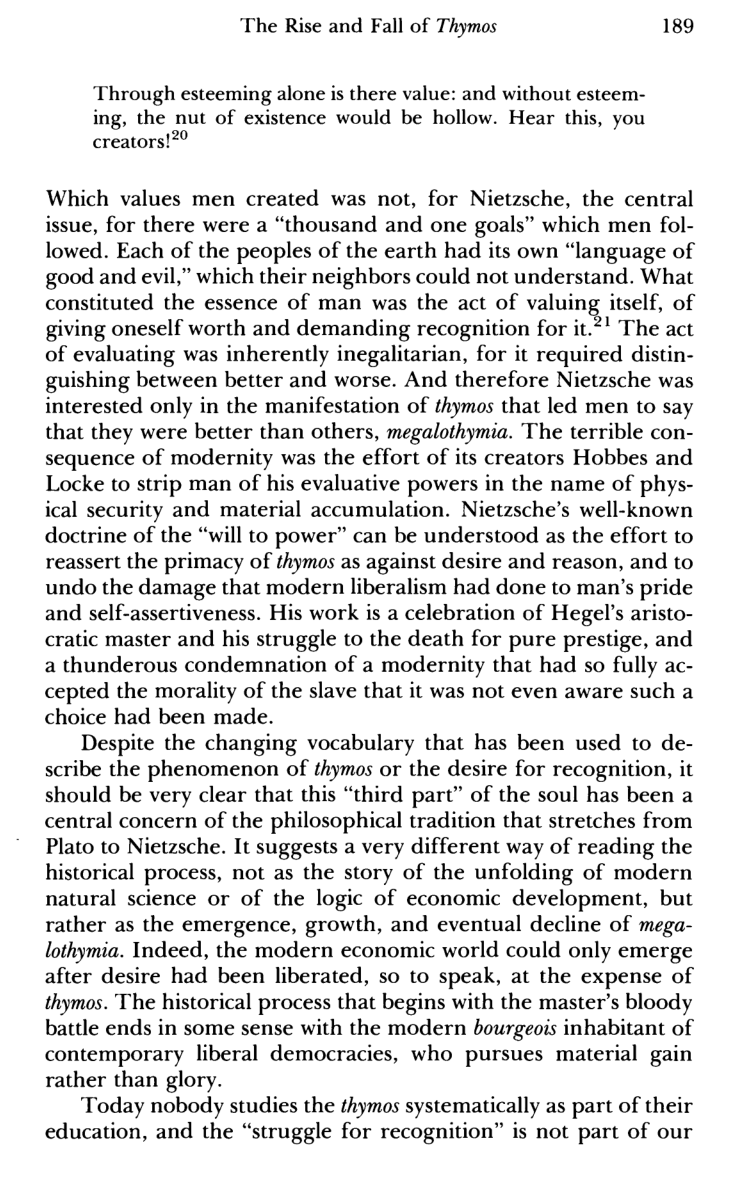
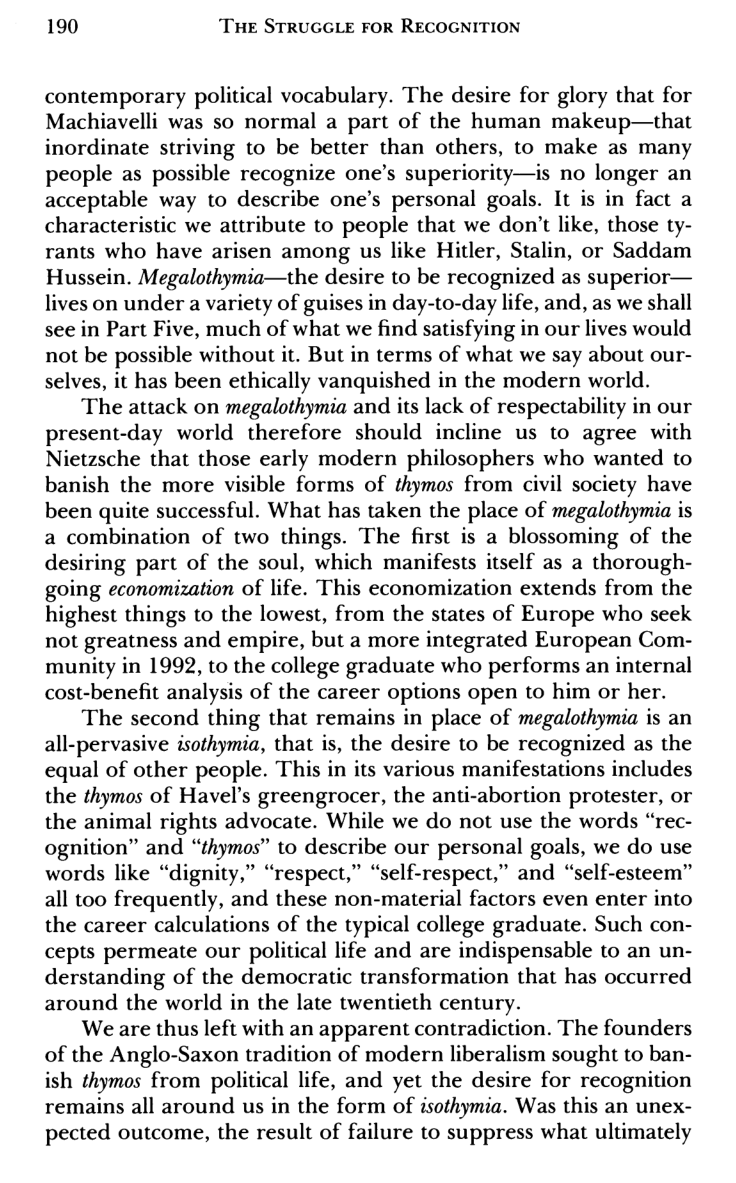
- The concept of thymos, or the innate human sense of self-esteem, drives individuals to demand recognition of their personal worth and dignity.
- Hegel posits that history began with a 'bloody battle for prestige,' resulting in a flawed social hierarchy of masters and slaves.
- Aristocratic societies failed to satisfy the human soul because masters were recognized only by 'incomplete' slaves, while slaves were not recognized at all.
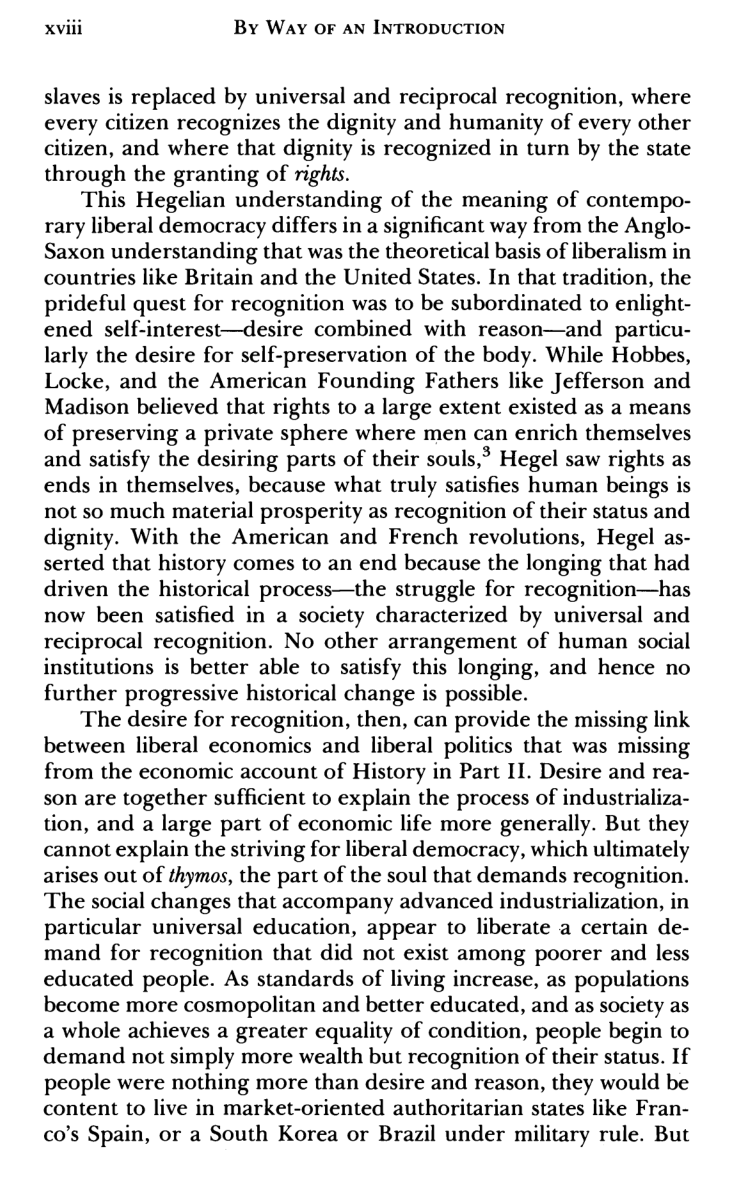
- Liberal democracy resolves this historical contradiction by replacing unequal status with universal and reciprocal recognition through the rule of law.
- Unlike Anglo-Saxon liberalism focused on self-preservation and material gain, Hegelian theory views the state as the ultimate fulfillment of the human longing for status.
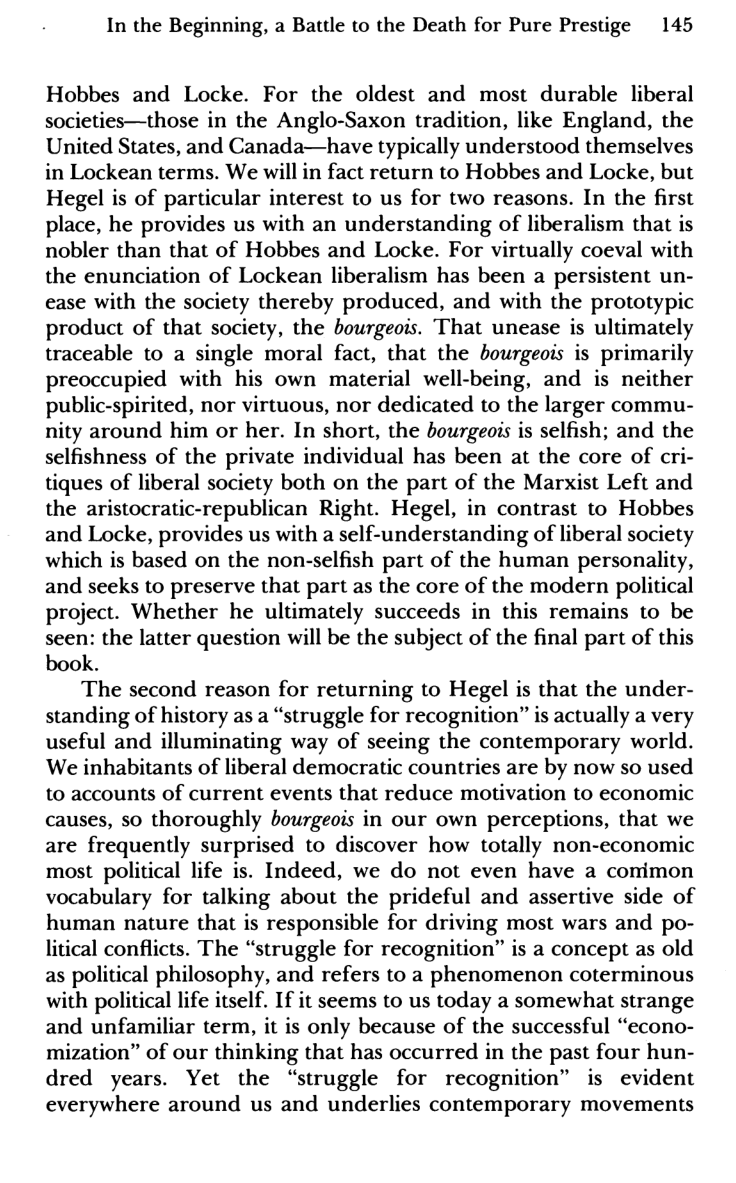
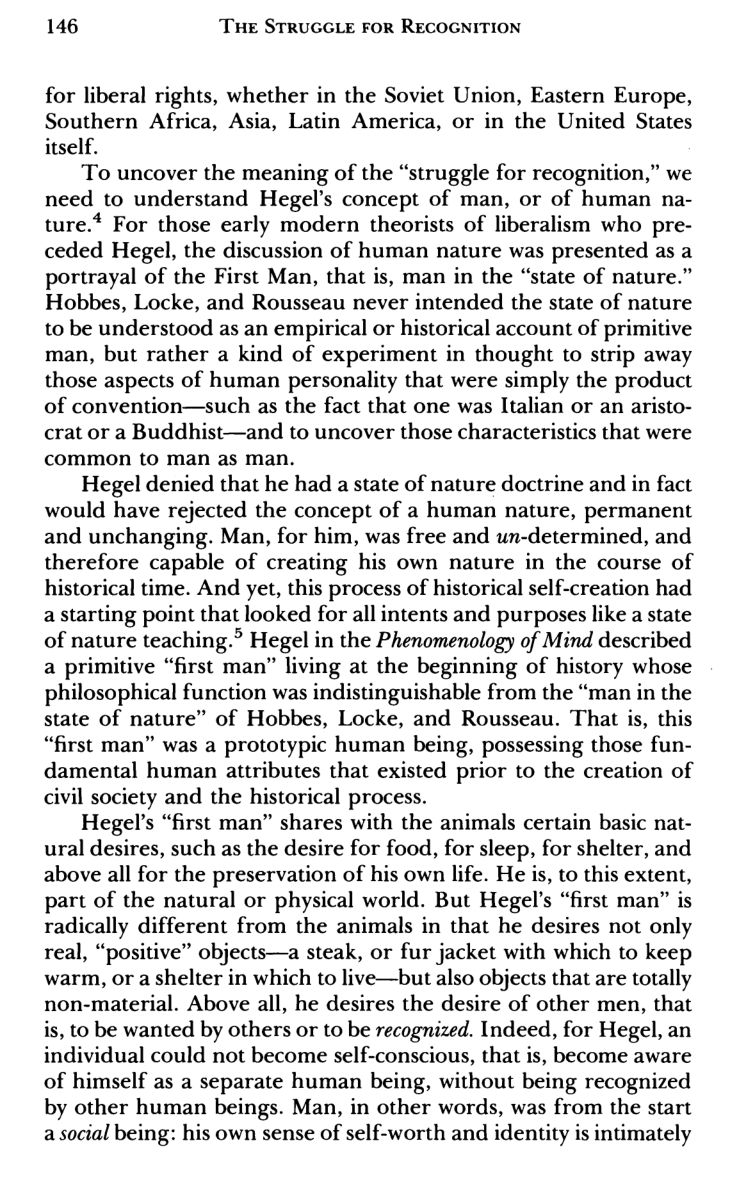
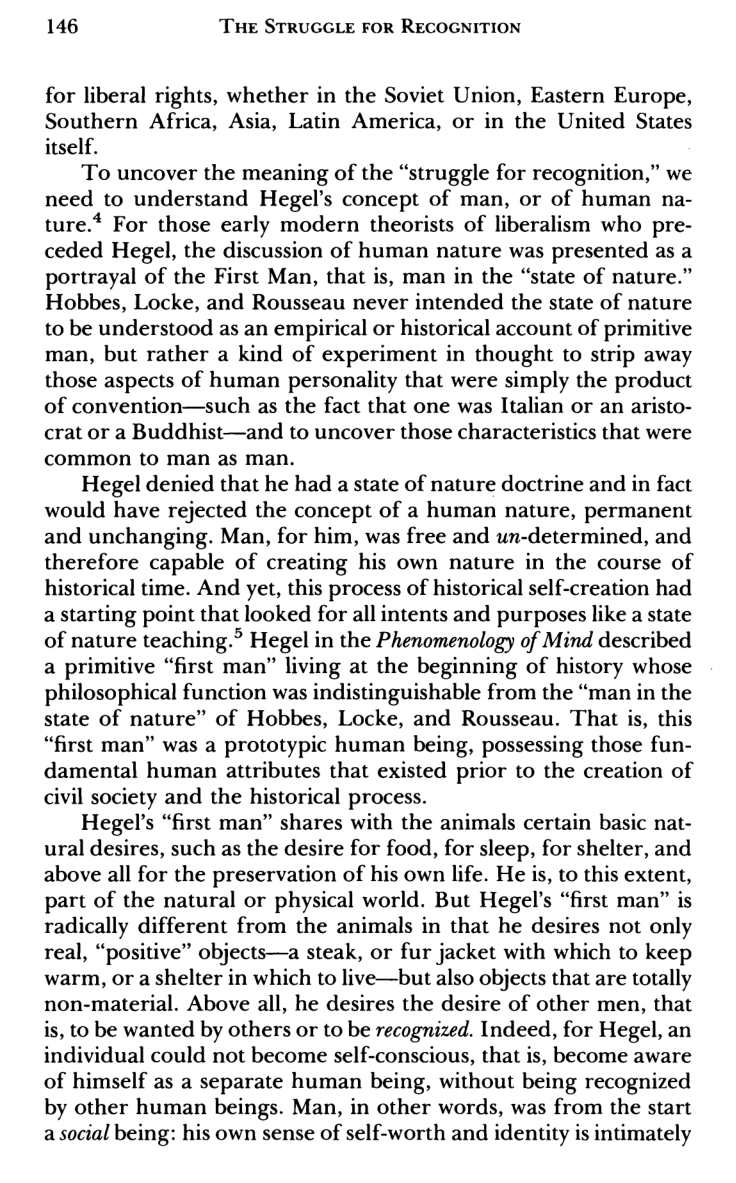
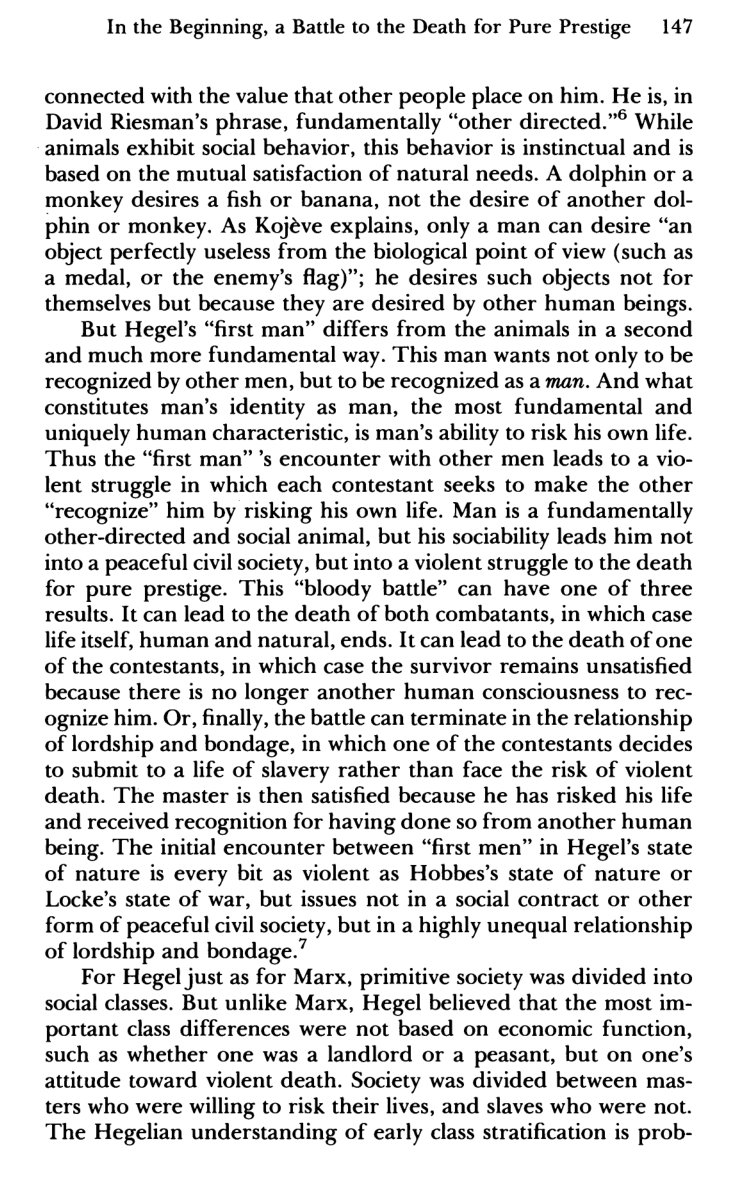
By Hegel's account, the desire to be recognized as a human being with dignity drove man at the beginning of history into a bloody battle to the death for prestige.
Thymos and Democratic Recognition
- Economic desire and reason explain industrialization but fail to account for the human drive toward liberal democracy.
- The demand for recognition, or thymos, emerges as a primary motor of history once basic material needs are met through education and wealth.
- Liberal democracy supersedes authoritarianism and communism because it treats citizens as autonomous adults rather than children.
- Nationalism and religion are viewed as 'irrational' forms of recognition that can both hinder and paradoxically support democratic stability.
- Successful liberal economies often rely on non-material incentives, where work is performed for social status and group recognition rather than just profit.
- The 'art of associating' in a democracy requires a prideful attachment to small communities that may be based on pre-modern identities.
But they also have a thymotic pride in their own self-worth, and this leads them to demand democratic governments that treat them like adults rather than children, recognizing their autonomy as free individuals.
Recognition and the End of History
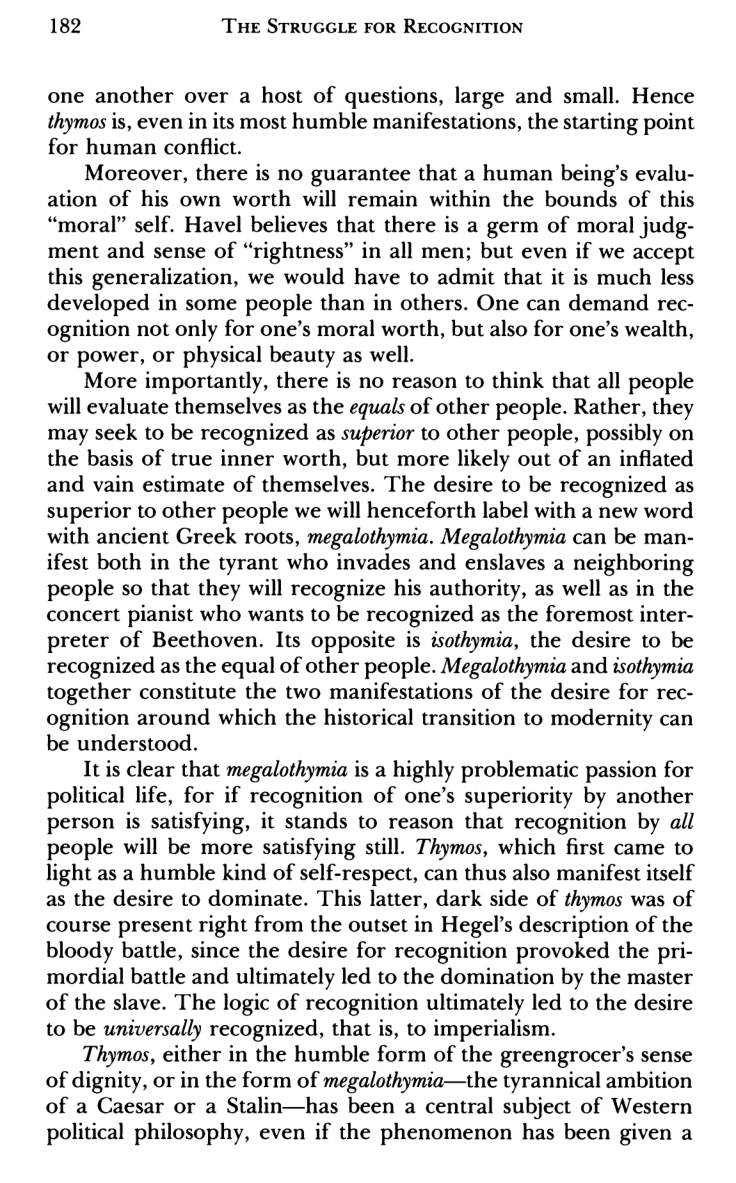
- The desire for recognition, or thymos, drives both individual combat and the imperialistic tendencies of nations seeking supremacy.
- Nationalism serves as a modern but irrational vehicle for recognition, fueling the power politics and conflicts of the last century.
- Liberal democracy transforms the irrational desire for superiority into a rational demand for equal recognition among citizens and states.
- Empirical evidence suggests that a world of reciprocal recognition between democracies significantly reduces the incentive for international war.
- The ultimate challenge to the 'end of history' is not external rivals like communism, but whether liberal democracy can survive its own internal contradictions.
- The 'last man' at the end of history faces a society that may be stable but potentially plagued by consumerist frivolity and social decay.
The desire for recognition that led to the original bloody battle for prestige between two individual combatants leads logically to imperialism and world empire.
The Problem of Recognition
- Liberal democracy attempts to resolve the historical struggle between lordship and bondage through universal and equal recognition.
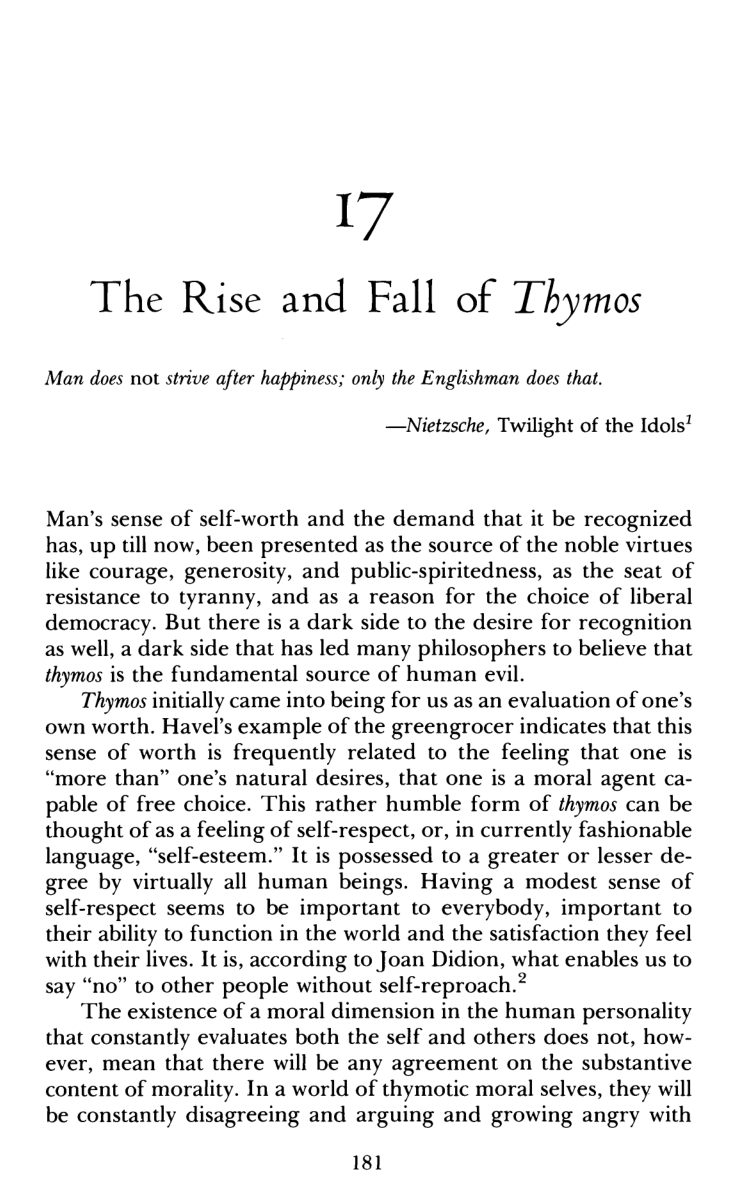
- Recognition is the psychological root of both political virtues like courage and destructive impulses like tyranny and imperialism.
- Critics from the Left argue that capitalism prevents true equality because economic disparity renders the poor invisible and unrecognized.
- Critics from the Right, following Nietzsche, argue that universal equality creates the 'last man'—a creature focused on comfortable self-preservation without higher aspirations.
- The long-term stability of modern regimes depends on whether equal recognition is truly 'completely satisfying' to the human spirit.
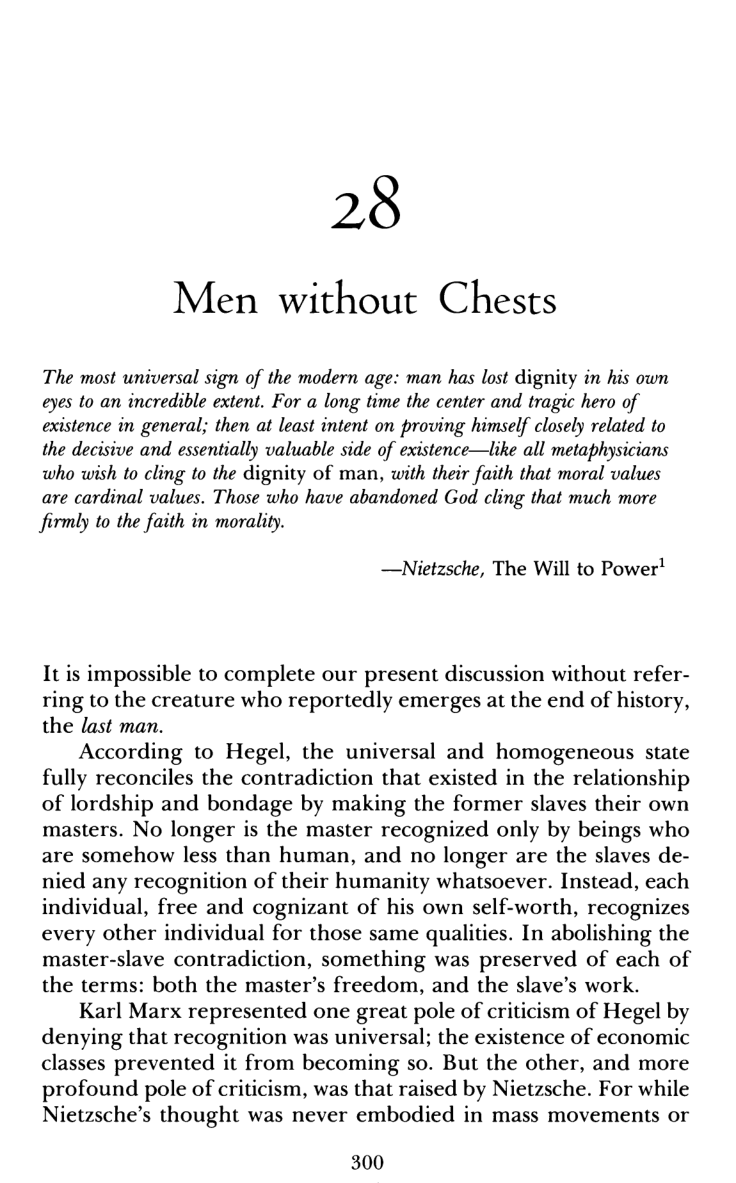
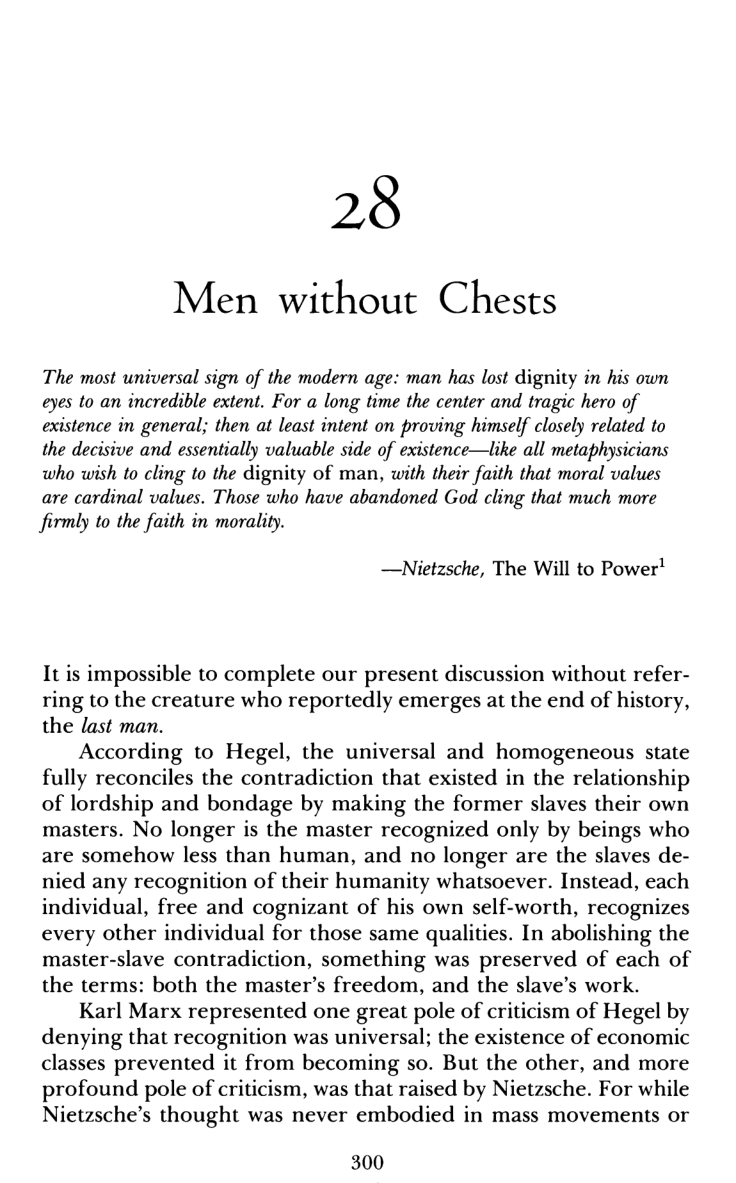
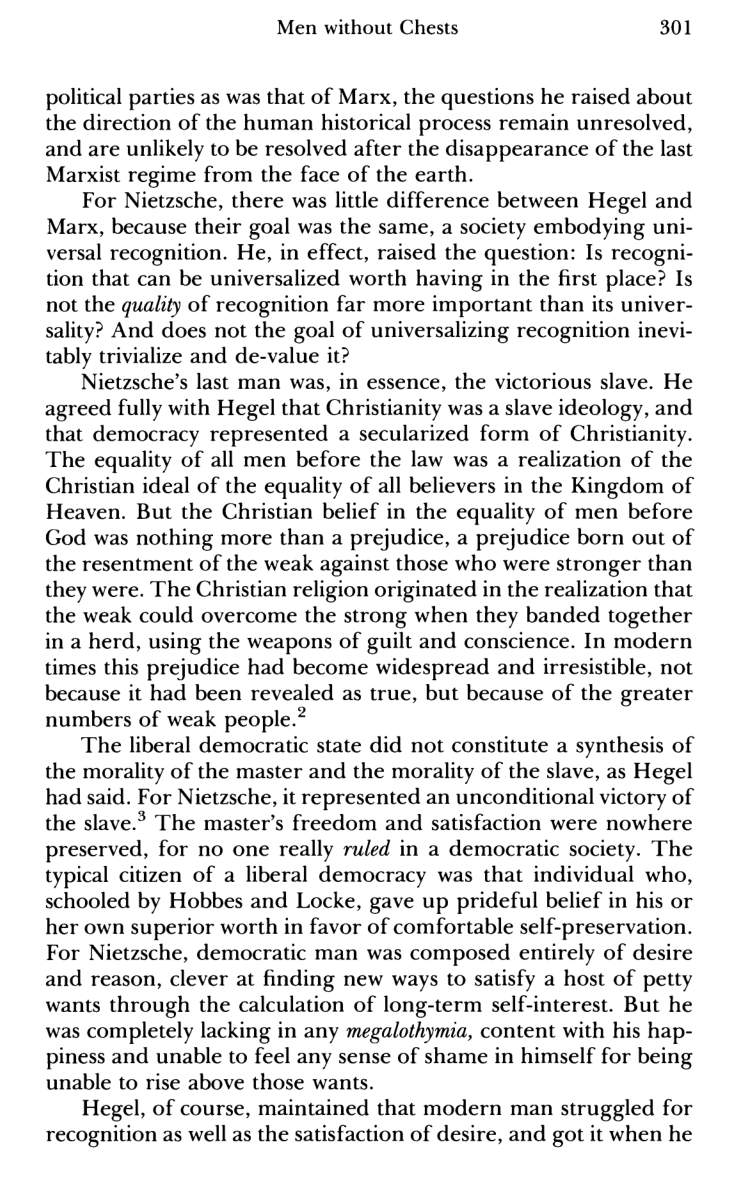
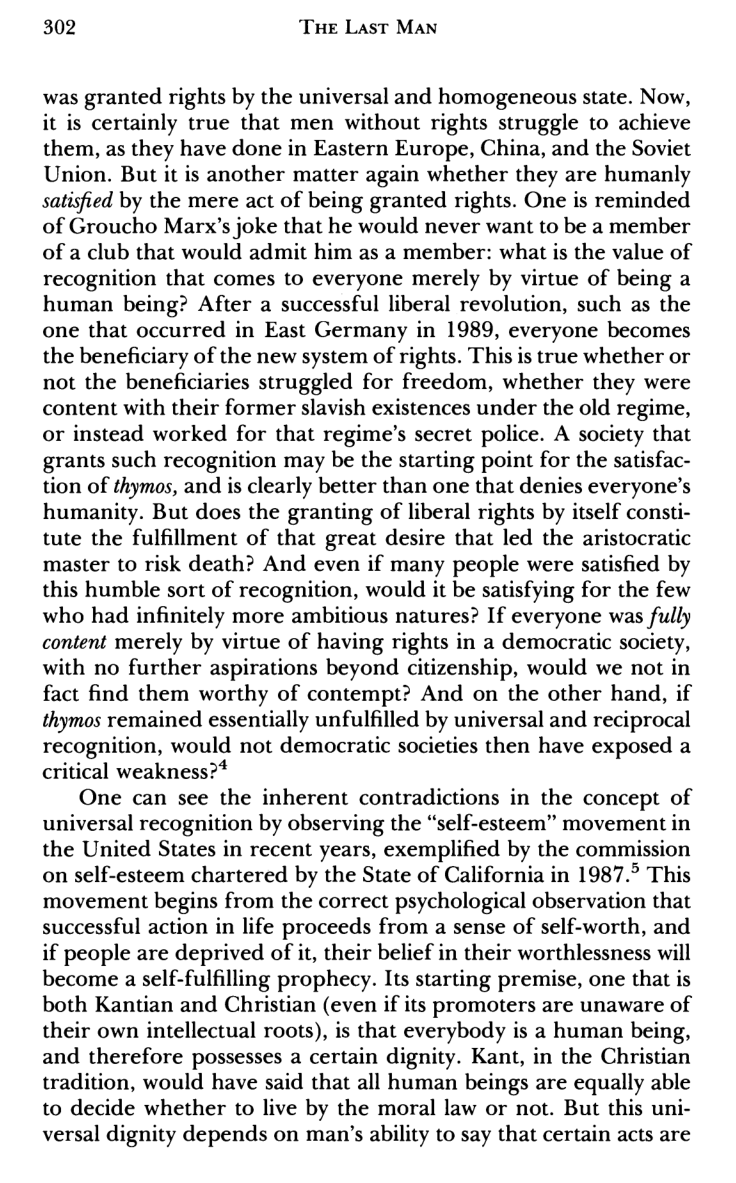
The typical citizen of a liberal democracy was a 'last man' who, schooled by the founders of modern liberalism, gave up prideful belief in his or her own superior worth in favor of comfortable self-preservation.
The Rise of Historical Pessimism
- The author questions if the 'peace and prosperity' of liberal democracy can truly satisfy the human drive for risk, struggle, and superior recognition.
- There is a concern that the desire for unequal recognition—feeling superior rather than just equal—is a fundamental human need that democracy may stifle.
- The horrors of the twentieth century, specifically Hiroshima and Auschwitz, have shattered earlier providential and teleological views of human history.
- Modernity has shifted from nineteenth-century optimism regarding scientific and political progress to a deep-seated historical pessimism.
- Contemporary thinkers struggle to identify a 'Universal History' or a meaningful, directional order to human events amidst threats of genocide and environmental collapse.
- The collapse of totalitarian regimes at the end of the century provides a unique opening to re-examine whether a coherent historical progress actually exists.
The twentieth century, it is safe to say, has made all of us into deep historical pessimists.
The Collapse of Progress
- The 19th century was defined by a 'Meliorist myth' that viewed human history as a linear record of accumulating wisdom and rational advancement.
- Early 20th-century thinkers believed that free trade and republican government had rendered war and torture obsolete in the civilized world.
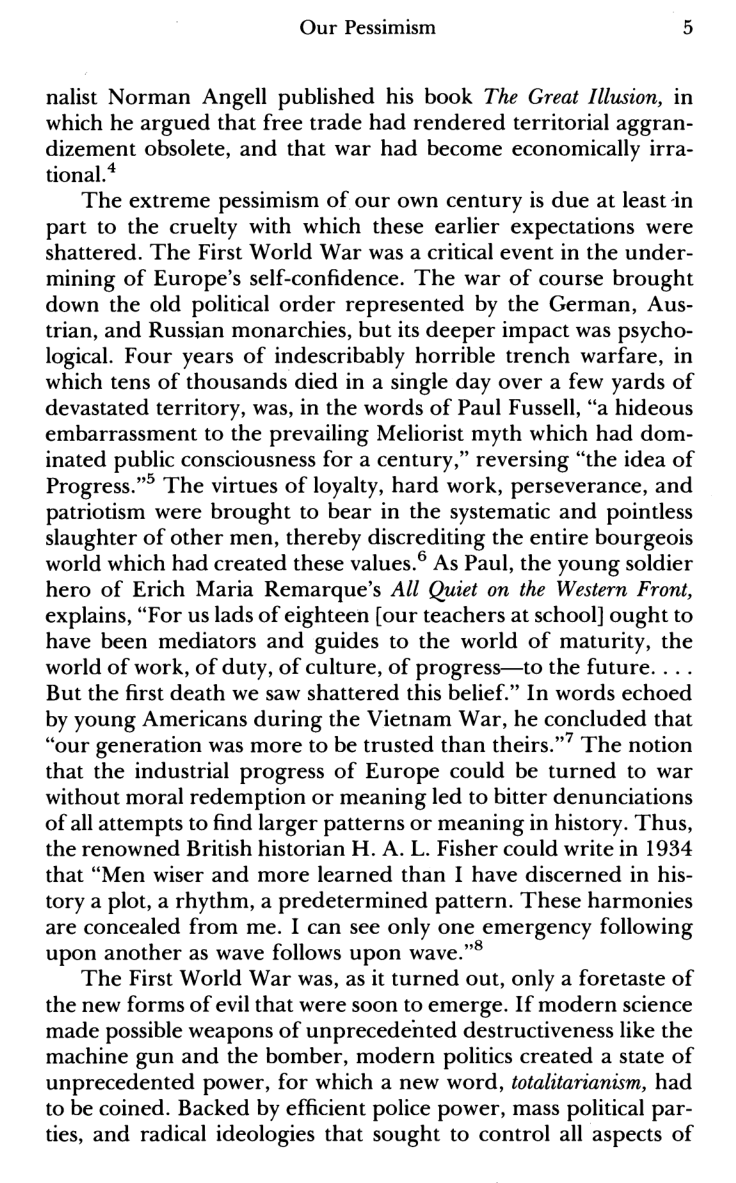
- The First World War shattered these expectations through four years of pointless, systematic slaughter that discredited bourgeois values like patriotism and duty.
- The psychological impact of trench warfare reversed the idea of progress, leading to a profound sense of cultural and historical pessimism.
- Post-war intellectuals began to reject the idea of a coherent historical 'plot,' viewing history instead as a series of meaningless emergencies.
- The industrial and scientific tools meant for human advancement were instead turned toward 'new forms of evil' and moral devastation.
Four years of indescribably horrible trench warfare, in which tens of thousands died in a single day over a few yards of devastated territory, was, in the words of Paul Fussell, 'a hideous embarrassment to the prevailing Meliorist myth.'
The Dark Side of Modernity
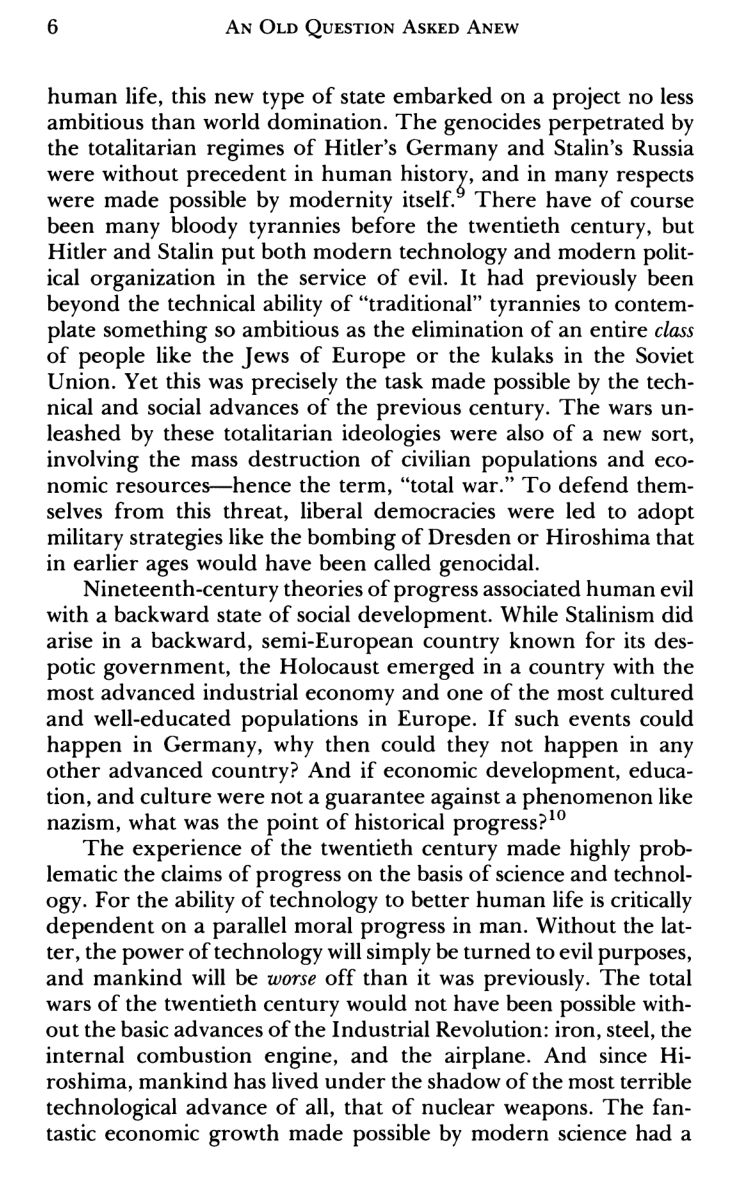
- The 20th century saw the rise of totalitarianism, a new form of state power that utilized modern technology and organization to pursue world domination.
- Modernity enabled unprecedented genocides, such as the Holocaust, by providing the technical means to eliminate entire classes of people.
- The emergence of Nazism in Germany challenged the 19th-century belief that education, culture, and economic development serve as guarantees against barbarism.
- Technological progress is value-neutral and its benefit to humanity is entirely dependent on a parallel moral progress in man.
- Global communications and industrial advances can be used as effectively by reactionary or fascist regimes as they are by democratic ones.
Hitler and Stalin put both modern technology and modern political organization in the service of evil.
The Crisis of Historical Progress
- The twentieth century's traumatic events shattered the nineteenth-century consensus that human history inevitably progresses toward liberal democracy.
- The rise of fascism and communism provided powerful ideological rivals that challenged the universality of Western political ideals.
- Two world wars and the horrors of the Nazi death camps undermined the European claim to superior rationality and the distinction between 'civilized' and 'barbarian.'
- Western thinkers developed a deep historical pessimism, viewing their own democratic systems as potentially narrow, ethnocentric accidents rather than global aspirations.
- The permanence of the communist-totalitarian challenge was so widely accepted that its sudden collapse in the late 1980s was almost entirely unanticipated by experts.
- Political maturity in the Cold War era was defined by the grim acceptance of a permanent, unending conflict between irreconcilable worldviews.
The suicidal self-destructiveness of the European state system in two world wars gave lie to the notion of superior Western rationality.
The Resilience of Totalitarianism
- Jeanne Kirkpatrick distinguished between traditional authoritarianism and radical totalitarianism, arguing the latter is invulnerable to internal reform.
- Totalitarian states seek to control the entirety of society by forcing populations to internalize the values of their masters.
- A profound lack of confidence in democracy led thinkers to believe that democratic systems were too fragile and self-critical to defend themselves against communism.
- Critics like Revel argued that the plurality of voices and constant self-doubt in democracies paralyzed their ability to maintain long-term foreign policy.
- The political Left often viewed Marxism-Leninism as a legitimate and authentic choice for non-Western nations despite rejecting it for their own societies.
- The prevailing intellectual consensus of the era suggested that the world was permanently divided between right-wing autocracies and left-wing totalitarianisms.
Societies of which permanent criticism is an integral feature are the only livable ones, but they are also the most fragile.
The Illusion of Communist Legitimacy
- Western intellectuals and political scientists largely failed to predict the collapse of the Soviet bloc, often mistaking stagnation for stability.
- Some scholars argued that the Soviet Union had achieved a form of 'institutional pluralism' that was more participatory than American democracy.
- The concept of a 'social contract' suggested that citizens traded political freedom for state-provided security, health care, and literacy.
- Samuel Huntington and others believed the Soviet government possessed a legitimate consensus and shared vision with its people.
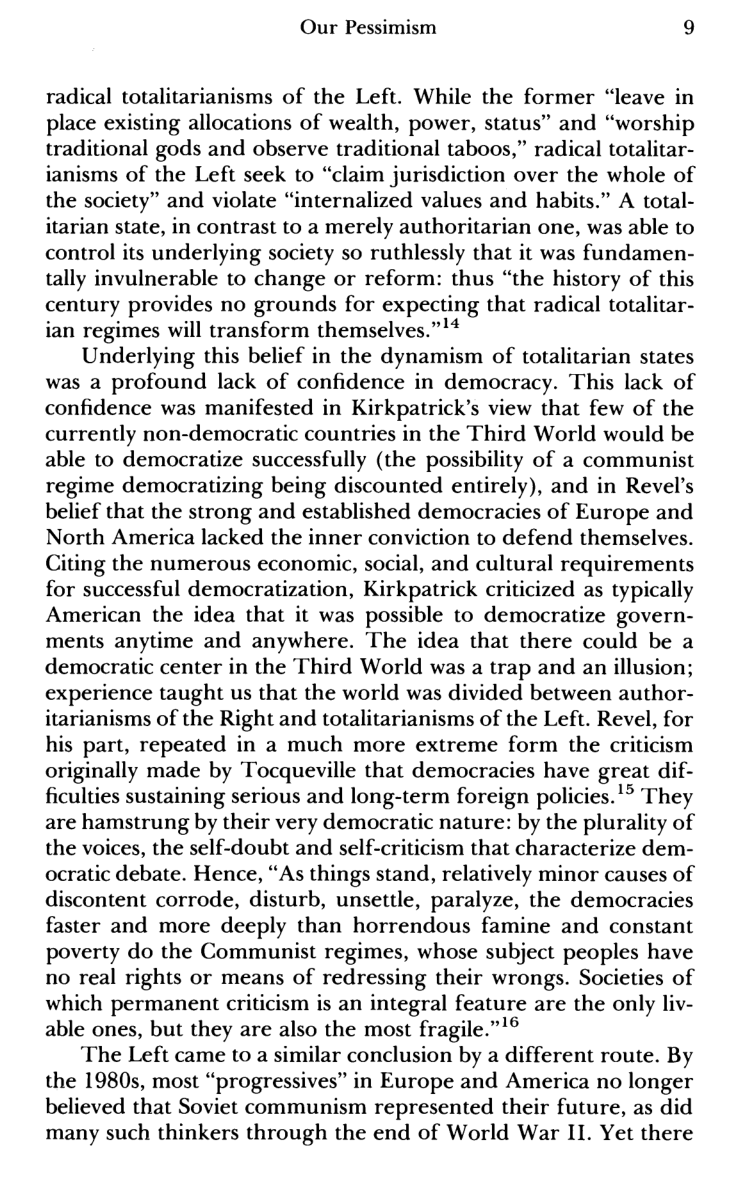
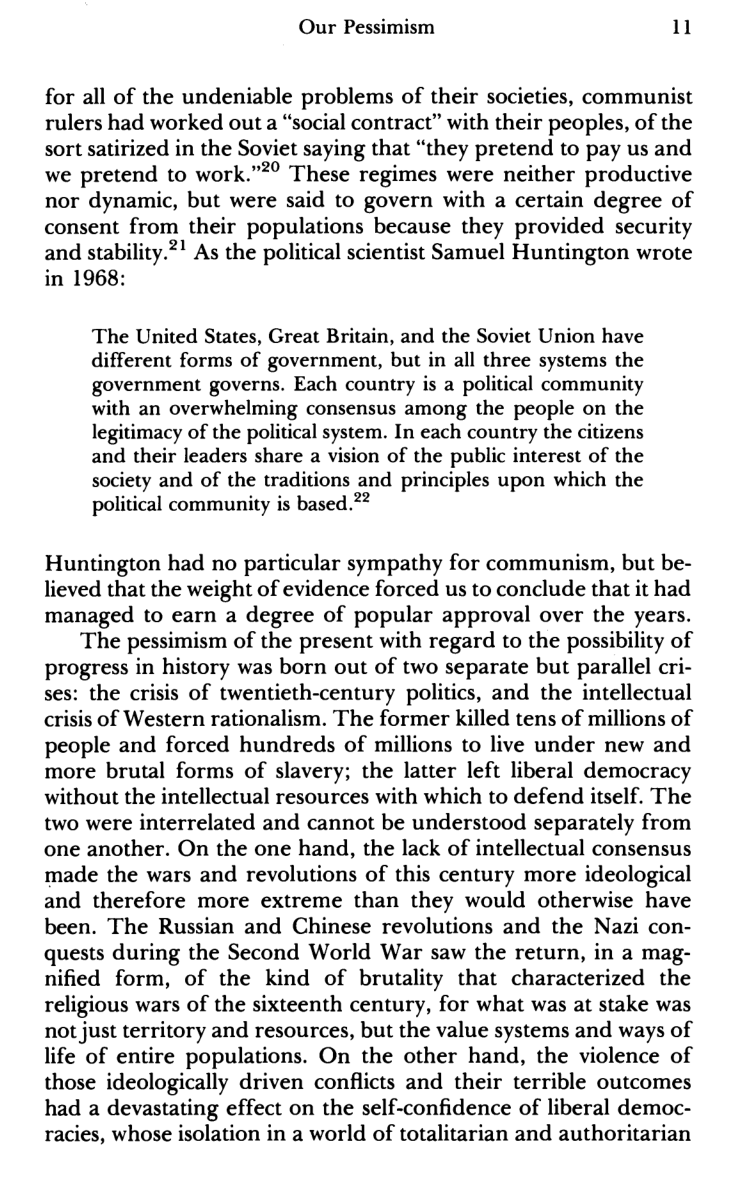
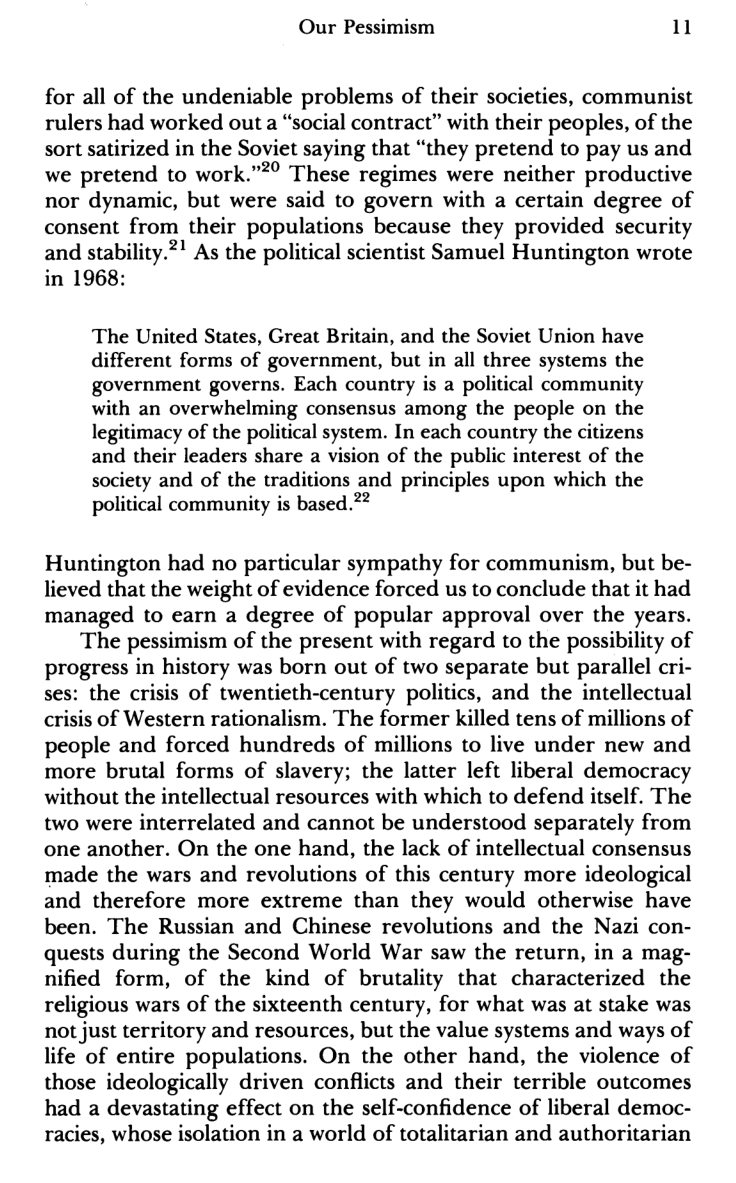
- The prevailing pessimism regarding historical progress stems from the brutal political crises of the 20th century and a parallel intellectual crisis in Western rationalism.
- The lack of intellectual consensus intensified 20th-century conflicts, making them ideological wars over value systems rather than mere territorial disputes.
The Soviet leadership almost seems to have made the Soviet Union closer to the spirit of the pluralist model of American political science than is the United States.
The Crisis of Authoritarianism
- The mid-twentieth century was defined by ideologically driven conflicts that shook the self-confidence of liberal democracies.
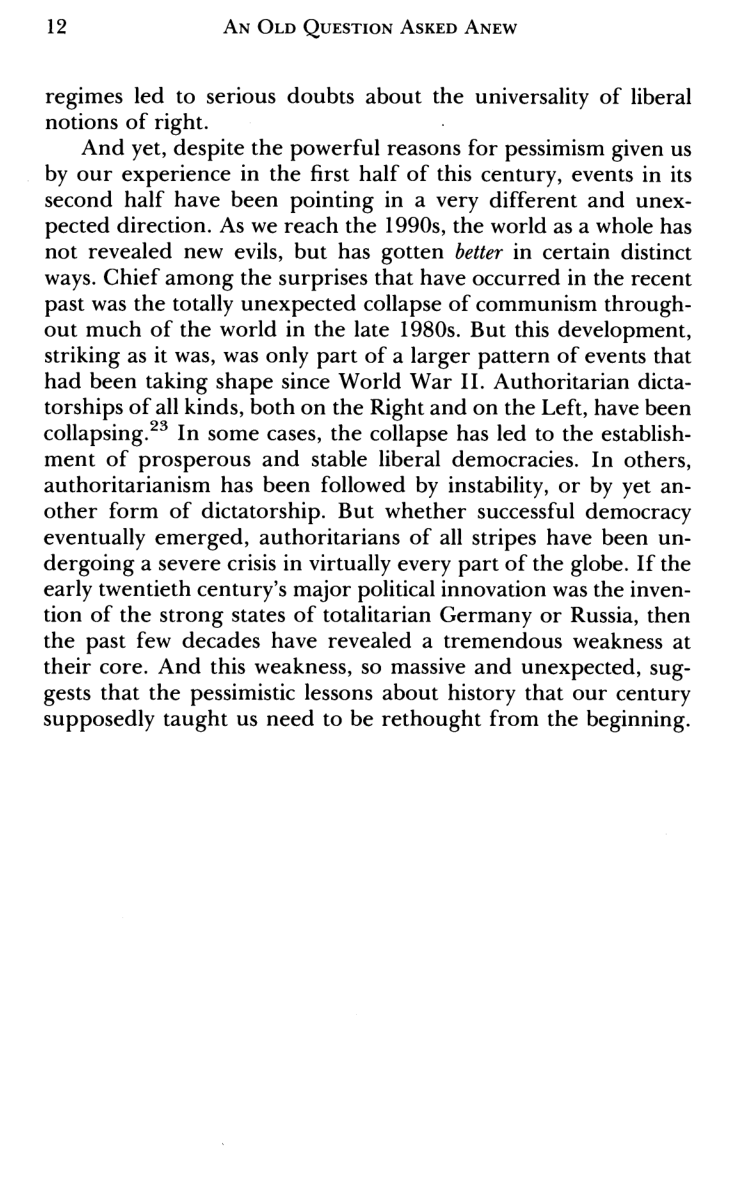
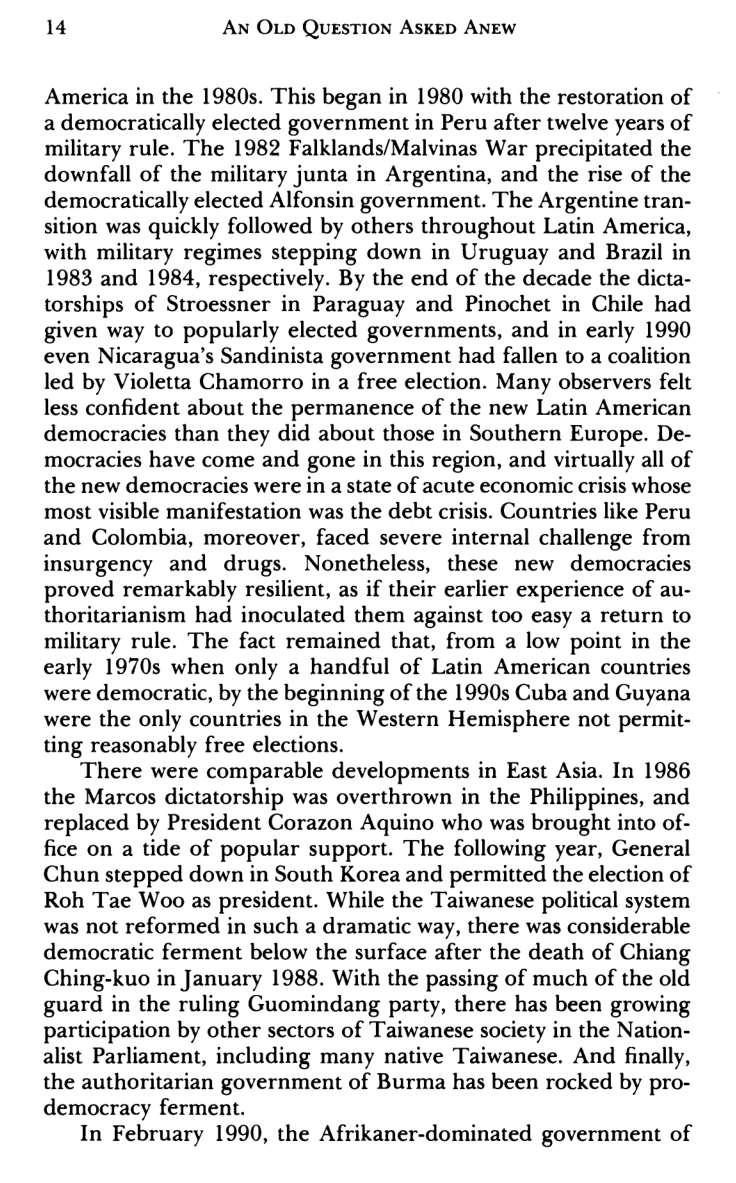
- Contrary to pessimistic expectations, the late twentieth century saw a global collapse of both right-wing and left-wing authoritarian regimes.
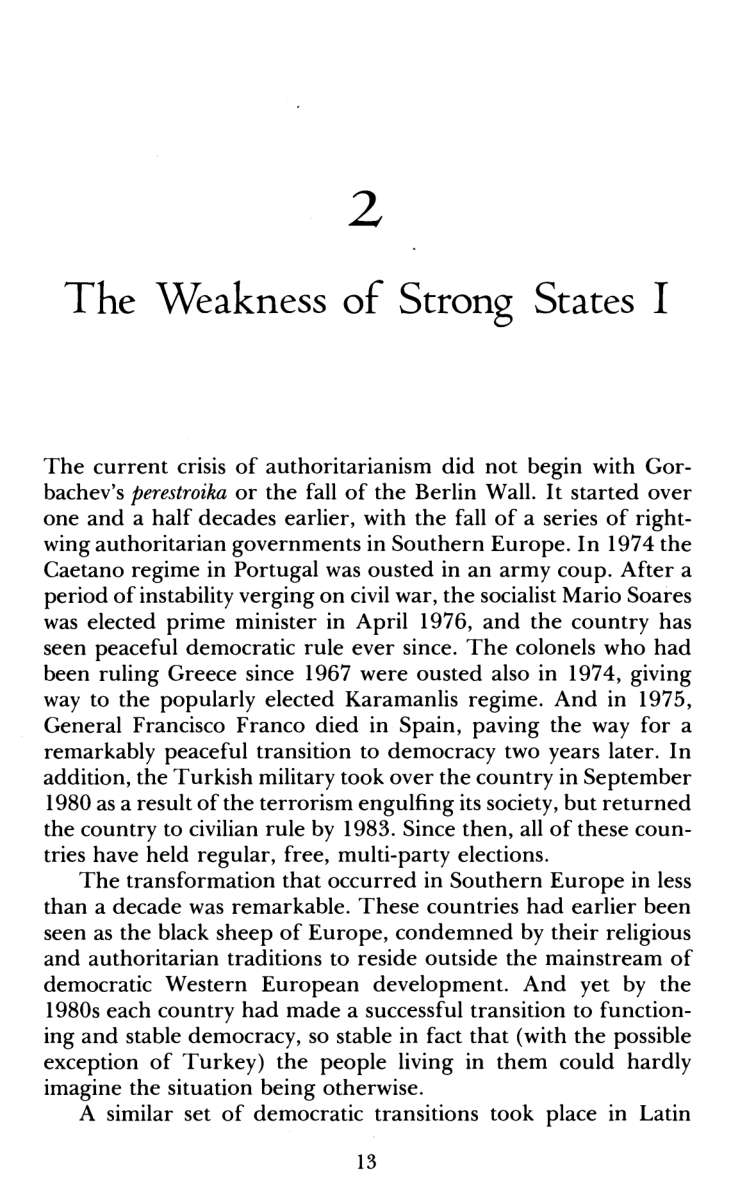
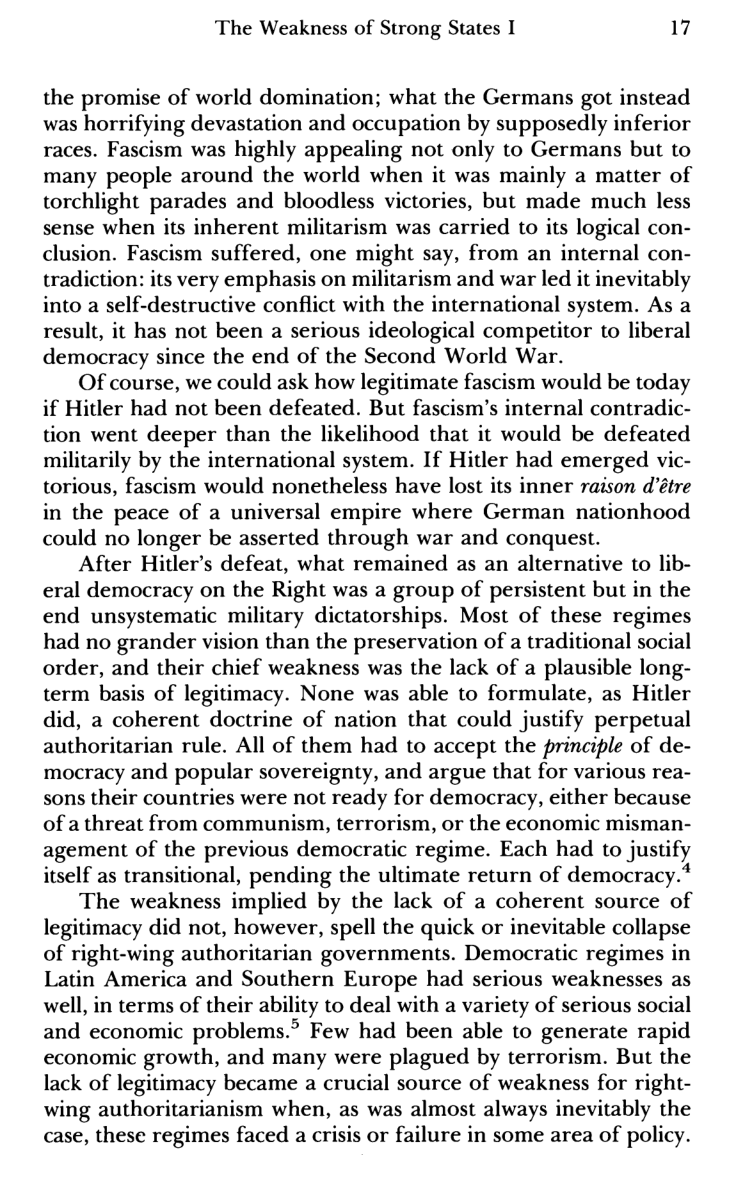
- The fall of communism in the 1980s was part of a broader trend that began with the democratic transitions in Southern Europe during the 1970s.
- Countries like Portugal, Greece, and Spain successfully transitioned from dictatorships to stable democracies, defying their previous reputations as political outliers.
- The widespread failure of strong states suggests a fundamental weakness at the core of totalitarian and authoritarian systems.
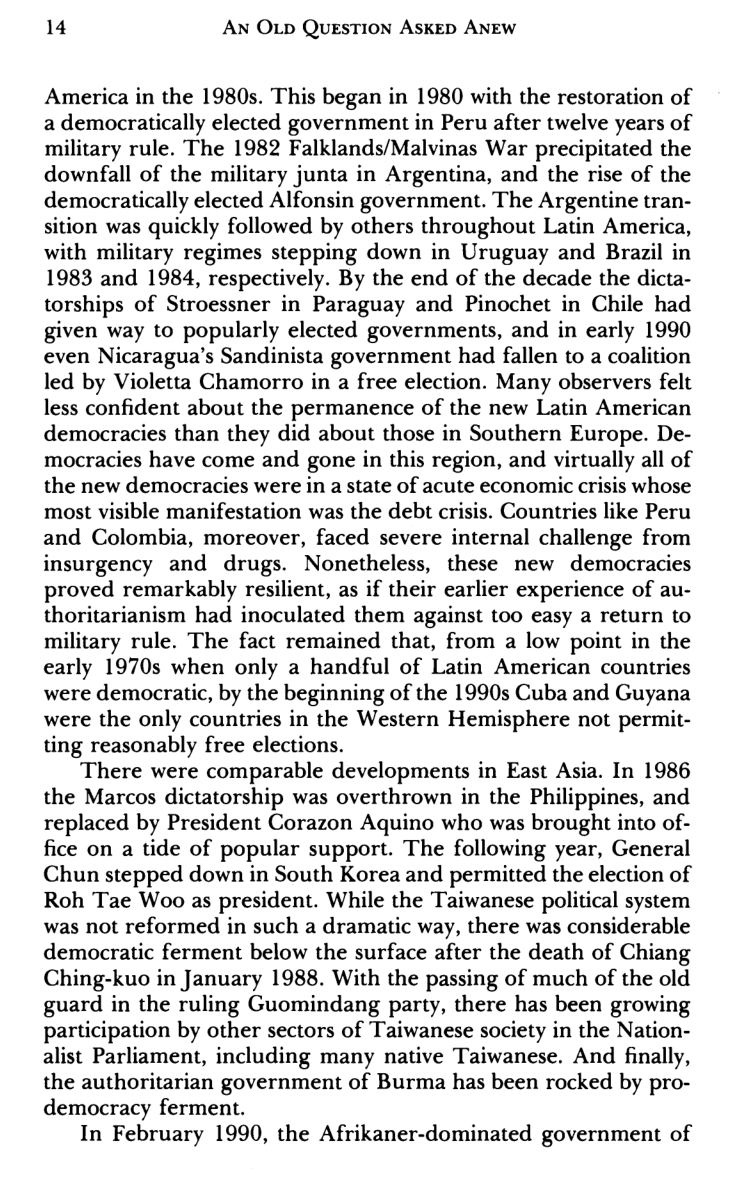
- This shift toward democracy extended into Latin America, starting with Peru and Argentina, signaling a global rethinking of historical progress.
If the early twentieth century's major political innovation was the invention of the strong states of totalitarian Germany or Russia, then the past few decades have revealed a tremendous weakness at their core.
The Crisis of Strong States
- A wave of democratization swept through Latin America in the 1980s, replacing long-standing military regimes in countries like Brazil, Chile, and Nicaragua.
- Despite economic crises and internal insurgencies, these new Latin American democracies showed unexpected resilience against returning to authoritarianism.
- Similar democratic transitions occurred across East Asia, including the fall of the Marcos dictatorship in the Philippines and political reforms in South Korea and Taiwan.
- The collapse of these regimes revealed a fundamental misunderstanding of the 'strong state,' which often lacks the long-term viability of liberal democracies.
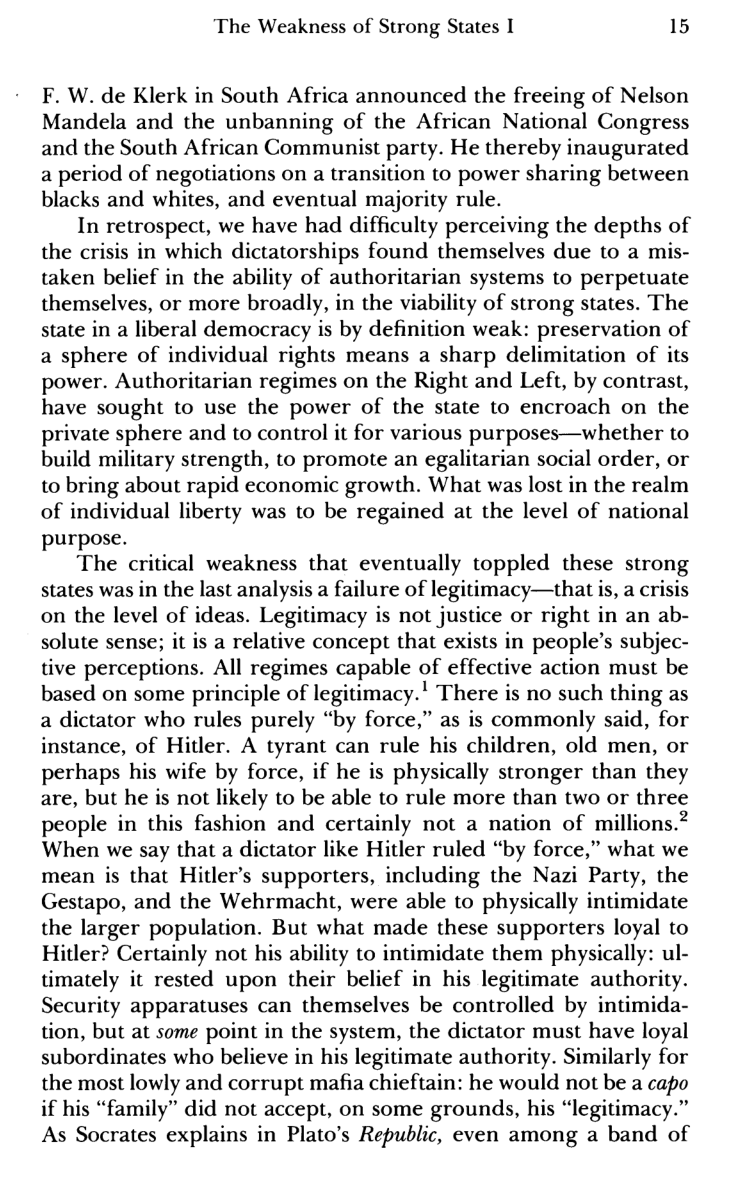
- The ultimate downfall of these authoritarian systems was a crisis of legitimacy, proving that no dictator can rule by sheer physical force alone without a subjective perception of authority.
There is no such thing as a dictator who rules purely 'by force,' as is commonly said, for instance, of Hitler.
The Necessity of Legitimacy
- Dictators cannot rule millions through physical force alone; they require a core group of loyal subordinates who believe in their legitimate authority.
- Even criminal organizations like the mafia or bands of robbers require internal principles of justice and legitimacy to function and divide spoils.
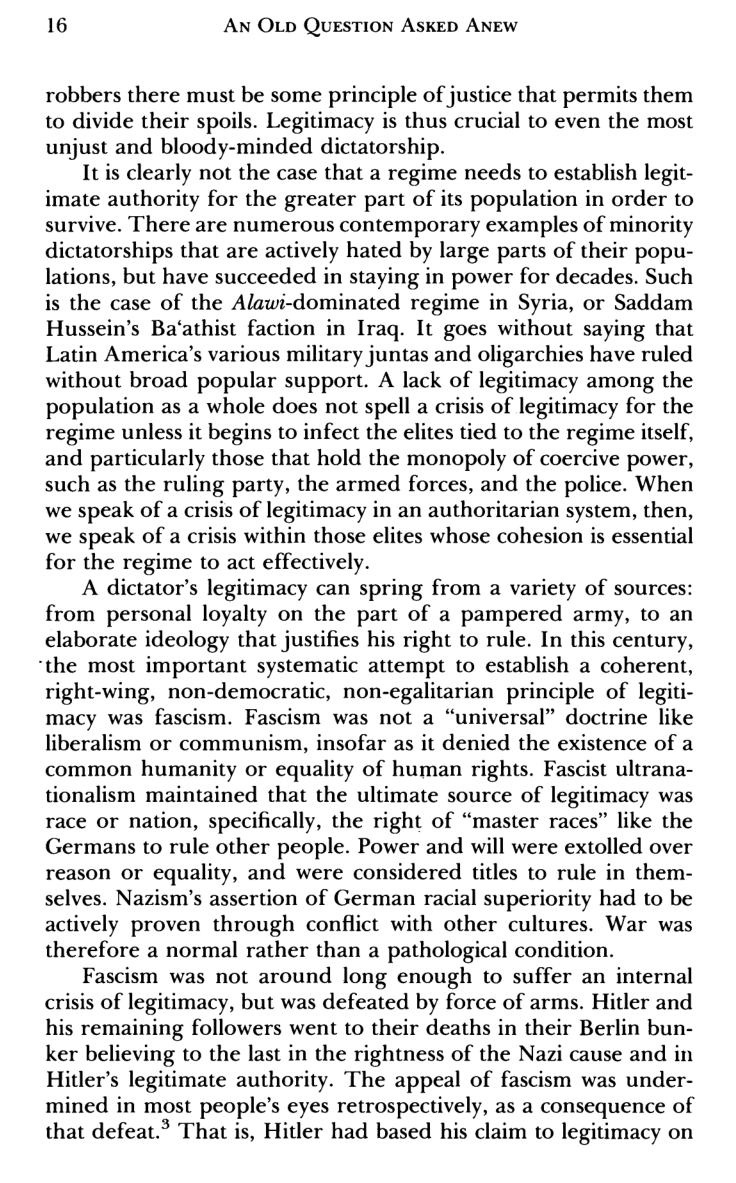
- A regime can survive despite being hated by the general population as long as the ruling elites and security apparatus remain cohesive and loyal.
- A true crisis of legitimacy in an authoritarian system occurs only when the internal belief in the regime's right to rule falters among the military and political elites.
- Fascism established legitimacy through ultranationalism and the glorification of power, asserting that 'master races' earned the right to rule through conflict.
- The legitimacy of Nazism was ultimately destroyed not by internal dissent, but by the failure of its central promise of world domination and its total military defeat.
As Socrates explains in Plato's Republic, even among a band of robbers there must be some principle of justice that permits them to divide their spoils.
The Collapse of Right-Wing Authoritarianism
- Fascism's inherent militarism created a self-destructive contradiction that led to its global delegitimization after World War II.
- Post-war military dictatorships lacked a coherent ideological doctrine, often justifying their rule as merely transitional until democracy could be restored.
- Unlike legitimate democratic regimes, authoritarian governments lack a 'fund of goodwill' to survive policy failures or economic crises.
- The lack of a long-term basis for legitimacy makes right-wing regimes vulnerable to sudden collapse when faced with internal or external pressures.
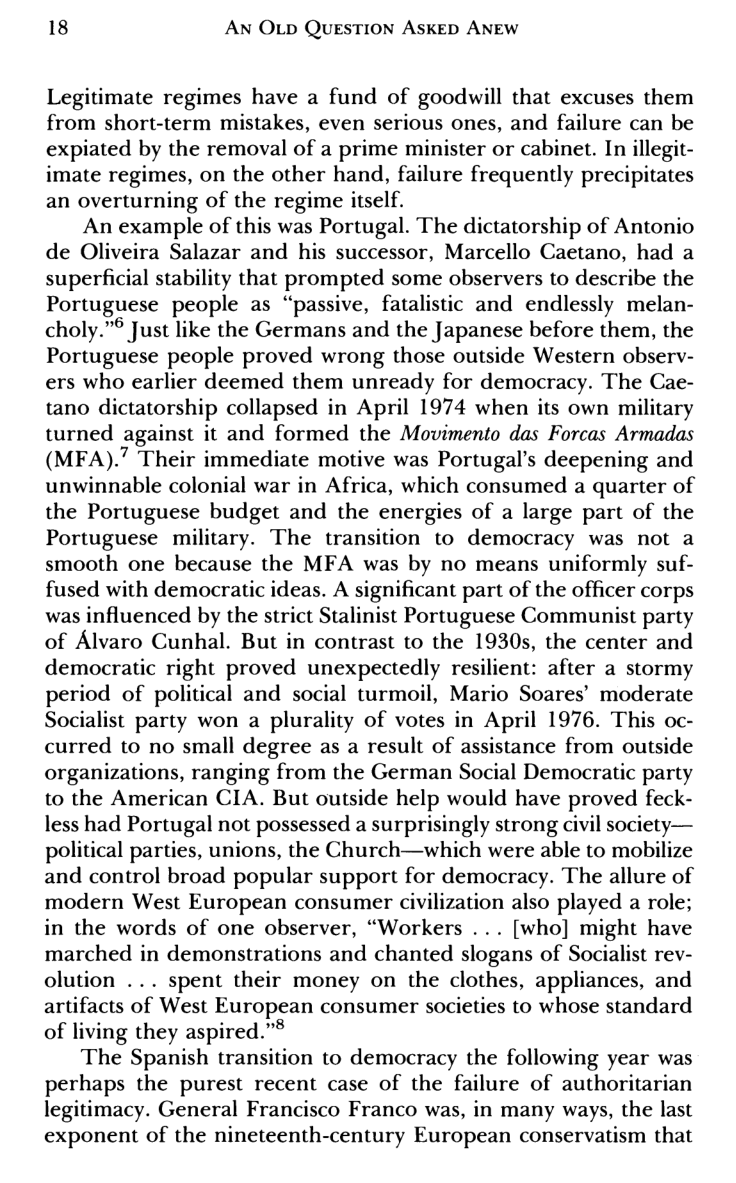
- The 1974 Portuguese revolution demonstrates how even 'passive' populations and military institutions can rapidly pivot toward democracy when a dictatorship fails.
In illegitimate regimes, on the other hand, failure frequently precipitates an overturning of the regime itself.
The Failure of Authoritarian Legitimacy
- Portugal's democratic transition succeeded because a strong civil society and the allure of Western consumerism effectively countered revolutionary socialist impulses.
- The Spanish transition represents a pure case of legitimacy failure, where the traditional pillars of 'throne and altar' collapsed as the Catholic Church liberalized after Vatican II.
- Key figures within the Francoist regime, including King Juan Carlos and Catholic technocrats, viewed the old dictatorship as an anachronism compared to a modernizing Europe.
- The Spanish Cortes performed a 'political suicide' by passing laws that mandated its own replacement by a democratically elected body.
- In Greece and Argentina, military regimes did not fall to force but collapsed internally after losing the belief in their own right to rule following external failures.
The last Francoist Cortes did a remarkable thing: it overwhelmingly passed a law in November 1976 that in effect constituted its own suicide by stipulating that the next Cortes be democratically elected.
The Failure of Authoritarianism
- Military regimes in Argentina and Uruguay lost their primary justification for rule after successfully suppressing the internal insurgencies they were formed to fight.
- Strong military governments in Peru and Brazil proved incapable of managing complex economic crises, leading to a loss of institutional confidence and a return to civilian rule.
- The South African apartheid system collapsed because its social engineering goals were fundamentally incompatible with the economic realities of industrialization.
- The transition to democracy in these regions was characterized by a voluntary retreat from power by the old regimes rather than violent revolution.
- The ultimate cause of these transitions was a growing consensus among elites that democracy is the only legitimate source of authority in the modern world.
Such an effort at social engineering was both monumental in its ambition and, in retrospect, monumentally foolish in its ultimate aim.
The Erosion of Authoritarianism
- Right-wing authoritarian regimes often collapsed because their leaders lost the moral confidence to rule in the face of democratic ideals.
- Even die-hard dictators felt compelled to seek a 'patina of democratic legitimacy' through elections, often leading to their own unintended displacement.
- Traditional authoritarian states were limited in scope, typically leaving the structures of civil society intact while focusing on political control.
- Totalitarianism, unlike traditional despotism, sought to systematically destroy civil society and private interests in favor of total ideological control.
- The Soviet state's attempt to redefine the 'strong state' involved the total absorption or elimination of independent institutions like the press and the Church.
It is difficult to kill people in the name of throne and altar if the king himself seeks to be no more than the titular monarch of a democratic country.
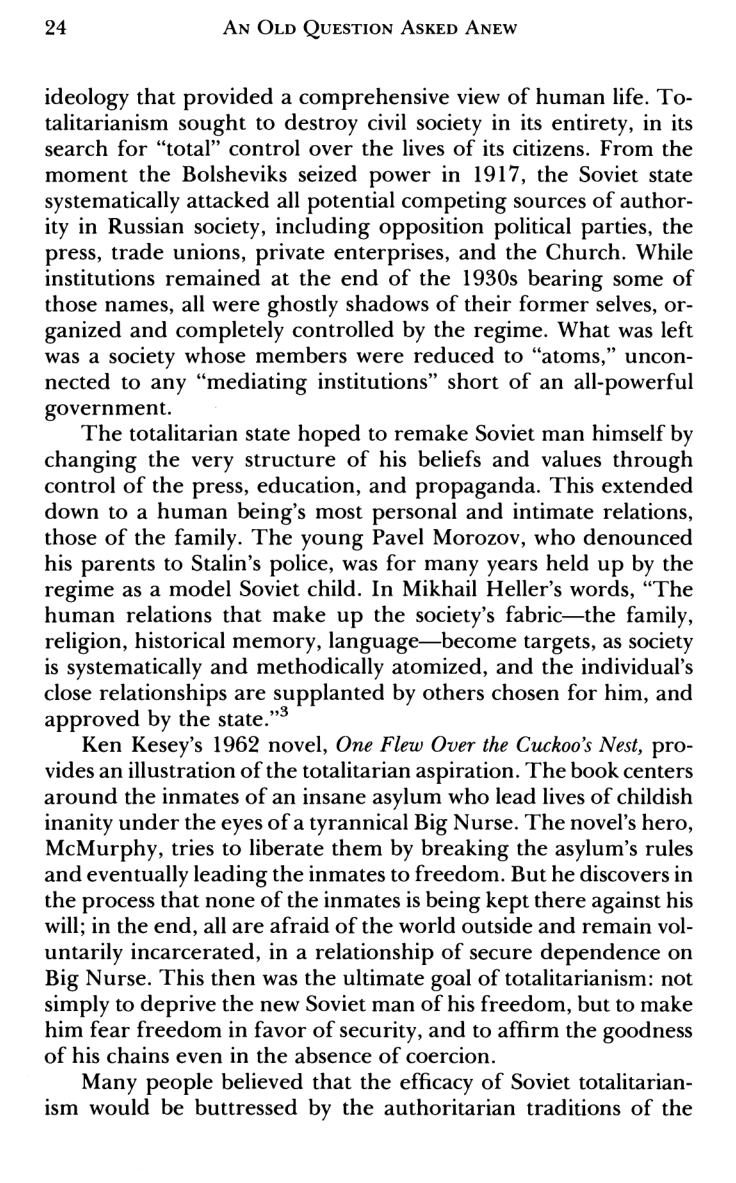
The Totalitarian Aspiration
- Totalitarianism seeks to atomize society by destroying mediating institutions like family and religion to leave the individual alone before the state.
- The regime aims to reshape human nature so that individuals eventually fear freedom and voluntarily embrace the security of their own 'chains.'
- Ken Kesey’s 'One Flew Over the Cuckoo’s Nest' serves as an allegory for the Soviet citizen’s psychological dependence on a tyrannical authority.
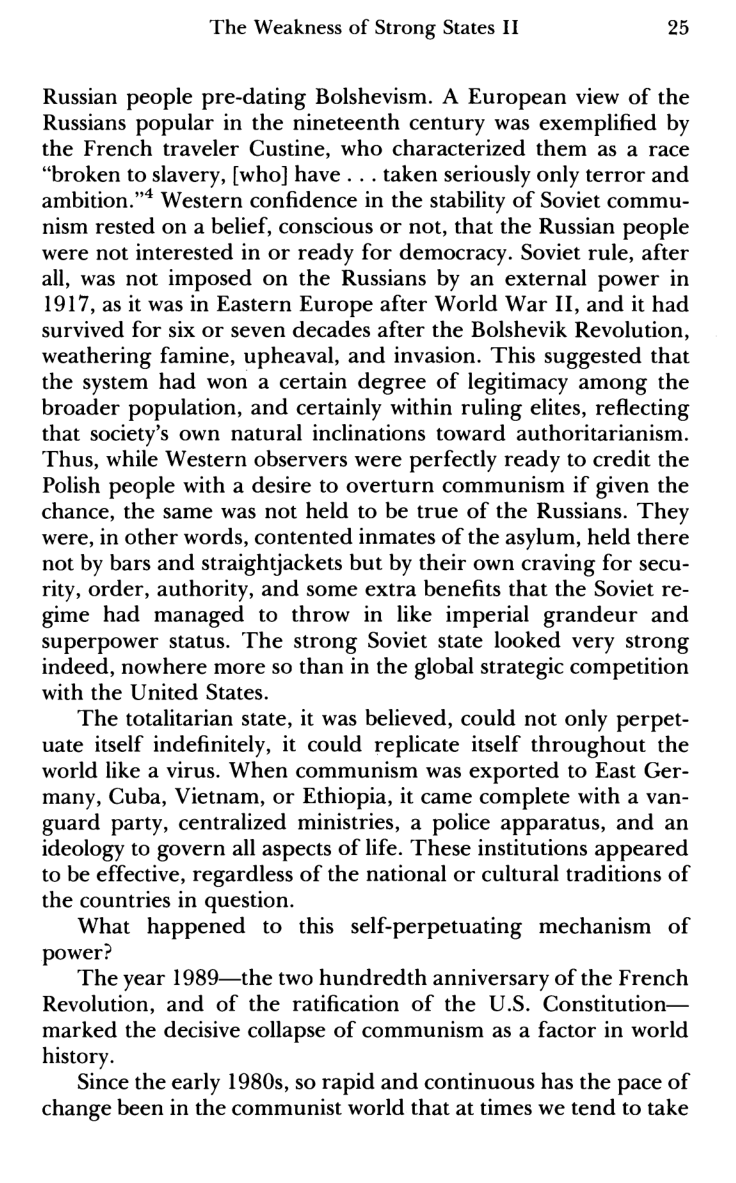
- Western observers often assumed Russians were culturally predisposed to slavery, viewing their long-term stability as a sign of internal legitimacy.
- The Soviet model was perceived as a self-replicating virus capable of imposing its rigid structure on any nation regardless of local traditions.
- The strength of the Soviet state was believed to be permanent because it replaced external coercion with an internal craving for order and status.
This then was the ultimate goal of totalitarianism: not simply to deprive the new Soviet man of his freedom, but to make him fear freedom in favor of security, and to affirm the goodness of his chains even in the absence of coercion.
The Collapse of Communism
- The year 1989 represented a historic turning point, marking the decisive collapse of communism as a global force two centuries after the French Revolution.
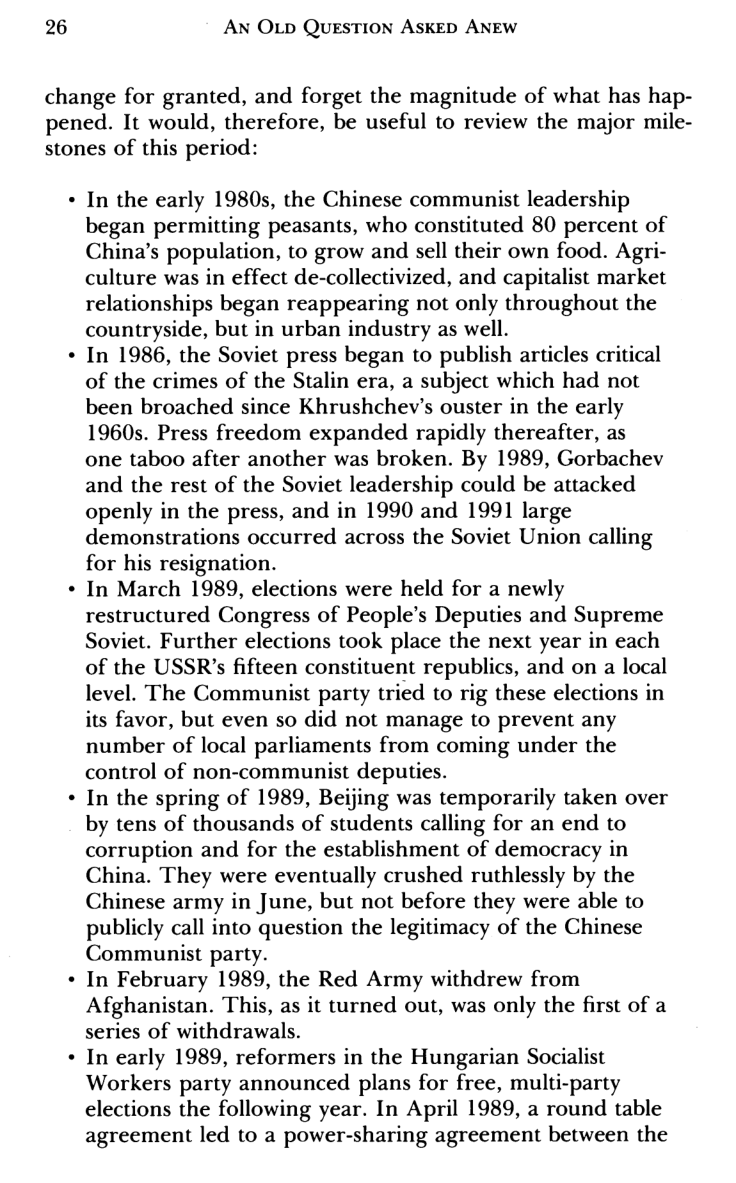
- China initiated significant reforms in the early 1980s by de-collectivizing agriculture and allowing capitalist market relationships to emerge.
- The Soviet Union underwent a rapid transformation through glasnost, leading to open criticism of the leadership and the eventual revocation of the Communist party's guaranteed 'leading role.'
- Democratic movements and free elections across Poland, Hungary, and the Soviet republics systematically dismantled the political monopoly of communist parties.
- The fall of the Berlin Wall triggered a domino effect that toppled communist regimes throughout Eastern Europe, effectively dissolving the Warsaw Pact.
- Despite the ruthless suppression of student protesters in Beijing, the legitimacy of the Chinese Communist party was publicly and permanently challenged.
The year 1989—the two hundredth anniversary of the French Revolution, and of the ratification of the U.S. Constitution—marked the decisive collapse of communism as a factor in world history.
The Soviet System's Collapse
- The rapid devolution of power from the central Soviet government to constituent republics accelerated through 1990 and 1991.
- The failure of the August 1991 coup demonstrated a surprising public commitment to democratic institutions among the Soviet people.
- The Soviet regime's legitimacy was uniquely vulnerable to economic failure because it based its right to rule on material delivery.
- Hidden inflation and stagnant growth meant the civilian economy was actually shrinking for a decade before Gorbachev took power.
- A profound intellectual revolution occurred within the Soviet economic establishment, replacing old-guard thinkers with reformers.
- The collapse of the USSR defied the predictions of 1980s experts who believed the totalitarian system was too rigid to allow such changes.
This occurred partly as a result of the plotters' incompetence and lack of resolve, but also because of a remarkable outpouring of support, led by Boris Yeltsin, for democratic institutions on the part of the allegedly passive and authority-craving Soviet people.
The Crisis of Soviet Legitimacy
- Economic decline was a catalyst for perestroika, but not its sole cause, as the USSR in 1985 was in a 'pre-crisis' state rather than a total collapse.
- The fundamental failure of the Soviet system was its inability to control individual thought despite decades of state propaganda.
- Widespread public anger persisted over the unacknowledged crimes of Stalinism, including the Great Terror and the costs of collectivization.
- The emergence of a corrupt and hypocritical class of party functionaries undermined the regime's claim to be a classless society.
- Language shifted toward Western definitions, where 'democratization' and 'normalcy' became synonymous with liberal democracy rather than Leninist ideals.
- The rejection of the system was driven not just by its victims, but by its own high-ranking beneficiaries and architects within the party apparatus.
Any number of Soviet young people, despairing of the deteriorating quality of life in the USSR, will tell you that their only desire is to live in a 'normal' country.
The Internal Collapse of Totalitarianism
- The Soviet system's collapse was driven by an internal crisis of confidence among the elite rather than external imposition.
- Gorbachev's initial reforms, intended as tools for political consolidation, unexpectedly took on a life of their own as they resonated with a disillusioned public.
- Liberal democracy and market economics emerged as the only consistent standards by which the failing old system was measured.
- The rapid reconstitution of civil society through thousands of new associations proved that the Soviet people were not inert or atomized.
- The rejection of the old social contract was evidenced by the popular election of Boris Yeltsin and the defense of democratic institutions against the 1991 coup.
- The decline of totalitarianism began decades earlier when the regime abandoned indiscriminate terror following Stalin's death.
Like the Eastern Europeans before them, they proved not inert and atomized, but spontaneously ready to defend their dignity and rights.
The Post-Totalitarian Transition
- The death of Stalin necessitated the dismantling of a terror system that threatened even the highest-ranking Soviet officials.
- Ending indiscriminate state violence shifted power toward society, allowing for the rise of consumer demand and black markets.
- The emergence of regional 'mafias' and corrupt bureaucratic empires demonstrated the central government's weakening grip on its republics.
- Vaclav Havel's term 'post-totalitarian' describes regimes that moved away from mass murder but remained shadowed by their repressive pasts.
- China's economic reforms under Deng Xiaoping signaled a clear-sighted admission that socialist central planning had failed.
- A state that allows an extensive private sector and spontaneous business organizations ceases to be truly totalitarian.
The dismantling of a system of terror so deadly to its practitioners therefore became almost mandatory once Stalin's death made it possible for the top leadership to do so.
The Fragility of Chinese Reform
- The Chinese leadership attempted to maintain legitimacy by acting as agents of modernization rather than defenders of Marxist orthodoxy.
- Economic opening inadvertently empowered civil society and created a cosmopolitan elite that eventually demanded political freedom.
- The 1989 Tiananmen Square protests reflected a fundamental dissatisfaction with a system that offered economic liberty without political rights.
- Succession struggles in totalitarian systems often force leaders to 'play the reform card,' unleashing social forces they cannot later control.
- Following the 1989 crackdown, China transitioned into a standard authoritarian state lacking a coherent, globally attractive ideology.
- Totalitarianism failed more rapidly in Eastern Europe because Soviet institutions were forcibly imposed on societies where civil structures like the Church remained partially intact.
But playing this card almost inevitably unleashes new forces and attitudes in society that then escape the control of the manipulator.
The Collapse of Communism
- The rapid collapse of Eastern European communist regimes in 1989 revealed a total demoralization of the old guard once Soviet military support was withdrawn.
- In sub-Saharan Africa, the failure of Marxist states and one-party systems led to economic collapse, prompting a shift toward democratic experiments and free elections.
- Communism has transitioned from being viewed as a 'higher civilization' to a symbol of political and economic backwardness, now existing as a reactionary rearguard action.
- While the ideological threat of communism has vanished, the transition to stable democracy remains fragile and fraught with economic and social obstacles.
- Critics argue that the vacuum left by communism may be filled by aggressive nationalism or fascism rather than peaceful liberal democracy.
Communists now find themselves in the unenviable position of defending an old and reactionary social order whose time has long since passed, like the monarchists who managed to survive into the twentieth century.
Democracy and National Separation
- The Soviet Union's structure was fundamentally incompatible with democracy because genuine freedom would trigger immediate ethnic and national fragmentation.
- Democratization in the post-Soviet space requires a painful and potentially bloody process of national separation before stable states can emerge.
- Emerging nationalisms are not inherently expansionist; some, like the 'small Russia' concept, represent a shift toward internal focus rather than imperial reach.
- Transitional authoritarian regimes in Eastern Europe and the USSR lack long-term legitimacy and will eventually face the same pressures to democratize as Latin American dictatorships.
- Despite decades of social engineering, totalitarianism failed to create a 'new man,' leaving elites who surprisingly resemble their Western counterparts.
For while totalitarianism managed to destroy the visible institutions of pre-revolutionary Russian and Chinese society, it was utterly ineffective in its aspirations to create a new man of either the Soviet or Maoist variety.
The Worldwide Liberal Revolution
- Citizens in post-totalitarian states proved to be autonomous adults capable of distinguishing truth from falsehood rather than the dependent children predicted by Western theory.
- Authoritarian regimes of both the Left and Right suffer from a bankruptcy of ideas, leaving them without a 'cash reserve' of legitimacy during policy failures.
- Right-wing authoritarian states often fail because successful economic development creates a prosperous middle class that no longer tolerates military rule.
- Totalitarian systems of the Left rely on terror to control civil society, but once terror is relaxed, the state loses its grip on the citizens' belief systems.
- Succession crises in communist regimes often force power-hungry contenders to use 'reform' as a political weapon against rivals, further destabilizing the system.
Some have compared legitimacy to a kind of cash reserve. All governments, democratic and authoritarian, have their ups and downs; but only legitimate governments have this reserve to draw on in times of crisis.
The Worldwide Liberal Revolution
- Succession processes in authoritarian regimes often undermine their own credibility by exposing systemic abuses and unleashing uncontrollable social forces.
- The collapse of ideological coherence in Marxist-Leninist states has led to a devolution of power and the rise of nationalist or traditionalist symbols over communist ones.
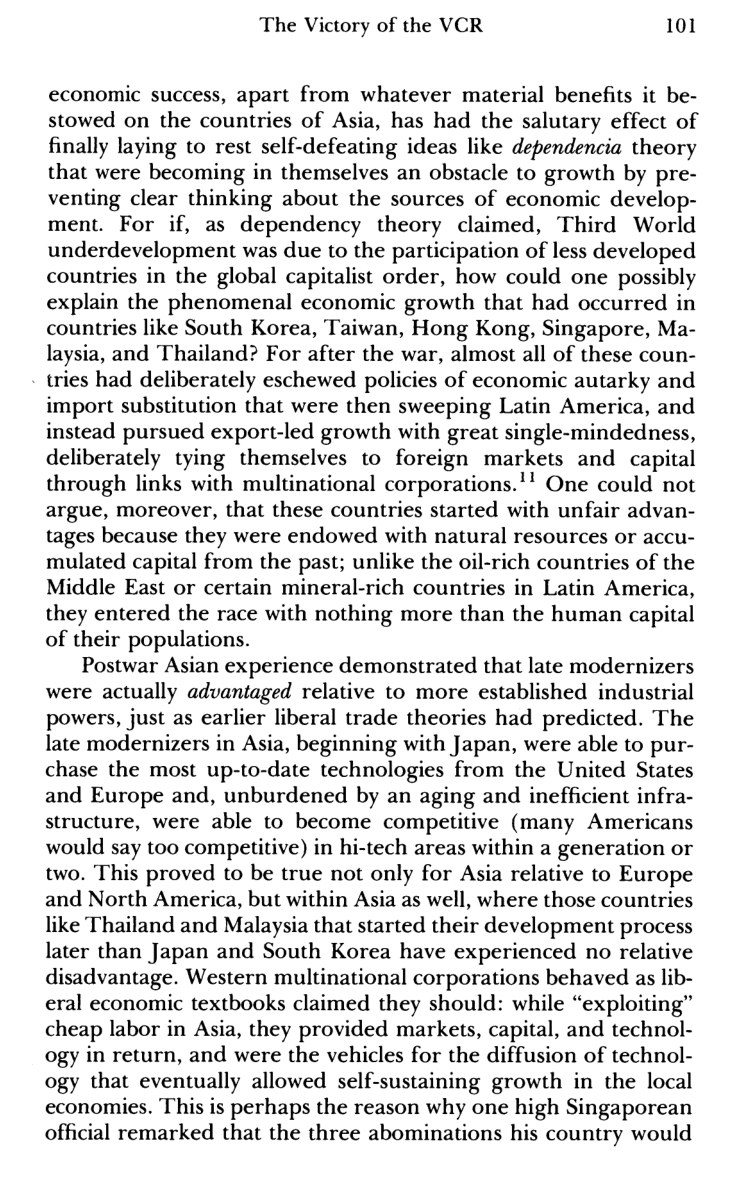
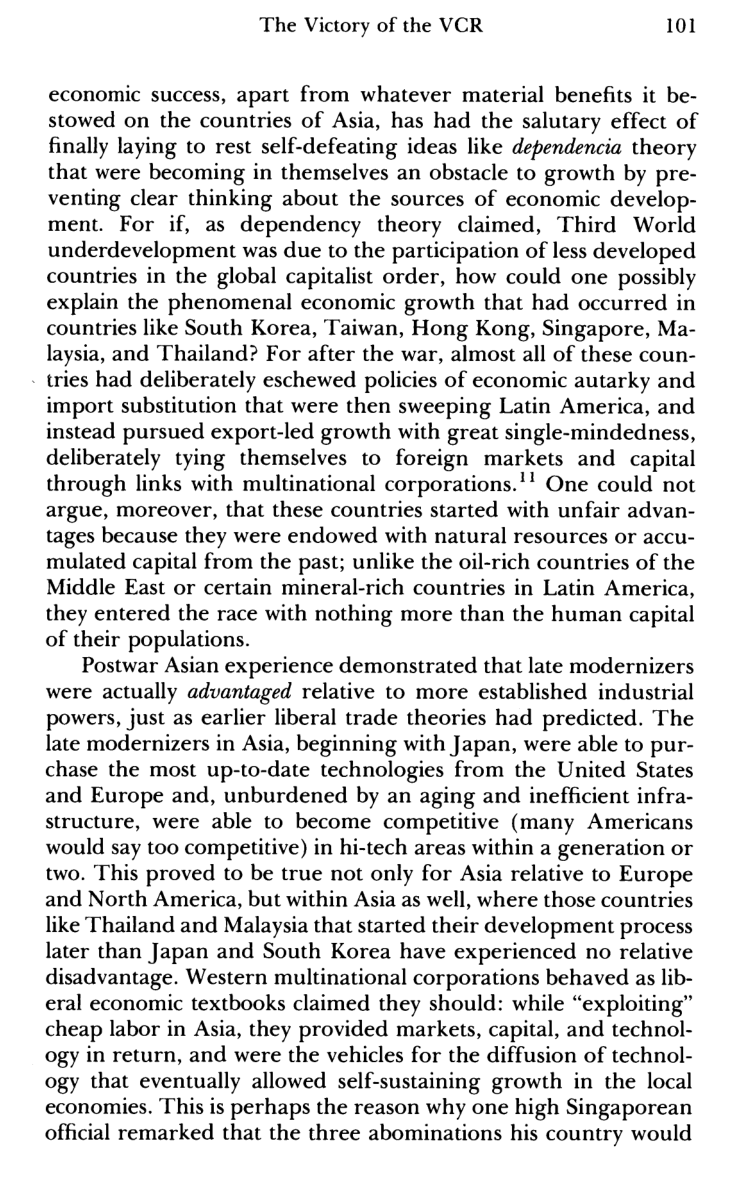
- East Asia's post-war economic miracle demonstrated that market principles and global integration could generate massive wealth regardless of a nation's initial resource base.
- The visible success of capitalist Asia triggered a terminal crisis in communist states, forcing leaders in China and the Soviet Union to acknowledge the failures of central planning.
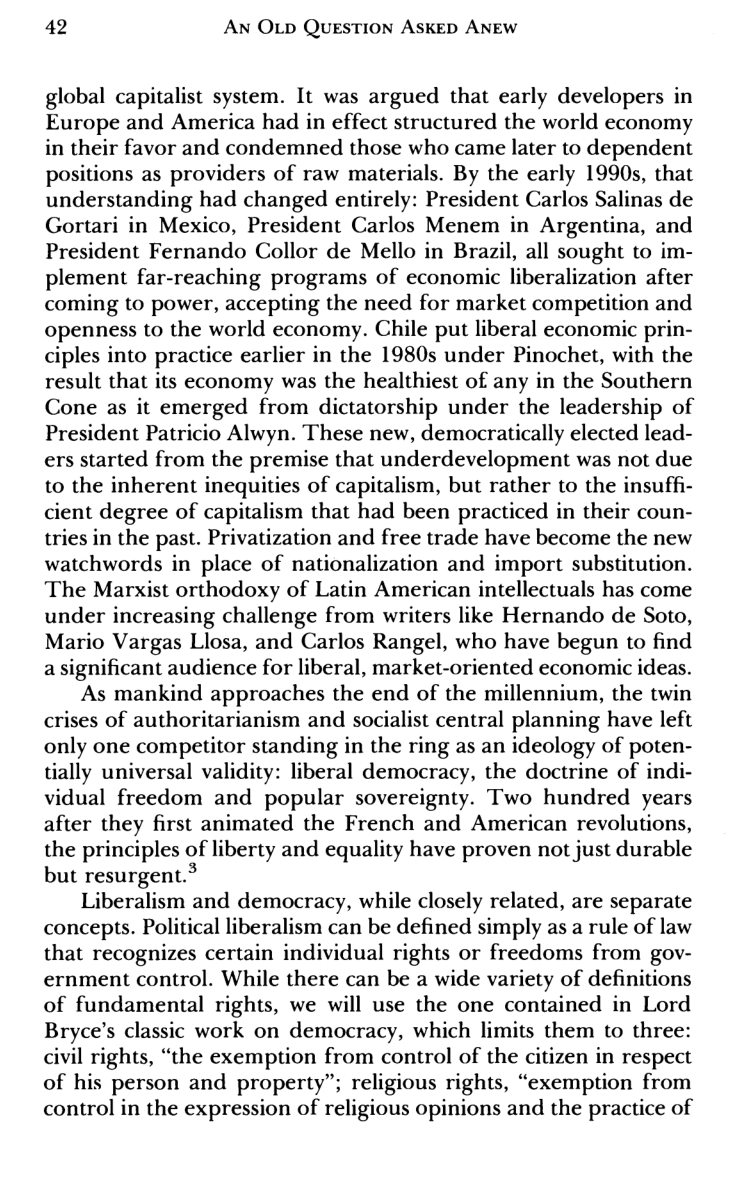
- Latin American economic thought shifted from 'dependency theory' and blaming global capitalism to embracing liberalization and market-oriented reforms by the early 1990s.
The conservatives opposed to reform in the Soviet Union are as likely to place an Orthodox icon on their wall as a picture of Lenin.
The Worldwide Liberal Revolution
- Latin American nations shifted from Marxist orthodoxy toward market competition and openness to the world economy during the 1980s.
- New democratic leaders argued that underdevelopment resulted from an insufficient degree of capitalism rather than its inherent inequities.
- Liberal democracy has emerged as the only ideology of potentially universal validity following the crises of authoritarianism and central planning.
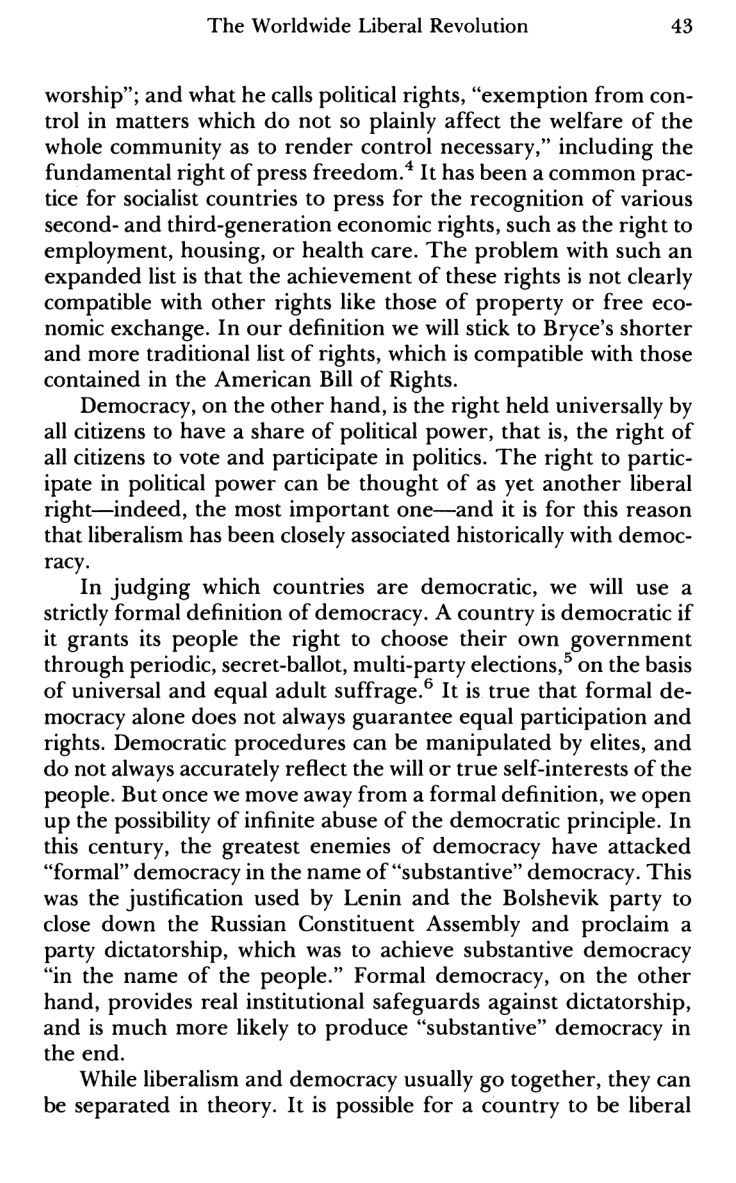
- Political liberalism is defined as the rule of law protecting individual rights, specifically civil, religious, and political freedoms.
- Democracy is defined formally as the universal right of citizens to choose their government through periodic, multi-party elections.
- A strict formal definition of democracy is necessary to prevent the 'infinite abuse' of the democratic principle by those claiming to represent the people's true interests.
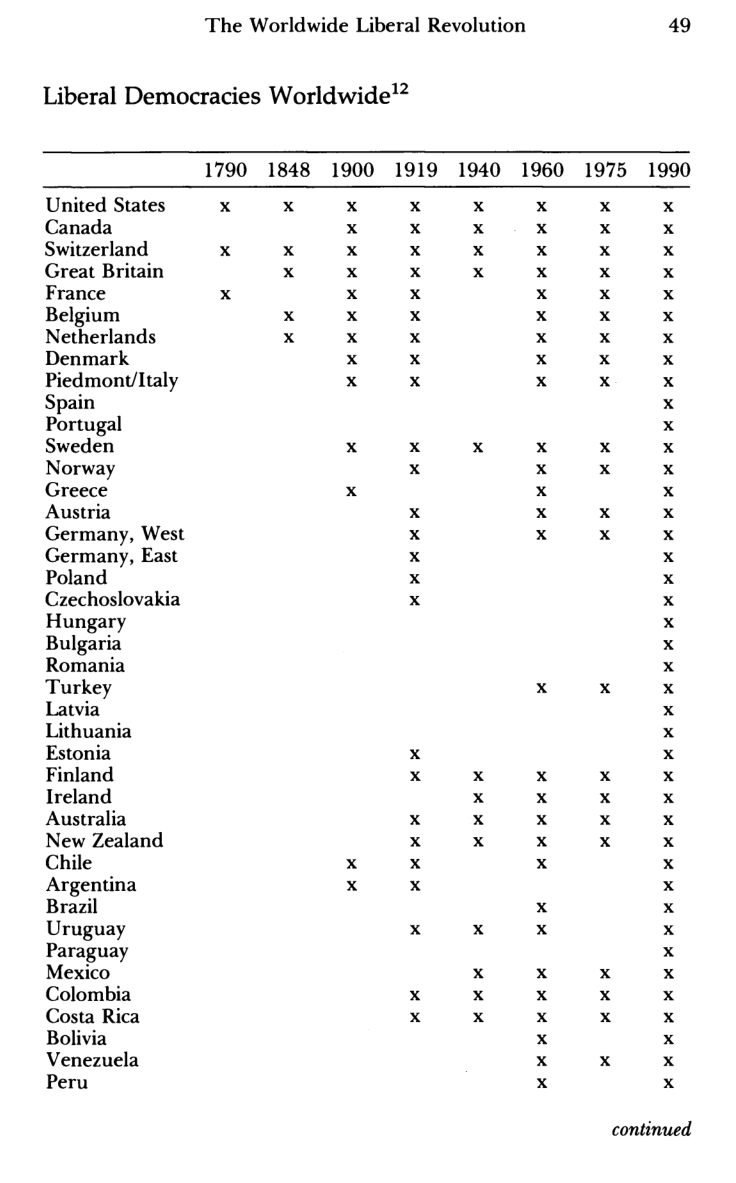
As mankind approaches the end of the millennium, the twin crises of authoritarianism and socialist central planning have left only one competitor standing in the ring as an ideology of potentially universal validity: liberal democracy, the doctrine of individual freedom and popular sovereignty.
Defining Liberal Democracy
- The distinction between 'formal' and 'substantive' democracy has often been used by dictatorships to justify the suppression of institutional safeguards.
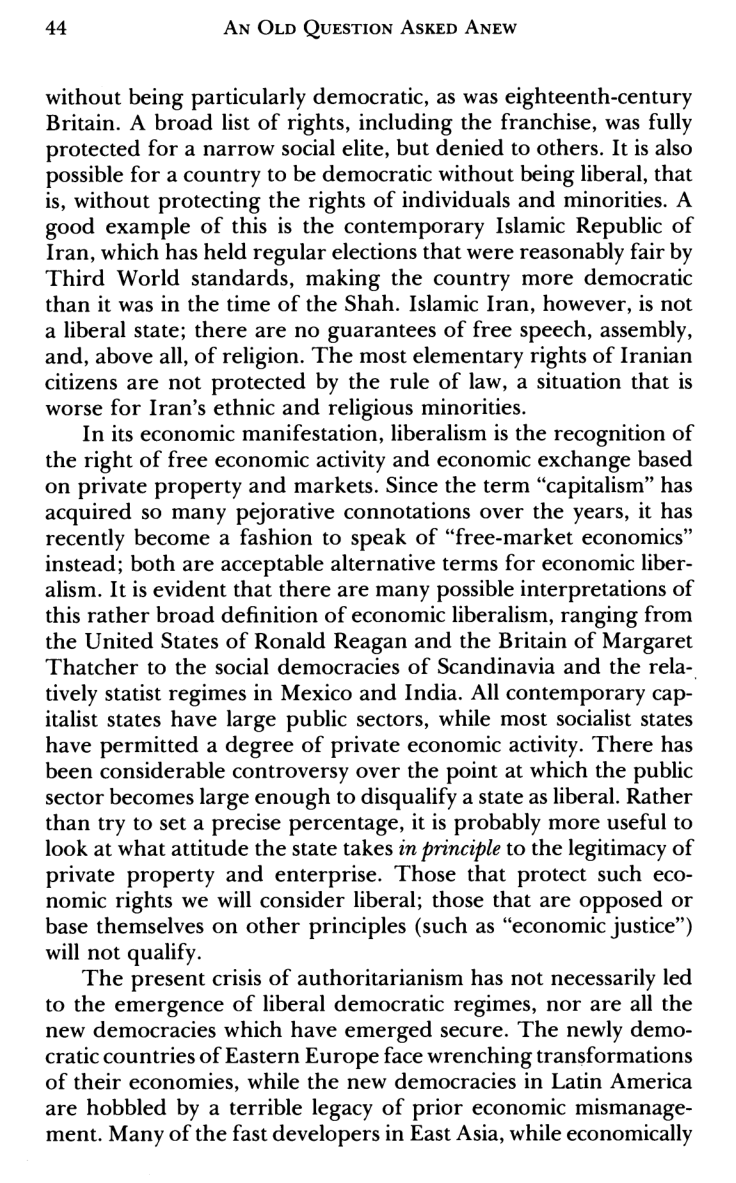
- Liberalism and democracy are theoretically distinct; a state can be liberal without being democratic, or democratic without being liberal.
- Economic liberalism is defined by the protection of private property and market activity, regardless of the size of the public sector.
- The legitimacy of a state's liberal status depends on its principled stance toward private enterprise rather than a specific economic percentage.
- While a global liberal revolution is visible, many new democracies face economic instability or authoritarian relapses that threaten their survival.
- The current historical pattern suggests a move toward liberal democracy despite significant regional setbacks and economic challenges.
It is also possible for a country to be democratic without being liberal, that is, without protecting the rights of individuals and minorities.
The Triumph of Liberalism
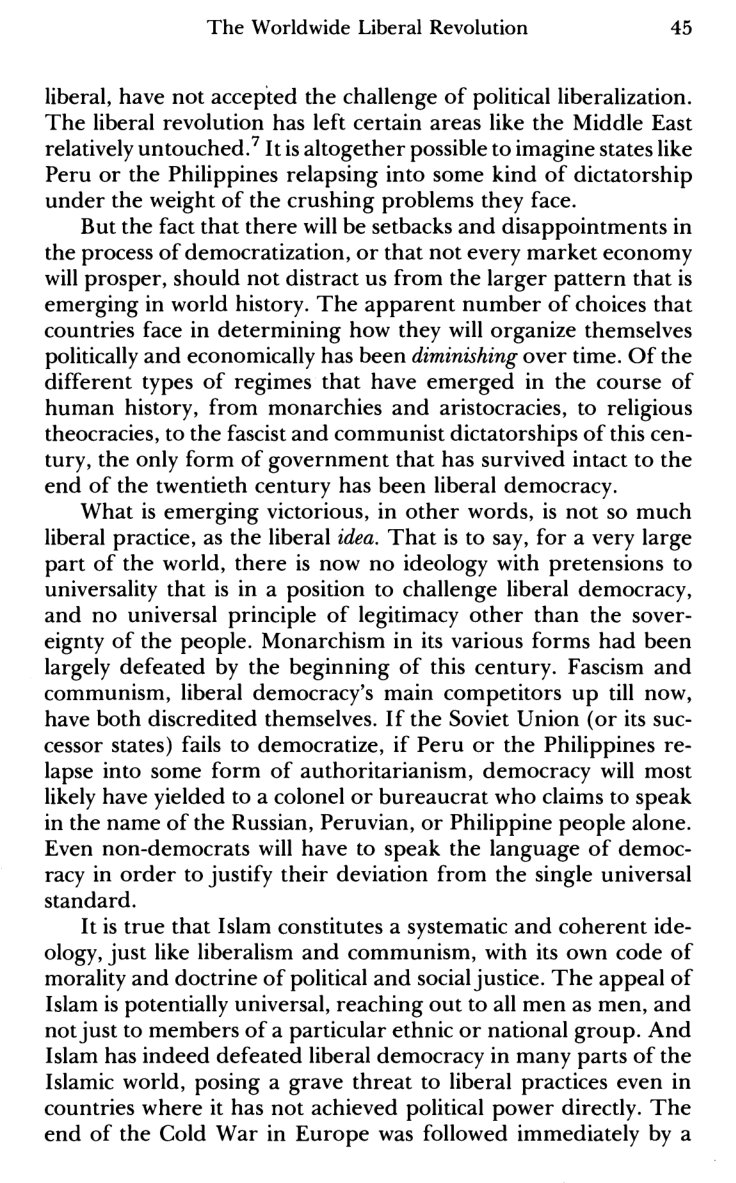
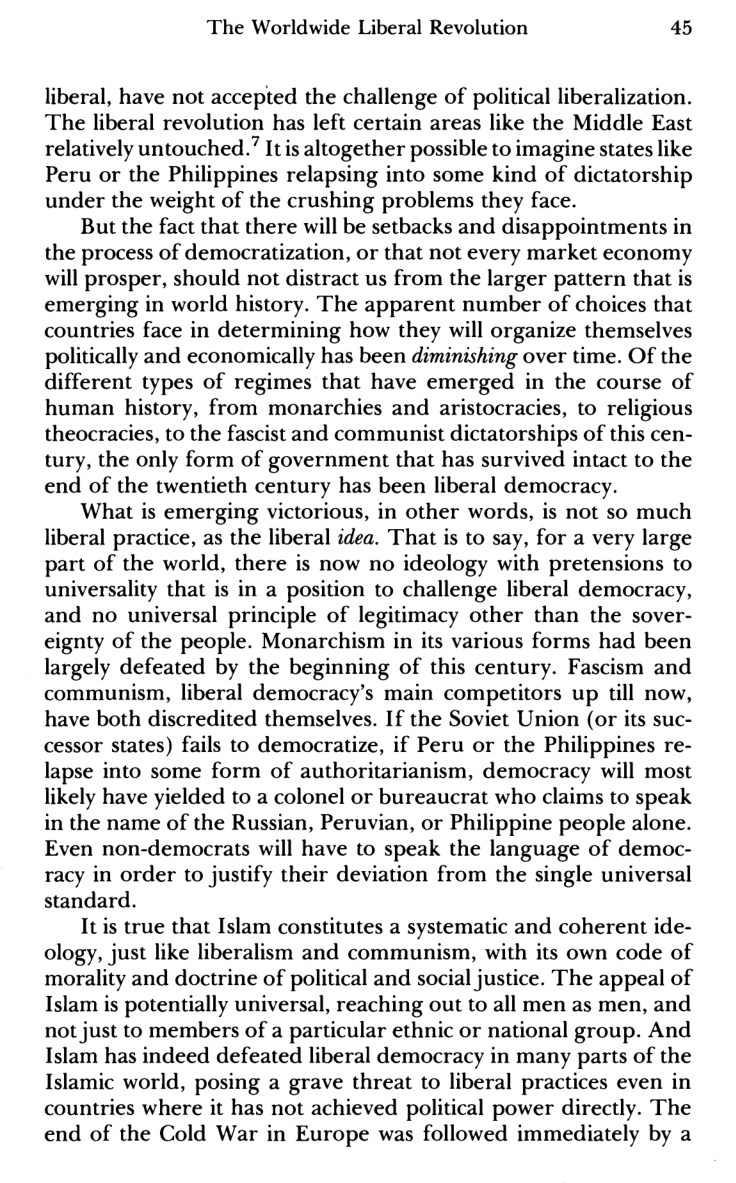
- Liberal democracy has emerged as the only political regime to survive the twentieth century with its legitimacy intact.
- While liberal practice may falter, the liberal idea remains the only universal principle of legitimacy recognized globally.
- Alternative ideologies like fascism and communism have discredited themselves, leaving no universal competitors to the sovereignty of the people.
- Even authoritarian leaders must now adopt the language of democracy to justify their deviations from the global standard.
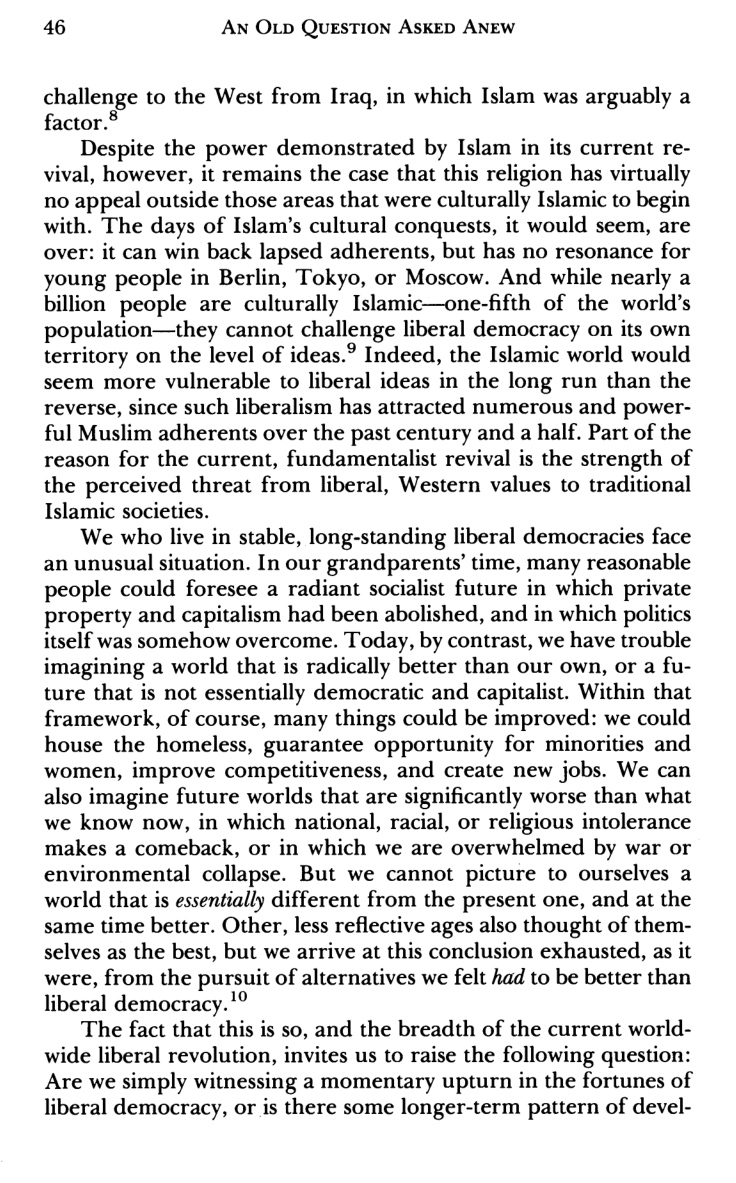
- Islam represents a coherent ideological alternative but lacks universal appeal outside of historically Islamic cultural spheres.
- Modern society struggles to imagine a future that is radically better than or fundamentally different from democratic capitalism.
Even non-democrats will have to speak the language of democracy in order to justify their deviation from the single universal standard.
The Worldwide Liberal Revolution
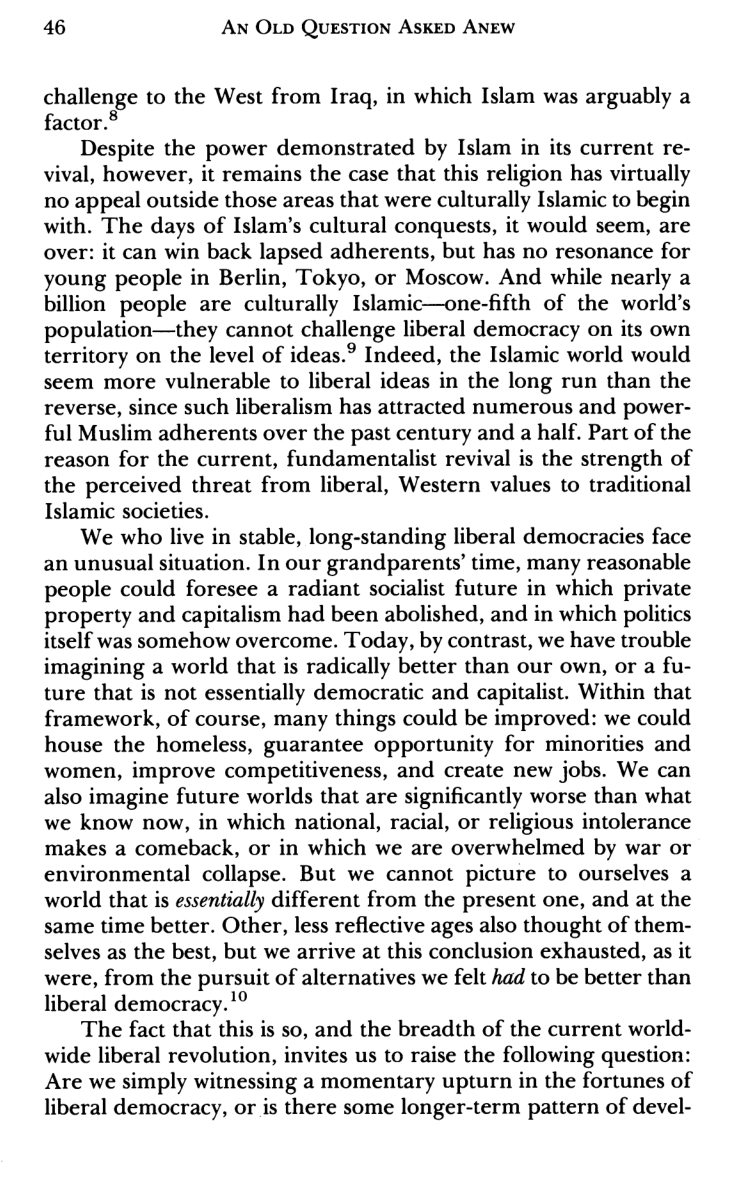
- The current global shift toward liberal democracy raises the question of whether this is a permanent historical development or a temporary cyclical trend.
- Skeptics point to the 1970s as evidence of democratic fragility, citing the Vietnam War, the OPEC crisis, and the rise of authoritarian regimes in Latin America and Africa.
- The transition to democracy often appears accidental, driven by the 'maelstrom of external contingency' and the specific personalities of individual leaders.
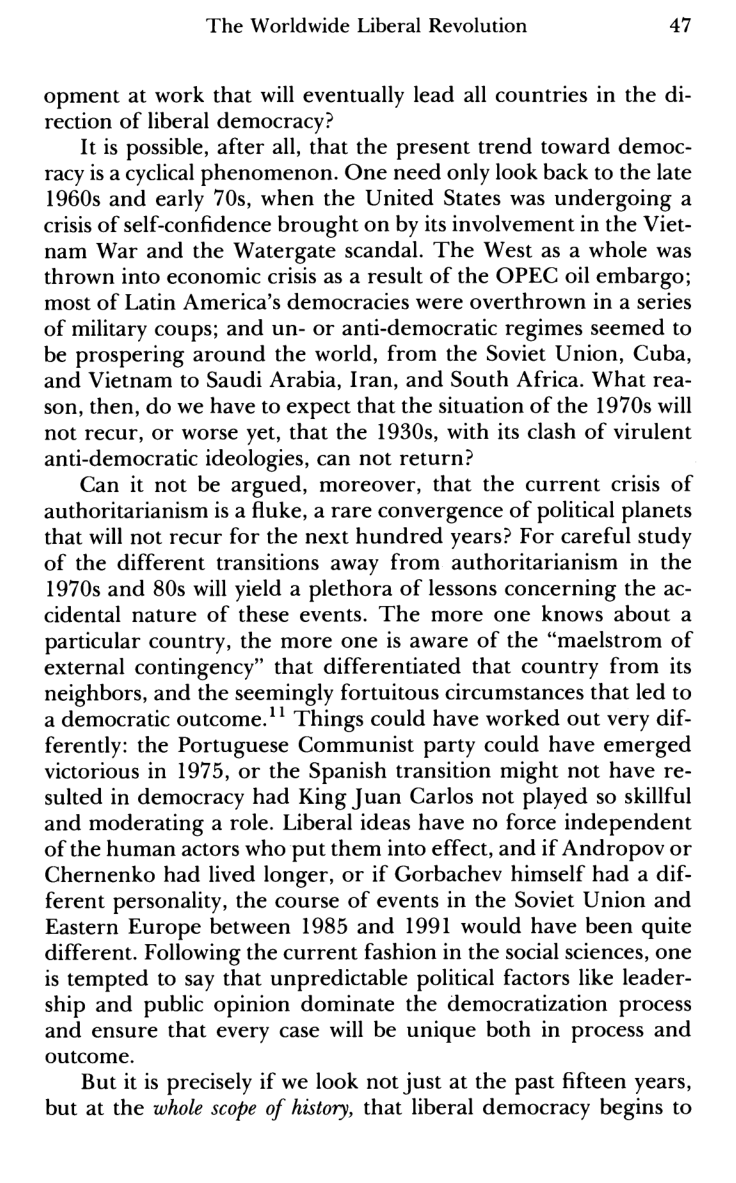
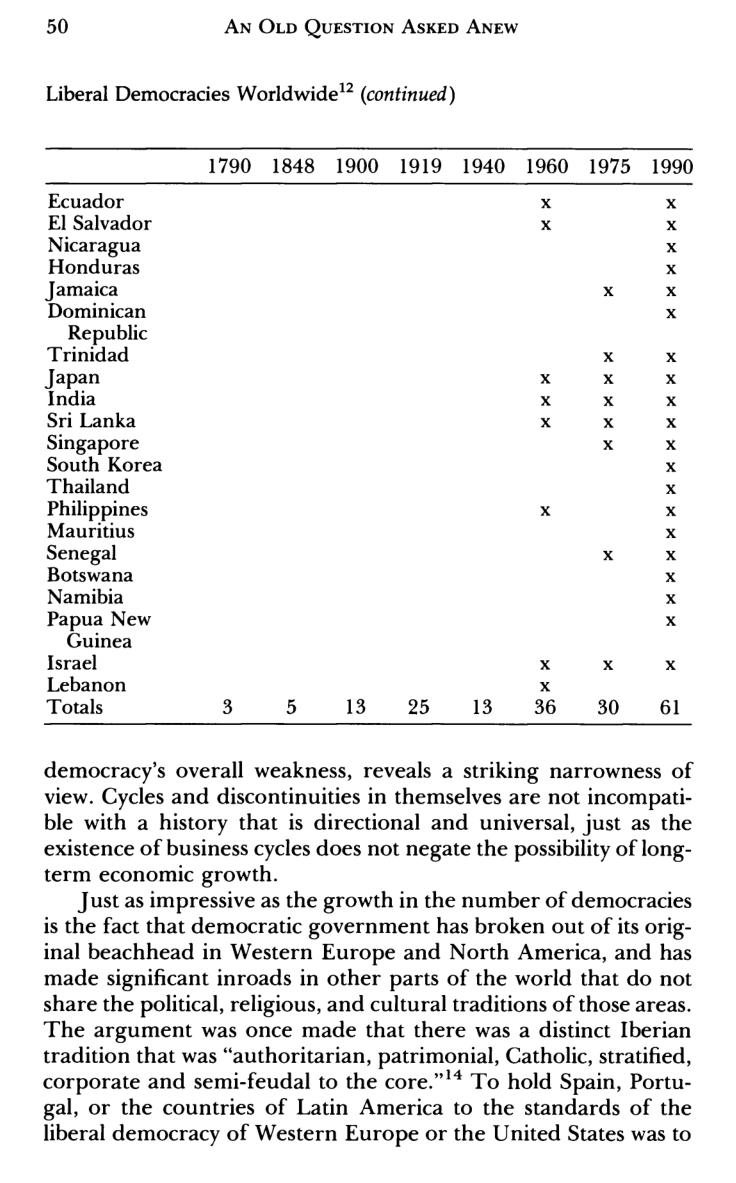
- Despite these setbacks and the role of chance, a long-term 'secular trend' suggests a persistent movement toward democracy over the centuries.
- Historical data shows that while democratic growth is not continuous or unidirectional, major reverses like Nazism and Stalinism have eventually been overcome.
The more one knows about a particular country, the more one is aware of the 'maelstrom of external contingency' that differentiated that country from its neighbors, and the seemingly fortuitous circumstances that led to a democratic outcome.
The Universal Liberal Revolution
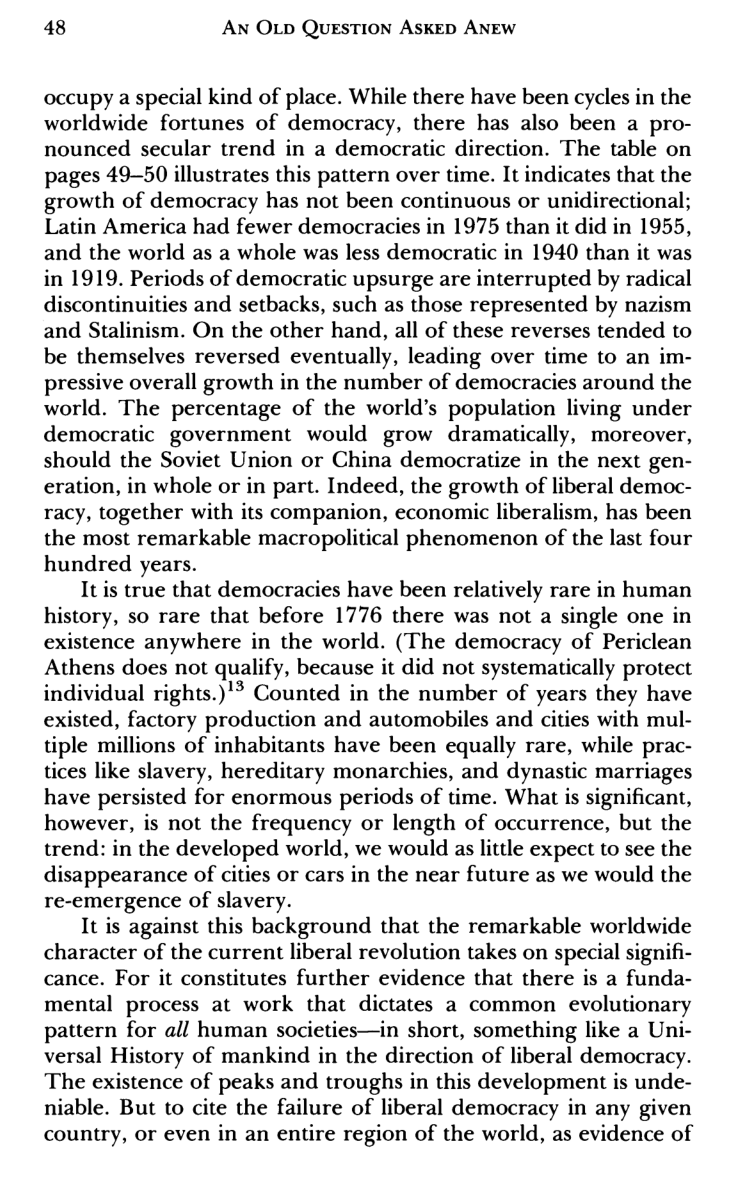
- The expansion of liberal democracy and economic liberalism is identified as the most significant macropolitical trend of the last four centuries.
- While historically rare before 1776, democracy is presented as a modern evolutionary pattern comparable to the permanence of industrialization and urbanization.
- The author argues for a 'Universal History' of mankind, suggesting a fundamental process drives all human societies toward a common democratic destination.
- Short-term failures or regional setbacks in democracy are viewed as cyclical fluctuations rather than evidence against a long-term directional trend.
- The movement has successfully transcended its original Western European and North American roots, challenging the idea that certain cultures are inherently incompatible with liberal values.
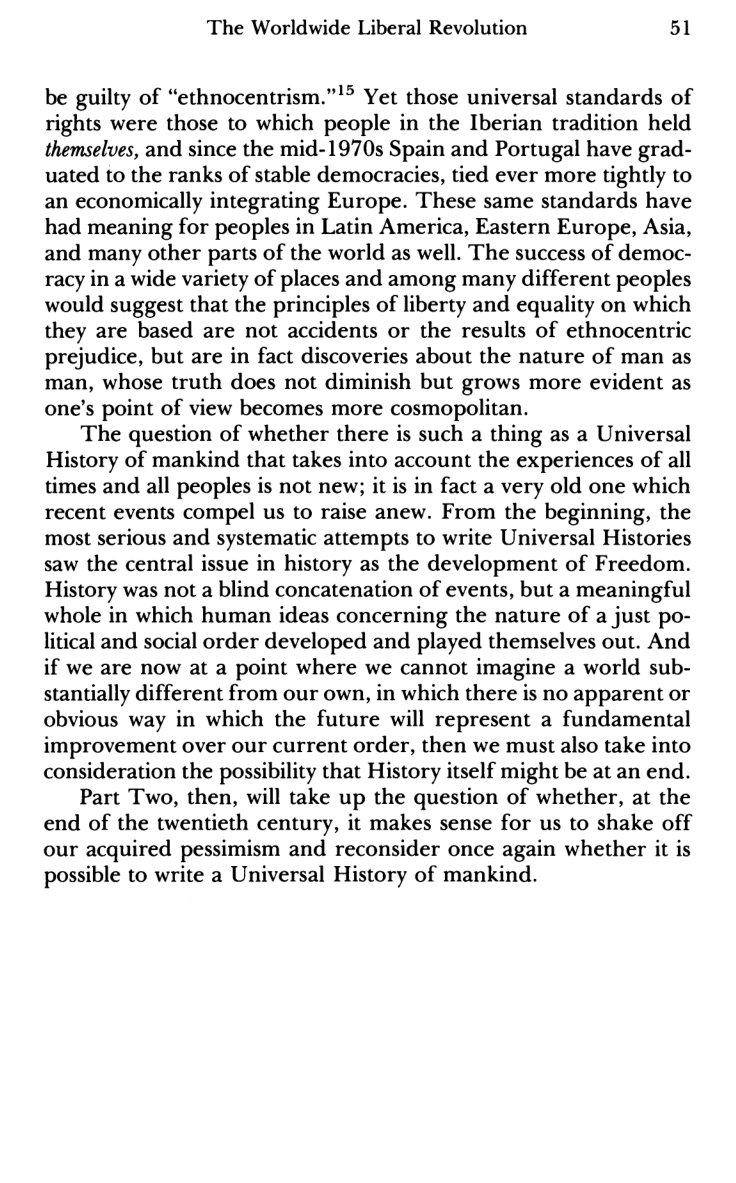
But to cite the failure of liberal democracy in any given country, or even in an entire region of the world, as evidence of democracy's overall weakness, reveals a striking narrowness of view.
The Universal History of Freedom
- The global spread of democracy suggests that liberty and equality are discoveries about human nature rather than ethnocentric prejudices.
- Universal History is defined not as an encyclopedia of facts, but as a search for a meaningful pattern in the development of human societies.
- The author proposes that if we cannot imagine a fundamental improvement over the current order, we may be witnessing the end of History itself.
- Classical thinkers like Plato and Aristotle viewed political history as a cyclical process of regime change rather than a linear progression toward a final goal.
- Aristotle specifically argued that no regime could fully satisfy man, leading to an endless cycle of revolution and replacement.
- The text challenges modern pessimism by suggesting a return to the systematic study of history as the development of human freedom.
He stands proudly on the pyramid of the world-process; and while he lays the final stone of his knowledge, he seems to cry aloud to listening Nature: 'We are at the top, we are at the top; we are the completion of Nature!'
Origins of Universal History
- Ancient Greek thought viewed history as a cyclical process where natural cataclysms periodically erased all human memory and progress.
- Christianity introduced the first truly Universal History by asserting the equality of all men and a shared destiny under a divine plan.
- The Christian model established history as finite and linear, moving toward a specific 'end' or goal that gives meaning to all preceding events.
- The Renaissance and the Scientific Revolution shifted the focus from divine salvation to the secular accumulation of knowledge and mastery of nature.
- Modern progress is defined by the cumulative nature of scientific discovery, allowing each generation to build upon the successes of the past.
- Fontenelle's allegory suggests that human wisdom is like a single mind that never ages, ensuring an endless capacity for growth and development.
The particular events of history can become meaningful only with respect to some larger end or goal, the achievement of which necessarily brings the historical process to a close.
The Origins of Universal History
- Machiavelli initiated the modern concept of progress by suggesting that politics be freed from moral constraints to conquer fortune.
- Enlightenment thinkers like Condorcet envisioned history as a progression toward human perfectibility, equality, and universal education.
- Immanuel Kant proposed that while individual human actions appear chaotic, history reveals a slow, progressive evolution of reason over generations.
- Kant defined the 'end point' of history as the achievement of a perfectly just civic constitution that guarantees human freedom.
- The mechanism for this progress is 'asocial sociability,' where human vanity and competitiveness drive the creation of civil societies and scientific advancement.
- Universal History serves as a framework to distinguish essential evolutionary patterns from the overwhelming mass of raw historical facts.
It was precisely man's competitiveness and vanity, his desire to dominate and rule, which was the wellspring of social creativity, ensuring the realization of potentials 'unborn in an Arcadian shepherd's life.'
The Evolution of Universal History
- Immanuel Kant proposed the need for a 'new Kepler or Newton' to identify the universal laws governing human historical evolution.
- Kant envisioned history as a series of civilizations that, despite being destroyed, preserve a 'germ of enlightenment' for their successors.
- Georg Wilhelm Friedrich Hegel fulfilled Kant's project by developing a comprehensive system that integrated empirical history with philosophical depth.
- Hegel's dialectic suggests that progress occurs through the 'cunning of reason,' where conflict and internal contradictions drive society toward higher levels of development.
- The ultimate goal of this historical process is the realization of human freedom and the growth of collective consciousness.
History proceeds through a continual process of conflict, wherein systems of thought as well as political systems collide and fall apart from their own internal contradictions.
Hegel and the Dialectic of Freedom
- Hegel views human history as a progressive evolution toward universal freedom, culminating in the modern constitutional state and liberal democracy.
- Contrary to accusations of state-worship, Hegel can be seen as a defender of civil society and private economic activity independent of state control.
- The Hegelian dialectic is not a rigid metaphysical formula but a process similar to a Socratic dialogue where internal contradictions drive change.
- History functions as a dialogue between societies where systems with grave internal contradictions fail and are replaced by more rational ones.
- The collapse of the Roman Empire and the medieval city are cited as examples of historical progress driven by the resolution of moral and economic tensions.
One might describe history as a dialogue between societies, in which those with grave internal contradictions fail and are succeeded by others that manage to overcome those contradictions.
Hegel and the Birth of Historicism
- Hegel introduced the concept of historicism, arguing that truth is essentially relative to the social and cultural conditions of a specific era.
- Human history is framed not just by material progress, but as a succession of evolving forms of consciousness and contradictory perspectives.
- Great religions and ideologies are viewed as historical products; for example, Hegel saw Christianity as an ideology born from the needs of slaves seeking liberation.
- Modern 'perspectivism'—such as feminist critiques of past domesticity or racial cultural divides—is rooted in this Hegelian shift toward historical relativity.
- Hegel broke from traditional philosophy by rejecting a fixed 'human nature,' asserting instead that man is undetermined and free to create his own nature.
Hegel, by contrast, did not deny that man had a natural side arising from needs of the body like food or sleep, but believed that in his most essential characteristics man was undetermined and therefore free to create his own nature.
Hegel and the End of History
- Hegel argues that human desire is not fixed but is a product of historical periods and social milieus.
- Modern consumerism represents desires created by man himself rather than innate biological needs.
- Human nature is defined by the process of 'becoming' rather than a static state of being.
- History is viewed as a progression toward rationality and freedom, reaching a logical terminal point in the liberal state.
- The 'end of history' signifies the discovery of the ultimate principles of liberty and equality, leaving no superior alternatives.
- Karl Marx later adopted Hegel's historical framework while challenging his conclusions on the finality of the liberal state.
For it is human nature to have no fixed nature, not to be but to become something other than it once was.
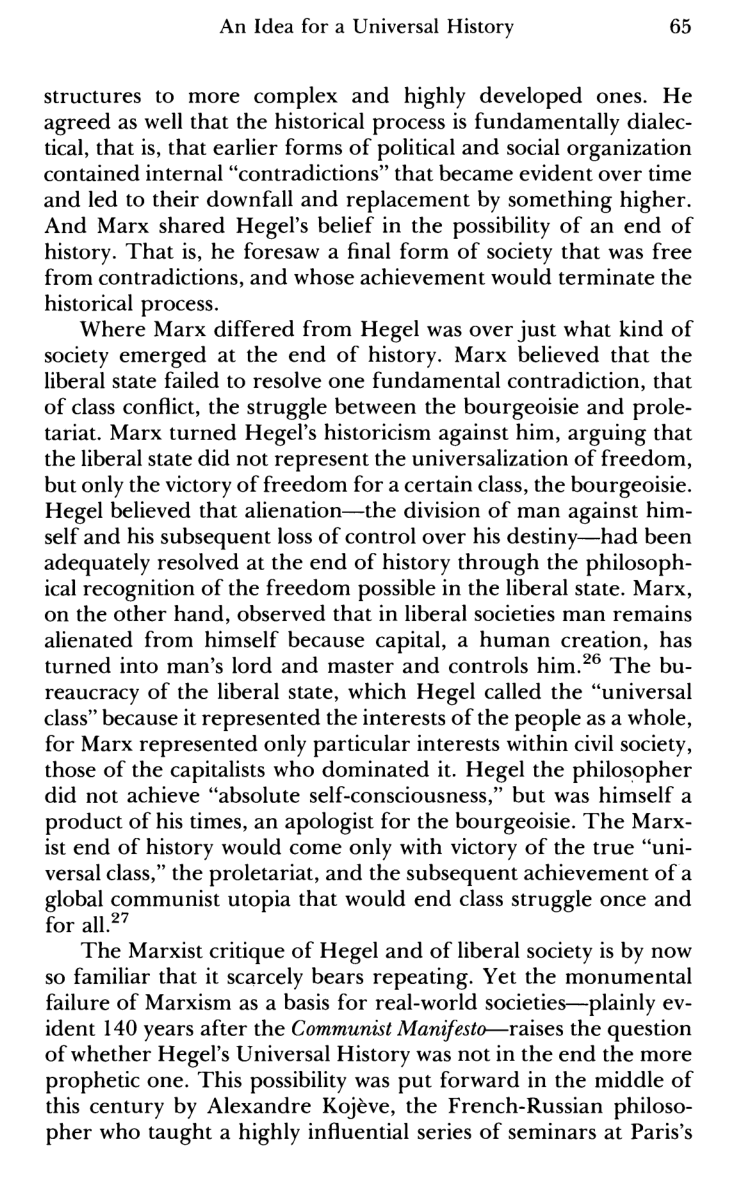
Marx, Hegel, and History's End
- Both Marx and Hegel viewed history as a dialectical process where internal contradictions lead to the collapse of social orders and their replacement by higher forms.
- Marx critiqued Hegel's liberal state, arguing it failed to resolve class conflict and merely represented the interests of the bourgeoisie rather than universal freedom.
- While Hegel believed alienation was resolved through the liberal state, Marx argued that capital remains a master over man, necessitating a proletarian revolution.
- The historical failure of Marxist societies suggests that Hegel's vision of the liberal state may have been more prophetic than Marx's communist utopia.
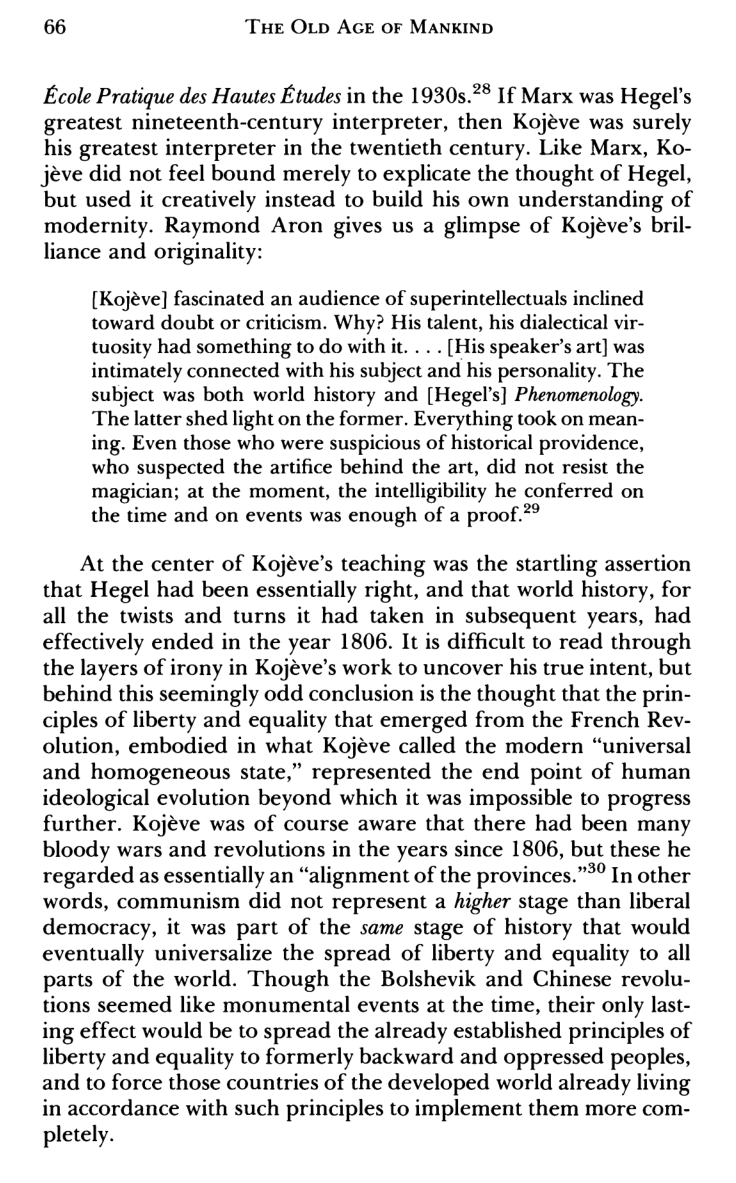
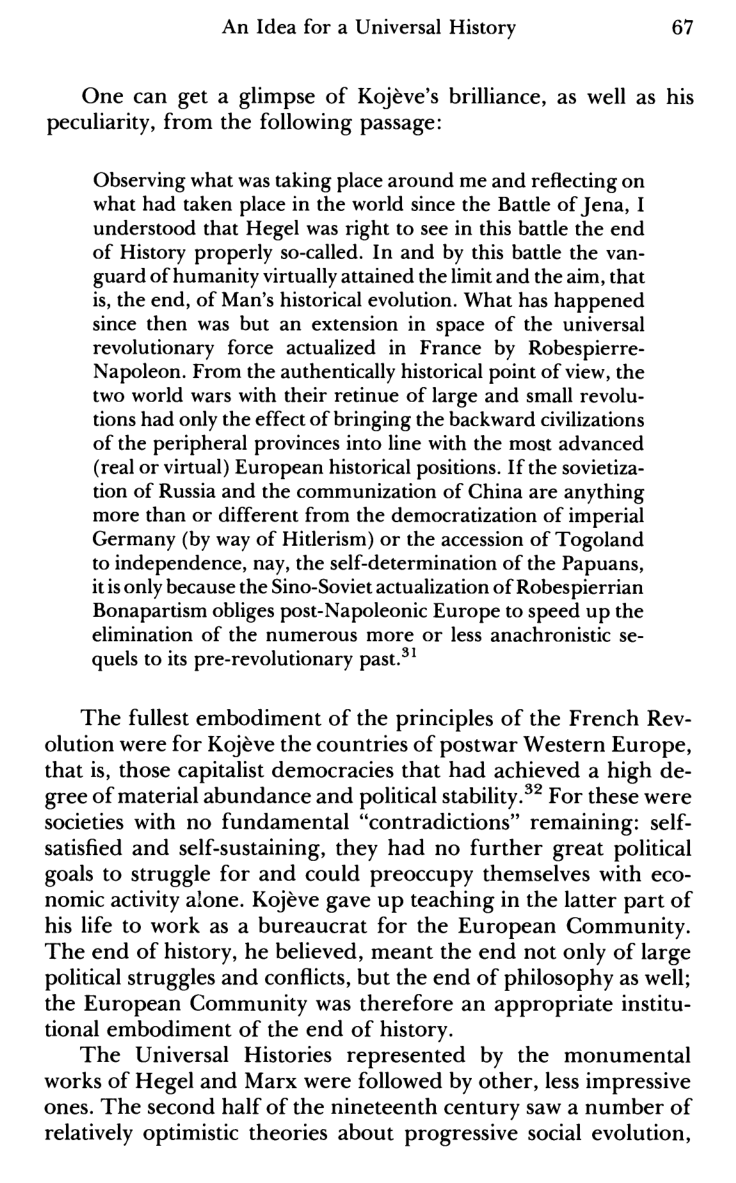
- Alexandre Kojève emerged as a brilliant twentieth-century interpreter of Hegel, famously asserting that world history effectively ended in 1806.
- Kojève used dialectical virtuosity to convince intellectuals that the events of world history had achieved a final intelligibility through Hegelian thought.
At the center of Kojève's teaching was the startling assertion that Hegel had been essentially right, and that world history, for all the twists and turns it had taken in subsequent years, had effectively ended in the year 1806.
The End of History
- Alexandre Kojève argued that the principles of liberty and equality from the French Revolution represent the final stage of human ideological evolution.
- Major 20th-century conflicts, including the Bolshevik and Chinese revolutions, are viewed merely as the 'alignment of the provinces' to these established ideals.
- Communism is interpreted not as a successor to liberal democracy, but as a tool to spread democratic principles to backward or oppressed regions.
- Postwar Western Europe is presented as the ultimate embodiment of this state, where fundamental social contradictions have been resolved.
- The end of history implies the cessation of large-scale political struggle and philosophy, replaced by economic management and bureaucracy.
In and by this battle the vanguard of humanity virtually attained the limit and the aim, that is, the end, of Man's historical evolution.
Cyclical History and Modernization Theory
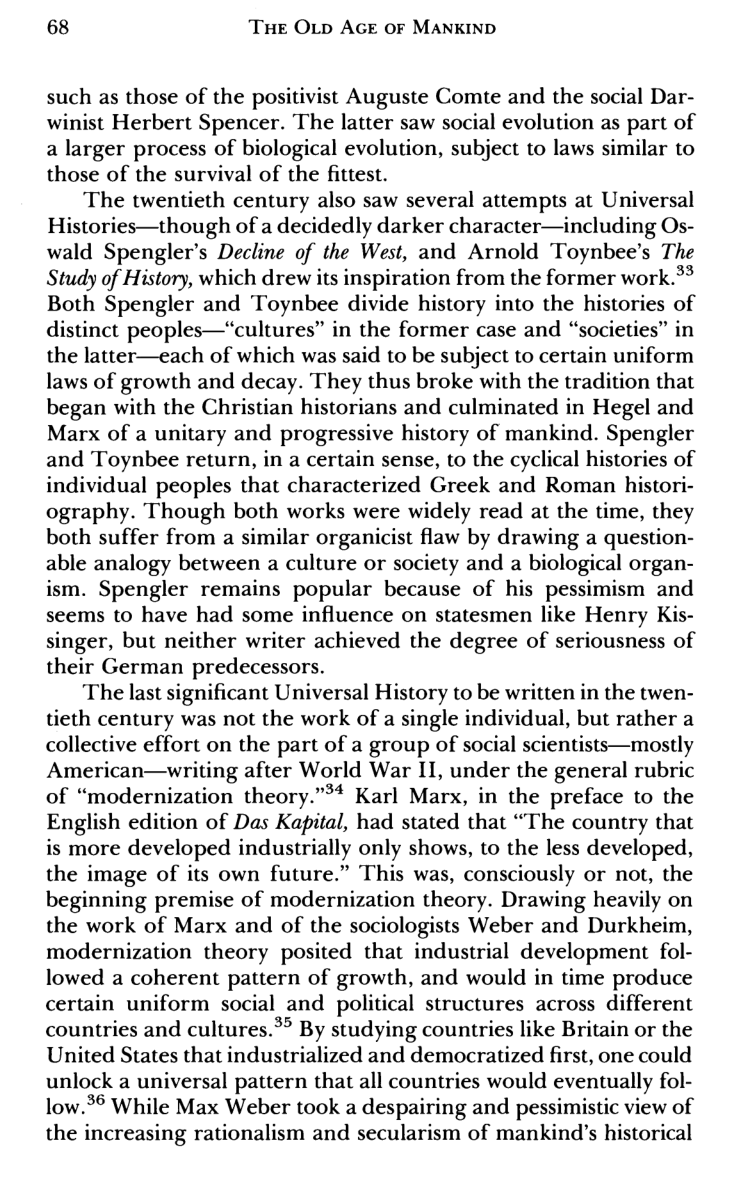
- Spengler and Toynbee challenged the concept of unitary human progress by proposing that distinct cultures follow cyclical patterns of organic growth and decay.
- Modernization theory emerged post-WWII as a collective social science effort to re-establish a directional, universal history based on industrial development.
- Drawing on Marx and Weber, modernization theorists believed that advanced industrial nations provided a 'future image' for less developed countries.
- The theory posited that industrialization would eventually produce uniform social and political structures, specifically liberal democracy, across all cultures.
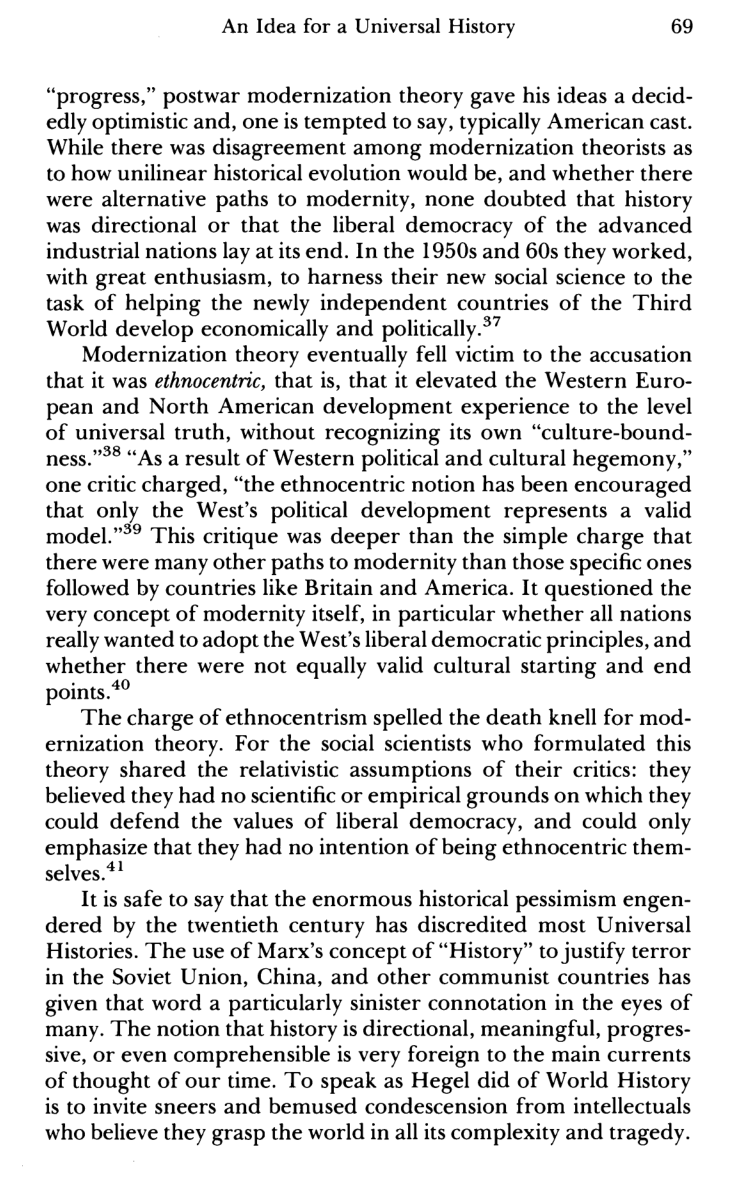
- Critics eventually dismantled modernization theory by accusing it of ethnocentrism and questioning if Western development was a truly universal model.
The country that is more developed industrially only shows, to the less developed, the image of its own future.
The Return of Universal History
- Twentieth-century historical pessimism has largely discredited the idea of history as a directional or progressive process.
- The misuse of Marxist historical theory to justify state terror has made the concept of 'History' appear sinister to modern intellectuals.
- Contemporary thinkers often prefer a pose of pessimism because it appears more profound and serious than a naive optimism that might be proven wrong.
- The unexpected global rise of democratic forces and the instability of authoritarianism suggest that a directional history may actually exist.
- A directional history requires a 'Mechanism' or set of first causes that prevents the repetition of superseded social forms.
- Without a process of total historical forgetting, societies cannot truly return to past cycles like slavery or absolute monarchy.
For a naive optimist whose expectations are belied appears foolish, while a pessimist proven wrong maintains an aura of profundity and seriousness.
Science as History's Engine
- Modern natural science is identified as the primary mechanism providing history with a clear, non-cyclical directionality.
- Unlike art, music, or literature, which achieve perfections that cannot be surpassed, science is unequivocally cumulative and builds upon itself over time.
- The discovery of the scientific method created a permanent historical divide, separating all subsequent time from the era of ignorance.
- Scientific laws remain immune to human caprice, as neither dictators nor parliaments can repeal the fundamental laws of nature.
- Military competition forces the global adoption of science, as technology provides a decisive advantage that ensures the survival of advanced societies.
Zulu spears were no match for British rifles, no matter how brave individual warriors were: mastery of science was the reason why Europe could conquer most of what is now the Third World.
War as Modernization's Engine
- The threat of war acts as a powerful rationalizing force that compels states to adopt uniform social and technological structures.
- To maintain autonomy, states must centralize authority, implement national taxation, and break down traditional kinship or religious ties.
- Military competition necessitates mass mobilization, which often leads to increased education and the eventual enfranchisement of lower classes.
- Historical 'defensive modernizations' in France and Spain were driven by the constant economic and organizational demands of seventeenth-century warfare.
- The Ottoman Empire and Meiji Japan underwent radical social restructuring, such as abolishing elite warrior castes, specifically to counter Western military superiority.
- War provides an unambiguous test of a society's success in modernization that economic motives alone may not provide.
Any state that hopes to maintain its political autonomy is forced to adopt the technology of its enemies and rivals.
War as a Modernizing Force
- The Meiji Restoration in Japan was driven by an urgent need to adopt Western technology to avoid the colonial fate of China.
- Prussian reforms, including universal conscription and the Napoleonic Code, were direct responses to military defeat by Napoleon.
- Russian modernization over 350 years, from Peter the Great to Alexander II, has been primarily motivated by military setbacks and territorial ambitions.
- Gorbachev’s perestroika was initially a 'defensive modernization' triggered by the fear that the Soviet Union could not compete with Reagan’s Strategic Defense Initiative.
- Military competition acts as a 'great unifier' that forces states to adopt modern technological rationalism and social structures to preserve their autonomy.
- Kant’s concept of 'asocial sociability' suggests that human conflict, rather than cooperation, is the primary engine for developing societal potential.
The persistence of war and military competition among nations is thus, paradoxically, a great unifier of nations.
The Mechanism of Economic Rationalization
- Natural science drives historical change through the conquest of nature to satisfy human desires, a process known as economic development.
- Industrialization requires the application of human reason to social organization, resulting in a rational division of labor and increased productivity.
- Technological advancements in transportation and communication expand market sizes, enabling economies of scale and further specialization.
- Economic growth necessitates urbanization and labor mobility, which systematically undermines traditional social structures like tribes and clans.
- Traditional social groups are replaced by modern bureaucratic organizations that prioritize economic efficiency and merit-based recruitment over personal ties.
The latter may in certain respects be more humanly satisfying to live in, but since they are not organized according to the rational principles of economic efficiency, they tend to lose out to those that are.
The Rationalization of Labor
- Modern bureaucracies institutionalize the rational organization of labor by dividing complex tasks into hierarchical, routine structures.
- The shift from self-employment to bureaucratic employment represents an 'unplanned revolution' common to all industrialized nations.
- While industrial development does not require infinite bureaucratic size, even small units must adhere to rational principles of efficiency.
- The rational organization of labor is as essential to economic productivity as technological innovation itself.
- Attempts by communist regimes to abolish the division of labor have historically resulted in extreme tyranny and human suffering.
Attempts by communist regimes to abolish the division of labor and to end the slavery of specialization have only led to a tyranny more monstrous than that of the Manchester workshops condemned by Marx.
The Homogenizing Power of Rationalization
- Economic development and the division of labor act as a homogenizing force that replaces traditional social hierarchies with rational market relationships.
- Traditional patron-client relationships, such as those in Franco's Spain or the Mafia, are eroded when peasants move to cities and landowners become market-oriented producers.
- Modern natural science serves as a cumulative mechanism that gives history a clear, directional trajectory through technological and social evolution.
- The shift from tribes and clans to modern political parties and labor unions is a direct consequence of the organizational requirements of industrialization.
- While science regulates the direction of history, it is driven by deeper human desires for security and the limitless acquisition of material goods.
A modern-day, would-be Franco would lack the social basis on which to recruit any army.
The Directionality of Science
- Modern natural science creates a directional history by driving economic growth and complex social organization.
- The relationship between science and human happiness remains ambiguous, despite science's ability to raise productivity.
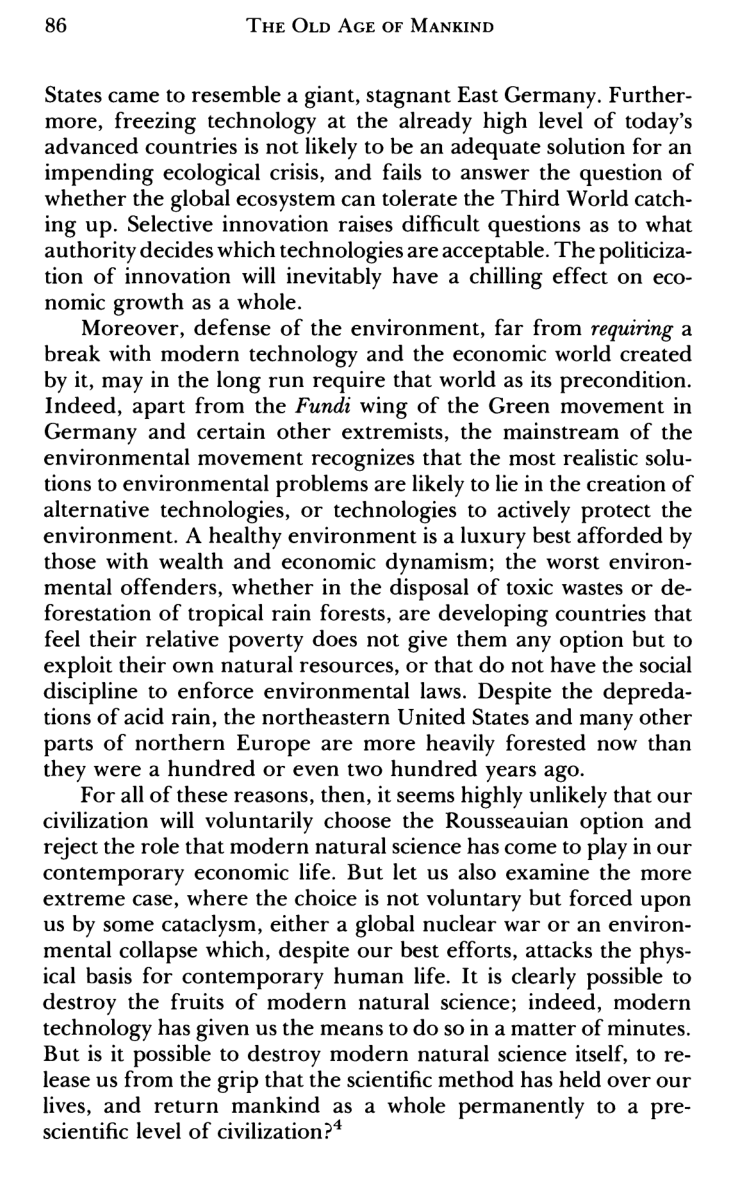
- The scientific method is so foundational that its loss would require the total destruction of the method itself, not just its products.
- Science fiction often depicts a 'mixed' barbarism, but rational social structures would likely reappear as long as the scientific method survives.
- The possibility of reversing historical directionality depends on whether science can be deliberately rejected or involuntarily lost.
- Opposition to technological civilization persists through movements ranging from Romanticism to modern religious fundamentalism.
Science has been lost; latter-day Visigoths and Vandals ride around in the outback on Harley-Davidsons and dune buggies, trying to steal gasoline and bullets from one another because the production technology has been lost.
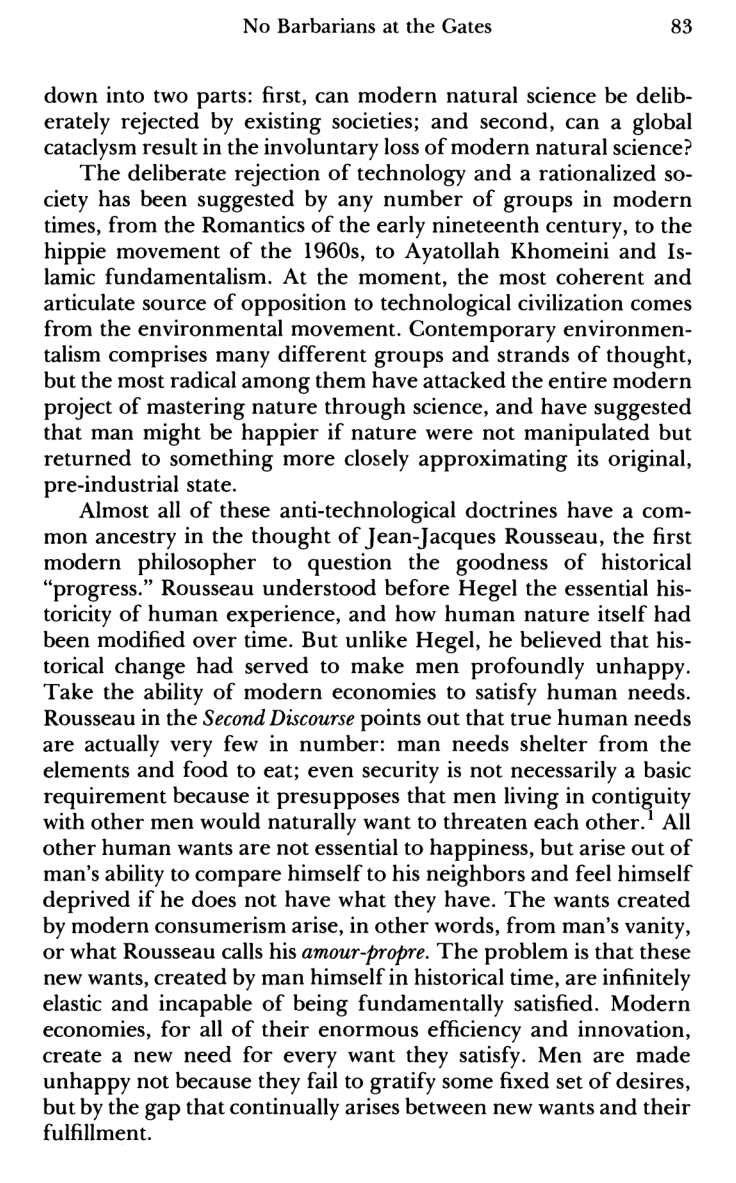
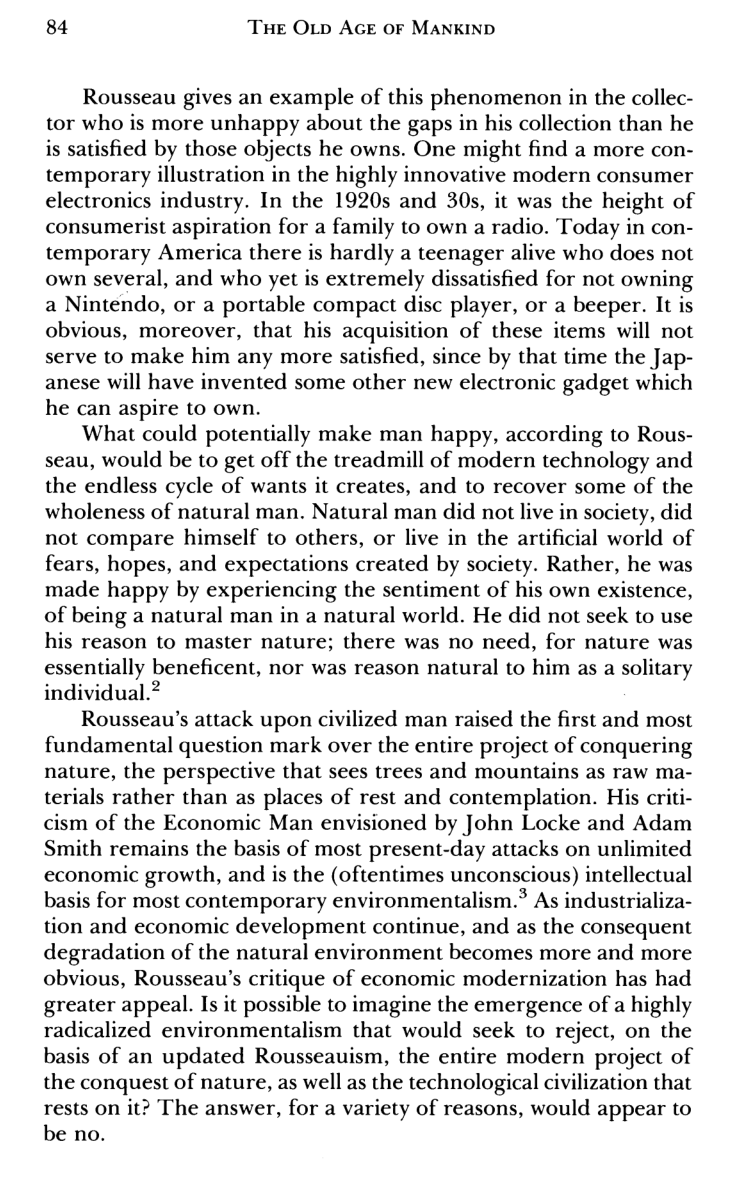
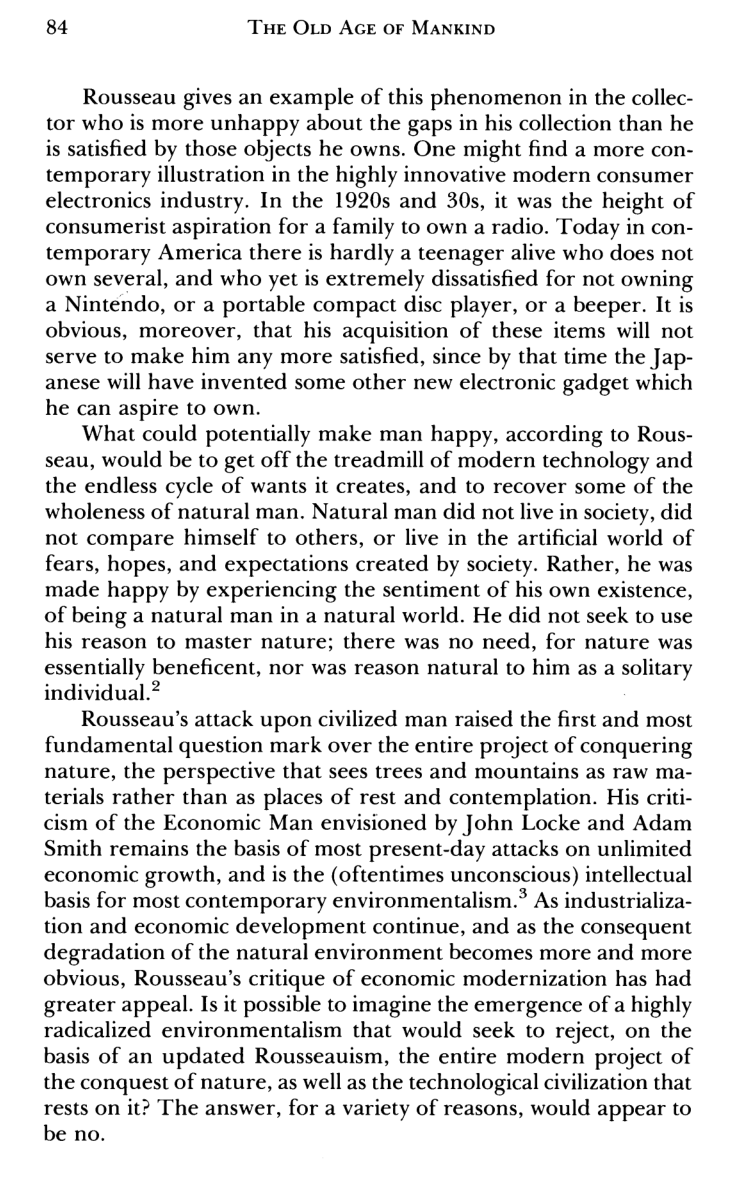
Rousseau and the Technological Treadmill
- Radical environmentalism challenges the modern project of mastering nature, advocating for a return to a pre-industrial state.
- Jean-Jacques Rousseau is identified as the philosophical ancestor of anti-technological thought, arguing that historical progress has decreased human happiness.
- Rousseau posits that true human needs are minimal, while modern consumerism is driven by 'amour-propre' or vanity and social comparison.
- Modern economies create an 'infinitely elastic' cycle of desire where every satisfied want generates a new, unfulfilled need.
- Happiness, for Rousseau, lies in escaping the artificial expectations of society to recover the 'sentiment of existence' as a natural being.
- Rousseau's critique remains the foundational intellectual basis for contemporary opposition to unlimited economic growth.
Modern economies, for all of their enormous efficiency and innovation, create a new need for every want they satisfy.
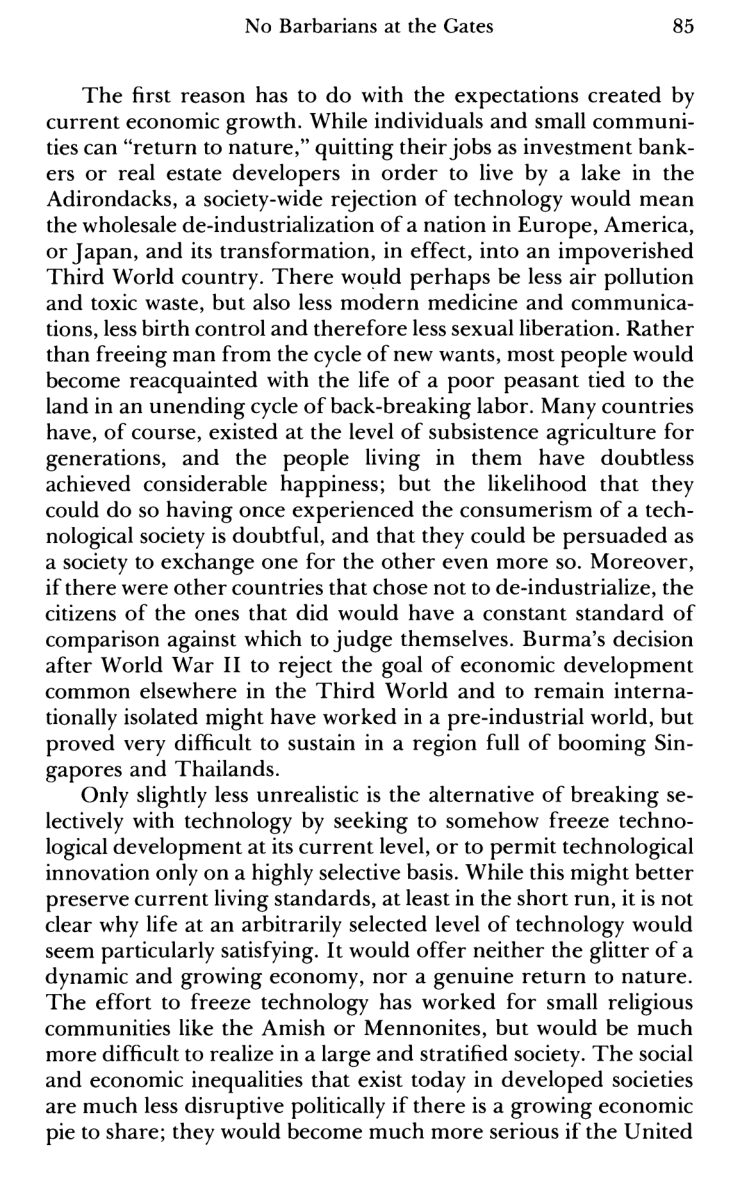
The Limits of Environmental Radicalism
- Rousseau's critique of modernization forms the basis for radical environmentalism, yet a total rejection of technology remains unlikely.
- A society-wide return to nature would necessitate de-industrialization, leading to impoverished conditions and the loss of modern medicine and sexual liberation.
- The psychological transition from a consumerist society to subsistence agriculture is nearly impossible once modern standards have been experienced.
- International competition and the 'standard of comparison' from neighboring industrial nations make isolationist, non-technological paths unsustainable.
- Selective technological freezing is politically unstable because it removes the 'growing economic pie' that mitigates social and economic inequality.
- Freezing technology at current levels fails to address the ecological impact of the developing world catching up to Western standards.
Rather than freeing man from the cycle of new wants, most people would become reacquainted with the life of a poor peasant tied to the land in an unending cycle of back-breaking labor.
The Persistence of Science
- Mainstream environmentalism increasingly views advanced technology and economic wealth as the primary tools for ecological protection rather than its enemies.
- Developing nations often become the worst environmental offenders because poverty forces them to exploit resources without the luxury of social discipline or regulation.
- It is highly improbable that modern civilization will voluntarily choose a 'Rousseauian' rejection of science and return to a pre-industrial economic state.
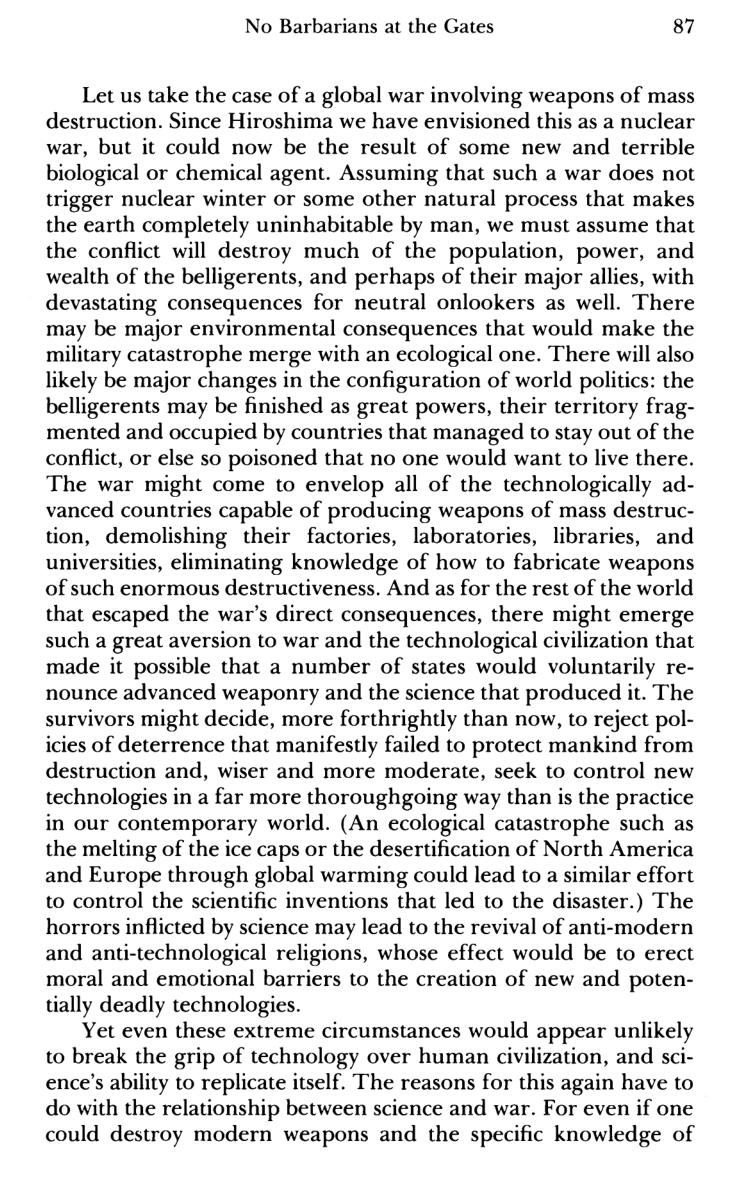
- Even a global cataclysm, such as nuclear or biological war, might destroy the fruits of science without necessarily eradicating the scientific method itself.
- A post-apocalyptic world might see a profound moral aversion to technology, leading survivors to attempt a more thorough and moderate control over scientific advancement.
A healthy environment is a luxury best afforded by those with wealth and economic dynamism; the worst environmental offenders, whether in the disposal of toxic wastes or deforestation of tropical rain forests, are developing countries.
The Irreversibility of Science
- Global disasters or ecological catastrophes may trigger anti-technological religious movements seeking to ban deadly inventions.
- The scientific method is now a universal human memory that cannot be 'un-invented' without the total physical annihilation of the species.
- Military competition forces even 'good' states to adopt advanced technology to survive against ambitious 'bad' states.
- Modern natural science creates a directional history that is fundamentally irreversible due to its economic and social consequences.
- A truly cyclical history is no longer possible because modern science leaves an indelible imprint that prior civilizations lacked.
And, as Machiavelli taught at the beginning of the modern era, the good states will have to take their cue from the bad ones if they are to survive and remain states at all.
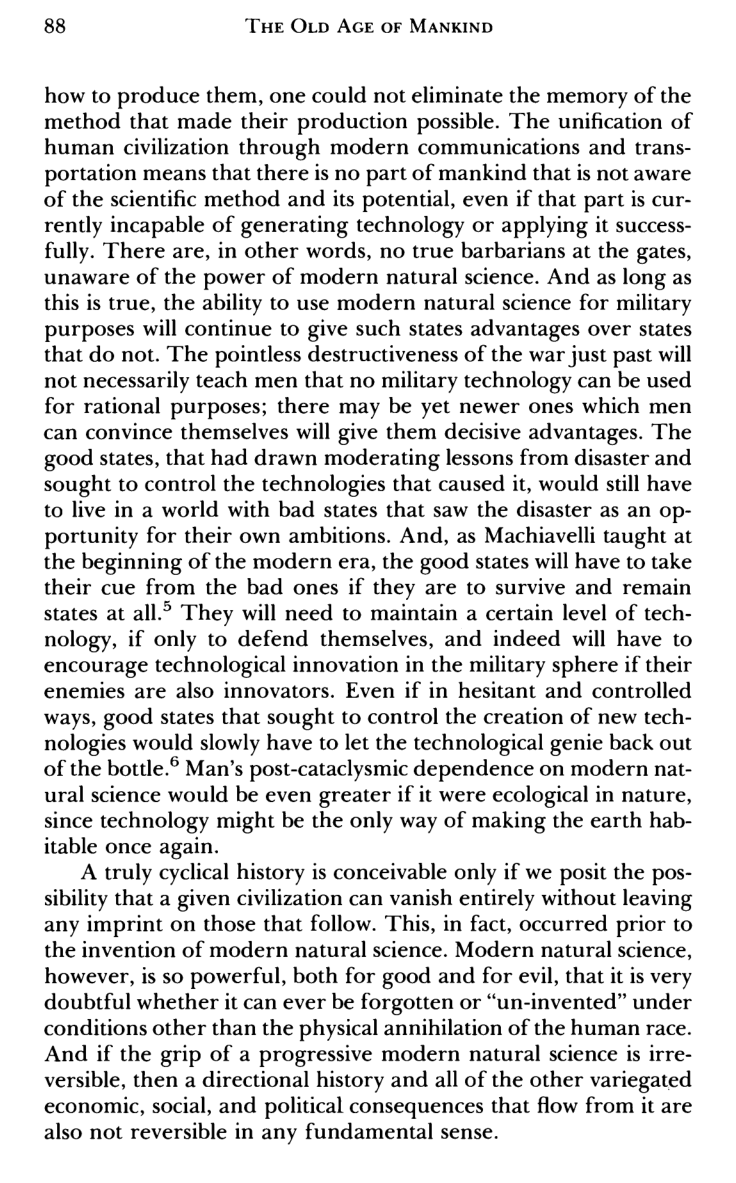
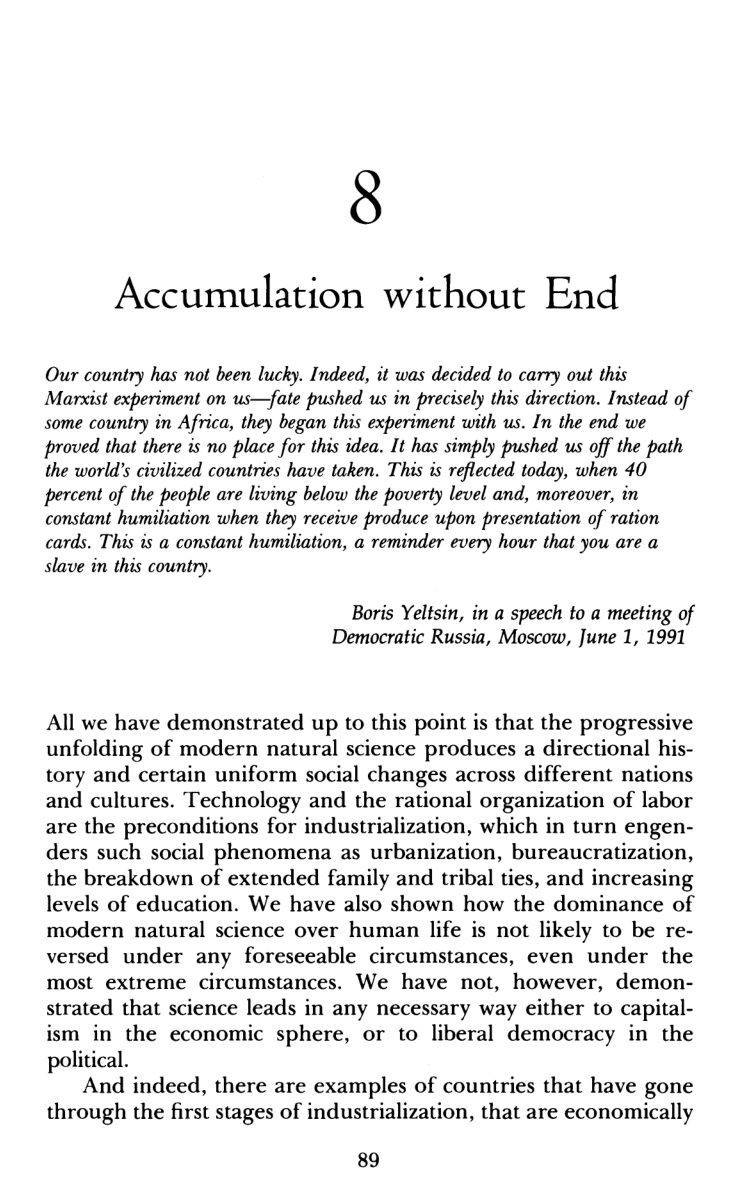
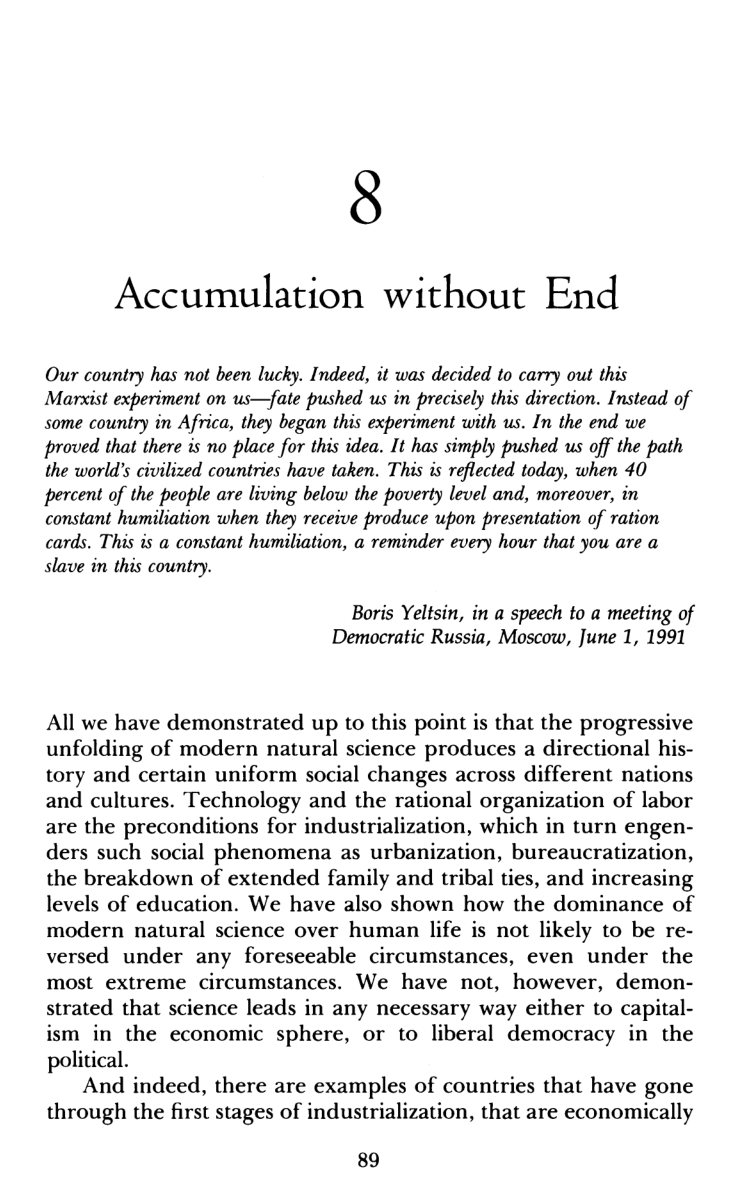
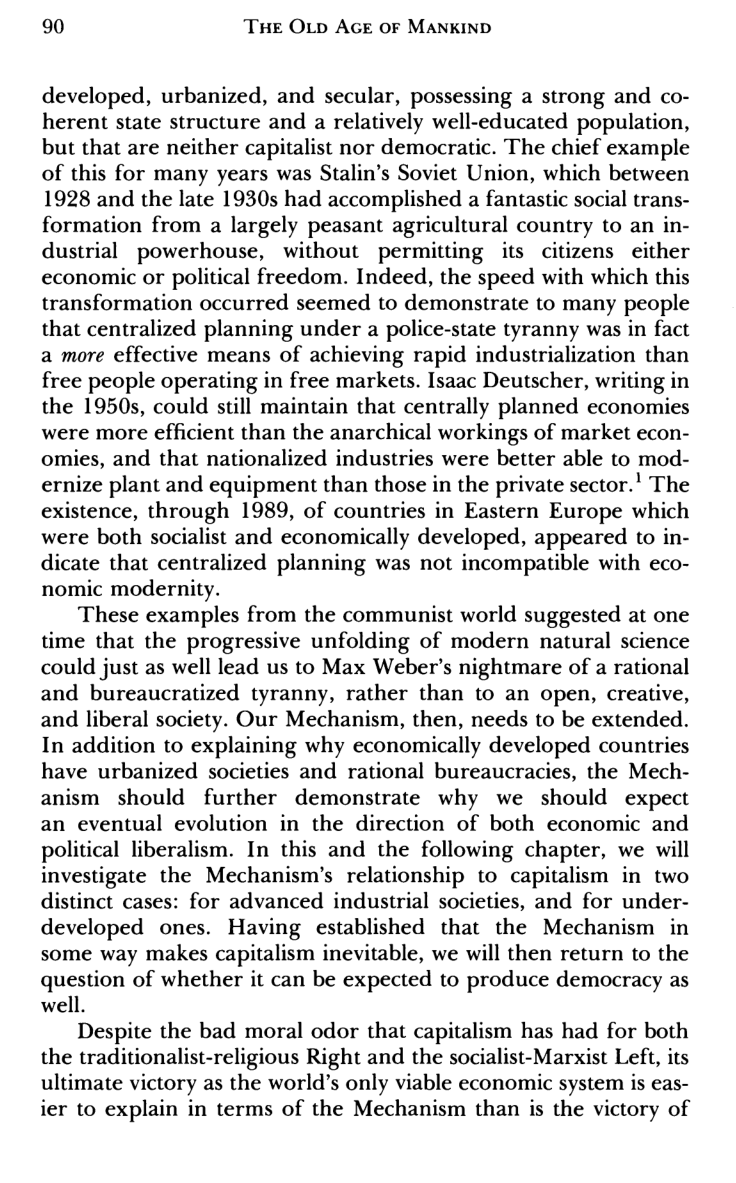
The Limits of Industrialization
- Modern natural science drives a directional history through technology and the rational organization of labor.
- Industrialization consistently produces social changes like urbanization, bureaucratization, and the breakdown of traditional family ties.
- The Soviet Union demonstrated that a country can achieve rapid industrial modernization without adopting capitalism or democracy.
- Centralized planning was once viewed as a potentially more efficient engine for modernization than free-market anarchy.
- The 'Mechanism' of scientific progress must be further analyzed to explain why it eventually favors economic and political liberalism over rationalized tyranny.
- Capitalism's global victory is more easily explained by its superior efficiency in utilizing technology compared to centrally planned systems.
These examples from the communist world suggested at one time that the progressive unfolding of modern natural science could just as well lead us to Max Weber's nightmare of a rational and bureaucratized tyranny.
The Evolution of Industrialization
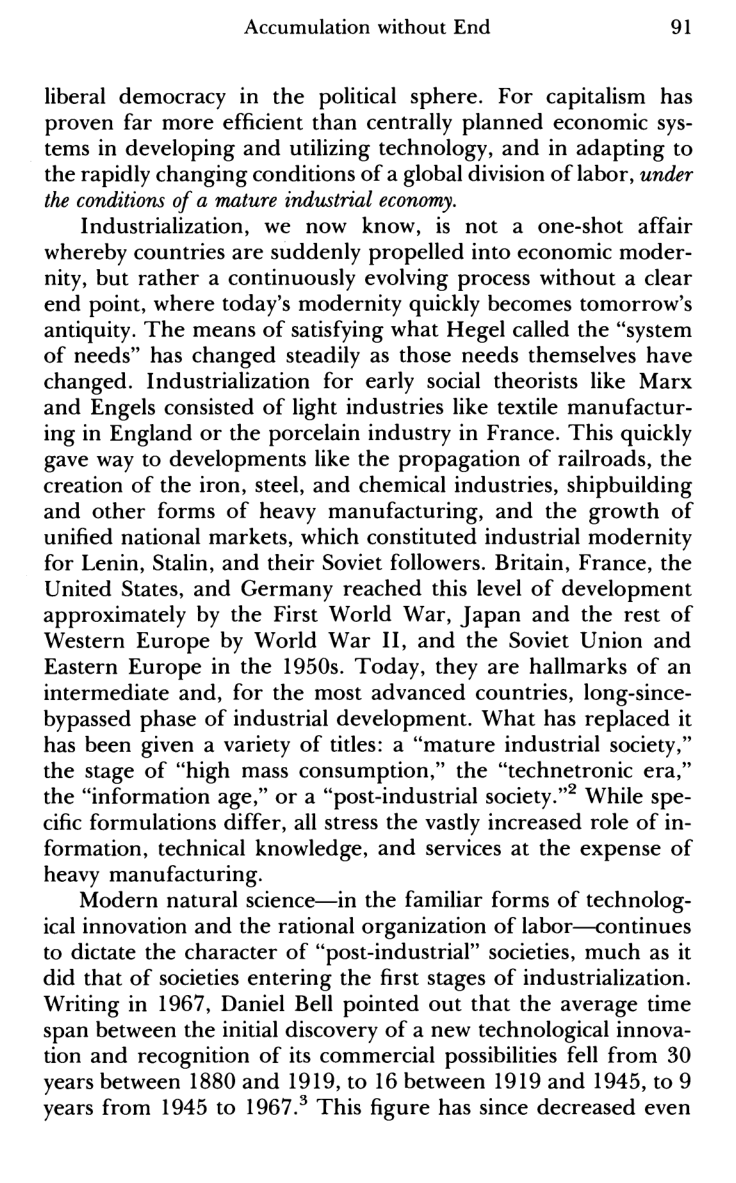
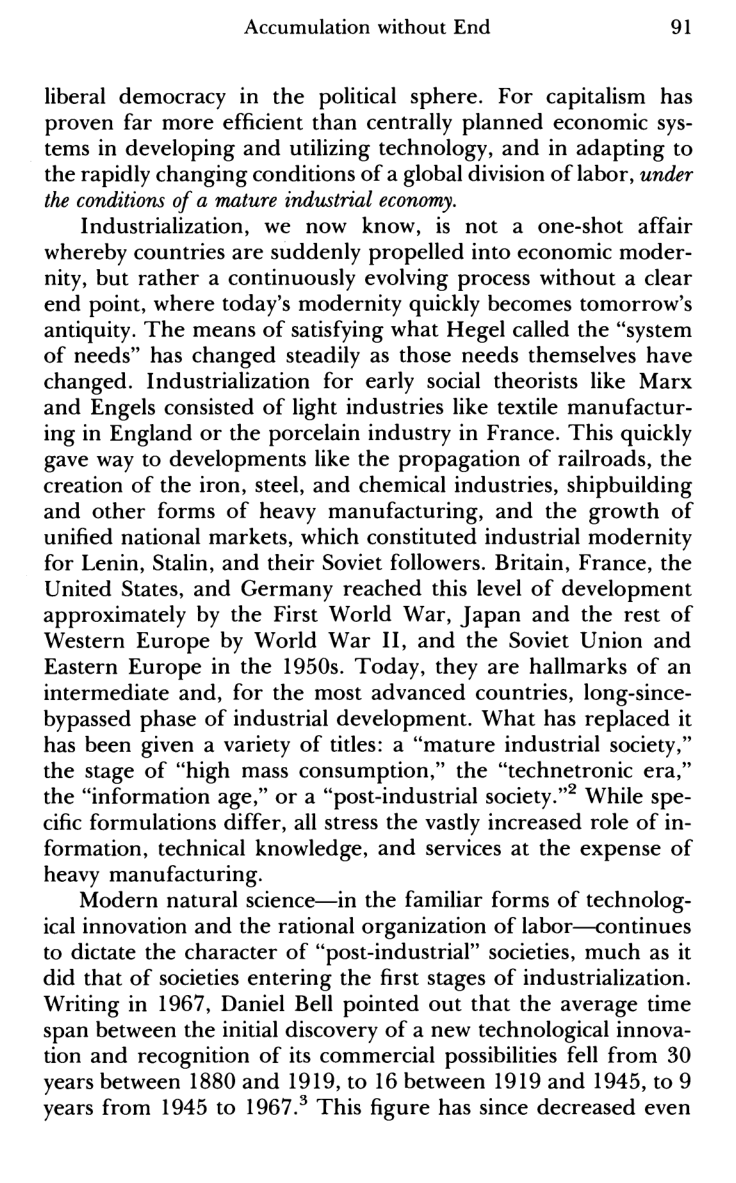
- Industrialization is a continuous, evolving process rather than a single event, where modern standards rapidly become obsolete.
- The focus of advanced economies has shifted from heavy manufacturing like steel and shipbuilding to information, technical knowledge, and services.
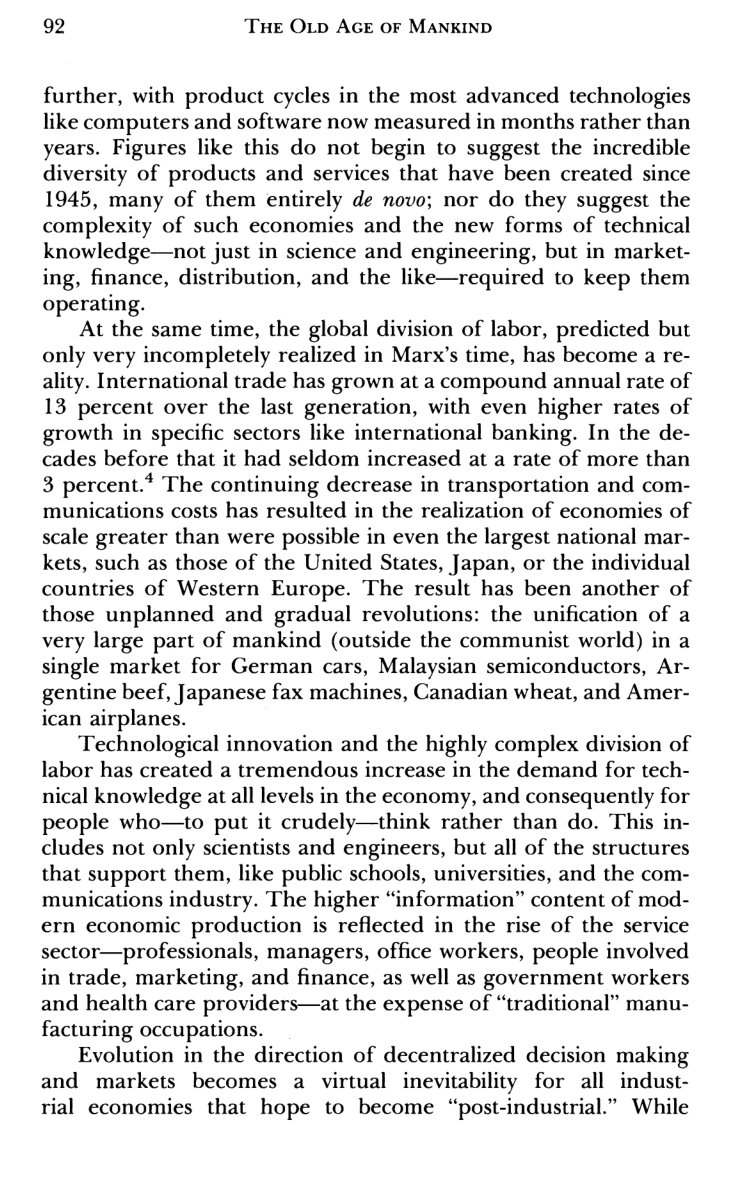
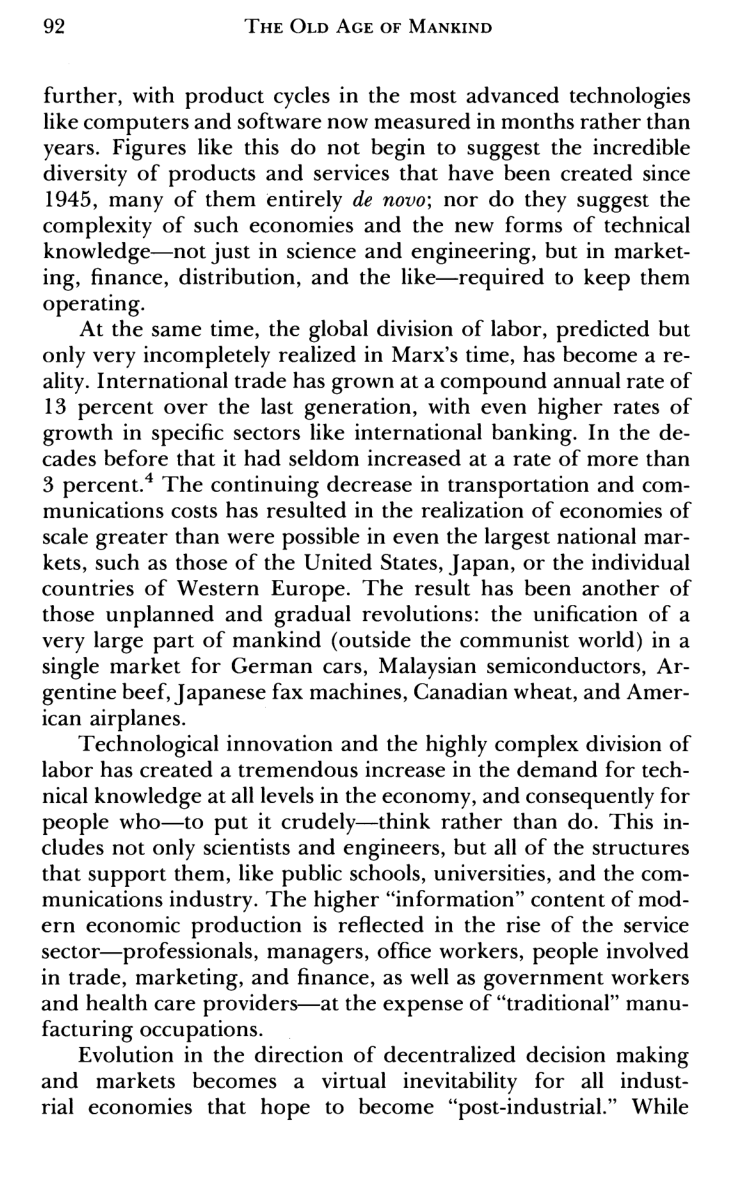
- The time span between technological discovery and commercial application has collapsed from decades to months in high-tech sectors.
- A global division of labor has emerged, creating a unified international market that transcends national boundaries.
- Modern natural science and the rational organization of labor remain the primary drivers of post-industrial societal structures.
Industrialization, we now know, is not a one-shot affair whereby countries are suddenly propelled into economic modernity, but rather a continuously evolving process without a clear end point, where today's modernity quickly becomes tomorrow's antiquity.
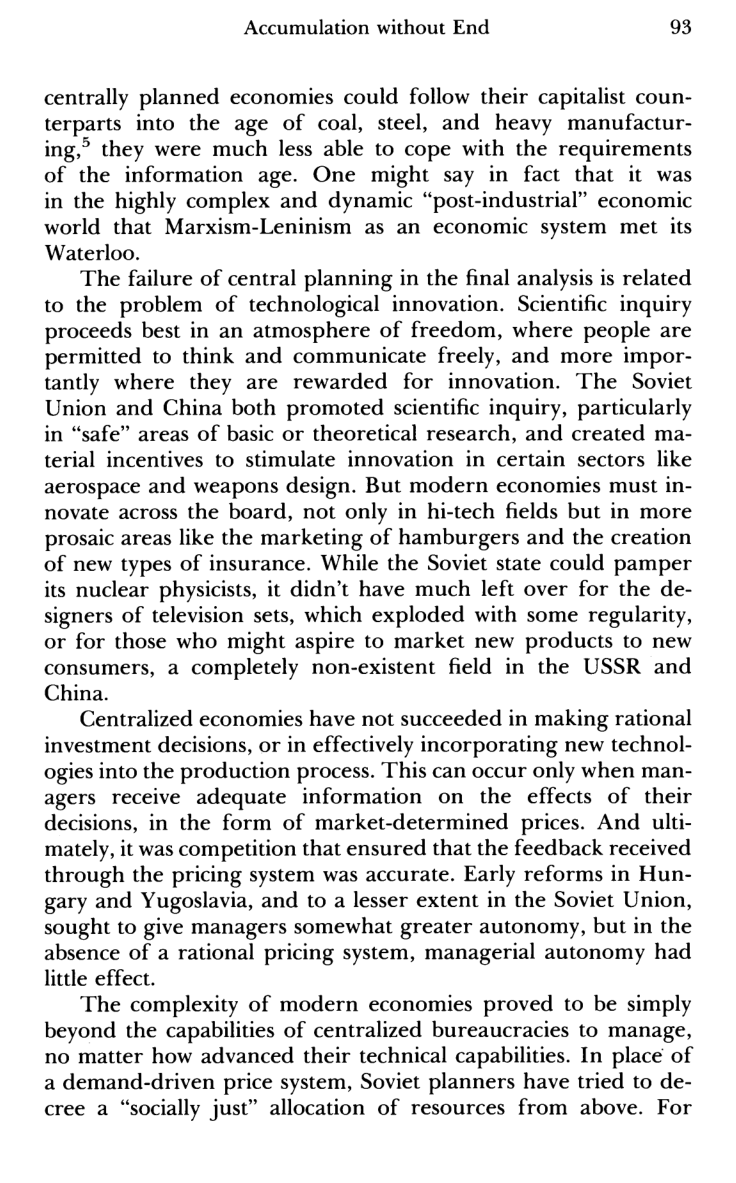
The Information Age Waterloo
- Modern economic production has shifted toward a higher 'information' content, prioritizing thinkers and service-sector professionals over traditional manufacturing labor.
- Decentralized decision-making and market systems are essential for economies transitioning from heavy industry to a post-industrial state.
- Marxism-Leninism failed as an economic system because central planning could not manage the complex requirements of the information age.
- While command economies could incentivize specific sectors like aerospace, they failed to foster the broad-based innovation required for consumer goods and services.
- The absence of market-determined prices deprived managers of the feedback necessary to make rational investment or production decisions.
- The sheer complexity of modern resource allocation proved impossible for bureaucracies to manage, regardless of their computing power or technical expertise.
One might say in fact that it was in the highly complex and dynamic 'post-industrial' economic world that Marxism-Leninism as an economic system met its Waterloo.
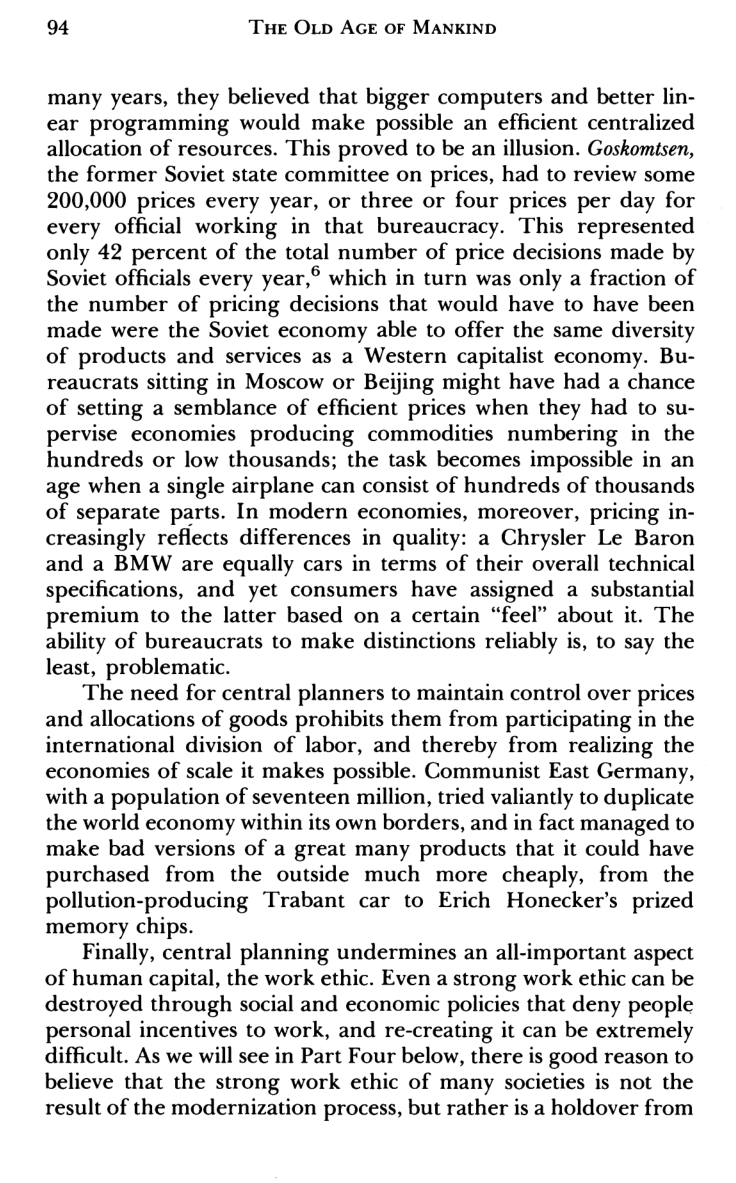
The Limits of Central Planning
- Modern economic complexity, involving products with hundreds of thousands of parts, makes centralized price-setting impossible compared to simpler industrial eras.
- Bureaucratic systems fail to account for subjective consumer preferences and quality distinctions that drive value in advanced economies.
- Autarkic policies force small nations like East Germany to inefficiently duplicate the global economy, resulting in inferior and costly domestic products.
- Central planning erodes the work ethic by removing personal incentives, a loss that is difficult to reverse even after systems change.
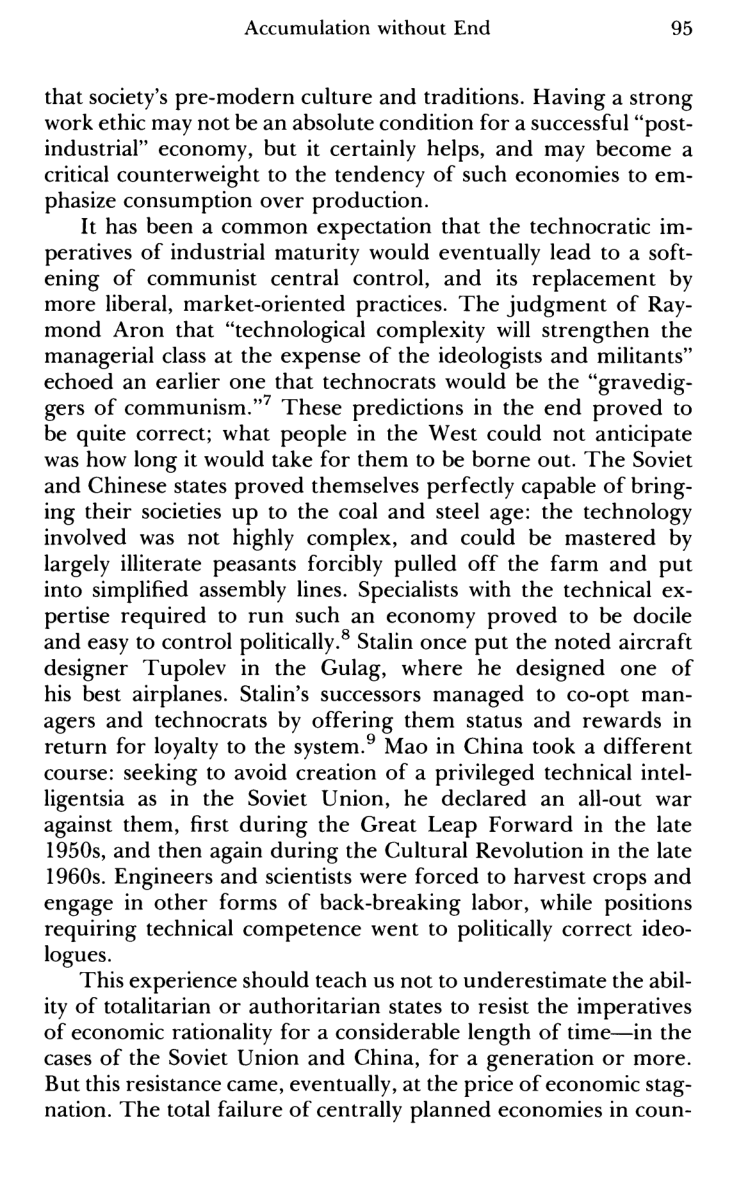
- While technocrats were long predicted to be the 'gravediggers of communism,' totalitarian states successfully co-opted or suppressed them for decades.
- The transition from the 'coal and steel age' to high-tech maturity exposes the fundamental incompatibility between rigid ideology and technological imperatives.
Stalin once put the noted aircraft designer Tupolev in the Gulag, where he designed one of his best airplanes.
The Logic of Industrialization
- Centrally planned economies in the Soviet Union and China eventually stagnated by failing to progress beyond 1950s-era industrialization.
- To survive, communist leaderships were forced to restore the prestige of technical intelligentsias, who became the primary carriers of liberal economic ideas.
- The 'economic logic' of advanced industrialization creates an irresistible pressure for nations to adopt market mechanisms and global trade integration.
- By the late 1980s, the collapse of socialist models in Eastern Europe and reforms in China signaled a universal shift toward capitalist economic culture.
- While states retain some regulatory freedom, no viable alternative path to full economic modernity has been discovered outside of market competition.
As Mao feared, the technological intelligentsia became the principal bearer of "bourgeois liberalism," and played a key role in the subsequent economic reform process.
The Appeal of Dependency Theory
- Socialist central planning appealed to developing nations as a rapid, albeit coercive, method for capital accumulation and industrialization.
- The perceived failure of capitalism in regions like Latin America sustained Marxism's relevance long after its decline in the West.
- Dependency theory emerged as a way to blame Third World poverty on colonialism, neo-colonialism, and the actions of multinational corporations.
- Lenin's theory of imperialism provided the foundation for dependency theory by suggesting capitalism exports exploitation to the global periphery.
- Economist Raul Prebisch argued that the global capitalist order created a 'perpetual dependent development' where Northern wealth required Southern poverty.
- Dependency theory's alliance with Southern nationalism had a corrosive effect on actual economic development for an entire generation.
Indeed, it is safe to say that were it not for the Third World, Marxism would have died a much quicker death in this century.
The Fall of Dependency Theory
- Dependency theory argued that the global economic order doomed developing nations to perpetual backwardness as providers of raw materials.
- In response to perceived exploitation, many nations adopted illiberal policies like import substitution or sought integration into the Soviet bloc.
- The theory's credibility was destroyed by the rapid economic success of East Asian nations like South Korea and Taiwan.
- Asian countries succeeded by doing the opposite of dependency theory's prescriptions, embracing export-led growth and global capitalist integration.
- The East Asian experience proved that late modernizers actually hold an advantage by being able to adopt the latest technologies without legacy infrastructure.
- The success of the 'Asian Tigers' demonstrated that human capital is more vital for development than natural resources or isolationism.
The developed North had locked up the world market for sophisticated manufactured goods like automobiles and airplanes, leaving the Third World to be, in effect, global "hewers of wood and drawers of water."
The Asian Economic Miracle
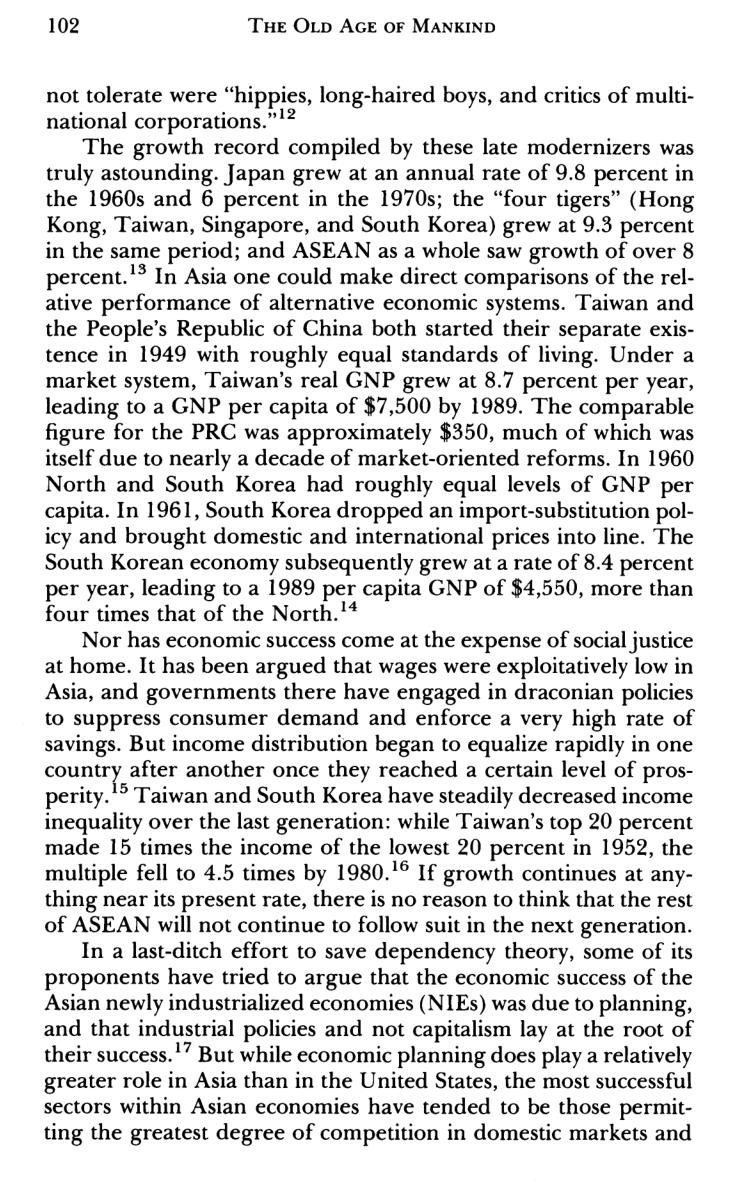
- Western multinational corporations acted as catalysts for growth in Asia by providing capital and technology in exchange for labor.
- Late modernizers like Japan and the 'four tigers' achieved astounding annual growth rates between 8 and 10 percent.
- Direct comparisons between market-oriented and command economies, such as the two Koreas and Chinas, reveal a massive disparity in per capita GNP.
- Economic success in Taiwan and South Korea has led to a significant decrease in income inequality rather than permanent exploitation.
- While state planning existed, the most successful Asian sectors were those that embraced domestic competition and international integration.
This is perhaps the reason why one high Singaporean official remarked that the three abominations his country would not tolerate were 'hippies, long-haired boys, and critics of multinational corporations.'
Obstacles to Third World Growth
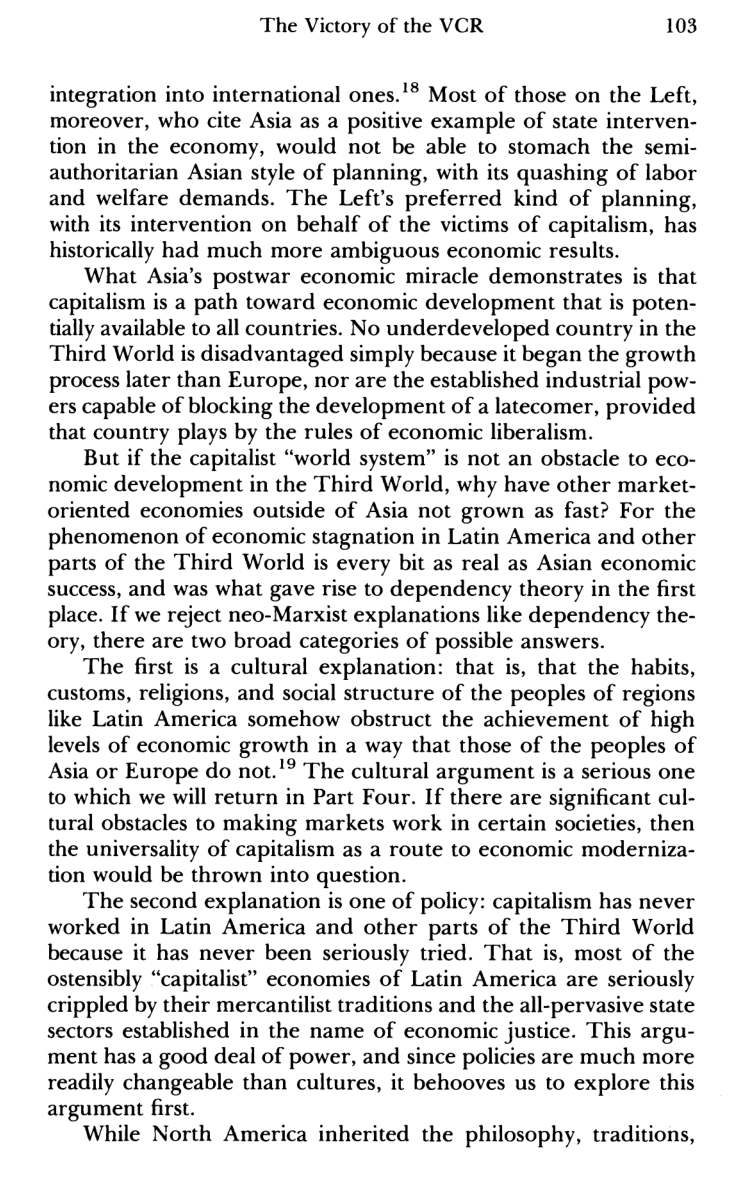
- The success of Asian economies suggests that the global capitalist system is not inherently rigged against late-developing nations.
- Cultural explanations posit that specific social structures and customs in regions like Latin America may obstruct the high growth levels seen in Asia or Europe.
- A policy-based explanation argues that true capitalism has never been fully implemented in Latin America due to deep-seated mercantilist traditions.
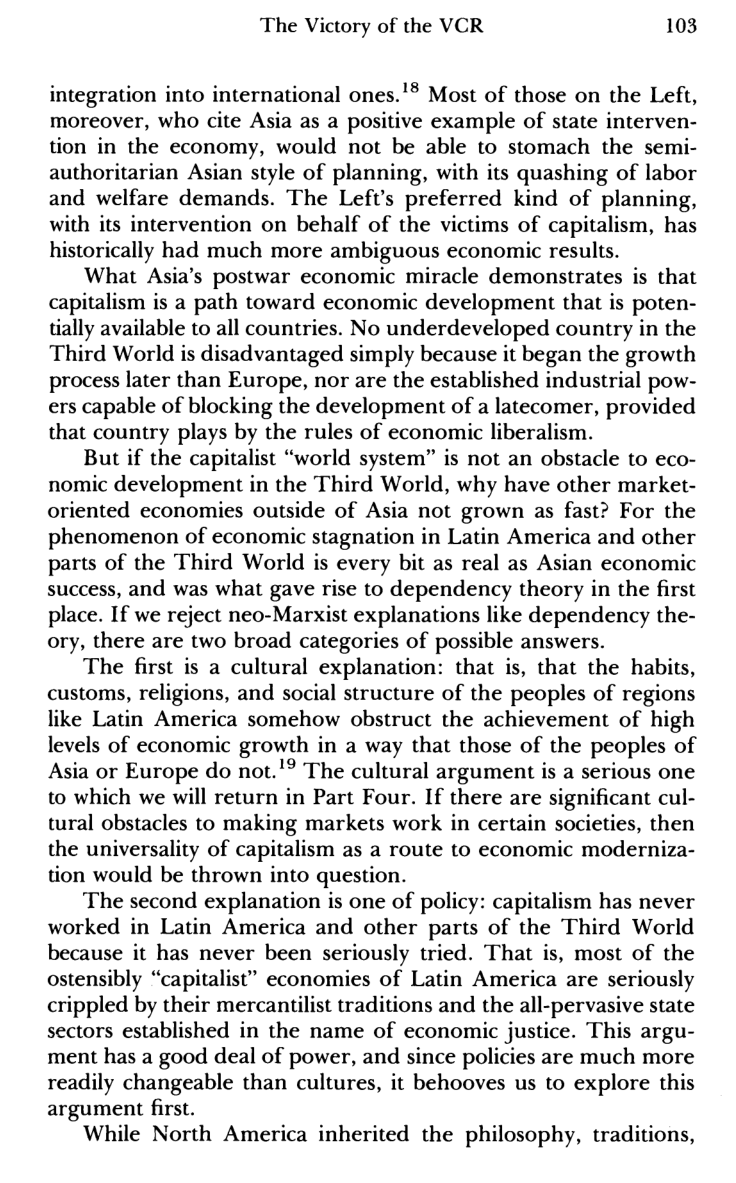
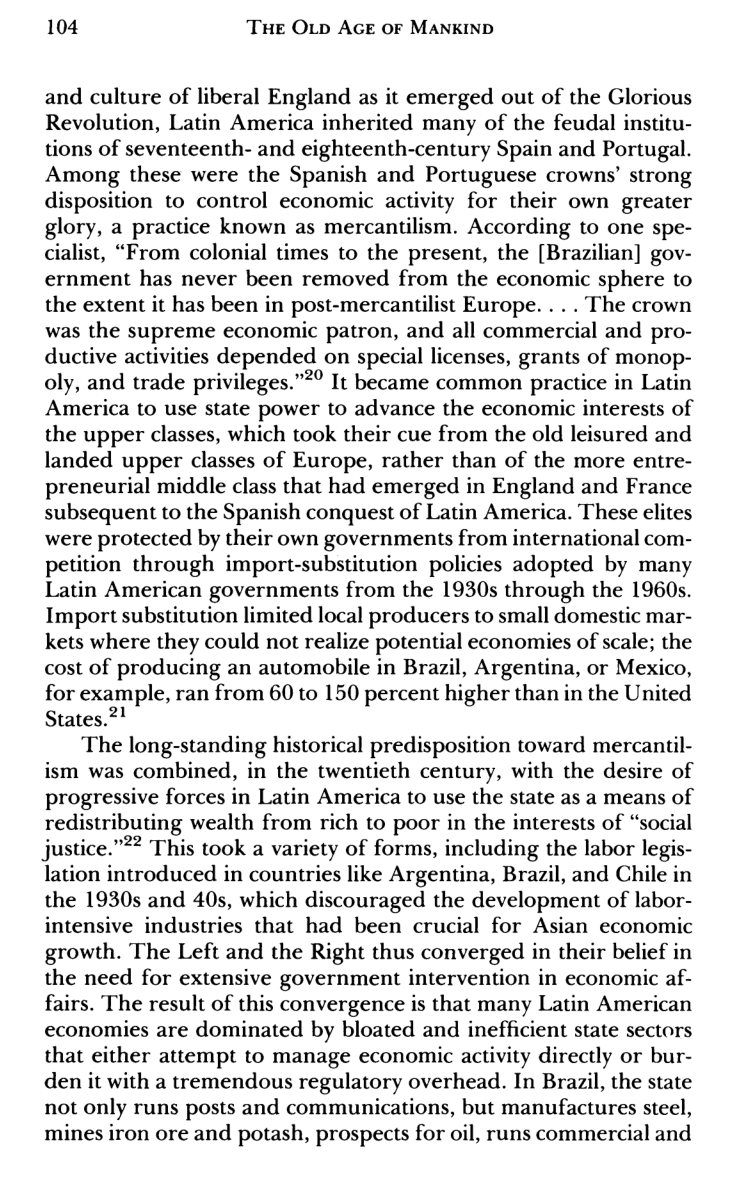
- Latin American economic history is characterized by state-granted monopolies and licenses that favor landed elites over an entrepreneurial middle class.
- Import-substitution policies intended to protect local industries resulted in massive inefficiencies and costs significantly higher than international standards.
- The twentieth-century push for social justice further expanded the state's role, often discouraging the labor-intensive industries that fueled Asian success.
The crown was the supreme economic patron, and all commercial and productive activities depended on special licenses, grants of monopoly, and trade privileges.
The Failure of Latin American Mercantilism
- Both the political Left and Right in Latin America converged on a belief in extensive government intervention, leading to bloated and inefficient state sectors.
- In Brazil, the state manages everything from steel manufacturing to investment banking, using public companies as tools for political patronage rather than profit.
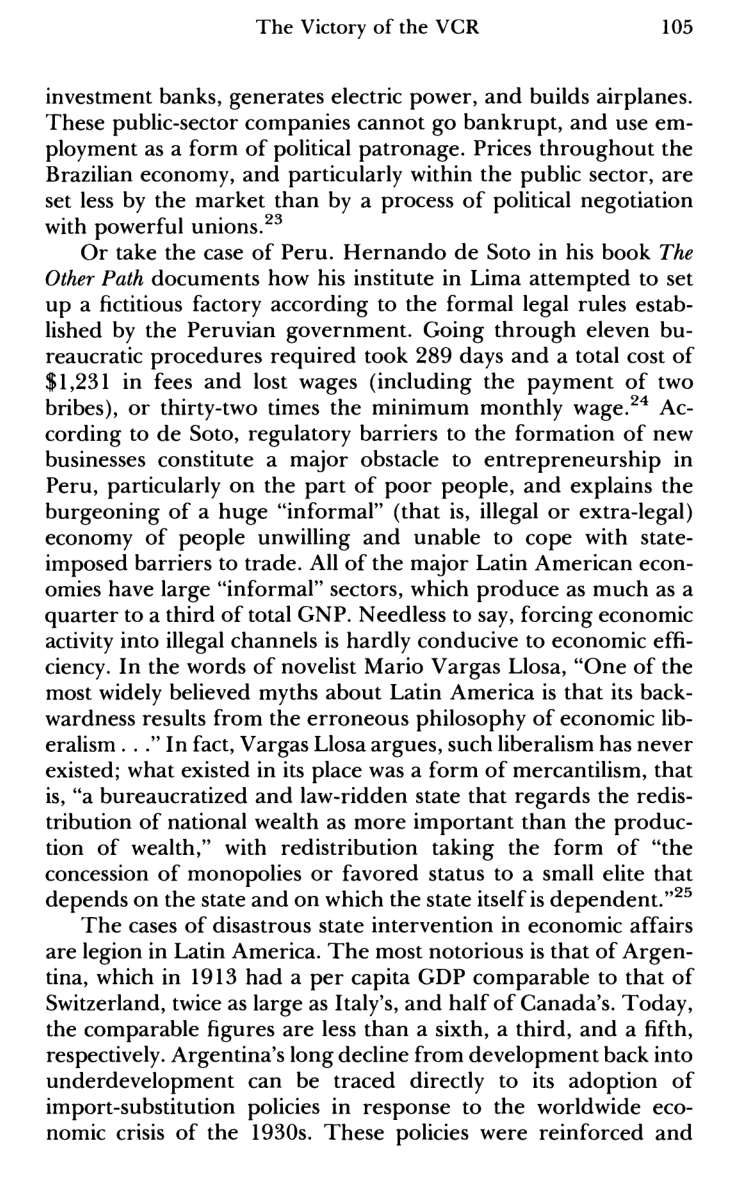
- Excessive regulatory barriers in Peru, such as a 289-day process to start a factory, have forced a massive portion of the population into an 'informal' illegal economy.
- Novelist Mario Vargas Llosa argues that Latin American backwardness stems not from liberalism, but from a mercantilist system that prioritizes wealth redistribution over production.
- Argentina serves as a primary example of decline, falling from a per capita GDP comparable to Switzerland in 1913 to underdevelopment due to protectionist and populist policies.
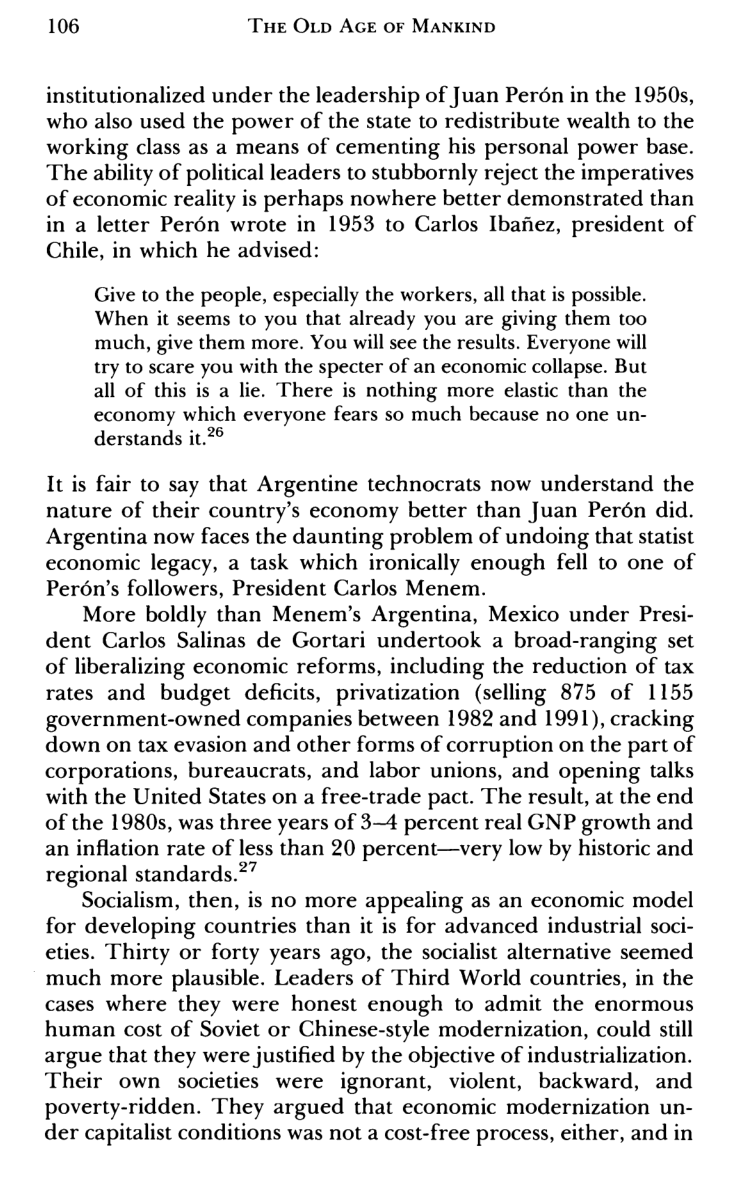
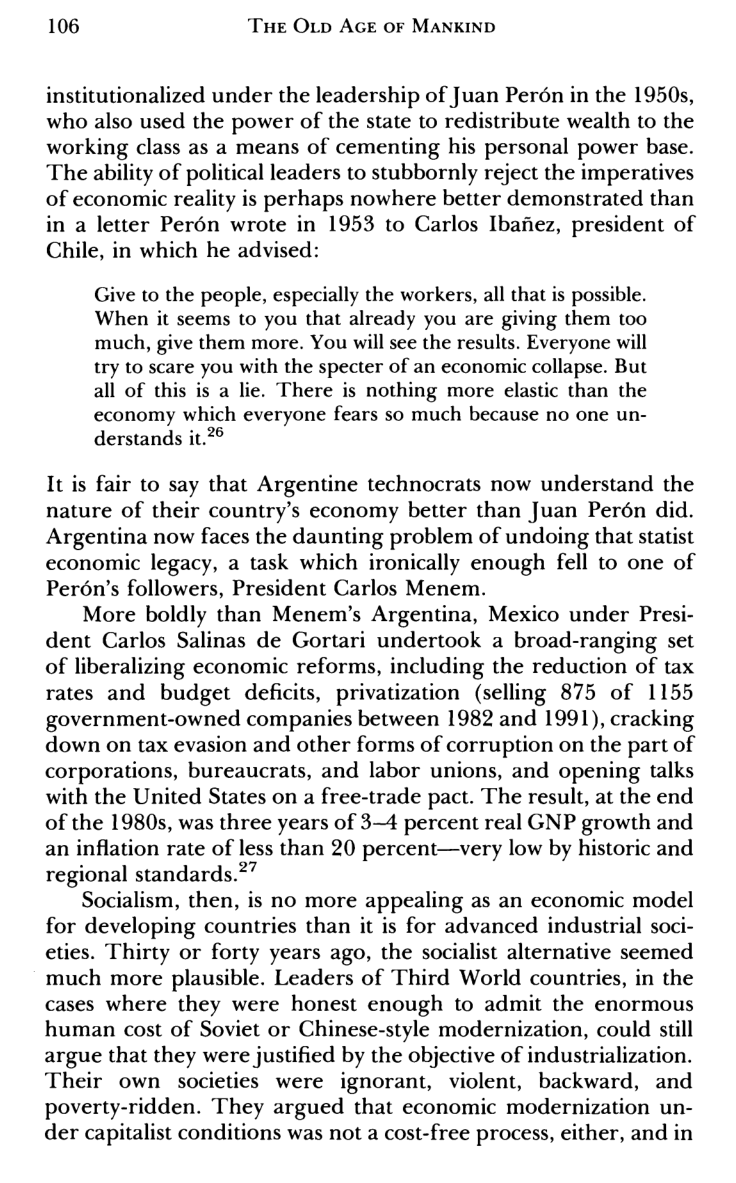
- Political leaders like Juan Perón maintained power by ignoring economic imperatives and advising others to redistribute wealth regardless of the risk of collapse.
Everyone will try to scare you with the specter of an economic collapse. But all of this is a lie. There is nothing more elastic than the economy.
The Failure of Socialist Development
- Latin American nations like Argentina and Mexico have begun dismantling statist legacies in favor of liberalizing economic reforms.
- Mexico's shift toward privatization and free trade resulted in significant GNP growth and stabilized inflation by the late 1980s.
- The success of Asian 'Newly Industrializing Economies' proves that economic liberalism allows latecomers to catch up to the West within a single generation.
- The human and social costs of capitalist modernization are shown to be benign when compared to the wholesale terror of Soviet or Chinese-style command economies.
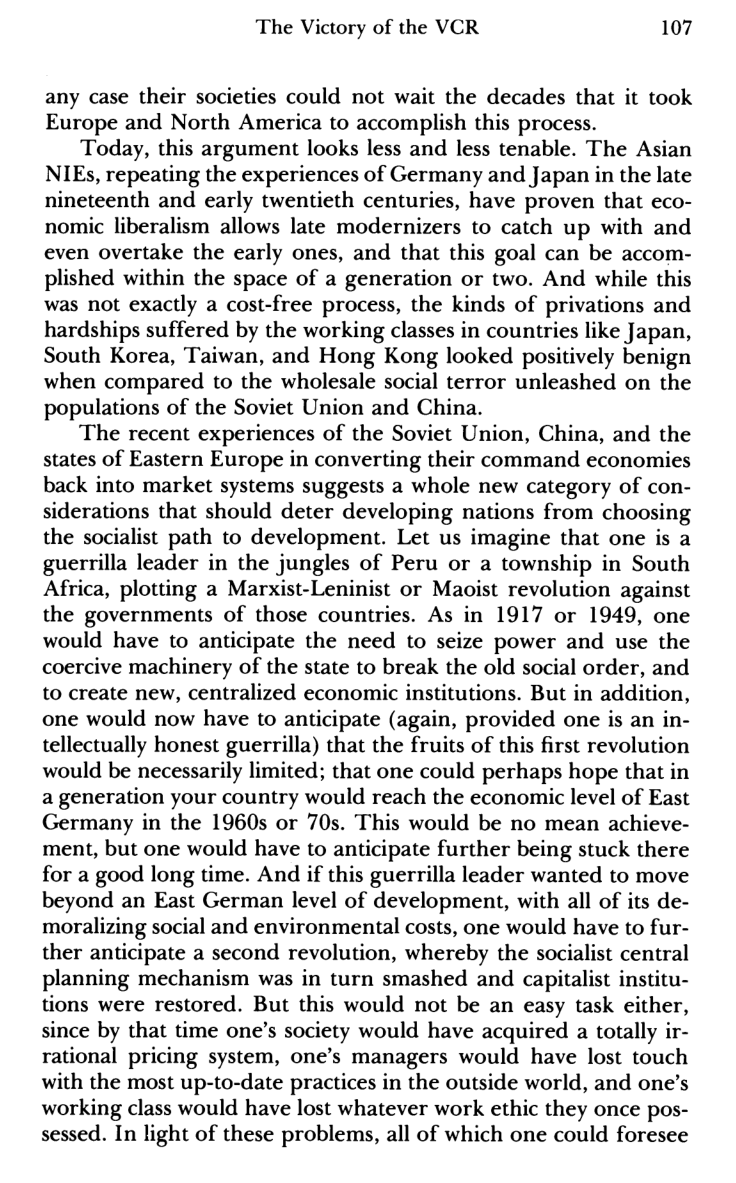
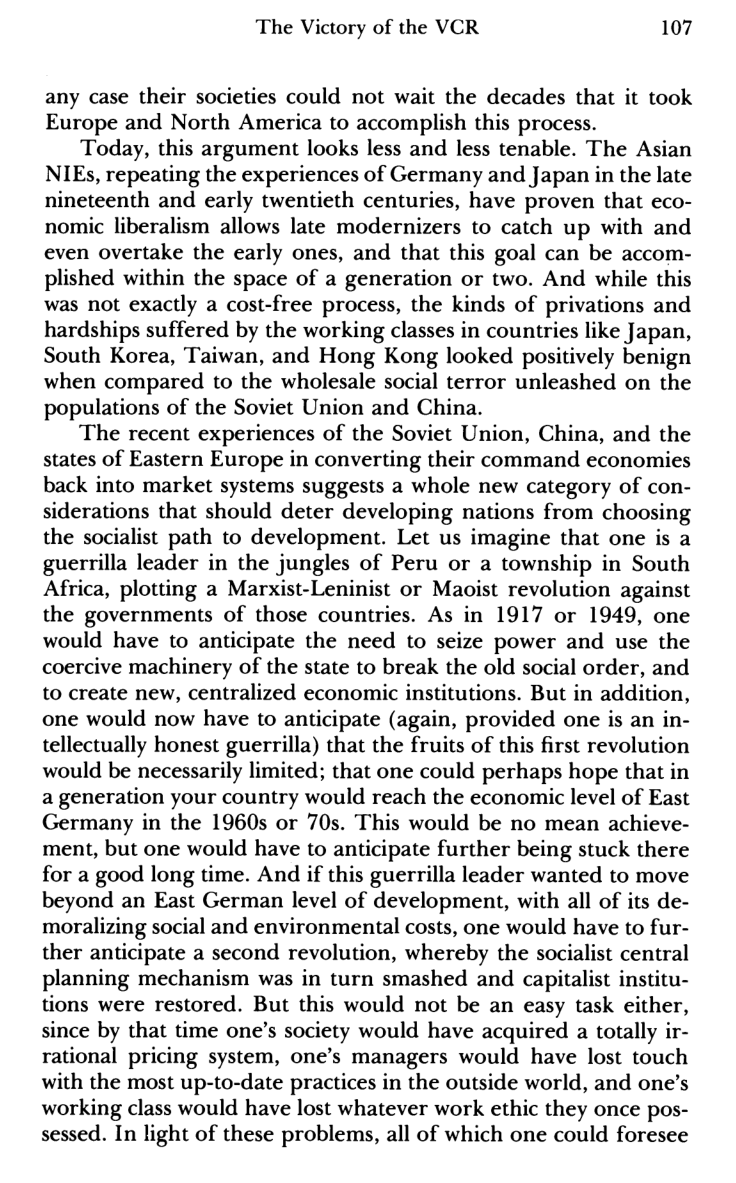
- Modern revolutionaries must now face the reality that a socialist victory likely leads to a developmental dead end, eventually requiring a second capitalist revolution.
As in 1917 or 1949, one would have to anticipate the need to seize power and use the coercive machinery of the state to break the old social order, and to create new, centralized economic institutions.
The Victory of the VCR
- Socialism creates long-term structural damage including irrational pricing, outdated management, and a degraded work ethic.
- The 'free-market guerrilla' approach suggests bypassing the socialist stage entirely to avoid the difficult task of restoring market functions.
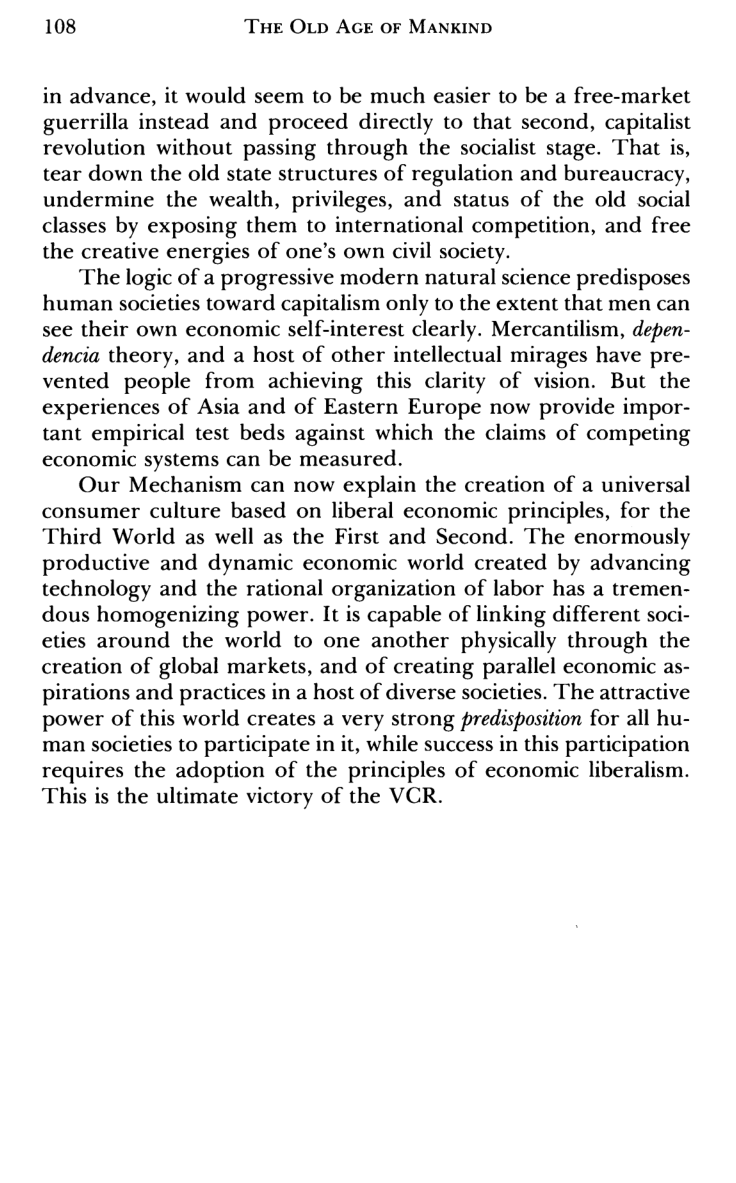
- Modern natural science and technology drive a universal consumer culture that homogenizes diverse societies through global markets.
- Success in the global economic system necessitates the adoption of economic liberalism and the rational organization of labor.
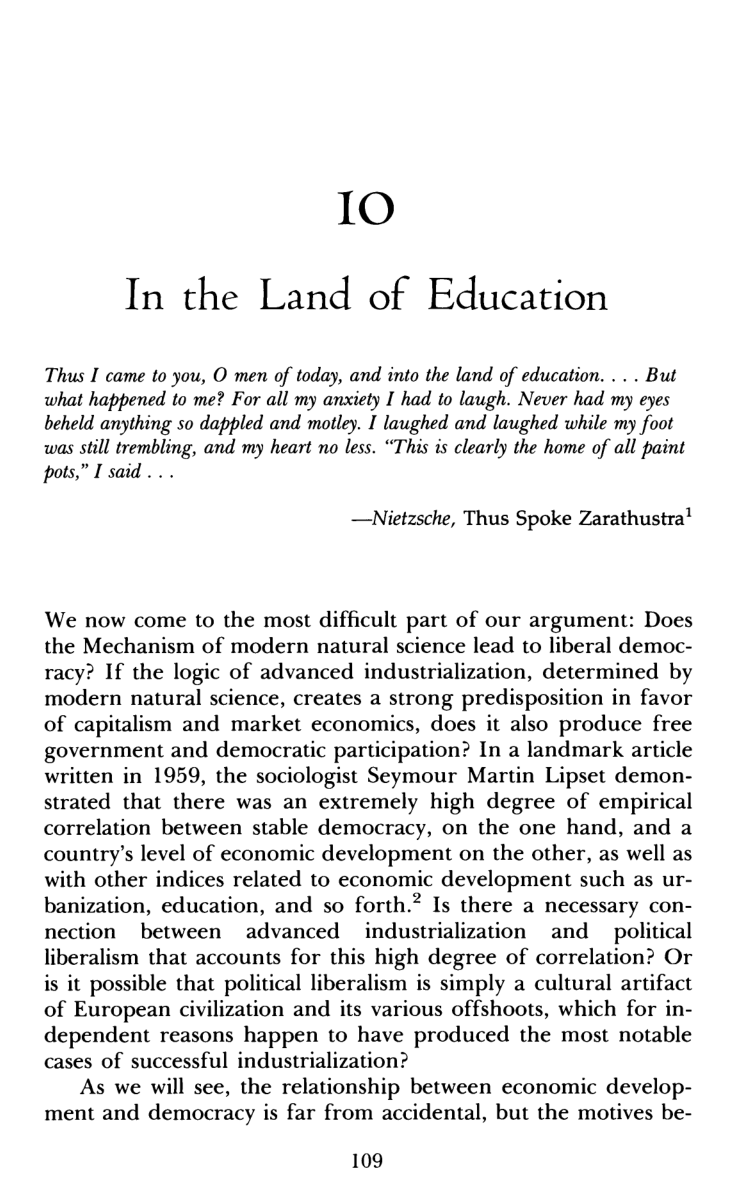
- While there is a high empirical correlation between economic development and democracy, the causal link is not purely economic.
- The 'Mechanism' of industrialization creates a predisposition toward capitalism, but the choice of democracy stems from non-economic motives.
This is the ultimate victory of the VCR.
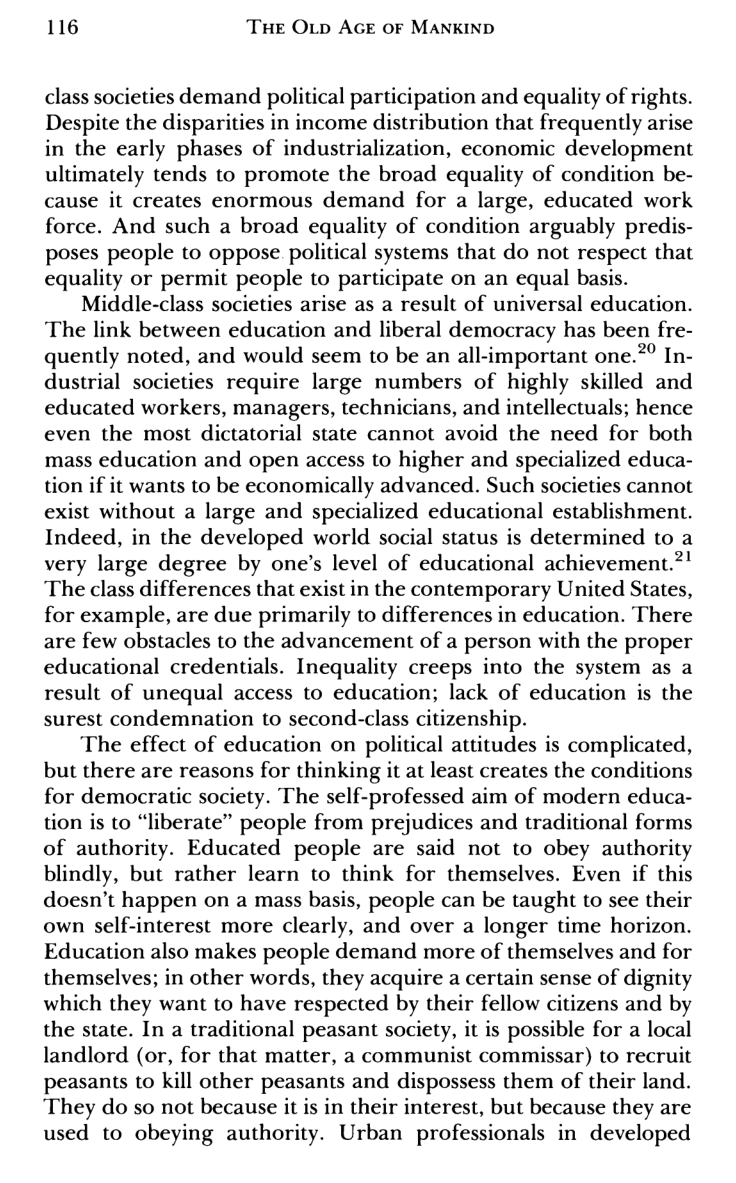
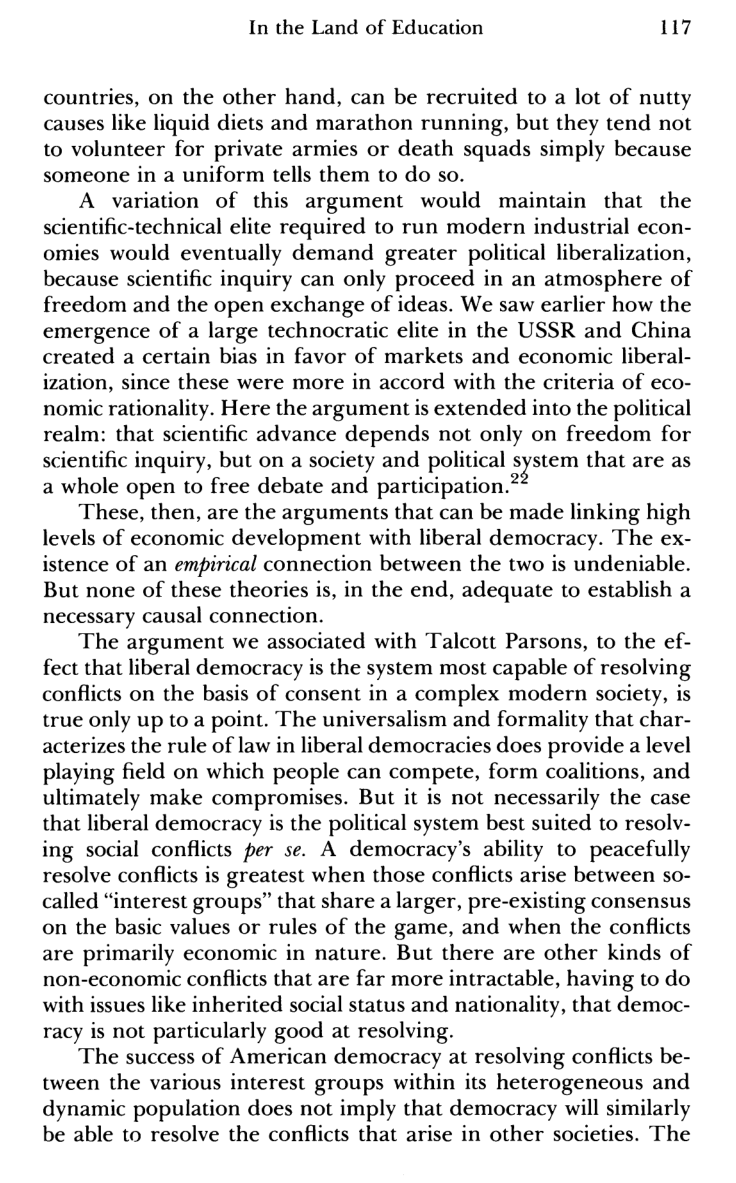
Wealth, Education, and Democracy
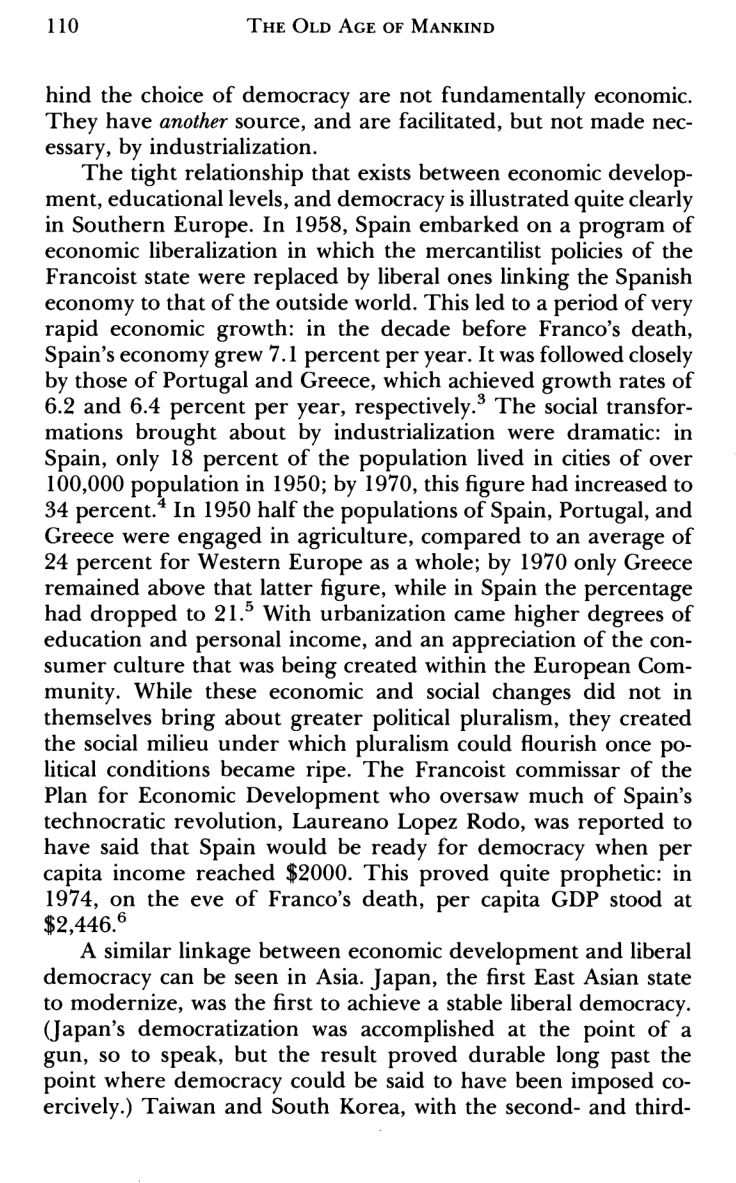
- Economic liberalization in Southern Europe during the mid-20th century triggered rapid growth and massive urbanization.
- The transition from agricultural to industrial societies created a social milieu where political pluralism could eventually flourish.
- Technocratic predictions suggested that specific per capita income thresholds, such as $2,000 in Spain, served as precursors to democratic readiness.
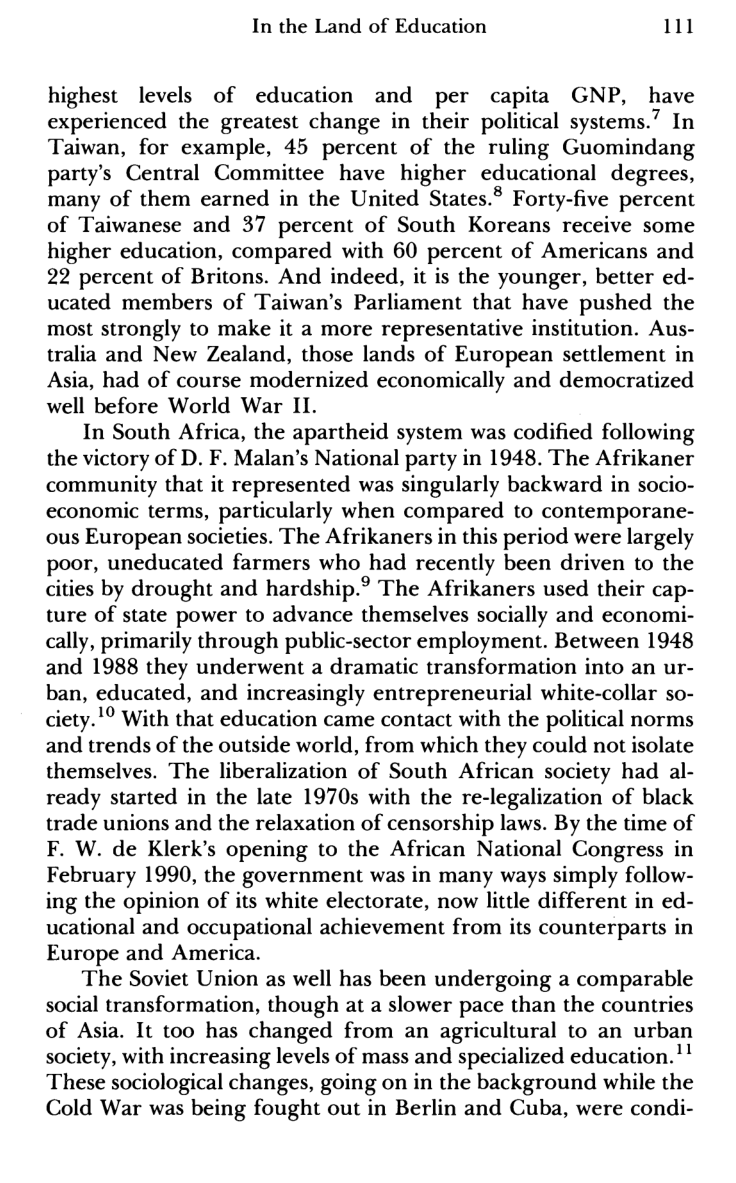
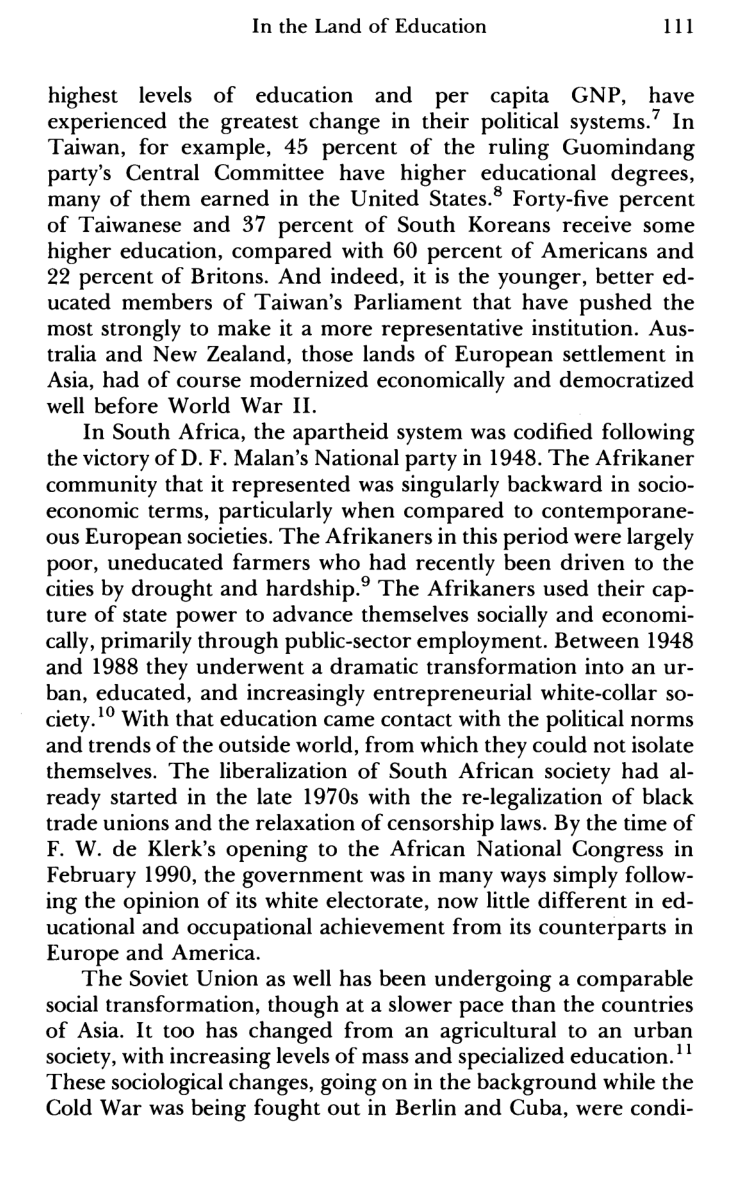
- In East Asia, high levels of education and GNP in Taiwan and South Korea have directly correlated with shifts toward more representative governance.
- The transformation of the Afrikaner community in South Africa from poor farmers to an urban, educated class exposed them to global political norms.
- While economic growth does not automatically grant freedom, it builds the structural foundation necessary for stable liberal democracies.
Laureano Lopez Rodo, was reported to have said that Spain would be ready for democracy when per capita income reached $2000.
Modernization and Democratic Emergence
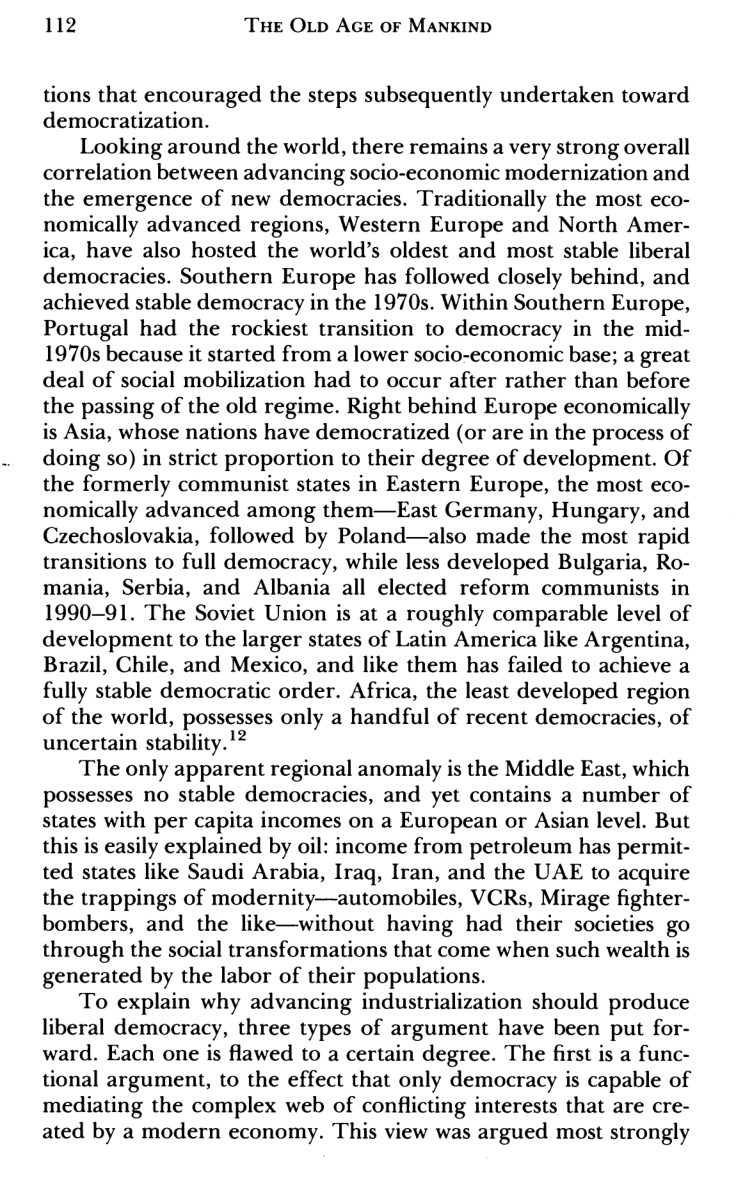
- The liberalization of South Africa and the Soviet Union was preceded by significant sociological shifts in education and urbanization.
- There is a strong global correlation between socio-economic advancement and the successful transition to stable liberal democracy.
- Asian and Eastern European nations have generally democratized in strict proportion to their level of economic development.
- The Middle East remains a regional anomaly because oil wealth allows for the acquisition of modern technology without the underlying social transformation of the labor force.
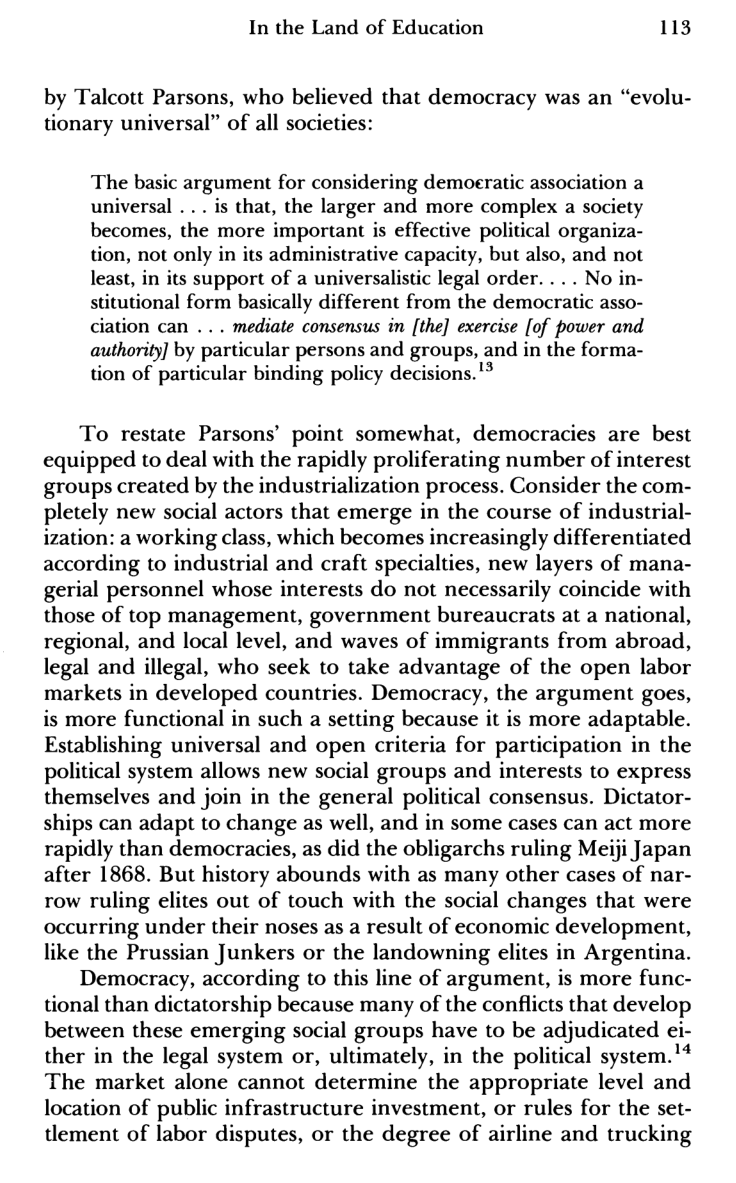
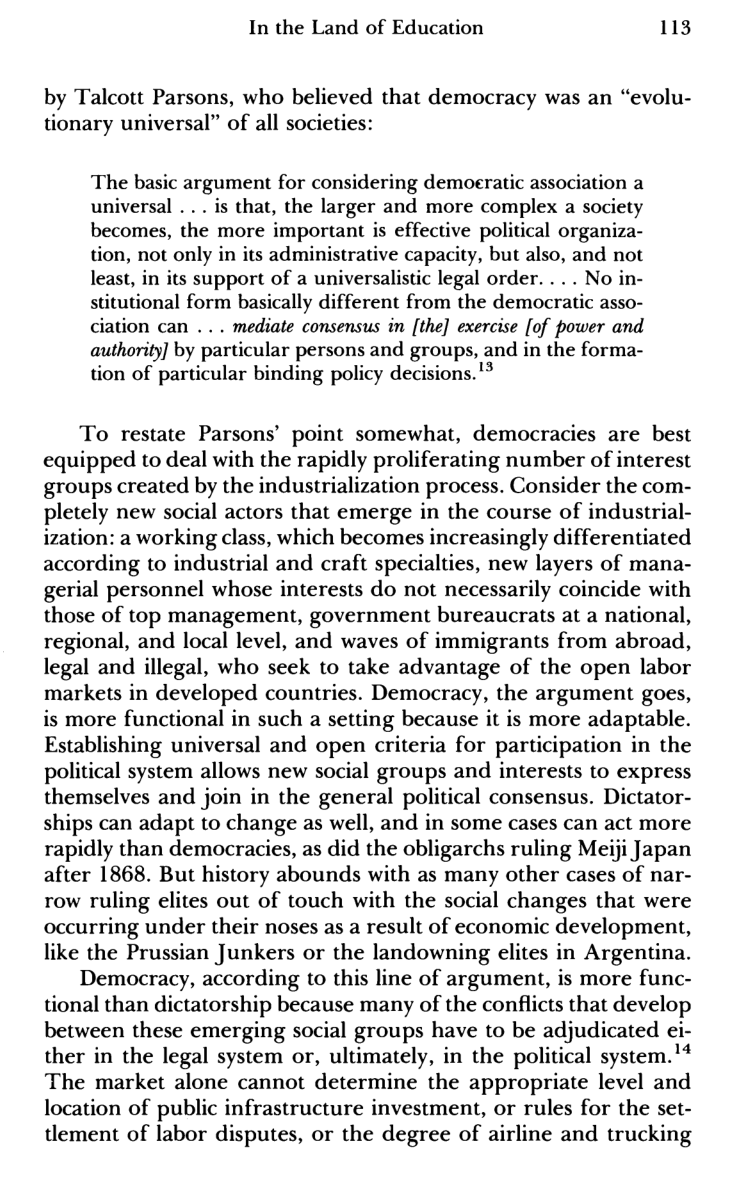
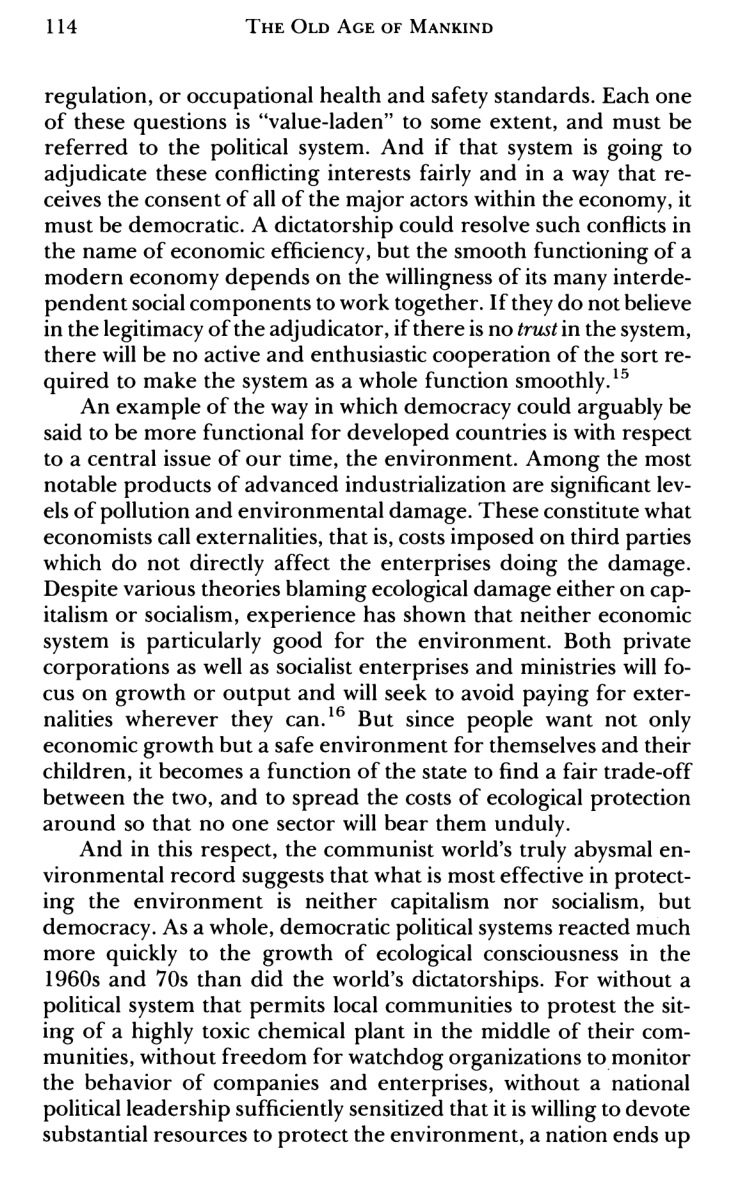
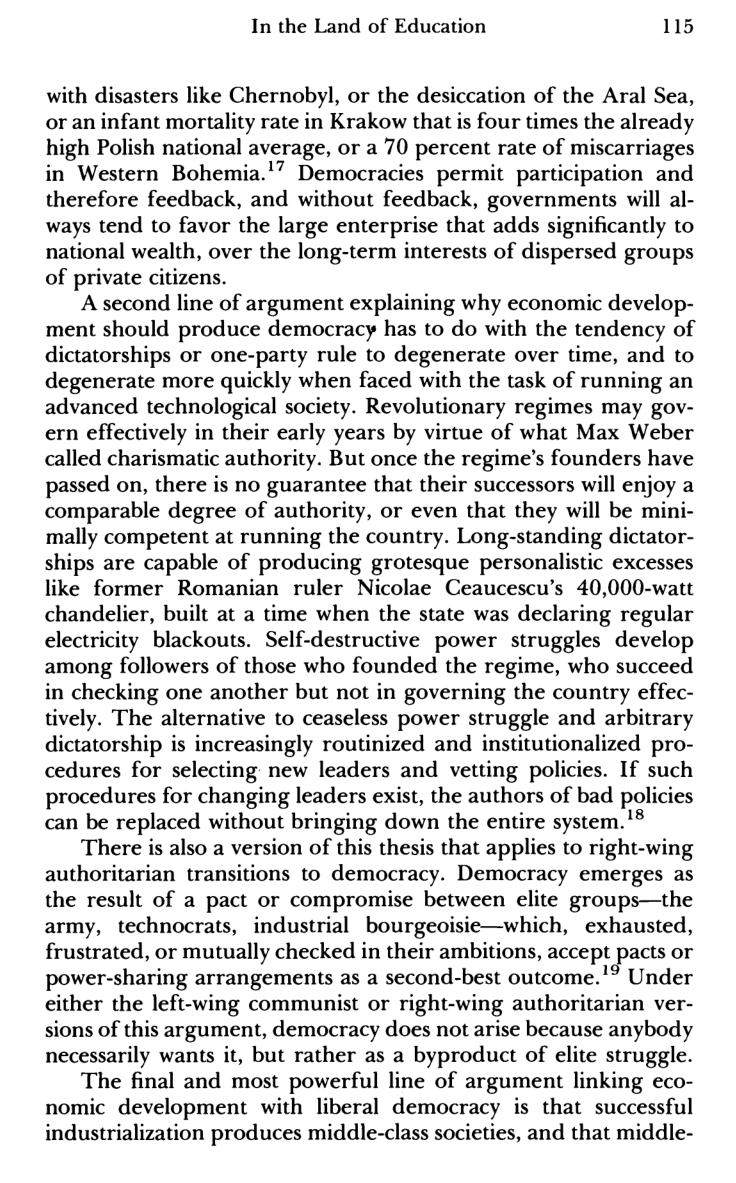
- Functionalist arguments suggest that democracy is an 'evolutionary universal' necessary for mediating the complex interests of modern industrial economies.
- Less developed regions, such as parts of Africa and the Balkans, face rockier transitions or retain authoritarian structures due to lower socio-economic bases.
But this is easily explained by oil: income from petroleum has permitted states like Saudi Arabia, Iraq, Iran, and the UAE to acquire the trappings of modernity—automobiles, VCRs, Mirage fighter-bombers, and the like—without having had their societies go through the social transformations that come when such wealth is generated by the labor of their populations.
Democracy and Industrial Complexity
- Democracy is uniquely equipped to manage the proliferation of diverse interest groups created by the industrialization process.
- Universal and open criteria for political participation allow new social actors, such as specialized labor and managerial layers, to join the general consensus.
- While dictatorships can sometimes act rapidly, they often become detached from social changes occurring as a result of economic development.
- Modern economies require the adjudication of value-laden conflicts, such as labor disputes and safety standards, which the market alone cannot resolve.
- The legitimacy and trust inherent in democratic systems foster the active cooperation necessary for a complex, interdependent economy to function smoothly.
- Democratic states are better suited to balance the trade-offs between economic growth and environmental protection through fair cost distribution.
If they do not believe in the legitimacy of the adjudicator, if there is no trust in the system, there will be no active and enthusiastic cooperation of the sort required to make the system as a whole function smoothly.
Democracy and Economic Development
- Democratic systems protect the environment more effectively than dictatorships by allowing local communities to protest and watchdog groups to monitor industrial behavior.
- The lack of feedback loops in non-democratic regimes leads to catastrophic ecological disasters like Chernobyl and the desiccation of the Aral Sea.
- Dictatorships tend to degenerate over time as charismatic authority fades, often resulting in grotesque personal excesses and incompetent governance.
- Institutionalized democratic procedures allow for the replacement of leaders who enact bad policies without causing a total systemic collapse.
- Economic development fosters a middle-class society that inherently demands political participation and equality of rights as a byproduct of education.
- Democracy often emerges not from a primary desire for liberty, but as a pragmatic power-sharing pact between exhausted elite factions.
Long-standing dictatorships are capable of producing grotesque personalistic excesses like former Romanian ruler Nicolae Ceaucescu's 40,000-watt chandelier, built at a time when the state was declaring regular electricity blackouts.
Education and Democratic Stability
- Universal education is the primary catalyst for the emergence of middle-class societies and the determination of social status.
- Industrial advancement forces even dictatorial states to provide mass education, creating a specialized intellectual class.
- Modern education fosters a sense of personal dignity and self-interest that discourages blind obedience to authority.
- The scientific-technical elite required for modern economies tends to demand political liberalization to facilitate the free exchange of ideas.
- While a strong empirical link exists between economic development and democracy, a necessary causal connection remains difficult to prove.
- Liberal democracy provides a formal, universalist framework for resolving conflicts through consent rather than coercion.
Urban professionals in developed countries, on the other hand, can be recruited to a lot of nutty causes like liquid diets and marathon running, but they tend not to volunteer for private armies or death squads simply because someone in a uniform tells them to do so.
Limits of Democratic Conflict Resolution
- Liberal democracy is most effective at resolving economic disputes between interest groups that already share a consensus on basic values.
- Democracy struggles with intractable non-economic conflicts rooted in inherited social status, nationality, and religion.
- The American democratic success is unique because its population was largely 'born equal' and assimilated into a fluid structure without rigid feudal classes.
- The persistent alienation of Black Americans represents a failure of American democracy to resolve deep-seated cultural and historical inequality.
- In highly polarized or stratified societies, democracy can lead to stalemate, stagnation, or the protection of inefficient elites.
- Class conflict in countries with feudal legacies often results in a 'social pathology' where the democratic system itself is viewed as corrupt by the opposition.
Black slavery constituted the major exception to the generalization that Americans were 'born equal,' and American democracy could not in fact settle the question of slavery through democratic means.
The Limits of Democracy
- Democracy struggles to resolve disputes over national sovereignty because identity and territory are often uncompromisable.
- The Soviet Union's collapse demonstrates that democracy cannot maintain a unitary state without a shared sense of national identity.
- American success with diversity is attributed to the lack of ethnic groups with historical claims to sovereign lands or distinct languages.
- Modernizing dictatorships can sometimes be more effective than democracies at dismantling entrenched, inefficient landowning classes.
- In the Philippines, democratic institutions have failed to implement land reform because the legislature is controlled by the landowning elite.
- Dictatorial power in Japan and Peru successfully broke the grip of agrarian oligarchs, potentially creating better long-term conditions for stability.
The question of national sovereignty is inherently uncompromisable: it either belongs to one people or another—Armenians or Azerbaijanis, Lithuanians or Russians.
The Limits of Democratic Evolution
- Modernizing dictatorships can facilitate market economics by forcibly dismantling inefficient traditional social structures and landowning classes.
- Economic development does not inherently dissolve social cleavages; in some cases, it can sharpen national or ethnic identities as groups fear cultural homogenization.
- Democracy often fails when social diversity exceeds a certain limit, suggesting it is most functional in societies that are already relatively egalitarian or 'born equal.'
- If democracy is merely a tactical truce between warring non-democratic elites, it remains inherently unstable and vulnerable to shifts in the balance of power.
- While industrialization creates an educated middle class that may prefer liberal rights, education alone does not guarantee a universal evolution toward democracy.
In other words, if democracy arises in the Soviet Union only because ambitious figures like Gorbachev and Yeltsin need a demagogic stick with which to beat the established party apparatus, it follows that the victory of one or the other would lead to a rescinding of democratic gains.
Education and Authoritarian Efficiency
- While literacy is essential for democracy, higher education does not inherently produce democratic values but rather reflects current global intellectual fashions.
- Modern Western education often teaches a relativist perspective that encourages tolerance but undermines the belief in the objective superiority of liberal democracy.
- The logic of industrialization does not naturally lead to democracy; instead, it often favors a 'market-oriented authoritarianism' for maximizing growth.
- Empirical evidence suggests that authoritarian modernizers, such as Meiji Japan or Pinochet's Chile, often outperform democratic counterparts in economic growth rates.
- Democratic voters frequently abandon free-market principles when their personal economic interests are threatened, a weakness less prevalent in authoritarian systems.
- The preference for liberal democracy among the educated middle class remains a choice that is not dictated by the functional requirements of an industrial economy.
Indeed, to think that education leads naturally to democratic values reflects considerable presumption on the part of democratic man.
Democracy Versus Authoritarian Efficiency
- Democratic publics often prioritize short-term economic self-interest and welfare over long-term rational growth.
- The American democratic system's inability to allocate the 'pain' of budget cuts illustrates a failure in economic functionality.
- Authoritarian regimes can enforce social discipline and suppress wage demands to prioritize investment and competitiveness.
- Market-oriented authoritarianism combines state-enforced discipline with enough freedom to foster technological innovation.
- Statist 'industrial policies' in authoritarian systems focus single-mindedly on growth rather than social justice or redistribution.
Market-oriented authoritarians, on the other hand, have the best of both worlds: they are able to enforce a relatively high degree of social discipline on their populations, while permitting a sufficient degree of freedom to encourage innovation.
The Mechanism of Universal History
- Taiwan's successful industrial policy was dependent on an authoritarian state's ability to shield technocrats from democratic political pressures.
- Economic development and liberal democracy are correlated, but there is no necessary causal connection between industrial maturity and democratic governance.
- The logic of modern natural science can lead to either a bureaucratic-authoritarian future or a liberal one, necessitating a deeper look at the democratic revolution.
- A 'Universal History' is possible because modern natural science provides a directional mechanism that links all of humanity through a global economic nexus.
- Global culture is increasingly defined by technologically driven economic growth and the material allure of modern consumerism.
- Societies attempting to resist this global unification are eventually defeated by superior military technology or seduced by the 'glittering material world' of science.
Those that were not defeated by superior military technology were seduced by the glittering material world that modern natural science has created.
Directional History and Totalitarianism
- Historical patterns may recur, but they exist within a directional, dialectical history shaped by memory and scientific progress.
- Modern natural science acts as a self-reconstituting force that dictates the social and economic structures of contemporary societies.
- Totalitarian regimes like Stalinism and Hitlerism are viewed as historical 'dead ends' rather than viable long-term alternatives for human organization.
- The 'totalitarian temptation' is characterized as a pathological 'disease of transition' primarily affecting developing nations during industrialization.
- While future eruptions of tyranny cannot be guaranteed against, they represent unexplainable discontinuities rather than a refutation of a larger evolutionary pattern.
- A Universal History can acknowledge the existence of catastrophic events without losing sight of the long-term regularity of human evolution.
And as long as a stake is not driven through that vampire's heart, it will reconstitute itself—with all of its social, economic, and political concomitants—within the space of a few generations.
Modernity and the Holocaust
- The author argues against the idea that the Holocaust's horror should end rational discourse regarding historical progress or the direction of history.
- There is a logical tension in viewing the Holocaust as both a uniquely evil event and a manifestation of a universal evil latent in all modern societies.
- The text suggests Nazism was a 'disease of the transition,' a pathological byproduct of Germany's specific cultural traditions and rapid industrialization rather than an inherent feature of modernity.
- While totalitarianism has consumed millions of lives, the author contends that these tragedies do not necessarily derail the broader 'locomotive of History.'
- A Universal History should not be expected to function as a secular theodicy that justifies every historical evil in pursuit of a final end.
In both cases there is an underlying concern that 'rationalization' will domesticate genocide.
The Mechanism of Modernity
- A Universal History serves as an intellectual tool rather than a source of personal redemption for history's victims.
- Historical discontinuities and atrocities like the Holocaust do not negate the existence of a coherent, directional process of modernization.
- Modernity is driven by a 'Mechanism' rooted in an economic interpretation of history where science serves human desire.
- Human desire is highly elastic, constantly expanding its horizon of possibilities beyond basic natural needs.
- While following a Marxist logic of production, the author concludes that capitalism, not communism, best facilitates the production and consumption of goods.
- The 'realm of freedom' only begins where labor determined by necessity ends, yet material production remains a realm of necessity.
The existence of discontinuities does not make any less real the remarkable similarities in the experiences of people living through the process of modernization.
The Realm of Necessity
- Marxist theory posits that true freedom begins only when the working day is shortened enough to allow for creative and intellectual pursuits.
- While Soviet-style societies technically reduced 'honest' labor time, the resulting freedom was squandered on scarcity-driven tasks like waiting in lines or avoiding political persecution.
- Capitalist workers are arguably more liberated from physical necessity because their surplus labor provides access to a vast array of consumer goods and technologies.
- Communist regimes failed because they adopted Western consumerist desires without the productive capacity to satisfy those expanding wants.
- Modernization theory suggests that as countries develop economically, they inevitably converge toward a singular model of capitalist liberal democracy.
- Economic theories of history are powerful but ultimately incomplete, as they assume humans are driven solely by industrial rationality and material growth.
The irony is that communist societies came to acquire the ever-expanding horizon of wants generated by Western consumerist societies without acquiring the means of satisfying them.
No Democracy without Democrats
- Economic modernization creates the material conditions for democracy but cannot explain the actual choice to adopt democratic governance.
- Major historical discontinuities, such as religious eruptions or nationalist passions, originate from human motivations entirely separate from economics.
- The American and French Revolutions occurred before industrialization, proving that the 'rights of man' were not conditioned by economic efficiency.
- History shows that prosperity without liberty is a viable option often chosen by authoritarian modernizers like Lee Kuan Yew or Deng Xiaoping.
- A true Universal History must account for 'Democratic Man'—individuals who value rights enough to risk their lives and livelihoods regardless of financial gain.
- Modern natural science and the 'Economic Man' it produced have pre-modern origins that require a deeper psychological and historical investigation.
The American Founding Fathers may have been angered over the attempts of the British Crown to tax them without representation in Parliament, but their decision to declare independence and fight Britain in order to establish a new democratic order can hardly be explained as a matter of economic efficiency.
Hegel and the Historical Dialectic
- Hegel's 'struggle for recognition' provides a deeper mechanism for history than Marx's purely economic focus.
- The historical process is driven by internal contradictions within socio-political organizations that lead to their eventual collapse and replacement.
- A true 'contradiction' is distinguished from a mere 'problem' by its ability to corrode a system's legitimacy and cause total structural failure.
- The 'end of history' is defined as a state where the social and political order completely satisfies essential human characteristics.
- History can be viewed as a marketplace or dialogue where different regimes compete and 'refute' one another through survival and triumph.
A 'problem' does not become a 'contradiction' unless it is so serious that it not only cannot be solved within the system, but corrodes the legitimacy of the system itself such that the latter collapses under its own weight.
The End of History Debate
- Historicist philosophers argue that if liberal democracy outlasts all rivals and satisfies its citizens, it may represent the final form of human government.
- The concept of 'world history as the final arbiter' suggests that a system's survival over centuries validates its claims to superiority.
- A major flaw in historicism is the difficulty of distinguishing between true social satisfaction and a temporary calm enforced by power or illusion.
- Without a fixed concept of human nature, it is impossible to determine if current social peace is a 'final conclusion' or merely a prelude to new revolutionary contradictions.
- Feminist critiques illustrate this uncertainty by suggesting that future matriarchal societies could emerge as a viable alternative to the historical patriarchal status quo.
- A 'trans-historical' approach offers an alternative by measuring democratic success against permanent human attributes rather than just empirical or current standards.
Without an underlying concept of human nature that posited a hierarchy of essential and non-essential human characteristics, it would be impossible to know whether an apparent social peace represented true satisfaction of human longings, rather than the work of a particularly efficient police apparatus, or merely the calm before a revolutionary storm.
History and Human Nature
- The concept of man's self-creation through history does not eliminate the need for a trans-historical standard of human nature.
- History is not a mere catalogue of past events but a deliberate abstraction that requires a standard to distinguish the important from the unimportant.
- Shifts in historical focus, such as the move toward social history, reflect changing egalitarian values rather than the abandonment of selective standards.
- A Universal History requires the historian to discard entire eras or peoples that do not contribute to the central narrative or 'plot' of human development.
- Evaluating the 'end of history' requires moving beyond empirical data to determine if liberal democracy satisfies the fundamental needs of 'man as man.'
- To judge if the modern world is truly free of contradictions, one must examine 'natural man' as he existed before the historical process began.
The Universal Historian must be ready to discard entire peoples and times as essentially pre- or non-historical, because they do not bear on the central "plot" of his or her story.
The Struggle for Recognition
- Self-consciousness is not an innate state but is achieved through a struggle where an individual risks their life for recognition.
- Liberal revolutions are driven by more than just economic desires or a reaction against the injustices of previous dictatorships.
- Prosperity alone is insufficient for human fulfillment, as evidenced by democratic movements in economically successful autocratic states like South Korea and Taiwan.
- Hegel, as interpreted by Alexandre Kojève, offers a non-materialist historical dialectic that prioritizes human motivation over Marxist economic determinism.
- The 'Hegel-Kojève' synthesis posits that the origin of human reality is found in a 'fight to the death' for social validation and status.
Therefore, to speak of the 'origin' of self-consciousness is necessarily to speak of a fight to the death for 'recognition.'
Hegel and the Struggle for Recognition
- While Anglo-Saxon liberalism is rooted in the philosophies of Hobbes and Locke, Hegel offers a nobler alternative that transcends mere material self-interest.
- The traditional 'bourgeois' individual is often criticized by both the Left and the Right for being selfish and preoccupied with private well-being over public virtue.
- Hegel's framework centers on the 'struggle for recognition,' a non-economic drive that explains political conflicts more accurately than modern economic models.
- The 'economization' of modern thought has obscured our vocabulary for discussing the prideful and assertive side of human nature.
- Unlike his predecessors, Hegel rejects a fixed 'state of nature,' arguing instead that man is free and creates his own nature through historical processes.
Indeed, we do not even have a corrimon vocabulary for talking about the prideful and assertive side of human nature that is responsible for driving most wars and political conflicts.
Hegel's First Man
- Hegel's 'first man' serves as a philosophical prototype of humanity prior to the creation of civil society and the historical process.
- Unlike animals that seek material objects, humans are defined by their desire for the 'desire of others' and the need for social recognition.
- The uniquely human characteristic is the ability to risk one's own life for non-material, biological useless ends like prestige or honor.
- The initial social encounter is not a peaceful contract but a 'bloody battle' for recognition that results in a hierarchy of lordship and bondage.
- Hegel argues that class divisions originate from this struggle for prestige rather than from purely economic functions.
Man is a fundamentally other-directed and social animal, but his sociability leads him not into a peaceful civil society, but into a violent struggle to the death for pure prestige.
The Warrior Ethos and Freedom
- Hegel argues that class stratification originated not from economic status, but from an individual's willingness to risk their life in a battle for prestige.
- The 'master' is defined by the courage to face violent death, while the 'slave' prioritizes physical survival over recognition.
- Aristocratic societies were built on a warrior ethos that valued symbolic honor and bravery over the sedentary, economic concerns of the peasantry.
- Modern liberal thought often views the risk of life for prestige as primitive or irrational, yet Hegel sees it as the foundation of true human freedom.
- Unlike animals or objects governed by instinct and physics, humans demonstrate freedom by acting against their biological drive for self-preservation.
- True freedom is distinguished from the mere absence of restraint; it requires the ability to transcend one's own physical and animal nature.
Bears typically do not stage hunger strikes on behalf of higher causes.
Freedom and Human Nature
- Hobbes views human beings as complex machines governed by basic passions and the laws of matter-in-motion, where rationality merely serves the instinct for self-preservation.
- Hegel argues that true humanity is defined by the ability to negate animal nature and act independently of physical or biological determination.
- Dignity, in the Hegelian sense, arises from the capacity for moral choice rather than a superior ability to calculate utility or satisfy desires.
- The willingness to risk one's life for 'pure prestige' serves as the ultimate proof of human freedom because it directly contravenes the most basic instinct of self-preservation.
- History begins with a battle for recognition, where individuals prove their autonomy by valuing a 'trifle' like a medal or flag over their own survival.
For by risking his life, man proves that he can act contrary to his most powerful and basic instinct, the instinct for self-preservation.
Prestige and Human Freedom
- Hegel argues that the willingness to risk one's life for pure prestige, rather than survival or resources, is what defines a being as specifically human.
- Unlike animal behavior driven by instinctual survival, human dignity is rooted in the capacity to demonstrate contempt for one's own biological life.
- Modern natural science threatens this view by suggesting all human behavior is a product of material causation, biology, and chemistry.
- Philosophers like Kant and Hegel sought to preserve an 'island' of human moral choice that remains independent of the mechanical laws of physics.
- Regardless of the metaphysical reality of free will, human psychology is fundamentally driven by a desire for recognition and respect that transcends material needs.
Only man is capable of engaging in a bloody battle for the sole purpose of demonstrating that he has contempt for his own life, that he is something more than a complicated machine.
The Origins of Human Freedom
- Hegel defines freedom as the transcendence of natural, animal existence through the creation of a new self.
- The 'struggle to the death for pure prestige' serves as the emblematic starting point for authentic human history.
- History is framed as a dialectical search to satisfy the mutual desire for recognition between masters and slaves.
- While modern liberal democracies share roots with Hegel, they are primarily built on the rational principles of Hobbes and Locke.
- Hobbes established the foundational liberal principle that government legitimacy derives from the rights of the governed rather than divine right.
- The Anglo-Saxon liberal tradition differs from Hegel by taking a distinct attitude toward the human desire for recognition.
Human freedom emerges only when man is able to transcend his natural, animal existence, and to create a new self for himself.
Hobbes, Hegel, and Human Passion
- Hobbes’s state of nature is not necessarily a historical fact but a permanent latent condition that emerges whenever civil society collapses.
- Both Hobbes and Hegel identify a primordial 'war of all against all' driven by the fundamental human desire for recognition and prestige.
- While material competition exists, Hobbes argues men most frequently fight over 'trifles' like words or smiles that signify a lack of respect.
- The human condition is defined by a tension between the prideful urge to risk one's life for glory and the rational fear of violent death.
- Hobbes and Hegel agree that the historical result of this conflict is the relationship of lordship and bondage, where the fearful submit to the brave.
- The primary divergence between these thinkers lies in the moral value they assign to pride versus the instinct for self-preservation.
The third [makes men invade] for trifles, as a word, a smile, a different opinion, and any other sign of undervalue, either direct in their persons or by reflection in their kindred, their friends, their nation, their profession, or their name.
Hegel, Hobbes, and Recognition
- Hegel views the master-slave dialectic as a necessary historical stage where the master's willingness to risk death represents a uniquely human transcendence of animal nature.
- In contrast, Hobbes identifies the desire for recognition and aristocratic pride as the primary sources of human misery and violence.
- Hobbes establishes self-preservation as the fundamental moral fact, arguing that the fear of violent death is the most rational and powerful human passion.
- The modern liberal state, according to Hobbes, is a social contract where individuals trade their pride and pursuit of recognition for physical security.
- This liberal tradition prioritizes the 'lowest common denominator' of biological survival over the noble but dangerous struggle for superior status.
- While Hegel finds moral value in the aristocrat's risk, Hobbes views the same impulse as a 'vanity' that must be constrained to ensure peace.
Hegel, in other words, finds something morally praiseworthy in the pride of the aristocrat-warrior who is willing to risk his life, and something ignoble in the slavish consciousness that seeks self-preservation above all else.
From Leviathan to Liberalism
- Hobbes views the desire for recognition and pride as sources of human misery that must be subdued by a powerful state.
- The transition from Hobbesian absolutism to modern democracy is bridged by the concept of popular consent as the basis for legitimacy.
- Locke refined Hobbes's focus on self-preservation by arguing that absolute monarchs themselves could become the primary threat to a citizen's life.
- To protect the fundamental right to life, Locke proposed limited government and the right of revolution against tyrannical rule.
- Locke expanded the purpose of civil society beyond mere survival to include the protection of private property and the pursuit of abundance.
Hobbes compares his state to the Leviathan because it is "King of all the children of pride."
Locke, Hegel, and Liberalism
- Locke’s 'first man' prioritizes material comfort and self-preservation over the Hegelian desire for prestige and recognition.
- Hegel’s concept of the first man is defined by a willingness to risk life for freedom, viewing material possessions as secondary to human recognition.
- The American founding was deeply rooted in Lockean principles, establishing government primarily to protect natural rights like life, liberty, and property.
- Anglo-Saxon political thought seeks to solve the problem of conflict by persuading would-be masters to accept a 'classless society of slaves' focused on self-interest.
- Liberal societies focus on creating a sphere of individual choice with limited state power rather than defining positive moral goals or superior ways of life.
- The modern instinct to view Hegel’s prestige battle as irrational stems from a cultural moral primacy placed on comfortable self-preservation.
It is rather that they saw the problem of politics as being in some sense the effort to persuade the would-be master to accept the life of the slave in a kind of classless society of slaves.
The Limits of Lockean Man
- Lockean liberalism creates a moral vacuum by remaining indifferent to the 'positive content' of an individual's life, focusing instead on the open-ended pursuit of wealth.
- The typical product of liberal society is the 'bourgeois' individual, who is consumed by self-preservation and material well-being at the expense of community engagement.
- Liberalism struggles to justify why a rational individual would ever risk their life for their country or choose public service over private profit.
- Hegel argues that the 'struggle for recognition' is essential to human dignity, as it allows individuals to transcend their physical needs and natural determination.
- The desire for recognition is linked to the moral side of human nature, driving the noble passions of patriotism, courage, and generosity through self-sacrifice.
- Hegel views the master's willingness to risk death as a core human trait that provides the motor for the dialectical process of history.
Lockean man did not need to be public-spirited, patriotic, or concerned for the welfare of those around him; rather, as Kant suggested, a liberal society could be made up of devils, provided they were rational.
The Desire for Recognition
- The 'desire for recognition' is a central but often overlooked motor of human history and political life.
- While modern politics is often viewed as a competition for economic resources, historical philosophers identified a deeper psychological drive for status and value.
- This concept has been described through various terms including Plato's 'thymos,' Machiavelli's 'glory,' and Hobbes's 'pride.'
- Thymos represents a part of the human personality distinct from both reason and desire, serving as the source of pride, anger, and shame.
- The central problem of political philosophy has often been the challenge of taming or harnessing this drive for the benefit of the community.
- Plato's Republic identifies thymos as the essential quality of the 'guardian' class, characterized by courage and the willingness to risk life for one's own.
It is the part of the personality which is the fundamental source of the emotions of pride, anger, and shame, and is not reducible to desire, on the one hand, or reason on the other.
The Discovery of Thymos
- Socrates challenges the dualistic view that human behavior is governed solely by the interaction of desire and reason.
- The story of Leontius and the corpses illustrates a conflict where a man feels anger toward himself for succumbing to a base desire.
- This self-directed anger suggests a third part of the soul, 'thymos', which is distinct from both calculating logic and physical appetite.
- Thymos is identified as the seat of self-esteem and the source of indignation when one's sense of dignity is violated.
- While thymos can act as an ally to reason in suppressing foolish desires, it is primarily concerned with the value one sets on oneself.
- The relationship between anger and justice is highlighted, showing that the 'nobler' a person feels, the more they react against perceived injustice.
But finally, overpowered by the desire, he opened his eyes wide, ran toward the corpses and said: 'Look, you damned wretches, take your fill of the fair sight.'
Thymos and the Greengrocer
- Thymos is defined as the psychological seat of the desire for recognition, manifesting as pride when we are valued justly and shame when we are not.
- Anger acts as a powerful force that can override basic survival instincts, functioning as a demand for others to align their evaluation of us with our own self-worth.
- While thymos is an internal sense of value, it typically drives individuals to seek external validation because subjective certainty of worth requires recognition by another consciousness.
- Vaclav Havel uses the example of a greengrocer displaying a communist slogan to illustrate how individuals compromise their integrity for the sake of security.
- The greengrocer's slogan is not a statement of belief but a signal of obedience and a 'shield' intended to protect him from the state and informers.
- This behavior reflects a survival instinct that suppresses the thymotic need for authentic recognition in favor of being 'left in peace' by a repressive system.
The slogan is really a sign, and as such it contains a subliminal but very definite message: 'I am obedient and therefore I have the right to be left in peace.'
Ideology and the Greengrocer's Dignity
- The greengrocer uses ideological slogans to mask the reality of his own fear and degradation from himself.
- Ideology provides a 'high' facade that allows individuals to maintain a sense of disinterested conviction while actually submitting to power.
- Human dignity is rooted in the belief that one is a moral agent capable of choice, rather than just a fearful animal driven by self-preservation.
- Unlike the classical figure Leontius, the greengrocer uses the 'lie' of the state to avoid the shame of acknowledging his own weakness.
- Havel argues that the longing for moral integrity and transcendence is innate to all humans, regardless of their social stature.
- The post-totalitarian state's greatest damage is the erosion of moral character by forcing individuals to live within a systemic lie.
The greengrocer would be embarrassed and ashamed to put such an unequivocal statement of his own degradation in the shop window, and quite naturally so, for he is a human being and thus has a sense of his own dignity.
The Faustian Bargain of Communism
- Václav Havel describes life under communism as a state of constant humiliation where citizens were forced into petty moral compromises.
- The post-totalitarian state maintained control not through terror, but by offering small consumer rewards like refrigerators or vacations in exchange for moral complicity.
- This system fortified the 'desiring' part of the soul against the 'thymotic' part, effectively bribing people to suppress their sense of self-worth.
- While consumerism exists in the West, communist societies made it impossible to lead a normal or successful life without participating in the system's deceit.
- To maintain absolute moral integrity, an individual had to become a professional dissident, sacrificing all material comforts for a life of exile or imprisonment.
- Thymos, or the spirited part of the soul, is identified as the essential source of courage and the refusal to accept moral degradation.
The seedy post-totalitarian states of the Brezhnev era tried to make everybody morally complicit not through terror but, ironically enough, by dangling before them the fruits of modern consumer culture.
Thymos and the Human Spirit
- Thymos, or the desire for recognition, serves as the psychological foundation for noble virtues such as idealism, courage, and self-sacrifice.
- This innate sense of justice allows individuals to overcome basic survival instincts to defend what they perceive as right or honorable.
- Indignation can extend beyond the self to encompass solidarity with others, fueling movements like abolitionism or anti-apartheid activism.
- The desire for recognition is inherently paradoxical, functioning as both the seat of selflessness and a form of aggressive self-assertion.
- Because individuals often overvalue their own worth, thymotic evaluations of justice frequently conflict with the values of others.
- Modern political science often mistakenly conflates the self-assertion of thymos with the simple selfishness of economic desire.
The process of valuation and self-valuation pervades many aspects of day-to-day life that we commonly think of as economic: man is truly 'the beast with red cheeks.'
Thymos and Economic Justice
- Political scientists often oversimplify labor disputes as mere rational bargaining between competing interest groups seeking to maximize economic gain.
- Striking workers are motivated less by simple greed and more by a sense of violated dignity and the need for their worth to be recognized.
- Anger in job disputes typically stems from the perception that a wage offer fails to acknowledge the worker's human value rather than the absolute dollar amount.
- The intense hatred directed at strikebreakers arises because they are seen as individuals who have sacrificed their dignity and 'thymos' for immediate material gain.
- Economic demands are almost always framed as claims of 'economic justice,' reflecting a deep-seated psychological need for social recognition.
- Adam Smith argued that the pursuit of wealth is driven by vanity and the desire to be observed and noticed rather than the need to satisfy physical necessities.
The anger that arises in job disputes seldom has to do with the absolute level of wages, but rather arises because management's wage offer does not adequately 'recognize' the dignity of the worker.
Thymos and Economic Motivation
- Wealth is often pursued not for material comfort but for the social attention and approbation it commands from others.
- Poverty is experienced as a relative deprivation and a source of shame because it renders the individual invisible or unworthy of sympathy.
- The 'thymotic' need for dignity explains why a self-sufficient tribal leader may feel more satisfied than a well-fed but invisible modern laborer.
- Revolutions are frequently triggered by rising expectations and economic growth rather than absolute misery, as seen in the French Revolution.
- Political instability in modernizing nations arises when economic progress creates new demands for recognition that outpace material gains.
- Historical events like the American Civil War demonstrate that human motivations often transcend simple economic desire or self-preservation.
The day-laborer may eat better, but he is totally dependent on an employer to whom he is virtually invisible as a human being.
Thymos and Human Recognition
- Economic explanations for the American Civil War are insufficient compared to the thymotic struggle over slavery and the Union.
- Modern political conflicts like abortion are driven by competing claims of dignity and the relative status of social roles rather than economic gain.
- Racism's primary injury is often the 'invisibility' of the individual, where poverty serves to exacerbate a fundamental lack of human recognition.
- Erotic love and sexual conquest frequently function as a search for validation of one's personal worth and desirability by another.
- While reason and desire remain powerful drivers of human behavior, the 'thymotic' part of the soul is essential for understanding non-economic motivations.
- The desire for recognition underlies the broader civil rights agenda as a contest over justice and human dignity.
Such exchanges make sense only to the thymotic part of the soul.
Thymos and Political Revolution
- The desire for recognition, or thymos, is often obscured by material greed but remains a primary driver of human behavior.
- While economic failure weakened communist regimes, the demand for democratic rights was an end in itself, representing a quest for universal recognition.
- Revolutionary momentum is frequently triggered by small, symbolic incidents of injustice rather than large-scale economic shifts.
- The collapse of the Soviet bloc was fueled by a moral need to restore dignity to victims of past state crimes and to tell the truth about history.
- Public anger often crystallizes around specific examples of official arrogance and corruption, such as the misuse of party funds for personal luxury.
The would-be coup makers of August 1991 deceived themselves that the Russian people would trade "their freedom for a piece of sausage."
The Catalyst of Thymotic Anger
- The collapse of East German socialism was accelerated not just by economic failure, but by the moral outrage sparked by the hypocrisy of the elite's lifestyle.
- Average citizens felt a deep sense of injustice when viewing the relative opulence of Honecker's residence, which contradicted the regime's egalitarian claims.
- In China, economic reforms and increased opportunity did not satisfy students; instead, they demanded political recognition and the right to be taken seriously as adults.
- Revolutionary movements in the late 1980s were often triggered by specific acts of injustice rather than abstract demands for a post-industrial economy.
- The 'desire for recognition' serves as a primary driver for political change, where thymotic anger catalyzes the transition from reform to revolution.
For the tremendous hypocrisy those images revealed, on the part of a regime that was explicitly devoted to equality, deeply offended people's sense of justice and was sufficient to get them into the streets.
The Dual Nature of Thymos
- Revolutionary change requires thymotic individuals who value dignity over the 'cost-benefit analysis' of the economic man.
- Thymos serves as the seat of noble virtues like courage and public-spiritedness, enabling individuals to resist tyranny.
- While thymos provides a sense of self-worth or self-esteem, it is also the fundamental starting point for human conflict and disagreement.
- The desire for recognition has a dark side, as individuals may demand recognition for wealth, power, or beauty rather than moral worth.
- Megalothymia is the desire to be recognized as superior to others, a drive that can manifest in both vanity and tyrannical conquest.
It is only thymotic man, the man of anger who is jealous of his own dignity and the dignity of his fellow citizens, the man who feels that his worth is constituted by something more than the complex set of desires that make up his physical existence—it is this man alone who is willing to walk in front of a tank or confront a line of soldiers.
The Ambiguity of Thymos
- Thymos manifests in two forms: isothymia, the desire for equality, and megalothymia, the desire for superiority.
- Megalothymia is inherently problematic for political stability as it naturally progresses toward domination and universal recognition through imperialism.
- Western political philosophy has historically struggled to harness the positive aspects of thymos while neutralizing its destructive 'dark side.'
- In Plato's Republic, thymos is the essential root of courage and public-spiritedness, drawing individuals away from selfish desires toward the common good.
- Socrates warns that thymotic guardians are like ferocious watchdogs who may turn on their masters if not properly educated and tamed.
- Historical views on the quest for glory varied, with thinkers like St. Augustine viewing it as a vice that could nonetheless produce human greatness.
He hints at the various points in the Republic, for instance when he compares the thymotic guardian to a ferocious watchdog who can bite his master as well as a stranger if not properly trained.
Machiavelli and the Megalothymia
- Machiavelli broke from medieval tradition by basing political philosophy on how men actually live rather than how they ought to live.
- He identified megalothymia, or the desire for glory, as the primary psychological drive behind the ambition of princes and republics alike.
- To prevent tyranny, Machiavelli proposed mixed republics where the thymotic ambitions of the elite are balanced against the people's desire for independence.
- This institutional balancing of competing ambitions served as an early precursor to the modern concept of the separation of powers.
- In contrast, later liberal thinkers like Hobbes and Locke sought to eradicate thymos entirely, replacing it with a combination of reason and material desire.
- The 'bourgeois' was a deliberate creation of social engineering intended to ensure peace by suppressing aristocratic pride in favor of self-interest.
The bourgeois was an entirely deliberate creation of early modern thought, an effort at social engineering that sought to create social peace by changing human nature itself.
The Victory of the Bourgeois
- Modern liberalism emerged as a direct challenge to the traditional aristocratic class and its values of megalothymia.
- The aristocratic warrior prioritized honor, leisure, and the willingness to risk life in battle over economic productivity or labor.
- Economic modernization requires a fundamental ethical shift where the desiring part of the soul, guided by reason, triumphs over thymotic pride.
- The transition to modernity often involved offering aristocrats a deal: trading their status for the pursuit of unlimited material acquisition.
- The American founding represents the near-total victory of Lockean principles, defining the pursuit of happiness as the right to acquire property.
- Despite the focus on commerce, the authors of the Federalist Papers recognized that the desire for recognition could not be entirely banished from politics.
In one society after another, Hobbes's deal has been offered to the old class of aristocrats: namely, that they trade in their thymotic pride for the prospect of a peaceful life of unlimited material acquisition.
Channeling Thymos in Democracy
- James Madison distinguished between factions based on economic interests and those driven by 'passions' or moral opinions.
- Political opinions are viewed as expressions of self-love, where an individual's sense of worth becomes tied to their evaluation of right and wrong.
- The American Constitution was designed to channel the desire for recognition into productive outlets rather than repressing it.
- The democratic process serves as a stage for thymotic self-assertion, allowing citizens to seek recognition for their views through debate and voting.
- The system of checks and balances uses 'ambition to counteract ambition,' preventing potential tyrants from rising above the status of public servants.
- Critics of early liberal thought feared that removing thymos from politics would create 'men without chests'—individuals lacking the pride that defines humanity.
An American politician could harbor ambitions to be a Caesar or a Napoleon, but the system would allow him or her to be no more than a Jimmy Carter or Ronald Reagan—hemmed in by powerful institutional constraints and political forces on all sides.
Nietzsche and the Reassertion of Thymos
- Friedrich Nietzsche is presented as the modern champion of thymos, reacting against a bourgeois civilization focused solely on comfortable self-preservation.
- Nietzsche defines man as a 'valuing creature' whose essence lies in the ability to create and assign meaning through the concepts of good and evil.
- The act of valuing is inherently inegalitarian, as it requires distinguishing the better from the worse, leading to the concept of megalothymia.
- Modern liberalism, founded by thinkers like Hobbes and Locke, is criticized for stripping man of his pride in exchange for physical security and material gain.
- The historical process can be viewed as the decline of the 'aristocratic master' and the rise of the 'slave morality' inherent in modern economic life.
- The 'will to power' serves as a philosophical effort to restore human self-assertiveness against the dominance of reason and desire.
For Nietzsche, the very essence of man was neither his desire nor his reason, but his thymos: man was above all a valuing creature, the 'beast with red cheeks' who found life in his ability to pronounce the words 'good' and 'evil.'
The Transformation of Recognition
- Megalothymia, the desire to be recognized as superior, has been ethically vanquished and stigmatized in the modern world.
- Modern life has replaced the pursuit of glory with a thoroughgoing economization, where individuals and states prioritize material gain over empire.
- Isothymia, the desire to be recognized as an equal, has become the dominant thymotic expression in democratic societies.
- Concepts like dignity, self-respect, and self-esteem are the modern linguistic substitutes for the ancient drive for recognition.
- The persistence of isothymia suggests that the liberal attempt to banish thymos from politics was only partially successful.
- Hegel's dialectic offers a higher understanding of liberalism where the 'working slave' becomes the engine of historical progress.
Megalothymia—the desire to be recognized as superior—lives on under a variety of guises in day-to-day life, and, as we shall see in Part Five, much of what we find satisfying in our lives would not be possible without it.
The Paradox of Recognition
- The relationship of lordship and bondage arises when one combatant chooses slavery over death, creating an inherently unstable social dynamic.
- The master achieves a degree of humanity by risking his life for a non-biological end, yet remains unsatisfied because his recognition comes from a 'sub-human' slave.
- True recognition requires a peer of equal worth; praise from a coerced subordinate is as hollow as the instinctual greeting of a dog.
- The master's life becomes a static cycle of leisure and consumption, incapable of further education or historical evolution.
- Historical progress is driven by the 'contradiction' of this dissatisfaction, as neither party finds their desire for dignity fully realized in the master-slave hierarchy.
The master's worth is therefore recognized by someone not quite human.
The Slave's Path to Freedom
- The slave recovers their lost humanity through work, transitioning from labor motivated by fear to labor driven by self-discipline and a work ethic.
- Through the act of transforming nature with tools, the slave discovers technology and realizes the human capacity to reshape the physical world and human nature itself.
- Hegel views work as the ultimate expression of freedom because it demonstrates man's ability to overcome natural determination through creative labor.
- Property is redefined not just as a means to satisfy desire, but as an 'objectification' of the self that provides satisfaction through social recognition.
- The slave possesses a higher consciousness than the master because they must conceptualize freedom in the abstract before they can realize it in reality.
- While the master enjoys an unreflective, immediate freedom, the slave's struggle drives the historical invention of science, technology, and the principles of a free society.
The slave's consciousness is therefore higher than the consciousness of the master,
The Evolution of Slave Ideologies
- The slave achieves freedom through a painful process of self-education and overcoming the fear of death.
- Hegel identifies Stoicism and Skepticism as preliminary 'slave ideologies' that reconcile the oppressed to their lack of freedom.
- Christianity is viewed as the 'absolute religion' because it established the principle of universal human equality before God.
- Unlike Hobbesian equality based on the ability to kill, Christian equality is based on the universal faculty for moral choice.
- Christian freedom is defined as an inner spiritual condition rather than a mere absence of physical constraint.
- The Christian concept of dignity provided the intellectual foundation for modern liberal democratic societies.
The slave does not begin by challenging the master, but rather goes through a long and painful process of self-education as he teaches himself to overcome his fear of death and claim his rightful freedom.
Christianity and Human Freedom
- Martin Luther King Jr. and Christian doctrine define human dignity through moral character rather than intellectual or physical talent.
- Christianity introduced the concept of universal recognition, suggesting that all individuals possess equal worth in the eyes of God.
- Hegel critiqued Christianity as a 'slave ideology' that reconciled people to earthly bondage by promising liberation only in the afterlife.
- The concept of God is viewed by Hegel as a human projection of the ideal of freedom, leading to a form of self-alienation where man enslaves himself to his own creation.
- The historical process moves toward the secularization of Christian ideals, seeking to realize freedom and autonomy in the physical world.
- While the master initiated history through the risk of life, it is the slave's work and evolving self-consciousness that truly drive human progress.
The homeliest and most awkward orphan can have a more beautiful soul in the eyes of God than the most talented pianist or the most brilliant physicist.
The Pursuit of Rational Recognition
- The slave's internal sense of dignity, or thymos, serves as the primary engine of historical progress through the desire for recognition.
- The French Revolution is viewed as the earthly implementation of the Christian vision of universal freedom and equality.
- By risking their lives, former slaves overcame the fear of death that originally defined their servitude, proving their humanity.
- Hegelian liberalism differs from the Anglo-Saxon tradition by focusing on mutual recognition rather than just the protection of property and life.
- The modern democratic state represents the realization of human dignity where the 'Christian God' is brought down to live in secular institutions.
- Liberal democracy is ultimately more satisfying for its recognition of human worth than for its potential to provide material abundance.
It was the slave's continuing desire for recognition that was the motor which propelled history forward, not the idle complacency and unchanging self-identity of the master.
Rationality of Universal Recognition
- The liberal democratic state satisfies both the desiring and thymotic parts of the human soul by valuing individuals at their own sense of self-worth.
- Universal recognition resolves the historical contradiction of the master-slave relationship by synthesizing the master's satisfaction with the slave's labor.
- Democratic government represents a form of self-mastery where the distinction between master and slave is abolished in favor of equal citizenship.
- Nationalism is identified as an irrational form of recognition because it seeks dignity for an arbitrary group rather than for the individual as a human being.
- The struggle for national recognition mirrors the aristocratic prestige battle, inevitably leading to a defective cycle of dominance and subordination.
- The liberal state is uniquely rational because it provides recognition based on the universal human capacity for freedom rather than accidental historical traits.
The very distinction between masters and slaves was abolished, and the former slaves became the new masters—not of other slaves, but of themselves.
The Universal Homogeneous State
- The universal state grants recognition to citizens based on their shared humanity rather than specific ethnic or racial identities.
- A homogeneous society is achieved by abolishing the master-slave distinction, creating a classless structure where all citizens share in governance.
- Modern liberal democracy provides recognition through the protection of individual rights, including property, free speech, and religious practice.
- The authority of the rational state is derived from public debate and explicit agreement rather than tradition or religious faith.
- Popular self-government allows individuals to become their own masters by adhering to universal laws they helped create.
- While the Hegelian state resembles Lockean liberalism, it emphasizes a deeper rational self-consciousness regarding human nature.
Popular self-government abolishes the distinction between masters and slaves; everyone is entitled to at least some share in the role of master.
The Dual Pillars of History
- The author argues that modern democracies are not merely based on Lockean self-interest but also on the Hegelian need for universal recognition.
- While the libertarian Right emphasizes absolute individual freedom, historical movements like the civil rights era demonstrate a deeper quest for human dignity.
- The right to vote is interpreted not just as a tool for economic protection, but as a symbolic validation of an individual's worth and equality.
- The 'end of history' is supported by two distinct pillars: the economic drive of the desiring soul and the thymotic struggle for recognition.
- Capitalism and modern science satisfy the desiring part of the soul, while the struggle for recognition addresses the thymotic need for status and respect.
- A complete 'Universal History' must account for desire, reason, and thymos, making purely economic theories like Marxism fundamentally incomplete.
The fact that the American Founding Fathers did not use the terms "recognition" and "dignity" did not prevent the Lockean language of rights from sliding effortlessly and invisibly into the Hegelian language of recognition.
Recognition and Liberal Democracy
- Liberal democracy is an autonomous choice made for the sake of recognition rather than economic efficiency.
- Economic development empowers the 'slave' by demonstrating mastery over nature through technology and self-discipline through education.
- Education fosters a consciousness of human dignity, leading individuals to reject ideologies like communism that fail to provide universal recognition.
- Industrialization acts as a leveling force, breaking down traditional class barriers and creating de facto equality through social mobility.
- The 'missing link' between economics and politics is thymotic pride, which prevents people from being satisfied with mere material prosperity under autocracy.
- Advanced industrial societies eventually demand liberal democracy because they are urban, mobile, and free from traditional authority.
If human beings were nothing but reason and desire, they would be perfectly content to live in a South Korea under military dictatorship, or under the enlightened technocratic administration of Francoist Spain.
The Thymotic Drive for Recognition
- Economic development and education liberate a non-material demand for recognition that transcends simple desires for wealth.
- Hegel and Kojève argue that the desire for recognition, or thymos, is a more fundamental human longing than the materialist concerns of Locke or Marx.
- The 'end of history' thesis depends on whether the liberal democratic state can truly satisfy this deep-seated human need for status.
- Modern democracy attempts to synthesize the conflicting moralities of the master and the slave into a universal and equal recognition.
- A potential paradox exists where rational democratic societies may still require the survival of 'irrational' forms of recognition like religion and nationalism.
- The transition to liberal democracy is complicated by megalothymia—the desire to be recognized as superior rather than merely equal.
Will man be forever content to be recognized simply as the equal of all other men, or will he not demand more in time?
The Coldest of All Monsters
- The text explores the tension between the global consensus on liberal democracy and the practical difficulties of implementing it.
- Nietzsche's critique of the state is used to illustrate the 'cold' and artificial nature of political structures compared to organic peoples.
- While liberal democracy lacks serious ideological competitors outside the Islamic world, many nations struggle to maintain stable democratic traditions.
- The founding of a democracy is intended as a rational act, yet history shows that reason and politics often fail to control the trajectory of a nation.
- Historical examples like Latin America, Russia, and France demonstrate that formal constitutions do not guarantee an unbroken democratic tradition.
- The author questions why the current trend toward liberalism might eventually recede despite its perceived long-term victory.
State is the name of the coldest of all cold monsters. Coldly it tells lies too; and this lie crawls out of its mouth: 'I, the state, am the people.'
Peoples Versus States
- The stability of liberal democracy depends on the alignment between a state's political structure and a people's pre-existing moral community.
- While states are purposeful political creations, peoples are defined by sub-political traditions, customs, and shared beliefs about good and evil.
- Culture and social values originate in the thymotic part of the soul, which seeks recognition and assigns dignity to specific ways of life.
- The desire for recognition serves as the psychological foundation for powerful collective passions like religion and nationalism.
- A state may successfully shape a people's ethos over time, but it can also exist in a state of 'war' with its population if their values are fundamentally mismatched.
States in many cases sit in uneasy tension with peoples, and in some instances might be said to be at war with their peoples.
Thymos and the Liberal State
- Nationalism and religion are rooted in thymos, the desire for recognition of dignity, which makes their conflicts more volatile than material disputes.
- Unlike divisible economic resources, dignity is uncompromisable, leading to potential fanaticism and hatred when it is slighted.
- Liberal democracy attempts to replace irrational pride and traditional moral horizons with rational, self-interested calculation.
- Nietzsche described the state as a 'cold monster' because it destroys organic cultures by substituting instrumental habits for genuine virtues.
- The long-term stability of a democracy requires citizens to develop an irrational, thymotic pride in democratic values like tolerance.
- Cultural factors, specifically the intensity of ethnic or national consciousness, can act as significant obstacles to the establishment of stable liberal systems.
Unlike money, which can simply be divided, dignity is something inherently uncompromisable: either you recognize my dignity, or the dignity of that which I hold sacred, or you do not.
Cultural Foundations of Democracy
- National independence serves as a vehicle for self-determination provided that citizenship is not based exclusively on ethnicity or race.
- A strong sense of national unity is a prerequisite for stable democracy, as evidenced by the historical development of Western powers.
- Deep ethnic or racial cleavages in countries like Peru and South Africa present significant long-term obstacles to democratic stability.
- While Christianity's egalitarian principles paved the way for democracy, it required a process of secularization to allow liberalism to emerge.
- Religions like Protestantism, Buddhism, and Shinto facilitate democracy by treating faith as a private matter rather than a political mandate.
- Totalistic religions such as fundamentalist Islam and Orthodox Judaism struggle to reconcile with liberalism due to their regulation of public life.
Christianity in a certain sense had to abolish itself through a secularization of its goals before liberalism could emerge.
Cultural Constraints on Democracy
- Secularization is identified as a primary driver for liberal democracy in the Muslim world, using Turkey's rejection of Islamic heritage as a case study.
- Social equality is a prerequisite for stability, as seen in the 'born equal' culture of North America compared to the stratified class structures of Latin America.
- The legacy of lordship and bondage, particularly in hacienda agriculture, creates a master-slave dynamic that stifles the concept of individual freedom.
- A healthy civil society depends on the 'art of associating,' where people govern themselves through local bodies and private associations rather than relying on the state.
- Historical centralization of power in empires like Russia and China often leads to authoritarianism, whereas feudal systems with divided power tend toward stable democracy.
This led to the situation described by Hegel as characteristic of the early periods of lordship and bondage: violent and idle masters, and a class of fearful and dependent slaves with little concept of their own freedom.
Culture and Democratic Stability
- The ability of a society to organize privately and spontaneously at local levels is a critical factor in the success of liberal democracy.
- Centralizing traditions, such as those in France and Spain, can hinder the development of local responsibility and civil society.
- The most stable democracies often followed a sequence where liberal rights were practiced by a small elite before being expanded to the general population.
- Cultural factors like national identity and religion explain why identical constitutions succeed in some nations but fail in others.
- Cultural preconditions are not sufficient for democracy, as evidenced by Nazi Germany, which possessed many democratic indicators but succumbed to irrational self-assertion.
- Democracy ultimately requires a deliberate political decision and cannot be achieved solely through gradual cultural evolution.
The realm of politics remains autonomous from that of culture, and has its own special dignity as the point of intersection between desire, thymos, and reason.
The Agency of Democracy
- Successful transitions to democracy depend heavily on the political skill of statesmen to neutralize military forces and maintain symbolic continuity.
- Democratic failure is often the result of specific bad decisions by individual politicians rather than inevitable cultural or economic forces.
- Viewing specific cultural factors as necessary preconditions for democracy is a common mistake that ignores the system's universal rationality.
- India serves as a primary counter-example to cultural theories, maintaining democracy despite lacking wealth, industrialization, or religious homogeneity.
- Historical predictions that Catholic, Orthodox, or Russian cultures were inherently incapable of democracy have been repeatedly disproven by events.
- The argument that a country requires a preexisting democratic tradition to democratize is a logical fallacy that would have prevented any democracy from ever forming.
The fact that democracy took off because it was the most rational possible political system and "fit" a broader human personality shared across cultures is not seriously considered.
Culture, State, and Economic Success
- All cultures possess authoritarian roots, meaning no people is inherently barred from transitioning to democracy.
- States and political institutions play a primary role in shaping the cultures and habits of the people they govern.
- Liberal democracy relies on 'irrational' foundations like patriotism and spontaneous association that the state itself cannot create.
- Successful political modernization requires the preservation of pre-modern elements like religion and ethnicity within a constitutional framework.
- Economic performance varies wildly between capitalist nations, suggesting that policy and culture are as influential as market structures.
Successful political modernization thus requires the preservation of something pre-modern within its framework of rights and constitutional arrangements, the survival of peoples and the incomplete victory of states.
Culture and the Work Ethic
- While government policy significantly impacts economic booms and crashes, it fails to fully explain the variations in global economic behavior.
- Culture acts as a critical driver of economic performance, influencing attitudes toward work in ways that mirror its influence on democratic stability.
- Modern social science often avoids discussing 'national character' due to the risks of stereotyping and the egalitarian bias against value judgments.
- Empirical evidence from multi-ethnic societies suggests that specific ethnic groups consistently outperform others regardless of their immediate environment.
- Subtle cultural differences, such as the German tradition of high-precision craftsmanship, persist despite broader technological or macroeconomic shifts.
- Liberal economic theory traditionally views work as an inherently unpleasant necessity, contrasting with the idea of work as a cultural or human essence.
The British had invented radar and were well ahead of the Germans in technology, yet the German machine was surprisingly good because the antenna was machined to tolerances superior to anything that could be produced in England.
Thymos and the Work Ethic
- Traditional liberal economic theory posits that labor is a rational calculation weighing the unpleasantness of work against the utility of material gain.
- The concept of a 'work ethic' suggests that labor habits are rooted in culture and custom rather than simple utilitarian logic.
- High-achieving 'workaholics' often behave irrationally by working so much they lack the time or health to enjoy their earnings.
- Modern intense labor is frequently driven by thymos—the desire for status, recognition, and self-worth—rather than physical need or desire.
- Max Weber’s study of the Protestant ethic highlights how non-utilitarian, religious origins can fundamentally shape economic behavior and capitalist development.
In fact, their behavior is irrational in strictly utilitarian terms: they work so hard that they are never able to make use of their money; they can't enjoy their leisure because they have none; and in the process they ruin their health and their prospects for a comfortable retirement, because they are likely to die sooner.
The Spiritual Roots of Work
- Max Weber argued that early capitalist success was driven by a 'this-worldly asceticism' where work was a spiritual calling rather than a means for consumption.
- Modern Protestant conversions in Latin America correlate with rising personal income and significant decreases in criminal behavior and drug use.
- Japan's economic success is rooted in religious traditions like Jodo Shinshu Buddhism, which provided a functional equivalent to the Protestant work ethic.
- The Japanese Bushido ethic blended warrior values with asceticism and learning, creating a native 'spirit of capitalism' prior to Western influence.
- While some religions foster growth, others like Hinduism may act as barriers by sanctifying poverty and social immobility through the caste system.
Nonetheless, 'the idea of duty in one's calling' lived on 'like the ghost of dead religious beliefs' in the contemporary world, and the work ethic of modern Europe could not be fully explained without reference to its spiritual origins.
Religion and Economic Vitality
- Traditional Hinduism and Gandhian philosophy sanctify poverty, potentially inducing a 'this-worldly' torpor that contrasts with the spirit of capitalism.
- V. S. Naipaul argues that the caste system and dharma impose a rigid obedience that stifles individual creativity and the pursuit of excellence.
- Social scientists often view religion as an irrational obstacle to modernization, yet certain religious doctrines have historically acted as catalysts for economic growth.
- The most competitive capitalist societies often rely on an 'irrational' work ethic where labor is viewed as a redeeming end in itself rather than a means to consumption.
- The success of modern liberal economies may paradoxically depend on 'pre-modern' thymotic drives that encourage asceticism and intense productivity.
There are minute rules, as comforting as bandages; individual perception and judgment, which once called forth his creativity, are relinquished as burdens.
The Evolution of Work Ethics
- The separation of the capitalist work ethic from its religious roots led many to predict a decline in productivity and discipline.
- Observers in the 1970s feared that a culture of immediate consumption and 'self-realization' would replace the traditional ascetic drive.
- The predicted decline of the American work ethic was reversed in the 1980s, driven more by economic necessity and rational self-interest than cultural shifts.
- Human desire and insecurity are described as 'infinitely elastic,' pushing individuals to work to their physical limits despite material affluence.
- While rational self-interest drives work in the West, other cultures like Japan maintain high productivity through group-oriented thymos and national identity.
- The contrast between East and West German productivity suggests that material incentives often outweigh shared cultural heritage in determining work output.
Those who feared the consequences of consumerism for the work ethic tended, like Marx, to forget the infinitely elastic nature of human desire and insecurity, which continues to push people to work up to their physical limits.
Group Identity and Economic Motivation
- Japanese economic success is driven by a thymotic attachment to the group rather than individual short-term material gain.
- Economic nationalism in Japan manifests as a preference for domestic suppliers and a willingness to pay higher prices for national products.
- Lifetime employment, which Western liberalism views as an efficiency-killing rigidity, actually fosters higher effort through mutual paternalistic loyalty.
- The Japanese work ethic is sustained by a pride in labor derived from recognition by overlapping communities, from the corporation to the nation.
- While group consciousness exists in some European craft guilds and export-oriented nations, it is almost entirely absent in the individualistic culture of the United States.
- The failure of communism demonstrates that abstract ideological group consciousness is far less effective at stimulating work than cultural or national identity.
The paternalistic loyalty shown by a company to its worker is repaid by a higher level of effort on the part of the worker, who is working not only for himself but for the glory and reputation of the larger organization.
The Thymotic Origins of Work
- Western liberal economic theory relies on individual self-interest, which may be an inferior motivator compared to group-oriented interests.
- Highly atomistic economic liberalism can become counterproductive when labor is viewed merely as a commodity rather than a source of pride.
- The success of capitalism often depends on the survival of pre-modern cultural traditions and 'irrational' thymos that foster collaboration.
- Cultural differences, such as those between Japan and the United States, persist even when nations share identical political and economic systems.
- While market-oriented policy is a necessary precondition for growth, cultural factors like religion and nationalism ultimately dictate the wealth of nations.
- As ideological conflicts like the Cold War fade, deep-seated cultural differences in economic behavior will become more pronounced and difficult to resolve.
Like political liberalism, economic liberalism is not totally self-sustaining, but depends on a degree of irrational thymos.
Culture and Economic Failure
- Global competition is shifting from a battle of rival ideologies to a competition between different cultures.
- Modern economics forces a homogenization of mankind that often destroys traditional cultures in its wake.
- The failure of certain cultures to achieve capitalist prosperity may lead to the rise of new authoritarian alternatives.
- Islamic fundamentalism is interpreted as a response to the failure of Muslim societies to maintain dignity against the West.
- Unlike Meiji Japan, many Islamic modernization efforts failed to produce the military or economic success necessary to challenge Western dominance.
But it may not win every battle, finding instead that certain cultures and certain manifestations of thymos are difficult to digest.
The Rise of Illiberalism
- Islamic fundamentalism is framed as a nostalgic re-assertion of ancient values in response to the failure of both traditional and Western models.
- The movement bears similarities to European fascism, particularly in how it impacts modernizing countries where traditional cultures feel most threatened.
- In the United States, persistent economic failure has led some black leaders to reject integration in favor of a distinct Afro-centric identity.
- This shift replaces the pursuit of universal human dignity with a demand for the recognition of group-specific dignity and cultural separateness.
- A new challenge to liberal universalism emerges from successful Asian societies that pair liberal economies with paternalistic authoritarianism.
- The text suggests that both economic failure and extraordinary economic success can generate ideologies that reject Western liberal values.
The strength of the Islamic revival can only be understood if one understands how deeply the dignity of Islamic society had been wounded in its double failure to maintain the coherence of its traditional society and to successfully assimilate the techniques and values of the West.
Asian Deference and Group Identity
- Asia's economic success stems from integrating traditional cultural features, such as a strong work ethic, into modern business environments rather than just mimicking the West.
- In Confucian societies, individual status and dignity are derived from membership in interlocking groups rather than personal ability or inherent worth.
- The 'tyranny of the majority' manifests as social ostracism for those who assert individual rights against the group, creating intense pressure for lifelong conformity.
- Unlike Western models where teenage rebellion is a necessary step toward adult independence, Asian cultures emphasize continuous deference to elders and family.
- Individual pride (thymos) in these cultures is attached to the reputation of the collective group rather than the self-worth of the individual.
But the moment he seeks to assert his personal dignity and rights against the group, he is subject to a social ostracism and loss of status that can be as devastating as the overt tyranny of traditional despotisms.
Group Consciousness and Asian Democracy
- Japanese social structure prioritizes group harmony over individual autonomy, leading to parental influence in major life decisions like marriage.
- Unlike Western democracy, which thrives on open contestation and thymotic clashes, Japanese politics emphasizes consensus and stability.
- Political power in Japan is characterized by the long-term dominance of the Liberal Democratic Party, where serious maneuvering occurs in private rather than through public debate.
- The Western ideal of the lone individual standing against injustice is often viewed as lunacy in Asian societies that value collective agreement.
- While Japan maintains the formal structures of a liberal democracy, it functions more like a benevolent one-party system driven by bureaucracy and patronage.
- The Japanese system is democratic not because of popular pressure, but because the populace chooses to be ruled by a stable, central authority.
In many Asian societies, by contrast, such wholesale rejection of the prevailing consensus by a lone individual would be regarded as lunacy.
Asian Authoritarianism and Group Harmony
- The Japanese political system is rooted in a group-oriented culture that prioritizes social consensus over open political contestation.
- Lee Kuan Yew argued that paternalistic authoritarianism aligns with Confucian traditions and facilitates higher economic growth than liberal democracy.
- Singapore justifies its mild but intrusive authoritarianism as a superior alternative to the perceived 'egalitarian self-indulgence' of the West.
- Group-oriented societies impose high levels of conformity, limiting individual expression and opportunities for women while fostering potential chauvinism.
- While Western liberalism better assimilates immigrants, it suffers from a breakdown of community and family structures that Asian societies have largely maintained.
- The predicted erosion of traditional Asian values by modern consumerism has failed to materialize as these societies resist the atomization of the West.
Democracy is a drag on growth, Lee has argued, because it interferes with rational economic planning and promotes a kind of egalitarian self-indulgence in which a myriad of private interests assert themselves at the expense of the community as a whole.
Asia's Ideological Turning Point
- Asian societies face a choice between adopting Western liberal democracy or developing a systematic illiberal alternative based on paternalistic authoritarianism.
- The appeal of the Asian model lies in its strong sense of community and social cohesion, which contrasts with the perceived breakdown of social institutions in the West.
- Economic success and Western social decay may lead Asian nations to reject democratic forms as irrelevant impositions rather than universal ideals.
- A potential 'new authoritarianism' in Asia would likely be a 'tyranny of deference' characterized by voluntary obedience rather than a totalitarian police state.
- While an empire of deference might achieve great prosperity, it risks leaving the human desire for recognition—thymos—incompletely satisfied by treating citizens like children.
The tyranny would be one of deference, the willing obedience of people to higher authority and their conformity to a rigid set of social norms.
The Persistence of Cultural Identity
- Despite global homogenization, cultural identities are reasserting themselves on a sub-political level to maintain barriers between nations.
- While capitalism and liberal democracy have become the dominant forms of organization, their interpretations remain varied across different states.
- The nation-state is expected to remain a central pole of identification rather than collapsing into a single universal entity.
- The theory of 'realism' in international relations posits that war and imperialism are eternal constants of the human condition.
- There is a tension between the concept of a directional history leading to peace and the pessimistic view that international relations never evolve.
The triumph of the coldest of all cold monsters has been incomplete.
The Foundations of Realism
- Realism traces its origins to Machiavelli's belief that states must emulate the ruthless tactics of their worst adversaries to ensure survival.
- The doctrine gained dominance in post-WWII American foreign policy through figures like Hans Morgenthau and later Henry Kissinger.
- Realist theory posits that international anarchy creates a permanent state of insecurity where defensive actions are inevitably perceived as offensive threats.
- The theory assumes that all states seek to maximize power regardless of their internal governance, whether they are democracies or dictatorships.
- Realists argue that the likelihood of war is determined by the balance of power within the system rather than the specific ideologies of individual nations.
The true progenitor of realism was Machiavelli, who taught that the best states would have to emulate the policies of the worst states if they were to survive.
The Mechanics of Realism
- Realism posits that the distribution of power is the primary determinant of war and peace, categorized into bipolar or multipolar systems.
- The 'billiard ball' theory suggests that a state's internal values and social structures are irrelevant to predicting its international behavior.
- Bipolar systems, such as the Cold War era, are often viewed by realists as more stable than multipolar systems due to less flexible alliance structures.
- Realism serves as both a description of global politics and a prescription for foreign policy, rooted in the cynical necessity of self-preservation.
- The doctrine emphasizes the balance of power and military strength over international agreements or organizations like the United Nations.
- Realist strategy dictates that alliances should be formed based on a nation's power rather than its ideology or internal regime character.
In its most extreme form, realism treats nation-states like billiard balls, whose internal contents, hidden by opaque shells, are irrelevant in predicting their behavior.
Tenets of Political Realism
- Realism prioritizes a dispassionate balance of power over ideological revenge, as seen in Metternich's refusal to dismember France after Napoleon's defeat.
- Statesmen are advised to assess foreign threats based on military capabilities rather than perceived intentions, as capabilities are more stable indicators of potential action.
- The theory advocates for the exclusion of moralism in foreign policy to avoid the 'moral excess' and 'political folly' of identifying national aspirations with universal laws.
- International systems are categorized as 'legitimate' or 'revolutionary,' with the former being preferred for their stability and mutual acceptance of state existence.
- Liberal democracies can act as revolutionary states when they aggressively promote their form of government, potentially increasing global conflict.
- Realists often seek accommodation with powerful enemies because they view international competition as a permanent condition regardless of a state's internal ideology.
Military capabilities—the quantities of tanks, planes, and guns—are not as fickle, but constitute in themselves indicators of intent.
The Unreality of Realism
- Realism emerged as a necessary corrective to naive liberal internationalism, providing a framework for security during the ideological clashes of the 20th century.
- Henry Kissinger and other realists argued that ideological differences, like those between the U.S. and the Soviet Union, were permanent and required accommodation over confrontation.
- The realist perspective prioritizes the avoidance of nuclear war and state stability over the promotion of human rights or internal governmental reform.
- The effectiveness of realism was rooted in a world divided by hostile ideologies—fascism, communism, and liberalism—where international law was often a delusion.
- The personal history of practitioners like Kissinger, who witnessed the collapse of civilization in Nazi Germany, deeply informed the pessimistic and power-centric nature of the doctrine.
History was rather a chaotic and ceaseless series of struggles among nations, in which liberalism had no particularly privileged position.
The Fetish of Realism
- Realism has become a dogmatic framework for foreign policy experts who fail to recognize its diminishing relevance in the post-Cold War era.
- The theory's persistence has led to absurd policy proposals, such as maintaining the Warsaw Pact or encouraging nuclear proliferation to Germany to preserve stability.
- Realism is compared to a doctor prescribing agonizing chemotherapy to a patient whose cancer is already in remission.
- The framework relies on the reductionist assumption that war is a permanent human condition rooted in unchanging nature rather than specific societal structures.
- Realism mistakenly attributes aggression to the international 'system' of anarchy, when such threats actually depend on the internal motives of the states involved.
- The author argues that without inherent vanity or the desire for recognition within societies, the Hobbesian state of war would not naturally exist.
Treating a disease that no longer exists, realists now find themselves proposing costly and dangerous cures to healthy patients.
Thymos and International Conflict
- Rousseau's vision of the state of nature suggests that a focus on mere self-preservation leads to isolation and peace rather than war.
- Realism's assumption of perpetual conflict relies on states behaving like Hegel's 'master' seeking recognition rather than Rousseau's 'timid solitary.'
- The primary driver of international war is identified as thymos—the desire for acknowledgment of value or dignity—rather than simple survival.
- Imperialism and conflict originate from a struggle for recognition on ideological, religious, or nationalist grounds.
- Structural realism fails to account for internal state motivations, often reducing complex human desires for domination to mechanical interactions.
- Empirical evidence, such as military juntas yielding power, contradicts the realist claim that all actors are universal power maximizers.
The ultimate ground of war among states is therefore thymos rather than self-preservation.
The Limits of Power Theory
- Realist theorists like Morgenthau argue that even decolonization and national consolidation are forms of power maximization.
- A definition of power that includes both territorial conquest and voluntary retreat risks losing its analytical and descriptive value.
- Economic growth and the pursuit of export markets represent a 'struggle for power' that can be mutually beneficial rather than zero-sum.
- Modern states often prioritize domestic consumption and regional prosperity over relative power positions against their neighbors.
- Concepts of legitimacy and human rights act as significant constraints on the raw pursuit of power for its own sake.
Are cases of countries seeking to grow smaller equally instances of the struggle for power, as those cases where they are seeking to grow larger through conquest and military buildup?
Legitimacy and the Powerless
- The collapse of the Warsaw Pact demonstrates that shifts in power can occur entirely through changes in perceived legitimacy rather than material force.
- Realism fails to account for how intentions and standards of legitimacy evolve over time, treating international relations as a static vacuum.
- Imperialism is rooted in 'megalothymia,' the aristocratic master's drive to be recognized as superior through the subjugation of others.
- The historical transition away from colonialism reflects a global shift in the verdict that such domination is no longer a legitimate form of power.
- A regime's military capabilities are rendered irrelevant if its soldiers lack the will to use them against protesters or perceived enemies.
- War and territorial conquest were once considered legitimate aspirations of the aristocratic class, driven by a desire for universal but unequal recognition.
It does not matter how many tanks and planes a country has if its soldiers and airmen are not willing to get in them and use them against the nation's purported enemies.
The Liberal Sublimation of Thymos
- Early modern liberalism sought to replace aristocratic ambition and religious fanaticism with the rational accumulation of property.
- The bourgeois revolution elevated the 'slave's fear of death' over the master's desire for recognition, creating new zones of domestic peace.
- Joseph Schumpeter argued that capitalist societies are inherently anti-imperialistic because economic competition absorbs the energy once used for war.
- Imperialism is viewed not as a universal human trait but as a product of specific aristocratic orders oriented toward conquest.
- Modern liberal societies, influenced by Christian slave morality, show a decreasing tolerance for violence, suffering, and casualties.
With its advent, religion was defanged by being made tolerant.
The Softening of Customs
- Modern democratic leaders face high political costs for war and must provide competitive incentives to soldiers who were once treated as servants.
- The rise of social equality and compassion has broken down class barriers, making the casual brutality of the past socially and politically unthinkable.
- The Industrial Revolution shifted the source of national wealth from territorial conquest to technology, education, and rational labor organization.
- Global free trade and the exponential increase in the technological costs of war have made military aggression economically irrational for modern states.
- Nations like Japan and Singapore demonstrate that prosperity can be achieved through human capital rather than the seizure of land or natural resources.
Tocqueville, amazed that she speaks of this as lightly as she discusses the weather, attributes the softening of customs that had occurred since then to the rise of equality.
The Peace of Liberal Democracies
- Nuclear deterrence likely prevented Cold War crises from escalating into direct superpower conflict due to the high costs of war.
- Historical data suggests that modern liberal democracies almost never go to war with one another, a phenomenon known as the democratic peace.
- Liberal states lack motives for mutual domination because they recognize each other's legitimacy based on shared principles of universal rights.
- Democracy transforms human instincts, redirecting the desire for recognition (megalothymia) away from imperialism and violent conflict.
- The collapse of the Soviet bloc demonstrates that foreign policy is driven more by internal ideology and 'new thinking' than by objective strategic positions.
- The Soviet transition proved that democratization leads to a reassessment of external threats, viewing other democracies as inherently non-aggressive.
In such states megalothymia has found other outlets besides war, or else has atrophied to the point that there is little left to provoke a modern version of the bloody battle.
The Democratic Peace Theory
- Realists argue that peace between liberal democracies is merely a byproduct of mutual external threats rather than internal political structures.
- The author counters that democratic peace is rooted in a fundamental shift in national character toward consumerism and bourgeois stability.
- Unlike temporary alliances between autocracies, the lack of hostility between modern democracies makes war between them 'subrationally thinkable.'
- Historical conflicts in bourgeois eras are explained as atavisms—holdovers of aristocratic values like glory and national greatness.
- The transition from a warlike ethos to a commercial one suggests that modern European states understand each other too well to foster deep insecurity.
They know that their neighbors are too self-indulgent and consumerist to risk death, full of entrepreneurs and managers but lacking in princes or demagogues whose ambitions alone are sufficient to start wars.
Nationalism and Modern Recognition
- Nationalism serves as a transitional stage of thymos between dynastic ambition and the universal recognition of the modern state.
- While more egalitarian than monarchy, nationalism is fundamentally irrational because it limits recognition to a specific ethnic or national group.
- The persistence of war after the bourgeois revolutions is attributed to megalothymia being incompletely sublimated into economic activity.
- Imperialism represented a projection of nationalism where liberal societies failed to universalize rights, valuing their own dignity over that of colonized peoples.
- The rise of the nation-state ended dynastic wars of conquest but created new conflicts through the difficult disentanglement of intertwined nationalities.
The demand for this kind of recognition leads potentially to conflict with other groups seeking recognition for their particular dignity.
The Rise and Contingency of Nationalism
- The shift to mass participation in war required objectives that satisfied national identity rather than just the ambitions of individual rulers.
- Nationalism introduced a 'thymotic anger' into international relations, making leaders less flexible and leading to punitive outcomes like the Versailles Treaty.
- Modern nationalism is often mistakenly viewed as an eternal, elemental force of human nature rather than a relatively recent historical development.
- The Industrial Revolution was the primary catalyst for defining social groups as linguistically and culturally homogeneous entities.
- In pre-industrial societies, class identity often superseded national identity, with noblemen sharing more in common with foreign peers than their own peasants.
- While the collapse of communism has seen a resurgence of nationalist sentiment, it remains a contingent phenomenon rather than a permanent feature of the human psyche.
Moreover, once mass populations were motivated for war by nationalism they could rise to heights of thymotic anger seldom seen in dynastic conflicts, constraining leaders from dealing with enemies moderately or flexibly.
The Evolution of Nationalism
- Modern industrialization forces societies to become more egalitarian and homogeneous to support a national economy.
- Nationalism is a product of economic logic that replaces older social divisions like tribe and class with a common linguistic culture.
- National identities are often deliberate fabrications or 're-discoveries' rather than permanent, natural attachments.
- Nationalist intensity peaks during the transition to industrial society, particularly when political freedom is denied.
- In mature industrial societies, the nation as a source of identity tends to decline in favor of universal and equal recognition.
- The horrors of the twentieth century led Europe to redefine nationalism in a more tolerant, less exclusionary fashion.
Uzbek and Kazakh nationalists are today going back to libraries to 're-discover' historical languages and cultures that are for many of them entirely new acquisitions.
The Domestication of Nationalism
- The European Community represents a deliberate effort to redirect nationalistic passions toward economic activity and cooperation.
- Modern European nationalism has become a domesticated version of its former self, focusing on policy disputes rather than existential conflict.
- The historical decline of religious fanaticism in politics serves as a precedent for how liberalism can neutralize powerful, elemental forces.
- Just as religion was relegated to the private sphere, nationalism may eventually be expressed through culture rather than political domination.
- The trauma of the two world wars may have permanently altered European consciousness, similar to the impact of the 17th-century wars of religion.
- Advanced liberal democracies are moving toward a model where national identity is celebrated through lifestyle and tradition rather than imperialism.
The French can continue to savor their wines and the Germans their sausages, but this will all be done within the sphere of private life alone.
The Evolution of Modern Nationalism
- Mature European nationalisms are undergoing 'Turkification,' shifting from imperial expansion toward the purification and protection of a traditional homeland.
- Modern nationalist movements, such as those in France and Germany, focus on expelling foreigners to enjoy domestic prosperity rather than ruling over them.
- The end of the Cold War has unleashed dormant nationalisms in Eastern Europe and the Soviet Union, often as a violent byproduct of democratization.
- The breakup of multi-ethnic states like Yugoslavia and the USSR is complicated by deeply intertwined populations, leading to inevitable conflict and transfers.
- While new nationalisms in less developed regions may be primitive and aggressive, they are unlikely to reverse the long-term trend of older nations toward private life.
- Sub-national groups, such as Quebecois and Slovaks, continue to challenge existing nation-states by demanding recognition of their distinct cultural identities.
Like religion, nationalism is in no danger of disappearing, but like religion, it appears to have lost much of its ability to stimulate Europeans to risk their comfortable lives in great acts of imperialism.
Nationalism and Global Stability
- Post-communist nationalism in Eastern Europe is unlikely to trigger a global conflict comparable to World War I due to a lack of great power interest in strategic exploitation.
- Advanced European states now view regional ethnic conflicts as 'tar babies' to be avoided rather than opportunities for territorial or strategic gain.
- Current nationalist struggles in the former Soviet bloc are viewed as transitional 'birth pangs' that may eventually lead to stable, liberal democratic orders.
- The principle of national self-determination has become a dominant global legitimacy standard, making traditional territorial aggrandizement increasingly difficult to sustain.
- Third World nationalism has proven to be a powerful equalizer, allowing less developed nations to successfully resist military interventions by technologically superior superpowers.
On the contrary, most advanced European states would seek to avoid entanglement in such controversies like a tar baby, intervening only in the face of egregious violations of human rights or threats to their own nationals.
The Post-Historical Divide
- Territorial conquest has become unprofitable even for developing nations due to the high costs of war and the availability of internal economic development.
- While nationalism remains intense in the Third World and Eastern Europe, it is slowly declining in developed liberal democracies.
- The same economic forces that originally created centralized nation-states are now eroding national barriers through a single, integrated world market.
- The world is increasingly divided into a 'post-historical' part focused on economic interaction and a 'historical' part still governed by power politics.
- In the post-historical world, nationalisms are expected to make peace with liberalism and retreat into the sphere of private life.
- The boundary between these two worlds is fluid, with states like the former Soviet Union and China attempting transitions between them.
For the foreseeable future, the world will be divided between a post-historical part, and a part that is still stuck in history.
Worlds in Collision
- China and major Latin American states are increasingly integrated into the post-historical world through economic interdependence and bourgeois foreign policy.
- The historical and post-historical worlds exist in parallel but face inevitable friction along specific axes of conflict.
- Oil remains a critical vulnerability for developed nations because its production is concentrated in the historical world and can be manipulated for political ends.
- Immigration creates a permanent link between the two worlds, driven by economic demand for labor and political instability in developing regions.
- Liberal democracies struggle to restrict immigration because doing so often conflicts with their universalist principles of right and equality.
- Post-historical states maintain an interest in the historical world to manage 'world order' issues, such as the proliferation of dangerous technologies.
All developed democracies have imposed limits on immigration at one time or another, but this has usually been done, so to speak, with a bad conscience.
Democracy and Realist Internationalism
- The world is divided into a 'post-historical' democratic half and a 'historical' half that still operates on conflict and violence.
- While realism remains a necessary tool for democracies to deal with non-democratic states, it fails as a universal descriptive model for state behavior.
- Imperialism and war are not constants of human nature but are dictated by changing concepts of legitimacy, such as dynastic or religious systems.
- Liberal democracy uniquely fosters peace by replacing the master-slave dynamic with a system that satisfies the human longing for recognition.
- The traditional moralism of American foreign policy, often dismissed by realists, aligns with the actual historical trend toward global democratization.
The relationship between democracies and non-democracies will still be characterized by mutual distrust and fear, and despite a growing degree of economic interdependence, force will continue to be the ultima ratio in their mutual relations.
Legitimacy and Perpetual Peace
- Revolutionary challenges to Soviet legitimacy were both morally satisfying and politically prudent as they aligned with the aspirations of the people.
- Democracies must recognize that legitimacy is a form of power and that strong-looking states often hide grave internal weaknesses.
- The long-term security of the West depends on the flourishing of liberal democracy in former rivals like Russia, Germany, and Japan.
- Immanuel Kant's theory of a league of democracies suggests that international peace is only possible when states move beyond the 'state of nature' through shared law.
- The failure of the League of Nations and the United Nations stems from a failure to follow Kant's precept that members must be democratic constitutions.
- A foreign policy based on ideological considerations and human rights leads to more durable alliances than one based solely on the balance of power.
But in making calculations of power, democracies have to remember that legitimacy is a form of power as well, and that strong states frequently hide grave internal weaknesses.
The Kantian International Order
- Immanuel Kant argued that a lasting federation of nations requires all member states to be republican liberal democracies.
- The United Nations failed to meet Kantian standards by prioritizing sovereign equality over the internal political character of its members.
- The inclusion of illiberal regimes like the Soviet Union and various Third World autocracies prevented the UN from achieving true collective security.
- While the end of the Cold War briefly revitalized the UN, it remains vulnerable to the interests of non-democratic powers like Russia and China.
- A truly effective league of nations would resemble NATO, where shared liberal principles allow for genuine legal and security cooperation.
- A de facto Kantian order already exists through organizations like the G7 and the European Community which mandate liberalism as a membership prerequisite.
International law is merely domestic law writ large.
The Post-Historical World
- Industrial democracies are now linked by legal agreements that make the use of force between them unthinkable.
- The collapse of communism marks a shift from traditional geopolitics to a post-historical focus on economic innovation and environmental cooperation.
- Post-historical life prioritizes comfortable self-preservation and rational recognition over the prestige-driven struggles of the past.
- While liberal democracy is clearly preferable to fascism or communism, it remains uncertain if it can fully satisfy human desires in the long term.
- The transition to a 'realm of freedom' suggests a future where work is minimized and mutual recognition is universal.
- The ultimate question is whether the liberal order contains inherent contradictions that will persist even after its rivals are defeated.
The post-historical world is one in which the desire for comfortable self-preservation has been elevated over the desire to risk one's life in a battle for pure prestige.
Democracy and Internal Discontents
- The survival of democracy should be evaluated through internal sustainability rather than just defense against external foreign tyrannies.
- Even if liberal democracy faces no serious external threats, it may still be vulnerable to 'internal rot' similar to the collapse of communism.
- Empirical evidence of democratic challenges is often ambiguous, requiring a trans-historical standard of 'man as man' to identify potential defects.
- Kojève’s theory posits that history ends when the universal state fully satisfies the fundamental human desire for recognition.
- The ultimate question of history's end depends on whether the 'thymos' (the desire for recognition) is truly satisfied by capitalist liberal democracy.
- There is a potential tension between the logic of economic desire and the psychological requirements of thymos within modern institutions.
Left to themselves, can those stable, long-standing liberal democracies of Europe and America be indefinitely self-sustaining, or will they one day collapse from some kind of internal rot, much as communism has done?
The Discontents of Liberalism
- Liberal society faces a fundamental tension between satisfying human desire and satisfying the thymotic need for recognition.
- Critics from the Left argue that capitalism creates economic inequalities that prevent the realization of universal, reciprocal recognition.
- Critics from the Right contend that the goal of equal recognition itself is flawed because it denies the inherent inequality of human beings.
- Social inequality is categorized into conventional barriers, such as legal or cultural restrictions, and natural barriers, such as talent and market dynamics.
- While capitalism creates new stratifications, it is often more egalitarian than the agricultural societies it replaced by prioritizing skill over inherited privilege.
- The conflict between the desire for equality and the reality of natural or market-driven inequality remains an unresolvable tension within liberal frameworks.
Not everyone can be a concert pianist or a center for the Lakers, nor do they have, as Madison noted, equal facilities for acquiring property.
The Limits of Middle-Class Equality
- Modern democracies have accepted a permanent role in social welfare and income redistribution, making the New Deal's legacy largely invulnerable to conservative rollback.
- The term 'middle-class society' is a misnomer for a social pyramid that remains hierarchical but offers enough mobility for most to identify with middle-class aspirations.
- In this post-historical 'classless society,' remaining inequalities are increasingly attributed to natural talent, the division of labor, and culture rather than human law.
- Cultural inequality, exemplified by the American black 'underclass,' remains the most difficult barrier to eradicate because it is rooted in home environments and moral values.
- Public policy has proven largely incapable of 'creating culture' or regenerating the internalized values necessary for individuals to exploit economic opportunities.
- Despite the creation of immense wealth, capitalism fails to satisfy 'isothymia,' the fundamental human desire for equal recognition.
This expression is a misnomer, insofar as the social structure of modern democracies still resembles the classic pyramid, rather than a Christmas ornament bulging in the middle.
The Tension of Dignity
- In prosperous democracies, poverty is primarily a crisis of recognition and dignity rather than a lack of physical necessities.
- The division of labor creates a hierarchy of respect where certain occupations are inherently viewed as more prestigious than others.
- There is an ineradicable tension between liberty and equality, as increasing the status of the disadvantaged often requires abridging the freedoms of others.
- Material prosperity alone cannot solve the psychological damage of being 'less well-off' because desire and thymos (the need for recognition) are satisfied differently.
- The failure of the Marxist project demonstrates that attempts to force absolute social equality require a monstrously powerful and repressive state.
- Current left-wing critiques lack radical solutions for inequality because the desire for individual recognition has triumphed over the desire for total equality.
The real injury that is done to poor or homeless people is less to their physical well-being than to their dignity.
The Persistence of Isothymia
- Modern political debates focus on the trade-off between liberty and equality rather than the rejection of liberal principles.
- Variations in social democracy, from Scandinavia to the US, all exist within the 'broad tent' of liberal democracy.
- Traditional class-based struggles are being replaced by radical challenges to inequalities like racism, sexism, and homophobia.
- The concept of isothymia suggests that people may eventually refuse to accept natural inequalities such as intelligence or beauty.
- Public policy for the handicapped prioritizes the protection of dignity (thymos) over mere economic efficiency or physical ease.
- The drive for equal recognition often intensifies as material abundance and de facto equality increase.
A political movement may one day revive Aristophanes' plan in the Assembly of Women to force handsome boys to marry ugly women and vice versa, or the future may turn up new technologies for mastering this original injustice on the part of nature.
The Passion for Equality
- In democratic societies, the passion for equality is more tenacious and abiding than the love of liberty.
- As actual inequalities diminish, people become more acutely aware and resentful of the remaining differences.
- The future threat to liberal democracy is likely to come from within, using the language of liberalism to redefine its core meanings.
- A proliferation of new, often contradictory 'rights' aims for a more thoroughgoing equalization of society at the expense of basic liberties.
- The current incoherence regarding rights stems from a philosophical crisis and the lack of a rational consensus on the nature of man.
- There is a potential for a 'superuniversalization' of rights that could eventually dissolve the distinction between human and non-human dignity.
These passions exist in American society because of, and not despite, the smallness of its actual remaining inequalities.
The Erosion of Human Dignity
- Traditional human dignity was historically rooted in the concept of 'autonomous moral choice' and the status of being an uncaused cause.
- Modern science and philosophy have systematically dismantled this autonomy, reducing human behavior to economic, biological, and psychological determinism.
- The collapse of the qualitative distinction between humans and 'living slime' undermines the justification for man's dominion over nature.
- Egalitarian logic is increasingly extended to the animal rights movement, questioning why human life is legally protected while other sentient life is not.
- The lack of a rational basis for human superiority creates a logical vacuum where even viruses or inanimate objects could theoretically claim equal rights.
- Environmentalism often masks a lingering belief in human dignity by selectively protecting nature based on human preference rather than inherent value.
Autonomous man, rationally able to follow laws he has created for himself, was reduced to a self-congratulatory myth.
The Crisis of Human Dignity
- The extension of rights to the natural world implies a belief that human beings lack a unique moral status or autonomous reason.
- Modern relativism leaves liberal democracy unable to defend the traditional concept of universal human dignity against attacks from both radical environmentalism and identity politics.
- While the Left critiques liberal democracy for its economic inequalities, a more profound threat may emerge from the Right regarding the equal recognition of unequal people.
- The 'universal and homogeneous state' aims to resolve the master-slave dialectic by granting each citizen mutual recognition of their freedom and self-worth.
- The loss of human dignity in the modern age has led to the emergence of the 'last man,' a creature who no longer views himself as the tragic hero of existence.
The intellectual impasse in which modern relativism has left us does not permit us to answer either of these attacks definitively, and therefore does not permit defense of liberal rights traditionally understood.
Nietzsche's Critique of Universal Recognition
- Nietzsche challenges the Hegelian and Marxist goal of universal recognition, questioning if recognition is worth having if it is granted to everyone indiscriminately.
- He views liberal democracy as the secularized victory of 'slave morality,' rooted in Christian prejudices and the resentment of the weak against the strong.
- The 'last man' in a democratic state is described as an individual who prioritizes comfortable self-preservation over pride or superior worth.
- Nietzsche argues that modern democratic man lacks 'megalothymia,' being composed only of desire and reason while remaining unable to feel shame for his petty wants.
- The text suggests that being granted rights may not provide true human satisfaction, as recognition loses its value when it is decoupled from individual merit or struggle.
- While liberal democracy is an improvement over tyranny, it may fail to satisfy the deeper human need for distinction and excellence.
One is reminded of Groucho Marx's joke that he would never want to be a member of a club that would admit him as a member: what is the value of recognition that comes to everyone merely by virtue of being a human being?
The Paradox of Universal Recognition
- The author questions whether universal and reciprocal recognition in a democracy can truly satisfy the ambitious human desire for distinction.
- The modern self-esteem movement is criticized for attempting to grant dignity without requiring moral standards or specific accomplishments.
- True self-esteem requires the capacity for shame and self-disgust, as it must be rooted in an individual's adherence to a moral law or standard.
- Democratic egalitarianism creates a contradiction by refusing to judge certain lifestyles or actions as more worthwhile than others.
- The value of recognition is inherently tied to the status of the person granting it, suggesting that elite recognition is more satisfying than mass approval.
But in the end, the mother will know if she has neglected her child, the father will knew if he has gone back to drinking, the daughter will know if she has lied, for 'the tricks that work on others count for nothing in that very well-lit back alley where one keeps assignations with oneself.'
The Tension of Recognition
- Modern democratic recognition through citizenship may be less satisfying than the intimate, mutual recognition found in pre-industrial communities.
- Nietzsche argued that megalothymia—the desire to be recognized as superior—is the essential catalyst for human excellence and creativity.
- True greatness requires a 'war against the self' and a rejection of the self-satisfaction and 'good health' promoted by egalitarian societies.
- Thymos drives individuals to prove they are more than just needy, instinctual animals through struggle and sacrifice.
- A fundamental paradox exists in revolutionary movements where megalothymic leaders use their superior ambition to establish isothymotic, equal societies.
- Democratic societies risk stifling human potential by promoting the equality of all lifestyles rather than pushing individuals toward self-surpassing excellence.
Nietzsche pointed out that any form of real excellence must initially arise out of discontent, a division of the self against itself and ultimately a war against the self with all the suffering that entails: 'one must still have chaos in oneself to give birth to a dancing star.'
The Rise of the Last Man
- Democratic societies prioritize toleration over virtue, leading to a culture where no single way of life is viewed as superior.
- The absence of moral hierarchy causes a shift in focus toward the body, material gain, and the prevention of physical suffering.
- Public discourse avoids moral judgment in favor of uncontroversial concerns like personal health, exercise, and safety.
- Nietzsche's 'last man' avoids the exertion of ruling or obeying, preferring a comfortable, homogenized existence where 'everybody is the same.'
- Historical awareness and modern education foster a relativism that prevents people from committing to the absolute values necessary for greatness.
- The 'last man' is jaded by the knowledge that all value systems are merely temporary horizons rather than objective truths.
No shepherd and one herd! Everybody wants the same, everybody is the same: whoever feels different goes voluntarily into a madhouse.
The Hollow Last Man
- Relativism in democratic societies often serves to validate mediocrity by suggesting that no single way of life is superior to another.
- The 'last man' avoids sacrifice and risk, viewing historical conflicts over religion or nationality as mere 'silly prejudices' rather than noble causes.
- Modern education fosters a sense of broadmindedness that Nietzsche characterizes as 'hollow chests,' lacking the depth of true belief or conviction.
- While modern individuals have unprecedented freedom to choose their values, the sheer variety of options makes any single commitment feel arbitrary and temporary.
- Unlike ancestral beliefs that formed the bedrock of moral character and community, modern beliefs often isolate individuals or fade when they become inconvenient.
- Thinkers like Tocqueville feared that the advent of democracy would lead to the disappearance of the 'master's' noble way of life in favor of a passive, private existence.
For thus you speak: 'Real are we entirely, and without belief or superstition.' Thus you stick out your chests—but alas, they are hollow!
The Despotism of Equality
- Tocqueville warns that democratic equality can lead to a 'soft despotism' where citizens become isolated, focusing only on petty personal pleasures.
- The erosion of social bonds in democracy risks creating a population of 'perpetual children' overseen by a mild but absolute tutelary power.
- The transition from aristocracy to democracy shifts societal focus from 'beautiful but useless' pursuits to things that are merely 'useful but ugly.'
- Democratic life may stifle the extraordinary moral and intellectual efforts seen in aristocratic eras, such as the intense, self-sacrificing devotion of Pascal.
- Individual citizens in large democracies often feel weak and impotent, losing the sense of being their own masters despite theoretical political freedom.
As for the rest of his fellow citizens, he is close to them, but does not see them; he touches them, but he does not feel them; he exists only in himself and for himself alone.
The End of History
- Blaise Pascal's life illustrates a profound tension between worldly utility and spiritual contemplation, where physical suffering and 'meaningless mysticism' produced enduring intellectual depth.
- Tocqueville viewed the global spread of democracy as an inexorable force, suggesting that the best course is to moderate its effects rather than resist its inevitability.
- Alexandre Kojève posits that the end of history occurs when man achieves total recognition and material abundance, effectively causing 'Man properly so-called' to cease to exist.
- The disappearance of the human subject implies a return to a state of animality, where life is defined by the satisfaction of needs rather than the struggle for higher causes.
- A paradoxical relationship exists between human excellence and injustice, as the struggle against oppression is what traditionally calls forth man's highest qualities.
- Kojève accepted the end of philosophy and art with irony, choosing to spend his final years working within the bureaucracy of the emerging European Commission.
Human life, then, involves a curious paradox: it seems to require injustice, for the struggle against injustice is what calls forth what is highest in man.
The End of Human History
- The achievement of a stable, post-historical society may render the creation of great art and philosophy impossible, as there are no new eras or truths to discover.
- Revolutionaries in places like Romania and China represent the peak of human freedom through their willingness to risk their lives for a cause.
- The transition to a stable democracy replaces existential struggle with material comforts like dishwashers and VCRs, potentially abolishing the very conditions that make us human.
- Nietzsche’s 'last man' represents a future of physical security and material plenty that satisfies animal needs but may leave the human spirit profoundly unfulfilled.
- There is a latent danger that humans, dissatisfied with mere happiness, might intentionally drag the world back into history and war to regain a sense of struggle.
Or would it turn out that man's satisfaction, as opposed to his happiness, arose not from the goal itself, but from the struggle and work along the way?
The Future of Thymos
- Nietzsche’s psychological insights focus on the desire for recognition and the potential threat democracy poses to human excellence.
- The 'last man' represents a future of rational consumption and masterless slavery that humans will eventually find boring and intolerable.
- Liberal democracy faces an internal contradiction where individuals will rebel against being undifferentiated members of a homogeneous state.
- The desire for struggle and risk remains a constituent part of the human soul, even if the state succeeds in abolishing war and insecurity.
- Democracy is threatened by two extremes: an excess of isothymia (fanatical equality) and megalothymia (the desire to be superior).
- While isothymia eventually fails by ignoring natural limits, megalothymia remains a necessary precondition for the preservation of life and civilization.
They will want to be citizens rather than bourgeois, finding the life of masterless slavery—the life of rational consumption—in the end, boring.
The Necessity of Megalothymia
- Megalothymia, the desire to be recognized as superior, is a morally ambiguous but essential driver of art, technology, and effective governance.
- A society based solely on universal and equal recognition would lack the dynamism and defensive spirit required to survive against more ambitious civilizations.
- Liberal democracies maintain stability by providing productive outlets for this 'excess energy' rather than attempting to banish it entirely.
- Capitalism serves as the primary outlet for megalothymia, where entrepreneurs seek glory and status rather than simple material consumption.
- The redirection of ambitious natures into business rather than politics or the military helps protect the long-term stability of democratic institutions.
Megalothymia is, as it always was, a morally ambiguous phenomenon: both the good things and the bad things of life flow from it, simultaneously and necessarily.
Channeled Ambition in Liberalism
- Early liberal founders sought to redirect human passions and the desire for recognition away from destructive politics and toward economic innovation.
- The Industrial Revolution transformed the life of a tradesman from a static craft into a dynamic arena for mastery and technological conquest.
- Modern science serves as a thymotic activity where individuals compete for recognition through the mastery of nature and its inherent risks.
- Democratic constitutions use institutional checks and popular sovereignty to prevent the rise of tyrannical ambition in political leaders.
- The narrowing of policy differences in advanced democracies has reduced the personal imprint leaders can leave on their societies.
- Foreign policy remains one of the few remaining arenas where democratic politicians can achieve significant historical recognition.
The founders of modern liberalism understood, in effect, that Alcibiades' desire for recognition might have been better directed toward manufacturing the first steam engine or microprocessor.
Outlets for Megalothymia
- Democratic politics remains a primary arena for those seeking worldwide recognition, as the powers of a head of state allow for the creation of new global realities.
- The existence of a 'historical' world characterized by struggle and war provides a necessary outlet for ambitious individuals who feel stifled by the comfort of post-historical societies.
- Figures like Orde Wingate and Régis Debray illustrate how malcontents in prosperous nations often seek meaning by participating in foreign conflicts and revolutionary movements.
- Megalothymia is increasingly channeled into purely formal activities like professional sports and high-risk leisure, which serve no purpose other than establishing superiority.
- Extreme sports like Alpine climbing allow individuals to artificially recreate the conditions of historical struggle, including the risk of violent death, within a post-historical context.
- International athletic competitions, such as the World Cup, have largely replaced military conflict as the primary vehicle for nationalist strivings and the desire to be 'number one'.
The Alpinist has, in short, re-created for him or herself all the conditions of historical struggle: danger, disease, hard work, and finally the risk of violent death.
Megalothymia and Formal Snobbery
- In the absence of war or economic struggle, thymotic individuals seek recognition through contentless activities like extreme sports.
- Alexandre Kojève revised his view of the 'end of history' after observing Japan, where peace led to the creation of formal arts rather than animalistic passivity.
- Traditional Japanese arts like tea ceremonies serve as arenas for megalothymia through pure snobbery and the creation of non-utilitarian rules.
- The West is undergoing a 'Japanization' where the desire for superiority is expressed through formal excellence rather than social or political utility.
- Modern democracies do not banish the desire for superiority but drive it underground, redirecting it toward technical, athletic, or aesthetic achievements.
- The end of history implies the decline of socially useful art in favor of empty formalism and aesthetic competition.
A tea ceremony does not serve any explicit political or economic purpose; even its symbolic significance has been lost over time. And yet, it is an arena for megalothymia in the form of pure snobbery.
The Power of Associational Life
- Modern nation-states often leave citizens feeling disconnected due to the impersonal nature of large-scale representative government.
- Mediating institutions like unions, churches, and civic groups provide a vital middle ground for exercising public-spiritedness.
- Associational life serves as a 'school for democracy' that prevents individuals from retreating into purely selfish, bourgeois concerns.
- Community membership offers a more personal form of recognition than the state, acknowledging specific individual qualities rather than just universal personhood.
- The very principles of liberty and equality that define modern democracy can paradoxically undermine the sense of duty required to sustain these communities.
- Liberal theory prioritizes individual rights over communal duties, framing moral obligation as a contractual matter of self-interest.
A private association, no matter how small, constitutes a community, and as such serves as an ideal of a larger project toward which an individual can work and sacrifice his own selfish wants.
The Fragility of Community
- The democratic principle of equality weakens community by eroding the moral distinctions and exclusions necessary for cohesive group identity.
- Communities founded solely on enlightened self-interest are inherently weaker than those bound by absolute moral obligations.
- The family serves as the primary form of associational life, yet it is undermined when treated as a 'joint stock company' rather than a site of irrational sacrifice.
- Liberalism's focus on cost-benefit utility leads to the abrogation of family duties when personal costs outweigh perceived individual benefits.
- National survival is threatened by liberal theory because rational self-preservation provides no logical justification for a citizen to die for their country.
- The capitalist marketplace and liberal state actively subdue the pride and honor required to sustain traditional communal bonds.
Raising children or making a marriage work through a lifetime requires personal sacrifices that are irrational, if looked at from a cost-benefit calculus.
The Erosion of Community
- Modern capitalist economies atomize society by prioritizing labor mobility and education over local roots and permanent social ties.
- The dynamism of the market forces individuals to treat their families as portable units, retreating into a microscopic world while losing regional identity.
- Strong communities, such as those in Asian cultures or early America, are historically bound by shared religious values rather than rational self-interest.
- The American social contract was originally supported by a belief in divine rewards and punishments, which provided a moral glue that liberalism alone lacks.
- The pursuit of a 'purer' liberalism based on total tolerance and openness has paradoxically weakened the possibility of deep communal belief.
- Rebuilding community life may require individuals to surrender certain rights and accept historical forms of intolerance that define group boundaries.
The sense of identity provided by regionalism and localism diminishes, and people find themselves retreating into the microscopic world of their families which they carry around with them from place to place like lawn furniture.
The Limits of Liberalism
- Liberal democracies rely on pre-existing community values and religious moral codes that liberalism itself does not produce.
- While 'self-interest rightly understood' provides a stable ground for public virtue, it eventually corrodes the communal foundations necessary for a self-sustaining society.
- The lack of constructive outlets for 'megalothymia'—the desire to be recognized as superior—risks a return to primitive, violent prestige battles.
- Modern substitutes for struggle, such as corporate competition or extreme sports, may fail to satisfy the deepest human need for serious and just causes.
- The 'last man' of liberal democracy, focused on private comfort, may eventually seek out violent risk and sacrifice simply to prove their own freedom and humanity.
One suspects that some people will not be satisfied until they prove themselves by that very act that constituted their humanness at the beginning of history: they will want to risk their lives in a violent battle.
The Necessity of Struggle
- Hegel argued that peace and prosperity alone cannot satisfy the human need for pride and self-respect.
- Without the crucible of war or sacrifice, citizens risk degenerating into self-absorbed, hedonistic 'bourgeois' individuals.
- The fear of death and the act of sacrifice serve as social glues that transform isolated individuals into a unified community.
- In a world where all just causes have been won, people may begin to struggle against peace and democracy simply out of boredom.
- The 1968 French student protests are cited as an example of rebellion triggered by the absence of meaningful struggle in a prosperous society.
Experience suggests that if men cannot struggle on behalf of a just cause because that just cause was victorious in an earlier generation, then they will struggle against the just cause.
The Boredom of Peace
- The origins of World War I were driven not just by strategic calculus, but by a profound public boredom with the dullness of civilian life.
- European populations greeted the prospect of conflict with frenzied enthusiasm, viewing war as a means to achieve national unity and overcome social divisions.
- The century of peace following the Congress of Vienna created a middle-class civilization that many felt lacked challenge and spiritual depth.
- The outbreak of war represented a mass-scale shift from individual security to a collective 'megalothymia' where entire nations sought recognition through struggle.
- In Germany, the conflict was framed as a moral revolt against the materialism and commercialism of bourgeois societies like Britain and France.
No one knows anybody else. But all are seized by one earnest emotion: War, war, and a sense of togetherness.
The Perils of Relativism
- The concept of duty was historically viewed as an absolute moral value demonstrating inner strength rather than a contractual obligation.
- Relativism acts as an indiscriminate weapon that undermines not only dogmatic certainties but also democratic values like tolerance and equality.
- Nietzsche viewed the collapse of absolute truth as an opportunity to 'revalue all values' and liberate human creativity from moral constraints.
- Nietzsche’s philosophy explicitly rejected human equality in favor of a morality that justifies the domination of the weak by the strong.
- The transition from thymos to desire in liberal democracy was intended to constrain megalothymia through institutional arrangements and economic pursuit.
- Nietzschean nihilism predicts a future of 'immense wars' of the spirit that exist solely to affirm the act of war itself.
It fires indiscriminately, shooting out the legs of not only the 'absolutisms,' dogmas, and certainties of the Western tradition, but that tradition's emphasis on tolerance, diversity, and freedom of thought as well.
The Limits of Universal Recognition
- Liberalism sought to domesticate the 'master' by subordinating prideful thymos to economic desire and rational self-interest.
- Hegel viewed the transition to democracy not as the death of thymos, but its transformation from the pride of the few into the equal recognition of the many.
- Nietzsche rejected this 'impoverished' common good, arguing instead for a return to megalothymia where man is defined solely by his strength of will and anger.
- The inherent dissatisfaction with liberty and equality in fully realized democracies creates a permanent potential for the 'restarting' of history.
- Stable liberal democracies paradoxically rely on irrational, pre-modern foundations like religious work ethics or national identity to function effectively.
- Because no system can satisfy all human impulses, history may be cyclical as people eventually rebel against the imperfections of even the most stable regimes.
The dissatisfaction arises precisely where democracy has triumphed most completely: it is a dissatisfaction with liberty and equality.
The Cost of Recognition
- The Nietzschean pursuit of megalothymia leads to a destructive oscillation between bestial struggle and the safety of the 'last man.'
- Modern warfare has democratized the risk of death, transforming the quest for heroic recognition into anonymous, objectless slaughter.
- The global economic mechanism and technological logic act as a bulwark against the return of historical, thymotic struggles.
- Historical examples like Germany and Japan prove that economic security is more effectively achieved through free trade than military conquest.
- Contemporary liberal society faces a deficit of passion, where individuals are more likely to become 'last men' focused on material acquisition than seekers of greatness.
Rather than the mark of exceptional character, it became an experience forced on masses of men, and ultimately women and children as well.
The Balance of Liberal Democracy
- Modern European civilization appears satisfied and stable rather than fanatical, as evidenced by the pragmatic concerns over German unification costs.
- Plato’s ideal regime requires a balance of the three parts of the soul: reason, desire, and thymos (the need for recognition).
- Liberal democracy succeeds by transforming the desire for recognition into a rational form, allowing for a domesticated version of megalothymia.
- The primary threat to democracy is a conceptual confusion in modern thought regarding human dignity and the definition of rights.
- This intellectual impasse leads to conflicting demands for hyper-equalized rights versus the re-liberation of the desire for superiority.
- The historical trend toward democracy may eventually resolve the crisis of cultural relativism by proving the universality of the liberal model.
These are not the hallmarks of a civilization wound tight like a spring, ready to immolate itself on the pyre of new and unforeseen fanaticisms, but rather of one quite satisfied with what it is and will be.
The Converging Wagon Train
- The author suggests that global cultural and institutional convergence may eventually render moral relativism an obsolete concept.
- Humanity is metaphorically described as a single wagon train on a long road toward a common destination, rather than a garden of diverse, unrelated plants.
- Apparent differences between societies are framed as temporary artifacts of their specific stage of historical development rather than permanent cultural traits.
- While some societies face setbacks like conflict, stagnation, or alternative routes, the majority are seen as moving toward the same 'town' or institutional endpoint.
- The ultimate rationality of history remains provisionally inconclusive, as it is unclear if the final destination will satisfy human desires or prompt a new journey.
Rather than a thousand shoots blossoming into as many different flowering plants, mankind will come to seem like a long wagon train strung out along a road.
Scholarly Debates on Soviet Stability
- The text catalogs academic and political citations regarding the perceived strength versus the inherent fragility of the Soviet system.
- It highlights a historical tendency among Western observers to either overestimate Soviet efficiency or underestimate the potential for democratic transition.
- Prominent thinkers like Jean-François Revel and Jeane Kirkpatrick are cited for their warnings about the vulnerability of democracies to totalitarian expansion.
- The notes contrast traditional Sovietology, which often viewed the USSR as a stable 'pluralist' entity, with the radical changes brought by Gorbachev's reforms.
- The author includes a self-critique, admitting to a past assessment that underestimated the systemic problems of the Soviet Union.
There are, of course, scholars who would suggest that political participation in the Soviet Union is somehow not real. . . such assertions do not seem to me to be worth prolonged and serious discussion.
The Weakness of Strong States
- Max Weber's tripartite division of authority—traditional, rational, and charismatic—serves as a foundational but limited framework for analyzing totalitarian legitimacy.
- Scholars debate whether Nazi Germany and the Soviet Union fit into Weber's formal system of ideal types, suggesting the system's artificiality.
- Internal dissent in totalitarian regimes, such as the 1944 plot against Hitler, indicates that even the strongest states face internal threats to their survival.
- The transition from authoritarianism to democracy in Southern Europe, specifically Portugal, Spain, and Greece, highlights the fragility of non-democratic regimes.
- Public opinion and referendums in post-Franco Spain demonstrate a significant popular mandate for aligning with Western European democratic standards.
- The collapse of authoritarian rule often stems from a crisis of legitimation rather than purely external pressure.
The difficulty in fitting totalitarian states into Weber's categories suggests the limitations of his rather formal and artificial system of ideal types.
The Fragility of Authoritarianism
- Internal military dissent and the reassertion of traditional command hierarchies often undermine strongmen, as seen in the Greek transition to democracy.
- The softening of long-standing political polarizations, such as between Peru's oligarchy and the APRA party, facilitates democratic consolidation.
- The collapse of Saddam Hussein's Iraq illustrates that massive military structures can prove hollow if the population is unwilling to fight for the regime.
- Authoritarian states frequently display critical weaknesses by engaging in destructive, unnecessary wars that a democratic system would likely avoid.
- While external crises and public protests contribute to the fall of regimes, the ultimate collapse often depends on the regime's own loss of determination to hold power.
- Totalitarianism is analyzed through the lens of 'Soviet Man' and the repackaging of communist parties into socialist entities in post-1989 Europe.
Its imposing military structure, the largest in the Middle East and based on oil reserves second only to Saudi Arabia's, proved hollow because in the end the Iraqi population was not willing to fight for the regime.
The Collapse of Soviet Totalitarianism
- Radical democratic demands from the population destabilized 'repackager' regimes in Eastern Europe, leading to the fall of the Bulgarian government.
- Revised economic data suggests Soviet defense spending was significantly higher than CIA estimates, consuming 25 to 30 percent of the GNP.
- Soviet leaders like Andropov and Gorbachev were motivated to reform by an early awareness of a looming, systemic economic crisis.
- The inherent pathologies of centralized planning were well-documented as early as the 1950s, suggesting the KGB likely provided similar warnings to leadership.
- Gorbachev's ideological evolution moved from praising Stalin in 1985 to embracing the limited liberalization of the 1920s New Economic Policy by 1988.
- The text argues against Western detractors who believed the Russian people were culturally or historically incapable of choosing democracy.
I fully endorse Jeremy Azrael's view that the Russian people are owed an apology by their numerous Western detractors, who believed them incapable of choosing democracy, and by their own Russophobic intelligentsia.
The Worldwide Liberal Revolution
- Scholars debate whether the Soviet Union under Khrushchev and Brezhnev evolved into a form of 'institutional pluralism' or remained a strictly state-defined authoritarian system.
- The study of Communist regimes was historically isolated into specialized fields like 'Kremlinology' that focused narrowly on a small circle of powerful men rather than civil society.
- A significant shift occurred in the late 20th century as Latin American and Eastern European leftists began rethinking the legitimacy of revolutionary dictatorships.
- Modern democracy is defined through Schumpeter’s lens as a free competition among leaders for the electorate's vote, rather than older 18th-century definitions.
- While democratic pressures have reached the Middle East, Islam often acts as a barrier to liberalization because democratic processes can bring fundamentalist groups to power.
Indeed, these societies were regarded as so different that they were studied by separate disciplines of 'Sinology,' 'Sovietology,' or 'Kremlinology,' that paid attention not to the broad sweep of civil society, but only to politics, its supposed sovereign, and often the politics of a group of ten or twelve powerful men at that.
The Resilience of Liberal Democracy
- Saddam Hussein's Ba'ath party is characterized as an explicitly secular organization that only adopted Islamic rhetoric for political expediency.
- Islamic fundamentalism and terrorism are viewed as significant challenges but not vital threats to the structural dominance of liberal democracy.
- The author argues that while critics suggest alternatives like fascism or nationalism, none actually propose a superior form of social organization.
- The classification of liberal democracies remains controversial, with many states labeled as only 'partly free' due to human rights failures or contested elections.
- Historical Athenian democracy is contrasted with modern liberalism by noting its ability to execute Socrates for exercising free speech.
- The text introduces the concept of a 'Universal History' as a means to find a connecting thread between disparate human societies and political evolutions.
Hence Athenian democracy was able to execute its most famous citizen, Socrates, for in effect exercising his right of free speech and corrupting the young.
The Historiography of Universal History
- The text traces the origins of 'Universal History' back to Christian historians like Isidore of Seville, whose work influenced global chronological standards.
- Early modern efforts by thinkers such as Jean Bodin and Bossuet sought to categorize the variety and vicissitudes of human experience on a global scale.
- Immanuel Kant’s contributions are highlighted as a pivotal shift toward viewing history from a cosmopolitan and philosophical perspective.
- The document documents a fierce intellectual backlash against Hegel, with critics like Karl Popper and Bertrand Russell labeling him an enemy of the open society.
- Recent scholarship attempts to rehabilitate Hegel’s reputation, arguing that his support for monarchy was compatible with modern constitutional states rather than simple authoritarianism.
And the whole story of Hegel would indeed not be worth relating, were it not for its more sinister consequences, which show how easily a clown may be a 'maker of history.'
Hegelian Sovereignty and Historical Desire
- Hegel's support for estates and corporatism was not a rejection of popular sovereignty, but a belief that political participation must be mediated through associations to be meaningful.
- The text distinguishes Hegelian historicism from Karl Popper's definition, criticizing Popper for failing to recognize the difference between unchanging nature and historical evolution.
- A fundamental tension exists between modern social science, which treats man as subject to physical laws, and the Hegelian view that human essence is distinct from nature.
- Hegel identifies the 'inexhaustible' nature of consumerism, noting that the sense of 'comfort' is a socially constructed desire driven by those seeking profit.
- The influence of Alexandre Kojève is highlighted, noting his role in interpreting Hegel for a generation of prominent French intellectuals like Lacan and Bataille.
Hence the need for greater comfort does not exactly arise within you directly; it is suggested to you by those who hope to make a profit from its creation.
Modernization Theory and Kojève's Paradox
- Alexandre Kojève presented a paradoxical worldview, simultaneously admiring Stalin while serving the European Community and viewing the United States as the ultimate realization of a classless society.
- Kojève argued that the primary difference between the US, USSR, and China was merely their level of wealth, with all three pursuing the same historical end-state.
- Modernization theory, as developed by scholars like Talcott Parsons and Daniel Lerner, suggests a universal path of social evolution toward a specific model of development.
- The concept of 'political development' in American social science often implies a hierarchy of historical forms that inevitably culminates in liberal democracy.
- Critics argue that modernization literature is ideologically biased, prioritizing stability and order over radical systemic transformation.
- The academic framework of political development has been accused of ethnocentrism for assuming Western liberal pluralism is the final goal of all societies.
the Russians and the Chinese are only Americans who are still poor but are rapidly proceeding to get richer.
The Directionality of Science
- Modernization theory faces critiques regarding ethnocentrism and the rejection of the concept of historical progress.
- Thomas Kuhn's challenge to the cumulative nature of science suggests that scientific paradigms are revolutionary and discontinuous rather than additive.
- The author argues that scientific paradigms do not need to be epistemologically 'true' to drive historical change, only effective at predicting and manipulating nature.
- A natural hierarchy exists among scientific discoveries, ensuring that knowledge advances in a coherent and unidirectional manner.
- Technological superiority provides the capability for military victory, even when political factors lead to the defeat of advanced powers by less developed ones.
It is this hierarchy among paradigms that ensures a coherence and unidirectionality to the advancement of scientific knowledge.
Military Competition and Modernization
- State-centered reforms driven by military necessity often act as a double-edged sword, modernizing infrastructure while creating new forms of bureaucratic despotism.
- Historical examples such as Peter the Great and the Qing Dynasty show that modernization is frequently a defensive response to external military threats.
- The Soviet Union's attempt at perestroika initially aimed for military competitiveness but eventually weakened the economy and the military's standing.
- Technological development provides a framework for change but does not mechanically dictate the specific social or economic character of a nation.
- Contrary to Marxist predictions, industrial advancement has often replaced simple manual tasks with more complex intellectual labor rather than making workers mere appendages.
- National traditions in countries like Germany and Japan have led to different industrial paradigms compared to the American model of mass production.
This kind of state-centered reform "from above" is, of course, a two-edged sword; while destroying traditional or feudal institutions it also creates a new, "modern" form of bureaucratic despotism.
Labor Division and Natural States
- The division of labor is identified as a primary driver for the creation of new technology rather than just a result of it.
- Historical perspectives from Marx and Smith highlight the transition from sporadic machine use to systematic industrial manufacturing.
- Sociological and biological views suggest the division of labor extends beyond economics into human reproduction and non-human organisms.
- Premodern bureaucracies in empires like China and Turkey prioritized social stability over the optimization of economic efficiency.
- Rousseau's philosophy challenges Hobbesian views by suggesting that aggression is not natural to man but a product of civil society.
- Modern environmental concerns regarding the 'end of nature' are contextualized as a process that began centuries ago with early human activity.
Apart from the economic consequences of abolishing the division of labor, it is not clear that a life of such dilettantism could ever be satisfying.
The Paradox of Technological Progress
- Modern nature is largely a human artifice, indistinguishable in its manipulation from technological structures like the space shuttle.
- The early modern scientific revolution was fundamentally built on the project of conquering and manipulating nature for human benefit.
- If technology has become a master rather than a servant, a global cataclysm could be viewed as a benevolent 'reset' for humanity.
- Classical philosophers like Plato and Aristotle viewed the cyclical loss of human invention as a natural and unsentimental process.
- Controlling dangerous technologies would require a world government, yet the scientific method would remain accessible to dissidents and criminals.
- Socialist economies have historically failed to keep pace with capitalist counterparts in modernizing manufacturing and industrial processes.
If modern technology has not served to make men happier, but has become their master and destroyer, then the prospect of a cataclysm that would, so to speak, wipe the slate clean and force mankind to start over would be a manifestation of the benevolence of nature rather than of nature's cruelty.
Scholarly Foundations of Dependency Theory
- The text provides an extensive bibliography of scholars who analyzed the adaptation of Soviet and Chinese Leninist systems to industrial maturity.
- It introduces the concept of 'The Victory of the VCR' as a chapter heading, signaling a shift toward technological and cultural influences on political authority.
- A significant portion of the citations focuses on dependency theory, exploring the structural relationships between developed and underdeveloped nations.
- The references highlight the intellectual history of Latin American underdevelopment, citing key figures like Raúl Prebisch, André Gunder Frank, and Celso Furtado.
- The notes contrast modernization theory with dependency perspectives, specifically looking at how multinational corporations impact local capital in Brazil and elsewhere.
- It acknowledges the historical precedent of late-stage development, drawing connections back to Thorsten Veblen's analysis of Imperial Germany.
Chapter 9. The Victory of the VCR
Dependency Theory and Modernization
- Dependency theory emerged as a significant critique of modernization theory, framing Western social science as an ideological tool rather than objective knowledge.
- Scholars like Fernando Cardoso noted that even in dependent economies, structural shifts in industrialized societies can lead entrepreneurs toward democratic liberalism.
- Critics of modernization theory argued that imposing Western political and economic models on developing nations constitutes a form of cultural imperialism.
- The dependency perspective fostered the 'world-system' theory, which views global history since the sixteenth century as a struggle between a dominant center and an exploited periphery.
- Economic data from Taiwan and South Korea challenges traditional dependency theory, showing high income equality and middle-class development comparable to the West.
The notion that either the political or economic liberalism of the developed world should be the end point of historical development was attacked as a form of 'cultural imperialism'.
Economic Development and Political Change
- The text highlights the failure of indiscriminate import substitution in Latin America compared to more successful industrial models in Asia.
- Scholars argue that underdevelopment in certain regions may be linked to cultural mindsets and specific state-driven economic policies.
- There is a documented correlation between economic development, rising education levels, and the eventual legitimacy of democratic political systems.
- Southern European nations experienced higher growth rates during their industrialization phases than the original members of the European Community.
- The transformation of South Africa's Afrikaner population from rural 'poor whites' to urban white-collar professionals illustrates rapid class shifts.
- The transition from authoritarianism to democracy is often preceded by significant capital accumulation and shifts in the labor force.
In any case, import substitution was particularly indiscriminate in Latin America, and was continued long after it could be justified for the protection of new industries.
The Functional Path to Democracy
- Technocratic education in the Soviet Union shifted from ideological to functional criteria, leading elites to recognize the irrationality of their economic system.
- Urbanization and education are identified as the foundational social shifts that eventually necessitated the reforms of perestroika.
- A functional argument suggests that liberal democracy is required to protect the market from state interference driven by political goals like national power or justice.
- The Soviet party-state evolved from a top-down ruler into a mediator between competing industrial sectors, as ideology failed to provide practical guidance for resource allocation.
- While education is widely recognized as a prerequisite for democratic consolidation, the specific mechanism of why it predisposes individuals toward democracy remains under-theorized.
- Environmental degradation in Eastern Europe and the USSR highlights the failure of non-democratic systems to manage the ecological costs of industrialization.
Ideology provides little guidance in resolving a struggle between, say, two branches of the chemical industry for investment resources.
Obstacles to Democratic Modernization
- The Soviet 'new class' of party bureaucrats acts as a modern equivalent to feudal oligarchs, obstructing both capitalism and democracy.
- While dictatorship is not a guarantee of reform, a modernizing autocracy can theoretically achieve social transformation faster than a democracy.
- The emergence of a large Spanish-speaking population in the American Southwest is noted as a unique case of lower linguistic assimilation compared to previous ethnic groups.
- Democratic stability is unlikely to take root in societies where there is no fundamental belief in democratic legitimacy for its own sake.
- Authoritarian regimes are often cited as superior promoters of early industrialization, as seen in historical examples like post-1868 Japan.
- Certain brutal regimes are better described as 'failed' or 'incompetent' totalitarianisms rather than strictly following the traditional totalitarian model.
A better term would perhaps be 'failed' or 'incompetent' totalitarianisms, which nonetheless fails to capture their brutality.
Modernity and Its Discontents
- The historical realization of communism deviated from Marxist theory by taking root in semi-industrialized and agricultural nations like Russia and China rather than advanced industrial ones.
- Nazi Germany is characterized as a hybrid of modern and anti-modern elements, with the Holocaust partially explained by a rejection of modern atomization.
- Islamic fundamentalism in Iran is framed as a nostalgic reaction to rapid economic growth that disrupted traditional social norms, paralleling the rise of fascism.
- The legitimacy of a society cannot be historically judged solely on economic competitiveness versus military power, as both are forms of survival.
- The search for a trans-historical understanding of human nature requires private philosophical reflection or dialogue with great thinkers rather than public consensus.
- While mathematics yields inter-subjective agreement through private reflection, determining the truth of human nature remains a complex philosophical challenge.
Fundamentalist Shi'ism, like fascism, can be seen as a nostalgic effort to recover a form of pre-industrial society through new and radically different means.
Recognition and Human Nature
- Human affairs lack the 'clear and distinct ideas' found in mathematics, making consensus on justice or human nature difficult to achieve.
- The distinction between a philosopher's 'evident' views and the delusions of a madman is often blurred, as group consensus may merely reflect aristocratic prejudice.
- Leo Strauss argues that a philosophy of nature is indispensable to account for the uniqueness of the historical process and to prevent cyclical cataclysms.
- Hegel posits that no human can be truly 'inner-directed,' as human identity is fundamentally dependent on social interaction and recognition.
- Apparent self-sufficiency, such as that found in religious devotion, is actually a form of 'other-directedness' because humans create the standards they follow.
- The historical struggle for recognition is often misunderstood by contemporary observers who fail to grasp the motives behind prestige-seeking behaviors like dueling.
Individuals may believe that they have 'clear and distinct ideas' concerning these topics, but so do lunatics and madmen, and the distinction between the two is not always clear-cut.
Foundations of Political Freedom
- Rousseau distinguishes between natural freedom to follow instincts and a metaphysical freedom that requires liberation from physical passions.
- The historical process is framed as a journey of human self-creation, moving from animal-like existence toward perfectibility.
- Hegel critiques Hobbes by arguing that the working slave is the one who truly realizes the idea of freedom through struggle.
- Hobbesian equality is rooted in the universal capacity of any individual to kill another, rather than in spiritual or moral superiority.
- The modern liberal state and universal human rights are built upon the shared, foundational fear of violent death.
- Political philosophy shifted from praising aristocratic pride to prioritizing physical security as the primary moral fact.
For according to him, men were fundamentally equal in their ability to kill one another; if one was physically weaker, then he could still get the better of his opponent through cunning or by ganging up with other men.
Locke and the Social Contract
- Tacit consent suggests that citizens approve of a constitution by remaining in a country and participating in its political processes.
- Locke expands the right of self-preservation to include the right to property as a necessary means for sustaining life.
- Civil society transforms natural property into conventional property, liberating human acquisitiveness from the limits of personal consumption.
- The productivity of human labor is identified as the primary source of economic value, turning worthless natural materials into wealth.
- Locke's philosophy encourages a specific type of pride in liberty, allowing patriotism to coexist with the pursuit of comfortable self-preservation.
- The social contract is designed to protect the 'industrious and rational' from the 'quarrelsome and contentious' members of society.
But civil society is the precondition for a liberation of human acquisitiveness: man can accumulate not just what he needs, but whatever he wants without limit.
Thymos and the Political Spirit
- The text explores the philosophical tension between self-preservation and the desire for recognition or pride, known as thymos.
- While Locke and Hobbes prioritize self-preservation and fear, the Platonic tradition emphasizes thymos as a distinct part of the soul associated with anger and courage.
- Hobbes is criticized for reducing courage and anger to mechanisms of hope and fear rather than recognizing them as independent passions.
- Václav Havel’s political writings illustrate how the suppression of human dignity and the humiliation of citizens can lead to a sudden, powerful reclamation of spirit.
- The transition from a 'humiliated' populace to one that overthrows a totalitarian regime is presented as a manifestation of thymotic strength.
The previous regime, armed with its arrogant and intolerant ideology, denigrated man into a production force and nature into a production tool.
Thymos and Moral Choice
- Vladimir Posner's biography serves as a case study for the moral degradation and compromised choices inherent in the post-totalitarian Soviet system.
- The desire for recognition, or thymos, is framed as an ideal form of desire distinct from material needs like hunger, though linguistically related to them.
- Adam Smith and Jean-Jacques Rousseau both identify vanity and social comparison, rather than natural needs, as the primary drivers of private property and economic ambition.
- The text explores how thymotic self-overcoming and the pursuit of justice often transcend economic interests, as seen in debates over rights and religious belief.
- Aristotle’s concept of 'greatness of soul' (megalopsychia) is presented as the central virtue of thymos, balancing honor with actual merit.
This routine acceptance of moral degradation is itself part of the degradation of thymotic life that Havel sees as an inevitable consequence of post-totalitarian communism.
Thymos and the Desire for Recognition
- Aristotle defines the 'great-souled man' as one who demands recognition for his virtue and values 'beautiful but useless' things as a sign of independence.
- The Greek concept of megalothymia, or the thirst for honor and glory, stands in direct opposition to the Christian virtue of humility.
- Socrates argues that thymos (spiritedness) is insufficient for a just city and must be governed by reason in the form of a philosopher-king.
- Clausewitz defends the longing for renown as the 'essential breath of life' in warfare, despite its potential for ignoble abuse.
- Early modern thinkers like Hobbes and Locke sought to downplay thymos, viewing the desire for recognition as a primary source of social evil.
- Rousseau identified 'amour-propre' (vanity) as the fundamental cause of human suffering and social corruption.
Other emotions may be more common and more venerated—patriotism, idealism, vengeance, enthusiasm of every kind—but they are no substitute for a thirst for fame and honor.
Rousseau and the Thymotic Soul
- Rousseau distinguishes between 'amour de soi', a harmless natural self-love, and 'amour-propre', a competitive vanity born of social comparison.
- The process of comparing one's worth to others is identified as the primary source of human inequality, wickedness, and unhappiness.
- Unlike Hobbes or Locke, Rousseau sought to transform thymos into a foundation for public-spirited citizenship rather than suppressing it.
- Legitimate government is framed as the creation of the 'general will', allowing citizens to achieve a social analogue of natural freedom.
- True freedom is found through active participation in a cohesive democracy rather than the mere private acquisition of property.
- The 'general will' acts as a collective thymotic entity that finds satisfaction in its own self-determination and autonomy.
The general will, made up of the individual wills of the citizens of the republic, could be thought of as a single, giant thymotic individual who found satisfaction in his own freedom to be self-determining and self-assertive.
Labor, Recognition, and the State
- The master-slave dialectic posits that masters seek recognition from peers but inevitably reduce them to slaves, leaving only the slave to provide recognition.
- Kojève interprets the slave's fear of death as a metaphysical necessity that reveals the human capacity for self-negation and transformation.
- Hegel and Locke converge on the idea that human labor is the primary source of value and a creative force that invents new, non-natural needs.
- While Locke views labor as an unpleasant necessity driven by the fear of death and the desire for security, Hegel sees it as a more fundamental act of self-creation.
- The transition to the 'Universal and Homogeneous State' is framed by Hegel as the manifestation of a divine or rational order in the world.
Kojève argues that the fear of death is metaphysically necessary to the slave's subsequent development, not because he flees it, but because it reveals to him his essential nothingness.
Foundations of Modern Democracy
- Nationalism is defined as a sentiment of anger or satisfaction tied to the violation or fulfillment of national principles.
- The Christian desire for eternal life can be interpreted as a sophisticated extension of the natural instinct for self-preservation and the fear of death.
- Modern liberal democracies rely on specific 'values' such as high empathic capacity and a 'civic culture' that balances consensus with diversity.
- In contemporary American society, tolerance has become the central virtue, while intolerance is viewed as more unacceptable than traditional vices like greed or lust.
- National unity is identified by some scholars as the only true prerequisite for the successful transition to a democratic state.
- The recent wave of democratization in Catholic countries may be attributed to shifting socioeconomic levels and the secularization of the Church rather than inherent doctrine.
National unity is the only true precondition for democracy listed by Dankwart Rustow in 'Transitions to Democracy.'
The Autonomy of Politics
- The text highlights the historical difficulty of establishing stable democracies in Muslim-majority nations as of the mid-1980s.
- It critiques the thesis that feudalism is a necessary precursor to democracy, noting that centralizing monarchies like Sweden also achieved stability.
- The importance of sequencing is emphasized, suggesting that national identity and effective institutions should ideally precede mass participation.
- Institutional design is identified as a critical factor, with parliamentary systems potentially offering more resilience than presidential ones during crises.
- Modern political scholarship is shifting back toward recognizing the 'autonomy and dignity of politics' rather than focusing solely on economic or cultural factors.
While not denying the importance of economic and cultural factors, Linz and his associates have properly emphasized the autonomy and dignity of politics, and put it into much better balance with the realm of the sub-political.
Democracy and Economic Utility
- The Soviet Union's potential for democratization is supported by high educational and urbanization levels, despite elite pessimism.
- Cultural fatalism and 'Russophobia' among the Russian elite act as self-fulfilling prophecies that hinder democratic progress.
- The Judeo-Christian tradition historically views work as both a divine imitation and a curse, often equating paradise with eternal rest.
- Modern economic definitions of 'utility' are criticized for being too broad, often failing to distinguish between material gain and psychological recognition.
- The concept of 'thymos' is introduced as a driver for human behavior that cannot be explained by simple material utility maximization.
- Max Weber's thesis on the Protestant work ethic is contextualized within a broader history of economic and religious thought.
A certain Russophobia among the Russian elite itself, a deep pessimism in the ability of Soviet citizens to take control of their own lives, and a fatalism about the inevitability of strong state authority, at a certain point become self-fulfilling prophecies.
Critiques of the Weber Thesis
- Scholars challenge Max Weber's thesis by noting that capitalist spirits existed in non-Protestant Jewish and Italian Catholic communities prior to the Reformation.
- Critics argue that the 'decayed' Puritanism Weber identified was a product of existing capitalism rather than its original cause.
- The economic disparity between Protestant and Catholic regions may stem from Counter-Reformation obstacles to rationalism rather than Protestantism's inherent virtues.
- Modern Liberation Theology is viewed as a successor to the Counter-Reformation for its role in delegitimizing unlimited capitalist accumulation in Latin America.
- Cultural and religious factors, such as the Hindu prohibition on killing cows, are cited as specific institutional impediments to economic growth in non-Western contexts.
- Recent data suggests a reversal of leisure trends, with American workers facing longer hours and a significant decline in free time since the 1970s.
Contemporary 'Liberation Theology' in Latin America is a worthy heir to the Counterreformation insofar as it has served to de-legitimize rational, unlimited capitalist accumulation.
Empires of Resentment and Deference
- Japanese social structures prioritize vertical relationships between superiors and inferiors over horizontal peer connections.
- The East Asian family model promotes economic rationality through internal discipline and ancestral standards rather than the nepotism seen in other cultures.
- Western political concepts like accountability are emerging in Japan, yet the dominant Liberal Democratic Party maintains hegemony without structural reform.
- South Korea has actively sought to model its own governing party after the Japanese LDP rather than Western democratic parties.
- While Japanese management practices are exportable, deeper cultural institutions like family and national identity remain rooted in specific historical experiences.
- The concept of the 'end of history' faces a contradiction between the persistence of national differences and the ideal of a rational, universal state.
In Japan, the primary social relationships are not with one's contemporaries, but vertical ones between sempai and kohai, superior and inferior.
The Unreality of Realism
- Kenneth Waltz argues for the historical continuity of international politics, suggesting that conflicts between ancient and modern eras share the same fundamental nature.
- Realism is characterized by the belief that the lack of a common sovereign and international law is the root cause of global conflict.
- Waltz distinguishes his 'systemic' theory from 'reductionist' theories by focusing solely on the structure of the international system rather than domestic politics.
- The text highlights a debate between those who see expansionism as inherent to certain states and those who see it as a product of the international system's structure.
- Waltz's approach reduces the complexity of world politics to a single essential fact: whether the system is bipolar or multipolar.
In an astonishing reversal of customary linguistic usage, he calls theories that take account of domestic politics 'reductionist,' in contrast to his theory, which reduces the entire complexity of world politics to the 'system.'
The Limits of Realism
- Multipolarity functions best in a dynastic world where states can freely adjust power balances by adding or subtracting provinces.
- Nationalism and ideology act as constraints that prevent states from making the flexible alliances necessary for a stable multipolar system.
- World War I is presented not as a failure of multipolarity, but as the result of a 'decayed multipolarity' that had hardened into an inflexible bipolarity.
- Kenneth Waltz's structural realism is criticized for producing banal observations by intentionally ignoring internal state politics and human behavior.
- Modern capitalist states tend to respond to a neighbor's rapid growth by attempting to duplicate their success rather than undermining it through power politics.
It is not at all clear that World War I was the result of multipolarity so much as a decayed multipolarity that increasingly resembled bipolarity.
The Obsolescence of War
- The historical drive for conquest is increasingly viewed as an outdated survival skill rather than a functional economic necessity.
- Modern middle-class societies experience significantly less personal violence and death than in previous centuries, largely due to medical advancements.
- The decline of slavery, dueling, and major war shares a common root in the shift from lordship and bondage to rational, universal recognition.
- The graphic portrayal of violence in modern media is likely a reflection of its rarity in the actual lives of contemporary audiences.
- Nuclear weapons, while creating tension, have paradoxically served as a deterrent that prevents direct armed conflict between major powers.
- Empirical studies suggest a strong correlation between liberal democratic regimes and a significant reduction in international conflict.
The graphic portrayal of violence on film is probably a reflection of how unusual it is in the lives of the people who attend those films.
Nationalism and Realist Theory
- The text critiques realist interpretations of Soviet reform, arguing that perestroika represented a fundamental shift in national objectives rather than a tactical retreat.
- Mearsheimer's reductionist view of peace between liberal democracies is challenged by pointing to numerous historical counter-examples like the U.S.-Canadian relationship.
- The potential for German revanchism regarding lost territories serves as a critical test for the theory that liberal democracies do not engage in conflict with one another.
- Nationalism is explored as a byproduct of industrialization, though the text warns against purely economic explanations given nationalist movements in pre-industrial nations.
- The breakdown of the nineteenth-century concert of Europe is attributed to the rigidity of national identity rather than inherent flaws in multipolar power structures.
The re-emergence of a politically significant degree of revanchism in a democratic Germany against a democratic Poland will be an important test of the thesis that liberal democracies don't fight one another.
Evolution of Nationalism and Statehood
- National consciousness is often a modern construct, exemplified by Ataturk's deliberate invention of a Turkish historical identity.
- The survival of Christian Democratic parties in Europe signifies the triumph of liberalism over religion, as these groups prioritize democratic values over sectarian intolerance.
- Nationalism is not a random occurrence but a historical phenomenon subject to internal laws of evolution driven by social and economic contexts.
- The emergence of small, militarily unviable states suggests a shift in the international system where national defense is no longer the primary justification for large states.
- A distinction remains between the 'developed' world of liberal democracies and 'underdeveloped' regions where old-style imperialist nationalism still persists.
It is interesting that many new national groups are seeking sovereignty despite the fact that their size and geographical position make them unviable militarily as independent entities, at least according to realist premises.
Ideology and the End of History
- U.S.-sponsored radio broadcasts played a critical role in the Cold War by sustaining democratic ideals within the Soviet bloc, a factor often overlooked by military-focused realists.
- Immanuel Kant’s vision of perpetual peace is rooted in a republican constitution defined by freedom, common legislation, and legal equality.
- The 'End of History' thesis suggests that while liberal societies face economic and social problems, modern critics are unwilling to abandon liberal principles for Marxist alternatives.
- The concept of a 'classless society' in postwar America is analyzed through a Kojèvean rather than a strictly Marxist lens.
- Contemporary social movements are extending the definition of oppression to include new categories such as 'lookism,' reflecting an evolving pursuit of equality.
- The text references Nietzsche’s critique of the 'common man' and the loss of 'thymos' or spiritedness in democratic, egalitarian societies.
Frequently slighted or neglected by realists who believed the Cold War was entirely a matter of tank divisions and nuclear warheads, the U.S.-sponsored radios turned out to play a major role in keeping alive the idea of democracy.
Wisdom, Nihilism, and History's End
- Leo Strauss argues that Hegel viewed the 'end state' of history as being validated by the rule and popularization of wisdom rather than mere universal homogeneity.
- The California self-esteem movement is critiqued for potentially undermining personal accountability by prioritizing the avoidance of failure and criticism in education.
- Allan Bloom documents how Nietzschean relativism and nihilism have transitioned from sources of dread to a 'happy face' acceptance in contemporary American culture.
- Max Weber expresses deep skepticism toward the 'naive optimism' of science as a path to happiness, fearing a future of specialists without spirit.
- Alexandre Kojève posits that if man returns to an animal state at the end of history, human activities like art and love will become purely instinctual and natural.
- The text references the tension between the 'last man' who invents happiness and the spiritual disenchantment caused by modern rationalization.
Hence it would have to be admitted that after the end of history, men would construct their edifices and works of art as birds build their nests and spiders spin their webs, would perform musical concerts after the fashion of frogs and cicadas, would play like young animals, and would indulge in love like adult beasts.
The End of History Dilemma
- The 'last man' in the universal state represents a loss of humanity as the basis for human struggle and identity withers away.
- Hegel argued for 'mediating institutions' like estates and corporations to provide community identity within the large, impersonal modern state.
- Kojève’s interpretation of the end state differs from Hegel by envisioning an atomized society of equal individuals without mediating bodies.
- Strong community cohesion often exists in direct tension with individual rights, as seen in both Asian social conformity and American legal challenges.
- There is a fundamental scholarly disagreement over whether the 'end of history' implies the total elimination of war and struggle.
It is the state in which the basis of man's humanity withers away, or in which man loses his humanity.
Scholarly Citations and Bibliography
- The text provides a detailed academic bibliography covering political science, history, and philosophy.
- Significant focus is placed on Soviet economic reform and leadership during the Gorbachev era.
- A substantial portion of the references explores Latin American economic development and industrialization.
- The list includes foundational works on post-industrial society and the cultural contradictions of capitalism.
- Philosophical references bridge classical thought, such as Plato's Republic, with modern critiques by Nietzsche.
- The bibliography highlights the intersection of political theory and the practical modernization of states.
See the discussion of Nietzsche's relationship to German fascism in the introductory chapter of Werner Dannhauser, Nietzsche's View of Socrates.
Scholarly Foundations of Political Theory
- The bibliography highlights a significant focus on dependency theory and the economic structures of Latin America and Asia.
- A substantial portion of the literature examines the internal political dynamics and reform dilemmas within the Soviet Union and East Germany.
- The collection includes foundational texts on the evolution of democracy, modernization, and the transition from authoritarianism.
- Philosophical inquiries into the 'end of history' and Hegelianism are juxtaposed with practical analyses of military and political power.
- The sources reflect a late-20th-century academic interest in the intersection of Marxism-Leninism, capitalism, and global structural inequality.
Cooper, Barry. 1984. The End of History: An Essay on Modern Hegelianism.
Bibliography of Political Thought
- This section provides a comprehensive list of academic references spanning political science, sociology, and international relations.
- Key themes include the transition to democracy, the impact of modernization on communist societies, and the evolution of liberal legacies.
- The bibliography highlights influential works on the relationship between economic development and political structures, particularly in Latin America and Eastern Europe.
- Notable entries include Francis Fukuyama's seminal 'The End of History?' and works by Michael Doyle on Kantian liberalism.
- The list encompasses diverse perspectives on nationalism, totalitarianism, and the social consequences of the Great War.
Fukuyama, Francis. 1989. "The End of History?" The National Interest no. 16 (Summer): 3-18.
Bibliography of Political Philosophy
- The text consists of a comprehensive bibliography focusing on political science, history, and international relations.
- Major philosophical foundations are represented through the works of Hegel, Hobbes, Kant, and Marx.
- A significant portion of the citations addresses the evolution and internal governance of the Soviet Union during the late 20th century.
- The list highlights the intellectual debate surrounding 'endism' and the future of liberalism following the Cold War.
- Scholarly works on political development and democratization, particularly by Samuel Huntington, are prominently featured.
Harrison, Lawrence E. 1985. Underdevelopment Is a State of Mind: The Latin American Case.
Political and Social Bibliography
- This section provides a comprehensive list of academic references focusing on political science, sociology, and international relations.
- Key themes include the transition from authoritarianism to democracy, particularly in Latin America and Southern Europe.
- The list features foundational philosophical works by Friedrich Nietzsche and Jean-Jacques Rousseau regarding morality and human nature.
- Significant sociological theories are represented through the works of Talcott Parsons and Barrington Moore, Jr.
- The bibliography highlights late 20th-century geopolitical shifts, including the end of the Cold War and the evolution of world politics.
Transitions from Authoritarian Rule: Tentative Conclusions About Uncertain Democracies.
Scholarly Bibliography of Political Thought
- The text provides a comprehensive list of academic sources focusing on political science, philosophy, and economic development.
- Key themes include the transition from authoritarianism to democracy in Mediterranean and Asian contexts.
- Major philosophical works by figures such as Plato, Hegel, and Rousseau are cited alongside modern interpretations of their theories.
- The bibliography highlights the intersection of cultural values, such as the work ethic, with economic and political structures.
- Several entries focus specifically on the crisis of communism and the legitimacy of socialist states during the late 20th century.
Pye, Lucian W. 1990a. "Political Science and the Crisis of Authoritarianism."
Scholarly Bibliography of Political Thought
- This section provides a comprehensive list of academic references spanning political science, sociology, and history.
- Key intellectual figures such as Adam Smith, Leo Strauss, and Alexis de Tocqueville are represented through their seminal works.
- The bibliography covers diverse theoretical frameworks including modernization theory, dependency theory, and the history of political philosophy.
- Specific geopolitical focuses include Soviet national interests, Brazilian military rule, and the rise of German ideology.
- The collection highlights the intersection of economics and politics, featuring works on capitalism, race, and international relations.
Strauss, Leo. 1991. On Tyranny. Including the Strauss-Kojève Correspondence, revised and expanded edition, ed. V. Gourevitch and M. Roth.
Bibliography and Index of Ideas
- The text transitions from a scholarly bibliography to a comprehensive index, highlighting the intellectual foundations of political development and social theory.
- Key sociological works by Max Weber are cited, emphasizing the historical relationship between the Protestant ethic, capitalism, and social organization.
- The index entries reflect a focus on global political transitions, specifically the crisis of authoritarianism and the rise of liberal democracy across diverse regions.
- Philosophical concepts such as 'thymos' (the beast with red cheeks) and 'amour-propre' are indexed alongside historical events like the American Civil War and the Battle of Jena.
- The scope of the work encompasses a wide range of modern geopolitical issues, including apartheid, environmental degradation, and the evolution of Asian authoritarianism.
Beast with red cheeks, 162, 170-180, 188
Index of Political Evolution
- The text is a detailed index from a scholarly work, likely Francis Fukuyama's 'The End of History and the Last Man,' focusing on the global transition toward liberal democracy.
- It catalogs the collapse of Soviet-style communism and the rise of capitalism across diverse regions including Eastern Europe, Latin America, and East Asia.
- Key philosophical themes are highlighted, such as the role of 'thymos' (recognition), the influence of religion on work ethics, and the concept of 'slave ideologies.'
- The index tracks the historical shift from totalitarianism and centrally planned economies to civil societies and consumerist cultures.
- Significant historical figures and events, from the Bolshevik Revolution to the fall of the Berlin Wall, are cross-referenced with sociological concepts like legitimacy and modernization.
Christianity: as slave ideology, 62, 196-198, 205, 261, 301
Index of Political Evolution
- The text provides a comprehensive index of political and philosophical concepts, ranging from the preconditions for democracy to the 'end of history' thesis.
- It tracks the economic development of various regions, specifically contrasting the success of East Asian and Spanish models against the failures of dependency theory.
- Significant attention is given to the role of human desire, dignity, and recognition as drivers of historical change and political legitimacy.
- The index highlights the transition from authoritarian regimes to liberal democracies in Eastern Europe, East Germany, and Latin America during the late 20th century.
- It explores the intersection of culture and economics, citing the influences of Protestantism, Hinduism, and Islam on national development and modernization.
- The entries contrast the 'first man' of the state of nature with the 'last man' of stable, egalitarian liberal societies.
Dignity, 167, 168, 173, 174, 176, 180, 196-198, 201, 204-206, 214, 237, 295-298
Index of Historical and Philosophical Concepts
- The text provides a comprehensive index of key political figures ranging from Mikhail Gorbachev and Vaclav Havel to historical dictators like Adolf Hitler and Joseph Stalin.
- It highlights major philosophical frameworks, specifically focusing on the works of Hegel, Hobbes, and Kant regarding human nature and the directionality of history.
- The index tracks global geopolitical shifts, including the collapse of communism in Eastern Europe, the rise of Islamic fundamentalism, and the economic development of Asian 'tigers.'
- Key sociological concepts such as 'isothymia' (the desire to be recognized as equal) and the role of recognition in human history are cross-referenced with modern democratic movements.
- It documents the tension between traditional power politics (realism) and the evolution of international trade and global communications in the late 20th century.
Glory, as form of recognition, 162, 183, 184
Index of Political Evolution
- The text provides a comprehensive index of political and philosophical concepts, focusing heavily on the transition to liberal democracy and its theoretical origins.
- Key historical figures such as Alexandre Kojève, John Locke, and Karl Marx are cross-referenced with modern political movements like Leninism and Marxism.
- Significant attention is given to the 'Master and Slave' relationship and 'Megalothymia,' suggesting a focus on the psychological and social drivers of history.
- The index tracks the global spread of democratic transitions across Latin America, Japan, and the former Soviet bloc.
- Economic development and modernization theory are linked to the stability and legitimacy of various state forms.
Master and slave relationship, 147, 152, 155-156, 159-160, 182, 192-198, 200-201, 205, 207, 214, 217, 245, 259, 261, 300, 308-309
Historical Index and Political Concepts
- The index highlights the central role of nationalism as a form of recognition, tracing its evolution from industrialization to its impact on Eastern Europe and the Third World.
- A significant focus is placed on the transition from the optimism of the nineteenth century to the pervasive pessimism of the twentieth century regarding human progress.
- The text catalogs the collapse of totalitarianism and the rise of democratic transitions in countries like Poland, Portugal, and the People's Republic of China.
- Philosophical foundations of the modern state are referenced through the works of Nietzsche, Hegel, and Plato, particularly concerning human nature and the desire for prestige.
- Economic development and its relationship with political liberalism are explored through the lens of post-industrial society and multinational corporations.
Nationalism, 171, 207, 266-275; as form of recognition, 201, 214, 266, 270.
Index of Political Philosophy
- The text provides a detailed index of philosophical and political concepts, focusing heavily on the 'desire for recognition' as a driver of human history.
- It categorizes recognition into 'isothymia' (the desire to be equal) and 'megalothymia' (the desire to be superior), linking these to war, nationalism, and rights.
- The index highlights the intersection of religion and economic development, specifically referencing Weber's Protestant Ethic and the Shingaku movement in Japan.
- Key historical figures and events are listed, including the fall of communist governments in Romania and the Soviet Union, and the democratic transitions in South Korea.
- It references classical and modern thinkers such as Plato, Hegel, Rousseau, and Adam Smith to trace the evolution of the 'universal and homogeneous state'.
Recognition, desire for, 135, 144, 147, 150, 152-163, 165, 166, 170-191, 288, 289
Index of Political Evolution
- The index highlights the collapse of Soviet communism, detailing the transition from Stalinism to glasnost and perestroika.
- It explores the concept of 'Thymos'—the human desire for recognition—as a central driver of culture, work, and war.
- The text references the 'universal and homogeneous state' as a potential endpoint for political development and universal history.
- Significant attention is given to the relationship between economic development, technological innovation, and the rise of liberal democracies.
- The role of nationalism and religion is analyzed as a persistent force that complicates the transition to a globalized, democratic order.
Thymos, 162-165, 168-191, 198, 201, 204, 206-207, 213, 214, 288, 289, 334, 337; origins of work, 223-234; relationship to culture, 213; war and, 255, 256, 259.
Index of Historical Transitions
- The text serves as a thematic index focusing on the intersection of labor, human freedom, and historical conflict.
- It highlights the 'thymotic' or spirited origins of the work ethic and its role in human self-actualization.
- Major geopolitical shifts are referenced, including the impact of both World Wars on the global order.
- The index tracks the collapse of communist regimes through key figures like Yeltsin, Yakovlev, and Zhao Ziyang.
- Specific regional instabilities are noted, particularly the civil war and systemic collapse in Yugoslavia.
thymotic origins of, 223-234
The End of History
- Liberal democracy is presented as the final form of human government and the endpoint of ideological evolution.
- The “end of history” means the exhaustion of viable ideological alternatives to liberalism, not the end of conflict or events.
More than that, however, I argued that liberal democracy may constitute the 'end point of mankind's ideological evolution' and the 'final form of human government,' and as such constituted the 'end of history.'
The Directionality of History
We have become so accustomed by now to expect that the future will contain bad news with respect to the health and security of decent, liberal, democratic political practices that we have problems recognizing good news when it comes.
The Mechanism of Universal History
- Modern natural science supplies history’s direction because it is uniquely cumulative and universal.
- Military defense forces states into “defensive modernization,” adopting modern technology to preserve independence.
Modern natural science is a useful starting point because it is the only important social activity that by common consensus is both cumulative and directional, even if its ultimate impact on human happiness is ambiguous.
The Struggle for Recognition
- History is driven not only by material need but by the struggle for recognition and the desire for dignity.
- Hegel argues that human freedom begins when people risk life for prestige, transcending animal self-preservation.
The stakes in this bloody battle at the beginning of history are not food, shelter, or security, but pure prestige.
Recognition and the End of History
- Liberal democracy converts the desire for superiority into a rational demand for equal recognition among citizens and states.
- A world of reciprocal recognition among democracies appears to sharply reduce incentives for international war.
The desire for recognition that led to the original bloody battle for prestige between two individual combatants leads logically to imperialism and world empire.
The Problem of Recognition
The typical citizen of a liberal democracy was a 'last man' who, schooled by the founders of modern liberalism, gave up prideful belief in his or her own superior worth in favor of comfortable self-preservation.
The Rise of Historical Pessimism
The twentieth century, it is safe to say, has made all of us into deep historical pessimists.
The Collapse of Progress
- World War I shattered faith in progress through four years of systematic slaughter that discredited bourgeois ideals of duty, patriotism, and rational advance.
- Industrial and scientific tools meant for improvement were turned toward new forms of evil and moral devastation.
Four years of indescribably horrible trench warfare, in which tens of thousands died in a single day over a few yards of devastated territory, was, in the words of Paul Fussell, 'a hideous embarrassment to the prevailing Meliorist myth.'
The Crisis of Historical Progress
The suicidal self-destructiveness of the European state system in two world wars gave lie to the notion of superior Western rationality.
The Resilience of Totalitarianism
Societies of which permanent criticism is an integral feature are the only livable ones, but they are also the most fragile.
The Collapse of Communism
- The year 1989 marked the decisive collapse of communism as a global force, two centuries after the French Revolution.
- The fall of the Berlin Wall triggered a domino effect that toppled Eastern European communist regimes and effectively dissolved the Warsaw Pact.
The year 1989—the two hundredth anniversary of the French Revolution, and of the ratification of the U.S. Constitution—marked the decisive collapse of communism as a factor in world history.
The Crisis of Soviet Legitimacy
- The Soviet system’s fundamental failure was its inability to control individual thought despite decades of propaganda.
- The rejection of Soviet communism came not only from its victims but from high-ranking beneficiaries and architects within the party apparatus.
Any number of Soviet young people, despairing of the deteriorating quality of life in the USSR, will tell you that their only desire is to live in a 'normal' country.
The Triumph of Liberalism
- Liberal democracy emerged from the twentieth century as the only political regime whose legitimacy remained intact.
- Even authoritarian leaders now feel compelled to use democratic language to justify departures from the global standard.
Even non-democrats will have to speak the language of democracy in order to justify their deviation from the single universal standard.
The Worldwide Liberal Revolution
The more one knows about a particular country, the more one is aware of the 'maelstrom of external contingency' that differentiated that country from its neighbors, and the seemingly fortuitous circumstances that led to a democratic outcome.
The Universal Liberal Revolution
But to cite the failure of liberal democracy in any given country, or even in an entire region of the world, as evidence of democracy's overall weakness, reveals a striking narrowness of view.
The Universal History of Freedom
- If we cannot imagine a fundamental improvement over the present order, we may be witnessing the end of History itself.
- The spread of democracy suggests liberty and equality may be discoveries about human nature, not merely Western prejudices.
He stands proudly on the pyramid of the world-process; and while he lays the final stone of his knowledge, he seems to cry aloud to listening Nature: 'We are at the top, we are at the top; we are the completion of Nature!'
Science as History's Engine
- Modern natural science gives history non-cyclical direction by accumulating knowledge over time.
- Unlike art or literature, science is unequivocally cumulative: later discoveries build on earlier ones.
Zulu spears were no match for British rifles, no matter how brave individual warriors were: mastery of science was the reason why Europe could conquer most of what is now the Third World.
The Information Age Waterloo
- Marxism-Leninism failed economically because central planning could not manage the complexity of the information age.
- Without market prices, managers lacked the feedback needed for rational investment and production decisions.
One might say in fact that it was in the highly complex and dynamic 'post-industrial' economic world that Marxism-Leninism as an economic system met its Waterloo.
The Fall of Dependency Theory
- Dependency theory’s credibility was undermined by the rapid success of East Asian economies such as South Korea and Taiwan.
- The Asian Tigers showed that late modernizers can grow by adopting advanced technologies and integrating into global capitalism.
The developed North had locked up the world market for sophisticated manufactured goods like automobiles and airplanes, leaving the Third World to be, in effect, global "hewers of wood and drawers of water."
No Democracy without Democrats
- Economic modernization creates conditions for democracy but cannot explain the choice to adopt democratic rule.
- Prosperity without liberty remains a viable path chosen by authoritarian modernizers such as Lee Kuan Yew and Deng Xiaoping.
The American Founding Fathers may have been angered over the attempts of the British Crown to tax them without representation in Parliament, but their decision to declare independence and fight Britain in order to establish a new democratic order can hardly be explained as a matter of economic efficiency.
History and Human Nature
The Universal Historian must be ready to discard entire peoples and times as essentially pre- or non-historical, because they do not bear on the central "plot" of his or her story.
The Struggle for Recognition
Therefore, to speak of the 'origin' of self-consciousness is necessarily to speak of a fight to the death for 'recognition.'
Hegel and the Struggle for Recognition
Indeed, we do not even have a corrimon vocabulary for talking about the prideful and assertive side of human nature that is responsible for driving most wars and political conflicts.
Hegel's First Man
- Humans are defined by the desire for the desire of others: the need for social recognition.
- The uniquely human trait is the willingness to risk life for non-material ends such as prestige or honor.
Man is a fundamentally other-directed and social animal, but his sociability leads him not into a peaceful civil society, but into a violent struggle to the death for pure prestige.
The Origins of Human Freedom
Human freedom emerges only when man is able to transcend his natural, animal existence, and to create a new self for himself.
Hegel, Hobbes, and Recognition
Hegel, in other words, finds something morally praiseworthy in the pride of the aristocrat-warrior who is willing to risk his life, and something ignoble in the slavish consciousness that seeks self-preservation above all else.
From Leviathan to Liberalism
Hobbes compares his state to the Leviathan because it is "King of all the children of pride."
Locke, Hegel, and Liberalism
It is rather that they saw the problem of politics as being in some sense the effort to persuade the would-be master to accept the life of the slave in a kind of classless society of slaves.
The Limits of Lockean Man
Lockean man did not need to be public-spirited, patriotic, or concerned for the welfare of those around him; rather, as Kant suggested, a liberal society could be made up of devils, provided they were rational.
The Desire for Recognition
- Thymos is the part of the soul distinct from reason and appetite, and the source of pride, anger, and shame.
- Political philosophy has long faced the problem of taming or harnessing thymos for the community’s benefit.
It is the part of the personality which is the fundamental source of the emotions of pride, anger, and shame, and is not reducible to desire, on the one hand, or reason on the other.
Thymos and the Greengrocer
- Anger can override survival instincts as a demand that others recognize one’s self-worth.
- Havel’s greengrocer displays a communist slogan not from belief but as a shield of obedience against the state.
The slogan is really a sign, and as such it contains a subliminal but very definite message: 'I am obedient and therefore I have the right to be left in peace.'
The Dual Nature of Thymos
- Revolutionary change requires thymotic individuals who value dignity above the calculations of economic self-interest.
- Megalothymia—the desire to be recognized as superior—can appear as vanity, tyranny, or conquest.
It is only thymotic man, the man of anger who is jealous of his own dignity and the dignity of his fellow citizens, the man who feels that his worth is constituted by something more than the complex set of desires that make up his physical existence—it is this man alone who is willing to walk in front of a tank or confront a line of soldiers.
The Paradox of Recognition
- The master remains unsatisfied because recognition from a coerced, “sub-human” slave is hollow.
- Historical progress is driven by the contradiction that neither master nor slave receives fully satisfying recognition.
The master's worth is therefore recognized by someone not quite human.
Rationality of Universal Recognition
- Universal recognition resolves the master-slave contradiction by combining the master’s satisfaction with the slave’s labor.
- The liberal state is rational because it recognizes people for their universal capacity for freedom, not accidental traits.
The very distinction between masters and slaves was abolished, and the former slaves became the new masters—not of other slaves, but of themselves.
The Coldest of All Monsters
State is the name of the coldest of all cold monsters. Coldly it tells lies too; and this lie crawls out of its mouth: 'I, the state, am the people.'
Peoples Versus States
States in many cases sit in uneasy tension with peoples, and in some instances might be said to be at war with their peoples.
Thymos and the Liberal State
- Nationalism and religion are rooted in thymos, making their conflicts more volatile than material disputes.
- Dignity is less divisible than wealth, so insults to it can produce fanaticism and hatred.
Unlike money, which can simply be divided, dignity is something inherently uncompromisable: either you recognize my dignity, or the dignity of that which I hold sacred, or you do not.
Group Consciousness and Asian Democracy
In many Asian societies, by contrast, such wholesale rejection of the prevailing consensus by a lone individual would be regarded as lunacy.
Asian Authoritarianism and Group Harmony
Democracy is a drag on growth, Lee has argued, because it interferes with rational economic planning and promotes a kind of egalitarian self-indulgence in which a myriad of private interests assert themselves at the expense of the community as a whole.
Asia's Ideological Turning Point
The tyranny would be one of deference, the willing obedience of people to higher authority and their conformity to a rigid set of social norms.
The Peace of Liberal Democracies
- Modern liberal democracies almost never go to war with one another—the phenomenon of the democratic peace.
- Liberal states lack motives for mutual domination because they recognize one another’s legitimacy through shared rights.
In such states megalothymia has found other outlets besides war, or else has atrophied to the point that there is little left to provoke a modern version of the bloody battle.
The Post-Historical Divide
- The world is increasingly split between a “post-historical” sphere of economic interaction and a “historical” sphere still ruled by power politics.
- In the post-historical world, nationalism is expected to make peace with liberalism and retreat into private life.
For the foreseeable future, the world will be divided between a post-historical part, and a part that is still stuck in history.
The Post-Historical World
The post-historical world is one in which the desire for comfortable self-preservation has been elevated over the desire to risk one's life in a battle for pure prestige.
Democracy and Internal Discontents
Left to themselves, can those stable, long-standing liberal democracies of Europe and America be indefinitely self-sustaining, or will they one day collapse from some kind of internal rot, much as communism has done?
The Tension of Dignity
- In prosperous democracies, poverty is chiefly a crisis of recognition and dignity rather than physical necessity.
- Material prosperity cannot by itself heal the humiliation of being less well-off, because desire and thymos are satisfied differently.
The real injury that is done to poor or homeless people is less to their physical well-being than to their dignity.
The Persistence of Isothymia
A political movement may one day revive Aristophanes' plan in the Assembly of Women to force handsome boys to marry ugly women and vice versa, or the future may turn up new technologies for mastering this original injustice on the part of nature.
The Passion for Equality
These passions exist in American society because of, and not despite, the smallness of its actual remaining inequalities.
The Erosion of Human Dignity
Autonomous man, rationally able to follow laws he has created for himself, was reduced to a self-congratulatory myth.
The Crisis of Human Dignity
The intellectual impasse in which modern relativism has left us does not permit us to answer either of these attacks definitively, and therefore does not permit defense of liberal rights traditionally understood.
Nietzsche's Critique of Universal Recognition
- Nietzsche sees liberal democracy as the secular victory of slave morality, rooted in resentment against the strong.
- Recognition may lose its value when granted to everyone without merit or struggle.
One is reminded of Groucho Marx's joke that he would never want to be a member of a club that would admit him as a member: what is the value of recognition that comes to everyone merely by virtue of being a human being?
The End of Human History
- Stable democracy replaces existential struggle with comforts like dishwashers and VCRs, perhaps eroding the conditions that made us fully human.
- Dissatisfied with mere happiness, humans may try to drag the world back into history and war to recover struggle.
Or would it turn out that man's satisfaction, as opposed to his happiness, arose not from the goal itself, but from the struggle and work along the way?
The Limits of Liberalism
- Liberal democracies rely on inherited community values and religious moral codes that liberalism itself does not generate.
- The “last man,” absorbed in private comfort, may seek violent risk and sacrifice simply to prove his freedom and humanity.
One suspects that some people will not be satisfied until they prove themselves by that very act that constituted their humanness at the beginning of history: they will want to risk their lives in a violent battle.
Bibliography and Index of Ideas
Beast with red cheeks, 162, 170-180, 188
Index of Political Evolution
Christianity: as slave ideology, 62, 196-198, 205, 261, 301