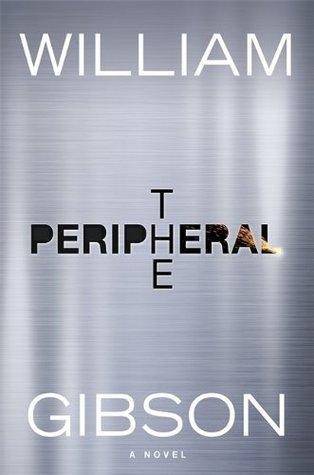
The Peripheral by William Gibson: Book Summary
Overview unavailable.
The Peripheral Introduction
- Introduces William Gibson’s dystopian science-fiction novel, centered on two interconnected futures, time travel, digital consciousness, and Flynne Fisher’s role in a reality-spanning conflict.
- Highlights major themes including technological innovation, social decay, identity, trauma, human nature, and the consequences of individual choices.
- Provides biographical background on Gibson, including his cyberpunk influence and landmark novel Neuromancer.
- Includes a comprehensive chapter-by-chapter contents list covering 124 titled sections.
- Begins the chapter summaries with “The Haptics,” introducing Flynne, her veteran brother Burton, haptic technology, trauma, family history, and the blurred boundary between gaming and reality.
Trauma, Technology, and Spectacle
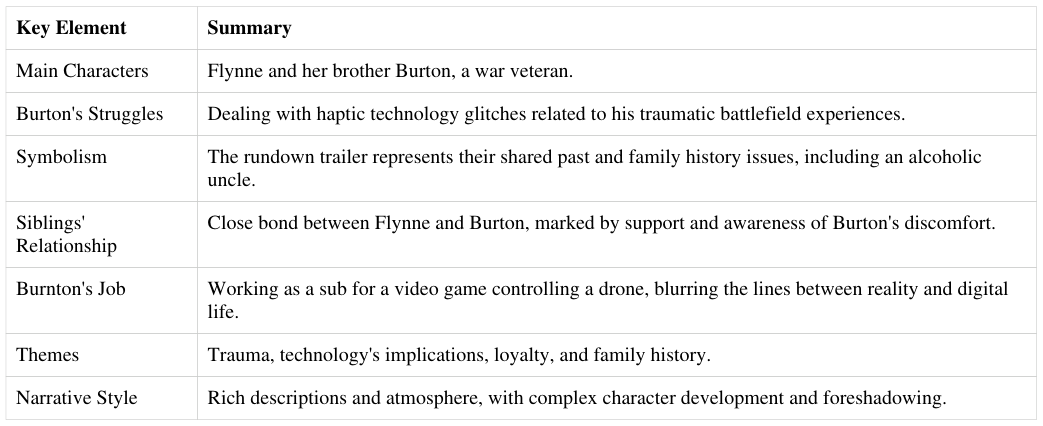
- Flynne and Burton’s close sibling bond is shaped by Burton’s war trauma, disability, and haptic glitches that revive battlefield sensations.
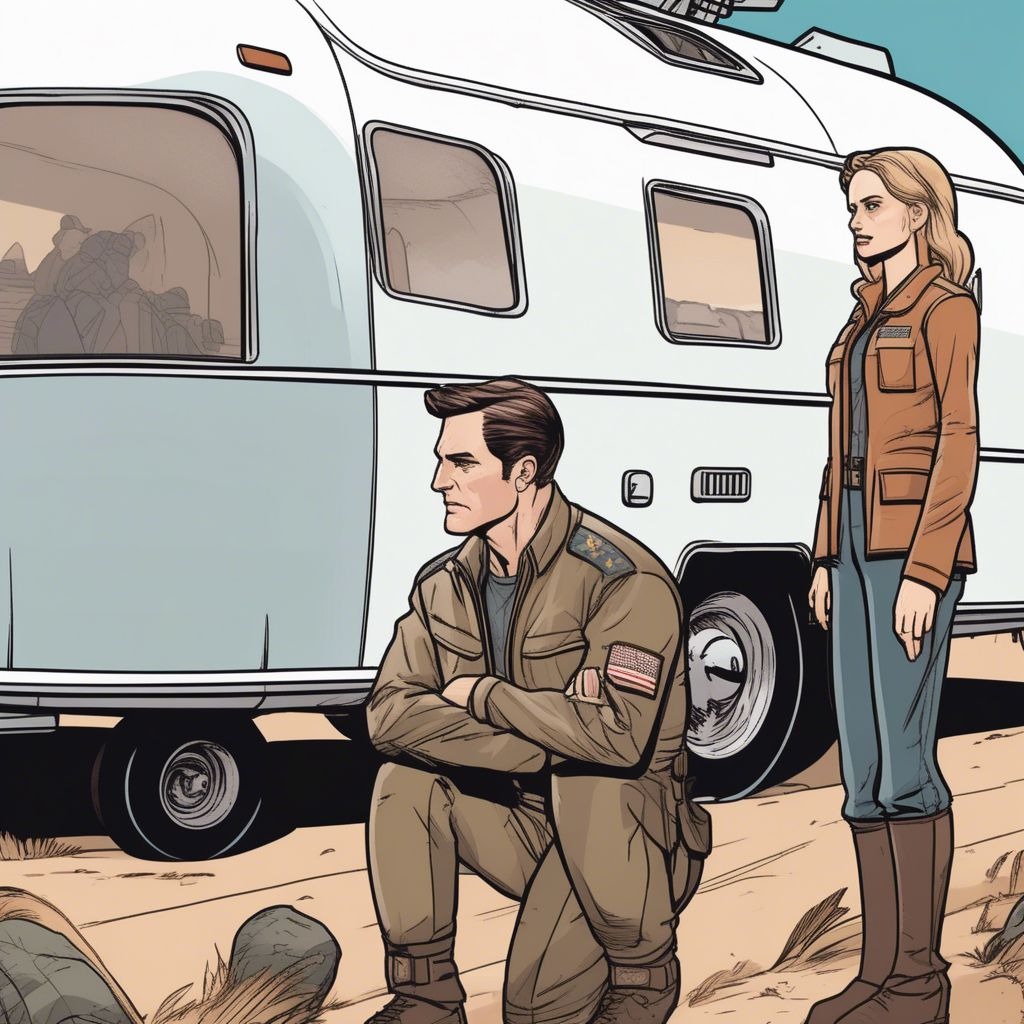
- The rundown Airstream trailer embodies the siblings’ shared childhood, difficult family history, and Burton’s struggle to remain connected to the world.
- Burton’s drone-control job introduces the novel’s blurred boundary between physical reality and digital experience, while drawing Flynne toward greater danger.
- In Wilf Netherton’s futuristic world, even ordinary routines are technologically managed, and a hangover is quickly overtaken by an urgent crisis involving celebrity Daedra West.
- Daedra’s unauthorized tattoos threaten a major project backed by Saudi interests, revealing how celebrity choices become entangled with cultural expectations, corporate power, and relentless public scrutiny.
- Together, the chapters suggest that technology and mass mediation magnify private decisions and personal trauma into wider social and political consequences.
This job reveals the blurred lines between reality and digital life, setting the stage for larger themes of technology and its implications.


Identity, Family, and Art
- Flynne worries that Burton’s fascination with the extreme group Luke 4:5 is pulling him toward dangerous influences, while Shaylene romanticizes his military past.
- Her anxiety about Burton and the town’s darker currents contrasts with the ordinary routines of gaming, though the appearance of his tomahawk adds an ominous edge.
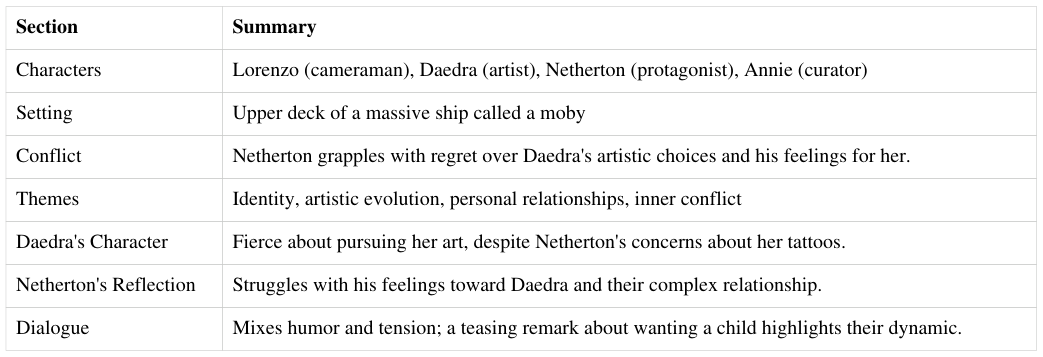
- Netherton struggles with regret and discomfort as Daedra embraces a bold artistic identity symbolized by her new tattoos.
- Daedra defends her commitment to art, while Annie’s description of her confidence as “so deeply earned” frames her transformation as hard-won growth.
- The playful, tense exchange between Netherton and Daedra reveals a complicated bond shaped by attraction, deception, past choices, and unfulfilled possibilities.
“so deeply earned.”
Surveillance and Patchwork Cities
- Flynne returns to her surveillance work, grounding the high-tech setting in gritty routines such as using Burton’s composting toilet and eating jerky with a Red Bull.
- She observes mysterious drone-like “dragonflies” swarming the fifty-sixth floor, alongside other anomalies that make the city increasingly strange and unpredictable.
- Shadows behind frosted glass briefly stir Flynne’s imagination, contrasting human intimacy and desire with the cold monotony of her assignment.
- Flynne’s call with Burton reveals that the supposed game is evolving into something closer to a security operation, reinforcing her sense of duty to her brother over personal invitations.
- Lorenzo and Netherton approach “Moby,” an eerie floating city made from Pacific garbage, while Daedra prepares for a risky mission amid hovering cameras and the mysterious patchers.
This eclectic place, more of an art installation than a city, is crafted from layers of plastic and other materials, symbolizing both beauty and the environmental crisis.
Technology Amid Decay
- The patchers’ grotesque, human-like forms embody the consequences of pollution and environmental neglect, provoking both curiosity and revulsion.
- Lorenzo’s discomfort raises questions about whether beauty can emerge from ecological decay, while also leaving room to recognize resilience and innovation in damaged communities.
- Flynne conducts a high-stakes surveillance operation, using Burton’s technology to observe a private gathering through drones and bugs.
- The gathering is attended only by remarkably fast, efficient robots, emphasizing the tension between technological spectacle and ordinary human experience.
- An ethereal woman in a shifting dark dress captivates Flynne and briefly mesmerizes the robots, while Flynne’s hostility toward the bugs reveals her competing desire for knowledge, control, and privacy.
The woman has an ethereal quality, her dark dress changing in response to her movements, almost merging with the shadows around her.
Grotesque Power Struggle
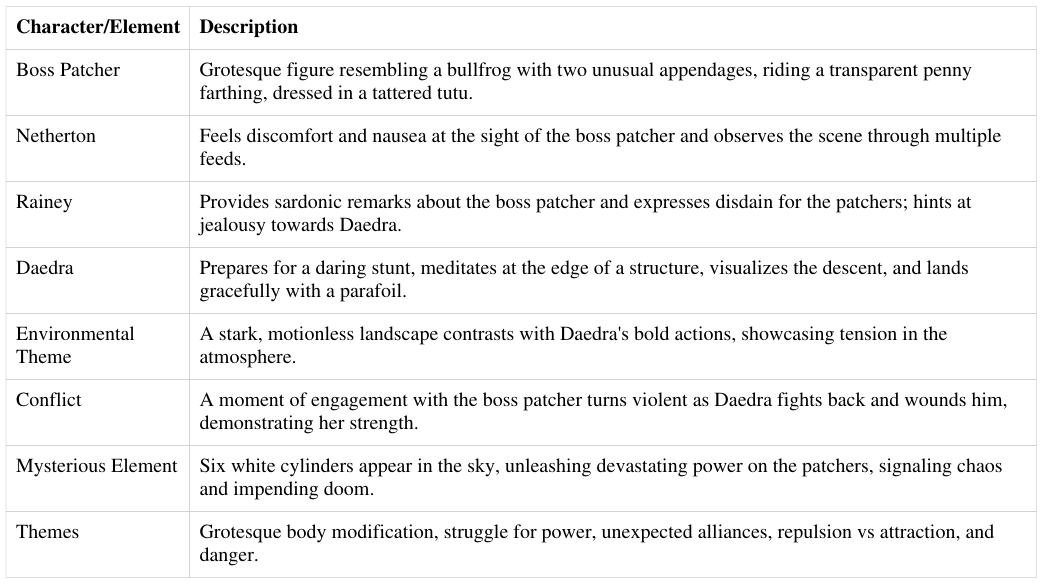
- The boss patcher is depicted through grotesque body modification, absurd clothing, and a bizarre penny-farthing, provoking Netherton’s disgust and Rainey’s sarcasm.
- Daedra performs a daring parafoil descent, establishing her as poised, physically capable, and radically self-possessed within a stark, motionless landscape.
- Tension between Rainey and Daedra surfaces through banter about Daedra’s nudity and tattoos, suggesting attraction, jealousy, and unstable alliances.
- Daedra’s confrontation with the boss patcher turns violent, and she wounds him, demonstrating her strength while intensifying the chapter’s struggle for power.
- Six mysterious white cylinders suddenly attack the patchers, transforming the scene into chaos and signaling a larger, potentially catastrophic threat.
Six white cylinders appear in the sky, unleashing devastating power on the patchers.
Surveillance and Political Danger
- In London, the protagonist’s efforts to detect surveillance and her suspicion of her phone reveal a world shaped by paranoia, hidden monitoring, and blurred boundaries between technology and reality.
- The contrast between the artificial, grid-like “Game London” and the varied architecture of the real city highlights the tension between manufactured experience and authenticity.
- Leon’s revelation that Homes is being held in “protective custody” after an outburst raises questions about secretive power structures, personal agency, and the danger surrounding ordinary relationships.
- Netherton and Rainey confront the fallout from their connections to Daedra and an international assassination plot, realizing that their professional and personal lives are now liabilities.
- Rainey urges a complete break and discretion, leaving both characters caught between political danger, compromised loyalties, and the fragile hope of survival.
The chapter pulsates with tension and a sense of urgency, revealing a vast web of relationships as she navigates a murky world of protective custody, hidden agendas, and personal stakes.
Trauma, Memory, and Connection
- Flynne’s search for Macon at Forever Fab is shaped by anxiety over his well-being and by Shaylene’s concerns about how he is coping.
- Through Burton and Conner, Flynne reflects on how military service and severe injury can transform veterans, their families, and old friendships.
- Ordinary routines—breakfast at Jimmy’s, family memories, and work at the shop—create an intimate contrast with the darker effects of war and trauma.
- The chapter acknowledges that veterans’ recovery experiences vary widely, presenting Gibson’s portrayal as one powerful perspective within a much broader reality.
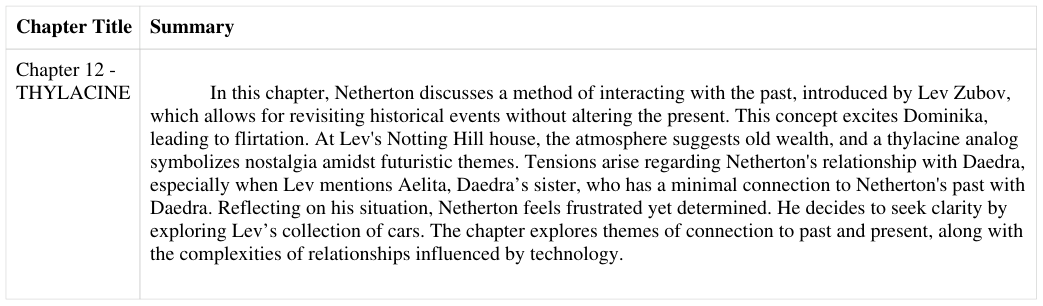
- Netherton introduces Dominika to a technology that can revisit the past without changing the present, while Lev’s house, collection, and thylacine analog connect futuristic possibilities to nostalgia and complicated relationships.
This ghostly connection excites Dominika, leading to a flirtatious moment as they discuss the implications of such technology.
Connections Across Worlds
- Netherton reflects on his strained connection with Daedra, finding relief when he learns Aelita retains a minor link to their shared technology.
- Lev’s interest in genetics, history, and the extinct thylacine ties nostalgia to the book’s futuristic concerns and symbolizes lost possibilities.
- Seeking clarity amid relationship turmoil, Netherton turns to Lev’s car collection and resolves to adapt to his changed circumstances.
- Flynne enters a dreamlike, technologically rendered world where time, age, and reality become difficult to distinguish.
- Her observations of the virtual city and its mysterious woman trigger memories of betrayal, lost comrades, and traumatic experiences in competitive gaming.
- The chapter links memory and identity, suggesting that digital environments can both reproduce past wounds and unsettle the boundaries of human connection.
You stand before the mirror, readying yourself; but in that moment, you remember a time
Trauma, Indulgence, and Duty
- Flynne’s movement between gaming and lived experience is presented as a struggle over identity, memory, and the lasting effects of betrayal and trauma.
- The text questions whether virtual environments help people recover and connect, invoking Sherry Turkle’s argument that technology can instead intensify isolation.
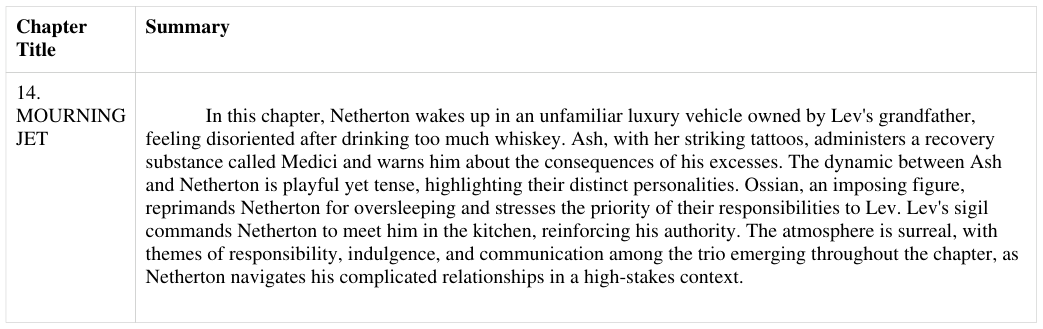
- In Chapter 14, Netherton wakes disoriented in Lev’s grandfather’s luxury vehicle after drinking too much whiskey.
- Ash gives Netherton the recovery substance Medici, while their playful but tense exchange reveals both her distinctive personality and the consequences of his excess.
- Ossian’s reprimand and Lev’s commanding sigil reinforce that responsibility to Lev must take precedence over indulgence, deepening the trio’s strained dynamic.
- The surreal garage setting—watched by Ossian and illuminated by flickering lights—heightens the chapter’s atmosphere of unease and disorientation.
Light flickers in response to his movement, amplifying the surreal atmosphere of the place.
Indulgence, Threat, and Obligation
- Netherton’s hangover symbolizes the consequences of excess, emphasizing that personal indulgence creates obligations and repercussions for others.
- The discussion of responsibility raises questions about whether accountability around substance use is universal or shaped by cultural and social expectations.
- Flynne’s decaying Halloween pumpkin evokes the passage of time and the loss of things she once valued.
- While piloting a quadcopter through a high-rise, Flynne encounters a transforming entity that unleashes a terrifying, seemingly invasive attack.
- Lev’s conversation with Netherton links family duty, Anton’s addiction recovery, advanced surveillance, and growing fears surrounding Aelita West’s safety.
The man is taken by surprise as the woman becomes a target for the unseen threat, her horror culminating in the destructive invasion of her body.
Threats and Uneasy Connections
- Lev and Netherton discuss Anton’s treatment, revealing the family’s struggle with anger, addiction, and difficult intervention.
- Aelita West’s canceled lunch and heightened security suggest a possible criminal threat connected to Netherton’s project and past.
- Surveillance technology becomes both protection and a source of unease, reinforcing the characters’ uncertainty and lack of control.
- In Chapter 17, Flynne feels alienated at Jimmy’s while seeking Macon’s advice about the phone Homes made for her.
- Flynne’s concerns about Burton and Conner’s escalating behavior draw her into a tense confrontation, showing her instinct to protect others despite her own anxiety.
The atmosphere is filled with the smell of alcohol and young energy.
Secrets Across Time
- Flynne’s confrontation with Conner highlights her courage, family loyalty, and growing maturity amid an atmosphere of violence and vulnerability.
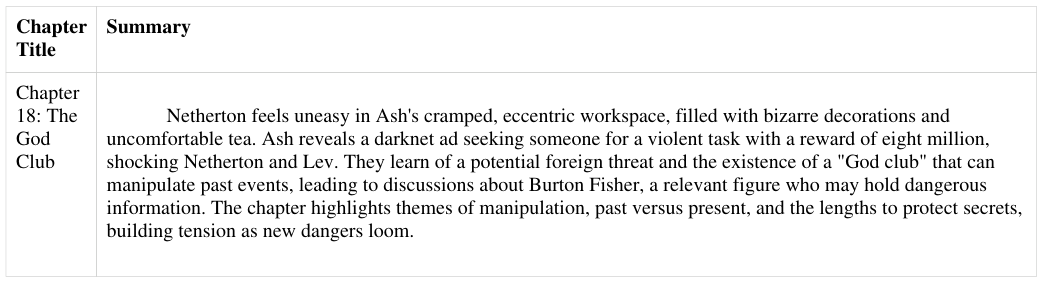
- Netherton feels uneasy in Ash’s cramped, bizarre workspace, where strange artifacts and dreadful tea create an unsettling mood.
- Ash reveals a darknet advertisement offering eight million for a likely violent task, suggesting that powerful and dangerous forces are moving in secret.
- The “God club” appears capable of influencing the past, raising the frightening possibility that historical events can threaten the present.
- Burton Fisher becomes a crucial target because he may possess information capable of compromising someone’s security, intensifying the mystery and the characters’ urgency.
The atmosphere is a blend of the bizarre and the uncomfortable, highlighted by the dreadful tea served in delicate, handle-less cups.
Reality’s Dangerous Threads
- Ash’s revelation that an advertisement seeks violence against someone close to Flynne makes the past feel like an immediate, personal threat.
- Flynne spots an aquamarine-taped drone and realizes Leon and Burton may have returned, while Burton’s need for a serious conversation heightens her unease.
- Burton reveals that Coldiron has warned of a hit on him connected to Flynne’s disturbing experience in the game, where she witnessed a woman being killed by nanotechnology.
- The possibility of a ten-million-dollar payout exposes the game’s real-world stakes and deepens the uncertainty between virtual events and physical consequences.
- Chapter 20 shifts to Netherton in Lev’s grandfather’s land-yacht, where he prepares to contact a mysterious polt while questioning its humanity and his own manufactured role.
The chilling detail of a woman being "eaten alive" weighs heavily on her.
Trust Under Threat
- Lev’s strategic but tense exchange with the polt reveals a complicated network involving an injured cousin, religious ties, assassins, and competing claims to self-worth.
- The polt seeks financial security for himself and his sister, while a proposed legitimate-lottery scheme forces Netherton to confront the alliance’s ethical ambiguity.
- Netherton recognizes that the polt is more shrewd than Lev, and the waiting call from the polt’s sister signals that their unconventional partnership has become serious.
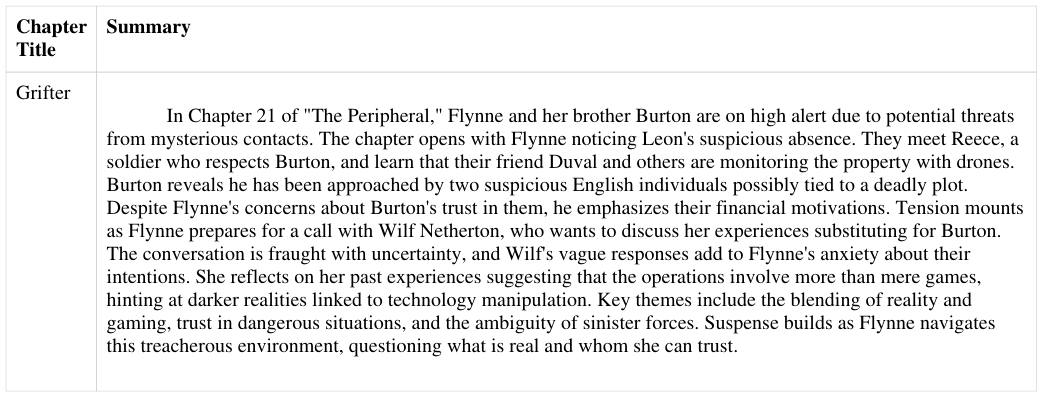
- Flynne and Burton remain on high alert as Leon disappears, drones monitor the property, and two suspicious Englishmen appear connected to a potentially deadly plot.
- Flynne’s uneasy conversation with Wilf blurs the boundary between gaming and reality, suggesting that the technology may be manipulating people as well as events.
Flynne expects this conversation might involve some "game," stirring her anxiety and skepticism about the intentions of those involved.
Timelines, Technology, and Fear
- Netherton and Flynne discuss memories and sensory traces from their separate timelines, highlighting how technology connects distant worlds.
- Flynne recounts encountering a strange, moving gray backpack whose sinister presence appears tied to a woman’s horrific fate.
- The conversation emphasizes surveillance, overlapping realities, and the way technology can function as both a tool and a source of danger.
- Flynne struggles with the emotional aftermath of witnessing violence, underscoring the fragility of life across these interconnected worlds.
- In bed and later at home, Flynne reflects on the increasingly real game, threats against Burton, Conner’s disturbing Tarantula scene, and her mother’s declining health.
The image of a tragic event hangs over them, reflecting the harsh realities shaped by their worlds.
Solace Amid Intrigue
- Flynne seeks comfort and distraction in Burton’s oversized sweatshirt, her bed, and a drone-game app after feeling emotionally drained.
- The drones’ intricate Celtic-knot formation gives Flynne a fleeting sense of beauty, order, and calm amid the chaos surrounding her.
- Her near-sleep is disrupted by the disturbing sight of clothing falling into the street, reminding her that danger remains close and unresolved.
- The scene emphasizes Flynne’s isolation, resilience, and reliance on technology as both a refuge and a symbol of the complex dangers affecting her life.
- In Chapter 24, Lev, Netherton, and Ash engage in tense strategic discussions involving a possible abduction, financial pressure, family resources, and the use of quantitative analysts to gain control.
She visualizes a satellite image of their property and watches the twenty drones moving in intricate, ballet-like formations to create a Celtic knot pattern above her.
Surveillance and Interrogation
- Netherton observes Ash’s strategic manipulation as a tense meeting grows more complex, culminating in the police being called and the legal stakes rising.
- Flynne worries about Conner’s dangerous behavior while Burton and Leon’s secretive activities hint at larger games involving advanced technology.
- Flynne consults Macon and Edward about Conner’s strange trike-linked device, confronting the risks of technology whose purposes remain opaque.
- Surveillance drones and blimps reinforce Flynne’s paranoia and her struggle to protect personal connections amid mounting threats.
- Detective Inspector Ainsley Lowbeer interrogates Lev and Netherton about Aelita’s disappearance, the alternate-timeline technology called continua, and their tangled relationships with the West sisters.
As Flynne leaves the snack bar, she notices surveillance drones, the blimps in the sky making her acutely aware of the constant watchfulness surrounding her.
Surveillance and Dead Men
- Lowbeer’s investigation exposes a tense power struggle, as her authority and surveillance tactics leave Netherton feeling scrutinized and potentially outmaneuvered.
- Netherton’s admission about a witness to Aelita’s final moments deepens the mystery while highlighting themes of loss, manipulation, and uncertain loyalties.
- The existence of alternate timelines or “stubs” complicates reality, identity, and the consequences of actions across different worlds.
- The chapter presents authority as potentially manipulative rather than inherently just, inviting questions about surveillance, control, and hierarchical power.
- Chapter 27 begins with Flynne learning of execution-style murders involving unidentified armed men; she joins Burton at the crime scene, where drones swarm to map and analyze the area.
The chapter closes on an ominous note, as Netherton senses he may have been outmaneuvered in their interaction with Lowbeer, revealing their vulnerability in the face of authority.
Violence and Artificial Selves
- Flynne witnesses a meticulously managed crime scene where horrific violence intrudes upon an apparently peaceful rural setting, exposing the fragile boundary between safety and danger.
- Tommy suggests the victims were ambushed while preparing violence themselves, while Burton confirms they were dangerous Nashville criminals known as “ugly ones.”
- Flynne’s decision to remain at the scene reflects her growing curiosity and bravery, even as she struggles to process how profoundly violence has disrupted her ordinary life.
- Lev and Netherton visit Lev’s father’s house, the “house of love,” which evokes painful family memories and reveals Lev’s resentment toward his parents and their expectations.
- The house contains advanced “pre-owned peripherals,” including a female model designed to resemble someone’s sister, emphasizing the novel’s recurring questions about technology, identity, and emotional substitution.
The intention is to help the actual person acclimatize to a new identity.
Peripherals and Pressure
- Milagros Coldiron wrestles with anxiety after a tense encounter involving Tommy and Conner, while her brother Leon’s sudden lottery win adds surreal instability to the morning.
- Netherton contacts Milagros about a secretive, urgent drone operation, forcing her to balance technical questions with humor and suspicion.
- Their conversation intertwines personal turmoil with larger crises, hinting that Milagros’s work is connected to deeper conflict and danger.
- On Lev’s yacht, Netherton and Lev treat the humanoid peripheral as both a machine and an unsettling presence, raising questions about identity and artificial existence.
- Netherton’s attempt to care for the peripheral is interrupted by Rainey, whose accusations about neglected messages and a workplace fallout intensify the surrounding tension.
The chapter builds tension as Milagros contemplates the implications of the work Netherton is proposing and her brother's unexpected lottery windfall.
Innovation Under Threat
- Flynne, Macon, Shaylene, and Edward debate a mysterious hardware contract that appears to involve gaming technology but may conceal medical or espionage-related purposes.
- The group recognizes the project’s ethical and legal ambiguity, yet their curiosity and camaraderie lead them to accept the risky opportunity.
- Burton’s sudden lottery win and absence from the meeting deepen suspicions about the job and its hidden connections.
- Netherton travels through London with a peripheral resembling Rainey while rumors spread that he was involved in Aelita’s death.
- Lowbeer warns Netherton that an armed peripheral has been hired to kill him, and a sudden gunshot turns their tense meeting into an immediate crisis.
Just as she is about to leave, carrying a ceremonial tipstaff that transforms into a weapon, chaos erupts—a gunshot fires from across the market, and screams fill the air.
Rumors, Violence, and Machines
- Netherton’s sense of safety collapses as rumors and possible investigations turn ordinary surroundings into a threatening web of danger.
- The chapter emphasizes how misinformation can produce real-world consequences, linking personal vulnerability to broader societal instability.
- Leon’s lottery win provides comic relief while revealing his generosity toward his family and his irreverent, unpredictable personality.
- Flynne reflects on Conner’s apparent violence and contrasts his methods with Burton’s, highlighting competing approaches to survival and conflict.
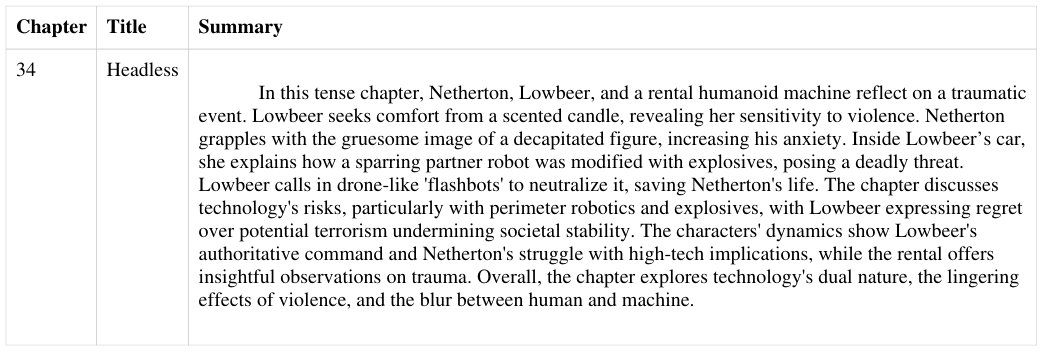
- Lowbeer, Netherton, and a humanoid rental confront the aftermath of an explosive robot attack, exposing the lethal risks of advanced perimeter technology.
- The characters’ reactions to trauma blur the boundary between human and machine while underscoring technology’s capacity both to protect and to destroy.
“The impending threat of violence becomes palpable, transforming the mundane backdrop of your reality into a web of danger, where your very existence feels precarious beneath the facade of a technological utopia.”
Trauma, Technology, and Choice
- Lowbeer reveals that a modified sparring robot was turned into an explosive weapon, while flashbots intervene to save Netherton’s life.
- The encounter highlights technology’s dual nature: perimeter robotics can protect society but can also enable terrorism and destabilizing violence.
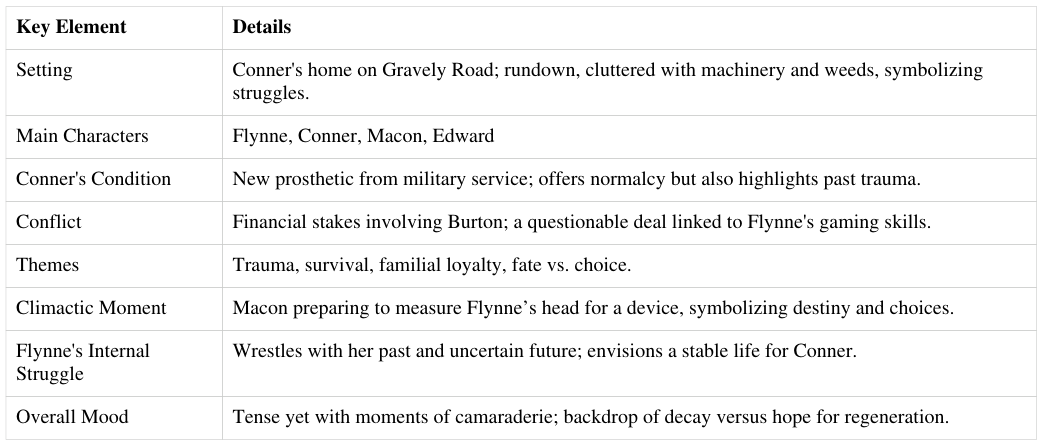
- At Conner’s decaying home, Flynne encounters his military prosthetic, which offers practical normalcy while keeping his trauma visibly present.
- Flynne learns that Burton’s precarious financial deal depends on her gaming abilities, drawing the family into a larger and uncertain conflict.
- Macon’s preparation to measure Flynne’s head becomes a symbolic moment as she weighs fate against choice and imagines a more stable future for Conner.
The house is rundown, cluttered with old machinery and junk overtaken by weeds, and this setting reflects the struggles of its inhabitants.
Beauty, Corruption, and Survival
- Lev recounts how their father, Anton, violently destroyed a peripheral, exposing his shame, rage, and sense of failure.
- Netherton is captivated by the peripheral’s graceful movement, seeing beauty and meaning beyond mere usefulness, while Lev shares troubling news about Fitz-David Wu and their grandmother’s fading memory.
- Flynne confides in Janice about Conner, the dead bodies, and the drones; Janice connects these events to Beatty and a hidden stash of money.
- The money leads back to Corbell Pickett, whose influence over drugs and local law enforcement reveals the corruption underlying the county’s apparent solidarity.
- Flynne struggles to remain a “good person” while protecting her family, confronting the compromises, silence, and loyalties demanded by survival; meanwhile, Flynne’s approaching visit intensifies tensions between Netherton and Ash.
As they watch the peripheral run on a treadmill, Netherton admires its beauty and movement, which feels more meaningful than mere functionality.
Deception and Dangerous Technology
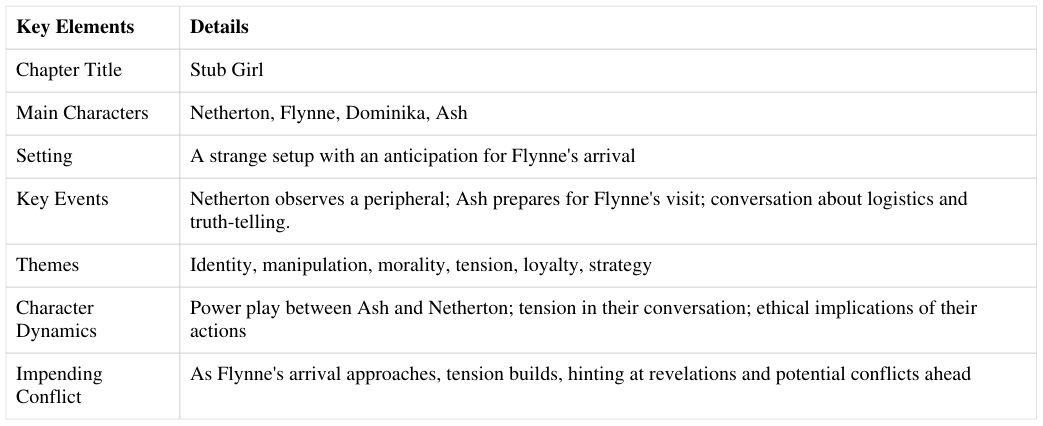
- Ash and Netherton prepare for Flynne’s arrival, struggling to create a welcoming setting while concealing the unsettling truth about peripherals and their plans.
- Netherton debates whether honesty, financial compensation, or strategic deception is the fairest way to handle Flynne, whose lack of knowledge leaves her vulnerable to their greater power.
- Ash focuses on practical details such as clothing and Lowbeer’s influence, revealing a tense power struggle shaped by competing loyalties and hidden agendas.
- Flynne and her companions prepare for a dangerous mission involving a device that lets her control something remotely without moving her body, highlighting the technology’s military potential.
- The characters’ banter conveys camaraderie, but the looming threats and Flynne’s difficult home circumstances give the mission an atmosphere of secrecy and danger.
As the clock ticks down to Flynne's arrival, the tension builds, setting the stage for revelations and potential conflicts in the chapters ahead.
Crossing Into Zero
- Netherton prepares for Flynne’s arrival, dressing in Ash-provided clothes while marveling at the vehicle’s advanced water-recycling technology.
- Ash presents a peripheral resembling Flynne, highlighting the strange mechanics of identity and embodiment across timelines.
- Netherton insists on personally greeting Flynne, revealing his sense of responsibility and the evolving tension and trust between him and Ash.
- Macon and Edward guide Flynne into a telepresence system, where reaching zero transforms her experience and places her inside an unfamiliar anthropomorphic drone.
- Flynne struggles with disorientation, altered vision, and the sight of her unfamiliar reflection as the chapter explores the unstable boundary between physical identity and virtual reality.
When she reaches zero, an unexpected sensation hits her; she's not herself anymore.
Identity in the Peripheral
- Immersive technology transforms the user’s perception and body, creating uncertainty about how much of the self exists in a virtual realm.
- Flynne’s peripheral becomes more humanlike as she controls its body language, unsettling Netherton while demonstrating the merging of technology and humanity.
- Flynne questions the reality of her surroundings and suspects that outside forces have manipulated her life, including the lottery and violence targeting her family.
- The conversation between Flynne, Ash, and Netherton exposes a future world whose interference has altered Flynne’s reality.
- The chapter ends with Flynne caught between fear and curiosity, reinforcing the blurred boundary between game and reality.
Suddenly, you’re no longer bound by the limitations of your previous identity; vibrant colors dance before your enhanced vision, and your hands, now robotic, seem to move independently, almost mischievously.
Peripherals and Manipulation
- The advanced peripheral replicates a person’s movements and emotions so convincingly that it raises unsettling questions about whether human identity can be digitized without losing its essence.
- Flynne discusses the peripherals with Janice, describing them as body-like extensions with built-in phones while expressing both excitement and apprehension about the future they reveal.
- Their conversation explores altered animals, the uncertain boundary between reality and simulation, and the dangers of information moving across timelines.
- Flynne faces financial complications, hired assassins, and shifting alliances, but Janice’s support reinforces her need to assert herself amid the chaos.
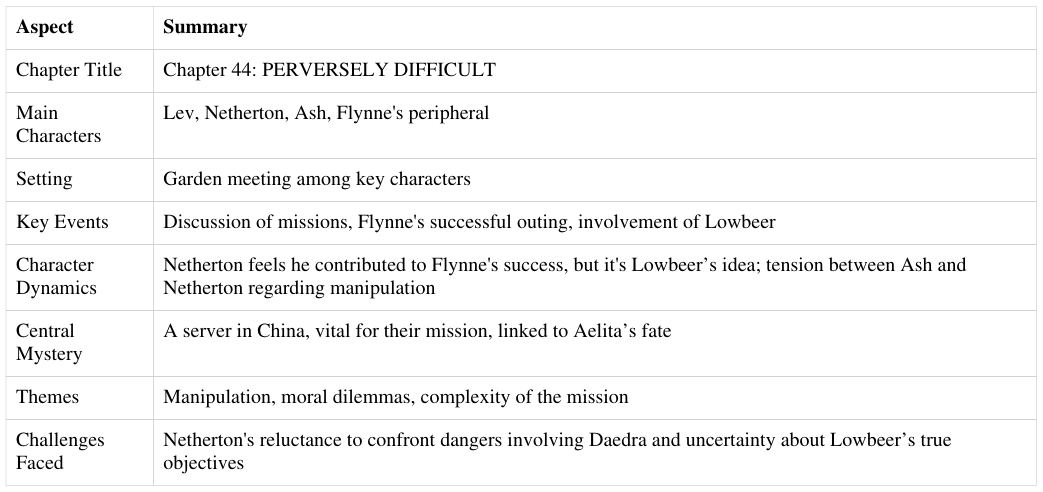
- In the garden meeting, Lowbeer’s influence becomes central: Netherton’s apparent success is largely hers, while tensions over manipulation and a crucial Chinese server deepen the mission’s moral and strategic uncertainty.
You feel a sense of dread as this replica, supremely advanced yet profoundly different from your friend, mirrors their movements and emotions.
Manipulation Across Time
- Netherton seeks clarity about Lowbeer’s agenda and learns that she wants to discover what happened to Aelita and who is responsible.
- The investigation depends on a mysterious server believed to be in China and may require confronting Daedra’s group, making the mission dangerously difficult.
- Netherton’s reluctance reflects the chapter’s larger concerns with manipulation, moral uncertainty, and the risks of pursuing hidden knowledge.
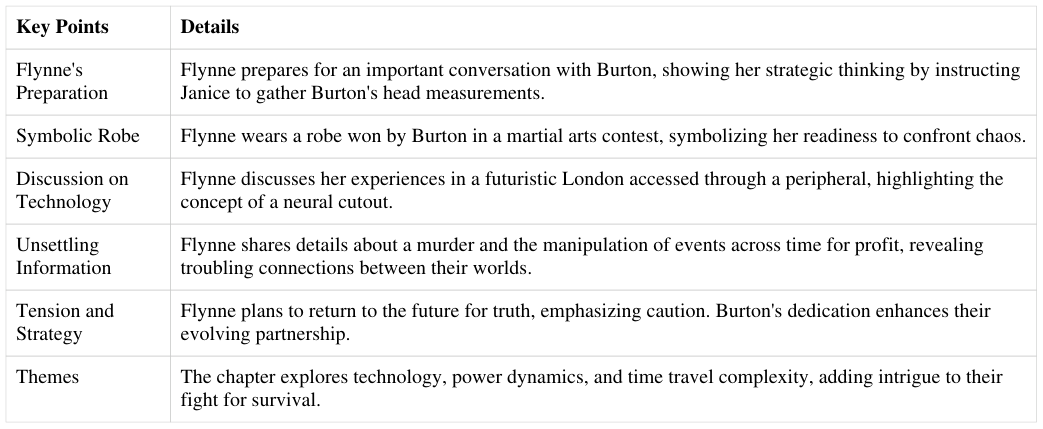
- Flynne strategically prepares for a crucial conversation with Burton, while Burton’s martial-arts robe symbolizes her readiness to face the chaos ahead.
- Flynne’s account of peripherals, neural cutouts, murder, and time being manipulated for profit reveals how deeply the future’s technology and power are entangled with the present.
The looming mystery of Aelita weighs on your conscience as you grapple with the implications of the powerful forces at play.
Simulated London, Real Danger
- Flynne awakens in her peripheral body and explores a technologically advanced future with Lev and Ash, adjusting to her altered appearance and unfamiliar customs.
- Aerial views of London reveal lush landscapes, empty streets, historical recreations, and simulated horses, blurring the boundary between lived memory and artificial reality.
- Flynne’s nostalgia for Cheapside clashes with the revelation that much of what she sees is manufactured, deepening the chapter’s focus on simulation and perception.
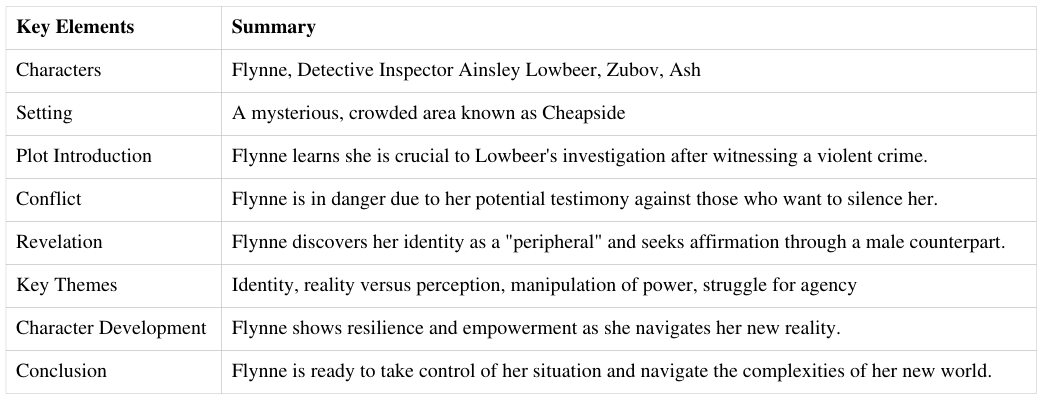
- Detective Inspector Ainsley Lowbeer tells Flynne that she witnessed a violent crime and is now a crucial—and endangered—witness in the investigation.
- The developing conflict links technology to power and identity, as Flynne struggles to understand her status as a peripheral while preparing to claim agency in a dangerous new world.
Flynne is surprised by her new appearance—her sleek haircut and seamless clothing, which she acknowledges feel like yoga pants.
Identity Amid Manipulation
- Flynne confronts the uncertain status of her peripheral existence and seeks a male equivalent to validate her experiences in her home world.
- Lowbeer reveals Zubov’s plans to manipulate the economy and create chaos, while Flynne agrees to serve as a witness and asserts her need for greater control.
- Flynne’s reflection on the peripheral body highlights the chapter’s tension between identity, bodily unfamiliarity, and unexpected comfort.
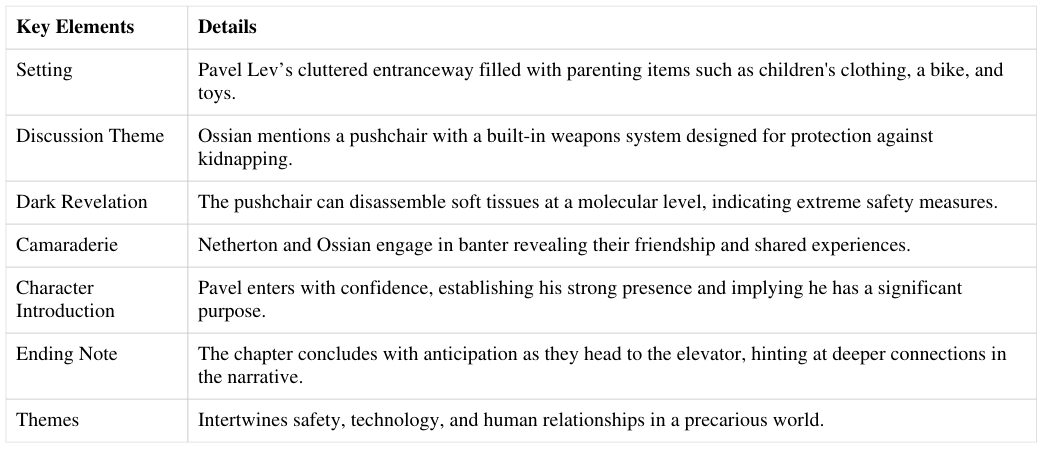
- Chapter 48 shifts to Pavel Lev’s cluttered home, where Netherton and Ossian’s banter introduces a dangerous pushchair equipped with molecular-level defensive technology.
- Together, the chapters explore agency, social recognition, gendered validation, and the unsettling fusion of advanced technology with ordinary human relationships.
She takes a moment for herself, examining the body of her peripheral in a mirror and noticing its distinct features, understanding better that this body isn’t hers yet feels comforting.
Awakening Into Freedom
- Netherton and Ossian’s banter reveals both their camaraderie and the dangers of a world where even baby equipment can disassemble soft tissue.
- Pavel’s arrival introduces a confident, ominous figure and heightens anticipation about the characters’ hidden connections and larger mission.
- Flynne, Ash, and Ossian help Conner, an AI peripheral designed for sparring, adjust to a newly awakened body despite the hostility surrounding his past.
- Conner’s astonishment at his new fingers and his ecstatic dash from the RV frame technological transformation as a kind of rebirth and liberation.
- The chapter raises questions about whether an AI’s exhilaration represents genuine freedom or merely a convincing experience produced within digital constraints.
He screams and whoops as he runs free, relishing his newfound physical form.
Reality and Political Intrigue
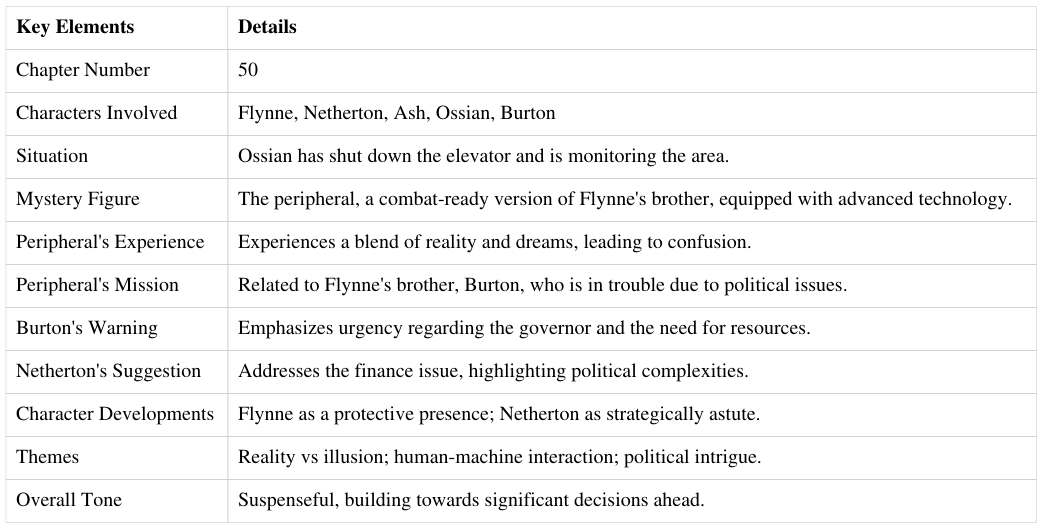
- Flynne, Netherton, Ash, and Ossian monitor a mysterious combat-ready peripheral modeled on Burton, heightening the chapter’s suspense.
- The peripheral’s experience blurs dreams and reality, raising questions about machine consciousness, identity, and whether technology can reproduce genuine human experience.
- Flynne takes on a protective, reassuring role as the peripheral struggles to understand its existence and mission.
- Burton’s political troubles involving the governor create an urgent need for resources and decisive action.
- Netherton recognizes that the financial problem must be confronted directly, revealing strategic insight amid complex political entanglements.
As the peripheral begins to move, it experiences sensations that blend reality and dreams, leading to confusion about its own existence.
Reality Under Fire
- Flynne and Conner struggle to stay grounded as technology blurs the boundary between bodies, peripherals, and reality.
- A sudden shooting near the property reveals that their plans are attracting dangerous outside forces, possibly connected to the statehouse.
- Flynne remains focused on raising money to buy the governor while protecting her family and keeping Burton informed.
- Netherton, Lowbeer, Lev, and Ash begin shaping a larger strategy, with Flynne positioned as essential to its success.
- Conner’s self-doubt and past mistakes surface, but he is drawn into the mission as the group faces mounting responsibility and risk.
As she prepares to take care of personal business, gunfire erupts nearby, heightening the tension.
Privilege and Espionage
- Flynne and her companions meet in Lev’s lavish home, where ordinary domestic spaces contrast with immense wealth and elaborate decor.
- Lowbeer devises a plan to gather intelligence at Daedra West’s gathering and locate the elusive Remembrancer.
- Netherton must draw on connections from his troubled past to secure an invitation, while Flynne becomes his “plus one.”
- Flynne’s confusion about the absence of recorded footage exposes the sharp differences between her society and the privacy-conscious world she has entered.
- The chapter explores privilege, surveillance, and manipulation as the characters navigate danger, divided realities, and the emotional stakes of returning home.
The atmosphere lightens when they share drinks, although discussions of danger linger in the air.
Complicated Choices
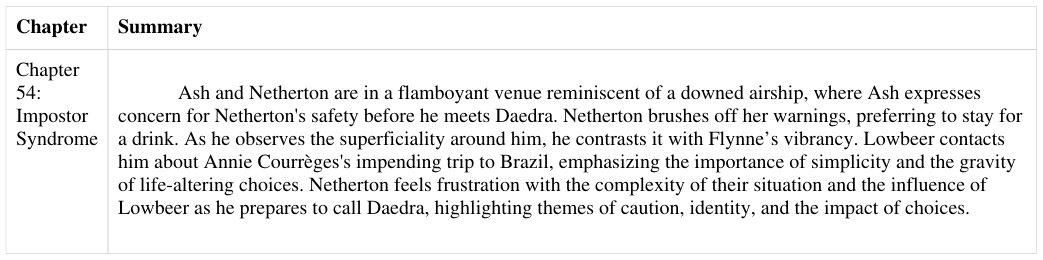
- In a surreal, flamboyant venue, Ash warns Netherton about meeting Daedra, revealing her protective concern and his tendency to dismiss danger.
- Netherton finds the peripheral world hollow and theatrical, contrasting it with the vitality and authenticity he associates with Flynne.
- Lowbeer’s warning about Annie Courrèges’s journey to Brazil emphasizes how seemingly simple decisions can carry irreversible consequences.
- Flynne learns from Deputy Tommy Constantine that two men have been killed near her property, linking the violence to Burton, Corbell Pickett, and dangerous local interests.
- Flynne reveals that she and Burton work for a covert security operation disguised as a game company, while her remote interface and witness to a murder make their situation increasingly precarious.
Despite the bizarre circumstances, she tries to remain calm, adopting a mantra of “Easy Ice.”
Vanished Sister, Fractured Ties
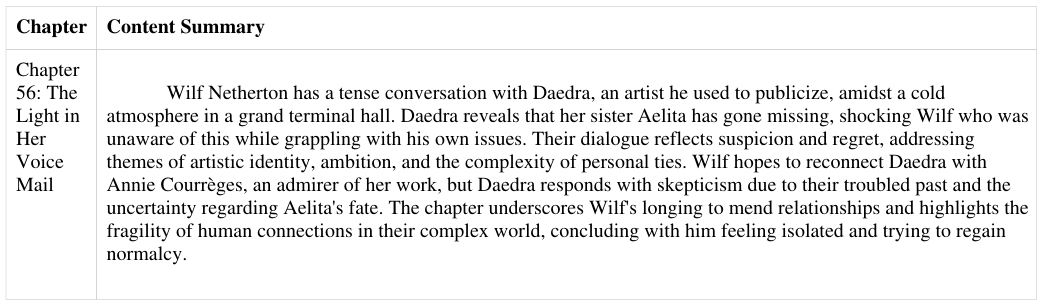
- Wilf Netherton has a tense meeting with Daedra in a cold, unsettling terminal, where their troubled history shapes every exchange.
- Daedra reveals that her sister, Aelita, has disappeared, shocking Wilf and prompting suspicion about his possible connection to the event.
- Their conversation explores artistic identity, ambition, regret, and the damaging overlap between personal and professional relationships.
- Wilf tries to reconnect Daedra with Annie Courrèges, but Daedra remains skeptical because of their past and the uncertainty surrounding Aelita.
- The encounter exposes the fragility of human bonds and leaves Wilf isolated, longing to repair relationships while struggling to return to normalcy.
The atmosphere is heavy and cold as he navigates through a grand yet unsettling terminal hall, hinting at the emotional weight of their exchange.
Class, Family, and Strain
- Wilf’s attempt to mend his relationship with the guarded Daedra shows how unresolved grievances and intertwined personal and professional histories can make reconciliation difficult.
- Flynne navigates a tense gathering at home involving Corbell Pickett, Burton, and Tommy, sensing that Pickett’s wealth and status make his presence there unusual and unsettling.
- Pickett’s visit highlights how wealth disparity shapes identity, social relationships, and feelings of both aspiration and alienation.
- As her mother’s health declines, Flynne assumes a caregiving role while trying to protect her from the men’s uncertain intentions.
- The chapter presents family loyalty, class tension, and past conflicts as forces that complicate connection and intensify uncertainty about the future.
Flynne feels a mix of awe and apprehension, aware that someone like Pickett doesn’t typically belong in their household.
Authority Under Surveillance
- Fitz-David Wu tells Netherton he has been forbidden to drink, prompting resentment and suspicion about who is controlling him.
- Wu reveals an ornate cylinder that transforms into a locket bearing Lowbeer’s stern image, deepening questions about authenticity, deception, and authority.
- Netherton’s actions have triggered statistically anomalous movements that alarm the “aunties,” suggesting an extensive and unsettling surveillance system.
- Wu urges Netherton to leave immediately, while Netherton’s drunken stumble emphasizes the urgency and danger of their situation.
- The chapter presents surveillance as both manipulative and potentially protective, inviting debate over whether authority can ever be trusted as genuine.
With an evident sense of urgency, Netherton downs his whiskey and stumbles slightly, knocking over his chair.
Power, Peril, and Exhaustion
- Flynne confronts the moral cost of accepting money from dubious sources as her family struggles to balance integrity with survival.
- Pickett pressures Flynne for information about Colombian investors, exposing his self-interest and connection to powerful political figures.
- The chapter emphasizes blurred boundaries between legality and crime, while Flynne resists the authority of influential men through intelligence and resilience.
- Netherton, disoriented in a moving windowless room with Wu, struggles to reconstruct his memories and prepare for a meeting involving Daedra West.
- Exhausted by dangerous alliances and surreal experiences, Flynne finds comfort in her sister Janice’s support amid continuing threats.
The combination of themes like familial loyalty, the strangeness of their reality, and the pressing dangers they face creates a vivid snapshot of Flynne’s life at this moment.
Perilous Bonds and Power
- Netherton, physically fragile after his encounter with Lowbeer, is taken into a luxurious but disorienting high-tech vehicle and urged to recover.
- Flynne’s peripheral unexpectedly appears, and the confrontation with Ossian reveals her formidable physical strength and the volatile relationships surrounding Netherton.
- Ash’s use of advanced medical technology to treat Ossian highlights technology’s double edge: it offers remarkable aid while deepening the characters’ sense of unreality.
- The chapter contrasts Netherton’s vulnerability with Flynne’s physicality, emphasizing how danger exposes different forms of strength and dependence.
- Lowbeer’s influence underscores the coercive power of elites and raises questions about how much autonomy the characters retain.
- Chapter 63 begins with Janice warning Flynne that Burton has become sick while experimenting with a device, extending the atmosphere of escalating threat.
The tension escalates when Ossian bursts in, only to be swiftly subdued by Flynne, revealing her formidable physicality.
Technology, Control, and Weapons
- Flynne finds Burton shaken after interfacing with a peripheral version of her, while Conner describes his injuries and urgent need for a custom device.
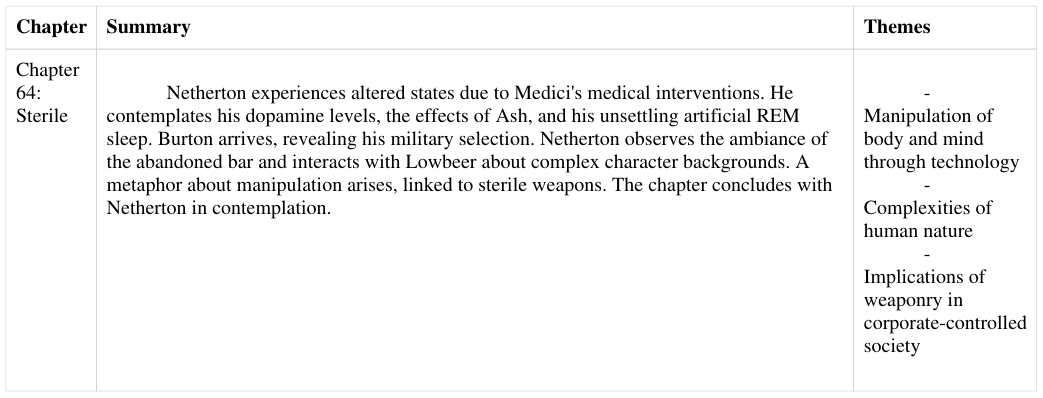
- Netherton struggles with the Medici’s unsettling medical interventions, including altered dopamine levels and artificially induced REM sleep.
- Lowbeer’s conversation with Netherton exposes the complicated histories of Burton and Ossian, emphasizing how human behavior mixes calculation, trauma, and impulsiveness.
- The discussion of a pram and unidentified sterile weapons hints at a covert and potentially devastating plan within the corporate-controlled society.
- Burton reveals that the group has purchased a strip-mall site for a new headquarters, signaling a strategic effort to consolidate operations and evade scrutiny.
Lowbeer reveals that there’s a pram involved, which ties into the sterile weapons they’ve secured without identification.
Into Economic Warfare
- Coldiron USA formalizes the group’s illicit operations as a property-development company, transforming criminal activity into an organized business venture.
- Flynne is unwillingly made Chief Communications Officer while Burton becomes CEO, creating tension over ambition, preparedness, and decisions made without her consent.
- The new headquarters, crowded with hospital beds and equipment, reflects the unsettling clinical nature of the group’s operations and their rapid personal transformations.
- Macon reveals that predatory trading algorithms are contributing to wider economic turmoil, placing the characters within a conflict shaped by powerful, unseen technological forces.
- Changing relationships—particularly between Shaylene and Burton—signal emerging professional maturity as the group balances excitement with fear and uncertainty.
- The chapter questions whether modernization and structured progress are inherently beneficial, emphasizing the ethical risks of entering an economic war they scarcely understand.
The mundane setting of the mall contrasts sharply with the high-stakes drama unfolding as they navigate their futures amidst shadows of uncertainty.
Haunted Living Architecture
- Netherton is guided by Ash and Lowbeer into a disorienting gray environment using a strange forehead device, where he encounters military reconnaissance machines called “drop bears.”
- The surrounding space behaves like a living architecture that consumes anything not created by itself, intensifying Netherton’s fear, discomfort, and mental strain.
- Lowbeer reveals that al-Habib’s death exposed a major strategic failure: he should have been neutralized immediately because he might still pose posthumous threats.
- Al-Habib’s hollowed-out corpse becomes part of the environment, while Lowbeer explains that the scene was a deception designed to help the criminal escape.
- The following chapter shifts to a surreal snack-bar meeting where Macon, Burton, and others negotiate a strip-mall purchase with lawyers, blending ordinary business with an atmosphere of unease and hidden security concerns.
a kind of living architecture that assimilates anything not of its own making.
Surveillance and Hidden Power
- Macon gives the narrator a trackable gel capsule, turning technology into a tool of surveillance and underscoring her limited autonomy.
- Their conversation suggests they are collateral—or pawns—in a vast financial and political game controlled by forces beyond their understanding.
- Macon advises allowing events to unfold, blending resignation, existential dread, and intrigue as the characters confront their precarious agency.
- Netherton recovers from the patchers’ island while Lowbeer exposes deceptive leadership, financial motives, and the tangled identities behind the ongoing conflict.
- Lowbeer casts herself as an “antibody” against wider corruption, while the discussion of al-Habib and Lev deepens the themes of illusion, manipulation, and hidden state agendas.
She positions herself as a protector of sorts, likening her actions to that of an antibody guarding against wider corruption.
Deception and Abduction
- The section centers on the struggle to distinguish truth from deception as characters confront unstable identities, hidden motives, and perilous realities.
- After being tased, Flynne is abducted by Reece, who says Pickett and Burton threatened his life unless he delivered her to them.
- Flynne’s dream of an expansive alternate town suggests a longing for escape, but she awakens to captivity and the grim circumstances surrounding her.
- Lev and Netherton discuss strategic alliances involving Burton, Lowbeer, and a possible operation connected to the first Gonzales administration.
- Flynne’s missing phone and implanted tracker reveal the reach of surveillance, while her disappearance creates urgency and mobilizes Lowbeer’s mysterious assets.
Reece confesses that he's acting under duress from Pickett and Burton, who have threatened his life if he doesn’t bring her to them.
Pickett’s Hostile Estate
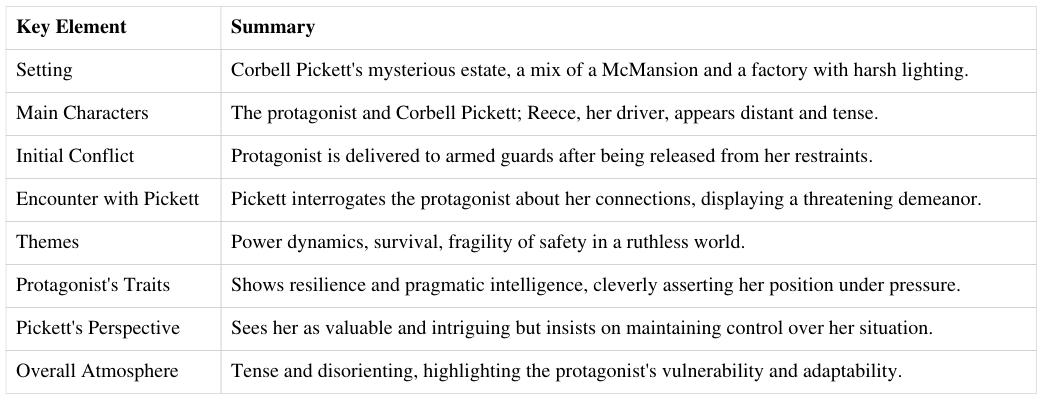
- The protagonist is brought to Corbell Pickett’s strange estate, a harsh blend of McMansion and factory, after being released from restraints but remaining in captivity.
- Reece’s distance and tension suggest that he, too, is caught within a dangerous web of coercion and uncertainty.
- Pickett interrogates her about Colombia, her connections, and her potential value, revealing a larger conflict involving money, threats, and powerful unseen players.
- Despite being restrained and threatened, the protagonist uses pragmatic intelligence and witty resistance to deny Pickett leverage and preserve her chances of survival.
- The chapter emphasizes unstable power dynamics, the fragility of safety, and the protagonist’s adaptability in a ruthless world.
When she arrives at Pickett’s house, it resembles a bizarre mix of a McMansion and a factory, awash in harsh lighting that adds to the disorienting atmosphere.
Survival Under Surveillance
- The section emphasizes oppressive power dynamics, showing how Corbell Pickett uses fear and control to dominate others while raising questions about the moral duties of authority.
- Netherton anxiously watches Ossian build a strange humanoid contraption as Flynne’s abduction unfolds, feeling powerless while Burton prepares to intervene despite his violent unpredictability.
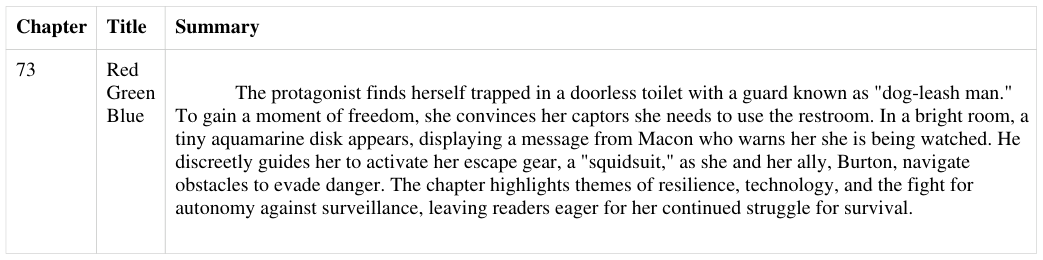
- Flynne is confined and closely guarded, but cleverly uses a restroom request to gain a brief opportunity for movement and communication.
- Macon covertly warns Flynne that she is being watched and helps her activate a technologically advanced “squidsuit,” linking surveillance, innovation, and survival.
- The escape with Burton presents resilience and individual ingenuity as vital, while also suggesting that personal resourcefulness alone cannot overcome larger systems of tyranny and injustice.
The protagonist finds herself trapped in a doorless toilet with a guard known as "dog-leash man."
Technology, Threat, and Escape
- Flynne’s struggle to reclaim her freedom underscores themes of resilience, autonomy, and survival under constant surveillance.
- The impending extraction intensifies the crisis as Ossian, Netherton, and Lowbeer confront lethal self-limiting swarm weapons and conflicting assessments of the danger.
- The team’s ability to maneuver digitally between realities reveals that physical confinement does not prevent technological intervention, expanding the stakes of the conflict.
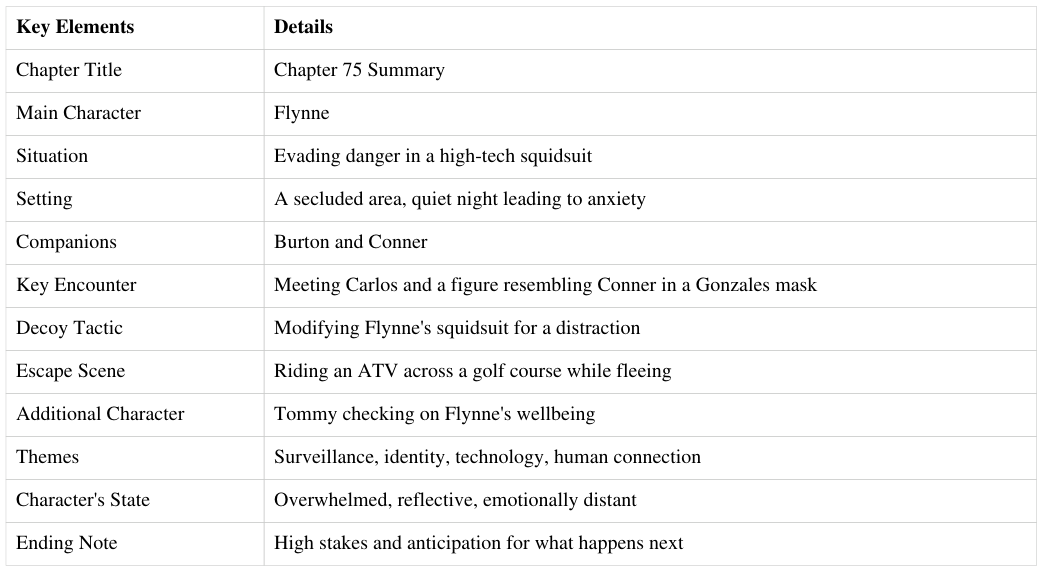
- Flynne evades danger in a high-tech squidsuit with Burton and Conner, using a decoy and an ATV escape across a golf course to stay ahead of her pursuers.
- The chapters frame advanced technology as both empowering and unpredictable, reflecting anxieties about automation, identity, human agency, and the erosion of personal connection.
The quiet night amplifies her anxiety, leading her to anticipate violence at any moment.
Technology, Escape, and Surveillance
- Flynne, Burton, and their allies use a masked decoy and modified squidsuit to mislead enemies before fleeing across a golf course as explosions signal the danger behind them.
- The escape reinforces the story’s themes of surveillance, manipulated identity, and technology’s influence on human relationships, while leaving Flynne emotionally overwhelmed and detached.
- Recovering afterward, Flynne learns that a tracker bug has been implanted in her stomach, emphasizing how invasively technology controls and monitors her body.
- The group remains resourceful under threat from Homes, securing supplies, replacing compromised devices, and strengthening their communications despite continuing danger.
- The playful Hefty Wheelie Boy combines nostalgia with advanced connectivity, accidentally linking Flynne to Netherton and underscoring her simultaneous isolation and dependence on technology.
As they drive away, distant explosions hint at the aftermath of their daring escape, underscoring the high stakes of their actions and the dangers they face.
Across Time, Toward Catastrophe
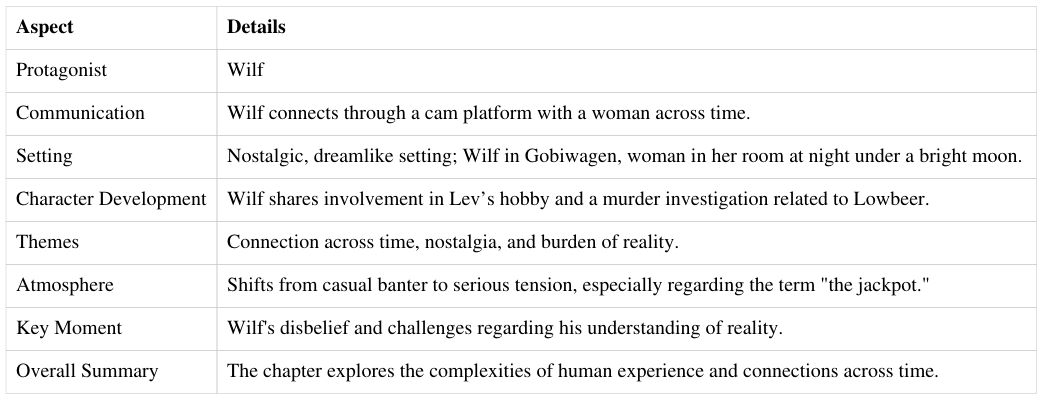
- Wilf connects with a woman across time through a cam platform, creating an intimate yet dreamlike encounter between two realities.
- Their playful conversation gradually becomes tense as the woman questions Wilf about his world and the ominous “jackpot.”
- Wilf’s involvement in Lev’s hobby and the murder investigation linked to Lowbeer adds intrigue and reveals his growing burden of knowledge.
- The “jackpot” is presented not as one disaster but as a cumulative environmental and social catastrophe caused by human negligence and climate change.
- The catastrophe reshaped society and killed roughly 80 percent of the population, turning the chapter’s themes of connection and nostalgia toward grim historical reality.
Wilf describes the jackpot not as a singular event but as a culmination of factors—an "androgenic" disaster caused by humanity's ignorance and mishaps with the environment.
History, Power, and Agency
- Wilf reveals that the post-jackpot future is bleak, shaped by past human decisions and marked by environmental catastrophe.
- Despite devastation, scientific advances produce cleaner energy, better food production, and improved medicine, showing that human ingenuity can coexist with destruction.
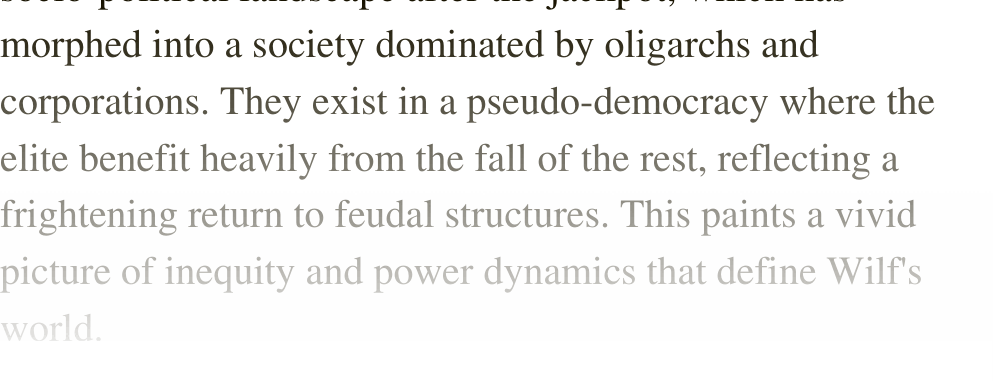
- Society has hardened into a pseudo-democracy ruled by oligarchs and corporations, while the wealthy profit from widespread collapse and restore feudal-like inequality.
- At Clovis Fearing’s antique shop, artifacts and espionage histories connect the past to the characters’ uncertain present, deepening the story’s themes of identity and memory.
- Lowbeer’s plans to sedate Wilf and monitor Flynne’s dreams reveal a world where technology and political power threaten personal agency.
They exist in a pseudo-democracy where the elite benefit heavily from the fall of the rest, reflecting a frightening return to feudal structures.
History and Altered Realities
- The opening reflection examines the tension between historical forces and personal agency, questioning whether the past determines identity or can be reshaped by individuals.
- Flynne returns to a transformed Porter, where new surveillance technology, outsiders, rumors, and defensive fortifications create an atmosphere of suspicion and instability.
- Burton’s assumption of the acting-sheriff role and Griff’s behind-the-scenes influence reveal shifting power structures as the community responds to Jackman’s disappearance.
- Flynne, Macon, Janice, Carlos, Clovis, and Conner must adapt to a threatening new reality, emphasizing themes of community resilience and social disruption.
- Netherton’s drugged journey with Lowbeer introduces a surreal, controlled atmosphere and prepares him to guide Flynne through her politically significant meeting with Daedra.
- The chapter’s contrasting settings—familiar hometown spaces and unsettling future interventions—underscore how technological and historical forces transform ordinary lives.
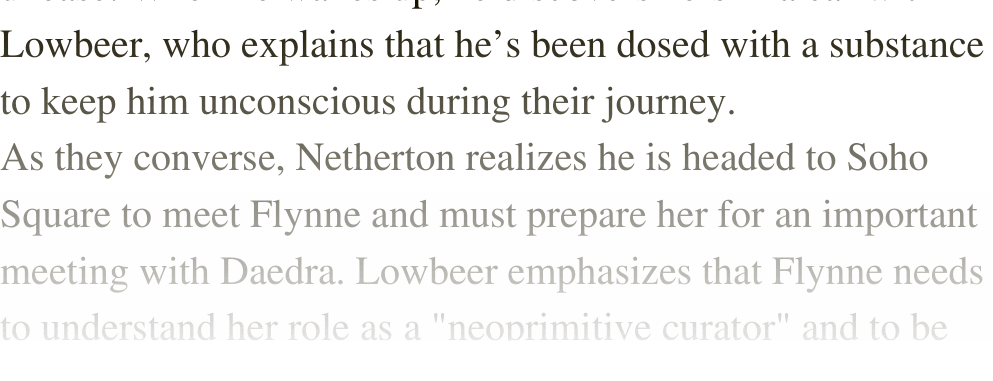
He's aware that Lowbeer is monitoring him, creating a sense of unease. When he wakes up, he discovers he’s in a car with Lowbeer, who explains that he’s been dosed with a substance to keep him unconscious during their journey.
Instability and Artificial Doubles
- Flynne signs contracts while Macon warns that a secretive competitor could threaten their fragile security and financial position.
- With Pickett gone and leadership unsettled, Flynne’s group fears intervention by organized forces such as the state police or Marines, prompting contractors to fortify their surroundings.
- Flynne’s memories of her simpler former life emphasize how quickly personal safety and social order can collapse.
- Connections to Homes, Milagros Coldiron, and drug-building operations deepen the sense of an ominous future marked by wealth concentration, violence, and societal breakdown.
- In Soho Square, Netherton and Lowbeer prepare a lifelike peripheral modeled on Flynne for a covert outing and possible identification, extending the conflict into questions of surveillance, identity, and manipulation.
a 'peripheral'—a lifelike automaton modeled after a real person, Flynne.
Synthetic Intimacies
- Soho Square has been transformed from a bustling shopping district into a lush, engineered greenway, blending urban history with an almost primordial future.
- As Netherton and the peripheral walk hand-in-hand, humor and shared curiosity soften their initial tension and create an unexpected intimacy.
- The peripheral mimics human emotion but has clear limitations, prompting questions about identity, authenticity, and the boundary between human and synthetic experience.
- Flynne and Wilf explore a surreal city shaped by assemblers, while Daedra’s self-tattooing and skin removal presents art as an unsettling record of personal identity.
- Their conversation about the mysterious Remembrancer and the chaotic Speaker’s Corner underscores the future’s mixture of technological sophistication, historical memory, and social strangeness.
Netherton learns the peripheral, though it seems to mimic human emotions, has its limitations and is curious about the world.
Danger Across Realities
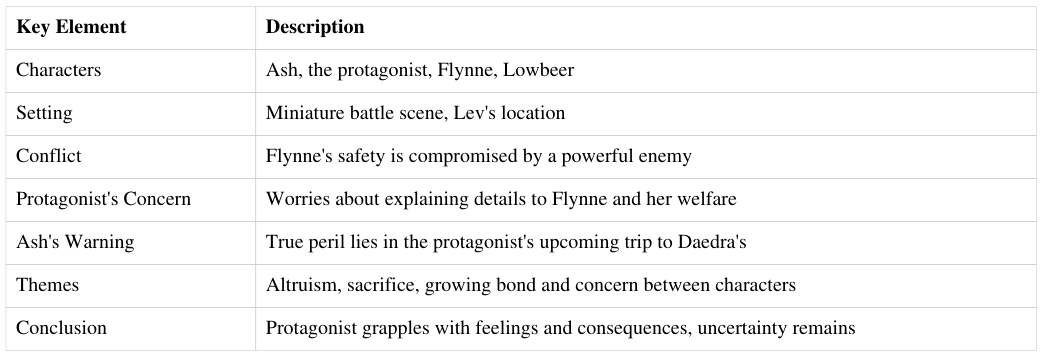
- Ash warns the protagonist that Flynne’s safety is threatened by a powerful enemy, while the protagonist’s own trip to Daedra’s presents an immediate personal danger.
- The exchange between Ash and the protagonist reveals a deepening bond shaped by mutual concern, altruism, and a willingness to sacrifice for Flynne.
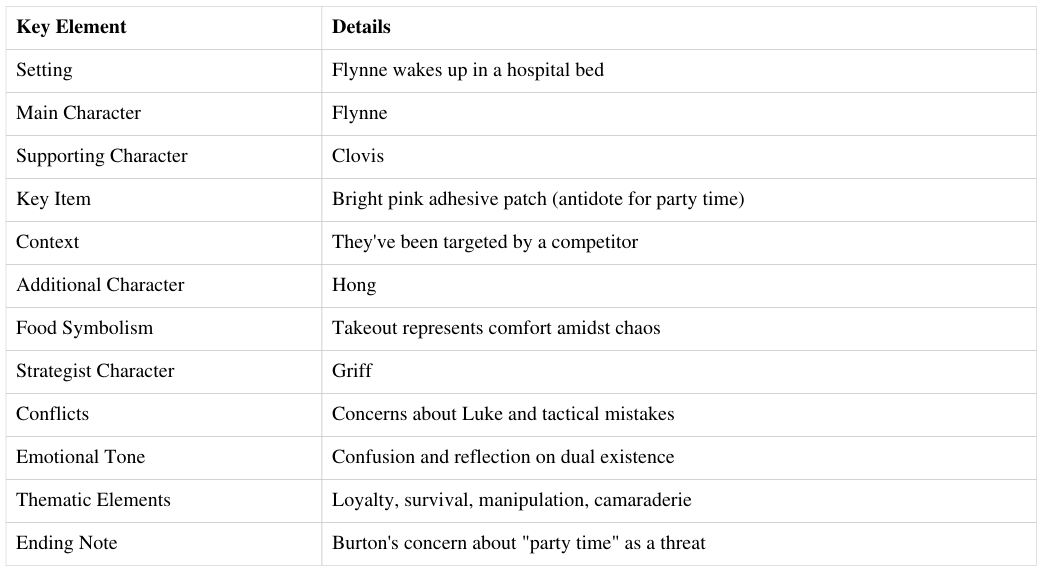
- Flynne awakens in a hospital after being targeted by a competitor and receives a bright pink patch humorously called the “antidote for party time.”
- Takeout, jokes, and camaraderie provide brief comfort as Flynne and her allies navigate escalating tactical and political threats.
- Flynne’s confusion over her physical needs and peripheral existence underscores the strain of living between two realities, while Burton’s unease leaves the danger unresolved.
Flynne’s mind is still grappling with her dual existence, her 'peripheral' self overhead, while she interacts with her friends and allies in this tactical setting.
Trust in Fractured Realities
- Flynne’s relationships deepen amid a chaotic mission, where camaraderie coexists with manipulation, survival pressures, and unconventional warfare.
- The chapter foregrounds the tension between virtual and physical existence, questioning how fractured realities shape identity, relationships, and decisions.
- Ash gives Netherton a “ticket for the parliament of birds,” enabling a hidden communication channel concealed from Lowbeer and other powerful observers.
- Ash warns that Lowbeer is investigating continua involving the manipulation of human lives, including dangerous plans connected to Vespasian and possibly Conner Penske.
- Their secret conversation exposes the fragility of trust in a surveillance-driven power structure, leaving Netherton uncertain whether even their private exchange was safe.
Ash informs Netherton that he is being given a “ticket for the parliament of birds.”
Violence and Resilience
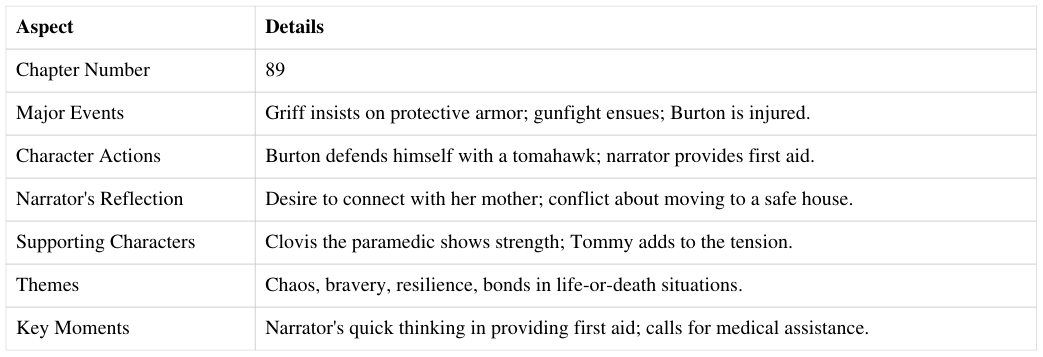
- Griff requires Burton and the narrator to wear protective armor, but their departure quickly turns into a chaotic gunfight.
- Burton is injured by a ricocheting bullet after bravely defending himself with a tomahawk.
- The narrator provides urgent first aid with a ceramic hook and calls for medical assistance, demonstrating quick thinking under pressure.
- Clovis the paramedic’s strength and Tommy’s presence intensify the emergency as the characters struggle to survive.
- The violence deepens the narrator’s emotional concerns about connecting with her mother and raises questions about whether crises truly create bonds or merely expose existing relationships.
The scene quickly escalates into chaos when a bullet ricochets, injuring Burton and causing a blood emergency.
Secrecy Amid Violence
- Rainey confronts Wilf about his dangerous entanglement with Lev, urging him to protect himself and step away.
- Rainey’s resignation from the Ministry signals her attempt to reclaim independence, while her confession that she still cares for Wilf exposes their unresolved emotional bond.
- Wilf’s realization that he misses Rainey reveals how secrecy and danger have deepened, rather than erased, their connection.
- Burton lies unconscious while a remotely operated isopod drone treats his bullet wound, underscoring the story’s blend of advanced technology and brutal violence.
- Flynne witnesses the aftermath of the encounter with anxiety and emotional numbness, struggling to process the casualties caused by their actions.
Burton, a key character, is unconscious and receiving treatment under a high-tech drone that resembles a giant pill bug, aptly called an isopod.
Moral Lines Amid Chaos
- Tommy comforts Flynne while voicing his anger over the use of “Luke 4:5,” an aerosol weapon capable of provoking extreme violence and sadism, deepening her guilt and uncertainty.
- Their fragile human connection offers Flynne brief relief from trauma and underscores the psychological cost of violence, warfare, and ethically compromised technology.
- Burton reconnects with Flynne through the Wheelie Boy interface after finding it, learning that Burton has been shot and that Griff Holdsworth is tied to the lethal chemical weapon known as “party time.”
- Flynne reveals a planned attack involving the weapon and insists that she and her family will not participate in its aftermath, refusing to become like those who deploy it.
- Flynne resolves to confront Griff directly, while the following chapter places her amid Burton’s medical crisis, Clovis, Griff, and revelations about a failed mission involving the powerful Lowbeer.
Flynne firmly asserts that they must not stoop to the level of those using such a weapon.
Lowbeer's Moral Manipulation
- A morally questionable operation is abandoned because its consequences could cause severe public harm and damage the participants’ reputations.
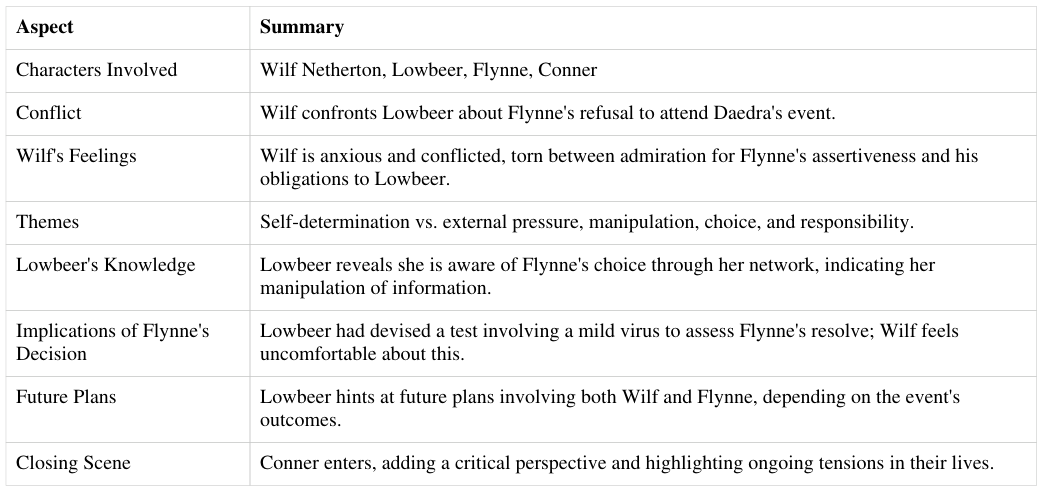
- Lowbeer’s advanced intelligence network makes her nearly omniscient, allowing her to learn about conversations and Flynne’s decisions without directly listening in.
- The stakes escalate when Griff reveals that Lowbeer intends to prevent the historical assassination of President Gonzales, potentially altering the future’s trajectory.
- Flynne struggles with the conflict between protecting those close to her and accepting the broader consequences of intervening in history.
- Wilf confronts Lowbeer over Flynne’s refusal to attend Daedra’s event, while Lowbeer reveals that the refusal was part of a test involving a mild virus designed to measure Flynne’s resolve.
- Moments of Conner’s humor briefly relieve the tension, but Lowbeer’s manipulation and hints of future plans leave Wilf and Flynne facing questions of autonomy, responsibility, and trust.
Lowbeer’s intelligence systems are so advanced she can monitor conversations and that any discussions involving her become immediately known to her.
Identity Amid Uncertainty
- Wilf and Flynne’s futures appear tied to an impending event, while Lowbeer’s influence highlights the tension between manipulation, choice, and responsibility.
- Lowbeer admits that even immense access to information cannot guarantee genuine understanding, challenging the idea that apparent certainties can be trusted.
- Flynne encounters the secrecy and strict operational controls of Klein Cruz Vermette while worrying about her injured brother, Burton.
- Netherton reveals that Lowbeer views Flynne as a test of character, forcing Flynne’s decisions and authenticity into question.
- Flynne’s peripheral evokes loss, nostalgia, and uncertainty about identity, while Netherton later wonders whether any part of her is truly present within the seemingly lifelike technology.
This raises questions about identity—when Flynne operates the peripheral, is part of her present within it?
Domestic Calm, Rising Threat
- Netherton encounters a deceptively casual kitchen scene as Lev cooks while Lowbeer warns that Aelita’s death may provoke powerful American enemies.
- Conner’s comic struggle with Lev’s strange kangaroo-wolf pets contrasts with the characters’ serious concerns, blending everyday absurdity with looming danger.
- Lowbeer insists that Flynne remain fully attentive during their evening plans, signaling that the threat around them is intensifying.
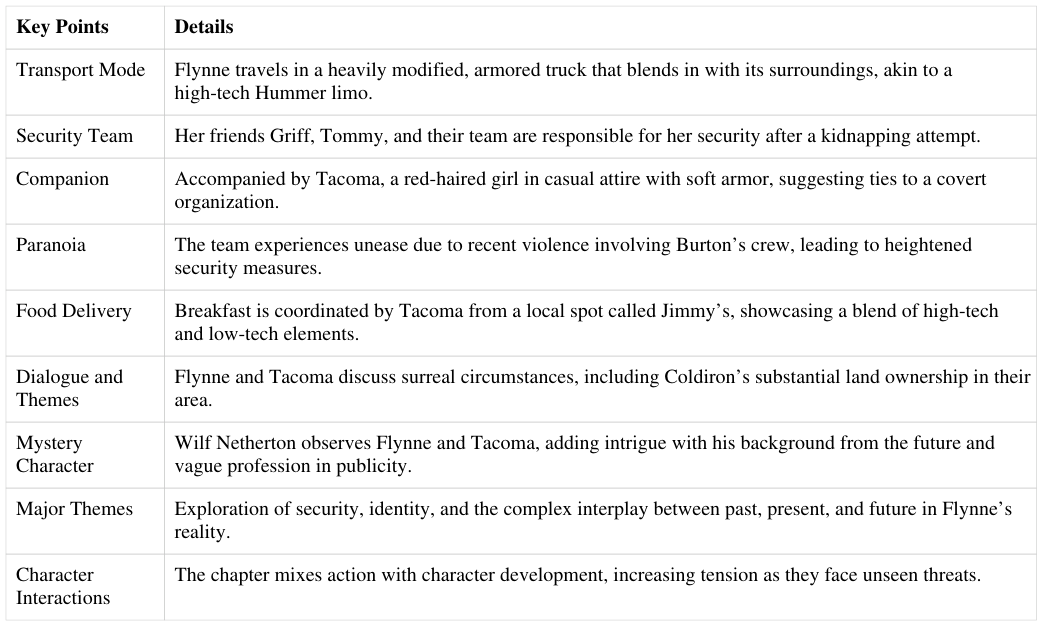
- Flynne is transported in a disguised, heavily armored truck after a kidnapping attempt, protected by Griff, Tommy, and their security team, with Tacoma as her armored companion.
- The convoy combines advanced surveillance and armor with ordinary comforts such as breakfast delivery, emphasizing the uneasy collision of high technology, paranoia, and daily life.
Meanwhile, Conner, who is outside, is seen wrestling with Lev's anthropomorphic pets, Gordon and Tyenna, which look like unusual crossbreeds of kangaroos and wolves.
Home Amid Intrigue
- Flynne and Tacoma navigate a paranoid, dangerous environment where drone-delivered food and corporate land ownership reveal the uneasy blend of advanced technology and ordinary life.
- They encounter Wilf Netherton, whose mysterious future background and vague role in publicity deepen the story’s intrigue.
- At Flynne’s home, armed relatives, family tension, and the Wheelie Boy surveillance robot expose how external violence has invaded domestic life—though the worn, authentic setting contrasts with the artificial spaces of Impostor Syndrome.
- Flynne’s mother refuses to relocate, arguing that personal efforts cannot overcome enduring forces such as death, taxes, and corrupt men; Flynne remains torn between skepticism and responsibility.
- A family ceramic tray’s connection to London antiquities dealer Clovis Fearing links Flynne’s everyday household history to the broader international mystery.
An unexpected moment occurs when a cat suddenly attacks the Wheelie Boy, showcasing the unpredictability of this world.
Flynne and Wilf’s Past
- Flynne’s growing realization about Lowbeer and her family’s connections hints at dangerous entanglements beyond their local world.
- At Flynne’s home, her tense conversation with Wilf is softened by Leon’s humor, but unresolved issues remain beneath the banter.
- Flynne redirects discussion of Clovis Fearing and presses Wilf about his past relationship with Daedra, seeking honesty about the forces shaping their connection.
- The Airstream trailer creates a vivid contrast between nostalgic relics of the past and the characters’ technologically advanced future.
- Wilf’s struggle with the idea that he is an “asshole” reveals his vulnerability, while Flynne’s questions deepen the chapter’s themes of identity, intimacy, and the lasting power of the past.
Inside the trailer, Flynne expresses nostalgic discomfort and a desire to establish a connection with Wilf through candid discussions about relationships. Their conversation shifts from light banter to deeper introspection as Wilf confronts the idea of being an "asshole," showcasing his vulnerabilities.
Ordinary Lives, Lethal Futures
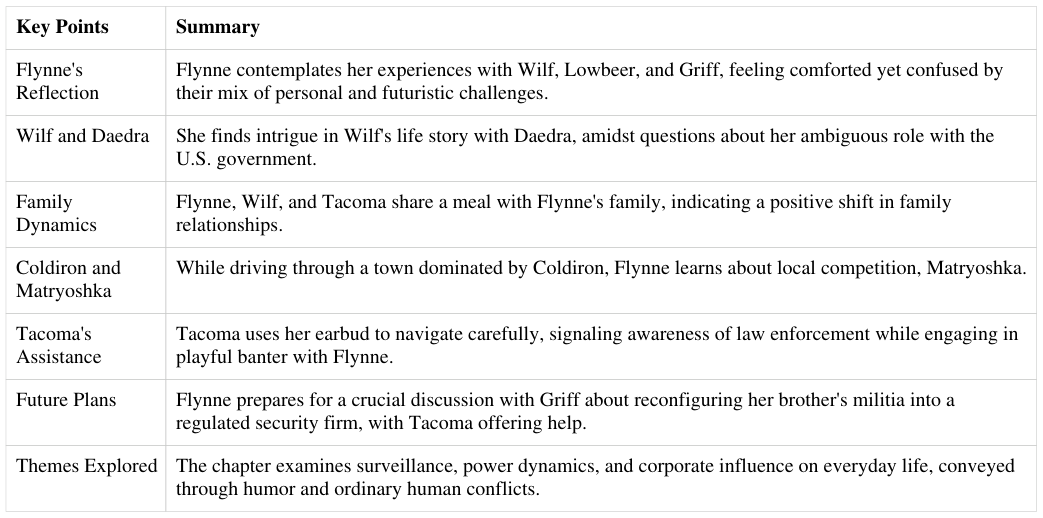
- Flynne reflects on Wilf, Lowbeer, and Griff, finding an unsettling sense of normalcy amid tangled personal, political, and futuristic problems.
- A shared family meal suggests improving relationships, even as Tacoma’s presence and playful banter reveal the tensions and humor within Flynne’s world.
- Flynne encounters a town dominated by Coldiron and learns about its competitor, Matryoshka, highlighting how corporate power and surveillance shape everyday life.
- Flynne prepares to discuss converting her brother’s militia into a regulated private-security firm, with Tacoma offering practical support.
- Netherton and Ossian examine disabled dueling pistols that deploy swarms of tiny assemblers to disintegrate flesh; originally intended as pram defenses, the weapons can be reactivated only with Lowbeer’s key.
They release tiny assemblers that can disassemble flesh, making them terrifyingly effective but also challenging to trace.
Technology, Disguise, and Danger
- Netherton’s skepticism, Ossian’s expertise, and Ash’s humor and urgency reveal how the characters adapt to an unsettling, technologically advanced world.
- The chapter explores identity and adaptation through discussions of communication enhancements, bizarre medical solutions, and weapons that blur the boundary between tools and arms.
- At the Sushi Barn, Griff tells Flynne that “stealth architecture” will protect her family discreetly, prioritizing her mother’s comfort over a conspicuous fortress.
- Griff also reveals his unusual connection with Ainsley, whose knowledge of his life helped shape his career and suggests communication across time and identity.
- Ash equips Flynne for a dangerous event with tracking weapons and a red Medici that will let her impersonate an art curator; Flynne’s unexpectedly brilliant critique demonstrates her intelligence and adaptability.
This is framed as a sort of disguise; she’ll spout nonsensical highbrow art talk without needing to fully understand it.
Static Across Timelines
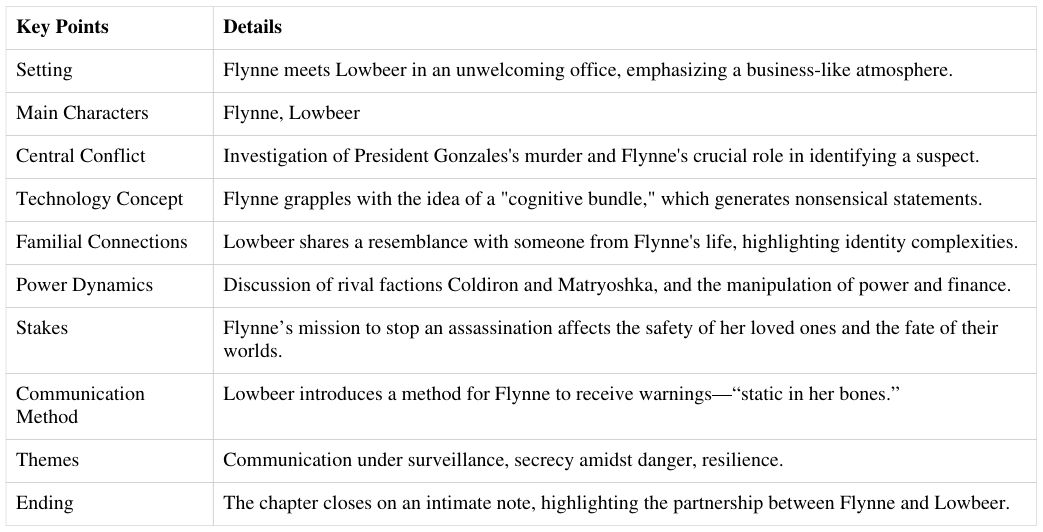
- Flynne confronts the unsettling concept of a “cognitive bundle” while meeting Lowbeer in a tense, impersonal office.
- Lowbeer reveals that they are investigating President Gonzales’s murder and that Flynne must identify a suspect at Daedra’s upcoming event.
- The conflict involves rival factions, Coldiron and Matryoshka, whose manipulation of power and finance threatens Flynne’s loved ones and multiple worlds.
- Lowbeer’s resemblance to someone from Flynne’s life deepens the story’s exploration of identity, familial connections, and masks across timelines.
- To communicate covertly, Lowbeer gives Flynne a warning system she will experience as “static in her bones,” reinforcing the themes of surveillance and secrecy.
- The next chapter begins with Wilf learning from Clovis that Flynne remains unconscious and connected to an unknown system or device.
“she will hear warnings as "static in her bones."”
Adaptation Under Threat
- Wilf encounters Flynne, Burton, and Conner in vulnerable states, emphasizing how advanced technology complicates both danger and human connection.
- Clovis’s wish to visit Wilf’s world—and her grimly comic nickname “Buttholeville”—reveals her frustration while preserving a sense of humor.
- Flynne wakes, learns Burton is recovering, and navigates bizarre devices and settings, including the Wheelie and a makeshift “hamster run” to a sushi restaurant.
- Flynne adapts to the strange technological present more easily than Wilf, highlighting the contrasting ways people respond to a chaotic future.
- Tommy warns that media attention and approaching law-enforcement convoys may expose the group as supposed remnants of a dismantled drug empire.
- The characters face escalating pressure from corruption and surveillance, with a confrontation appearing increasingly unavoidable.
Clovis expresses her desire to see Wilf's world, showcasing a mix of curiosity and frustration at her current circumstances in a place she grimly nicknames “Buttholeville.”
Preparation Amid Uncertainty
- Tommy’s breakfast burrito offers a small, human gesture of normalcy as he and another character prepare for a potentially disastrous confrontation with the heavily armed Homes.
- Flynne prepares to appear through an elegant peripheral, confronting the unsettling gap between her physical identity and her robotic representation.
- Lowbeer warns that threats against Annie Courrèges and tangled political loyalties could undermine the group’s plans, making Flynne’s upcoming performance crucial.
- Flynne reconnects with Burton and watches him spar with Conner through advanced peripherals, combining familial warmth and humor with the danger of their mission.
- Netherton travels to the gathering in Lev’s imposing, electrified family limousine, using its symbolism to signal affiliation with the powerful Zubov family and navigate a world governed by status and distrust.
Moreover, Tommy brings a breakfast burrito, which symbolizes his attempt to maintain some normalcy amid the chaos.
Memorial Across Worlds
- Flynne travels with Netherton in a luxurious, futuristic car, feeling the emotional and social distance between her two worlds.
- During a call home, Flynne learns that loved ones are gathering and begins to wonder whether her peripheral—and some trace of herself—would survive her death.
- As they approach their destination, increased security and police communications heighten the sense of danger surrounding the journey.
- They arrive at a heavily guarded bouncy castle and discover they are attending a celebration of Aelita West’s life, an unsettlingly strange form of memorial.
- Flynne and Netherton’s supportive banter develops amid themes of grief, identity, obligation, technological connection, and the fragile boundary between life and representation.
The area is heavily guarded by Michikoids, robotic figures in military-like uniforms, hinting at a tense atmosphere.
Dangerous Celebration
- Flynne and Wilf enter a crowded memorial gathering where somber black attire contrasts with the event’s lively atmosphere.
- Flynne’s encounter with the artist Daedra reveals her admiration for art while exposing her emotional vulnerability and discomfort around grief.
- Conner provides a sense of security but is suddenly removed by robotic guards, leaving Flynne and Wilf dangerously exposed.
- Daedra warns them that they are not safe, intensifying the chapter’s tension and suggesting hidden threats within the gathering.
- An enigmatic man who can manipulate walls introduces the mysterious technology of “assemblers,” expanding the story’s technological intrigue.
- The chapter explores how beauty, human connection, and artistic expression persist amid surveillance, danger, and advanced technology.
Suddenly, their bodyguard, Conner, is taken away by robotic guards, leaving Flynne and Wilf isolated with Daedra and an enigmatic man who can seemingly manipulate space.
Peripherals Under Threat
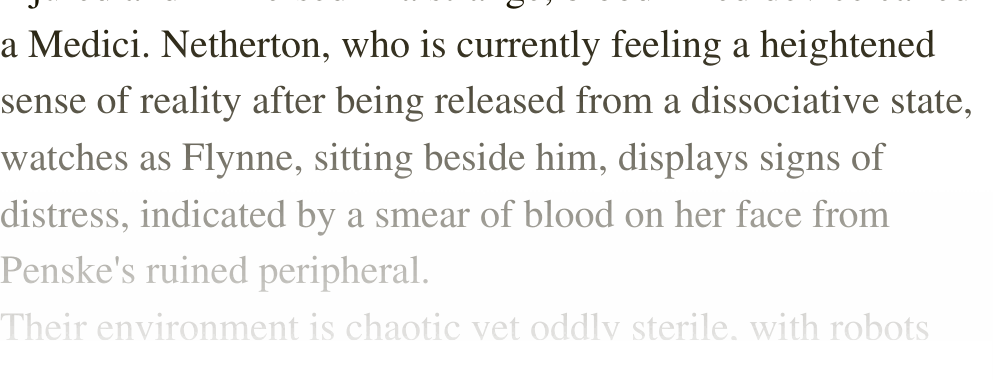
- Netherton and Flynne emerge from a disorienting dissociative state into a violent, chaotic scene involving Michikoids, blood, and an ominous threat.
- The aftermath reveals the disturbing contrast between technological sterility and brutal injury, while Netherton struggles with questions of control, autonomy, and identity.
- Flynne and Wilf become captives of the sinister balcony man, who is connected to a failed assassination attempt involving a peripheral.
- The balcony man raises the stakes by revealing that Flynne’s real self may be targeted by an imminent drone attack on her headquarters.
- Flynne attempts to negotiate and prevent further bloodshed, but the balcony man’s confidence and apparent power leave her in a desperate position.
The chilling interaction with the balcony man reveals he is waiting to witness her demise firsthand. He chillingly informs her that her real self is at risk due to an impending drone attack on her headquarters, framing a dire sense of urgency.
Fate Amidst Chaos
- Flynne and Wilf confront an enemy who takes pleasure in their distress, while Flynne’s resilience gives her a fragile chance to resist.
- Sir Henry Netherton is restrained and threatened, drifting through fear, memory, and dissociation as he faces an uncertain fate.
- The arrival of Sir Henry Fishbourne and the revelation of Hamed al-Habib’s branding strategy expose layers of authority, corporate manipulation, and manufactured identity.
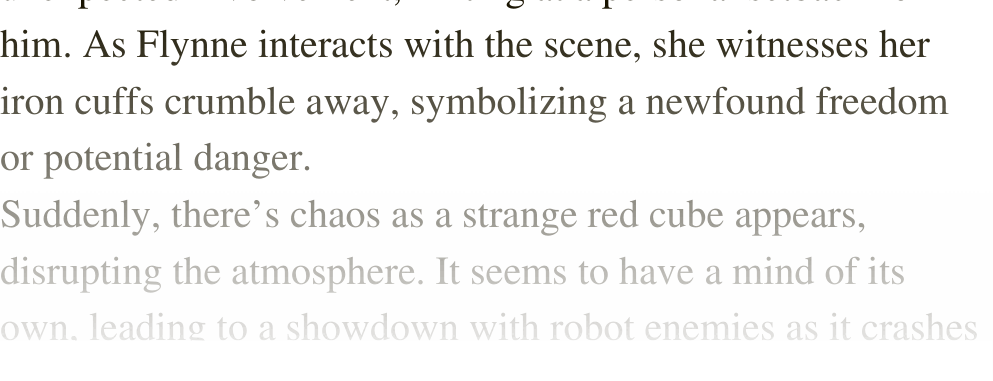
- Flynne’s iron cuffs disintegrate just as a strange red cube erupts into the scene, turning her apparent liberation into a new form of danger.
- The violence surrounding Sir Henry’s death changes the balance of power, while Lev anxiously travels home to learn what has happened to Flynne.
Suddenly, there’s chaos as a strange red cube appears, disrupting the atmosphere.
Aftermath and New Beginnings
- Lowbeer praises Lev’s handling of a dangerous situation while revealing disturbing details about al-Habib, Flynne’s past, and a murder, deepening the web of jealousy and family history.
- Growing media attention around Flynne follows a corporate buyout, increasing the pressure of public scrutiny as personal and political stakes converge.
- After surviving a major ordeal, Flynne reunites with friends at a lively celebration where gratitude, humor, and camaraderie provide relief from recent violence.
- Pickett remains in danger on Homes’ no-fly list, while Burton and Shaylene’s growing closeness hints at new romantic possibilities within the group.
- Flynne, Conner, and the others continue to wrestle with responsibility, guilt, disability, and recovery, while Tommy’s arrival and Flynne’s new home suggest hope and healing.
Flynne feels a sense of wonder and relief when she sees Tommy approach—his warm demeanor suggesting hope and healing in the wake of chaos.
Power and Ordinary Evil
- Flynne and her allies deliberately pace their technological and financial advances to prevent chaos and avoid repeating past mistakes.
- Their expanding ventures reshape the surrounding community, while setbacks such as Coldiron’s financial struggles force strategic adaptations.
- Flynne remains grounded by close relationships with Felicia and her family as uncertainty and responsibility grow.
- Conversations with Ainsley explore how ordinary human flaws can become dangerous forms of evil when magnified by circumstances.
- Chapter 121 shifts to Netherton’s intimate, playful relationship with Rainey, while also revealing his unresolved feelings for Flynne.
- Netherton’s personal entanglements overlap with professional obligations, culminating in plans for a Frankfurt briefing and a meeting in Putney.
Ainsley, with her experiences, warns Flynne not to underestimate the human capacity for malevolence, underscoring that the most dangerous individuals are often the most ordinary.
Posthuman Entanglements
- Haptic technology leaves visible bodily traces, suggesting that virtual or augmented experiences can have unsettling physical consequences.
- The characters move between celebrity culture, public relations, sexuality, tattoos, and geopolitical concerns, revealing how identity is managed as both personal expression and public signal.
- Security work repeatedly overlaps with performance and entertainment: characters guard parties, chase bugs, substitute for others, and navigate crises through mediated feeds.
- Military history, religious extremism, and social prejudice form a volatile backdrop, contrasting earned personal confidence with institutions and communities defined by control and hostility.
- The world’s art, architecture, and alien encounters are grotesquely hybrid: ritual sculptures, hollow structures, code-induced hallucinations, and posthuman beings blur the boundaries between technology, culture, and life.
“They ate the last two envoys,” he said. “Hallucinating in synch with a forest of code, convinced their visitors were shamanic spirit beasts.”
Threads of Danger
- Flynne and Burton navigate strained relationships, unspoken attraction, trauma, and the growing sense that someone may be hunting him.
- The characters move between ordinary domestic concerns—food, whiskey, sleep, family, and money—and extraordinary technologies that reshape perception and reality.
- The connection between timelines is portrayed as a one-way impossibility for travel but a two-way channel for information, creating opportunities for profit and serious danger.
- Interactions with the stub do not merely reveal events; they change the long-term outcomes, making observation itself consequential.
- Suspicion, surveillance, and security warnings intensify as possible crimes, abductions, and betrayals emerge beneath the characters’ guarded conversations.
Because really, now, Burton said, she was hunting him. Or would be, as soon as she realized she was, while his failure to see it was a done deal.
Shifts, Games, and Causality
- The characters confront the dangerous implications of sudden wealth, including possible IRS scrutiny and the suspicion that the lottery may be a Faustian bargain.
- Netherton recognizes that the polt possesses tactical abilities Lev never had to develop, intensifying concerns about protection, violence, and survival.
- Accounts of mysterious “shifts” reveal fragmented voices, disturbing encounters, and uncertainty over whether reality is being manipulated like a game.
- The possibility that people are being killed merely for witnessing events turns the investigation into a matter of existential danger, while drones and secrecy offer only limited reassurance.
- The text introduces a theory that acts of connection create new causal branches, linking the investigation to questions of alternate realities, surveillance, concealed identities, and institutional power.
History had its fascinations, but could be burdensome. Too much of it and you became Ash, obsessed with a catalog of vanished species, addicted to nostalgia for things you’d never known.
Strange Machines, Mortal Threats
- Tommy and Burton confront a baffling roadside murder: several men were shot in the head from outside a vehicle, turning the case into a possible locked-room mystery.
- Lev and Netherton encounter a seemingly sentient artificial woman whose biological makeup is human at the cellular level, despite lacking a digestive system and requiring careful acclimatization.
- Confidential circuitry, printing technology, and unknown contractors point to powerful organizations operating behind layers of secrecy and reassessing their plans.
- Flynne, Macon, and Edward agree to investigate and reproduce an enigmatic device assembled from approximated and printed parts, driven by a mix of caution and curiosity.
- The danger becomes personal as someone attempts to kill or intimidate a target, while memories, explosives, wealth, and increasingly expensive gaming assets complicate the surrounding power struggle.
She didn’t look like an it, though. And she did look sentient, if disinterested.
The Game Is Real
- Flynne’s community is bound together by concealed compromises, corruption, and mutual protection, with Tommy and the Sheriff’s Department caught in the middle.
- The characters’ strange technological operation escalates from a difficult game into full-body control of an anthropomorphic drone, turning virtual experience into physical participation.
- Netherton and the others encounter what appears to be the future—or another continuum—making the stakes far larger than a conventional game or experiment.
- Money cannot simply solve the problems of Flynne’s world; truth, family loyalty, and the burdens people quietly bear matter more than wealth.
- Flynne recognizes that events are already in motion, with many moving parts, and Janice insists that Flynne must have a voice in shaping what happens next.
“A game?” “It’s never been a game,” he said. “It was easiest for us to tell your brother that.”
Conspiracies and Peripherals
- Netherton remains uncertain about Lowbeer’s motives, while the group suspects a Chinese connection without firm evidence.
- Flynne’s accidental witness to a murder makes her a target, and the investigation suggests powerful actors may be trying to manipulate or destabilize her world.
- The characters struggle to distinguish reality from simulation, artificial bodies, historical reconstructions, and dreamlike experiences.
- Peripherals, personality AIs, and engineered bodies blur the boundaries between human identity and technology, raising questions about what counts as real.
- The scattered alliances begin to solidify around urgent practical goals: protecting Flynne, securing a peripheral, raising money, and responding to threats from Zubov and others.
I am very old, elaborately and artificially so. I don’t feel entirely real to myself, frankly.
Surveillance and Power
- Privacy is treated as a temporary, negotiated privilege, while invisible observers and diplomatic protocols shape nearly every interaction.
- Flynne and her allies pursue the mysterious man from Aelita West’s balcony, despite warnings that they cannot protect her from danger—or from herself.
- The characters manipulate identity and official records, even retroactively altering a passenger manifest to reshape someone’s life.
- Political and criminal intrigue escalates as the group realizes they may have effectively bought a governor and become entangled with powerful, opaque forces.
- The strain of these events is both emotional and physical, producing regret, farewells, exhaustion, timesickness, and a growing sense that reality itself has become unstable.
You might as well be convinced you’re invisible when you close your eyes.
Economics, Power, and Leverage
- The characters realize that the conflict is fundamentally economic, an invisible war between competing financial systems rather than a conventional political struggle.
- Individuals are treated as assets, liabilities, or leverage, with their value determining whether they are protected, exploited, or killed.
- The protagonists feel powerless before forces they cannot understand or stop, yet some accept the unfolding chaos because it is dangerous and fascinating.
- Alliances are transactional and unstable: protection is exchanged for assistance, while hidden actors infiltrate institutions and manipulate people’s choices.
- Surveillance and bodily control become intimate threats, exemplified by the tracker implanted in a woman’s stomach and the constant monitoring of vital signs.
“Eras are conveniences, particularly for those who never experienced them. We carve history from totalities beyond our grasp.”
Collapse, Escape, and Revelation
- A sentient suit imitates its surroundings while Flynne and Burton navigate a tense nighttime escape involving swarm weapons, explosions, and projected assemblers.
- Flynne discovers that implanted trackers connect her group to powerful security interests, prompting Macon to improvise a dangerous extraction and replacement.
- Wilf struggles to accept the reality of the future and the immense jackpot, while hints of multinational corporate structures suggest its consequences extend far beyond one country.
- Ash describes a devastating history in which ecological collapse, mass death, and assembler technology radically reshape civilization—while the richest people become even richer.
- The characters confront how difficult reality is to understand, recognizing that conspiracy theories thrive because people fear complexity more than simple explanations.
At the deepest point of everything going to shit, population radically reduced, the survivors saw less carbon being dumped into the system, with what was still being produced eaten by these towers they’d built.
Threats Across Altered Worlds
- Flynne’s familiar town and world have been radically transformed, making even humanlike entities difficult to understand as human.
- Powerful forces are mobilizing against Flynne and her allies, with Lowbeer’s warnings suggesting that increasingly vast resources are being deployed to kill her.
- The characters confront engineered realities, political manipulation, and the possibility that local or global economies could suddenly collapse.
- Netherton is drawn into Lowbeer’s cryptic political world, where access is temporary, knowledge is dangerous, and every action carries hidden consequences.
- Violence erupts abruptly and chaotically, while the final passage hints at an even more frightening power: people who can erase relationships and identities retroactively.
Now anyone I asked about her, however privately, no longer knows me. Retroactively.
Agency in a Controlled World
- Characters confront morally compromised actions, emphasizing that refusing to become an “asshole” requires difficult choices and personal accountability.
- A looming assassination and pervasive surveillance reveal how little agency individuals may have when powerful systems and urgent political concerns shape their options.
- The text critiques algorithmic governance: vast data and calculated decision points are treated as substitutes for certainty, disguising systemic shortcomings as rational outcomes.
- Technological and economic power are concentrated in the hands of a few, with corporations and families effectively owning entire landscapes while institutions adapt to serve them.
- Amid collapsing worlds and increasingly artificial beings, personal bonds—especially concern for mothers, fathers, and friends—remain a fragile source of humanity.
The shortcomings of the system are best understood as the result of taking this ocean of data, and the decision points produced by our algorithms, as a near enough substitute for perfect certainty.
Diverging Futures
- Flynne confronts illness, death, and the uneasy ordinary sadness underlying extraordinary events.
- Characters wrestle with alternate timelines, recognizing that a received message has caused their worlds—and identities—to diverge.
- Technology and violence become increasingly unsettling, from directed flesh-eating swarms to synthetic implants and concealed cognitive systems.
- Flynne is drawn into a dangerous operation requiring disguise, observation, and the possibility of becoming someone who would normally refuse to act.
- The characters find fragile intimacy and comfort in being understood, even as reality feels increasingly unreal and events move beyond their control.
But this is no longer their past, so she isn’t who I’ll become. We diverged, however imperceptibly at first, when that message was received.
Protocol, Power, and Peripherals
- Characters treat extraordinary technologies, political systems, and social violence as ordinary features of life, revealing how thoroughly their future has normalized the bizarre.
- A covert operation moves through layers of public relations, arrest tactics, security protocols, and criminal power, with success promising to be a “game changer” whose consequences cannot be predicted.
- The characters navigate an uneasy blend of loyalty, deception, and menace, from resisting arrest and hiding people in trunks to confronting allies who may have betrayed them.
- A surprise funeral and the possibility of dying across connected realities introduce a more intimate emotional tension beneath the tactical action.
- The setting grows increasingly uncanny: fairy-like police dispatchers, protean assemblers, strange materials, and heavily guarded gatherings make the future feel both technologically advanced and dreamlike.
What would happen here if she died there, she wondered for the first time?
Consequences Across Continua
- The characters confront violence, death, and deception, while shifting identities and disguises reveal how much power depends on performance and reputation.
- The story moves between interconnected realities, where legal status, wealth, and political influence determine who can be protected, punished, or erased.
- Ash, Daedra, and others survive a dangerous episode through calculated alliances, with Lowbeer and her network receiving much of the credit.
- The text argues that evil is rarely glamorous or extraordinary; ordinary cruelty can expand into something much larger when circumstances allow it.
- The accompanying questions emphasize the lasting psychological effects of military haptics on Flynne’s brother and the mixture of concern, familiarity, and responsibility in their sibling relationship.
Evil wasn’t glamorous, but just the result of ordinary half-assed badness, high school badness, given enough room, however that might happen, to become its bigger self.
Technology, Trauma, and Survival
- Haptic and gaming technology profoundly shape the characters’ lives, blurring virtual work with real-world trauma and making Burton’s return to civilian life more difficult.
- The decaying trailer and conversations about money reveal a lower-middle-class world marked by economic insecurity and precarious opportunities.
- Gaming and advanced technology function as forms of escapism, offering temporary relief from war, hardship, and painful memories while also keeping those realities close.
- Flynne and Burton’s casual, humorous dialogue conveys an intimate sibling bond that provides comfort amid trauma, survival, and uncertainty.
- The term “Hefty Pal” suggests shadowy digital financial dealings, emphasizing how technology intersects with the characters’ economic struggles.
- The trailer’s melancholic atmosphere and the metaphor of the “ghosts of the tattoos” portray war as an experience whose invisible scars continue to shape veterans’ identities and memories.
The 'ghosts of the tattoos' symbolizes the lingering effects of war that persist in the minds and bodies of veterans.
Celebrity Crisis and Consequences
- Netherton’s solitary awakening, hangover, and physical discomfort symbolize vulnerability, isolation, and his difficulty coping with professional demands.
- Rainey’s forceful interaction establishes a hierarchical, urgent professional relationship centered on controlling public perception.
- The discussion of tattoos and cultural appropriation reveals tensions between individual expression, cultural sensitivity, and aesthetic standards in a posthuman society.
- References to Saudi backing and entertainment-industry interests raise the stakes by intertwining money, morality, and reputation.
- The motif of the “death cookie” foreshadows dangerous consequences, while Netherton’s disorientation threatens his ability to manage the unfolding crisis.
The term 'death cookie' hints at the profound and dangerous consequences of celebrity actions in their environment.
Struggle and Transformation
- Flynne and Shaylene share complicated feelings about Burton, whose military past and affiliations expose the damaging influence of group behavior in their community.
- Flynne rejects Luke 4:5’s bigotry and anti-gay agenda, revealing her progressive moral outlook and her unease with Burton’s connections.
- The tomahawk embodies Burton’s survivalist instincts and potential for violence while also highlighting Flynne’s anxiety and protective concern.
- Flynne’s awakening in the “launch bay” marks a transition from ordinary life into a vast, uncertain, and potentially dangerous adventure.
- Daedra’s tattoo represents her environmental and artistic identity, while Netherton recognizes that her confident new style reflects hard-won artistic growth.
- Rain, dim lights, and towering cliffs reinforce the chapter’s atmosphere of tension, beauty, and impending danger.
The setting, described vividly through rain, dim city lights, and the juxtaposition of the van's perspective to towering cliffs, creates a mood of tension and anticipation.
Artistic Growth and Surveillance
- Daedra’s artistic maturity is portrayed as something “deeply earned” through struggle, perseverance, and personal experience rather than as an effortless gift.
- Netherton invokes Annie’s admiration for Daedra to affirm the power of Daedra’s work and connect the two characters despite their unspoken personal tension.
- Their exchange presents artistic authenticity as a commitment to personal expression, even when criticism or past habits create pressure to regress; the “retrograde impulse” warns against undoing hard-won growth.
- Daedra’s flirtatious response reveals her blend of confidence, playfulness, toughness, and vulnerability.
- The opening of Chapter 5 shifts to Flynne, whose awareness of drone-like dragonflies and unusual surroundings suggests surveillance and heightened danger, while mundane acts such as eating jerky keep her grounded and human.
“something so deeply earned”
Games, Waste, and Transformation
- Flynne’s supposed game has become a high-stakes security operation, blurring the boundary between simulation and reality.
- The whale-like blimp adds surrealism and foreboding, suggesting surveillance and hidden dangers in Flynne’s environment.
- Flynne and Burton share a casual, trusting bond, but her warnings about the cameras reveal the serious pressure underlying their work.
- Flynne’s internal thoughts portray her as resilient, curious, responsible, and motivated by loyalty to her brother as well as survival.
- The patchers’ city symbolizes humanity’s chaotic, unintended reshaping of nature through pollution and environmental neglect.
- The patchers’ altered, gender-indeterminate bodies suggest that ecological transformation can destabilize identity and distance people from their human origins.
The 'patchers’ city' serves as a metaphor for the consequences of human intervention in the ecological balance.
Technology, Waste, and Survival
- Lorenzo and Rainey’s discussion of Daedra presents success as inseparable from ambition, betrayal, manipulation, and personal sacrifice.
- The patchers’ garbage-built city and precarious lives embody transience, showing how both human communities and their environments depend on continual change.
- The ‘cams’ extend human observation and control while raising doubts about authenticity and the distortion introduced by technological mediation.
- The patcher traveling by kick-bike through waste suggests a bleak future in which humanity must live with the consequences of environmental neglect.
- In Chapter 7, robots preparing a party signal the automation of daily work and the blurring of boundaries between human behavior and synthetic performance; Flynne finds this more compelling than conventional media.
The patcher on the kick-bike, moving laboriously through a landscape made of waste, suggests a future where human survival is intricately tied to the remnants of past environmental neglect.
Agency Amid Surveillance
- Flynne’s fascination with a robotic sushi chef reveals her appreciation for the artistry and creative possibilities of technology.
- By manipulating and driving away surveillance bugs, Flynne asserts her agency and resists being reduced to a passive observer.
- Her hostility toward constant surveillance reflects broader anxieties about privacy, autonomy, and eroding personal boundaries.
- Daedra’s visualization suggests that self-awareness and introspection can prepare individuals to confront external threats.
- The grotesque boss patcher embodies alienation and extreme bodily modification, while his power complicates conventional ideas about beauty, morality, and authority.
- Daedra’s violent confrontation with the boss patcher presents survival as a brutal struggle for autonomy against oppressive forces.
Flynne’s frustration with the bugs embodies a universal concern about privacy in a hyper-connected world.
Surveillance and Human Connection
- Technology mediates relationships through surveillance, digital feeds, and remote communication, creating distance and alienation between characters.
- Grotesque visual imagery reflects inner psychological states: the boss patcher’s metamorphosis embodies horror and power, while Daedra’s movements convey controlled strength.
- The contrast between organic, irregular real London and sterile Game London explores the difference between authentic experience and manufactured reality.
- “Protective custody” symbolizes both safety and confinement, highlighting tensions between autonomy, surveillance, loyalty, and social control.
- Conversations about arrest and monitoring reveal mistrust and ethical dilemmas, while checking on Shaylene shows that personal responsibility and human bonds remain meaningful amid chaos.
Real London is depicted with its organic, historical texture and irregularities, while Game London represents a manufactured, sterile version devoid of character.
Connection Amid Turmoil
- Rainey recognizes that the events will damage both her and Netherton’s professional reputations, underscoring the far-reaching consequences of their circumstances.
- The conversation between Netherton and Rainey blends professional duty, personal history, and emotional tension, especially around Netherton’s connection to Daedra.
- Rainey’s “It could be worse” expresses resilience: despite uncertainty, being alive and together offers a reason to maintain hope.
- The cramped drinking closet mirrors the characters’ emotional entrapment, while Netherton’s whiskey suggests resignation and an attempt to cope with overwhelming pressure.
- Rainey’s sharp political awareness and maturity challenge assumptions about childhood, revealing how the dystopian world forces young people into adult responsibilities.
- At Forever Fab, shared food and compostable materials suggest a casual, environmentally conscious workplace, while Flynne and Shaylene’s exchange points to the emotional burden of caring for veterans.
“It could be worse.”
Hidden Scars and Possibilities
- Conner Penske’s missing limbs and unscarred face symbolize the hidden psychological wounds veterans carry and the community’s difficulty supporting their reintegration.
- Flynne’s sorrow for Conner and reflections on her transformed brother reveal her sensitivity, while emphasizing war’s effects on identity, families, and neglected mental health.
- Jimmy’s functions as a symbol of Flynne’s constrained routine and isolation, while the polymer in old shotgun shells reflects the characters’ need to remain flexible before hardening under pressure.
- The chapter’s ideas about quantum tunneling and branching histories challenge a linear view of time, emphasizing alternate possibilities and the consequences of choices.
- The thylacine represents lost possibilities and humanity’s urge to restore the past through technology, while Netherton’s relationship with Daedra underscores the fragility of connection in a high-stakes world.
Conner’s physical state—missing limbs but unscarred features—serves as a metaphor for the hidden scars veterans carry.
Connections and Rising Stakes
- Netherton questions whether his relationship with Daedra was genuine, confronting the consequences of past connections and the uncertainty of future ones.
- The framed, flayed hides of Netherton’s former selves symbolize changing identities and the lasting remnants of past roles.
- The exchange between Lev and Netherton highlights how knowledge is incomplete, unstable, and shaped by uncertain circumstances.
- Lev’s wealthy and powerful family background illustrates how legacy can impose responsibilities and conflict with personal ambition.
- Flynne’s practical clothing reflects her determination to be prepared, while her experience in Operation Northwind transforms gaming from a livelihood into a life-and-death responsibility; London’s imposing cityscape mirrors her isolation and vulnerability.
However, her experiences in Operation Northwind lead her to realize the stakes involved; players' lives and families depend on their successes.
Identity Amid Danger
- Burton mentors Flynne by teaching her to recognize intent and see herself as an active, capable hunter rather than a pawn.
- Watching the woman and her companion awakens Flynne’s envy of their warmth and normalcy, while deepening her isolation and trauma from past losses.
- Flynne’s memories of fighting an SS officer reveal her growth into a morally reflective person who understands that violence has consequences beyond the game.
- “Easy Ice” symbolizes Flynne’s longing for emotional detachment and a simpler existence amid the life-or-death pressures surrounding her.
- The trailer’s heat, discomfort, and unpredictability mirror Flynne’s anxiety as she prepares for her mission, while Netherton’s disorientation suggests that surroundings can destabilize personal identity.
The warmth of their connection starkly contrasts with her own feelings of isolation and the haunting memories of her past endeavors that resulted in the deaths of her squad members.
Identity, Technology, and Decay
- Netherton’s disorientation underscores the importance of familiar environments in preserving a coherent sense of identity amid chaos.
- The encrypted, shifting language between Netherton and Ash reveals how technology can obstruct genuine emotional and contextual understanding.
- Ash’s triangular lozenge symbolizes dependence on technological solutions for human vulnerabilities, while also warning against trusting them blindly.
- The opulent Mercedes land-yacht embodies wealth’s paradox: luxury offers comfort and escape but can also produce isolation, alienation, and emptiness.
- Ash’s tattoos, unusual eyes, dark clothing, and jewelry present her as both caretaker and harbinger, while Netherton’s changing view of the Gobiwagen reflects his gradual adaptation to the privileged world he once judged.
- Flynne’s decaying pumpkin introduces the theme of impermanence, linking the loss of beauty to the broader inevitability of change and decay.
Ash's tattoos of extinction symbolize a connection to a world that is both beautiful and tragic, mirroring her own role within the narrative as someone who possesses knowledge and control yet operates within a chaotic environment.
Fragility and Control
- Flynne’s sorrow and disgust reveal her struggle to process violence, loss, and the vulnerability of anything beautiful or meaningful.
- The pumpkin’s transformation from a joyful carved symbol into a rotting object reflects how identity and outward appearances can deteriorate while inner meaning persists.
- Flynne’s experience with the quadcopter and mysterious entity highlights the tension between technological power and humanity’s limited ability to control its consequences.
- Calling the horrific events “just a game” shows Flynne’s attempt to distance herself from an overwhelming reality and rationalize the chaos she witnesses.
- Lev’s response to Anton’s situation emphasizes familial duty, while the security-module discussion raises concerns about surveillance, privacy, and the boundary between safety and freedom.
- Lev’s focus on cognitive therapy and other treatments over social life suggests that health and behavioral management are prioritized in his society.
“that’s why we can’t have anything nice” signals her resignation toward the world’s brutality.
Health, Chaos, and Protection
- Lev’s confrontation with Netherton exposes conflicts over deteriorating health, personal accountability, and technology’s influence on individual choices.
- The shared meal becomes a symbol of care and control: Lev’s careful preparation contrasts with Netherton’s emotional discomfort and disinterest.
- Flynne’s visit to Jimmy’s reveals her maturity, alienation, and protective concern for Burton amid a chaotic younger crowd.
- Flynne’s confrontation with Conner highlights courage, vulnerability, and the way aggression can conceal personal distress.
- Jimmy’s dark, drug-filled atmosphere intensifies the chapter’s themes of danger, lost youth, and Flynne’s eventual rejection of the surrounding chaos.
Despite the danger posed by Conner's drunken state and the scorpion-monocle, Flynne stands her ground, displaying courage amid chaos.
Secrets Across Realities
- Ash’s eccentric, cluttered workspace reflects her unconventional creativity and the chaotic, morally ambiguous world she inhabits.
- The exclusive “God club” suggests a covert network built on dangerous activities, secrecy, loyalty, and uncertain ethics.
- A murder advertisement intensifies the narrative by connecting seemingly benign technology with society’s darker impulses.
- Lev’s privileged family background and guarded silence reveal his discomfort with hidden networks and the moral implications of his activities.
- Ash’s ideas about changing the “stub,” two-way information flow, and shifting glowing spheres emphasize how perception, causality, and reality remain unstable.
- Netherton’s growing unease with Ash and evolving view of Lev expose his increasing awareness of the threats surrounding Burton Fisher and their clandestine operations.
In each instance in which we interact with the stub, we ultimately change all of it.
Childhood Meets Danger
- Aquamarine duct tape recalls Burton and Leon’s playful drone games, symbolizing creativity, friendship, and lost childhood innocence.
- Flynne shifts from treating the violence at Jimmy’s as a game to recognizing that it represents a real threat to her life.
- Burton’s urgent concern highlights his protective nature and the strength of the siblings’ family bond.
- The Hefty Pal and lottery ticket embody the characters’ hopes of escaping poverty and finding a better future.
- Flynne’s decision to stop helping Burton in the game marks her growing independence and awareness of its dangerous consequences.
- The chapter shows technology collapsing the boundary between virtual entertainment and lethal real-world violence.
Technology can blur the lines between gaming and real-life consequences, turning playful interactions into lethal stakes.
Improvisation and Moral Power
- Ash’s theatrical enthusiasm symbolizes creativity, role-playing, and improvisation as essential tools for navigating an unstable world.
- The polt reflects human resilience, resourcefulness, loyalty, and the moral compromises people may make to protect those they love.
- The “Faustian bargain” frames the characters’ choices as temptations that may offer practical gains at the cost of integrity or humanity.
- The interaction between Lev and the polt shows that power is fluid: apparent authority can shift when an opponent proves tactically skilled and determined.
- Netherton’s decision to listen reveals growing humility and awareness of complex human dynamics, while the land-yacht and dead screen evoke tension between history, technology, reality, and performance.
- Money functions as both leverage and a sign of desperation, making negotiations a direct struggle over security, influence, and survival.
Just like actors on a stage, they must think on their feet and respond creatively to unpredictable developments to maintain their safety and achieve their goals.
Risk, Trust, and Reality
- Burton and Flynne’s willingness to face danger is driven by financial desperation and the hope of achieving stability through a major reward.
- Trust remains fragile: Flynne questions Reece, Burton doubts Coldiron’s warnings, and Flynne’s contact with Wilf marks a cautious move toward cooperation.
- Fear both pushes Flynne into dangerous choices to protect her family and clouds her judgment about whom to trust.
- The chapter blurs reality and perception through technology and “gamified” environments, suggesting that navigating an altered reality may matter more than understanding it.
- Flynne’s substitution for Burton raises questions about identity, agency, and who owns experiences carried out through technology.
- Security systems, surveillance, and institutional support offer only an illusion of safety, while Netherton’s fascination with Flynne’s voice connects her to a past he cannot truly know.
The chapter suggests that the line between reality and perception is blurred, particularly through Flynne's experience.
Reality, Danger, and Connection
- Flynne’s world blurs the boundary between reality and virtual experience, making ordinary objects appear grotesque and threatening.
- Her decision to intervene when she sees the woman in the brown bathrobe reflects both protective instincts and a desire to affect events in an otherwise hopeless reality.
- Flynne recalls violence with a disturbing mixture of clarity and detachment, suggesting how trauma can produce numbness without erasing psychological damage.
- The conversation presents technology—especially drones—as both wondrous and dangerous, raising questions about ethics, humanity, and mechanized power.
- The drones’ Celtic-knot formation offers Flynne a moment of order, beauty, and interconnectedness amid fear, isolation, and confusion.
The drones' movements create an intricate pattern, reminiscent of the symbolism of interconnectedness and eternity found in Celtic knots.
Games, Family, and Choice
- Flynne’s mother, ordinary routines, and Burton’s sweatshirt provide emotional grounding and comfort after a chaotic, traumatic day.
- The “game” functions both literally as virtual reality and metaphorically as life itself, where decisions carry real consequences and the rules are difficult to understand.
- Flynne’s retreat into isolation, comfortable clothing, and technology reveals exhaustion, confusion, vulnerability, and an attempt to regain control.
- Lev’s refusal to use his family’s financial resources reflects his desire for independence and distrust of familial obligations, even when collaboration might be strategically useful.
- The exchanges among Lev, Netherton, and Ash expose a conflict between individual self-reliance and collective strategy, while also contrasting academic intelligence with practical power.
- Their discussion of fixed time ratios rejects conventional time-travel logic and emphasizes that each moment is irreversible, making present decisions urgent and consequential.
It blurs the lines between leisure and survival, indicating how life itself can feel like a game with rules that are often unfathomable.
Power, Survival, and Reinvention
- Police involvement transforms Lev and his team’s tense strategy into a matter of legal scrutiny, raising the stakes and forcing greater caution.
- The thylacine represents the untamed, primordial unknown, reflecting the characters’ struggle to survive in a world where familiar rules have broken down.
- Ash’s explanation of her altered name reveals her effort to reinvent herself and escape identities imposed by family or circumstance.
- The chapter links advanced technology to financial power, showing how control of systems and resources can determine people’s realities and fates.
- Despite distrust and ambition, Lev’s interactions with Ash and Netherton contain vulnerability and restrained camaraderie born from shared urgency.
- In Chapter 25, Burton’s practical hobby, the group’s concern for Conner, and the lottery ticket emphasize self-sufficiency, loyalty, hope, and the risky possibility of change.
The thylacine symbolizes the primordial and untamed aspects of the world they inhabit. Its presence conveys themes of survival and the unknown.
Technology, Time, and Loyalty
- Technology and augmentation offer empowerment and survival advantages but also create risks of misuse, ethical conflict, and diminished agency under powerful forces.
- Macon’s unpaid technical support embodies community through cooperation, mutual aid, and the sharing of knowledge in a harsh environment.
- Flynne is characterized as empathetic, resourceful, loyal, and resilient, especially in her concern for Conner and Burton and her willingness to confront difficult truths.
- Lev’s grandfather’s drawing room symbolizes oppressive tradition and complicated family legacies through its gloomy, extravagant British décor.
- Lowbeer’s introduction establishes her as an intelligent, authoritative investigator, while her confusion about “stubs” highlights the challenge of applying conventional law to branching timelines.
- Netherton’s relationship with Daedra West reveals how personal desires for connection and validation can complicate professional duties and entangle him in the mystery.
The drawing room reflects a blend of gloom and excessive British opulence, characterized by dark green woodwork, heavy furniture, and an oppressive yet gaudy aesthetic.
Power, Technology, and Violence
- Netherton’s emotional struggle contrasts with Lowbeer’s clinical professionalism, highlighting the conflict between personal desire and institutional responsibility.
- Lowbeer’s DNA-sampling remark raises concerns about surveillance, privacy, trust, and the balance between public safety and individual rights.
- The characters’ discussion of stubs presents technology as both a means of liberation and a source of ethical danger, revealing opposing attitudes toward progress.
- Netherton increasingly recognizes that power can operate subtly through manipulation, deepening his awareness of complex authority structures.
- The idea of “third-worlding” stubs frames alternate realities through the lens of colonialism, cultural exploitation, and unequal power.
- Flynne’s encounter with murdered bodies reveals how arbitrary violence and organized crime intrude into ordinary life, while drones symbolize the growing role of technology in law enforcement.
The term 'third-worlding' in relation to 'stubs' indicates a critical examination of exploring alternate realities as a form of colonialism.
Violence Beneath Normalcy
- The murder investigation symbolizes the struggle to impose control and gather information in a chaotic, surveilled society.
- Flynne and Burton’s willingness to confront danger together reveals a deeply protective bond and shared awareness of community risks.
- The gruesome murders disrupt Flynne’s ordinary routines, emphasizing how fragile the apparent peace of daily life is.
- The “locked-room mystery” framing presents the murders as a complex puzzle involving hidden motives, circumstances, and moral ambiguity.
- Flynne’s choice to accompany Tommy marks her growth from passive observer to someone willing to confront unsettling realities, while Tommy steadies her through the crisis.
- The opening discussion of Lev’s “house of love” introduces family love as a conflicted force shaped by expectation, oppression, memory, and obligation.
The stark contrast is created when Flynne's mundane routine—picking up medication and doing dishes—is shattered by the gruesomeness of the murder investigation.
Autonomy Against Family Legacy
- Lev experiences his tradition-bound family as oppressive and is drawn to Lowbeer’s striking autonomy, revealing his struggle for individuality.
- The peripheral is both a technological instrument in Lev’s plan and a link between his personal actions, family business interests, and Lowbeer’s political agenda.
- Netherton’s unease about the peripheral reflects ethical anxieties about artificial beings and the blurred boundary between human identity and technology.
- Lev’s dismissal of the family house as a “source of pain” shows emotional detachment and his desire to escape inherited burdens.
- The grotesque, ostentatious house and the tense exchange between Lev and Netherton reinforce themes of alienation, distrust, family legacy, and technologically mediated relationships.
His cautious demeanor highlights the ethical complexities of life in their society, where artificial beings blur the lines between human and technology.
Unease, Ethics, and Artificial Life
- Familial relationships give the protagonist financial security and negotiating leverage, reinforcing her independence.
- The atrium’s grotesque, claustrophobic imagery creates tension and mirrors the protagonist’s anxiety about Netherton’s request.
- The ambiguous reference to “building” suggests illicit drug production, highlighting the protagonist’s ethical boundaries and refusal to participate in illegal work.
- The buzzing fly symbolizes intrusive fears and the unseen danger surrounding the protagonist, contrasting mundane domestic life with looming threats.
- Netherton’s response to the peripheral raises questions about sentience, consciousness, and whether human-like behavior can create genuine companionship.
- The luxurious but highly secured yacht combines wealth with confinement and surveillance, emphasizing isolation and the unstable boundary between human and synthetic identity.
The peripheral’s human-like interactions create a sense of companionship, even though it is not genuinely sentient.
Technology, Memory, and Improvisation
- The “resistance-training exoskeleton” symbolizes the characters’ preparation for hidden physical and psychological conflicts, as well as their need to adapt to uncertain technological futures.
- Netherton and Rainey’s discussion of job security shows how corporations and digital systems increasingly shape professional identity, reputation, and personal stability.
- Rainey’s reference to the “ghosts of the Commonwealth” suggests that past conflicts and political memories continue to influence present relationships and alliances.
- Ash’s design choices for the peripheral reveal a human desire to create familiarity and emotional connection even with artificial beings.
- In Chapter 31, the characters’ improvised construction work reflects resourcefulness, while their decision to accept Shaylene’s job combines financial motivation, curiosity, and interest in corporate espionage.
- Cronuts provide a moment of camaraderie and normalcy, offering comic relief amid the risks and tensions of their work.
It illustrates humanity’s innate tendency to seek relatable aspects, even in artificial constructs, symbolizing the deep human need for connection and understanding amid technological estrangement.
Trust Under Surveillance
- Colombia’s shift from drug haven to financial hub changes the characters’ calculations, making legitimate business opportunities seem possible and encouraging carefully measured risks.
- Netherton’s uncertainty about whether he is seeing reality or a manipulated appearance exposes how advanced technology undermines trust and perception.
- The rental’s discussion of appearance and its discomfort with having a beard reflect technology’s destabilizing influence on identity.
- Monitoring systems and the Android Avatar Act reveal a dystopian society where security depends on surveillance at the expense of privacy and freedom.
- Tense dialogue, Lowbeer’s warnings, and the market’s dangerous atmosphere build suspense before the tipstaff’s sudden transformation into a weapon sends the situation into chaos.
The sudden transformation of the tipstaff into a weapon and the ensuing chaos underscores the imminent danger that Netherton faces.
Reality, Violence, and Consequences
- Leon treats his lottery winnings as a joke and a weapon for spite, revealing a reckless, superficial relationship with wealth and responsibility.
- Flynne connects Conner’s brutality to military conditioning, recognizing the conflict between combat effectiveness and ethical restraint.
- The winking cartoon bull reflects Flynne’s frustration with surveillance, judgment, and her lack of control over reality.
- The “stupidity tax” represents the consequences of poor choices while exposing a society that profits from vulnerability; Leon’s humor masks an uneasy awareness of others’ suffering.
- Flynne and Leon distinguish between complete fiction and deceptive half-reality, while Flynne’s anticipated conversation with Burton and Lowbeer’s trauma responses reveal strained relationships and the persistence of past violence.
“helping people to pay their damn stupidity tax”
Technology, Power, and Trauma
- Peripherals designed for training or support can be weaponized, revealing how technology expands both human capability and the forms of violence available.
- The claim that terror should belong only to the state critiques unauthorized uses of fear while exposing tensions among authority, social order, and individual agency.
- Lowbeer’s scented candle represents her attempt to preserve calm and manage trauma through small, deliberate comforts amid danger.
- The peripheral’s modular skull raises ethical questions about commodified bodies, individuality, and the blurred boundary between human life and artificial constructs.
- The Aunties embody a surveillance system that combines decades of algorithms with human judgment, offering protection while increasing the risks of predictive control.
- Memory shapes the characters’ trust and responses to danger, while Conner’s neglected house and yard symbolize trauma, lost potential, and the lasting consequences of past choices.
Technology can both enhance human experience and become a tool for violence, complicating our interactions and forging a new terrain of warfare that blends physical and psychological threats.
Trauma, Technology, and Choice
- Flynne’s view of Conner shifts toward empathy and regret as she sees that his apparent happiness comes at a terrible cost.
- Conner’s prosthetic symbolizes trauma, adaptation, disability, and his effort to reclaim agency and normalcy.
- Interactions among Flynne, Burton, and Conner expose strained family bonds, especially Flynne’s frustration with decisions made without her consent.
- Conner’s damaged home and yard mirror his interrupted life, embodying loss, memory, and the enduring effects of trauma.
- Flynne’s imagined alternate life for Conner reveals longing and sorrow, while her wish to step outside suggests a need for emotional distance and control.
- In Chapter 36, Anton’s violence reflects destructive pride, Netherton recognizes the peripheral’s unexpected grace, and Lev’s remarks reveal tensions between family tradition, faith, and morality.
It reflects both his past—a once-hopeful life—and his current challenges, tying together themes of loss, memory, and the burdens carried by those who have faced trauma.
Memory, Danger, and Trust
- Lev associates Ash’s scented candle with memory, showing how sensory experiences can revive powerful emotions and connect the present to the past.
- Lev and Netherton respond differently to danger—Lev pragmatically accepts risk, while Netherton seems more detached—yet their exchange is marked by mutual respect and candidness.
- Their discussions of contracts, illicit finance, and “herding trading algorithms” depict a technologically advanced society where commerce, manipulation, ethics, and survival overlap.
- References to memory, assassins, and threats expose the fragility of identity and the constant precariousness of the characters’ world.
- Flynne’s decision to tell Janice everything reveals profound trust; Janice’s patient, nonjudgmental listening helps Flynne process Conner’s situation and the burdens represented by “cancer rent.”
These discussions reveal a complex environment where commerce, ethics, and survival are intertwined, illustrating a society that operates with a blend of legality and illicit activities.
Corruption and Perception
- Flynne’s dangerous involvement is driven by duty to support her mother, emphasizing sacrifice over personal gain.
- Learning about Corbell Pickett exposes the corruption and power structures shaping Flynne’s county, helping her understand the risks she faces.
- Tommy and other decent people preserve order within a flawed system, but doing so may require moral compromises and deliberate silence.
- Flynne’s recognition of local corruption marks her growth from naivety toward a more complex understanding of her community.
- The bag of money illustrates how loyalty can entangle ordinary people in wrongdoing, creating communal complicity and silence.
- Netherton’s encounter with the peripheral raises questions about subjective reality, emotional connection to artificial beings, and the need for honesty with Flynne.
He feels empathy for the peripheral, which represents a construct of Flynne, suggesting that our perceptions can create emotional connections even in artificial situations.
Entering the New Reality
- Netherton’s discomfort with professional clothing and unfamiliar technology reflects his struggle with identity and belonging in a transformed world.
- Ash’s statement that they will need Netherton “for the foreseeable future” establishes his vital, continuing role and raises the stakes of the unfolding events.
- The debate over misleading Flynne reveals that those in power prioritize control and secrecy, inviting questions about the morality of their agenda.
- Flynne is positioned for a transformative role: the imagery of the ball and crown suggests empowerment, recognition, and entry into an extraordinary new world.
- Skin-conduction technology and the futuristic setting blur the boundary between human ability and technological control, creating an atmosphere of distance and unease.
- Flynne’s initial skepticism gradually gives way to acceptance, signaling her growth as she begins to embrace her capabilities and responsibilities.
“you’re the one gets to go to the ball”
Identity Across Realities
- Netherton’s gray-and-black clothing symbolizes individuality, anonymity, preparedness, and adaptation to a transformed environment.
- His determination to be present for Flynne’s arrival reveals a shift from detached observer to someone personally invested in her well-being.
- The peripheral connects Flynne and Netherton across realities while raising questions about identity, authenticity, emotional attachment, and the merging of their fates.
- Ash’s description of Netherton as a “bullshit artist” suggests a relationship built on wary acceptance, mutual reliance, and tensions over morality and responsibility.
- Lowbeer’s silence and sigil heighten the sense that events are becoming difficult to control, while recycled shower water reflects scarcity, sustainability, and the need to adapt.
Ash's acknowledgment of Netherton as a 'bullshit artist' indicates a level of acceptance of his flaws and a recognition of his role within their group.
Identity Under Technology
- Flynne and Macon’s banter and cooperation reveal a deep trust forged through shared challenges and danger.
- Flynne’s awakening in another body explores identity as fluid, raising questions about the relationship between self-perception and physical form.
- The invasive technology reflects fears about surveillance, loss of privacy, and the erosion of personal agency.
- The confined trailer and Flynne’s countdown create an atmosphere of tension, uncertainty, and an attempt to impose control on the unknown.
- Ash’s calm expertise presents technology as both a guide and a disruptor, capable of enabling transformation while weakening ordinary human connection.
- Flynne’s disorientation and instinctive examination of her new body symbolize the struggle to adapt and rediscover oneself amid rapid technological change.
Flynne's awakening in another person's body highlights the fluidity and complexity of identity.
Reality, Games, and Connection
- Flynne’s altered color perception and interaction with the peripheral suggest that reality is shaped by both sensory experience and technology, making existence unstable and ambiguous.
- Flynne’s ability to influence the peripheral’s body language hints at empathy and emotional transfer between humans and artificial intelligence, blurring the boundary between them.
- Ash’s description of the future as “the game” makes Flynne question whether events are orchestrated and reconsider her role as more than a passive participant.
- Flynne’s history with games fuels her skepticism, leading her to question the motives of those around her and the boundary between play and reality.
- Flowers provide a sensory, organic contrast to the technological setting, grounding Flynne in tangible reality while offering brief emotional respite.
- Flynne’s fear, curiosity, and determination emerge through her physical actions, while the idea of “autonomic bleed-over” connects bodily responses with psychological states.
Flynne's ability to alter the peripheral's body language signifies a deep connection that transcends mere control; it hints at the potential for empathy and emotional transfer between humans and AI.
Flynne’s Technological Transformation
- Flynne’s bodily sensations are projected through the peripheral, blurring the boundary between psychological experience and physical reality.
- Her gradual adaptation to the unfamiliar technology illustrates human resilience, growth, and transformation under disorienting conditions.
- Peripherals and AI reshape identity and relationships by complicating ideas of agency, individuality, and what it means to be human.
- Flynne recognizes that her experience is more consequential than an ordinary game, suggesting technology capable of altering reality with serious consequences.
- Flynne and Janice’s trusting friendship provides emotional support as they confront revelations, uncertainty, and the possibility that outside forces have manipulated their lives.
“If it’s a game, it’s not just another game.”
Complexity, Control, and Truth
- Tasmanian tigers symbolize the uneasy fusion of genetic manipulation, artificial constructs, nature, and environmental ethics.
- Flynne’s reference to “moving parts” conveys a dangerous situation shaped by numerous actors, competing interests, and chaotic interconnections.
- The exchanges among Netherton, Ash, and Lev reveal a nuanced relationship in which manipulation, specialization, and generalist abilities must work together.
- Flynne’s desire to go outside represents her struggle for freedom, agency, and normalcy amid confinement and upheaval.
- The heavily encrypted server illustrates how knowledge becomes power, while limited access to information leaves some characters vulnerable and powerless.
- Lowbeer’s search for answers about Aelita and the mission’s “perverse difficulty” reinforce the narrative’s themes of truth-seeking, moral consequences, and obstacles that grow more complex as they are pursued.
“perversely difficult”
Flynne Takes Agency
- Flynne’s decision to consult Burton shows her growing resourcefulness, critical thinking, and willingness to become an active agent in a dangerous situation.
- Janice’s insistence on the right costume reflects how appearance can shape confidence and signal Flynne’s transition into a more assertive role.
- Flynne views the future as both familiar and alien, creating uncertainty about technology, human continuity, and the consequences of their actions across time.
- Flynne and Burton’s dialogue emphasizes fragile trust, paranoia, deception, and the need to investigate motives—especially through the principle of “follow the money.”
- The peripheral, robot body, haptic technology, and time-crossing experiences complicate identity and blur the boundaries between human experience, machinery, present reality, and the future.
The moonlight evokes a sense of mystery and uncertainty, symbolizing the obscured truths they face.
Reality, Identity, and Control
- Flynne’s insistence on keeping the situation “locked down” reflects her understanding that information is both a source of power and a potential liability.
- Entering an unfamiliar reality forces Flynne to question her identity, consciousness, surroundings, and assumptions about history.
- Curiosity helps Flynne adapt, while her skepticism prevents her from accepting an artificial or technologically mediated world without scrutiny.
- Technology reshapes communication and human interaction, yet dialogue, curiosity, and shared experience remain essential forms of connection.
- Netherton’s memories of Cheapside contrast with the sterile future, showing how personal and collective history continue to shape perceptions of the present.
- The artificial environment and human-like mechanical systems blur the boundary between reality and illusion, raising questions about authenticity, agency, and technological influence.
feels human yet operates mechanically.
Power, Identity, and Peripherals
- Ash’s seamless clothing and visual modifications suggest a society where bioengineering and technological enhancement are normalized, reflecting changing values around individuality and freedom.
- Flynne discovers that her decision to replace her brother made her a crucial witness—and placed her in serious danger.
- Detective Lowbeer controls key information and offers protection in exchange for cooperation, making their relationship both unequal and transactional.
- The idea of the “peripheral” complicates conventional definitions of reality, identity, legal personhood, and death across different time continua.
- Flynne’s demand for a male peripheral reveals her need for corroboration and support in a situation where her testimony might otherwise be dismissed.
- The chapter raises ethical concerns about technology commodifying human presence and allowing powerful institutions to treat lives as less real or less valuable.
Lowbeer indicates that, in her world, Flynne's existence as a 'peripheral' does not conform to their legal system's definitions of reality.
Family Life Under Surveillance
- Lowbeer’s striking appearance and the men’s black hats emphasize hidden power, vulnerability, and contrasting social positions.
- The clutter in Pavel Lev’s entranceway presents family life as chaotic, demanding, and full of vitality.
- A cloaked buggy equipped with molecular-level weaponry turns an ordinary parenting object into a symbol of extreme security and morally ambiguous technology.
- Ossian’s cynical joke about training to “stand up smart and lie” reveals a pragmatic character shaped by secrecy, distrust, and survival.
- Pavel’s confident entrance establishes him as an influential authority, while the banter between Netherton and Ossian shows how friendship persists under constant societal danger.
The mention of the buggy containing a weapons system that targets threats at a molecular level underscores a stark juxtaposition: a seemingly innocent item of parenting intertwined with high-tech weaponry.
Liberation and Unstable Reality
- Conner’s exuberant transformation from trauma-induced restraint into physical freedom emphasizes liberation, renewed identity, and the joy of recovering bodily abilities.
- Ash acts as a bridge between advanced technology and human feeling, combining technical authority with empathy as she helps manage Conner’s transition.
- The phrase “the sounds he made” represents Conner’s return to uncensored expression after a period of traumatic silence.
- The RV and Lev’s father’s extravagant car collection create a surreal atmosphere of opulence and freedom, sharply contrasting with Conner’s former confinement.
- “While the getting’s good” introduces urgency, suggesting that Flynne and the others must seize a fleeting opportunity involving the governor.
- The peripheral’s uncertainty about whether its experience is real, together with its military training, raises questions about identity, agency, layered reality, and the capabilities technology can provide.
“It’s not a dream, but I’m also not okay,”
Blurred Reality and Urgency
- The characters struggle to distinguish physical identity, memory, and action from technologically mediated reality, creating a layered and uncertain sense of existence.
- Urgency shapes the plot, as securing the governor’s help requires immediate action and sufficient financial resources.
- Flynne, Netherton, Ash, and the peripheral bring contrasting strengths to crisis decisions, with protection, analysis, and collaboration all proving essential.
- The peripheral embodies the complicated idea of property: although genetically human and potentially sentient, it is also treated as an owned object, raising questions about agency and identity.
- Tension arises through abrupt dialogue, internal uncertainty, and the unresolved condition of the peripheral, while the phrase “tango hotel soldier shit” hints at military or covert dangers.
- Flynne and Conner’s garden interaction reveals their loyalty and shared uncertainty as they question whether their experience is madness or a genuine shared reality.
Ash’s reminder that the peripheral is genetically human yet a considerable piece of property emphasizes the idea that ownership can be complicated, intertwining individual autonomy with larger societal forces.
Flynne Under Pressure
- Flynne faces tangible threats alongside the confusion of an unstable reality, creating an urgent need to act to protect herself and her loved ones.
- Lev’s backyard offers a deceptive sense of safety: its walls suggest confinement, while the dull sky reflects Flynne’s anxiety and disorientation.
- Flynne demonstrates resilience through clear thinking, rejecting Conner’s violent impulses, responding quickly to danger, and actively seeking solutions to financial and personal threats.
- Technology, especially the peripheral device, connects the present with the future while intensifying confusion, distress, and uncertainty in the characters’ relationships.
- The phrase “boots on the ground” signals a shift from distant planning to direct action, with Netherton expected to become practically involved.
- Flynne’s family responsibilities and Lowbeer’s insistence that she is “entirely central” place her at the heart of the unfolding strategy and increase the pressure on her.
The high walls and flower beds represent both a confined safety and a reminder of entrapment in her circumstances.
Surveillance, Power, and Longing
- Netherton’s thoughts of a “better world” and a relaxing drink reveal his longing for normalcy and comfort amid crisis.
- The tense, pragmatic dialogue emphasizes responsibility, past actions, and the consequences characters must face.
- Lev’s luxurious home—part homely kitchen, part expansive art gallery—reflects his blend of comfort, sophistication, and artistry.
- Flynne becomes increasingly troubled by advanced surveillance, recognizing how wealth can purchase privacy and how information may be manipulated.
- Lowbeer’s authority demonstrates that power depends not only on technology and wealth, but also on controlling relationships, perception, and narrative.
Netherton's imagination of a 'better world' and a relaxing drink illustrates his longing for normalcy and comfort amidst chaos.
Netherton Amid Artificiality
- Netherton’s unfamiliar surroundings and Ash’s familiarity highlight the importance of companionship and support as he navigates a dangerous, high-stakes environment.
- Lowbeer’s strategy shows how personal relationships can be repurposed for political goals, requiring Netherton to reconnect with Daedra West for strategic advantage.
- Netherton’s choice of a cloaked table reflects his desire for anonymity, isolation, and observation, revealing his conflicted longing for connection.
- The bar’s hyper-lurid, artificial atmosphere contrasts escapism with reality, exposing the patrons’ superficial and emotionally detached behavior.
- Netherton sees Flynne as authentic and vibrant, unlike the self-absorbed people around him, deepening his alienation and desire for genuine connection.
- His whiskey drinking represents an attempt to manage anxiety, avoid responsibility temporarily, and reflect on the consequences of confronting Daedra.
This environment serves as a counterpoint to the underlying themes of reality, as patrons indulge in social exhibitionism while remaining detached, almost robotic.
Technology, Fear, and Agency
- The imaginary airship reflects Netherton’s sense of drifting through a world shaped by others, while also suggesting a possible transformation if he takes control of his choices.
- Michikoid serving units embody technology’s pervasive role in social life, emphasizing alienation and the contrast between scripted interactions and genuine human connection.
- Flynne’s calmness amid murders and threats reveals her resilience, resolve, and capacity to confront extreme danger without panic.
- Violence, economic instability, and political alliances expose the community’s precarious survival, while Flynne’s status as the sole witness makes knowledge itself dangerous.
- Flynne and Tommy develop trust through candid conversation, even as technology complicates identity by separating consciousness from the physical body.
The airship also represents a vessel of transformation—Netherton is at a pivotal point where he can either seize control of his path or remain passive as events unfold around him.
Art, Regret, and Artificiality
- Daedra’s unrecognized sigil symbolizes her artistic evolution and merging of identity, technology, and a larger cultural narrative.
- Wilf and Daedra’s strained conversation reveals how technology, fame, and past grievances can both connect people and deepen their alienation.
- Wilf’s request to see Daedra’s face expresses a longing for authenticity, while his “unfinished business” reflects regret over loss and past choices.
- The secluded Kensington bar mirrors the characters’ emotional isolation, creating an atmosphere suited to confrontation and introspection.
- Annie Courrèges’s potential collaboration with Daedra emphasizes the importance of artistic connection, shared vision, and professional legacy.
- Flynne’s mother’s comparison of rich people to dolls, along with Flynne’s unease about her nanopaint parka, introduces themes of artificial perfection, wealth, and troubling technological history.
“some horribly novel sort of regret”
Power, Family, and Surveillance
- Flynne’s return to her physical body heightens her awareness of sensation and suggests a longing for grounded, embodied connection.
- Corbell Pickett’s presence exposes a sharp social and economic divide, while Flynne’s mother carefully restrains her anger in the face of his wealth and influence.
- Flynne’s loyalty to her family and her care for her mother reveal her protective nature, even as she struggles with identity and outside pressure.
- Rain, discomfort, and shifts between humor and seriousness reinforce the chapter’s themes of familial tension, class conflict, and emotional resilience.
- In Chapter 58, Netherton encounters subtle surveillance and fractured authority; his restricted drinking and the peripheral’s insistence on discretion intensify his sense of danger.
- The locket links memory, identity, authority, and impersonation, suggesting that objects and appearances cannot be trusted in this world.
The locket symbolizes the blending of memory and identity, a tangible link to authority (Lowbeer) and the consequences of impersonation.
Surveillance and Power
- Netherton’s disorientation, physical clumsiness, and reliance on the peripheral reveal his alienation and diminishing control amid a rapidly changing reality.
- The setting “Impostor Syndrome,” along with references to deception and identity crises, creates an atmosphere of distrust and existential danger.
- The “aunties” symbolize pervasive surveillance, raising questions about whether social monitoring provides protection or erodes freedom; Netherton’s restricted drinking similarly reflects environmental control.
- The chapter on “Adventure Capitalists” argues that greed and entitlement among powerful individuals can damage society more extensively than conventional criminals.
- Flynne’s dealings with Pickett highlight the importance of transparency, trust, and informed self-advocacy, while her mother’s illness emphasizes the emotional and practical burdens of family responsibility.
The characters allude to the idea that the real harm in society often comes from individuals driven by greed and a sense of entitlement, like Corbell, rather than traditional 'criminals' such as psycho killers and rapists.
History, Risk, and Disorientation
- Flynne’s reflections suggest that individual choices—such as Corbell’s—echo across generations, shaping present realities and creating moral dilemmas.
- The Colombian adventure capitalists symbolize the uncertainty of modern business, where funding and alliances may conceal unethical origins or hidden obligations.
- Family memories, community ties, and inherited legacies strongly influence characters’ motivations and the challenges they face in the present.
- Netherton’s impaired memory leaves him confused and dependent on Wu, complicating their communication and placing Netherton in a vulnerable position.
- The subterranean brick corridors mirror Netherton’s psychological disorientation while suggesting confinement, surveillance, manipulation, and technological control.
- Netherton’s concern with Daedra West and the idea of “the hook” emphasize how personal connections can also become strategic tools in struggles over influence and information.
The setting of 'subterranean corridors of brick' symbolizes confinement and disorientation, reflecting Netherton's internal struggle.
Timesick and Moral Compromise
- Flynne’s “timesickness” reflects both physical exhaustion and the mental strain of navigating a surreal, unfamiliar reality.
- Janice’s concern for Flynne highlights the close, supportive familial bond between them.
- Flynne’s fascination with the woman’s animated tattoos reveals her struggle to balance wonder with overwhelm as her sense of identity evolves.
- The idea that they have “bought” the governor exposes the group’s morally ambiguous alliances and the compromises they make for protection.
- Ash acts as a stabilizing authority while caring for the group, and Netherton’s recovery through the Medici device contrasts with his vulnerability and contempt for his condition.
It highlights how she often oscillates between finding this new reality fascinating and overwhelming.
Reality Beneath Appearances
- The Medici device symbolizes hope and possible recovery for Netherton while illustrating how advanced technology is woven into everyday life.
- Ossian’s injury prompts Flynne’s immediate defense of her brother, revealing strong protective instincts and complicated family tensions.
- The resistance-training exoskeleton reinforces the futuristic setting and shows technology shaping both personal abilities and social interactions.
- Burton’s discovery of an eerily empty peripheral city unsettles Flynne’s assumptions about reality, exposing isolation beneath the appearance of a populated world.
- The city’s loneliness intensifies tension among Flynne, Burton, and the wounded Conner, contrasting serious danger with moments of banter.
- Flynne’s bond with Janice provides emotional stability and a semblance of normalcy, while Ash’s unpredictable influence forces the characters to negotiate trust and dependence.
He finds the city eerily quiet, with few signs of life, suggesting that much of it may not be as vibrant or populated as they had assumed.
Reality, Agency, and Power
- The characters’ virtual environment feels authentic despite being artificial, forcing them to question reality, perception, existence, and the reliability of their senses.
- Netherton’s experience with the Medici suggests that consciousness and emotion can be chemically or technologically manipulated, challenging the authenticity of inner experience.
- The idea of “sterility” links the containment of dangerous weapons with Netherton’s emotional disconnection and inability to form genuine responses.
- Ossian’s use of Flynne’s peripheral raises concerns about autonomy, privacy, and the ways technology can threaten personal relationships.
- Buying the mall and appointing Flynne as CCO mark a movement toward self-sufficiency, greater responsibility, and control over the group’s future as old economic powers decline.
The environment, with its sterile technology and ominous undertones, generates a surreal and unsettling atmosphere that challenges the characters’ senses and consciousness.
Surreal Wars and Identity
- The “invisible two-party world war” frames the characters’ economic conflict as an unseen but ruthless struggle for control, where survival depends on strategic adaptation.
- Flynne’s memories of paintball robots contrast with her dangerous present, emphasizing how rapidly she has lost her former innocence and ordinary life.
- Netherton’s encounter with the gray place, Lowbeer, and the “drop bear” presents a surreal confrontation with fear, control, and an uncertain reality.
- His transformation into having “forepaws” suggests adaptation or evolution, while the threat of being consumed by the island’s assemblers reflects technology’s capacity to treat people as disposable.
- References to al-Habib, Hamed’s escape, DNA, and memory make identity seem manipulable, raising questions about survival, reinvention, and what makes a person authentic.
The revelation of his 'forepaws' suggests a transformation or adaptation to his new environment, emphasizing themes of evolution and survival in unpredictable circumstances.
Control, Collateral, and History
- Being deemed “essential” reflects a person’s usefulness to corporate goals rather than their individual worth, leaving them vulnerable to becoming collateral damage in hidden power struggles.
- The tracker pill symbolizes surveillance disguised as protection: it offers safety through constant locatability while undermining autonomy and freedom.
- The idea of collateral damage forces the characters to confront whether their lives are expendable within systems driven by corporate ambition, fate, and power.
- Shaylene’s wish to get lost reveals her desire to escape tracking, manipulation, and the forces dictating her safety and choices.
- Lowbeer frames historical eras as convenient human constructions, while contrasting Netherton’s habitual dissatisfaction with Ash’s grief over specific ecological and political losses.
Eras are conveniences... We carve history from totalities beyond our grasp.
Power Behind Appearances
- Lowbeer suggests that al-Habib uses his peripheral to manipulate a community remotely, emphasizing the tension between authenticity and detached performance.
- Lowbeer’s description of herself as an “antibody” protecting a “disease” reveals both a strong sense of duty and deep cynicism about societal corruption.
- The dialogue between Netherton and Lowbeer shows that power operates through manipulated identities, altered histories, and hidden forms of control.
- Lowbeer’s distinction between actual and ostensible policy exposes a layered political reality in which public appearances conceal what truly governs events.
- The candle functions as a symbol of clarity and truth amid moral ambiguity, while its extinguishing suggests the loss of insight.
- Reece’s kidnapping of the protagonist is driven by threats from Burton and Pickett, showing how fear and desperation can undermine morality and the sense of free choice.
Lowbeer sees herself as an 'antibody' protecting a 'disease,' implying that she believes she is working against corruption and decay in society.
Threats and Shifting Alliances
- Reece’s emotional turmoil reveals him as a conflicted participant in the kidnapping, torn between survival instincts, shame, and moral awareness.
- Burton emerges as a powerful and dangerous figure whose intimidation controls Reece and influences the wider network of characters.
- Terse, urgent dialogue heightens tension while exposing Reece’s fear and the protagonist’s confusion and anger.
- Lev presents collaboration across continua and political networks as both strategically valuable and dependent on trust, shared goals, and vigilance.
- The need to protect Burton and his sister, along with requests for weapons, suggests that diplomacy is giving way to more dangerous, militarized conflict.
- The disappearance of Flynne’s phone signatures signals a crisis involving surveillance, insecurity, and possible danger, while shared food offers a fragile metaphor for cooperation.
The disappearance of Flynne’s phone signatures signals a moment of crisis and uncertainty, suggesting foul play or a significant change in her circumstances.
Power, Assets, and Entrapment
- Sharing food symbolizes unity, trust, and human connection amid danger and chaotic plans.
- The chapter broadens the meaning of “assets” beyond resources or personnel to include relationships, alliances, and strategically valuable knowledge.
- Lev’s ambivalence toward the Federation and reflections on his grandfather reveal his struggle between inherited legacy and personal autonomy.
- References to Lowbeer’s “cross” underscore the tangled political interests, conflicts, and overlapping stakes shaping the characters’ choices.
- Pickett’s harsh, factory-like compound and glaring floodlights intensify the protagonist’s dread, vulnerability, and sense of powerlessness.
- The protagonist’s tense exchanges with Reece and Pickett’s men reveal shifting trust, emotional complexity, and her refusal to surrender her autonomy—even while confronting memories of fatal crashes.
The floodlights that 'bright as day and ugly as shit' suggest an invasive scrutiny, amplifying her feelings of vulnerability.
Power, Trust, and Technology
- The phrase “difference between a cashed check and leverage” portrays power as transactional: the protagonist’s life may become disposable when incentives and alliances shift.
- The anthropomorphic baby buggy symbolizes technology merging with childhood imagination, turning an ordinary object into an emotionally engaging companion.
- Ossian and Netherton’s strained interaction reveals a hierarchy of competence, vulnerability, and differing attitudes toward survival, while Netherton’s faith in Burton provides reassurance.
- Discussions about Ash, Lowbeer, and unknown figures emphasize pervasive mistrust, deception, and uncertainty within the group.
- Ossian’s exoskeleton modifications and the tracker implanted in Flynne show technology serving both creative and military purposes, while making the rescue mission more calculated and raising questions about control and agency.
It indicates that while the protagonist's life has intrinsic value, it could become disposable if the right incentives emerge.
Survival Under Surveillance
- The toilet’s lack of privacy symbolizes captivity’s assault on autonomy, dignity, and even basic bodily needs.
- The protagonist demonstrates adaptability and resourcefulness by recognizing the bug, responding to Macon, and turning limited tools and technology to her advantage.
- The shifting colors—red, green, blue, and aquamarine—reflect her movement from fear and confusion toward heightened awareness and action.
- Technology functions ambiguously as both an instrument of surveillance and a possible means of rescue or escape.
- The “squidsuit” represents survival through camouflage, transformation, and a fluid physical and psychological identity.
Much like a cuttlefish changes its color and texture to blend into its environment, the protagonist must also adapt to her circumstances.
Technology and Entrapment
- Ossian’s “sharp point” signals that escalating events are approaching a decisive and dangerous turning point, likely concerning Flynne’s safety.
- Netherton’s discomfort with the Bentley’s hermetically sealing, “octopoid” door reflects fears of technological control, confinement, and loss of agency.
- The pram’s “first gentle touch” suggests that even minimal contact with advanced technology can trigger unpredictable and lethal consequences.
- Lowbeer contrasts intelligence with the practical experience needed to wield power effectively, while Netherton’s hesitation reveals his caution and awareness of escalating risks.
- Flynne’s disorientation in the squidsuit mirrors her anxiety and disconnection from reality as high technology, danger, and emotional crisis converge.
- The chapters emphasize technology’s dual nature: it enables control and progress while generating awe, instability, and profound danger.
The 'first gentle touch' refers to the initial interaction with the dangerous technology inside the pram, indicating that even a slight attempt to engage with it can provoke a violent response.
Flynne Amid Chaos
- Camaraderie and teamwork become essential as Burton, Carlos, and Tommy protect Flynne, emphasizing trust and loyalty in a dangerous situation.
- The contrast between the dark, quiet night and futuristic technology creates an eerie atmosphere that blends the familiar with the unpredictable.
- The characters’ actions explore survival, moral compromise, technological danger, and the struggle to preserve human connection and identity.
- Flynne’s tears reveal her despair and vulnerability, allowing her to process trauma while confronting the conflict between her experiences and desire for a normal life.
- The narrative critiques violence, corruption, surveillance, and the loss of personal agency, while the tracker bug and Hefty Wheelie Boy extend themes of control and connection across distance.
The 'builder's fireball' serves as a literal and metaphorical explosion of consequences, highlighting the unpredictable nature of their world.
Trust Across Realities
- Flynne’s survival depends on trusting allies such as Macon and Janice, even when danger and uncertainty make their motives difficult to assess.
- The bomb-delivery discussion portrays the adversaries as ruthlessly efficient, detached, and highly organized, raising the stakes of Flynne’s predicament.
- Flynne’s irritation over receiving a new phone reveals her longing for normalcy and continuity amid a life increasingly shaped by forces beyond her control.
- Janice’s distrust of the Belgians reinforces the broader atmosphere of fragile alliances, suspicion, espionage, and possible betrayal.
- The Frontierland discussion explores competing realities: moonlight transforms perception, the “jackpot” evokes trauma and catastrophe, and Flynne’s feeling of being “kidnapped and rescued” reflects her loss of agency.
Flynne feels like she is 'getting kidnapped and rescued'?
The Jackpot’s Aftermath
- The female character’s faith in multiple realities reflects openness and adaptability, encouraging Wilf to move beyond rigid assumptions and find meaning amid change.
- Wilf’s difficulty processing events reveals his disconnection from his past and present, along with unresolved trauma and a fragmented sense of identity.
- The “jackpot” is portrayed not as one apocalypse but as a prolonged, human-caused climate of systemic collapse that reduced the global population, damaged ecosystems, and weakened medicine.
- Science helped humanity survive through cleaner energy, carbon removal, stronger antibiotics, and new food technologies, but these advances remained entangled with violence and suffering.
- After the jackpot, wealth and power concentrated among oligarchs, corporations, hereditary elites, and institutions such as the City of London, while Wilf struggles emotionally to recount what happened.
The jackpot is characterized as multicausal and ongoing, more a climate than a single catastrophic event.
Memory Amid Decline
- Technological advancement is portrayed as both a source of potential solutions and part of a deteriorating society where benefits remain unequally distributed.
- Clovis Fearing embodies the persistence of history, memory, and the burdens of a forgotten era.
- Wilf Netherton’s hesitation to reveal the jackpot reflects his protective feelings toward Flynne and the moral consequences of dangerous knowledge.
- Lowbeer’s decision to sedate Wilf underscores her controlling, protective leadership and the urgent stakes of their mission.
- Clovis’s antique shop creates an atmosphere of eerie nostalgia, using relics and decay to mirror the characters’ haunted pasts and uncertain futures.
Clovis Fearing represents the depth of history and the lingering shadows of the past.
Change, Memory, and Loyalty
- The discussion of Lowbeer and Clovis’s espionage past reveals bonds shaped by secrecy, moral ambiguity, and unresolved questions of loyalty and trust.
- Artifacts in Clovis’s shop symbolize nostalgia, cultural memory, lost histories, and the burden of the past, connecting personal memories to broader historical cycles.
- Flynne’s changing hometown reflects how technology, corporate influence, and social disruption can erode community identity while forcing people to adapt.
- Janice’s observation about conspiracy theories highlights the human preference for simple explanations when reality becomes too complex or frightening.
- Camaraderie supports the characters through uncertainty, while Conner’s training and Flynne’s concern for her town demonstrate resilience, ambition, and responsibility.
The once quaint town now feels transformed, highlighting themes of loss, adaptation, and the tension between progress and community identity.
Control in a Technological World
- Accelerating change drives characters toward micromanagement, revealing their struggle to preserve stability and influence over their own lives.
- Advanced technologies such as surveillance drones and body armor increase physical security while eroding privacy, safety, and normalcy.
- Skepticism toward legal and corporate institutions reflects growing distrust of traditional authority and the expanding power of corporations.
- The moon functions as a guiding beacon amid darkness, symbolizing clarity and direction in Flynne’s uncertain journey.
- Netherton’s interactions with peripherals and Lowbeer’s oversight expose tensions between human connection, technological mediation, and autonomy.
- Small comforts, such as coffee and humor, provide grounding and warmth within an uncanny, highly controlled environment.
“Safety is both augmented and compromised, forcing them to reconcile their need for protection with the potential loss of privacy and normalcy.”
Pressure and Uncertainty
- The text explores the uneasy blending of human experience and advanced technology, warning against anthropomorphizing artificial entities while acknowledging their human-like qualities.
- Rain and moonlight create imagery of uncertainty and clarity, reflecting the narrative’s tension between hope and despair.
- Flynne feels overwhelmed by complex contracts and circumstances she cannot fully understand, emphasizing how people may be forced to act amid uncertainty.
- Macon’s warning about a race to the top reveals an unstable system strained by ambition, competition, and the threat of collapse.
- References to unemployed veterans, state police, temptation, and power portray a volatile society where rival factions and moral compromise make conflict likely.
- Flynne’s memories of simpler times contrast with present danger, while the characters’ reliance on alliances highlights the importance of trust and cooperation.
“It’s a race to the top, and the way we’re doing it... is seriously stressing the system.”
Survival and Transformation
- Flynne and Conner’s importance to their alliance shows that survival depends on cooperation, trust, and strategic relationships rather than individual strength alone.
- Macon’s warning that the group’s methods are “seriously stressing the system” suggests that desperate actions may destabilize society and trigger broader consequences.
- The discussion presents power as a constant struggle in a violent, uncertain world where alliances and calculated choices determine who survives.
- Netherton’s interaction with the peripheral reveals the tension between technological substitutes for intimacy and the enduring human need for genuine connection.
- The transformed greenway and repurposed buildings symbolize regeneration after catastrophe, while Lowbeer’s masquerade highlights how technology makes identity fluid and socially constructed.
“They want you back. Just about now. You and Conner.”
Technology, Memory, and Connection
- Netherton’s instinctive connection with the peripheral reveals growing vulnerability and a desire for companionship beyond mere survival.
- Soho Square’s serene, rain-washed blend of nature and architecture creates a surreal contrast with the tension of Netherton’s mission.
- Assemblers blur the boundary between organic growth and mechanical construction, presenting both utopian efficiency and ethical concerns about manipulating nature.
- Daedra West’s body art reflects a society where personal experience, identity, and corporeality have become forms of art and commerce.
- Wilf’s nostalgia, the greenways, and the Remembrancer collectively explore the costs of progress, the value of shared memory, and the persistence of human empathy in a high-tech world.
People have turned their skin into canvases of life experiences, blurring the lines between art, reality, and commerce.
Altruism Under Threat
- Flynne’s precarious position exposes the danger posed by powerful entities and the responsibility others feel to protect her.
- Chatelaine and Ash’s discussion questions whether altruism can survive extreme danger, portraying self-sacrifice as both troubling and necessary.
- The battle in the Serpentine symbolizes an unstable struggle for survival, while the contrast between violence and children’s enjoyment highlights the coexistence of conflict and distraction.
- Their disagreement over public relations reveals how misinformation and uncertainty can endanger people by distorting their understanding of reality.
- Fear, loyalty, and sacrifice shape the characters’ choices, while references to powerful partygoers and engineered environments suggest enduring hierarchies amid sweeping social transformation.
The sounds of cannons and the cheers of children contrast sharply with the gravity of the characters' situation.
Danger, Duty, and Access
- Ash’s baroque attire and mourning beads symbolize her layered identity, social status, and the heavy responsibilities entwined with her role.
- The sentient-seeming peripheral makes questions of autonomy, consequence, and choice feel visceral, intensifying concern for Flynne’s peril.
- The dialogue moves from foreboding tension to introspection, revealing a deepening relationship shaped by shared fears, responsibility, and possible self-sacrifice.
- “Party time” signifies the chaotic danger surrounding the group, while Clovis’s confidence suggests that opposition and public scrutiny can sometimes strengthen their position.
- Food and playful banter provide brief normalcy, while Clovis and Burton’s security roles emphasize teamwork; the emerging focus on “access” connects safety and influence to power.
“anybody they protest just looks better”
Secrets Across Realities
- Flynne’s hospital bed represents vulnerability and temporary refuge as she struggles to reconcile her physical body with her “peripheral” self.
- Humor about names and food provides relief from fear, strengthening camaraderie while the characters confront grim circumstances.
- References to the commission’s hired Luke and “Lord’s own sweet judgment” reveal an escalating conflict involving psychological pressure and external threats.
- The “ticket for the parliament of birds” symbolizes access to a secret communication network shaped by secrecy, trust, and manipulated information.
- Ash’s guarded protectiveness, Netherton’s horror at the birdsong, Lowbeer’s strategic menace, and the silent spider all suggest a world of surveillance, hidden motives, and creeping entanglement.
The spider, moving silently and imperceptibly, symbolizes the creeping entanglement of deceit and surveillance present in this world.
Secrecy Under Fire
- Ash’s warning to Netherton reflects both genuine concern and self-protection, revealing how personal survival complicates trust.
- Vespasian’s sudden death underscores the instability of power and foreshadows the dangers facing Netherton and the other characters.
- The dusty, enclosed setting of Ash’s tepee reinforces an atmosphere of concealment, manipulation, and unease.
- Ash’s demand for secrecy highlights the threat of surveillance and the high stakes of sharing information in a controlled society.
- The violent confrontation involving Burton emphasizes the value of preparation and decisive action while exposing the physical and psychological costs of chaos.
The dusty smell contrasts with the clean, almost sterile conversation, underscoring the hidden layers of deception and manipulation that characterize the interactions among the characters.
Courage and Compromised Loyalties
- The crisis demonstrates resilience through action: staying grounded, assessing danger, and addressing urgent injuries rather than freezing in fear.
- Burton, Clovis, the protagonist, and Tommy showcase teamwork by dividing responsibilities and trusting one another under pressure.
- The “squidsuits” symbolize how technology can both protect people and erase their individual identities in the dehumanizing machinery of warfare.
- Rainey’s warning about dangerous knowledge reveals a world built on secrecy, controlled information, and fragile relationships.
- Rainey’s resignation prioritizes autonomy, safety, and integrity, while Wilf’s obedience to Lev exposes his dependence and limited freedom.
- Wilf’s unexpected grief over Rainey shows that genuine emotional bonds can emerge even within transactional and dangerous circumstances.
As bullets strike and alter the suit's appearance, it signifies how individuals in these conflicts may lose their distinct identities, becoming mere components in a larger, dehumanizing system of violence.
Technology, Trauma, and Control
- Wilf’s image of lying rigidly on a huge bed suggests entrapment, emotional paralysis, and a loss of agency.
- The drone surgery and blood-stained sheets juxtapose advanced technology with brutal human suffering, exposing the fragility of life beneath civilization’s surface.
- Flynne moves from shock and fear toward numbness and acceptance, revealing her resilience as well as her guilt and sense of responsibility.
- Tommy and Flynne’s discussion emphasizes the moral dilemmas of using powerful weapons, especially when innocent people may be harmed.
- The isopodal drone embodies technology’s double edge: it can save lives while also enabling remote violence and dehumanized forms of warfare.
- The debate over “Luke 4:5” expands the theme of control from physical force to the possible manipulation of human minds and autonomy.
The imagery of the 'dancing master lying perfectly straight on the huge bed' can symbolize the rigidity and lack of spontaneity in Wilf's current predicament.
Moral Agency Under Threat
- Flynne’s guilt and sense of responsibility establish her as a moral anchor who reflects deeply on her role in the surrounding violence.
- The characters reject becoming “assholes,” emphasizing that personal integrity must survive even when difficult circumstances make harmful choices tempting.
- Their distrust of government and military power motivates them to resist reckless uses of force, including drone operations and chemical weapons.
- Communication and cooperation—particularly sharing information with Lowbeer—become strategic tools for preventing violence and protecting others.
- The group values moral agency over passive victimhood or self-preservation, accepting personal risk in order to act according to their principles.
The emphasis on not becoming 'assholes' signifies the importance of staying true to one's values, even when external circumstances challenge them.
History, Agency, and Ethics
- Past trauma, violence, betrayal, and Burton’s injury motivate Flynne’s determination to act, showing how history creates urgency and responsibility in the present.
- Flynne and Griff recognize that their choices carry serious consequences for both their current world and the future, especially concerning the possible assassination of Felicia Gonzales.
- The characters treat history as malleable rather than fixed: knowledge of past and possible future events creates both fatalism and hope that they can redirect outcomes.
- Lowbeer’s access to all information makes privacy effectively nonexistent, undermining the characters’ autonomy and intensifying the themes of surveillance and control.
- The debate over using “party time” pits the desire to prevent tragedy against the possibility of committing atrocities, leaving Griff caught between personal ethics and forces beyond his control.
Griff insists that using it would lead to atrocities, raising questions about the cost of achieving their goals and the lengths they are willing to go to protect their future.
Morality Across Divergent Timelines
- The characters confront the high stakes of altering historical pathways, with divergent timelines making their choices both powerful and unpredictable.
- Conner’s humorous description of the “hot nurse” briefly relieves the surrounding tension and underscores the characters’ camaraderie and humanity.
- Griff prioritizes moral integrity over tactical advantage, revealing an ongoing struggle between achieving desired ends and preserving ethical principles.
- Lowbeer portrays governance as paradoxically dependent on secrets and lies, while testing Flynne’s character through morally ambiguous choices.
- Flynne’s refusal to attend Daedra’s event demonstrates her self-determination, even as Netherton feels torn between supporting her and conforming to social expectations.
- The discussion suggests that disadvantage can cultivate distinctive competence, resilience, and practical skill.
the state requires proof, paradoxically built on secrets and lies
Technology, Choice, and Alienation
- The discussions frame surveillance and advanced technology as forces that challenge personal autonomy, moral certainty, and human relationships.
- The Apollinaris-versus-Perrier exchange symbolizes compromise, adaptability, and the need to accept unexpected circumstances.
- Flynne’s interactions reveal her as resourceful yet vulnerable, with loyalty to her brother and a strong need for connection.
- The tension between technological protection and nostalgia for natural illness raises questions about authenticity and what it means to be human.
- Flynne’s alienation, anxiety, and uncertain surroundings emphasize her struggle to preserve familial ties while facing chaos and threats.
It symbolizes her feeling of being trapped in a situation beyond her control, as if everything familiar is fading into an unfamiliar hue.
Technology, Chaos, and Identity
- Flynne’s precarious surroundings mirror the collapse of familiar structures, emphasizing her vulnerability and the mounting weight of her circumstances.
- Conversations about immunity and technological constraints question whether the characters possess genuine autonomy or merely make choices shaped by external pressures.
- Flynne’s perception of the peripheral as resembling an unknown figure intensifies themes of fragmented identity, loss, and existential dread.
- The chapter contrasts the kitchen’s warmth and domestic routine with the violent chaos outside, showing how ordinary life persists alongside constant danger.
- The peripheral’s “disanthropomorphized” nature challenges conventional ideas of humanity, sentience, and identity in digital or technologically extended forms.
- Lev’s secure family home represents an attempt to preserve safety and normalcy, while Conner’s relationship with the creatures reflects an uneasy acceptance of chaos.
“crossed possums with coyotes”
Protection Amid Chaos
- The dialogue reveals varying degrees of intimacy, from Lev and Lowbeer’s frank partnership to Conner’s growing camaraderie, showing how relationships endure under pressure.
- Flynne’s sleep and her mother’s caregiver highlight the need for respite, familial support, and self-care amid emotional upheaval and responsibility.
- The convoy’s fortified but inconspicuous truck symbolizes survival, while Tacoma and Griff represent loyalty and the protective networks essential in a dangerous world.
- Flynne’s request for a breakfast burrito expresses her longing for ordinary comfort and normalcy despite the surrounding high-stakes crisis.
- The “matryoshka” metaphor portrays Coldiron’s operations as layers of concealed ownership and corporate control, emphasizing secrecy, power, and manipulation.
- Flynne’s connection with Netherton and her emotional detachment from violence point to intertwined destinies, trauma, and the struggle to survive its aftermath.
Flynne's desire for a simple breakfast burrito, despite the high-stakes situation, reveals her yearning for normalcy and comfort amidst chaos.
Agency Amid Threat
- Advanced technology, including drones and armored vehicles, builds a dystopian world where innovation coexists with constant danger.
- Tacoma’s claim that Flynne and her brother own substantial land forces Flynne to reconsider her agency, identity, and responsibilities.
- Flynne’s relationships with Tacoma and Netherton combine camaraderie, apprehension, curiosity, and respect as she seeks connection in a tense setting.
- Strict security measures protect the characters while restricting their movement, emphasizing the conflict between safety and personal freedom.
- The contrast between Flynne’s lived-in home and the sterile Impostor Syndrome corridor links physical environments to memory, emotional states, and human connection.
- Flynne’s choice about where to place the Wheelie represents a small but meaningful assertion of control amid familial tension and external threats.
Flynne's house, filled with signs of life and history, evokes warmth and familiarity, while the Impostor Syndrome corridor is sterile and impersonal, emphasizing a disconnection from past experiences and human touch.
Flynne Between Change and Roots
- The fly and aggressive cat introduce disruption and unpredictability, symbolizing outside forces invading Flynne’s fragile domestic peace.
- The phrase “natural processes only” suggests that decay, familiarity, and other organic experiences persist despite technological change.
- Flynne demonstrates resilience by managing her surroundings, setting boundaries, and maintaining agency amid uncertainty.
- Flynne’s mother represents tradition, stability, and skepticism toward outside influences, contrasting with Flynne’s technologically and economically complicated world.
- Flynne’s conversations with her mother reveal how personal choices are shaped by larger forces such as economic instability, war, and social change.
- Familial duty remains central: Flynne prioritizes her mother’s safety, while Janice’s acceptance reflects trust and shared responsibility.
“there’s death and taxes and foreign wars”
Family, Nostalgia, and Connection
- Flynne is shocked by the revelations linking Clovis and Lowbeer, realizing that past relationships continue to shape her present challenges.
- Her conversation with her mother highlights tensions between progress and nostalgia, while emphasizing family loyalty and the struggle to maintain personal agency.
- Wilf and Leon’s sarcastic humor functions both as emotional protection and as a way of creating connection, revealing hidden vulnerability.
- Flynne’s protective behavior toward her family shows her caretaker role and the emotional burdens she carries.
- The trailer symbolizes both isolation and intimacy, bringing Flynne and Netherton closer while temporarily sheltering them from a chaotic outside world.
- References to old technology, dating expectations, and Netherton’s self-criticism deepen the section’s reflections on change, identity, relationships, and personal growth.
Sarcasm and humor can serve as both a defense mechanism and a form of connection.
Ordinary Human Connections
- Wilf’s past relationship with Daedra reveals the emotional consequences of blurred professional and personal boundaries, leaving him introspective and conflicted.
- Flynne’s questions about Daedra signal growing personal interest in Wilf, deepening their intimacy and trust.
- Wilf’s admission that he was once “taken” with Daedra exposes his vulnerability and desire for honesty in his present relationships.
- The trailer and its surroundings function symbolically as a meeting point between past and present, technological complexity and emotional solace.
- Flynne’s family observations, banter with Tacoma, and reflections on uncertainty emphasize that ordinary human bonds and struggles persist even in a futuristic world.
Readiness is often an illusion in the face of reality.
Weapons, Identity, Divergence
- Advanced weapons that disintegrate soft tissue function primarily as terrifying deterrents, raising ethical concerns about replacing negotiation and protection with fear and violence.
- Lowbeer’s untraceable dueling pistols—and their temporary deactivation—reveal both the strategic value and persistent danger of highly controlled technology.
- The group’s discussion of Flynne’s absence underscores her importance to the operation and reflects a collaborative network built on specialized roles and mutual trust.
- The weapons challenge conventional ideas of firearms by dismantling organic matter rather than firing projectiles, illustrating the increasingly dehumanizing nature of conflict.
- Griff’s revelation that he and Flynne’s mother, Ainsley, once lived parallel lives unsettles Flynne and introduces questions about identity, connection, and diverging timelines.
He explains that while they had identical experiences up to the point of receiving a significant communication, their paths diverged afterward.
Hidden Truths and Power
- “Stealth architecture” symbolizes the characters’ need to blend into ordinary life while secretly building protection against danger.
- Griff’s connection with Ainsley reveals how unexpected relationships can uncover buried emotions, identity, and personal history.
- Griff’s vulnerability and physical emotion show the profound weight of his shared experiences with Ainsley.
- Flynne’s understanding of reality, family, and identity becomes more complicated as she recognizes her mother’s connections to strangers.
- Sushi Barn functions as both a temporary refuge and a surreal setting that grounds the characters’ extraordinary revelations.
- The Medici, weapons, and discussion of art explore power, technological responsibility, performative communication, and the fluid nature of identity.
The Medici allows Flynne to sound knowledgeable without necessarily understanding or even believing what she says, which underscores the disconnect between language and meaning in a technologically advanced society.
Trust Under Surveillance
- Flynne’s concern for strengthening her home defenses marks her transformation from a passive participant into an assertive, pragmatic protector.
- The mysterious recruiter and uncertain motives surrounding him highlight how secrecy and deception make trust difficult to establish.
- The idea of a “cognitive bundle” reflects attempts to simplify and manage communication when genuine clarity is difficult or dangerous.
- Flynne’s perception of the business-like room reveals her anxiety as she confronts the seriousness of her increasingly perilous situation.
- Lowbeer’s focus on identifying the murderer underscores the political stakes, while their constrained communication reveals a world shaped by surveillance, power, and withheld information.
Knowledge is both a weapon and a shield.
Technology, Belonging, and Agency
- Flynne develops from a confused observer into an active participant, gaining agency as she questions Lowbeer and recognizes her role in a larger conflict.
- Flynne must identify a murderer under intense surveillance while bearing the psychological and political consequences of her actions.
- The interaction between Wilf and the locals reveals how technological understanding depends on background, experience, and adaptation.
- Clovis and Wilf’s humor, alienation, and concern for Flynne highlight the intertwined themes of identity, marginalization, and belonging across physical distance.
- Clovis’s desire to see Wilf’s world expresses a universal longing for adventure, knowledge, connection, and a better life; local news similarly shows how broader events affect isolated communities.
there is a yearning for something more—possibly for adventure, knowledge, or a better life.
Acceptance and Resistance
- “Buttholeville” functions as a self-deprecating symbol of social stigma, limited prospects, and the characters’ longing to escape their environment.
- Flynne returns from an intense experience disoriented and exhausted, yet preserves normalcy through conversation, humor, and plans to go out.
- Flynne and Netherton represent contrasting responses to strange realities: she adapts and accepts, while he resists and expresses discontent with the future.
- References to spare bodies, kings, gangsters, and the Wheelie reveal a world where advanced technology and political instability are woven into everyday life.
- Flynne’s recognition that her past has changed, along with her decision to visit Sushi Barn, emphasizes her shifting identity, resilience, and determination to remain connected to ordinary pleasures.
government run by kings and gangsters
Media, Resistance, and Identity
- Media and public relations can redirect attention toward selected figures while concealing larger crises, such as the impending arrival of Homes.
- Tommy’s makeshift defenses are nearly useless against smart munitions and attack drones, underscoring the overwhelming power imbalance and urgency of the conflict.
- The dialogue portrays corruption as embedded in political authority, making “resisting arrest” an act of defiance against an oppressive system rather than merely a legal violation.
- A breakfast burrito offers a brief moment of comfort and ordinary human routine amid preparations for violence, while the phrase “evil remnants” reveals a morally blurred world shaped by survival.
- The peripheral’s transformation into a beautiful figure raises questions about fluid identity, external appearance, and how technology reshapes the characters’ sense of self.
“Who was that?”
Identity, Technology, and Power
- Ash’s understated yet luxurious dress suggests that authenticity and subtle elegance can carry more social value than overt displays of wealth.
- Lowbeer’s political maneuvering reveals how fragile trust becomes when loyalties are divided and alliances may conceal betrayal.
- Burton’s transformed body, exoskeletons, peripherals, and “infomercial voice” blur the boundary between physical reality, perception, and personal identity.
- Conner and Burton’s sparring embodies resilience: despite technological alteration and injury, they struggle to reclaim agency and strength.
- Flynne’s uneasy response to the peripheral exposes her emotional disconnection and longing to recognize herself amid technological and personal upheaval.
- Clovis’s extraction of data advances the political intrigue by presenting information as a source of power capable of shifting control.
The pang of familiarity when looking in the mirror suggests a longing for connection to her own identity, showcasing the psychological impact of being thrust into a world of advanced technology and danger.
Power, Paranoia, and Identity
- The ZIL limousine symbolizes power, inherited legacy, and Netherton’s deliberate association with the influential Zubov family.
- Ash’s warning about touching the vehicle reveals a technologically advanced world shaped by mistrust, surveillance, and paranoid security measures.
- Netherton’s discomfort with the limousine and elite expectations reflects his desire for normalcy amid political maneuvering and social pressure.
- The discussion of agendas and black clothing emphasizes how identity and personal freedom are constrained by roles, appearances, and external directives.
- Flynne’s experience of the car, rain, and uncertainty connects present danger with childhood memories while raising questions about death, memory, and the persistence of consciousness.
“When was it you were last without one [an agenda]?”
Memorial Amid Surveillance
- Flynne’s concern for her mother and friends shows that familial bonds remain central to her priorities despite the surrounding chaos.
- The whispering fairy police dispatchers suggest hidden authority, surveillance, and larger forces influencing Flynne’s journey.
- Entering the bouncy castle, Flynne and Netherton experience curiosity and apprehension, with Netherton’s hand squeeze revealing their need for reassurance.
- The memorial’s “celebration of life” reframes death as communal remembrance and acceptance rather than solely grief or finality.
- Byron Burchardt’s sudden death prompts Flynne to confront loss, guilt, regret, and the complexity of relationships left unresolved.
The presence of the Michikoids, with their quasi-military uniforms, and the odd nature of the event—a surprise memorial—added to their uncertainty.
Art, Identity, and Danger
- Flynne experiences awe, excitement, and anxiety in an unfamiliar environment where artistic spectacle is shadowed by security and the mysterious Lowbeer.
- The New Zealanders’ moko tattoos prompt Flynne to reflect on cultural identity, representation, and her connection to Ciencia Loca.
- Flynne’s awkward admiration of Daedra exposes her vulnerability, while Daedra’s bluntness and skepticism reveal a guarded, critical artist who resists being misunderstood.
- The idea of “assemblers” and the presence of robot girls emphasize transformation and the blurred boundaries between human and machine, identity and form, protection and threat.
- Wilf’s composed but occasionally uncertain behavior leaves Flynne divided between trusting his protection and recognizing that he may be bluffing.
- The chapter’s celebration of art and identity becomes a broader meditation on authenticity, resistance to social control, and the danger concealed beneath digital and cultural façades.
The contrast between the celebratory facade and the hidden risks creates a tension that permeates their interactions, emphasizing the precariousness of their situation.
Technology, Violence, and Identity
- Flynne and Daedra’s interactions expose contrasting struggles with insecurity, guardedness, and the desire to be recognized beyond public perception.
- Netherton’s dissociative state represents compromised autonomy, suggesting that advanced technology can manipulate consciousness and diminish personal agency.
- The descent from elevator to lobby, the lined Michikoids, and the looming explosion create an increasingly ceremonial, threatening atmosphere.
- The “confetti storm” merges beauty with destruction, symbolizing a society where violence, spectacle, celebration, and grief have become difficult to separate.
- The Michikoids’ detached bodies and the injured man reflect dehumanization, while the explosion and scream violently restore Netherton to the dangers of reality.
- Netherton’s memories of a lively Cheapside contrast with the empty present, emphasizing loss, societal transformation, and the emotional scars left by conflict.
The glittering bits being soft as mulch reflects the surreal blending of beauty and horror, indicating how life in this future world is intertwined with violence and spectacle, blurring the lines between celebration and grief.
Entrapment and Dual Realities
- Daedra’s regret over Netherton’s “gift” reveals distrust, blame, and remorse within the group, emphasizing the dangerous consequences of their choices.
- Newgate evokes fear and childhood trauma for Netherton, symbolizing both physical confinement and the inescapable weight of history.
- The deserted street, despite expectations of bustle, reflects the collapse of normalcy and the alienation produced by their technologically transformed world.
- Balcony Man embodies the immediate threat against Flynne and Wilf, while the dark, ritualistic setting reinforces their entrapment and impending violence.
- Flynne’s intelligence and courage emerge as she negotiates for survival, confronting the moral dilemma of saving herself and Wilf without sacrificing others.
- The attack’s impact across virtual and physical realities underscores the story’s central duality: technological boundaries cannot contain real consequences.
The setting is dark, foreboding, and ritualistic, suggested by descriptions like a 'coldness,' 'iron-barred doors,' and 'flagstone floors.'
Power, Identity, and Violence
- The robot girls’ imagery of “blood” and “extra eyes” creates a horror-inflected vision of technology, blurring the boundary between machinery and living beings.
- Balcony Man’s casual attitude toward violence against Wilf reveals the chilling detachment of power, reducing human lives to disposable game pieces.
- The chapter’s broader concerns include survival, oppressive forces, technological morality, and the struggle to preserve human agency amid conflicts between virtual and physical selves.
- While restrained, Sir Henry Netherton questions the history and purpose of his cuffs, entering a dissociative state that destabilizes his sense of reality; Daedra’s yawn intensifies the scene’s eerie absurdity.
- The exchange with the bearded man exposes shifting power dynamics and links identity to branding, while Hamed al-Habib’s view of ownership reveals a predatory logic beneath the group’s competing agendas.
His approach reduces human life to mere game pieces, showcasing the dehumanizing effects of authority and technology.
Agency Amid Chaos
- The characters inhabit a tense, exhausting situation, with fear, confusion, disinterest, and impatience revealing the immense pressure they face.
- Lowbeer’s comment about Sir Henry underscores the impermanence of power and the fact that even influential figures suffer unexpected setbacks.
- Flynne’s hesitation with the candy-cane gun and frustration over the Homes drones dramatize her struggle to assert personal agency against chaotic threats and bureaucratic constraints.
- The red cube’s cheerful appearance contrasts with the surrounding violence, symbolizing the unpredictability and absurdity of crisis.
- Flynne’s interaction with Lowbeer presents power as manipulative and transactional, shaped by corporate interests and personal vendettas rather than justice.
- Wilf’s cautious compliance and desire to go home express a basic longing for safety, while the excavating machines transformed into children’s playgrounds suggest how the past is repurposed in the present.
The red cube serves as a metaphor for unpredictability and chaos, contrasting sharply with the tension of the characters' interactions.
Survival, Connection, and Renewal
- The text contrasts individualistic wealth with communal joy, emphasizing the value of reclaiming abandoned spaces and resources for shared benefit.
- Lowbeer’s comment suggests that success in high-stakes situations can mean avoiding catastrophe, making awareness and careful decisions crucial.
- Relationships among the characters combine affection, ambition, jealousy, and manipulation, while publicists and media shape social power through image management.
- The gathering at the former paintball franchise becomes a space for reunion, healing, humor, and solidarity after shared hardship.
- Flynne’s understated but pivotal role demonstrates the importance of personal agency and collective effort, while Burton’s openness to Shaylene signals emotional growth.
The imagery of the moon catching the edge of a digger’s scoop can symbolize hope and a sense of wonder amid the ruins of the past.
Resilience and Moral Complexity
- Conner’s humor helps him cope with physical hardship, easing tension and preserving a sense of normalcy for everyone around him.
- A joyful celebration sharply contrasts with the characters’ traumatic pasts, showing how shared survival can become community, connection, and resilience.
- Ainsley argues that evil grows from ordinary human flaws rather than from a distinct class of “monsters,” urging Flynne to remain alert to her own moral responsibilities.
- Community gives Flynne stability amid uncertainty, while her changing perspective helps her recognize that the compound, like wider society, contains the capacity for both good and evil.
- The jelly jar of Conner’s old prosthetic parts symbolizes technology being repurposed into something meaningful, while Coldiron’s advances embody both hope and anxiety about progress and lost humanity.
- Flynne’s discomfort with the name “Forever Fab” reflects her preference for authenticity and integrity over branding driven by commercial motives.
Ainsley emphasizes that evil comes from ordinary human flaws and not from a special class of 'monsters.'
Relationships and Moral Awareness
- Custom medication frees a family from constant health crises, creating a more hopeful and supportive atmosphere focused on the future.
- Flynne fears that their mission could unconsciously reproduce the oppressive systems they aim to dismantle, emphasizing the importance of learning from history.
- Ainsley’s warning that “the moment we forget it, we’re lost” stresses the need for self-awareness about humanity’s capacity for both good and evil.
- Putney and Rainey’s intimate banter reveals how close relationships enrich perception, transform ordinary routines, and provide a sense of belonging.
- Rainey’s demand for authentic espresso reflects her discerning tastes, sensual confidence, and resistance to artificiality.
- Putney’s feelings for Flynne expose the ethical tension between personal desire and professional responsibility, while his relationship with Rainey offers emotional grounding.
“the moment we forget it, we’re lost”
Peripheral Quiz Themes
- Putney’s efforts to express his feelings for Flynne show growing self-awareness and emotional maturity.
- Rainey’s teasing challenges Putney’s immaturity, encouraging him to reconsider desire, responsibility, and consequences.
- Putney’s preparation for the next day’s meeting highlights the value of foresight, professionalism, and balancing plans with spontaneity.
- The quiz revisits major themes from the opening chapters, including trauma, identity, celebrity culture, artistic change, and the tension between reality and digital life.
- Questions also emphasize the contrast between small-town relationships and futuristic environments shaped by surveillance, advanced technology, and social experimentation.
The chapter suggests that the job Burton takes involves controlling a drone in a video game setting, highlighting themes of reality versus digital life.
Peripheral Chapter Quizzes
- The quizzes span Chapters 9–21 of The Peripheral, alternating between Flynne’s experiences in a troubled near-future America and Netherton’s dealings in a technologically advanced London.
- Flynne’s storyline involves Macon’s trauma, Leon and Burton’s dangerous activities, confrontations with Conner, and ominous encounters involving drones and surveillance.
- Netherton becomes entangled in political intrigue, assassination plans, strained relationships, substance-abuse concerns, and morally complicated schemes involving Lev and the polt.
- The questions repeatedly emphasize the contrast between authentic reality and manufactured worlds, as well as privacy, surveillance, and the power of advanced technology.
- Recurring themes include war trauma, nostalgia, decay, family loyalty, unpredictable danger, and the possibility that the past can influence or alter the present; the Chapter 21 quiz begins but is cut off.
The past can directly manipulate current events in the story.
Chapters 21–32 Review
- The chapters explore trust, ambiguity, and conflicting motivations among characters such as Burton, Flynne, Wilf, Netherton, Lev, and Lowbeer.
- Flynne’s storyline emphasizes her emotional strain, connections to familiar comforts, encounters with surveillance drones, and awareness of overlapping timelines.
- The plot escalates through Aelita West’s disappearance, timeline “stubs,” police investigations, gruesome homicides, and the discovery of bodies linked to law enforcement.
- Lev and Netherton’s storylines focus on family pressure, complicated feelings about parents, and their increasingly intimate interactions with the peripheral.
- Several chapters introduce urgent schemes and suspicious propositions, with characters remaining skeptical while nevertheless moving toward dangerous action.
- Recurring motifs include archaic language, Celtic-knot complexity, surveillance, hidden identities, financial incentives, and rising personal and political stakes.
The bodies found in the stolen car were identified as local law enforcement officers.
Peripheral Quiz Themes
- The quiz sections from Chapters 33–37 explore lottery winnings, violence, trauma, prosthetics, family loyalty, and hidden injustices within Flynne’s community.
- Several questions contrast Burton’s and Conner’s approaches to conflict while examining Conner’s possible involvement in lethal violence and his difficult recovery.
- Lev and Netherton’s chapters add political and technological intrigue, including traumatic memories, destroyed peripherals, financial manipulation, and Lowbeer’s influence.
- Chapters 38–42 focus on Flynne’s transition into advanced telepresence, including remote control, expanded vision, altered body language, and the unsettling physical sensations of a peripheral.
- The later questions emphasize preparation, logistics, responsibility, and emotional uncertainty as Flynne’s new identity and future-facing experiences become increasingly complicated.
Flynne interacts with a telepresence avatar that gives her a wider color vision than she is used to.
Flynne’s Expanding Mission
- The quiz sections follow Flynne as she investigates her experiences, considers returning to the past, and becomes increasingly central to the mission.
- A mysterious server believed to be in Japan, advanced peripheral bodies, and simulated or reconstructed environments emphasize the story’s blend of technology, time travel, and power.
- Flynne encounters Detective Inspector Ainsley Lowbeer, whose involvement—and whose influence over events—raises the stakes of the investigation.
- Netherton struggles with self-doubt, danger, and difficult personal choices, especially concerning Annie Courrèges and his uncertain role in the mission.
- The arrival of Conner, a repurposed AI enjoying his new physical abilities, contrasts with the escalating violence surrounding Lev’s house and the broader operation.
- By Chapter 55, Flynne and Burton are connected to a covert security operation in Colombia, while questions remain about the deaths of several young men and the forces behind them.
Gunfire erupts inside Lev's house, increasing the tension in the chapter.
The Peripheral’s Late Chapters
- The quiz covers Chapters 56–67, testing events involving Daedra, Wilf Netherton, Flynne, Burton, and their shifting personal relationships.
- Several chapters explore artistic identity, family loyalty, illness, disappearance, and the pressures created by criminal and corporate interests.
- Netherton’s storyline centers on drinking, memory, surveillance, authority, and unsettling encounters with Wu, Lowbeer, Ash, and the Medici.
- Technology repeatedly blurs physical and virtual reality, producing both practical aid and disturbing bodily or psychological consequences.
- The later chapters introduce a new headquarters, economic instability driven by predatory algorithms, and mysterious strategic operations involving al-Habib.
Netherton is guided by Ash and Lowbeer into a disorienting gray world filled with strange shapes and entities.
Surveillance Across Realities
- The quiz prompts focus heavily on surveillance, tracking devices, captivity, and the tension between personal safety and independence.
- Flynne repeatedly faces danger and confinement, while technology, allies, and improvisation become essential to her escape and survival.
- Netherton, Lev, Ossian, and others navigate advanced technologies and shifting realities, balancing collaboration, concern, confidence, and possible corruption.
- Chapters 75–77 emphasize futuristic evasion and identity through the squidsuit, implanted tracker, relocated phone, and mini-robot device.
- The later chapters expand from individual peril to broader themes of connection, environmental catastrophe, scientific hope, and the unequal aftermath of “the jackpot.”
The protagonist is confined in a doorless toilet with a guard known as 'dog-leash man.'
Escalating Threats and Loyalties
- Flynne’s life becomes increasingly dangerous as powerful enemies target her, her family faces trouble back home, and Burton is drawn into violent conflict.
- The rural and futuristic worlds remain connected through conspiracy theories, governmental control, espionage, advanced technology, and competing secret strategies.
- Netherton’s relationship with Lowbeer grows more tense as surveillance, manipulation, and uncertainty surround his interactions with Ash and the peripheral.
- Several characters confront the loss of simpler times, the difficulty of understanding history, and the unsettling transformation of cities and human relationships.
- The later chapters emphasize physical vulnerability: Flynne wakes in a hospital, Burton is badly injured, and allies resort to armor, drones, and improvised medical treatment.
Netherton is initially aware that he is being monitored by Lowbeer during his dream.
Quiz Across Timelines
- The quizzes trace Flynne’s growing involvement in threats surrounding Burton, including the “party time” weapon, Griff Holdsworth, and the medical efforts to save her brother.
- Several questions explore surveillance, intelligence, and ethical responsibility, especially Lowbeer’s monitoring systems and Griff’s explanation for abandoning a potentially harmful project.
- Flynne and Wilf’s relationship develops amid tension, with discussions of Daedra, personal loyalties, and moments of uneasy domesticity shared with Tacoma.
- The later chapters shift between futuristic technology and Flynne’s home community, featuring armored transport, the Wheelie Boy camera, family resistance to relocation, and Corbell Pickett.
- The section repeatedly contrasts advanced peripherals and covert organizations with ordinary human concerns, while hinting at plans for a state-registered security firm and raising questions about the nature of sentient machines.
Flynne is transported in a heavily modified truck that is designed to blend in while being fully armored.
Flynne Across Futures
- The quiz material follows Flynne’s struggle with persuasion and intelligence, introducing bizarre or advanced tools such as fecal transplant therapy, the Red Medici, and the “cognitive bundle.”
- Flynne’s relationships stretch across time and identity, with Griff’s connection to Ainsley and her interactions with Lowbeer, Wilf, and Clovis revealing the story’s layered social world.
- The chapters showcase futuristic technology embedded in ordinary life, including disguised weapons, peripherals, robotic devices, exoskeletons, stealth architecture, and the Gobiwagen.
- A persistent sense of danger underlies the events: Tommy hints at a precarious situation, Homes convoys approach, and Flynne ultimately feels isolated and unsupported in her mission.
- The later chapters shift toward formal gatherings and political or social maneuvering, as Flynne attends Aelita West’s celebration, prepares for events in an elegant peripheral, and encounters the Zubov family’s historical status.
Clovis nicknames her current place 'Buttholeville' to reflect her enjoyment of the surroundings.
Power, Danger, and Connection
- Chapters 113–117 place Flynne and Netherton in increasingly tense situations involving disorientation, restraint, violence, and threats to survival.
- Advanced technology—from high-tech elevators and medical devices to Michikoids and crumbling iron cuffs—shapes both the setting and the characters’ experiences of control and freedom.
- Flynne’s encounters with the balcony man, Lowbeer, and other powerful figures reveal dangerous alliances and a shared fate with Wilf.
- The later chapters shift toward recovery and reflection, contrasting celebrations, nostalgic urban scenes, and a technologically integrated home with lingering political and personal dangers.
- Netherton’s interactions with Rainey and memories of Flynne underscore the emotional complexity beneath his professional obligations.
Flynne experiences a newfound freedom represented by her crumbling iron cuffs in Chapter 117.
Trauma, Technology, and Spectacle
- Flynne and Burton’s close sibling bond is shaped by Burton’s war trauma, disability, and haptic glitches that revive battlefield sensations.
- Burton’s drone-control job blurs physical reality and digital experience while drawing Flynne toward danger.
This job reveals the blurred lines between reality and digital life, setting the stage for larger themes of technology and its implications.
Identity, Family, and Art
“so deeply earned.”
Grotesque Power Struggle
- Daedra’s confrontation with the grotesque boss patcher turns violent, demonstrating her strength and intensifying the struggle for power.
- Six mysterious white cylinders suddenly attack the patchers, transforming the scene into chaos and signaling a larger threat.
Six white cylinders appear in the sky, unleashing devastating power on the patchers.
Reality’s Dangerous Threads
- Burton reveals that Coldiron has warned of a hit on him connected to Flynne’s experience witnessing a woman killed by nanotechnology in the game.
- A possible ten-million-dollar payout exposes the game’s real-world stakes and deepens the uncertainty between virtual events and physical consequences.
The chilling detail of a woman being "eaten alive" weighs heavily on her.
Surveillance and Interrogation
- Flynne consults Macon and Edward about Conner’s strange trike-linked device, confronting the risks of technology whose purpose remains opaque.
- Detective Inspector Ainsley Lowbeer interrogates Lev and Netherton about Aelita’s disappearance, alternate-timeline technology, and the West sisters.
As Flynne leaves the snack bar, she notices surveillance drones, the blimps in the sky making her acutely aware of the constant watchfulness surrounding her.
Surveillance and Dead Men
- The existence of alternate timelines, or “stubs,” complicates reality, identity, and the consequences of actions across worlds.
- Flynne learns of execution-style murders and joins Burton at the crime scene, where drones swarm to map and analyze the area.
The chapter closes on an ominous note, as Netherton senses he may have been outmaneuvered in their interaction with Lowbeer, revealing their vulnerability in the face of authority.
Innovation Under Threat
- Flynne and her companions debate a mysterious hardware contract that appears to involve gaming but may conceal medical or espionage purposes.
- Lowbeer warns Netherton that an armed peripheral has been hired to kill him, and a sudden gunshot turns their meeting into an immediate crisis.
Just as she is about to leave, carrying a ceremonial tipstaff that transforms into a weapon, chaos erupts—a gunshot fires from across the market, and screams fill the air.
Identity in the Peripheral
- Flynne’s peripheral becomes more humanlike as she controls its body language, unsettling Netherton and demonstrating the merging of technology and humanity.
- Flynne suspects that outside forces have manipulated her life, including the lottery and violence targeting her family.
Suddenly, you’re no longer bound by the limitations of your previous identity; vibrant colors dance before your enhanced vision, and your hands, now robotic, seem to move independently, almost mischievously.
Simulated London, Real Danger
- Flynne explores a technologically advanced future where lush landscapes, historical recreations, and simulated horses blur lived memory with artificial reality.
- Lowbeer tells Flynne that she witnessed a violent crime and is now a crucial—and endangered—witness.
Flynne is surprised by her new appearance—her sleek haircut and seamless clothing, which she acknowledges feel like yoga pants.
Awakening Into Freedom
- Flynne, Ash, and Ossian help Conner, an AI peripheral designed for sparring, adjust to an awakened body despite hostility surrounding his past.
- Conner’s astonishment at his new fingers and ecstatic dash from the RV frame technological transformation as rebirth and liberation.
He screams and whoops as he runs free, relishing his newfound physical form.
Into Economic Warfare
- Flynne is unwillingly made Chief Communications Officer while Burton becomes CEO, creating tension over ambition, preparedness, and decisions made without her consent.
- Predatory trading algorithms are contributing to wider economic turmoil, placing the characters inside an economic war shaped by unseen technological forces.
The mundane setting of the mall contrasts sharply with the high-stakes drama unfolding as they navigate their futures amidst shadows of uncertainty.
Deception and Abduction
- After being tased, Flynne is abducted by Reece, who says Pickett and Burton threatened his life unless he delivered her to them.
- Flynne’s missing phone and implanted tracker reveal the reach of surveillance, while her disappearance mobilizes Lowbeer’s mysterious assets.
Reece confesses that he's acting under duress from Pickett and Burton, who have threatened his life if he doesn’t bring her to them.
Survival Under Surveillance
- Flynne is confined and closely guarded but cleverly uses a restroom request to gain a brief opportunity for movement and communication.
- Macon covertly warns Flynne that she is being watched and helps activate a technologically advanced squidsuit.
The protagonist finds herself trapped in a doorless toilet with a guard known as "dog-leash man."
Across Time, Toward Catastrophe
- The “jackpot” is presented not as one disaster but as a cumulative environmental and social catastrophe caused by human negligence and climate change.
- The catastrophe reshaped society and killed roughly 80 percent of the population, turning cross-time connection toward grim historical reality.
Wilf describes the jackpot not as a singular event but as a culmination of factors—an "androgenic" disaster caused by humanity's ignorance and mishaps with the environment.
History, Power, and Agency
- Society after the jackpot has hardened into a pseudo-democracy ruled by oligarchs and corporations, with the wealthy profiting from collapse and restoring feudal-like inequality.
- Despite devastation, scientific advances produce cleaner energy, better food production, and improved medicine, showing ingenuity coexisting with destruction.
They exist in a pseudo-democracy where the elite benefit heavily from the fall of the rest, reflecting a frightening return to feudal structures.
Lowbeer's Moral Manipulation
- The stakes escalate when Griff reveals that Lowbeer intends to prevent the historical assassination of President Gonzales, potentially altering the future’s trajectory.
- Flynne struggles between protecting those close to her and accepting the broader consequences of intervening in history.
Lowbeer’s intelligence systems are so advanced she can monitor conversations and that any discussions involving her become immediately known to her.
Technology, Disguise, and Danger
- Griff says “stealth architecture” will protect Flynne’s family discreetly, prioritizing her mother’s comfort over a conspicuous fortress.
- Ash equips Flynne with tracking weapons and a Red Medici so she can impersonate an art curator; Flynne’s unexpectedly brilliant critique demonstrates her adaptability.
This is framed as a sort of disguise; she’ll spout nonsensical highbrow art talk without needing to fully understand it.
Peripherals Under Threat
- Flynne and Wilf become captives of the sinister balcony man, who is connected to a failed assassination attempt involving a peripheral.
- The balcony man reveals that Flynne’s real self may be targeted by an imminent drone attack on her headquarters.
The chilling interaction with the balcony man reveals he is waiting to witness her demise firsthand. He chillingly informs her that her real self is at risk due to an impending drone attack on her headquarters, framing a dire sense of urgency.
The Game Is Real
- The characters’ operation escalates from a difficult game into full-body control of an anthropomorphic drone, turning virtual experience into physical participation.
- Netherton and the others encounter what appears to be the future—or another continuum—making the stakes far larger than a conventional game.
“A game?” “It’s never been a game,” he said. “It was easiest for us to tell your brother that.”
Collapse, Escape, and Revelation
- Flynne and Burton navigate a tense nighttime escape involving a sentient suit, swarm weapons, explosions, and projected assemblers.
- Ash describes how ecological collapse, mass death, and assembler technology radically reshaped civilization while the richest people became even richer.
At the deepest point of everything going to shit, population radically reduced, the survivors saw less carbon being dumped into the system, with what was still being produced eaten by these towers they’d built.
Power, Danger, and Connection
- Flynne and Netherton face disorientation, restraint, violence, and threats to survival as their shared fate with powerful figures becomes increasingly dangerous.
- Advanced technology—from medical devices to Michikoids and crumbling iron cuffs—shapes the characters’ experiences of control and freedom.
Flynne experiences a newfound freedom represented by her crumbling iron cuffs in Chapter 117.