Generative illustration for The Selfish Gene


The Selfish Gene
Overview unavailable.
Publication Front Matter
- Introduces Richard Dawkins, including his academic background, Oxford role, major books, fellowships, and awards.
- Presents the title pages and publication details for Oxford University Press’s 30th anniversary edition of The Selfish Gene.
- Lists copyright, edition history, ISBNs, cataloguing information, and printing details.
- Provides the table of contents, including introductory pieces, thirteen chapters, endnotes, bibliography, index, and review extracts.
The Legacy of the Gene
- The author reflects on the enduring popularity of his first book, noting that audiences often prioritize it over his newer works.
- Despite being written decades ago, the core scientific arguments of the book remain largely valid and have not been recanted by the author.
- The title 'The Selfish Gene' was nearly changed to 'The Immortal Gene' to avoid the negative connotations of the word 'selfish'.
- A significant portion of the book's criticism stems from readers who interpret the title literally without engaging with the text's nuances.
- The central thesis focuses on the gene as the primary unit of selection in Darwinism, rather than the species or the individual organism.
- The author argues that 'selfishness' at the genetic level can paradoxically explain the existence of altruistic behavior in individual organisms.
Many critics, especially vociferous ones learned in philosophy as I have discovered, prefer to read a book by title only.
The Logic of the Gene
- The author clarifies that 'selfishness' at the genetic level is the primary driver of natural selection, rather than the species or organism.
- Altruism in individuals is explained as a strategic outcome of gene selfishness, including kin selection and reciprocal cooperation.
- A distinction is made between 'replicators' (genes) and 'vehicles' (organisms), resolving the debate over the unit of natural selection.
- The author suggests 'The Immortal Gene' or 'The Cooperative Gene' as alternative titles to avoid common misunderstandings of the word 'selfish'.
- Genes do not act in isolation; they pursue self-interest against a background of other genes that form their immediate environment.
The gene is the unit in the sense of replicator. The organism is the unit in the sense of vehicle.
Cooperation and Strategic Personification
- Natural selection favors 'gangs' of mutually compatible genes that cooperate within the gene pool to ensure their collective survival.
- The concept of the 'selfish gene' is not violated by cooperation; rather, it explains why genes form self-interested cartels.
- Ultra-selfish or 'outlaw' genes exist that actively work against the interests of the rest of the genome, such as meiotic drive genes.
- The author defends the use of anthropomorphic personification as a legitimate tool for conceptualizing complex biological and physical processes.
- Personifying genes serves as a mental shortcut to help scientists avoid errors in Darwinian calculations regarding altruism and spite.
Personifying genes, if done with due care and caution, often turns out to be the shortest route to rescuing a Darwinian theorist drowning in muddle.
The Logic of Personification
- Natural selection favors genes that increase their total representation in the gene pool through aggregate replicas.
- Personifying genes as having 'intelligence' is a useful mental tool to understand how they navigate generations.
- Organism-level personification is more complex because animals possess brains and subjective motives, unlike genes.
- Hamilton's mathematical framework allows biologists to calculate the 'as-if' strategies individuals use to maximize gene survival.
- The 'runt' example illustrates how an individual's self-sacrifice can be a calculated strategy for the benefit of shared genes in siblings.
- Both gene-level and individual-level personification should lead to the same logical conclusion if the Darwinian math is applied correctly.
As soon as he reaches it he should give up and preferably let himself be eaten by his litter-mates or his parents.
The Burden of Truth
- Readers have reported profound existential distress and nihilistic depression after encountering the 'bleak' message of evolutionary biology.
- Dawkins argues that the truth of a scientific theory is independent of whether its emotional or spiritual implications are perceived as comforting.
- The author contends that human meaning is derived from immediate, warm ambitions rather than the ultimate, purposeless fate of the cosmos.
- Critics have attempted to link 'selfish gene' theory to right-wing political ideologies like Thatcherism, suggesting the science mirrors competitive social structures.
- Dawkins emphasizes that humans are unique in their ability to rebel against biological imperatives, using examples like contraception to show we do not derive values from genes.
What should we have done, fiddled the equations?
A New Way of Seeing
- Dawkins acknowledges the editorial support and intellectual contributions of Latha Menon, Michael Rodgers, and Robert Trivers.
- The restoration of Robert Trivers' original Foreword highlights his influential theory on the evolution of self-deception.
- The Selfish Gene experienced a paradoxical reception, growing in reputation for 'extremism' even as its core concepts became scientific orthodoxy.
- The 'selfish gene' perspective is presented not as a new theory, but as a logical outgrowth of neo-Darwinism viewed from a different angle.
- Dawkins uses the Necker cube metaphor to illustrate how shifting from an organism-centered view to a gene-centered view reveals the same truth in a different dimension.
- A shift in scientific perspective can be more valuable than a new theory by creating a 'climate of thinking' that reveals previously unimagined facts.
Its reputation for contentiousness took years to grow until, by now, it is widely regarded as a work of radical extremism.
The Visionary Gene's-Eye View
- The author argues that 'popularizing' science is not merely simplifying it, but can involve a transfiguration of vision that constitutes an original scientific contribution.
- Vivid metaphors and new language are presented as tools that fuel creative genius, potentially even for figures like Einstein.
- The book was written to provide a 'full-throated' expression of the gene-centered view of evolution, which was previously too laconic in technical literature.
- The writing process began in 1972 during industrial power-cuts and was completed in a 'fever of excitement' during a 1975 sabbatical.
- The second edition preserves the original text's 'youthful quality' and revolutionary spirit rather than diluting it with conventional updates.
- New chapters were inspired by game theory and the author's work on the extended phenotype to maintain the book's original sense of novelty.
If you push novelty of language and metaphor far enough, you can end up with a new way of seeing.
Natural Selection and Social Theory
- The author criticizes the academic practice of 'honorary authorship,' where senior scientists claim credit for work they did not write.
- Humans and chimpanzees share 99.5% of their evolutionary history, yet humans often erroneously view themselves as divinely superior.
- Natural selection is defined as the non-random differential reproduction of genes, serving as the fundamental architect of all biological life.
- The social sciences have historically neglected Darwinian theory, often constructing models of behavior that ignore genetic foundations.
- A new body of social theory, pioneered by figures like Fisher and Hamilton, seeks to explain altruism, aggression, and sex differences through a genetic lens.
- The text introduces Richard Dawkins' work as a bridge that brings these complex evolutionary theories to a popular audience.
The chimpanzee and the human share about 99.5 per cent of their evolutionary history, yet most human thinkers regard the chimp as a malformed, irrelevant oddity while seeing themselves as stepping-stones to the Almighty.
Survival Machines and Social Logic
- The author argues that deceit is fundamental to animal communication, leading to the evolution of self-deception to better mask lies.
- Natural selection does not necessarily favor nervous systems that produce accurate images of the world, challenging traditional views of mental evolution.
- Darwinian social theory provides a scientific basis for understanding the genetic equality of the sexes and the dynamics of parental investment.
- The text refutes claims that evolutionary biology is politically reactionary, suggesting instead that it offers a logical framework for social justice.
- The book introduces the provocative concept that humans are 'survival machines'—robotic vehicles programmed to preserve selfish genes.
- The author aims to popularize complex, non-mathematical scientific ideas for the general reader without resorting to oversimplification.
We are survival machines—robot vehicles blindly programmed to preserve the selfish molecules known as genes.
The Three Imaginary Readers
- The author aims to present biology as a gripping mystery story, accessible to laypeople without sacrificing the subject's essential complexity.
- The 'expert' reader serves as a critical foil, challenging analogies while hopefully gaining a fresh perspective on familiar biological concepts.
- For students, the author argues that zoology is the study of the most complex and perfectly-designed machinery in the known universe.
- The book bridges the gap between technical literature and general understanding by providing a non-mathematical interpretation of original sources.
- The text is rooted in the ethological tradition of Niko Tinbergen but is heavily influenced by modern ideas from figures like G. C. Williams and W. D. Hamilton.
- The author acknowledges the collaborative nature of the work, citing specific colleagues who contributed titles and rigorous editorial feedback.
I have long felt that biology ought to seem as exciting as a mystery story, for a mystery story is exactly what biology is.
The Dawn of Evolutionary Reason
- The author acknowledges a wide range of academic peers and editors who refined the manuscript's genetic accuracy and stylistic clarity.
- Dawkins posits that the maturity of a civilization is defined by its discovery of the reason for its own existence through evolution.
- Charles Darwin is credited with providing the first coherent, tenable account of human existence, rendering pre-1859 philosophical answers obsolete.
- Despite its scientific certainty, the profound philosophical implications of Darwinism remain largely ignored in humanities and university curricula.
- The book aims to explore the biology of selfishness and altruism, specifically correcting the 'group selection' errors of previous popular authors.
- The central thesis argues that evolution functions for the good of the gene or individual rather than the species as a whole.
If superior creatures from space ever visit earth, the first question they will ask, hi order to assess the level of our civilization, is: 'Have they discovered evolution yet?'
The Selfish Gene Argument
- The author argues that natural selection is a ruthless process, likening genes to successful Chicago gangsters who survive through toughness and competition.
- A successful gene's primary quality is ruthless selfishness, which typically translates into selfish behavior in the individual organism.
- Altruism is not the norm in nature; it only occurs under special, limited circumstances where it serves the gene's own selfish interests.
- The book is a description of how evolution actually works, not a moral prescription for how human beings ought to behave.
- Humans are unique because of the influence of culture, which may allow us to consciously rebel against our biological programming.
- Understanding our genetic predisposition toward selfishness is a necessary prerequisite for building a cooperative and generous society.
Let us try to teach generosity and altruism, because we are born selfish.
Defining Selfishness and Altruism
- The author clarifies that the book is not a stance on the nature versus nurture debate, but an exploration of the rules of evolution.
- The core argument is based on the logic of natural selection: any entity evolved through this process is expected to be selfish.
- Altruism and selfishness are defined behaviorally based on survival prospects rather than subjective psychological motives.
- Welfare is specifically defined as the 'chances of survival,' where even tiny influences can significantly impact evolution over vast timescales.
- Apparent altruism is often revealed to be selfishness in disguise when the actual effects on long-term survival are analyzed.
- The study of these behaviors aims to explain why humans might be a puzzling exception to the general rule of biological selfishness.
I am not concerned here with the psychology of motives. I am not going to argue about whether people who behave altruistically are 'really' doing it for secret or subconscious selfish motives.
Selfishness and Altruism in Nature
- Individual animals often engage in selfish behaviors, such as blackheaded gulls eating neighbors' chicks to gain nutrition without leaving their own nests.
- Female praying mantises exhibit extreme selfishness through sexual cannibalism, which provides a meal and may even improve the male's sexual performance by removing inhibitory nerve centers.
- Emperor penguins demonstrate 'cowardly' selfishness by hesitating at the water's edge and attempting to push each other in to test for predators.
- Altruism is defined by its effect rather than conscious intent, exemplified by worker bees who perform suicidal stinging missions to protect the colony's food.
- Small birds provide another example of altruism by giving alarm calls that warn the flock of predators while drawing dangerous attention to themselves.
- Parental care is the most common form of animal altruism, involving significant personal cost and risk to protect and nourish offspring.
Indeed, since the insect head is the seat of some inhibitory nerve centres, it is possible that the female improves the male's sexual performance by eating his head.
The Fallacy of Group Selection
- The author uses the example of a bird feigning injury to protect its nest as an illustration of individual altruism.
- A common misconception in biology is that animals evolve to act 'for the good of the species' or the group.
- The theory of group selection suggests that groups of self-sacrificing individuals are less likely to go extinct than groups of selfish ones.
- The author argues that individual selfishness and altruism are actually explained by the fundamental law of gene selfishness.
- A major flaw in group selection is that a single selfish 'rebel' can exploit altruists and pass on selfish traits, eventually overrunning the group.
- The orthodox alternative to group selection is individual selection, though the author prefers the term gene selection.
If it is species that are competing in what Darwin called the struggle for existence, the individual seems best regarded as a pawn in the game, to be sacrified when the greater interest of the species as a whole requires it.
The Group Selection Fallacy
- Selfish individuals inevitably infiltrate and dominate altruistic groups through inter-marriage and competition.
- Group extinction is a slow process that cannot compete with the rapid, short-term success of individual selfishness.
- Evolution is blind to the future, meaning individuals cannot restrain greed for the long-term survival of the group.
- The group-selection theory persists in education and popular media despite contradicting orthodox Darwinian mechanics.
- Human moral and political ideals, such as patriotism and unionism, often mirror the flawed logic of group-selectionist thinking.
But group extinction is a slow process compared with the rapid cut and thrust of individual competition.
The Ethics of Speciesism
- Humanist altruism often stops at the species boundary, creating a moral hierarchy that favors humans over all other animals.
- The concept of 'speciesism' suggests that prioritizing human rights over those of more sentient animals lacks a sound logical or biological basis.
- Society exhibits a massive disparity in value between a human fetus and a highly intelligent, feeling adult chimpanzee.
- The 'good of the species' argument in biology is logically inconsistent, as it fails to define why altruism should stop at the species level rather than the genus or class.
- If evolution favored the preservation of large groups, we would expect to see lions refrain from hunting antelopes for the 'good of the mammals.'
- Despite the logical flaws of group selection, the existence of individual altruism, such as 'stotting' in gazelles, still requires a robust evolutionary explanation.
A human foetus, with no more human feeling than an amoeba, enjoys a reverence and legal protection far in excess of those granted to an adult chimpanzee.
The Gene as Selection Unit
- The author argues that the gene, rather than the species or individual, is the fundamental unit of selection and self-interest.
- Darwinian evolution is presented as the only feasible explanation for how simple, unordered atoms transitioned into complex life forms.
- Natural selection is framed as a specific instance of a more general universal law: the survival of the stable.
- Stability is defined by collections of atoms that are either permanent enough or common enough to warrant a name, such as rocks or raindrops.
- The origins of life are traced back to the formation of increasingly complex molecules through chemical reactions in the early universe.
Darwin's 'survival of the fittest' is really a special case of a more general law of survival of the stable.
The Genesis of Stability
- Proteins like haemoglobin are complex, invariant structures that repeat billions of times in the human body with absolute precision.
- The formation of these molecules is governed by the physical principle that atoms naturally tend to settle into stable, low-energy patterns.
- The earliest form of natural selection was a simple chemical process: the survival of stable molecular forms and the rejection of unstable ones.
- While simple molecules can form spontaneously, complex organisms like humans cannot be created by mere chance or 'shaking atoms' together.
- Darwinian theory bridges the gap between the slow accumulation of stable molecules and the emergence of highly complex biological entities.
- Laboratory simulations of primordial Earth conditions demonstrate that simple gases and energy can spontaneously produce amino acids, the building blocks of life.
The earliest form of natural selection was simply a selection of stable forms and a rejection of unstable ones.
The Birth of Replicators
- Early Earth's atmosphere and energy sources like lightning and UV light naturally synthesized organic building blocks such as purines and pyrimidines.
- In the absence of life-forms to consume them, these molecules accumulated in a 'primeval soup' or 'thickening broth' over millions of years.
- A rare accident occurred where a molecule gained the ability to create copies of itself, acting as a template for surrounding building blocks.
- While the emergence of such a replicator is statistically improbable in a human lifetime, it becomes nearly certain over a timescale of hundreds of millions of years.
- This process of replication, similar to crystal formation, introduced a new kind of stability and abundance to the chemical world.
- Modern DNA functions as the sophisticated descendant of these original replicators, utilizing a positive-negative template system.
But bacteria and the rest of us are late-comers, and in those days large organic molecules could drift unmolested through the thickening broth.
The Evolution of Replicators
- The emergence of the first replicator led to a rapid depletion of building block molecules in the primeval soup.
- No copying process is perfect, and cumulative errors in replication are the fundamental drivers of biological evolution.
- While human errors in transcription are usually seen as negative, molecular mis-copying allows for the emergence of new varieties.
- Evolutionary trends favored molecules with higher longevity, meaning they were more stable and less likely to break apart.
- Fecundity, or the speed of replication, acted as a powerful selective pressure, allowing fast-replicating molecules to outnumber slower ones.
- Accuracy of replication is a third critical factor, as it ensures successful traits are preserved across generations.
We tend to regard erratic copying as a bad thing, and in the case of human documents it is hard to think of examples where errors can be described as improvements.
The Paradox of Replication
- Natural selection inherently favors high copying-fidelity because errors lead to the loss of potential descendants.
- Evolution is a paradoxical byproduct that occurs 'willy-nilly' despite the biological mechanisms designed to prevent it.
- The primeval soup evolved toward molecules with greater longevity, fecundity, and copying-fidelity through the process of natural selection.
- The semantic debate over whether to label early replicator molecules as 'living' is a distraction from the functional reality of their existence.
- Resource scarcity in the primeval soup led to competition among replicators, resulting in the extinction of less efficient varieties.
Evolution is something that happens, willy-nilly, in spite of all the efforts of the replicators (and nowadays of the genes) to prevent it happening.
The Rise of Survival Machines
- Early replicators evolved through a cumulative process of increasing their own stability while actively undermining rivals.
- The first living cells likely emerged as replicators built protein walls to protect themselves from 'proto-carnivores' that broke down other molecules for parts.
- Over four billion years, these replicators transitioned from floating freely in the sea to inhabiting complex, multi-cellular organisms.
- Modern genes are the direct descendants of these ancient replicators, existing as the 'ultimate rationale' for our biological existence.
- All living things—from bacteria to humans—are fundamentally uniform survival machines designed to preserve the same kind of molecule: DNA.
- The diversity of life represents the various specialized strategies these machines use to exploit different environments, such as trees, water, or even beer mats.
Now they swarm in huge colonies, safe inside gigantic lumbering robots, sealed off from the outside world, communicating with it by tortuous indirect routes, manipulating it by remote control.
The Immortal DNA Coil
- The original replicators of life may have been inorganic minerals or clay crystals that were eventually usurped by DNA.
- DNA is composed of four universal nucleotide building blocks—A, T, C, and G—which are identical across all living species.
- Every cell in a human body contains a complete set of genetic instructions, functioning like an architect's plan stored in every room of a building.
- The genetic code is organized into 46 chromosomes, or 'volumes,' though the boundaries between individual genes are often blurred.
- DNA serves two primary functions: providing instructions for building a body and performing high-fidelity self-replication.
- Natural selection acts as the blind architect that has assembled these complex instructions over billions of years.
It is as though, in every room of a gigantic building, there was a book-case containing the architect's plans for the entire building.
The Art of Survival Machines
- DNA functions as a master set of plans that are faithfully copied through billions of cell divisions to construct a complex organism.
- The primary mechanism of genetic influence is the indirect supervision of protein synthesis, translating a four-letter nucleotide code into an amino acid alphabet.
- Proteins act as both the physical fabric of the body and the chemical controllers that regulate cellular processes in precise sequences.
- Acquired characteristics are never inherited; each generation starts from scratch because the flow of information from gene to body is strictly one-way.
- Natural selection now favors 'gregarious' replicators that are skilled at building intricate survival machines like hearts, muscles, and eyes.
- The construction of a body is a massive cooperative venture where thousands of genes interact, making it nearly impossible to isolate the contribution of a single gene.
A body is the genes' way of preserving the genes unaltered.
The Genetic Blueprint and Sex
- Genes function as an interdependent complex where master genes control clusters of others through intricate cross-referencing.
- Sexual reproduction acts as a mechanism for shuffling genes, making individual bodies temporary vehicles for long-lived genetic units.
- Human genetics consists of 46 chromosomes organized into 23 pairs, with one set of 23 inherited from each parent.
- Paired chromosomes contain 'alternative' versions of the same information, such as different instructions for eye color at the same location.
- Genetic traits are determined by the interaction of these alternatives, categorized as dominant, recessive, or intermediate compromises.
- The central argument of the text is that the gene, rather than the individual, is the fundamental unit of survival across generations.
This means that any one individual body is just a temporary vehicle for a short-lived combination of genes.
The Genetic Loose-Leaf Binder
- Alleles function as rivals for specific slots on a chromosome, much like interchangeable pages in a loose-leaf binder.
- The 'gene pool' is a useful abstraction because sexual reproduction constantly reshuffles these genetic pages across the population.
- Mitosis creates identical cell copies, whereas meiosis is a specialized division that halves the chromosome count for sperm and eggs.
- During meiosis, chromosomes do not remain intact; they undergo a complex swapping process of multi-page chunks.
- This process of recombination ensures that every single sperm or egg cell produced by an individual is genetically unique.
What happens is that, during the manufacture of the sperm, single pages, or rather multi-page chunks, are detached and swapped with the corresponding chunks from the alternative volume.
The Genetic Mosaic
- The process of crossing over ensures that every sperm and egg cell contains a unique patchwork of maternal and paternal DNA.
- Unlike body cells, reproductive cells do not maintain intact chromosomes from one's parents but instead create new mosaic structures.
- The traditional metaphor of genes as discrete pages in a binder fails because genetic material is a continuous string of nucleotide letters.
- Crossing over occurs indiscriminately across the DNA strand, often splitting the functional units known as cistrons.
- The author adopts G. C. Williams's definition of a gene as a unit of chromosomal material that persists through enough generations to act as a unit of natural selection.
- Longevity and copying-fidelity are the primary characteristics that define a gene in the context of evolutionary replicators.
It is as though the architect's plans were written out, not on discrete pages, but on 46 rolls of ticker tape.
The Longevity of Genetic Units
- A genetic unit is defined as any length of chromosome, regardless of whether it aligns with specific cistron boundaries.
- The probability of a genetic unit being split by crossing-over during meiosis is directly proportional to its physical length.
- While a whole chromosome is unique and lasts only a single generation before being shuffled, smaller units can persist for many generations.
- Short genetic sequences have a high statistical probability of being passed down intact from ancestors to descendants.
- The life-span of genetic material is measured in generations, with smaller units effectively achieving a form of historical continuity.
The sperm was one of several millions, a vast armada of tiny vessels, and together they sailed into your mother.
The Longevity of Genetic Units
- Genetic units are not created from scratch but are unique arrangements of pre-existing sub-units formed during recombination.
- The smaller a genetic unit is, the more likely it is to persist intact through generations and be shared among distant relatives or even different species.
- Point mutations act as rare 'misprints' in the genetic code, with longer units being more susceptible to these alterations over time.
- Chromosomal inversions and translocations can 'edit' the genome by bringing together genes that function more effectively as a linked team.
- Natural selection favors beneficial genetic rearrangements, such as those responsible for complex mimicry in butterflies.
- Mimicry evolves when harmless species gain a survival advantage by genetically copying the warning colors of toxic species.
A piece of chromosome detaches itself at both ends, turns head over heels, and reattaches itself in the inverted position.
The Selfish Gene Defined
- Mimicry in butterflies demonstrates how individuals must commit to mimicking one specific toxic species rather than an ineffective intermediate form.
- Complex traits like mimicry are controlled by 'supergenes,' which are clusters of separate genes that have evolved to be tightly linked on a chromosome.
- The author defines a gene not as a single cistron, but as any genetic unit small enough to persist through many generations without being split by crossing-over.
- Genetic units act as 'traveling companions' or 'shipmates,' navigating the long odyssey from ancestors to descendants within the same chromosomal vessel.
- Natural selection operates on these long-lived genetic units, making them the fundamental entities of self-interest and biological selfishness.
- By defining the gene as a unit of survival probability, the author establishes it as the primary level at which evolution and competition occur.
Neighbouring cistrons on the same chromosome form a tightly-knit troupe of travelling companions who seldom fail to get on board the same vessel when meiosis time comes around.
The Immortal Gene
- Natural selection requires entities that exist in multiple copies and persist through evolutionary time.
- Unlike individuals or groups, genes function as indivisible, independent particles that do not blend during inheritance.
- The particulate nature of genes, first discovered by Mendel, is what makes Darwinian natural selection mathematically possible.
- Genes are effectively immortal, leaping from body to body across millions of years without growing senile or losing their identity.
- Individual organisms are temporary 'survival machines' or 'clouds' that are too unique and short-lived to be the primary unit of selection.
- Sexual reproduction ensures that an individual's specific genetic combination is broken apart and diluted within a few generations.
It leaps from body to body down the generations, manipulating body after body in its own way and for its own ends, abandoning a succession of mortal bodies before they sink in senility and death.
The Immortal Gene
- Individuals and chromosomes are temporary biological vessels, whereas genes persist through geological time by creating copies of themselves.
- A gene is defined in evolutionary terms as the largest unit of natural selection possessing longevity, fecundity, and copying-fidelity.
- While physical DNA molecules are short-lived, the information they carry can survive for millions of years by 'changing partners' during reproduction.
- The human body and other organisms are merely 'survival machines' designed to preserve and propagate these near-immortal replicators.
- Success for a gene depends on its ability to influence embryonic development in ways that make the host body more likely to reproduce than its rivals.
The genes are not destroyed by crossing-over, they merely change partners and march on. Of course they march on. That is their business. They are the replicators and we are their survival machines.
The Basic Unit of Selfishness
- At the genetic level, selfishness is a functional necessity because genes compete directly with their alleles for survival in the gene pool.
- While genes are the basic units of selection, they are not independent agents in the construction of an organism's body.
- Building a physical trait, such as a leg, is a massive cooperative enterprise involving thousands of genes and environmental factors.
- Evolutionary significance lies in the differences between genes, much like how nitrate acts as a specific variable in the growth of wheat.
- A gene's effect is highly dependent on its 'genetic climate,' which consists of the other genes present in the same body.
- A paradox exists between the gene as an independent, immortal traveler and its role as a cooperative builder of complex organisms.
The gene is the basic unit of selfishness.
The Rowing Gene Analogy
- Genes act like individual oarsmen in a boat, where the success of the body depends on the collective performance of the crew.
- Natural selection evaluates genes based on their average performance across many different bodies and combinations of partners.
- A 'good' gene is defined by its consistent ability to survive despite the random 'bad luck' of its environment or its temporary companions.
- Genetic success depends heavily on mutual compatibility, as genes must cooperate with others in the gene pool to build a functional organism.
- Evolutionary advantage is context-dependent; for example, a gene for sharp teeth is only 'good' if paired with a digestive system capable of processing meat.
Many a good gene gets into bad company, and finds itself sharing a body with a lethal gene, which kills the body off in childhood.
The Gene as Selection's Unit
- The gene is the fundamental unit of natural selection because it possesses potential immortality, unlike temporary bodies or species.
- A gene's success depends heavily on its 'environment,' which is primarily composed of other genes it must cooperate with.
- Medawar’s theory of aging suggests that senility is not an act of altruism but a result of how genes are selected based on the timing of their effects.
- Lethal genes that act early in life are ruthlessly eliminated, whereas those that act after reproduction can persist in the gene pool.
- The fact that every single one of an individual's ancestors survived long enough to reproduce proves the selective pressure for longevity until parenthood.
No doubt some of your cousins and great-uncles died in childhood, but not a single one of your ancestors did. Ancestors just don't die young!
The Evolution of Aging
- Senile decay results from late-acting lethal genes that accumulate because they are expressed only after an organism has already reproduced.
- Natural selection is less effective at weeding out harmful genes if their effects are delayed until later stages of life.
- Evolution favors genes that postpone the onset of lethal effects and hasten the benefits of advantageous ones.
- Human lifespan could theoretically be extended by banning reproduction until a later age, shifting the selective pressure against late-acting genes.
- Aging could potentially be treated by chemically 'fooling' genes into perceiving the body as younger than it actually is.
- Substances associated with old age may not be toxic themselves but act as environmental cues that trigger dormant deleterious genes.
According to this theory then, senile decay is simply a by-product of the accumulation in the gene pool of late-acting lethal and semi-lethal genes, which have been allowed to slip through the net of natural selection simply because they are late-acting.
The Paradox of Sex
- The Medawar theory suggests that mimicking the biological properties of a young body in an old one could theoretically extend lifespan.
- Gene-selection theory successfully explains individual mortality as a result of genes that express their deleterious effects late in life.
- The existence of sexual reproduction and crossing-over is difficult to justify because it breaks up the 'indivisible' units of selection.
- Asexual reproduction, such as that seen in greenflies and elm trees, is more efficient as it allows an individual to pass on 100 percent of its genes.
- The prevalence of sex is an evolutionary puzzle because it forces individuals to sacrifice half of their genetic representation in each offspring.
- The difficulty in explaining sex often arises from the flawed perspective of the individual, rather than the gene, as the primary unit of survival.
Why did sex, that bizarre perversion of straightforward replication, ever arise in the first place?
The Selfish Gene Perspective
- The traditional view of sexual reproduction as a group-level advantage for genetic diversity is challenged by the selfish gene theory.
- Sexuality and crossing-over can be explained as traits controlled by genes that manipulate other genes for their own survival.
- The existence of 'surplus' or non-coding DNA is no longer paradoxical when viewed as a parasite or passenger hitching a ride.
- While natural selection acts on the individual 'survival machine,' the long-term evolutionary consequences are recorded in the gene pool.
- Sex and crossing-over maintain the 'liquidity' of the gene pool, functioning much like the primeval soup for modern replicators.
The simplest way to explain the surplus DNA is to suppose that it is a parasite, or at best a harmless but useless passenger, hitching a ride in the survival machines created by the other DNA.
The Evolution of Survival Machines
- Evolution is fundamentally defined as the shifting frequency of specific genes within a communal gene pool.
- Modern survival machines—plants and animals—evolved from passive receptacles into complex entities to protect genes from chemical and molecular threats.
- The exhaustion of organic molecules in the primordial soup led to the divergence of plants, which capture solar energy, and animals, which exploit plants.
- While a body is physically a colony of cells, it is more accurately described as a colony of genes working in a coordinated chemical industry.
- Natural selection favors genes that cooperate, leading to the emergence of the individual as a single, coordinated unit rather than an anarchic collective.
- The intense competition to eat or avoid being eaten created a biological premium on central coordination and behavioral individuality.
I prefer to think of the body as a colony of genes, and of the cell as a convenient working unit for the chemical industries of the genes.
The Evolution of Gene Machines
- Individual bodies can be viewed as agents or 'survival machines' acting to increase the representation of their genes.
- Animals are distinguished from plants by their capacity for rapid, reversible, and repeatable movement.
- Muscles function as biological engines, converting chemical fuel into mechanical tension to move bones and joints.
- The complexity of animal behavior relies less on raw power and more on the intricate timing of muscle contractions.
- Biological timing mechanisms have bypassed mechanical solutions like cams in favor of sophisticated neural networks.
- The individual neuron is a more complex data-processing unit than a transistor, boasting tens of thousands of connections.
When seen in highly speeded-up film, climbing plants look like active animals.
The Biological Computer
- The human brain contains approximately ten billion neurons, achieving a level of miniaturization far superior to modern electronic transistors.
- Neurons function as biological wires, with axons that can span several feet, such as those running the length of a giraffe's neck.
- Brains act as biological computers, processing complex input patterns from sense organs to generate coordinated muscular output.
- Natural selection favored the development of sense organs to ensure muscle contractions are timed effectively relative to the outside world.
- The evolutionary invention of memory allows survival machines to influence current behavior based on events from the distant past.
- While computer memories are more reliable, biological memories are significantly more capacious and sophisticated in information retrieval.
Although the width of an axon is microscopic, its length may be many feet: there are single axons which run the whole length of a giraffe's neck.
The Mechanics of Purpose
- The text explores how animal behavior that appears purposeful can be explained through engineering principles rather than conscious intent.
- Negative feedback is the fundamental mechanism where a system measures the discrepancy between its current state and a 'desired' state to self-correct.
- The Watt steam governor serves as a classic example of a machine that regulates its own speed through mechanical feedback loops.
- Modern technology, such as guided missiles, uses complex feedback to mimic active searching and anticipation without requiring a conscious pilot.
- The author argues that 'purpose' in biological and mechanical systems is simply the state toward which a system tends to return.
- A common fallacy is the belief that because a machine was designed by humans, it must remain under immediate human control to function.
Nothing remotely approaching consciousness needs to be postulated, even though a layman, watching its apparently deliberate and purposeful behaviour, finds it hard to believe that the missile is not under the direct control of a human pilot.
The Indirect Control of Genes
- The relationship between genes and behavior is often misunderstood as direct manipulation, but it is actually a form of indirect programming.
- Computer chess serves as a model for this relationship, where the programmer cannot intervene once the game has begun.
- Because the number of possible chess moves exceeds the number of atoms in the galaxy, programmers must rely on general rules and strategies rather than specific contingencies.
- Like a programmer or a father teaching a son, genes provide the basic rules and 'advice' for survival before the organism is left to act on its own.
- The primary reason genes cannot control behavior in real-time is the significant time-lag between protein synthesis and environmental demands.
- This biological delay necessitates that survival machines be autonomous agents capable of making independent decisions in the moment.
The genes too control the behaviour of their survival machines, not directly with their fingers on puppet strings, but indirectly like the computer programmer.
Communication Across Cosmic Distances
- Physical travel between star systems is impractical due to the speed of light and mechanical constraints.
- Radio communication is more efficient than travel but suffers from extreme time lags that make dialogue impossible.
- Long-distance communicators, such as astronauts on Mars or whales in the ocean, must shift from conversation to long soliloquies.
- Whale songs may be structured as eight-minute repeating loops to account for the slow speed of sound across oceans.
- The 'A for Andromeda' story illustrates how an alien civilization can influence a distant world by broadcasting instructions for an autonomous computer.
- Because of the 200-year delay, the Andromedan computer had to operate as an independent agent rather than a remote-controlled tool.
The results were nearly disastrous for mankind, for the intentions of the Andromedans were not universally altruistic, and the computer was well on the way to dictatorship over the world before the hero eventually finished it off with an axe.
The Genetic Executive Computer
- Genes cannot control behavior directly due to time-lags in protein synthesis, necessitating the creation of a brain as a fast executive computer.
- The relationship between genes and behavior is compared to a chess programmer who provides general strategies rather than specific moves.
- Evolutionary survival is described as a predictive gamble where genes build traits based on the historical success of previous generations.
- Survival machines must navigate a complex world of trade-offs, such as the risk of predation versus the necessity of hydration.
- The ultimate currency in the 'casino of evolution' is the long-term survival of the genes themselves rather than the individual.
The currency used in the casino of evolution is survival, strictly gene survival, but for many purposes individual survival is a reasonable approximation.
Evolutionary Gambling and Learning
- Animals must weigh the odds of survival strategies, such as drinking habits at water-holes, without conscious calculation.
- Genes that build brains capable of making correct 'gambles' are more likely to be propagated through survival.
- The stock market serves as an analogy for biological strategies, where some individuals act as high-risk speculators and others as safe investors.
- Sexual selection often mirrors these gambling strategies, with males frequently acting as high-stake players and females as conservative investors.
- Learning is an evolutionary shortcut that allows genes to program general rewards and punishments rather than specific rules for every scenario.
- While learning allows for environmental adaptation, it can be 'tricked' by modern anomalies like saccharine or masturbation which provide rewards without biological benefit.
All we have to believe is that those individuals whose genes build brains in such a way that they tend to gamble correctly are as a direct result more likely to survive.
The Power of Simulation
- Decision-making entities use a repertoire of rules combined with a small random element to refine tactics based on past successes.
- Simulation serves as a vital predictive tool, allowing strategies to be tested without the high costs or lethal risks of real-world trials.
- Computers facilitate complex simulations in diverse fields like economics and ecology by manipulating abstract, electronically coded models.
- While simulations are only approximations of reality, they are vastly superior to the 'blind trial and error' of physical experimentation.
- The concept of 'vicarious trial and error' allows for the evaluation of multiple potential futures in a fraction of the time required by reality.
- Biological 'survival machines' likely evolved internal simulation techniques long before humans engineered similar technological systems.
One way of discovering whether it is a good plan is to try and see, but it is undesirable to use this test for all the tentative plans dreamed up, if only because the supply of young men prepared to die 'for their country' is exhaustible, and the supply of possible plans is very large.
The Evolution of Simulation
- Brains act as executive decision-makers that simulate potential futures to avoid the fatal risks of overt trial and error.
- Subjective consciousness may emerge when a brain's simulation of the world becomes complete enough to include a model of itself.
- The development of complex nervous systems represents an evolutionary trend toward the emancipation of survival machines from direct genetic control.
- While genes function as primary policy-makers by building the hardware, the nervous system handles moment-to-moment behavioral choices.
- In advanced species, brains have acquired the power to rebel against genetic dictates, such as the human decision to limit reproduction.
- For any behavior to evolve, there must be a specific gene that influences that behavior more successfully than its rival alleles.
The trouble with overt trial is that it takes time and energy. The trouble with overt error is that it is often fatal.
Genetics of Hygienic Behavior
- The text explores how complex behaviors, including altruism, can be genetically inherited through specific nervous system developments.
- A study of honey bees and 'foul brood' disease reveals that 'hygienic' strains combat infection through a multi-step behavioral process of infanticide.
- Experiments by W. C. Rothenbuhler demonstrate that this hygienic behavior is controlled by two distinct, recessive genes: one for uncapping the cell and one for removing the larva.
- The discovery of 'halfway' bees—those who uncap but do not remove larvae—proves that complex behavioral patterns can be decomposed into discrete genetic components.
- The author argues that we can validly speak of a 'gene for' a behavior without knowing the exact chemical or developmental pathway involved.
- Even if a gene's effect is mediated through learning or sensory preference, it remains a gene for that behavior if its presence consistently produces the outcome.
The susceptible strains are susceptible because they do not practise this hygienic infanticide.
Genes as Master Programmers
- Genes often cooperate as a single unit to produce complex behaviors, such as the hygienic actions of bees, despite being independent agents of replication.
- A gene 'for' a specific behavior does not imply it is the sole cause, but rather that it makes a certain outcome more likely than its alternative allele.
- The intricate details of embryonic development are secondary to the evolutionary success of the behavioral programs genes create.
- Genes act as master programmers, judged by the 'ruthless judge of the court of survival' based on how their machines handle life's hazards.
- The primary goals of any survival machine are individual survival and reproduction, priorities shared by all genes within a single organism.
- Communication is a vital tool for gene welfare, allowing one survival machine to influence the behavior or nervous system of another.
The genes are master programmers, and they are programming for their lives.
Deception in Animal Communication
- Animals utilize sophisticated physical and behavioral mechanisms, such as the mole-cricket's megaphone-shaped burrow, to amplify and transmit signals.
- Traditional ethology suggests communication evolved for the mutual benefit of both the sender and the receiver, as seen in the calls of lost chicks.
- Signals can be viewed as carrying information or 'meaning' that is generally true and beneficial for the survival of the species.
- The author defines 'lying' and 'deception' in a functional sense rather than a conscious, philosophical one, focusing on the survival impact of the behavior.
- Natural selection favors deceptive strategies, such as mimicry in insects or the predatory lures used by angler fish to exploit the instincts of their prey.
The angler is telling a lie, exploiting the little fish's tendency to approach wriggling worm-like objects.
Deception and Survival Machines
- Natural selection favors organisms that exploit communication systems, such as orchids mimicking female bees to ensure pollination.
- Predatory fireflies use 'femme fatale' tactics by imitating the light signals of other species to lure and consume unsuspecting males.
- Deception is not limited to inter-species interactions but is expected within species whenever the genetic interests of individuals diverge.
- Communication may inherently contain elements of deceit from its inception due to the fundamental conflict of interest between all living things.
- Individual organisms are viewed as 'selfish machines' that treat others as part of an environment to be exploited for genetic preservation.
- Even seemingly unrelated species, like moles and blackbirds, are linked through indirect competition for shared resources like food.
As we shall see, we must even expect that children will deceive their parents, that husbands will cheat on wives, and that brother will lie to brother.
The Logic of Animal Aggression
- Survival machines interact across species as predators, prey, or parasites, but the most intense competition occurs within the same species.
- Intraspecific rivals compete for the exact same resources, including food, territory, and potential mates.
- While the 'selfish gene' theory might suggest a policy of total murder, animal combat is often surprisingly restrained and formal.
- Konrad Lorenz famously characterized animal fights as 'tournaments' governed by rules rather than lethal violence.
- The decision to kill a rival involves complex costs, such as inadvertently benefiting a third competitor by removing their opposition.
- The selfish gene theory must explain why 'gloved fist' behavior persists instead of indiscriminate pugnacity.
Animals fight with gloved fists and blunted foils. Threat and bluff take the place of deadly earnest.
The Logic of Aggression
- Eliminating a rival does not guarantee personal gain, as third-party competitors may benefit more from the vacancy than the victor.
- Aggression involves significant risks and costs, including potential death, physical injury, and the depletion of time or energy.
- Animals function as 'robot survival machines' that perform unconscious cost-benefit calculations before engaging in conflict.
- John Maynard Smith applied Game Theory to biology to explain how behavioral policies are shaped by evolutionary pressures.
- An Evolutionarily Stable Strategy (ESS) is a behavioral policy that cannot be bettered by an alternative strategy if most of the population adopts it.
- The success of an individual's strategy is inherently dependent on the strategies being employed by the majority of the population.
Remember that we are picturing the animal as a robot survival machine with a pre-programmed computer controlling the muscles.
The Hawk-Dove Game
- An Evolutionarily Stable Strategy (ESS) is a behavioral pattern that, once adopted by a population, cannot be invaded by an alternative strategy.
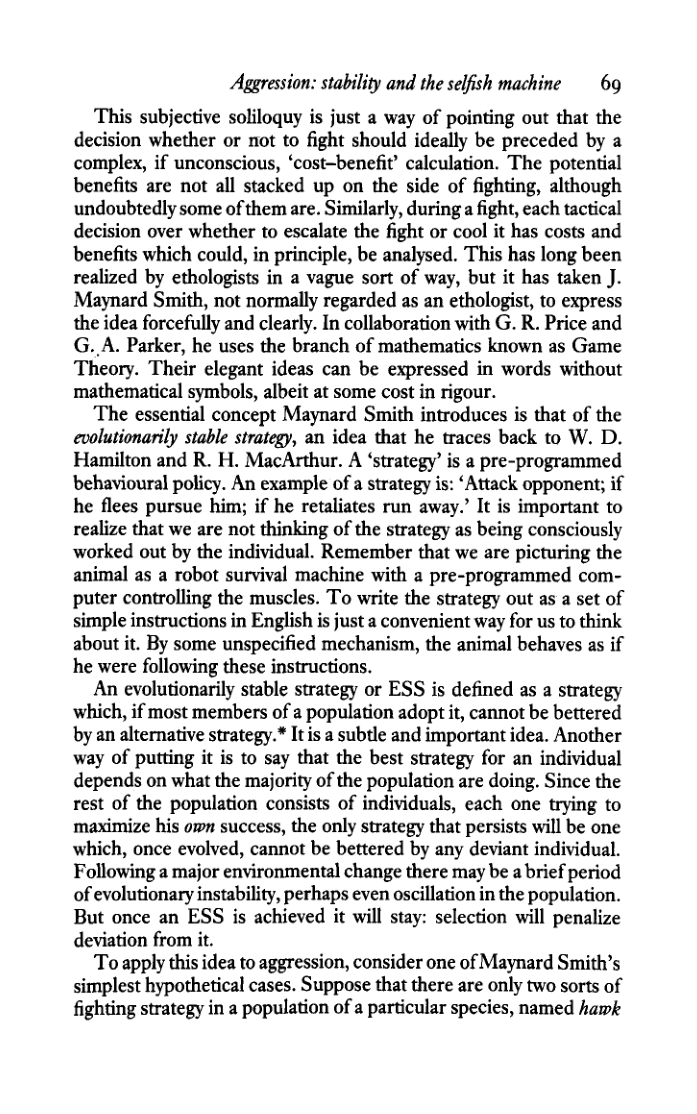
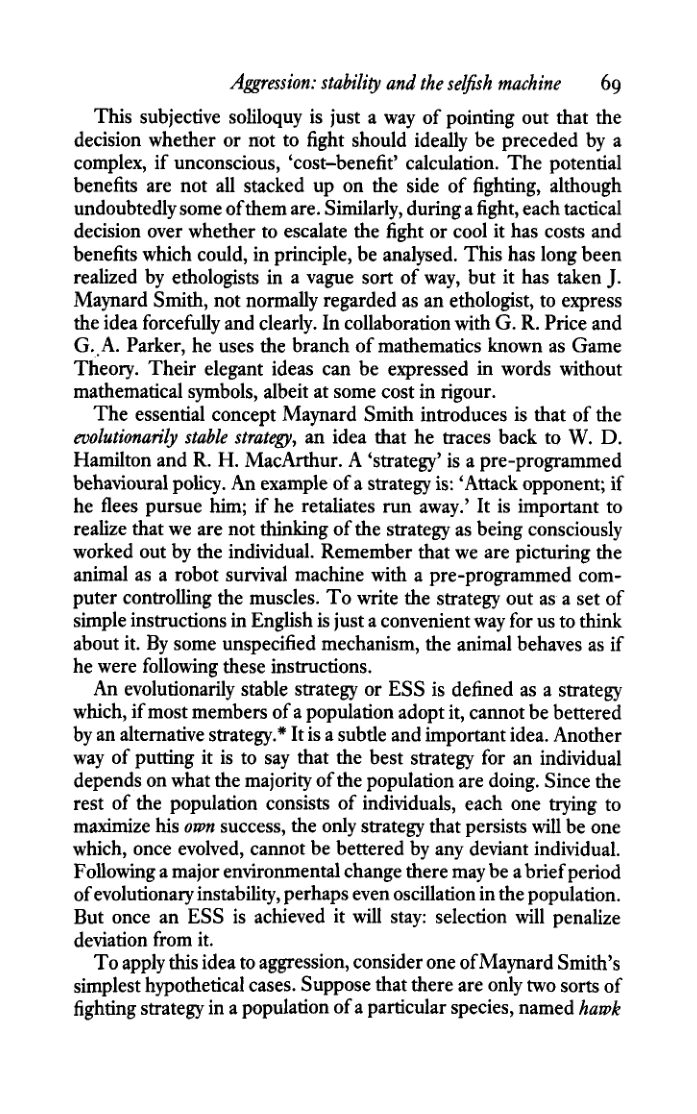
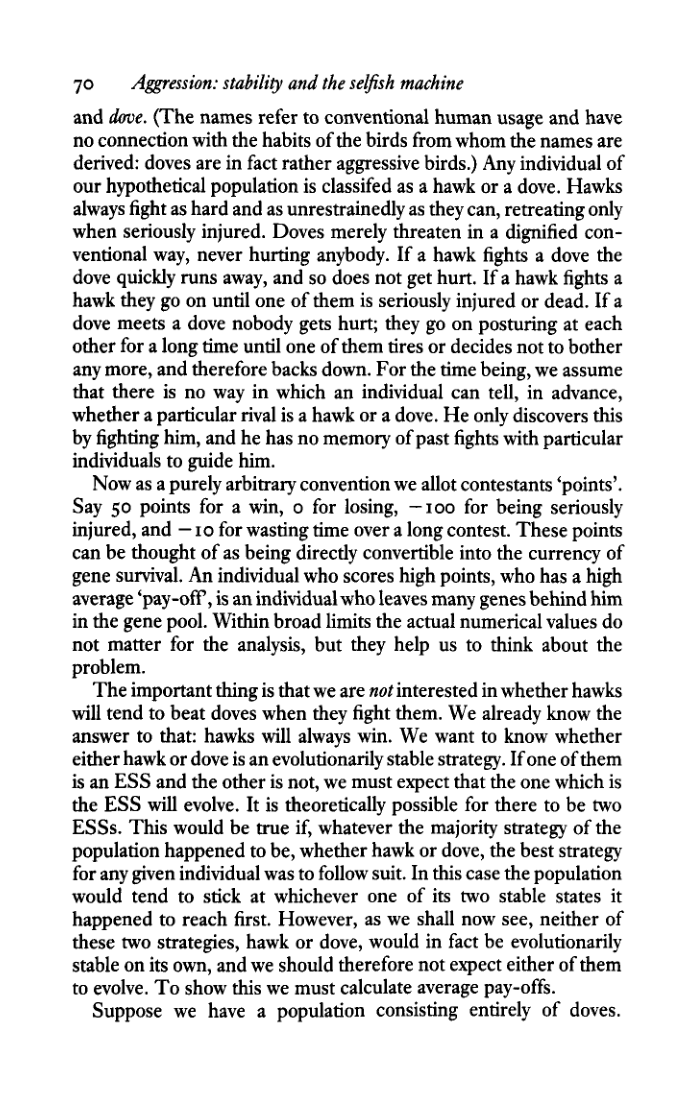
- The model defines 'Hawks' as aggressive fighters who risk serious injury and 'Doves' as ritualistic bluffers who avoid physical harm.
- Success is measured in 'points' representing genetic fitness, where wins add value and injuries or time-wasting subtract it.
- While Hawks always defeat Doves in individual encounters, the stability of the strategy depends on the average payoff within the entire population.
- A pure population of Doves is vulnerable to invasion by a single mutant Hawk because the Hawk's average payoff against Doves is significantly higher.
Hawks always fight as hard and as unrestrainedly as they can, retreating only when seriously injured.
The Evolution of Stability
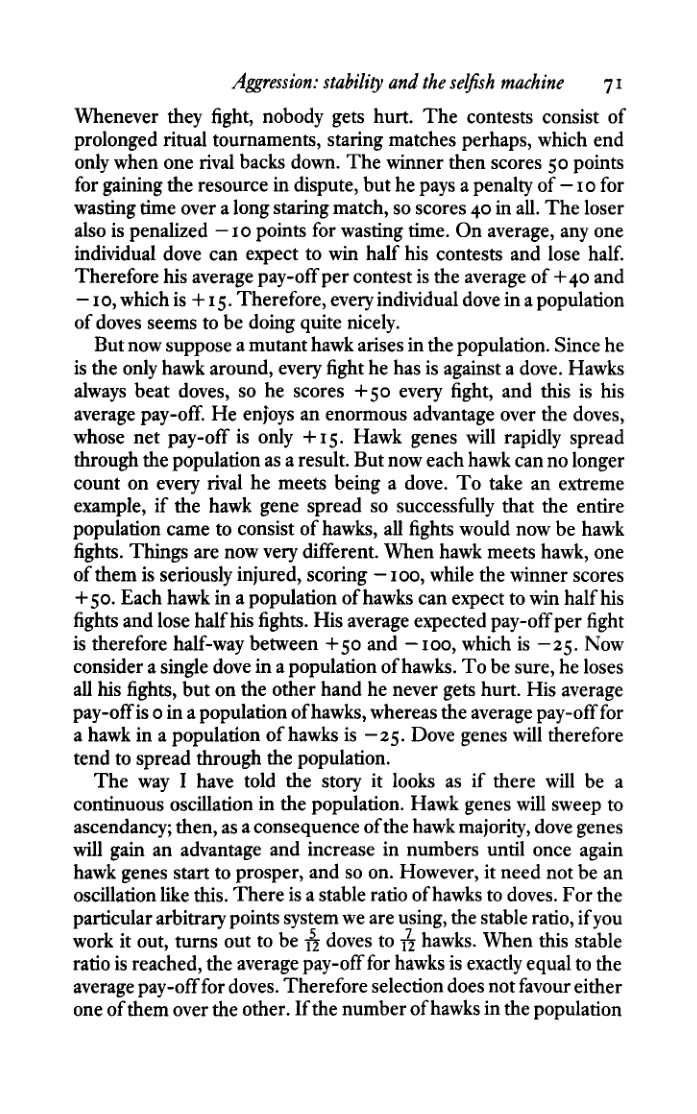
- In a population of doves, hawk genes spread rapidly because hawks exploit the non-violent nature of their rivals for high pay-offs.
- A population dominated by hawks becomes self-destructive, as frequent violent encounters lead to an average negative pay-off due to injury.
- Doves can actually thrive in a hawk-dominated environment because their strategy of retreating ensures a pay-off of zero, which is superior to the negative average of hawks.
- Natural selection leads to an Evolutionarily Stable Strategy (ESS) where the ratio of hawks to doves results in equal pay-offs for both strategies.
- The ESS is distinct from group selection because it describes a stable equilibrium driven by individual advantage rather than what is best for the group as a whole.
- A 'conspiracy' of all doves would yield higher average benefits for everyone, but such a system is unstable because it is vulnerable to invasion by a single hawk.
If only everybody would agree to be a dove, every single individual would benefit.
Stability and Strategic Treachery
- Evolutionarily Stable Strategies (ESS) are defined by their immunity to internal treachery rather than their benefit to the group.
- Conspiracies of 'doves' are inherently unstable because a single 'hawk' can exploit the group and dominate the evolutionary path.
- Human foresight allows for temporary pacts like price-fixing, but these constantly teeter on the brink of collapse due to short-term greed.
- In nature, an ESS can manifest either as a stable polymorphism of different individuals or as a single individual using a randomized strategy.
- For a randomized strategy to be effective, it must be unpredictable to prevent rivals from exploiting a recognizable pattern.
- Simplified models like the hawk-dove game serve as essential tools for understanding the complex dynamics of biological aggression.
An ESS is stable, not because it is particularly good for the individuals participating in it, but simply because it is immune to treachery from within.
Evolutionary Strategies of Aggression
- The simple Hawk-Dove model is expanded by introducing conditional strategies like Retaliator, Bully, and Prober-retaliator.
- A Retaliator acts as a Dove unless attacked, in which case it mimics a Hawk, making it a highly effective conditional strategist.
- Computer simulations reveal that Retaliator is the only truly evolutionarily stable strategy (ESS) among the five discussed.
- While Doves are unstable on their own, they can persist as a minority within a population of Retaliators, leading to complex population oscillations.
- The 'gloved fist' of animal aggression is explained by these models, where the intensity of conflict scales with the value of the resource.
- In species like elephant seals, the massive payoff of winning a harem justifies the high risk of vicious injury compared to lower-stakes species.
A retaliator behaves like a hawk when he is attacked by a hawk, and like a dove when he meets a dove.
The War of Attrition
- Time is a precious currency in nature, where even short delays in feeding or mating can be more costly than the risk of physical injury.
- The 'war of attrition' describes contests settled by posturing rather than combat, where the winner is simply the individual who waits the longest.
- Fixed bidding strategies for time are inherently unstable because mutants can easily exploit predictable limits by waiting slightly longer.
- Unlike a standard auction, both participants in a war of attrition pay the full price of the time spent, regardless of who wins the resource.
- The evolutionarily stable strategy (ESS) for such contests requires individuals to be unpredictable in their persistence to prevent exploitation.
- Mathematical analysis suggests that the average time spent will reflect the resource's true economic value, despite individual variations.
In the war of attrition both contestants pay the price but only one of them gets the goods.
The Evolution of Poker Faces
- In a war of attrition, natural selection penalizes any physical cues that reveal an individual's intent to surrender.
- The 'poker face' is an evolutionarily stable strategy because it prevents opponents from exploiting predictable behavior.
- Lying about one's intentions is unstable because it leads to a cycle of bluffing and bluff-calling that eventually collapses.
- Symmetric contests assume opponents are equal in strength and stakes, but real-world interactions are often asymmetric.
- Asymmetries in fighting ability, potential gains, or arbitrary factors like residency can dictate the outcome of a conflict.
- Arbitrary asymmetries, such as who arrived first, can serve as stable conventions to settle disputes without costly combat.
Anybody who betrayed, by the merest flicker of a whisker, that he was beginning to think of throwing in the sponge, would be at an instant disadvantage.
Arbitrary Asymmetries and Territoriality
- The 'resident wins, intruder retreats' strategy can be an Evolutionarily Stable Strategy (ESS) even if the roles are assigned arbitrarily.
- Once a majority adopts a specific convention for settling disputes, deviants are penalized by lower payoffs or higher injury risks.
- While both 'resident wins' and 'intruder wins' are theoretically stable, the latter is paradoxical and leads to its own destruction.
- A strategy where intruders always win would force individuals into constant, pointless movement to avoid being caught as residents.
- Natural selection favors the 'resident wins' model because it encourages individuals to hold ground, leading to the phenomenon of territorial defense.
- The stickleback fish experiment by Niko Tinbergen provides a practical demonstration of how territory influences behavioral dominance.
A simple analogy is to humans who settle a dispute quickly and without fuss by tossing a coin.
Territoriality and Paradoxical Strategies
- Tinbergen's experiments with sticklebacks demonstrate that territorial dominance is often a conditional strategy based on location.
- The 'resident wins' rule functions as an Evolutionarily Stable Strategy (ESS) triggered by the asymmetry of arrival time.
- Physical asymmetries like size usually dictate a 'sensible' strategy where the smaller individual retreats to avoid injury.
- A 'paradoxical strategy'—where the larger individual retreats—is mathematically stable because it prevents escalated conflict.
- While theoretically possible, paradoxical strategies are unlikely to persist because they have a narrow zone of attraction compared to sensible ones.
- The stability of these behaviors suggests that territorial defense may be an inherent logical outcome rather than a complex biological adaptation.
By simply moving the two tubes from one end of the tank to the other, Tinbergen was able to dictate which male attacked and which retreated.
Memory and Dominance Hierarchies
- The Mexican social spider exhibits a 'sequential displacement' behavior where intruders displace residents without physical conflict.
- Crickets utilize a general memory of past encounters, where winning streaks increase aggression and losing streaks encourage submissive behavior.
- General memory of success or failure can lead to the emergence of a rank order even without individuals recognizing one another.
- Higher animals like hens and monkeys use specific memory to recognize individuals, allowing them to 'learn their place' relative to specific rivals.
- Dominance hierarchies reduce group aggression and can increase productivity, such as higher egg production in stable hen flocks.
- Hierarchies are group-level properties resulting from individual evolutionary strategies rather than being an evolved 'function' for the group's benefit.
He used a model cricket to beat up real crickets. After this treatment the real crickets became more likely to lose fights against other real crickets.
Asymmetry and Evolutionary Stability
- The concept of Evolutionarily Stable Strategies (ESS) is more effective than the vague term 'function' for explaining animal interactions.
- Direct competition is most intense between members of the same species, whereas different species often ignore each other's territorial boundaries.
- Predation is logically a conflict over a resource—meat—where the genes of the predator and prey have mutually incompatible goals.
- Cannibalism is rare among adult carnivores because it is not an ESS; the risk of retaliation makes it an unstable strategy compared to hunting other species.
- Interspecific conflicts are governed by built-in asymmetries, leading to stable conditional strategies like 'if smaller, run away'.
- The divergence between lions and antelopes represents an evolutionary stability where each has become specialized in either chasing or fleeing.
The lion genes 'want' the meat as food for their survival machine. The antelope genes want the meat as working muscle and organs for their survival machine.
The Evolution of Compatibility
- The concept of the Evolutionarily Stable Strategy (ESS) explains how independent selfish entities can appear to function as a single organized whole.
- Biologists often mistakenly attribute biological advantages to social organizations as entities rather than focusing on individual selection.
- Genes are not selected for being 'good' in isolation, but for their ability to perform well against the background of the existing gene pool.
- A gene's success depends on its compatibility with other genes, such as a herbivore's teeth being advantageous only in a herbivorous gene pool.
- The 'oarsmen' analogy illustrates how selection at the individual level can create a uniform group, such as a crew speaking a single language, without needing group-level selection.
- Selection at the level of the single gene can create a powerful illusion of selection occurring at a higher level of organization.
Selection at the low level of the single gene can give the impression of selection at some higher level.
The Evolutionarily Stable Gene Pool
- The author uses a rowing crew analogy to show how a balanced system emerges from blind selection of individual components based on their performance within a specific context.
- Genes are not selected in isolation but are judged on 'merit' relative to the existing gene pool, which acts as their long-term environment.
- An evolutionarily stable set of genes is defined as a pool that resists invasion by new mutations, maintaining a state of equilibrium.
- Evolutionary progress often occurs as a series of discrete steps between stable plateaus rather than a continuous, steady climb.
- The appearance of a well-integrated, self-regulating organism is an illusion produced by selection occurring at the level of the individual selfish gene.
- While aggressive interactions between bodies are visible, the most significant genetic interactions occur internally during embryonic development.
Well-integrated bodies exist because they are the product of an evolutionarily stable set of selfish genes.
The Concept of Genesmanship
- The model of individuals as independent selfish machines fails when considering close relatives who share a high proportion of genes.
- A selfish gene is defined not as a single physical DNA fragment, but as all replicas of that sequence distributed across the global population.
- Individual altruism can be driven by gene selfishness if a gene programs a body to assist other bodies that carry replicas of itself.
- The 'Green Beard' effect describes a theoretical gene that produces both a visible label and a behavioral tendency to help others with that label.
- While theoretically possible, it is unlikely for a single gene to simultaneously code for a specific physical trait and a complex social preference for that trait.
The key point of this chapter is that a gene might be able to assist replicas of itself that are sitting in other bodies.
The Mechanics of Kin Selection
- The 'Green Beard Effect' describes a theoretical scenario where a gene produces both a visible label and a behavioral preference for others with that label.
- Altruism itself can act as a label, where individuals rescue those who are already performing altruistic acts, though this is considered biologically implausible.
- Kinship provides a more realistic mechanism for gene recognition, as close relatives have a statistically higher probability of sharing identical genes.
- W. D. Hamilton's work formalized the mathematics of kin altruism, showing that a gene can prosper if the cost to the individual is outweighed by the benefit to relatives.
- The calculation of relatedness focuses on rare genes rather than common ones, as rare genes are unlikely to be shared by chance but likely to be shared by family.
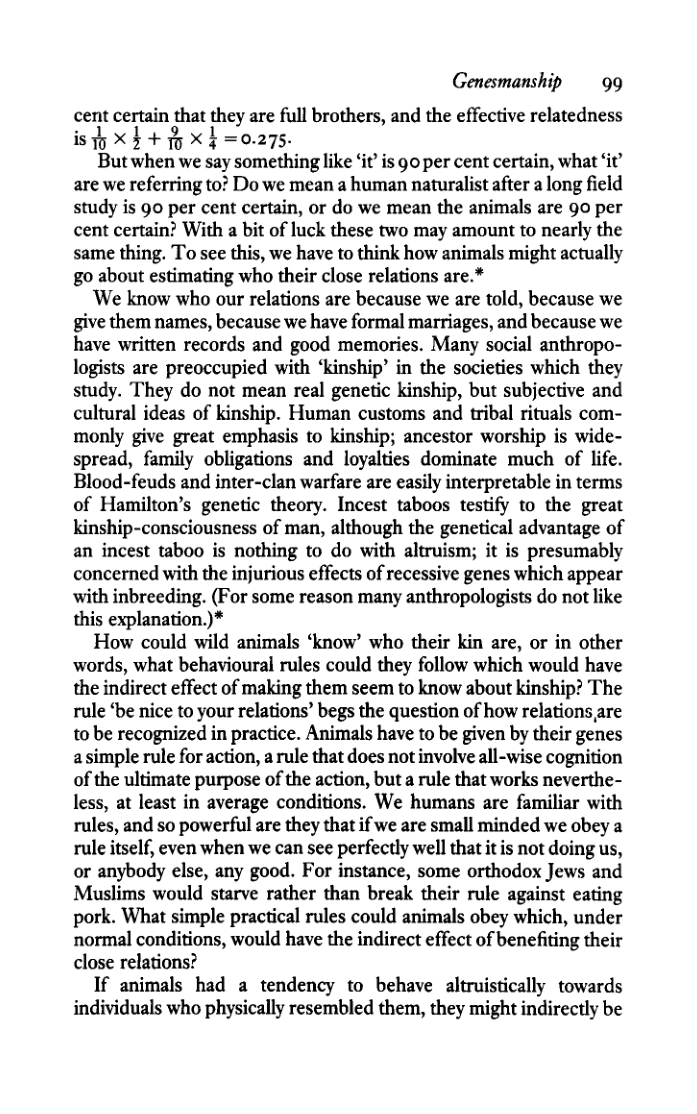
- A gene for altruism can spread if it 'recognizes' that the odds of a sibling carrying the same rare gene are exactly 50 percent.
A gene could prosper in the gene pool if it 'said' the equivalent of: 'Body, if A is drowning as a result of trying to save someone else from drowning, jump in and rescue A.'
Calculating Genetic Relatedness
- The probability of sharing a specific rare gene with a full sibling is approximately 50 percent due to the mechanics of inheritance.
- Parent-child relatedness is always exactly 0.5, as each child receives exactly half of their genes from each parent.
- The 'index of relatedness' serves as a mathematical tool to express the average chance of a gene being shared between any two relatives.
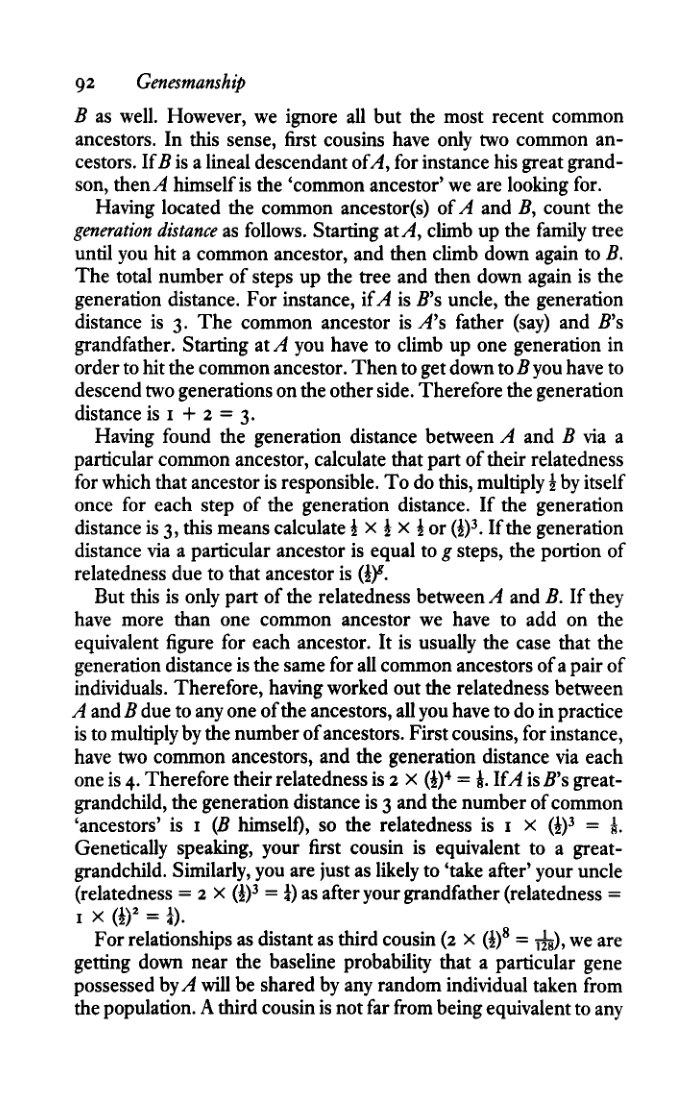
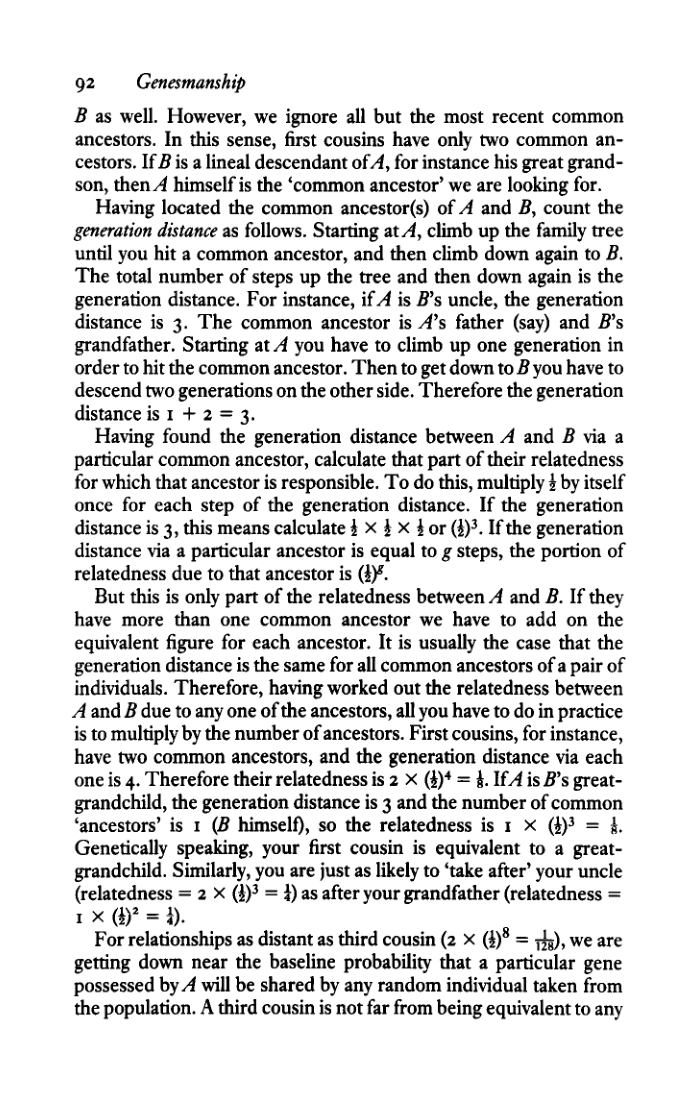
- A 'generation distance' can be calculated by climbing up the family tree to a common ancestor and back down to the relative in question.
- Relatedness is determined by multiplying 0.5 by itself for every step in the generation distance between two individuals.
- While these calculations are generally reliable, they can be complicated by factors like incestuous mating or specific insect biology.
The relatedness between two brothers is 1/2, since half the genes possessed by one brother will be found in the other.
The Mathematics of Kin Altruism
- Relatedness is calculated by raising one-half to the power of the generation distance and multiplying by the number of common ancestors.
- Genetically, an individual is as closely related to their uncle or grandfather as they are to a half-sibling, all sharing a relatedness of one-fourth.
- The success of an altruistic gene depends on a cost-benefit ratio where the number of relatives saved must outweigh the genetic loss of the altruist.
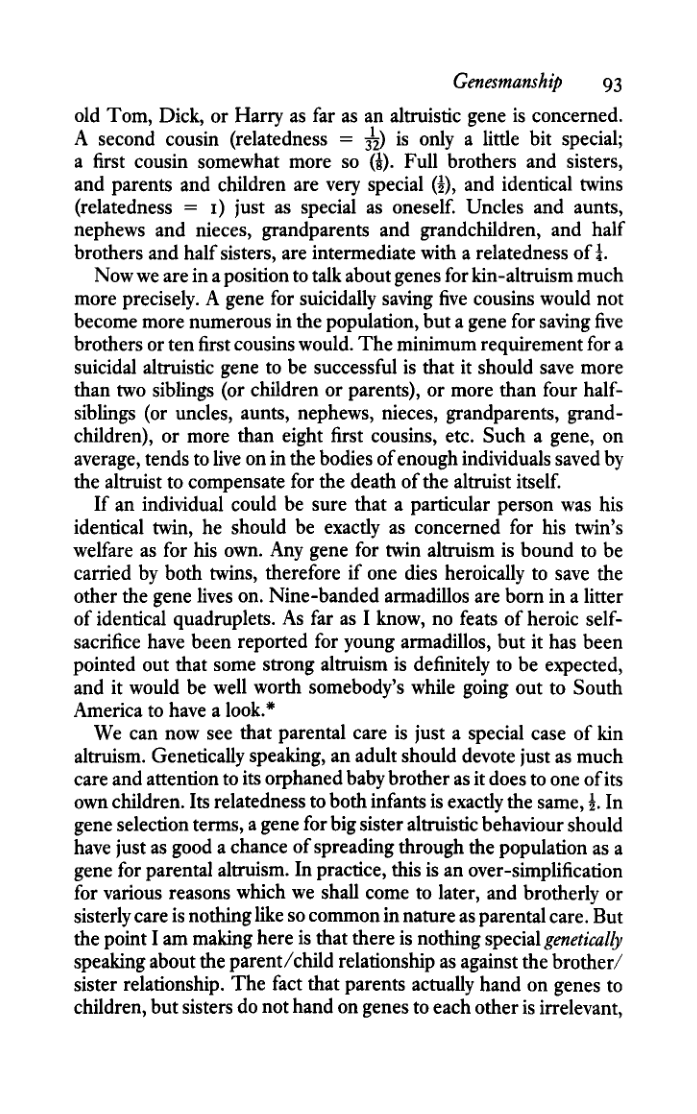
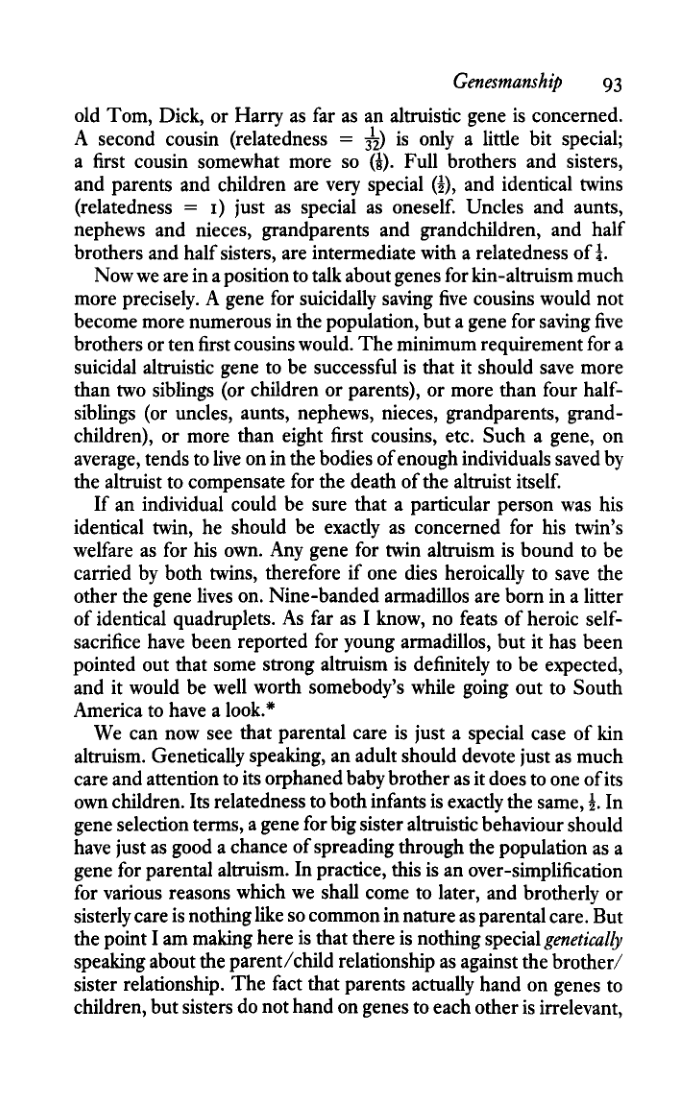
- A suicidal gene can only proliferate if it saves more than two siblings, four half-siblings, or eight first cousins.
- Identical twins share a relatedness of one, meaning a gene for twin altruism should theoretically value the twin's life as much as its own.
- Parental care is not genetically unique but is rather a specific, common manifestation of the broader principle of kin altruism.
A third cousin is not far from being equivalent to any old Tom, Dick, or Harry as far as an altruistic gene is concerned.
The Mechanics of Kin Selection
- Kin selection explains altruistic behavior through the shared probability of genes existing in relatives.
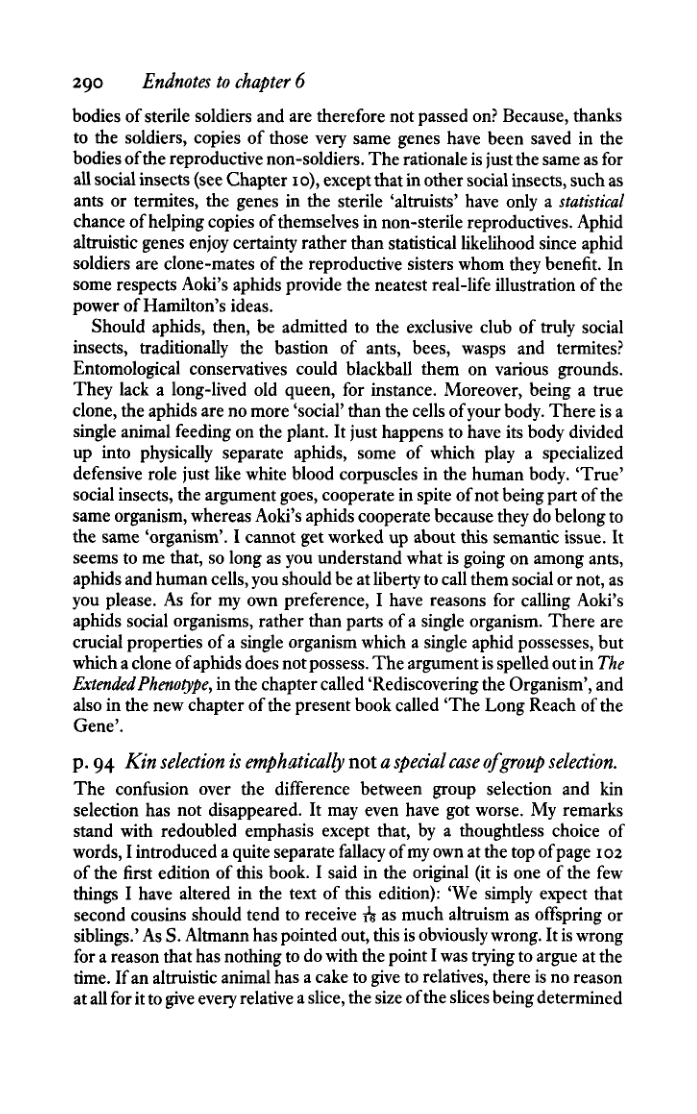
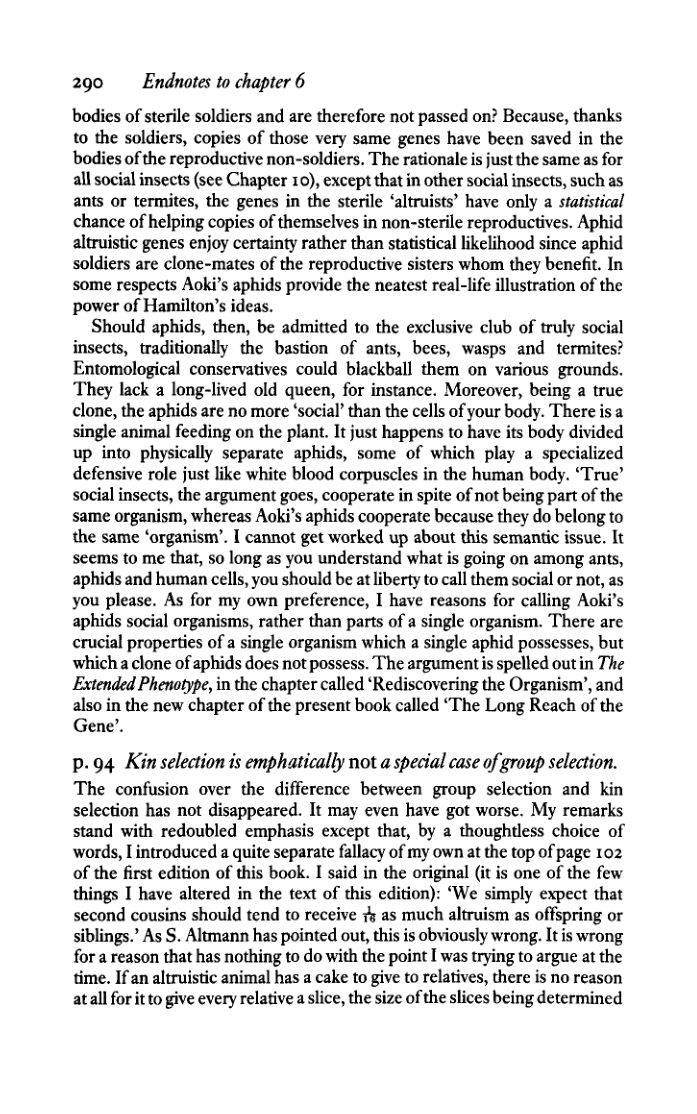
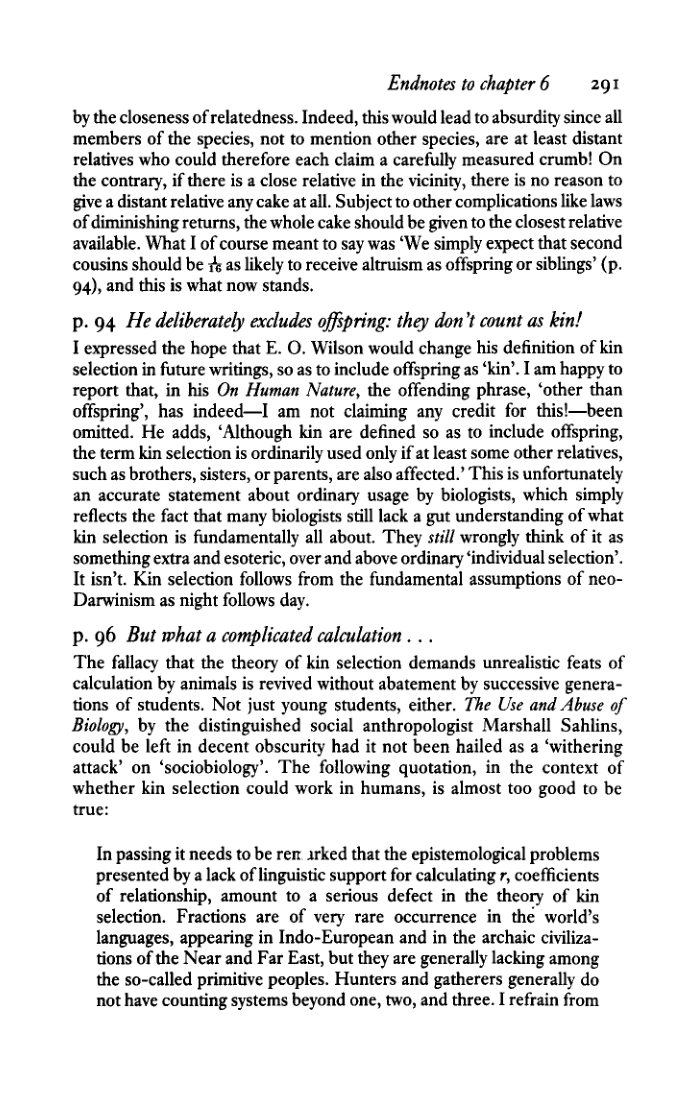
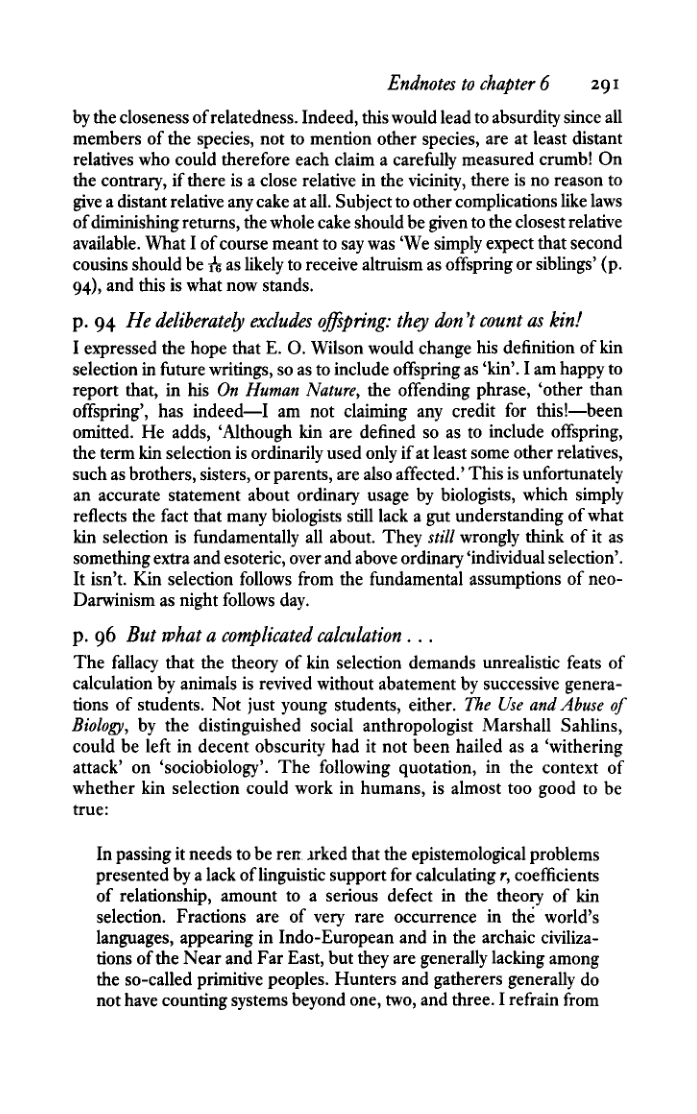
- The author argues that kin selection is a direct consequence of gene selection rather than a subset of group selection.
- E.O. Wilson is criticized for excluding parental care from the definition of kin selection, which the author views as a logical error.
- The distinction between family and non-family is not a hard line but a mathematical gradient of relatedness.
- In nature, altruistic acts are governed by statistical risks of death rather than conscious mathematical calculations.
- Parental care and sibling altruism evolve for the same reason: the high probability of the altruistic gene being present in the beneficiary.
The whole point of Hamilton's argument is that the distinction between family and non-family is not hard and fast, but a matter of mathematical probability.
The Actuarial Logic of Altruism
- Genetic relatedness must be adjusted by 'actuarial weightings' like life expectancy to determine the true value of an altruistic act.
- A gene for a grandparent helping a grandchild has higher selective advantage than the reverse because the grandchild has more future reproductive potential.
- Individuals function like life-insurance underwriters, weighing the risk to their own assets against the 'reproduction expectancy' of a relative.
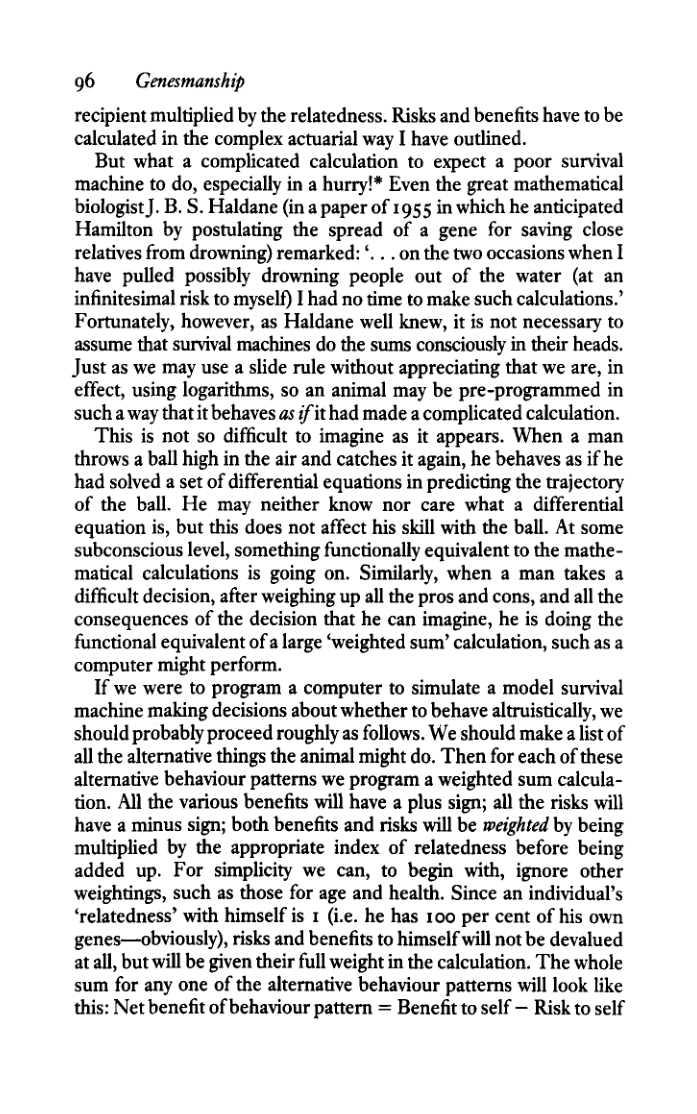
- Evolutionary altruism occurs when the net risk to the altruist is less than the benefit to the recipient multiplied by their degree of relatedness.
- Animals do not perform these complex mathematical calculations consciously; they are pre-programmed to behave 'as if' they had solved the equations.
- The subconscious execution of these biological 'weighted sums' is compared to a person catching a ball without understanding the underlying differential equations.
When a man throws a ball high in the air and catches it again, he behaves as if he had solved a set of differential equations in predicting the trajectory of the ball.
The Calculus of Altruism
- The net benefit of any behavior is calculated by weighing the risks and benefits to oneself against those of relatives, adjusted by their degree of relatedness.
- An animal's 'relatedness' to itself is 100 percent, meaning its own survival benefits are never devalued in the genetic equation.
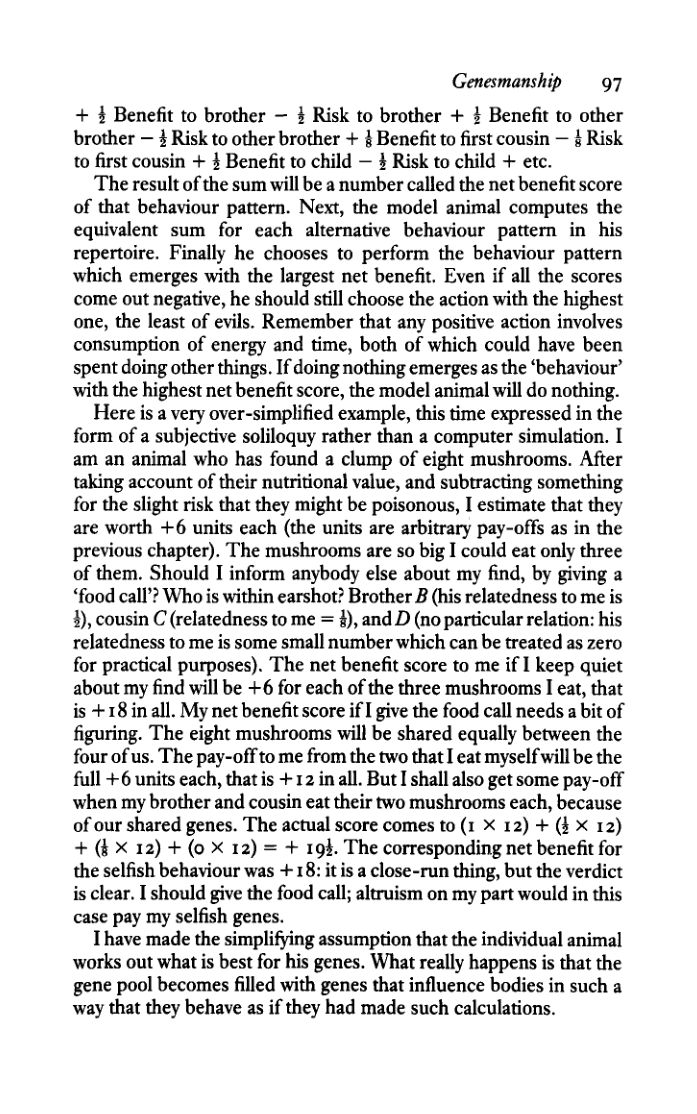
- Altruistic acts, such as giving a food call, are favored by natural selection if the weighted benefit to kin exceeds the personal cost to the individual.
- The model suggests that animals choose the behavior pattern with the highest net benefit score, even if that choice is simply to do nothing.
- In reality, animals do not consciously perform these complex calculations; rather, the gene pool becomes filled with genes that make bodies act 'as if' they had.
- Environmental factors, such as an individual's current hunger level or the age of relatives, further refine the ideal mathematical outcome of these behaviors.
What really happens is that die gene pool becomes filled widi genes diat influence bodies in such a way diat they behave as if diey had made such calculations.
The Calculus of Kinship
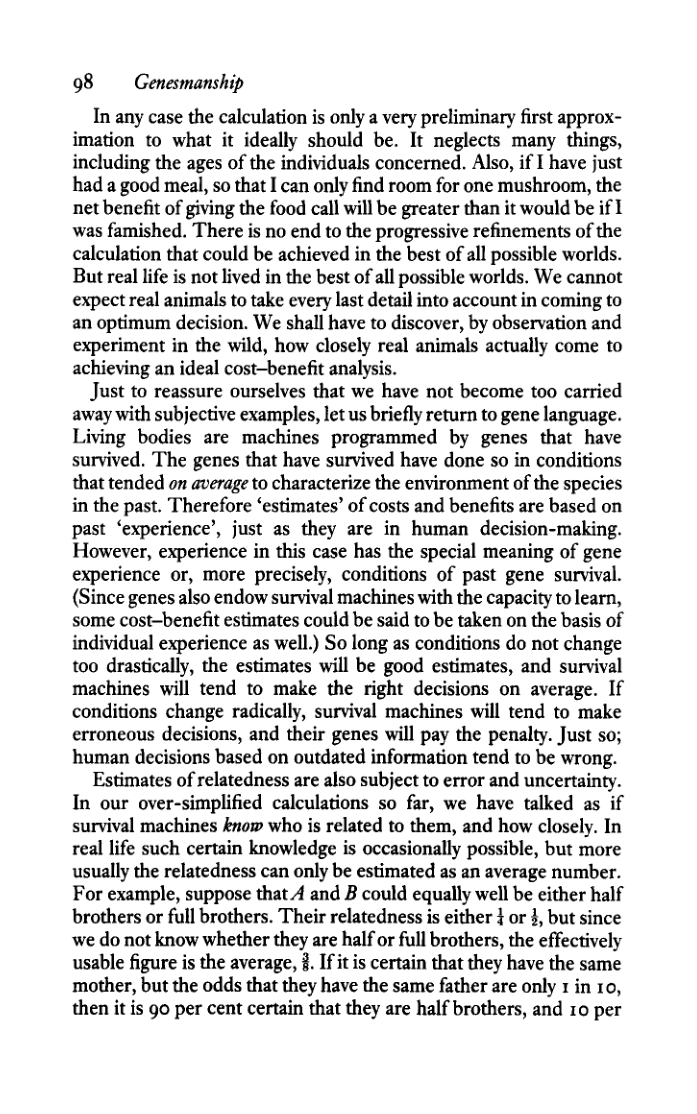
- Survival machines are programmed by genes to perform cost-benefit analyses based on ancestral environments.
- Genetic 'experience' functions as a historical record of conditions that favored survival, though it fails when environments change rapidly.
- In nature, relatedness is often an estimate or average probability rather than a known certainty.
- Human kinship systems, including ancestor worship and blood feuds, often align with genetic theories of altruism.
- Animals do not require conscious knowledge of kinship; they simply follow behavioral rules that work on average within their environment.
Animals have to be given by their genes a simple rule for action, a rule that does not involve all-wise cognition of the ultimate purpose of the action, but a rule that works nevertheless, at least in average conditions.
The Mechanics of Kin Selection
- Animals often follow simple behavioral rules that indirectly benefit their genetic relatives, even without conscious recognition of kinship.
- Physical resemblance can serve as a proxy for kinship, though this rule may lead to 'wrong' decisions like racial prejudice if environmental conditions change.
- In species with low mobility or small groups, the statistical probability of encountering a relative is high enough to favor a general rule of being 'nice' to any group member.
- Altruistic behaviors in whales and dolphins, such as rescuing drowning companions, likely persist because the cost is outweighed by the high probability of saving a relative.
- The rescue of a human by a dolphin can be interpreted as a 'misfiring' of a biological rule triggered by a 'long thing thrashing about' near the surface.
- Apparent altruism, such as the food calls of chicks or the defense of baboon troops, is evolutionarily stable if the genetic benefit to siblings or offspring exceeds the cost to the individual.
The rule's 'definition' of a member of the school who is drowning might be something like: 'A long thing thrashing about and choking near the surface.'
Misfiring Instincts and Adoption
- Natural selection shapes behavioral rules based on conditions that normally prevail in nature, such as the assumption that occupants of one's nest are kin.
- Adoption in the wild is often a 'misfiring' of the maternal instinct where a female invests energy in non-relatives at the expense of her own genetic success.
- Extreme cases of 'baby-snatching' by bereaved monkeys represent a double mistake: the adopter wastes resources while freeing a rival to reproduce again.
- Brood parasites like cuckoos actively exploit these rigid behavioral rules to trick other birds into raising unrelated offspring.
- The necessity of recognition mechanisms, such as guillemots identifying their own eggs, depends on the environmental risk of eggs or chicks getting mixed with neighbors.
I see this as a double mistake, since the adopter not only wastes her own time; she also releases a rival female from the burden of child-rearing, and frees her to have another child more quickly.
The Evolution of Discrimination
- Group selectionist arguments for communal egg-sitting fail because the system is vulnerable to exploitation by cheaters.
- A gene for cheating—laying extra eggs while refusing to incubate—would rapidly spread through a non-discriminating population.
- Altruistic adoption is not an evolutionarily stable strategy because it is easily bettered by selfish strategies that prioritize individual interests.
- Guillemots have evolved to recognize and sit exclusively on their own eggs to prevent being exploited by their own species.
- The evolutionary arms race between cuckoos and host species drives a cycle of increasingly perfect mimicry and sharper detection abilities.
So the gene for cheating the system would spread through the population, and the nice friendly baby-sitting circle would break down.
Estimating Kinship and Altruism
- Field naturalist Brian Bertram calculated the average genetic relatedness within lion prides based on social and reproductive patterns.
- In a typical pride, males are on average slightly less related than half brothers, while females are slightly closer than first cousins.
- Natural selection favors behaviors that treat others according to these average degrees of relatedness, even if individuals cannot identify specific siblings.
- The 'certainty' of a genetic relationship is as crucial to the evolution of altruism as the actual degree of relatedness.
- Parental care is more common than sibling altruism because the certainty of being a parent is generally higher than the certainty of being a sibling.
- Self-interest remains the highest priority because an individual can be more certain of their own identity than any other relative.
Although the parent/child relationship is no closer genetically than the brother/sister relationship, its certainty is greater.
The Certainty of Kinship
- The degree of altruism toward kin is limited by the 'identification problem,' or how certain an individual can be of their genetic relatedness to others.
- Individual selfishness is evolutionarily favored because an organism is the only entity it can be 100 percent certain contains its own genes.
- Mothers generally invest more in offspring than fathers because the physical act of birth provides greater certainty of relatedness compared to the risk of cuckoldry.
- The theory predicts varying levels of altruism among extended relatives, such as maternal grandmothers being more invested than paternal ones due to more reliable lines of descent.
- In societies with high infidelity, maternal uncles may be more altruistic than 'legal' fathers because their genetic link to the child is more certain.
- Asymmetry in parent-child altruism is partly due to practical capacity, as older parents are better equipped to provide aid than their dependent offspring.
The poor father is much more vulnerable to deception. It is therefore to be expected that fathers will put less effort than mothers into caring for young.
Kin Selection and Life Expectancy
- Life expectancy is a critical variable in the 'calculation' of altruism, favoring parental care over child altruism because parents are closer to death.
- The author argues that parental care is the most common and obvious manifestation of kin selection, despite critics viewing it as a separate phenomenon.
- Historical emphasis on social insects and collateral kin has led to the misconception that kin selection excludes the parent-child relationship.
- Any evolutionary theory that explains parental altruism must logically also predict altruism between other genetic relatives.
- A fundamental distinction is proposed between 'child-bearing' (bringing new individuals into existence) and 'child-caring' (investing in existing individuals).
- The survival machine must balance strategic decisions between bearing and caring to maximize the survival of its genes.
In a species in which children have a longer average life expectancy than parents, any gene for child altruism would be labouring under a disadvantage.
Caring Versus Bearing
- Evolutionary strategies are divided into 'caring' for existing individuals and 'bearing' new ones into the world.
- A pure caring strategy is evolutionarily unstable because it would be quickly outcompeted by mutants who focus on reproduction.
- While mammals often combine caring and bearing, genetic theory suggests no inherent preference between caring for a sibling versus a child since relatedness is equal.
- The debate over population regulation centers on whether animals altruistically limit their birth rates for the benefit of the group.
- Human population growth is determined not just by the number of children per couple, but also by the timing and spacing of generations.
The one thing that cannot be evolutionarily stable is a pure caring strategy.
The Limits of Growth
- Mathematical projections show that current population growth rates would lead to physically impossible scenarios, such as humans stacked to the edge of the universe.
- Technological fixes like the 'green revolution' are temporary palliatives that may worsen the crisis by enabling further unsustainable expansion.
- The ultimate check on uncontrolled birth rates is a logical certainty: a horrific increase in death rates through famine, plague, or war.
- The author critiques leaders who oppose contraception, noting that 'natural' population control inevitably manifests as mass starvation.
- While humans can use foresight to consider species welfare, the 'selfish gene' theory suggests individual organisms are not evolved to limit their own breeding for the greater good.
- In nature, animal populations rarely increase indefinitely; they are instead regulated by violent crashes, predation, and the reality that few individuals ever reach old age.
They express a preference for 'natural' methods of population limitation, and a natural method is exactly what they are going to get. It is called starvation.
The Evolution of Birth Control
- Populations are naturally limited by resources, but the debate centers on whether animals actively regulate their own birth rates to avoid starvation.
- The core disagreement between selfish gene theory and group selection is why birth rates are regulated, not if they are.
- Wynne-Edwards proposed that animals practice altruistic birth control to prevent the entire group from exhausting its food supply.
- Group selection suggests that populations of restrained breeders outlast populations that reproduce too rapidly and face extinction.
- Social structures like territoriality act as a licensing system where only those who secure a territory are permitted to breed.
- In some species, individuals who fail to secure a territory appear to accept their non-breeding status rather than fighting to the death.
Even in apparently faithful monogamous species, the female may be wedded to a male's territory rather than to him personally.
The Rules of Reproduction
- Wynne-Edwards suggests that territoriality and dominance hierarchies act as 'tickets of entitlement' to breed, which losers voluntarily respect.
- Dominance hierarchies, or 'peck orders,' minimize physical injury by ensuring lower-ranking individuals submit automatically to their superiors.
- The theory posits that animals compete for social status rather than directly for mates to prevent the population from growing too fast.
- Formal contests over status and territory may serve as a mechanism to limit population size just below the threshold of mass starvation.
- The concept of 'epideictic behaviour' suggests that massive animal aggregations, like starling flocks, function as a biological census.
- This census-taking allows individuals to adjust their reproductive output based on perceived population density via hormonal or nervous mechanisms.
For Wynne-Edwards, epideictic behaviour is deliberate massing in crowds to facilitate population estimation.
The Selfish Gene Theory
- The author challenges Wynne-Edwards's theory of group-selection birth control, arguing that the evidence for it is weak.
- David Lack's research on bird clutch sizes provides an alternative 'selfish gene' explanation for family planning in nature.
- A 'more means better' approach to reproduction is logically absurd because increased bearing leads to less efficient caring.
- Lack proposes that each individual selects a clutch size that maximizes their own number of surviving offspring, not the group's welfare.
- Birth control in the wild is actually a strategy to avoid spreading resources too thin, ensuring the survival of the maximum number of children.
- Rearing young is an exhausting investment of energy and food, making the 'optimal' number a matter of survival rather than altruism.
They are practising birth-control in order to maximize the number of surviving children they actually have, an aim which is the very opposite of that which we normally associate with birth-control.
The Economics of Family Size
- Reproduction is a costly endeavor where parents must balance the number of offspring with the resources available to care for them.
- Natural selection penalizes over-reproduction because individuals with too many children often see fewer of them survive to adulthood.
- The modern welfare state disrupts natural population control by decoupling family size from a parent's personal economic resources.
- The author argues that the 'unnatural' welfare state must be paired with 'unnatural' birth control to prevent systemic collapse and misery.
- Altruistic systems like the welfare state are inherently unstable because they are vulnerable to exploitation by individuals or institutions.
- In the wild, behaviors like territoriality serve as mechanisms to limit population density based on available food resources.
The welfare state is perhaps the greatest altruistic system the animal kingdom has ever known. But any altruistic system is inherently unstable, because it is open to abuse by selfish individuals, ready to exploit it.
The Strategy of Restraint
- Territorial outcasts often appear to 'accept' their non-breeding status, but this behavior can be explained by selfish gene theory rather than group altruism.
- For an outcast, waiting for a territory holder to die may be a statistically better gamble for future reproduction than engaging in a high-risk, exhausting fight.
- Animals act as gamblers, where a 'wait-and-hope' strategy is often more evolutionarily advantageous than a 'bull-at-a-gate' approach.
- Apparent passive acceptance of non-reproductive status in species like seals or lemmings is actually a calculated move to maximize individual long-term survival.
- While overcrowding is known to reduce birth rates, this 'stress' response may be an individual's evolutionary adaptation to avoid over-investing in doomed offspring.
- The debate centers on whether population control is a mechanism for the welfare of the group or a byproduct of individuals maximizing their own genetic success.
The best strategy for a gambler may sometimes be a wait-and-hope strategy, rather than a bull-at-a-gate strategy.
Selfish Genes and Population Control
- Overcrowding serves as a biological indicator of future famine, triggering evolved responses in animals to limit their offspring.
- The selfish gene theory suggests individuals reduce birth rates not for the good of the species, but to maximize their own successful rearing of survivors.
- Animals that ignore environmental cues of scarcity risk wasting resources on too many offspring, ultimately producing fewer surviving descendants.
- The theory reinterprets 'epideictic displays' as tools for selfish individuals to predict the optimum clutch size for the coming season.
- Efficient egg-laying is described as a form of prediction where individuals assess variables like population density to adjust their reproductive strategy.
Obviously, if a female is presented with reliable evidence that a famine is to be expected, it is in her own selfish interests to reduce her own birth-rate.
The Beau Geste Effect
- Animals may use environmental cues like population density to predict future food competition and adjust their clutch size accordingly.
- If individuals reduce their birth rates based on perceived density, it becomes advantageous for rivals to falsely signal a high population.
- The Beau Geste Effect describes individuals 'shouting' or mimicking a crowd to trick others into lowering their own reproductive output.
- This theory reinterprets Wynne-Edwards's group-selection observations through the lens of the selfish gene and individual advantage.
- Family planning in nature is an optimization strategy to maximize surviving offspring rather than a selfless act for the species.
- The focus shifts from population-wide regulation to internal family conflicts and the potential for parental favoritism.
If starlings are estimating population size by the volume of noise in a winter roost, it would pay each individual to shout as loudly as possible, in order to sound more like two starlings than one.
Measuring Parental Investment
- The behavior of 'survival machines' is often best explained through the metaphor of conscious purpose and resource allocation.
- Parental resources include food, time, energy, and the physical risks taken to protect offspring from predators.
- While energy or calories are tempting metrics, the true 'gold-standard' of evolution is the survival of genes.
- Robert Trivers defined Parental Investment (P.I.) as any investment in one child that decreases the parent's ability to invest in others.
- P.I. is effectively measured by the decrease in life expectancy of other current or future siblings.
- A more precise but complex measure would account for 'generalized altruism,' weighing costs against all genetic relatives including oneself.
When a child uses up some of its mother's milk, the amount of milk consumed is measured not in pints, not in calories, but in units of detriment to other children of the same mother.
The Economics of Motherhood
- A mother's parental investment is a finite resource representing the sum of all food, energy, and risk-taking she can afford in her lifetime.
- Genetically, a mother is equally related to all her offspring, suggesting an ideal strategy of equal investment to maximize grandchildren.
- Mothers may logically discriminate against 'runts' if the cost of bringing them to reproductive age outweighs the potential genetic return.
- Investment decisions are often dictated by the age of the child, with older children being more 'valuable' due to the resources already sunk into them.
- The weaning process occurs when a mother's resources are more effectively spent on the survival of new or future offspring rather than an older, more independent child.
- In extreme survival scenarios, a mother may even consume a weak offspring to recycle those resources into milk for the healthier siblings.
Indeed it may pay her to feed him to his brothers and sisters, or to eat him herself, and use him to make milk.
Evolution of the Menopause
- The menopause is viewed as a genetically deliberate adaptation rather than a mere biological failure.
- As women age, the efficiency of child-rearing decreases, making investment in grandchildren more genetically profitable.
- A 'grandchild altruism' gene can prosper if the survival rate of grandchildren significantly outweighs that of late-life offspring.
- Men experience a gradual decline in fertility because they invest less per child and can continue to benefit from siring new offspring with younger partners.
- The genetic relationship between a mother and her children is equal, suggesting any favoritism should be based on the child's capacity to benefit.
- The text introduces the concept of parent-offspring conflict, where children may evolve to grab more than their fair share of resources.
The difference between the abrupt change of life in women and the gradual fading out of fertility in men suggests that there is something genetically 'deliberate' about the menopause—that it is an 'adaptation'.
The Battle of Generations
- Parents are genetically inclined to invest in offspring because younger, more helpless individuals derive greater survival benefits from each unit of resource.
- While a child is genetically related to siblings by 50 percent, they are 100 percent related to themselves, creating an inherent drive for selfish resource acquisition.
- Altruism between siblings occurs when the benefit to a relative (weighted by relatedness) outweighs the cost to the individual's own survival prospects.
- A child should theoretically stop competing for resources only when the cost to their siblings exceeds double the benefit they receive themselves.
- The conflict over weaning illustrates this tension, as mothers seek to transition resources to future offspring while current offspring resist until self-sufficiency is more genetically profitable.
Have you ever heard a litter of piglets squealing to be first on the scene when the mother sow lies down to feed them? Or little boys fighting over the last slice of cake?
The Battle of Generations
- Parent-offspring conflict arises from a quantitative disagreement over the timing and distribution of parental investment.
- A child is genetically motivated to demand more than its 'fair share' of resources until the cost to siblings exceeds twice the benefit to itself.
- The mother acts as a mediator for her future unborn children, aiming for an equitable distribution that maximizes her total genetic success.
- Sibling competition leads to 'dishonest' signaling, such as baby birds screaming louder than their actual hunger levels to secure more food.
- Natural selection may favor a 'die gracefully' strategy in runts if their continued survival costs more in resources than the genetic benefit they provide compared to siblings.
- The escalation of begging signals is limited by external costs such as energy expenditure and the risk of attracting predators.
The runt should die gracefully and willingly. He can benefit his genes most by doing so.
The Battle of Generations
- Runts may be an evolutionary strategy for parents to hedge their bets against unpredictable food supplies.
- A runt should theoretically give up on life once its survival chances drop below the benefit its death provides to siblings.
- The relationship between parent and offspring is characterized as a subtle battle where no holds are barred.
- Offspring use psychological weapons like lying and deception to secure more than their fair share of resources.
- Parents must balance the risk of being cheated against the risk of accidentally starving a truly needy child.
- The 'blackmail' theory suggests chicks might scream to attract predators unless fed, though this is evolutionarily risky.
The principle of this ruthless tactic is the same as that of the hijacker threatening to blow up an aeroplane, with himself on board, unless he is given a ransom.
The Cuckoo's Blackmail Tactic
- A nestling might use the threat of attracting predators as a form of blackmail to secure more food from its parents.
- This strategy is particularly effective for baby cuckoos because they share no genetic relationship with their foster siblings.
- While the cuckoo risks its own life by screaming, the foster mother risks losing her entire brood, forcing her to prioritize the cuckoo's hunger.
- In gene terms, foster parents who succumb to the blackmail successfully rear more of their own children than those whose nests are discovered by predators.
- Unlike cuckoos, ordinary species are less likely to evolve this trait because the high genetic cost of losing siblings outweighs the individual gain.
- Brood parasites like honeyguides demonstrate extreme ruthlessness, using hooked beaks to kill foster siblings immediately after hatching.
As soon as he hatches out, while he is still blind, naked, and otherwise helpless, he scythes and slashes his foster brothers and sisters to death: dead brothers do not compete for food!
The Ruthless Baby Swallow
- The British cuckoo is famous for its mechanical efficiency in ejecting foster siblings and eggs from the nest to monopolize parental care.
- Researchers in Spain discovered that baby swallows, when placed in foreign nests, exhibit the exact same complex egg-ejecting behavior as cuckoos.
- The discovery is puzzling because swallows are not typically cuckoo hosts, and their nests are rarely parasitized.
- While the behavior could be an anti-cuckoo adaptation, it is logically inconsistent for a weak chick to perform a task that would be easier for an adult parent.
- The author proposes a chilling alternative: baby swallows may have evolved this behavior to murder their own unhatched siblings to reduce competition for food.
- This behavior suggests that the 'battle of the generations' begins the moment a chick hatches, driven by the drive for individual survival.
The blood may chill at the thought, but could this be what baby swallows do to each other?
The Battle of Generations
- A conflict of interest exists between parents and offspring regarding the distribution of parental investment and resources.
- From a genetic perspective, an individual offspring may benefit from reducing the number of its siblings to increase its own share of resources.
- A gene for fratricide could theoretically spread because an individual is 100% related to itself but only 50% related to its siblings.
- The ruthless behavior seen in cuckoos is likely an extreme manifestation of the selfish competition present in all families.
- Biologist R. D. Alexander argues that parents will always win this evolutionary conflict through parental manipulation.
- The author disputes Alexander's thesis, suggesting that offspring selfishness can evolve even if it eventually reduces their own reproductive success as adults.
Translating into gene language, a gene for fratricide could conceivably spread through the gene pool, because it has 100 per cent chance of being in the body of the fratricidal individual, and only a 50 per cent chance of being in the body of his victim.
The Genetic Tug of War
- Richard Alexander argues that parents must win conflicts with offspring because selfish children would eventually suffer from their own selfish offspring.
- The author critiques this view by highlighting a lack of fundamental genetic asymmetry, as both parent and child share 50 percent of their genes.
- By reversing Alexander's logic, one could just as easily argue that the child must always win, proving that individual-based perspectives are flawed.
- The 'selfish gene' is the only relevant entity in evolution, adapting its strategy based on whether it currently occupies a juvenile or parental body.
- A gene's optimum policy changes across a life history, exploiting different 'levers of power' available at different stages of development.
- The cost of a child's selfishness is not just the future behavior of their own children, but the immediate loss of siblings who share the same genetic value.
There is really only one entity whose point of view matters in evolution, and that entity is the selfish gene.
Battle of the Generations
- The conflict between parents and offspring is a genetic tug-of-war where each individual is programmed to maximize their own reproductive success.
- While Alexander argues parents have a built-in advantage, the child's genetic self-interest is actually weighted twice as heavily as its interest in siblings or future offspring.
- Parents hold practical power through size, strength, and control over resources like food and protection.
- Offspring counter parental power using psychological manipulation, such as lying about hunger levels or using smiles and purrs to reward parental behavior.
- The resulting biological dynamic is a compromise between the parent's ideal investment strategy and the child's exploitative demands.
- This internal family struggle mirrors the deceptive tactics seen in inter-species relationships, such as those between cuckoos and their hosts.
But the young are in a strong position to lie, because they know exactly how hungry they are, while the parent can only guess whether they are telling die truth or not.
The Biology of Exploitation
- Natural selection favors genes that encourage children to deceive or exploit parents for resources, despite the lack of conscious intent.
- Altruism is not a biological certainty; it must be taught to children because it contradicts their genetic drive for self-interest.
- The relationship between sexual partners is characterized by mutual mistrust and exploitation rather than pure cooperation.
- Each parent is evolutionarily incentivized to invest as little as possible in offspring to save resources for future mating opportunities.
- The traditional view of courtship as a cooperative venture for the good of the species is being replaced by a model of sexual conflict.
- The fundamental definition of maleness and femaleness across species is more complex than the superficial traits found in mammals.
If there is a human moral to be drawn, it is that we must teach our children altruism, for we cannot expect it to be part of their biological nature.
The Evolution of Anisogamy
- The fundamental biological distinction between male and female is defined by the size and number of their gametes.
- Females produce fewer, larger gametes with significant food reserves, while males produce millions of tiny, mobile gametes designed for gene transport.
- In primitive isogamous systems, all sex cells are identical in size and any individual can potentially mate with any other.
- The transition from isogamy to distinct sexes likely began when larger gametes provided a survival advantage to embryos, creating an opening for 'selfish' exploitation.
- Small, mobile gametes evolved to exploit larger ones, allowing their producers to maximize offspring numbers by investing fewer resources per mating.
- This initial asymmetry in parental investment creates a biological foundation for the exploitation of females by males.
The advantage to an individual of producing small, rapidly moving gametes would be that he could afford to make a larger number of gametes, and therefore could potentially have more children.
Evolution of the Sexes
- Biological sex originated from two divergent reproductive strategies: the 'honest' large-investment egg and the 'exploitative' small-investment sperm.
- Intermediate-sized gametes were evolutionarily penalized, leading to a runaway divergence between immobile, nutrient-rich eggs and mobile, numerous sperm.
- While a few males can fertilize many females, making many males 'expendable' from a group-selection perspective, populations still maintain near-equal sex ratios.
- The 'good of the species' theory fails to explain the survival of non-reproducing 'bachelor' males who consume resources without contributing offspring.
- The selfish gene theory, following R.A. Fisher's logic, suggests that the 50:50 sex ratio is an evolutionarily stable strategy for individual parental investment.
- Sex determination in mammals is a mechanical toss-up, with males producing equal numbers of X and Y chromosomes in their sperm.
The honest ones became eggs, and the exploiters became sperms.
The Evolution of Sex Ratios
- Genes can influence the sex ratio of offspring through various biological mechanisms like selective spermicide or embryo abortion.
- While a female-biased population might benefit a species' efficiency, it creates a massive genetic advantage for parents who produce rare sons.
- The 'pendulum' of sex ratios is governed by an evolutionarily stable strategy (ESS) that naturally corrects imbalances toward equality.
- Fisher's principle suggests that parents should invest equal resources into sons and daughters rather than just equal numbers.
- In polygynous species like elephant seals, a stable strategy might involve fewer sons if those sons require significantly more parental investment to become competitive.
- Because genes spend roughly half their existence in each sex, they are selected based on their performance in both male and female bodies.
Those who are producing nothing but daughters are assured of a safe few grandchildren, but this is nothing compared to the glorious genetic possibilities that open up before anyone specializing in sons.
The Evolutionary Battle of Sexes
- Genes are carried by both sexes but express different traits depending on whether they find themselves in a male or female body.
- Individual organisms act as selfish machines programmed to maximize the survival of their genes, often leading to conflicting strategies between mates.
- A fundamental imbalance exists because females invest more initial resources into a large, food-rich egg compared to the male's small sperm.
- Because mothers are more 'committed' at conception, they stand to lose more if an offspring dies, making them more vulnerable to exploitation by the father.
- Evolutionary pressure often favors males who desert their partners early to seek additional mating opportunities, shifting the burden of care to the female.
- The biological disparity in gamete size serves as the primary evolutionary basis for the female sex being exploited in parental investment.
The female sex is exploited, and the fundamental evolutionary basis for the exploitation is the fact that eggs are larger than sperms.
The Battle of the Sexes
- Monogamy in species like kittiwakes arises when the evolutionary penalty for desertion outweighs the benefits of seeking new mates.
- Deserted mothers may attempt to deceive new males into adoption, but natural selection favors males who detect and eliminate unrelated offspring.
- The Bruce effect in mice and infanticide in lions are biological strategies used by males to ensure they only invest in their own genetic progeny.
- Males may enforce prolonged courtship periods as a 'waiting game' to ensure a female is not already pregnant by a competitor.
- A deserted female's decision to abort or rear a child alone depends on the level of prior investment and the child's likelihood of survival.
- Evolutionary strategies are driven by genetic self-interest rather than spite, leading to complex behavioral conflicts between potential mates.
In this way a male mouse destroys his potential step-children, and renders his new wife receptive to his own sexual advances.
The Desertion Dilemma
- Natural selection may favor the parent who deserts the offspring first, forcing the remaining partner into a 'cruel bind' where they must stay to ensure the child's survival.
- The decision to desert is driven by the selfish gene's calculation that the abandoned partner will be compelled to finish rearing the child alone to protect their own genetic investment.
- To counter potential exploitation, females can utilize their status in a 'seller's market' by withholding copulation and driving a hard bargain.
- The 'domestic-bliss strategy' involves females being coy and insisting on long engagement periods to weed out unfaithful or impatient suitors.
- Prolonged courtship rituals, such as nest-building or feeding, serve as a form of pre-copulation investment that tests a male's commitment and reduces the female's risk.
The unpleasant truth is that in some circumstances an advantage accrues to the partner who deserts first, whether it is the father or the mother.
The Domestic Bliss Strategy
- Females may attempt to force male commitment by requiring a long, energy-intensive courtship period before copulation.
- The theory suggests that a male who has invested heavily in courtship is less likely to desert because he has already paid a high 'cost' to mate.
- The author critiques this as 'fallacious economics,' noting that past investment (sunk costs) should not logically dictate future behavior.
- A male's decision to desert depends heavily on the availability of 'fast' females in the population who do not require long courtships.
- To understand these dynamics, the author introduces four behavioral strategies: coy and fast females, and faithful and philandering males.
- The interaction of these strategies must be analyzed as an evolutionarily stable strategy rather than a conscious 'conspiracy' of females.
A business man should never say 'I have already invested so much in the Concorde airliner (for instance) that I cannot afford to scrap it now.'
The Evolutionary Mating Cycle
- A mathematical model assigns point values to reproductive success, rearing costs, and courtship time to evaluate mating strategies.
- In a population of coy females and faithful males, 'fast' females gain an advantage by avoiding the time-cost of courtship.
- The rise of fast females creates an opportunity for 'philanderer' males to exploit them, avoiding all rearing costs and maximizing their payoff.
- When philanderers dominate, coy females regain the advantage because their refusal to mate without courtship prevents them from incurring negative payoffs.
- The success of coy females eventually favors faithful males who are willing to invest in courtship, completing a self-correcting evolutionary cycle.
- This dynamic suggests that mating behaviors may exist in a state of endless oscillation or reach a stable equilibrium rather than a single fixed strategy.
In a population in which all the females are fast, philanderer genes will spread like wildfire.
The Domestic Bliss Strategy
- Populations reach an evolutionarily stable state (ESS) when specific ratios of coy or fast females and faithful or philandering males are maintained.
- The ESS can be achieved either through fixed individual strategies or by individuals dividing their time between different behavioral patterns.
- Deviations from the stable ratio are self-correcting because they trigger shifts in the opposite sex that penalize the original deviant.
- Females use 'coyness' to force males into significant pre-copulatory investments, such as nest-building, which reduces the male's incentive to desert.
- While arbitrary tasks like 'slaying a dragon' could theoretically work, natural selection favors useful tasks like courtship feeding that directly benefit the offspring.
- Courtship feeding serves as a direct investment by the male into the egg production process, narrowing the initial investment gap between parents.
Building a nest may be less romantic than slaying a dragon or swimming the Hellespont, but it is much more useful.
Deception and Parental Investment
- Courtship feeding in insects like the praying mantis can serve as a macabre form of paternal investment where the male becomes food for his offspring.
- Males may evolve deceptive strategies to appear faithful while intending to desert, gaining a genetic advantage by fathering multiple broods.
- Females counter deception by playing 'hard to get,' favoring previous mates to reduce the risks associated with unproven or unfaithful males.
- Natural selection creates an evolutionary arms race between male dishonesty and female detection, often resulting in a low but persistent level of deceit.
- In most birds and mammals, males are more likely to desert, but certain species like fish show unusual levels of paternal care due to external fertilization.
There is a macabre sense in which the unfortunate male mantis can be said to invest in his children.
The Desertion Dilemma
- Internal fertilization on land gives males a natural head start to desert, forcing females into a 'cruel bind' of sole parental care.
- In aquatic environments, external fertilization creates a tactical battle over which partner can shed their gametes first and escape.
- Male fish are often more vulnerable to desertion because the rapid diffusion of sperm requires them to wait until eggs are present before spawning.
- The 'he-man strategy' involves females forgoing paternal help entirely in exchange for securing superior genetic material for their offspring.
- Sexual selection leads to a 'winner-take-all' scenario where a few high-quality males perform the vast majority of copulations.
The male is inevitably provided with an opportunity to take the prior decision to desert, closing the female's options, and forcing her to decide whether to leave the young to certain death, or whether to stay with it and rear it.
The He-Man Strategy
- Females seek to identify males with high-quality genes to ensure the survival and reproductive success of their offspring.
- Longevity can serve as a reliable indicator of survival ability, though it does not necessarily guarantee virility or reproductive risk-taking.
- Physical traits like strong muscles or long legs act as genuine labels for underlying genetic fitness and resource-gathering ability.
- The 'He-man' strategy suggests mothers benefit by producing attractive sons who will secure a disproportionate number of matings.
- Sexual attractiveness can become a self-reinforcing trait, leading to the evolution of extravagant features through a runaway selection process.
- Once a trait is established as a female preference, natural selection favors it simply because it is attractive to the next generation.
In a society where males compete with each other to be chosen as he-men by females, one of the best things a mother can do for her genes is to make a son who will turn out in his turn to be an attractive he-man.
The Paradox of Handicaps
- Sexual selection can drive the evolution of traits, like long tails, to such extremes that they become physical encumbrances.
- A. Zahavi proposes the 'handicap principle,' suggesting that females prefer males with physical burdens because they prove the male's underlying quality.
- The theory argues that because males might attempt to 'fake' fitness with superficial traits, females evolve to demand costly, unforgeable signals.
- Under this logic, a peacock's tail is attractive specifically because it is a handicap that only a high-quality individual could survive.
- Critics argue the theory is contradictory because the handicap would still penalize the fitness of the resulting offspring.
- The debate highlights the tension between sexual attractiveness and the practical survival costs of elaborate biological displays.
A male bird with a long and cumbersome tail is showing off to females that he is such a strong he-man that he can survive in spite of his tail.
The Handicap Principle and Sexual Strategies
- The handicap principle suggests females choose males with physical burdens because surviving despite them proves genetic quality.
- Mathematical models have largely failed to validate the handicap principle as a workable evolutionary mechanism.
- In species like elephant seals, male success is determined by physical dominance and the ability to defend harems from rivals.
- Females often benefit from mating with dominant males as their sons may inherit the strength required for future reproductive success.
- Animal breeding systems are shaped by the fundamental conflict between male promiscuity and female counter-strategies like 'he-man' or 'domestic-bliss' selection.
- The specific reproductive strategy a species adopts is heavily influenced by its unique ecological circumstances.
A gene that makes males develop a handicap, such as a long tail, becomes more numerous in the gene pool because females choose males who have handicaps.
Sexual Selection and Risk
- Males often evolve gaudy colors as a high-risk, high-reward strategy to attract mates despite the increased danger of predation.
- Females generally adopt drabber appearances because their eggs are a limited, valuable resource that does not require advertisement to be fertilized.
- Evolutionary survival is a compromise between the conflicting pressures of avoiding predators and successfully attracting sexual partners.
- Females are typically more selective in choosing mates to avoid the high cost of 'wasted' parental investment, such as inter-species hybridization.
- Mating with a different species, like a horse with a donkey, results in sterile offspring that consume vast resources without passing on the parent's genes.
What shall it profit a male if he shall gain the whole world, and lose his immortal genes?
Evolutionary Strategies of Mating
- Females are biologically incentivized to be more selective in mating because their parental investment is higher and their reproductive capacity is limited.
- Hybridization and incest carry heavy genetic costs, leading to the evolution of female-driven taboos and preferences to avoid 'dead-end' offspring.
- Males benefit evolutionarily from promiscuity because sperm is abundant, making the concept of 'excess' copulation practically non-existent for them.
- Human mating systems vary wildly between monogamy and polygamy, suggesting that culture often overrides genetic predispositions.
- The 'domestic-bliss' strategy in humans involves females seeking long-term fidelity to ensure paternal investment in resource-heavy environments.
- Modern Western society presents an evolutionary anomaly where females often engage in more flamboyant sexual advertisement than males.
A male on the other hand can never get enough copulations with as many different females as possible: the word excess has no meaning for a male.
Sexual Competition and Group Living
- In modern Western society, the biological norm of male ostentation is reversed, with females investing more in physical attractiveness.
- A biologist might conclude that human females compete for males because eggs are no longer the primary scarce resource in this cultural context.
- Living in groups provides selfish individuals with survival advantages that outweigh the costs of sharing resources.
- Group benefits include increased hunting efficiency, such as hyenas taking down larger prey, and energy conservation through huddling.
- Hydrodynamic and aerodynamic advantages, like those found in schooling fish or V-formation birds, reduce the physical effort required for movement.
- The concept of reciprocal altruism, or 'you scratch my back, I'll scratch yours,' serves as a foundation for complex social interactions.
In the case of birds of paradise, we decided that females are drab because they do not need to compete for males.
Geometry for the Selfish Herd
- W. D. Hamilton's model suggests that group living is driven by individuals acting out of pure self-interest rather than collective benefit.
- The 'domain of danger' concept defines the area around an individual where they are the closest target for a predator.
- Animals minimize their risk by constantly migrating toward the center of a group to avoid the vulnerable edges.
- This selfish behavior leads to the formation of dense aggregations or herds even without an initial social instinct.
- While the model predicts a 'writhing heap' of bodies, real-world physical constraints eventually limit the density of these clusters.
- The theory contrasts sharply with altruistic explanations, framing the herd as a collection of individuals exploiting each other for cover.
There will be a ceaseless migration in from the edges of an aggregation towards the centre.
The Logic of Alarm Calls
- Bird alarm calls appear altruistic because they draw attention to the caller while warning the flock.
- Acoustic analysis shows these calls are evolutionarily designed to be difficult for predators to locate.
- Kin selection explains these calls if the warning saves close relatives who carry the same genes.
- The 'cave' theory suggests callers warn others to silence them, preventing the whole group from being spotted.
- The 'never break ranks' theory posits that staying with the flock is safer than being a conspicuous 'odd man out' during flight.
- These theories demonstrate how seemingly selfless acts can provide a direct selfish advantage to the individual's genes.
If an acoustic engineer were asked to design a sound that a predator would find it hard to approach, he would produce something very like the real alarm calls of many small song-birds.
Selfish Signals and Stotting
- The advantage of living in a flock creates a dilemma for birds when a predator is spotted: leaving alone is dangerous, but staying put is also risky.
- Warning calls may be a selfish manipulation to ensure the entire flock retreats together, preventing the caller from becoming an 'odd man out' for the predator.
- Apparent altruism in alarm calls is often a calculated risk where the danger of calling is less than the danger of remaining silent or breaking ranks alone.
- Thomson's gazelles perform 'stotting'—high, ostentatious jumps—which appear suicidal but may actually be a signal of fitness directed at the predator.
- Zahavi’s theory suggests stotting is a selfish advertisement: 'I am too fit to catch, so you should target my less athletic neighbor instead.'
- These behaviors challenge the idea of group selection by showing how individual survival and gene propagation drive seemingly selfless acts.
Translated roughly into English it means: 'Look how high I can jump, I am obviously such a fit and healthy gazelle, you can't catch me, you would be much wiser to try and catch my neighbour who is not jumping so high!'
The Social Insect Superorganism
- Social insects like bees, ants, and termites exhibit extreme cooperation and altruism that often results in the total subjugation of individual identity.
- A colony functions as a single unit or 'superorganism,' featuring a communal stomach, shared information systems, and collective temperature regulation.
- The division of labor mirrors a biological body, where sterile workers act as somatic cells (liver or muscle) and the few reproductives act as the germ line.
- Worker suicide and self-sacrifice are evolutionarily logical because sterile individuals do not pass on genes directly, making their death as inconsequential as a falling leaf.
- The selfish gene theory explains worker sterility by focusing on the preservation of shared genes through the care of relatives rather than personal offspring.
- Advanced insect societies feature highly specialized castes, such as 'honey-pot' ants used as living food stores or queens that function as immobile egg factories.
The death of a single sterile worker bee is no more serious to its genes than is the shedding of a leaf in autumn to the genes of a tree.
The Social Insect Strategy
- Evolutionary stability can be achieved by dividing a population into specialized 'bearers' who reproduce and 'carers' who provide labor.
- This extreme division of labor is primarily found in social insects, where workers are often infertile and dedicated to the queen's brood.
- The 'parental manipulation' theory suggests queens chemically enslave workers, while an alternative view suggests workers 'farm' the queen to propagate their own shared genes.
- Hymenoptera (ants, bees, and wasps) possess a unique haplodiploid sex-determination system where males develop from unfertilized eggs.
- Hamilton's theory posits that because of this genetic quirk, workers may be more closely related to the brood than the queen herself is.
If such a monstrous queen ever has to move from the royal cell she rides in state on the backs of squadrons of toiling workers.
Hymenopteran Genetics and Sociality
- Female hymenopterans (bees, ants, wasps) possess a double set of chromosomes, while males are haploid, possessing only a single set from their mother.
- Caste differentiation between workers and queens is determined by environmental factors like diet rather than genetic differences.
- Because males produce identical sperm, full sisters share 100% of their paternal genes and 50% of their maternal genes, resulting in a 75% relatedness index.
- A female is more closely related to her sisters (3/4) than she is to her own potential offspring (1/2).
- This genetic asymmetry incentivizes females to 'farm' their mother to produce more sisters, explaining why worker sterility evolved repeatedly in this order.
- The unique haplo-diploid system disrupts standard calculations of relatedness, requiring a return to first principles of gene replication.
It follows that a hymenopteran female is more closely related to her full sisters than she is to her offspring of either sex.
The Hymenopteran Sex Ratio Conflict
- Genetic relatedness in Hymenoptera creates a conflict of interest between the queen and her worker offspring regarding the sex ratio of reproductive siblings.
- While a queen maximizes her genetic fitness by investing equally in sons and daughters (1:1 ratio), workers are more closely related to sisters than brothers.
- For a worker, the optimal investment ratio is 3:1 in favor of sisters to maximize the propagation of their shared genes.
- The 'desires' of a gene depend entirely on the 'levers of power' available to the specific body—queen or worker—it happens to inhabit.
- This biological tension sets up a 'battle of the generations' to determine who truly controls the farm: the queen or the workers.
- Trivers and Hare tested this theory by weighing male and female reproductives across twenty ant species to measure actual investment ratios.
If we are right to picture the workers as the farmers and the queen as their brood mare, presumably the workers will be successful in achieving their 3: i ratio.
Slave-Making Ants and Power Shifts
- In typical ant colonies, workers control the sex ratio of offspring to favor their own genetic interests over the queen's.
- Slave-making ant species disrupt this power dynamic by kidnapping the young of other species to perform domestic labor.
- Because slave workers are unrelated to the brood they tend, they lack the evolutionary incentive to resist the queen's manipulation.
- The queen of a slave-making species can successfully bias the sex ratio toward her own preference because the slaves cannot 'break her code'.
- This scenario provides a critical test for the theory of worker-queen conflict by showing what happens when worker power is neutralized.
The slaves are, of course, blissfully ignorant of the fact that they are unrelated to the queen and to the brood that they are tending.
The Genetic Farm
- In slave-making ant species, the queen regains control over the sex ratio because the slaves have no genetic stake in the offspring.
- Trivers and Hare's research confirms that slave-making species approach a 1:1 sex investment ratio rather than the workers' preferred 3:1.
- The honey bee's apparent deviation from the theory is explained by the high cost of workers who swarm with a new queen, which counts as female investment.
- Multiple mating by queens reduces the relatedness among worker sisters, potentially serving as a counter-strategy against worker control.
- Workers lack a collective 'class' interest, as each individual is only 'concerned' with the propagation of its own specific genes.
The workers use their mother as a more efficient manufacturer of copies of their own genes than they would be themselves.
Mutualism and Interspecies Cooperation
- Parasol ants and certain termites have independently evolved sophisticated 'fungus farming' techniques, creating underground compost beds from chewed leaves.
- The relationship between ants and fungi is a form of mutual altruism where ants provide protection and propagation while fungi digest tough plant matter for the ants.
- Ants also engage in 'animal husbandry' by milking aphids for sugar-rich honeydew, which the aphids produce in vast quantities from plant sap.
- Evolution has shaped aphids to be more cooperative with ants, including the loss of natural defenses and the development of physical features that mimic ant faces.
- Symbiosis thrives on fundamental asymmetries where different species trade specialized skills, such as the aphid's feeding efficiency for the ant's combat prowess.
- These cooperative behaviors are driven by the selection of genes in both species that favor stable strategies of mutual benefit.
It has been suggested diat some aphids have evolved a backside that looks and feels like an ant's face, die better to attract ants.
The Symbiotic Gene Colony
- Symbiosis is a fundamental biological principle where distinct organisms, like the algae and fungi in lichens, form inseparable unions.
- The endosymbiotic theory suggests that human mitochondria were originally independent bacteria that joined our cells early in evolutionary history.
- The author proposes a radical view of the self as a 'gigantic colony' of symbiotic genes, blurring the line between individual organisms and collective units.
- Viruses are conceptualized as 'rebel genes' that have escaped these colonies to travel between hosts via air rather than through sperm and egg.
- Biological cooperation evolves whenever the benefit to the individual outweighs the cost, regardless of whether the partners are the same or different species.
- A significant evolutionary challenge arises in delayed reciprocity, where the risk of 'cheating' threatens the stability of mutualistic relationships.
We are gigantic colonies of symbiotic genes.
The Evolution of Reciprocal Altruism
- Mutual grooming in animals serves as a practical solution to parasites in hard-to-reach areas like the top of the head.
- While reciprocal altruism seems intuitively sensible, the 'selfish gene' theory must explain how it evolves without conscious foresight.
- Delayed repayment in altruistic acts requires individuals to recognize and remember each other to prevent exploitation.
- In a population of 'Suckers' who groom indiscriminately, a 'Cheat' strategy will always have a higher payoff by receiving benefits without incurring costs.
- Mathematical modeling suggests that without a mechanism to punish or avoid cheats, 'Cheat' genes will inevitably drive 'Sucker' genes to extinction.
B is a cheat, an individual who accepts the benefit of other individuals' altruism, but who does not pay it back, or who pays it back insufficiently.
Suckers, Cheats, and Grudgers
- In a population of only suckers and cheats, cheats always outperform suckers even as they drive the entire species toward extinction.
- The 'Grudger' strategy introduces reciprocal altruism by grooming strangers but refusing to help those who have previously cheated them.
- Grudgers face an initial disadvantage in cheat-dominated populations because they waste energy grooming individuals who will never reciprocate.
- Once Grudgers reach a critical mass, they thrive by frequently interacting with each other, eventually driving cheats toward a minority status.
- Both 'Cheat' and 'Grudger' are evolutionarily stable strategies (ESS), meaning a population dominated by either cannot be easily invaded by the other.
- Natural selection does not prevent extinction; an evolutionarily stable strategy can still lead a population to die out if the payoffs are too low.
If a population arrives at an ESS that drives it extinct, then it goes extinct, and that is just too bad.
Evolution of Reciprocal Altruism
- Computer simulations show that 'grudgers' eventually outcompete 'cheats' after an initial population crash caused by 'suckers'.
- The presence of 'suckers' paradoxically endangers 'grudgers' by providing an easy food source for 'cheats' to multiply.
- Reciprocal altruism is observed in nature through grooming behaviors in mice and symbiotic cleaning relationships in fish.
- Cleaner-fish utilize specific visual signals and dances to enter a 'trance-like state' in larger predators without being eaten.
- Evolutionary 'cheats' mimic cleaner-fish to bite chunks out of larger fish, yet the stable 'barber shop' system persists due to site-tenacity.
One might expect that a large fish would craftily wait until he had been thoroughly cleaned, and then gobble up the cleaner.
Reciprocity and Cultural Evolution
- Reciprocal altruism in humans may have driven the evolution of complex psychological traits like guilt, gratitude, and sympathy to manage social cheating.
- The human brain's capacity for mathematics and reasoning might have evolved as a tool for more devious cheating and better cheat detection.
- Money serves as a formal, symbolic token of delayed reciprocal altruism within human societies.
- While genetic evolution is slow, cultural transmission allows for a much faster form of evolution through non-genetic means.
- Language and bird songs provide examples of cultural evolution where traits are passed through imitation rather than inheritance.
- The concept of 'culture' is identified as the primary factor that makes the human species unique among evolved beings.
It is even possible that man's swollen brain, and his predisposition to reason mathematically, evolved as a mechanism of ever more devious cheating, and ever more penetrating detection of cheating in others.
Cultural Evolution and Memes
- Birdsong demonstrates cultural mutation where new forms arise through imitation errors and become stable across generations.
- Human culture evolves through non-genetic means at a pace far exceeding biological evolution.
- Scientific progress mirrors genetic evolution by moving through spurts of improvement and stable plateaux.
- Traditional Darwinian explanations often struggle to account for the vast diversity and complexity of human cultural behaviors.
- The author proposes a shift toward first principles to explain why human culture cannot be solely reduced to biological advantage.
- Cultural transmission is viewed as a distinct evolutionary process analogous to, but independent of, genetic selection.
Fashions in dress and diet, ceremonies and customs, art and architecture, engineering and technology, all evolve in historical time in a way that looks like highly speeded up genetic evolution, but has really nothing to do with genetic evolution.
The Birth of Memes
- Darwinism should be viewed as a universal principle of differential survival rather than a theory limited strictly to genetic biology.
- The fundamental unit of evolution is the replicator, and while DNA is the dominant replicator on Earth, others can exist in different chemical or electronic forms.
- A new type of replicator has emerged on Earth within the medium of human culture, evolving at a rate far exceeding biological evolution.
- The 'meme' is defined as a unit of cultural transmission or imitation, functioning as the cultural equivalent of the gene.
- Memes propagate by leaping from brain to brain, physically realizing themselves as structures within the nervous system of their hosts.
- Cultural ideas like 'God' or 'belief in life after death' act as successful memes by effectively parasitizing human minds to ensure their own replication.
When you plant a fertile meme in my mind you literally parasitize my brain, turning it into a vehicle for the meme's propagation in just the way that a virus may parasitize the genetic mechanism of a host cell.
The Evolution of Memes
- The concept of 'survival value' for a meme refers to its stability and penetrance within a cultural environment rather than its benefit to a gene pool.
- The idea of God persists as a highly successful meme because it offers psychological comfort and plausible answers to existential questions.
- While brains are products of genetic evolution, memes initiate a new, faster type of evolution that is not necessarily subservient to biological advantage.
- Memes replicate through imitation, utilizing the human brain as the 'soup' or environment for their propagation.
- Meme success is governed by the same principles as genetic success: longevity, fecundity, and copying-fidelity.
- The author argues that DNA does not hold a permanent monopoly on replication and that new replicators will inevitably start their own evolutionary processes.
The 'everlasting arms' hold out a cushion against our own inadequacies which, like a doctor's placebo, is none the less effective for being imaginary.
The Fidelity of Memes
- Meme survival depends more on fecundity—the speed and breadth of spread—than on the longevity of any single physical copy.
- Cultural replicators vary in lifespan, ranging from short-term trends like stiletto heels to millennia-old structures like religious laws.
- Unlike the particulate nature of genes, memes often appear to blend or mutate continuously as they are passed between individuals.
- The apparent blending of memes may be an illusion similar to polygenic inheritance, where many small units create a smooth appearance.
- A meme is defined as a unit of convenience: any portion of culture sufficiently distinctive and memorable to act as a viable unit of selection.
- Transmission of complex ideas, such as Darwinism, involves shared core concepts rather than verbatim copies of the original text.
If a single phrase of Beethoven's ninth symphony is sufficiently distinctive and memorable to be abstracted from the context of the whole symphony, and used as the call-sign of a maddeningly intrusive European broadcasting station, then to that extent it deserves to be called one meme.
The Nature of Memetic Competition
- A meme is defined as the essential core of an idea that is successfully transmitted and held in common across different human brains.
- Complex ideas can be subdivided into separate memes unless they are so closely linked that they are almost always inherited together.
- The metaphor of 'selfishness' and 'purpose' used for genes can be fruitfully applied to memes to describe their survival strategies.
- Unlike genes, memes do not have neat chromosomal alleles, resembling instead the chaotic replication of molecules in a primeval soup.
- Memes compete for limited resources, primarily human attention and time, as the brain cannot process an infinite number of ideas simultaneously.
- External commodities like television time and billboard space serve as additional battlegrounds for memetic dominance.
The computers in which memes live are human brains.
Co-adapted Meme Complexes
- Just as genes form co-adapted complexes for survival, memes can cluster into mutually-assisting sets such as the architecture, rituals, and laws of an organized church.
- The 'god meme' is often reinforced by the 'hell fire' meme, a psychologically potent concept that ensures its own survival through fear and self-perpetuation.
- The meme for blind faith is a defensive mechanism that secures its existence by actively discouraging rational inquiry and the demand for evidence.
- Blind faith acts as a powerful motivator for violence, justifying the persecution of others based on differing rituals or beliefs across religious and political spectrums.
- Memes and genes can exist in opposition; for instance, a meme for celibacy can thrive in a meme pool even though a gene for celibacy would fail in a gene pool.
- The success of a meme like celibacy depends on the host dedicating their time to transmission rather than biological reproduction.
The meme for blind faith secures its own perpetuation by the simple unconscious expedient of discouraging rational inquiry.
Memes and Cultural Immortality
- Cultural traits like celibacy can thrive as memes because they benefit the idea's propagation, even if they are biologically disadvantageous to the individual's genes.
- Meme-complexes evolve similarly to gene-complexes, forming evolutionarily stable sets that are difficult for new, competing ideas to invade.
- While individual genetic contributions are halved every generation and eventually vanish, memes can persist intact for centuries.
- The survival value of a cultural trait should be evaluated based on its advantage to the meme itself rather than its biological benefit to the host.
- Human brains capable of imitation provide the necessary environment for memes to automatically take over and evolve independently of genetic advantage.
- Humans possess a unique capacity for conscious foresight, allowing them to potentially resist the blind, unconscious drives of both genes and memes.
Socrates may or may not have a gene or two alive in the world today, as G. C. Williams has remarked, but who cares? The meme-complexes of Socrates, Leonardo, Copernicus and Marconi are still going strong.
Rebelling Against the Replicators
- Biological and cultural replicators, genes and memes, are inherently driven by short-term selfish advantage rather than long-term collective benefit.
- Natural selection typically favors evolutionarily stable strategies over 'conspiracies of doves,' even when the latter would be more beneficial to all.
- Humanity possesses a unique capacity for conscious foresight, allowing us to simulate the future and prioritize long-term interests over immediate selfish gains.
- Through deliberate cultivation, humans can foster pure, disinterested altruism, a phenomenon that has no precedent in the natural history of the world.
- While humans are built as gene and meme machines, we possess the unique agency to rebel against the 'tyranny' of our biological and cultural creators.
- The concept of 'reciprocal altruism' suggests that under certain technical conditions, 'nice' strategies can actually outperform selfish ones in a Darwinian sense.
We, alone on earth, can rebel against the tyranny of the selfish replicators.
The Prisoner's Dilemma Explained
- Robert Axelrod redefined the concept of 'nice' through the lens of game theory and the Prisoner's Dilemma.
- The game is deceptively simple yet serves as a foundational model for strategic defense, economics, and evolutionary biology.
- Success in the game depends on the simultaneous choice between two cards: COOPERATE or DEFECT.
- The 'dilemma' arises from a specific payoff hierarchy where the temptation to defect outweighs the reward for mutual cooperation.
- Biologists argue that wild animals and plants are constantly engaged in these strategic games over evolutionary timescales.
It is so simple that I have known clever men misunderstand it completely, thinking that there must be more to it!
The Prisoner's Dilemma Paradox
- The Prisoner's Dilemma illustrates a scenario where rational self-interest leads to a suboptimal outcome for all parties involved.
- Regardless of the opponent's choice, the 'impeccable logic' of the game dictates that an individual's best move is always to defect.
- Mutual defection results in a low payoff or punishment, whereas mutual cooperation would have yielded a significantly higher reward.
- The dilemma is defined by the inability to ensure trust or police agreements between players acting in isolation.
- The classic 'Prisoner' example uses jail sentences to demonstrate how two suspects will inevitably betray each other to avoid the 'Sucker's payoff'.
- In a simple, one-off game, the only way to avoid mutual defection is if a player is 'saintly' enough to accept a personal loss for the other's gain.
That is why the game is called a dilemma, why it seems so maddeningly paradoxical, and why it has even been proposed that there ought to be a law against it.
The Iterated Prisoner's Dilemma
- The iterated version of the Prisoner's Dilemma introduces the element of time, allowing players to build trust or mistrust through repeated interactions.
- Unlike the one-shot game, indefinite repetition allows both players to win at the expense of the 'banker' by policing each other's behavior.
- The game serves as a mathematical model for biological cooperation, such as birds grooming each other to remove parasites.
- In nature, the temptation to 'cheat' by receiving a service without reciprocating creates a classic Dilemma payoff structure.
- Cooperation strategies do not require conscious thought; they can be preprogrammed by genes in plants, animals, and even bacteria.
The successive rounds of the game give us the opportunity to build up trust or mistrust, to reciprocate or placate, forgive or avenge.
The Iterated Prisoner's Dilemma
- Unlike the simple game where defection is the only rational move, iteration introduces a vast landscape of strategic possibilities.
- Strategies in the iterated version can be conditional, relying on memory, forgiveness, or retaliatory behavior based on past history.
- Robert Axelrod organized a computer tournament where game theory experts submitted preprogrammed rules to compete against one another.
- The tournament included fifteen strategies, including a 'Random' baseline, paired in a round-robin format of 200 moves each.
- Success was measured by the total points accumulated across all pairings, with mutual cooperation serving as a benchmark for high performance.
- Retaliation built into most strategies meant that succumbing to the temptation to defect often resulted in lower overall scores than consistent cooperation.
My 'Grudger' is an example of this; it has a good memory for faces, and although fundamentally cooperative it defects if the other player has ever defected before.
The Success of Tit for Tat
- Robert Axelrod's tournament used computer programs as proxies for human strategies, mirroring how genes program biological bodies.
- The winning strategy, Tit for Tat, was the simplest entry: it starts with cooperation and thereafter mimics the opponent's previous move.
- When two Tit for Tat strategies meet, they achieve a perfect benchmark score through continuous mutual cooperation.
- The 'Naive Prober' strategy attempts to exploit others with random defections but ultimately triggers a cycle of retaliation that lowers its average score.
- Retaliatory cycles between probing strategies and Tit for Tat result in lower payoffs than the steady gains of mutual cooperation.
- More complex strategies like 'Remorseful Prober' attempt to break these cycles of recrimination by using a longer memory to recognize their own faults.
The winning strategy, remarkably, was the simplest and superficially least ingenious of all.
Niceness and Forgivingness Pay
- The 'Remorseful Prober' strategy improves upon 'Naive Prober' by allowing a free hit to break cycles of mutual retaliation.
- Axelrod's tournament revealed that 'nice' strategies—those that are never the first to defect—consistently outperformed 'nasty' ones.
- The eight top-scoring strategies in the competition were all categorized as nice, while the seven nasty strategies trailed significantly behind.
- Forgivingness is a crucial trait for success, as it allows players to overlook past misdeeds and return to mutually beneficial cooperation.
- Unforgiving strategies like 'Grudger' fail because they cannot escape loops of recrimination once a single defection occurs.
- The most successful theoretical strategy, 'Tit for Two Tats', suggests that even higher levels of magnanimity can lead to better outcomes.
It seems pretty convincing that nice guys do well in this game.
The Evolution of Cooperation
- Robert Axelrod conducted a second computer tournament to test strategies for the Prisoner's Dilemma, attracting 62 diverse entries.
- Contestants split into two camps: those who embraced 'nice' strategies and those who attempted to exploit anticipated 'softies' with nasty strategies.
- Despite the increased complexity and attempts at exploitation, Anatol Rapoport's Tit for Tat won for a second consecutive time.
- The failure of the 'super-forgiving' Tit for Two Tats in the second round demonstrates that a strategy's success is highly dependent on the specific environment of competitors.
- The author highlights the transition from arbitrary round-robin tournaments to the more objective framework of Evolutionarily Stable Strategies (ESS).
- A collaboration between Axelrod and biologist W. D. Hamilton successfully applied these game theory findings to biological evolution.
This was because the field now included more subtle nasty strategies capable of preying ruthlessly upon such an out-and-out softy.
Evolutionary Stability in Game Theory
- A strategy's success in a round-robin tournament is 'robust' if it performs well against a wide variety of arbitrary competitors.
- The success of strategies like Tit for Tat is highly dependent on the 'climate' or the specific mix of other strategies present in the population.
- Darwinian success is measured not by points or money, but by the number of offspring a strategy produces, leading to its dominance in the population.
- An Evolutionarily Stable Strategy (ESS) is defined by its ability to perform well and maintain its status when it is already numerous.
- Axelrod simulated natural selection by running multiple generations where successful strategies multiplied and failing ones went extinct.
- In the evolutionary simulation, 'nasty' strategies often saw initial success but eventually declined as the climate shifted toward stable, 'nice' strategies.
Because, in the world of Darwinism, winnings are not paid out as money; they are paid out as offspring.
The Instability of Niceness
- Tit for Tat dominates evolutionary simulations by exploiting 'soft' strategies while resisting 'nasty' ones.
- In a population of entirely 'nice' strategies, different behaviors become indistinguishable because they all cooperate by default.
- Tit for Tat is not a true Evolutionarily Stable Strategy (ESS) because it can be invaded by 'Always Cooperate' through neutral genetic drift.
- The presence of 'Always Cooperate' creates an opening for 'Always Defect' to return and exploit the overly saintly members of the population.
- A stable environment may actually consist of a mixture of retaliatory strategies and slightly nasty ones like 'Suspicious Tit for Tat'.
- The interaction between forgiving strategies and slightly aggressive ones mirrors the complex social dynamics found in human life.
So any other nice strategy, like die totally saintly Always Cooperate, although admittedly it will not enjoy a positive selective advantage over Tit for Tat, can nevertheless drift into the population without being noticed.
The Knife-Edge of Cooperation
- The concept of a 'collectively stable strategy' allows for multiple stable points, such as Always Defect and Tit for Tat, to coexist as potential dominant states.
- A 'knife-edge' or critical frequency determines which strategy selection will favor; once a population crosses this threshold, it coasts toward that strategy's dominance.
- In a population dominated by Always Defect, rare Tit for Tat individuals fail because they do not meet each other often enough to reap the rewards of mutual cooperation.
- Populations lack a collective will to 'leap' the knife-edge toward a better outcome, meaning transitions must occur through undirected natural forces.
- Clustering through genetic kinship or population 'viscosity' provides a mechanism for cooperative individuals to reach the critical mass needed to overcome defectors.
If only die population could just manage, by random drift, to get itself over die knife-edge, it could coast down die slope to die Tit for Tat side, and everyone would do much better at die banker's (or 'nature's') expense.
The Power of Local Clustering
- Genetic relatives tend to share behavioral traits, such as the tendency to cooperate using the Tit for Tat strategy.
- Local enclaves of cooperators can prosper by interacting with each other, even if their strategy is rare in the global population.
- Tit for Tat possesses a 'secret passage' to dominance because it benefits from clustering, whereas Always Defect suffers in clusters.
- Population 'viscosity' or limited movement allows cooperative strategies to reach a critical mass and eventually flip the entire population.
- Unlike competitive strategies, Tit for Tat is 'not envious,' seeking absolute gain rather than trying to outperform its partner.
It is as though there were a secret passage underneath the knife-edge. But that secret passage contains a one-way valve: there is an asymmetry.
The Trap of Zero Sum
- Tit for Tat strategies demonstrate that cooperation can lead to high shared scores, making the term 'opponent' often inappropriate.
- Human players frequently fail in Iterated Prisoner's Dilemma games because they prioritize beating their partner over maximizing joint profit.
- The distinction between zero sum games (chess) and nonzero sum games (Prisoner's Dilemma) is crucial for understanding mutual benefit.
- Legal systems often force cooperative situations, like divorce, into adversarial zero sum frameworks that benefit only the professionals involved.
- Lawyers may engage in a 'coded cooperation' that extends disputes to increase fees, effectively milking the clients' joint assets.
There is a banker paying out money, and it is possible for the two players to link arms and laugh all the way to the bank.
Zero Sum Games and Cooperation
- The legal profession often functions as a system that forces clients into zero sum games while ensuring a nonzero sum profit for the lawyers themselves.
- Legislative reform is difficult because many politicians are former lawyers who are conditioned by an adversarial, zero sum mentality.
- Human perceptions of competition, such as wage-bargaining and social 'envy', often mistake nonzero sum opportunities for zero sum conflicts.
- While sports like football are typically zero sum, specific league conditions can transform a match into a nonzero sum game where both teams benefit from a draw.
- The 1977 match between Bristol and Coventry illustrates how external information can shift incentives from fierce competition to mutual cooperation.
As well they might, since 'my learned friend and I' are cooperating very nicely all the way to the bank.
The Logic of Cooperation
- A football match between Coventry and Bristol shifted from a zero-sum battle to a non-zero-sum game once a draw guaranteed both teams' safety from relegation.
- Spectator sports are designed to be zero-sum for entertainment, but biological and human life often function as non-zero-sum games where mutual success is possible.
- The 'banker' in nature allows individuals to benefit from one another's success without needing to defeat rivals, aligning with the theory of the selfish gene.
- Cooperation in a Prisoner's Dilemma scenario relies heavily on the 'shadow of the future,' meaning the game must be repeated rather than a one-off encounter.
- If players know exactly when a game will end, the logic of cooperation collapses through backward induction, leading both to defect on every round.
- For the Iterated Prisoner's Dilemma to foster 'nice' behavior, the end of the sequence must remain unpredictable to the participants.
Referee Ron Challis watched helpless as the players pushed the ball around with little or no challenge to the man in possession.
The Shadow of the Future
- The perceived duration of a social interaction, or the 'shadow of the future,' dictates whether individuals choose to cooperate or defect.
- When the end of a game is unpredictable or distant, players are more likely to adopt 'nice' and forgiving strategies like Tit for Tat.
- If a player suspects the game is ending, the incentive to defect increases rapidly to avoid being the victim of the opponent's final betrayal.
- The 'live-and-let-live' system in WWI trenches serves as a real-world example of spontaneous cooperation between enemies facing long-term interaction.
- Military hierarchies often try to disrupt this natural cooperation because mutual non-aggression (CC) contradicts the goals of the general staff (DD).
I will probably be anxious to get my defection in first. Especially since I may fear that you are fearing that I...
Trench Warfare Prisoner's Dilemma
- Individual soldiers prioritized mutual cooperation over the generals' desire for total war to ensure their own survival.
- The 'live-and-let-live' system functioned as a real-world application of the Tit for Tat strategy in a Prisoner's Dilemma.
- Retaliatory capability was often signaled through non-lethal displays of virtuosity, such as shooting at inanimate targets near the enemy.
- Forgiveness and damping down mutual recrimination were essential for maintaining stability and preventing cycles of violence.
- Predictability and ritualized behavior, such as the 'evening gun,' helped establish a stable pattern of mutual trust between enemies.
Suddenly a salvo arrived but did no damage. Naturally both sides got down and our men started swearing at the Germans, when all at once a brave German got on to his parapet and shouted out 'We are very sorry about that; we hope no one was hurt.'
Unconscious Strategies of Cooperation
- Soldiers in WWI developed 'live-and-let-live' rituals where artillery was fired with such predictable regularity that it signaled peace to the enemy while appearing aggressive to commanders.
- These cooperative conventions emerged organically through repeated interactions rather than through formal verbal negotiation or conscious planning.
- The effectiveness of a strategy like 'Tit-for-Tat' depends entirely on its behavioral output—being nice, forgiving, and non-envious—rather than the motives or personality of its creator.
- Axelrod’s findings on the success of cooperation apply to the natural world, provided the 'shadow of the future' is long and the interactions resemble a Prisoner's Dilemma.
- Biological entities like bacteria may act as unconscious strategists, shifting from cooperation to aggression when a host's injury shortens the expected 'shadow of the future.'
- The 'niceness' of a strategy is defined by its behavior in a system, allowing even simple organisms or computer programs to achieve complex strategic outcomes.
To the high command they conveyed aggression, but to the enemy they conveyed peace.
Biological Tit for Tat
- Natural selection favors biochemical rules of thumb that allow simple organisms like bacteria to navigate cooperation and defection.
- Fig trees exhibit a form of unconscious retaliation by dropping fruit and killing wasp larvae if the wasps fail to pollinate enough flowers.
- Hermaphroditic sea bass utilize a strict alternation of sexual roles to ensure an equitable distribution of the high energy cost of producing eggs.
- In sea bass pairings, attempting to play the 'cheaper' male role out of turn is treated as a defection that leads to the dissolution of the partnership.
- While many animal behaviors mirror the Prisoner's Dilemma, human acts like unpaid blood donation may represent rare instances of pure, disinterested altruism.
The fig is a dark indoor hothouse for flowers, an indoor pollination chamber.
Vampire Bat Reciprocal Altruism
- Vampire bats exhibit blood-sharing behavior that aligns with the Axelrod model of reciprocal altruism.
- While much of the sharing occurs between genetic relatives, unrelated frequent roostmates also exchange blood through regurgitation.
- The survival economics of blood-sharing fit the Prisoner's Dilemma payoff matrix, where the cost to the donor is significantly lower than the benefit to the starving recipient.
- A sated bat loses relatively little life expectancy by donating, whereas a starving bat gains a massive increase in survival time from the same volume of blood.
- The system relies on individual recognition and repeated interactions, allowing bats to potentially employ a Tit for Tat strategy.
- Experimental evidence confirms that these bats possess the cognitive ability to recognize one another as individuals, a prerequisite for stable cooperation.
A given amount of blood adds more hours to the life of a highly starved bat than to a less starved one.
Vampire Cooperation and Genetic Tension
- Experimental evidence shows that vampire bats preferentially share blood with 'old friends' from their original caves rather than strangers.
- The statistical probability of this biased food sharing occurring by chance is calculated at less than one in 500.
- Vampire bats challenge the 'nature red in tooth and claw' myth by demonstrating mutualistic cooperation and loyal blood-brotherhood.
- The findings suggest that even under the governance of selfish genes, 'nice guys' can successfully finish first through reciprocal altruism.
- A fundamental tension exists in biology between the gene as an independent replicator and the individual body as a coherent, integrated machine.
- While genes are the ultimate units of selection, organisms behave as single-minded agents coordinated to achieve specific reproductive ends.
They rise above the bonds of kinship, forming their own lasting ties of loyal blood-brotherhood.
The Extended Phenotype Paradox
- Natural selection does not act on DNA directly because genes are physically shielded and indistinguishable at a molecular level.
- The success of a gene is determined by its phenotypic effects—the bodily manifestations and behaviors it produces during development.
- While most genes succeed by benefiting the whole organism, the 'paradox' of selection arises when a gene's interests conflict with the rest of the genome.
- Meiotic drive serves as a primary example of 'selfish' genetic behavior where a gene subverts the fair lottery of cell division to favor its own transmission.
- The concept of the phenotype can be extended beyond the individual body to explain how genes manipulate their environment for survival.
DNA is cocooned in protein, swaddled in membranes, shielded from the world and invisible to natural selection.
Genes That Beat the System
- Segregation distorters are 'cheating' genes that manipulate the meiotic process to ensure they appear in more than the fair 50 percent of offspring.
- The phenomenon of meiotic drive allows these genes to spread through a population even if they cause disastrous physical effects for the individual organism.
- The t gene in mice serves as a lethal example, spreading like a 'brushfire' despite causing sterility or death when inherited from both parents.
- Natural selection at the genetic level can favor traits that are net-negative for the body, highlighting a conflict between gene welfare and organism welfare.
- The existence of such genes raises fundamental questions about why most genetic processes remain fair and why life organized into integrated organisms at all.
- Biologists often overlook the mystery of why independent replicators originally 'clubbed together' to form complex, large-scale individual bodies.
Whenever, in a wild population, a t allele happens to arise by mutation, it immediately spreads like a brushfire.
The Extended Phenotype
- The author argues that viewing DNA as a tool for the organism is a profound error, suggesting instead that the organism is a vehicle for the gene.
- A central biological mystery is why genes cluster into large, coherent, and purposeful individual organisms at all.
- The 'extended phenotype' concept proposes that a gene's effects should be defined as all its impacts on the world, not just those within its host body.
- Phenotypic effects are the tools genes use to lever themselves into the next generation, and these tools can exist outside the individual's body wall.
- Animal architecture, such as the stone houses built by caddis larvae, serves as a practical example of genetic influence extending into the environment.
- Human intuition is often illogically more impressed by external animal constructions than by the far more complex internal architecture of eyes or joints.
The phenotypic effects of a gene need to be thought of as all the effects that it has on the world.
The Extended Phenotype
- Humans exhibit a double standard by marveling at hypothetical mammalian intelligence while ignoring the complex architectural feats of spiders and caddis larvae.
- The caddis larva's house is a Darwinian adaptation that provides a protective benefit, much like a lobster's shell.
- Natural selection acts on genes that influence the behavior required to build these structures, making the house an expression of the organism's genotype.
- A geneticist can validly speak of genes 'for' house properties, such as stone size or shape, in the same way they speak of genes for eye color.
- All genetic influence is indirect, moving from protein synthesis to physical traits; the external house is simply a further extension of this causal chain.
Yet we take a spider web for granted, as a nuisance in the house rather than as one of the wonders of the world.
The Extended Phenotype
- The concept of a gene's phenotype can be extended beyond the organism's body to include external structures like caddis fly houses.
- Genes in one organism can exert phenotypic effects on the body of a different organism, such as a parasite influencing its host.
- Fluke parasites cause snails to grow thicker shells, which benefits the parasite's survival but harms the snail's reproductive success.
- Evolutionary trade-offs exist between longevity and reproduction; parasites prioritize the host's survival over the host's ability to pass on its own genes.
- This manipulation is likely achieved through chemical influences that force the host to shift away from its own evolutionary 'preferred' state.
If it is legitimate to speak of a gene as affecting the wrinkliness of a pea or the nervous system of an animal (all geneticists think it is) then it must also be legitimate to speak of a gene as affecting the hardness of the stones in a caddis house.
The Long Reach of Genes
- Genes can exert phenotypic effects beyond the physical body they inhabit, manipulating the world and other organisms.
- Parasites like the fluke or Nosema protozoan can genetically influence host physiology to serve their own reproductive success.
- The Nosema parasite prevents beetle larvae from maturing by synthesizing juvenile hormones, creating giant larvae for the parasite to exploit.
- Parasitic castration, as seen in Sacculina and crabs, diverts the host's energy from reproduction to body growth for the parasite's benefit.
- The divergence of interests between host and parasite genes often stems from their different methods of exiting the host body for the next generation.
It is as if the genes reached outside their 'own' body and manipulated the world outside.
The Evolution of Symbiosis
- The primary determinant of parasite behavior is whether its genes share the same transmission vehicle as the host's genes.
- Parasites that are transmitted via the host's eggs are evolutionarily incentivized to cooperate with and aid the host's survival.
- Over time, mutualistic parasites may merge so completely with the host's tissues that they become unrecognizable as separate entities.
- In ambrosia beetles, parasitic bacteria have become so essential that they trigger the development of unfertilized eggs into males.
- The contrast between different hydra species demonstrates that only those whose algae are egg-transmitted evolve a beneficial, oxygen-providing relationship.
- This evolutionary spectrum suggests that complex organisms, including humans, may be relics of ancient parasitic mergers.
The two sets of genes can be expected to 'pull together' for just the same reasons as all the genes of one individual organism normally pull together.
Genetic Destiny and Cooperation
- Parasites and hosts evolve toward cooperation when their genetic success depends on the same reproductive vehicle, such as the host's eggs.
- When genes share a common 'outlet' into the future, they converge on the same optimal biological policies for the organism's survival and reproduction.
- The cooperation of an organism's 'own' genes is not due to inherent loyalty but because they are usually locked into the same sperm or egg route.
- Genetic rebels, such as plasmids or viroids, can bypass conventional inheritance by jumping in and out of chromosomes or moving between cells.
- If any gene discovers a way to spread that does not depend on the host's reproduction, it will cease to cooperate and act in its own selfish interest.
Our own genes cooperate with one another, not because they are our own but because they share the same outlet—sperm or egg—into the future.
The Sideways Reach of Genes
- The physical boundaries between individuals are porous, with sloughed-off cells and DNA constantly being exchanged through touch and breath.
- Natural selection favors 'rebel' DNA or viruses that exploit unorthodox, sideways routes between hosts rather than relying solely on sperm or eggs.
- Symptoms of illness, such as coughing or sneezing, may be engineered by parasites to facilitate their own transmission to new hosts.
- Behavioral changes in infected animals, like the ferocity of a rabid dog, serve as extended phenotypic effects that propagate the virus.
- The primary distinction in genetics should be between genes that travel via orthodox reproduction and those that travel via parasitic or sideways routes.
- Genes can exert influence far beyond the physical body of the host, manifesting in structures like beaver dams or manipulated host behaviors.
The rabies virus is transmitted in saliva when one animal bites another. In dogs, one of the symptoms of the disease is that normally peaceful and friendly animals become ferocious biters, foaming at the mouth.
The Extended Phenotype
- Beaver dams and the lakes they create are considered 'extended phenotypes' evolved through Darwinian selection just like physical traits.
- Selection favors genes that produce effective environmental modifications, such as lakes that facilitate the safe transport of timber.
- Parasites like cuckoos exert genetic influence at a distance by manipulating the behavior of their hosts without physical internal contact.
- The host's failure to reject a grotesquely large cuckoo chick suggests the parasite is not just 'fooling' the parent but chemically or neurologically hijacking it.
- Cuckoo nestlings may act as a 'super-stimulus' or addictive drug, triggering irresistible feeding responses in the host's nervous system.
- This manipulation bypasses the host's long-term interests, similar to how human biology responds to artificial stimuli like photographs or unhealthy food.
I am looking at a photograph of an adult dunnock, so small in comparison to its monstrous foster-child that it has to perch on its back in order to feed it.
The Life-Dinner Principle
- The cuckoo's red gape acts as a 'super-stimulus' that effectively hijacks the nervous system of the foster parent like a powerful drug.
- Foster parents are not necessarily 'fooled' or 'stupid' but are being neurologically manipulated by the parasite's signals.
- An evolutionary arms race exists between parasites and hosts, but it is characterized by a fundamental asymmetry in the cost of failure.
- The 'life/dinner principle' explains that the cuckoo must succeed to survive, while the host can fail and still reproduce later.
- Resistance to manipulation may carry high metabolic or economic costs, such as the need for a larger brain, making it less evolutionarily viable.
Its nervous system is being controlled, as irresistibly as if it were a helpless drug addict, or as if the cuckoo were a scientist plugging electrodes into its brain.
The Extended Phenotype in Action
- The concept of the 'extended phenotype' suggests that a parasite's genes can exert control over a host's body and behavior just as effectively as the host's own genes.
- Cuckoo birds manipulate their hosts through visual stimuli, such as a brightly colored gape, which acts like a powerful drug on the host's nervous system.
- Genetic mutations in parasites are selected based on their ability to influence the host, making the host's behavior a direct manifestation of the parasite's genetic success.
- In the insect world, parasitic strategies are even more diverse and extreme than those found in vertebrates, often involving the subversion of social structures.
- Certain parasitic ant queens, such as Bothriomyrmex decapitans, physically infiltrate host nests and decapitate the resident queen to hijack the labor of the orphaned workers.
She seeks out the host queen, and rides about on her back while she quiedy performs, to quote Edward Wilson's artfully macabre understatement, 'die one act for which she is uniquely specialized: slowly cutting off die head of her victim'.
The Extended Phenotype
- The parasite ant Monomorium santschii uses chemical mind-control to force host workers to murder their own queen.
- Ant colonies are prime targets for exploitation because they concentrate food resources and provide formidable physical protection.
- Certain butterfly caterpillars use specialized organs to produce sounds and volatile potions that manipulate ant aggression and induce an addictive 'binding' state.
- Natural selection favors genes that manipulate their environment to ensure propagation, regardless of whether the gene resides in the manipulator or the manipulated.
- The Central Theorem of the Extended Phenotype states that an animal's behavior maximizes the survival of the genes 'for' that behavior, even if those genes are in a different body.
For ants, matricide is an act of special genetic madness and formidable indeed must be die drug that drives diem to it.
Replicators and Vehicles
- The tension between the gene and the individual organism as the primary unit of selection is resolved by defining their distinct roles.
- Replicators are the fundamental units of selection, such as DNA molecules, which form lineages through identical copies.
- Vehicles are the communal survival machines, like individual bodies, that interact with the environment to propagate their replicators.
- The debate between individual selection and gene selection is a category error because they represent complementary roles rather than rival ones.
- A true rivalry exists between the individual organism and the group for the role of the vehicle, with the individual being the more coherent entity.
- While replicators do not behave or perceive the world, they construct vehicles that perform these survival tasks.
Replicators don't behave, don't perceive the world, don't catch prey or run away from predators; they make vehicles that do all those things.
The Unity of Gene Vehicles
- Individual organisms achieve coherence because their internal genes share a single, impartial exit channel into the future via meiosis.
- Parasites remain distinct from their hosts because their genes utilize a separate reproductive lottery to leave the shared vehicle.
- If parasite genes were transmitted through the host's eggs and sperm, the two species would eventually evolve into a single, unified organism.
- A pack of wolves fails to become a single 'vehicle' because individual genes benefit from competing against other members of the pack.
- Social insect colonies, like beehives, function as integrated vehicles because the genetic destiny of the swarm is concentrated in a single queen.
- The essential requirement for an entity to become an effective vehicle is an impartial exit channel for all the genes contained within it.
If fluke genes were passed on in snail eggs and sperms, the two bodies would evolve to become as one flesh.
The Cooperation of Replicators
- The fundamental state of life is a battleground of replicators competing for a place in the genetic future.
- Phenotypic effects, such as feathers or fangs, are the weapons genes use to ensure their survival.
- The bundling of genes into discrete 'vehicles' or bodies is a biological phenomenon that requires scientific explanation rather than being taken for granted.
- Genes cooperate in cells because complex chemical synthesis requires a 'production line' of enzymes working in a specific sequence.
- Natural selection favors groups of compatible genes that successfully complete these metabolic pathways over mismatched sets.
Why did those ancient replicators give up the cavalier freedom of the primeval soup and take to swarming in huge colonies?
The Evolution of Multicellularity
- Genes are selected as individual selfish entities that flourish only when they cooperate effectively with a specific set of other genes.
- Cell walls and membranes likely evolved as containment devices to keep useful chemical reactions and molecules from leaking away.
- Multicellularity allows organisms to occupy new ecological niches, such as becoming large enough to eat smaller competitors or avoid predation.
- Specialization within a 'club of cells' increases efficiency, with different cell types performing distinct tasks like sensing, moving, or digesting.
- In modern multicellular bodies, all cells are clones, meaning specialized somatic cells benefit their own genetic copies by supporting the germ line.
- The 'bottlenecked' life cycle describes how complex organisms always return to a single-celled state, such as a fertilized egg, to begin the next generation.
The fertilized egg is a narrow bottleneck which, during embryonic development, widens out into the trillions of cells of an adult elephant.
The Bottleneck of Life
- Splurge-weed reproduces through fragmentation, where growth and reproduction are essentially the same continuous process without discrete generations.
- Bottle-wrack introduces a single-celled 'bottleneck' stage, creating a clear distinction between the growth of an individual and the start of a new generation.
- The single-celled bottleneck gives an entity a more discrete, 'organismy' feel compared to organisms that simply break into indeterminate chunks.
- Evolutionary progress in complex organs requires 'going back to the drawing board' rather than just transforming existing physical structures.
- A single-cell start allows each generation to develop from a fresh design, bypassing the physical 'clutter of history' inherent in the previous generation's body.
The old object is too weighed down with the clutter of history.
The Bottleneck Life Cycle
- The single-cell bottleneck allows evolution to return to the drawing board rather than merely remodeling existing physical structures.
- Starting from scratch in each generation enables the implementation of new genetic design programs without inheriting physical defects.
- A bottlenecked life cycle creates a predictable calendar or clock that regulates the complex timing of embryonic development.
- Stereotyped growth phases allow specific genes to be switched on or off at precise moments in a repeating sequence.
- This temporal regulation is a fundamental prerequisite for the evolution of complex organs like the eye or the wing.
It does not inherit its parent's heart and remould it into a new (and possibly improved) heart.
Bottlenecks and Genetic Identity
- The reproductive method of a species determines whether evolution acts primarily on individual cells or the organism as a whole.
- Asexual 'splurge-weed' reproduces through broad-fronted budding, leading to plants composed of genetically diverse cell lineages.
- In contrast, 'bottle-wrack' reproduces via a single-cell spore, ensuring all cells within the resulting plant share a recent common ancestor.
- Genetic uniformity within an organism is essential for cells to collaborate in building complex organs and survival machines.
- Without a single-cell bottleneck, internal competition between mutant cell lines prevents the plant from functioning as a cohesive individual.
- The bottleneck effect increases the ratio of between-group variation to within-group variation, allowing natural selection to favor the fittest 'group' or organism.
In bottle-wrack, the individual plant will be a unit with a genetic identity, will deserve the name individual.
The Bottleneck and the Replicator
- The bottlenecked life history, starting and ending with a single cell, is the defining feature that forces living material into discrete organisms.
- Bottlenecking fosters evolution through three mechanisms: returning to the drawing board, orderly timing cycles, and ensuring cellular uniformity.
- Individual organisms and bottlenecked life cycles are mutually enhancing phenomena that evolve together in a reinforcing spiral.
- The fundamental unit of all life in the universe is the replicator, which is any entity capable of making copies of itself.
- Replicators survive and dominate not just through intrinsic properties, but through their indirect consequences on the world that facilitate their copying.
- Evolutionary success depends on the environment, which is largely composed of other replicators and their phenotypic consequences.
The two phenomena, bottlenecked life cycles and discrete organisms, go hand in hand. As each evolves, it reinforces the other. The two are mutually enhancing, like the spiralling feelings of a woman and a man during the progress of a love affair.
The Long Reach of the Gene
- Biological evolution transitioned from free-floating replicators to discrete vehicles like cells and multi-celled bodies.
- Biologists traditionally focused on the individual organism as the primary unit of life, viewing genes merely as internal machinery.
- A 'correct' biological perspective recognizes that replicators (genes) are the fundamental units, preceding organisms in both history and importance.
- The extended phenotype suggests that genes exert causal influence far beyond the physical boundaries of the individual body.
- The individual body is a practical 'bundling' of phenotypic effects rather than a theoretical necessity for life to exist.
- The only essential entity for life anywhere in the universe is the immortal replicator, not the organism.
The whole world is criss-crossed with causal arrows joining genes to phenotypic effects, far and near.
Genetic Determinism and Political Context
- Genetic determination is statistical rather than absolute, functioning much like a weather forecast rather than an unchangeable decree.
- The author clarifies that his 'Chicago gangster' analogy was intended to describe the environment of gene selection, not the inherent character of humans.
- Reflecting on the 1989 edition, the author expresses regret over past political asides that inadvertently align with 'New Right' ideologies of selfishness.
- Scientific works are often marred by political commentary because such references date rapidly and lose their original context.
- The text reaffirms that the gene remains the fundamental unit of selection, despite potential nuances regarding higher-level selection.
- A macabre entomological anecdote illustrates how extreme biological behaviors, like decapitation, can paradoxically facilitate mating.
At this the Professor of Entomology growled from the front row, as if it were the most obvious thing to have overlooked: 'Haven't you tried cutting their heads off?'
Evolvability and Linguistic Mutations
- The author proposes a 'higher-level' selection not based on groups, but on the inherent 'evolvability' of certain embryological plans.
- Major mutations in basic biological structures can open 'floodgates' for millions of years of radiating evolution.
- The core of any origin-of-life theory must involve self-replicating genetic entities, regardless of the specific chemical substrate.
- A famous biblical 'mutation' is explored where the Hebrew word for 'young woman' was mistranslated into the Greek word for 'virgin'.
- This linguistic error in the Septuagint likely led later gospel writers to interpolate the story of the virgin birth to fulfill a mistranslated prophecy.
But a major new mutation in basic embryological plan can also open up new floodgates of radiating evolution for millions of years to come.
Robots and Genetic Cooperation
- The author defends his 'lumbering robot' metaphor, arguing that modern robots are capable of intelligence and creativity rather than being rigid morons.
- He challenges the non-religious critics of genetic determinism to define what a human is if not a highly complex biological robot.
- A distinction is made between genes 'creating' us and 'controlling' us, noting that humans defy genetic control through actions like using contraception.
- The text addresses the misconception of genetic 'atomism,' clarifying that genes do not act in isolation to build specific body parts.
- The author emphasizes that the manufacture of a body is a cooperative venture where genes interact in inextricably complex ways with each other and the environment.
What on earth do you think you are, if not a robot, albeit a very complicated one?
The Cooperative Gene
- The author clarifies that terms like 'gene for altruistic behaviour' are shorthand, as traits like leg length result from complex multi-gene cooperation and environmental factors.
- Dawkins defends himself against Stephen Jay Gould's accusations of 'naive atomism' by pointing to his existing analogies of genes as rowing crews.
- Natural selection favors genes not for their isolated qualities, but for their ability to be compatible and complementary with other genes in the gene pool.
- The text reinforces G.C. Williams's definition of a gene as a unit of hereditary information with a selection bias higher than its rate of change.
- The individual organism is rejected as the primary unit of selection because it is too temporary and is fragmented by the process of meiosis.
Influences from the external environment too are indispensable; after all, legs are actually made of food!
Replicators and Evolutionary Lineages
- The distinction between a replica and a replicator is defined by whether changes to an individual are passed to its descendants.
- Organisms are not true replicators because physical alterations, like a stick-insect losing a leg, do not affect the inherited genome.
- A true lineage of copies requires an ancestor/descendant relationship where new mutations or 'blemishes' are shared by all subsequent generations.
- The rejection of Lamarckian inheritance confirms that the individual organism is not the primary unit of selection.
- The theory of aging, attributed primarily to Medawar and refined by Williams, suggests that senescence is molded by natural selection and gene pleiotropy.
- The evolutionary purpose of sexual reproduction remains a major biological mystery, with Hamilton's parasite theory emerging as a compelling explanation.
A lineage of copies would exist if we xeroxed a page of a book, then xeroxed the xerox, then xeroxed the xerox of the xerox, and so on.
The Debate Over Selfish DNA
- The concept of 'Selfish DNA' suggests that surplus, untranslated genetic material acts as a parasite or passenger rather than benefiting the organism.
- Stephen Jay Gould argues that selfish DNA and selfish genes are fundamentally different because the former succeeds by having no effect on the body.
- Dawkins counters Gould by asserting that selfish DNA is simply a special case of the broader selfish gene theory, regardless of whether the effect is visible.
- An analogy is drawn between cryptic tiger stripes and warning wasp stripes to show that 'no effect' or 'avoiding detection' is still a functional strategy.
- The Oxford English Dictionary has officially recognized a definition of 'selfish' pertaining to genetic material that spreads without phenotypic effect.
- Dawkins critiques the OED definition for being too narrow, as many selfish genes do indeed have significant effects on an organism's phenotype.
Orgel and Crick hit the nail on the head when they make the analogy between selfish DNA and cuckoo eggs: cuckoo eggs, after all, escape detection by looking exactly like host eggs.
Computers, Chess, and Humility
- The author reaffirms the functional analogy between the human brain and computers, despite differences in their physical architecture.
- Rapid technological advancement has increased transistor density from hundreds to billions within the volume of a human skull.
- Computer chess programs have evolved from amateur levels to challenging grandmasters, exemplified by the success of 'Deep Thought'.
- Commentators increasingly use the language of human consciousness and emotion to describe the strategic play of advanced machines.
- The author argues that a computer winning the world chess championship would provide a necessary lesson in human humility.
- A brief correction is offered regarding the distance of alien civilizations in Fred Hoyle's science fiction, noting the distinction between light-years and galaxies.
A desperate fling, which the computer contemptuously brushes aside ... The ultimate humiliation.
Metaphors and Virtual Consciousness
- The author criticizes scholars like Hoyle and Wickramasinghe for misrepresenting Darwinism and overstepping their fields of expertise.
- Biological metaphors, such as describing genes as 'selfish' or animals as 'gamblers,' are defended as useful linguistic tools for working scientists.
- The author recounts a heated academic dispute with philosopher Mary Midgley, arguing that some critics misunderstand scientific metaphors as literal claims.
- Consciousness is hypothesized to emerge when a brain's simulation of the world becomes sophisticated enough to include a model of itself.
- Drawing on Daniel Dennett's work, the author explores the 'virtual machine' concept, using the Apple Macintosh interface as an analogy for how the mind operates.
Perhaps consciousness arises when the brain's simulation of the world becomes so complete that it must include a model of itself.
The Serial Virtual Machine
- Modern user interfaces like the Macintosh create a natural, intuitive experience where the machine feels like an extension of the body.
- Standard digital computers are serial processors that handle tasks one at a time, creating an illusion of simultaneity through extreme speed.
- True parallel processing, as seen in supercomputers, involves dividing problems among hundreds of independent processors working at once.
- The human brain's hardware is fundamentally parallel, yet it evolved to run software that creates a serial 'stream of consciousness' illusion.
- Daniel Dennett suggests that while most animals operate in a native parallel mode, humans use a 'user-friendly' serial virtual machine for complex thinking.
- The serial nature of human thought may be a specific evolutionary adaptation for tasks that are inherently sequential.
The hardware of the brain is fundamentally parallel, like that of the Edinburgh machine. And it runs software designed to create an illusion of serial processing: a serially processing virtual machine riding on top of parallel architecture.
Social Minds and Genetic Rules
- The author critiques Daniel Dennett's view that consciousness is a cultural serial-processing software, suggesting it may not be uniquely human.
- Nicholas Humphrey proposes that consciousness evolved from the need for social animals to become 'expert psychologists' to predict peer behavior.
- Predicting the social world is significantly more complex than predicting the inanimate world, requiring subtle cues and mind-reading skills.
- Humphrey suggests the 'inner eye' of consciousness works through self-inspection, using one's own emotions to model the internal states of others.
- The concept of a gene 'for' a complex behavior like altruism simply means a genetic change that alters an existing, complex developmental process.
- Complex behaviors like sibling altruism likely evolve by repurposing existing neurological frameworks, such as those used for parental care.
Predicting what is going to happen in the inanimate world is a piece of cake compared with predicting what is going to happen in the social world.
Evolutionary Gradualism and Stable Strategies
- Fraternal behavior in birds likely evolved as a simple shift in the developmental timing of existing parental instincts rather than a complex new innovation.
- The author emphasizes that adaptive evolution proceeds through small, step-by-step alterations of pre-existing structures or behaviors.
- Animal communication is redefined as a form of manipulation or 'spellbinding oratory' rather than just the exchange of information.
- An Evolutionarily Stable Strategy (ESS) is intuitively defined as a strategy that performs well against copies of itself within a population.
- The concept of the ESS has become a foundational tool in biology for understanding how behaviors like aggression and cooperation dominate populations.
A nightingale's song is not information, not even deceitful information. It is persuasive, hypnotic, spellbinding oratory.
Evolutionary Errors and Digger Wasps
- The author corrects a previous error regarding the 'Retaliator' strategy, noting it is not a true Evolutionarily Stable Strategy (ESS) because 'Doves' can drift into the population.
- Dynamic computer simulations by Gale and Eaves revealed that the actual ESS in certain models is a stable mixture of 'Hawks' and 'Bullies'.
- While early ESS theory lacked empirical data, modern field measurements of costs and benefits are now being applied to natural behaviors.
- The Great Golden Digger Wasp provides a case study for ESS, where females must choose between digging their own burrows or entering existing ones.
- The macabre nature of wasps paralyzing prey to keep it fresh for larvae led Charles Darwin to question the existence of a beneficent creator.
- Research on New Hampshire wasp populations suggests a true mixed ESS exists between the 'Dig' and 'Enter' strategies based on time-budget economics.
He might as well have used the example of a French chef boiling lobsters alive to preserve the flavour.
Evolutionary Strategies and Social Asymmetry
- Wasp populations maintain a balance between digging new nests and entering existing ones based on the frequency of available burrows.
- The digging-entering dynamic functions as a mixed Evolutionarily Stable Strategy (ESS) where individual probability shifts based on profitability.
- Speckled wood butterflies demonstrate a 'resident always wins' rule where intruders concede sun patches without a fight.
- Serious conflict only occurs when both individuals are manipulated into believing they are the rightful owner of a resource.
- Paradoxical strategies exist in nature where smaller or weaker individuals may be deferred to regardless of physical size.
- Developmentally Stable Strategies (DSS) can emerge within an animal's lifetime through learning, similar to evolutionary ESS.
Only under these conditions did a really serious, prolonged fight break out.
The Paradox of Pig Strategies
- Researchers Baldwin and Meese used a modified Skinner box to study social dynamics between pairs of pigs.
- A 'master/slave' relationship emerged where one pig worked the lever while the other waited at the food dispenser.
- Counterintuitively, the dominant pig became the 'slave' worker while the subordinate pig became the 'master' eater.
- This paradox is explained by behavioral stability: a subordinate pig will stop working if a dominant pig blocks the food, but a dominant pig can displace a subordinate upon arrival.
- The 'Duke of Marlborough Effect' describes how winning a conflict increases subsequent sexual or competitive drive in crickets and humans.
- These behaviors demonstrate how stable strategies develop on a short-term developmental timescale rather than just an evolutionary one.
The so-called 'slave' pig, the one that did all the work, was the pig that was usually dominant.
Evolutionary Stability and Relatedness
- The author reflects on his early 'evangelical' promotion of Evolutionarily Stable Strategies (ESS) as a vital tool for biological clarity.
- ESS models are valuable because they focus on essential outcomes without requiring specific knowledge of complex genetic systems.
- The author acknowledges that his early descriptions of 'stable plateaus' inadvertently mirrored the theory of punctuated equilibrium.
- W.D. Hamilton's once-neglected papers on kin selection are now recognized as foundational to the study of genetic memes.
- The concept of relatedness is often misunderstood; it refers to shared genes above the baseline percentage common to all species members.
- The 'rare gene' simplification was a pedagogical device used to explain altruism without the complexity of common genetic baselines.
Progressive evolution may be not so much a steady upward climb as a series of discrete steps from stable plateau to stable plateau.
Kin Selection and Aphid Soldiers
- The concept of 'shared genes' is often misunderstood, leading some critics to incorrectly argue that high genetic similarity across a species should necessitate universal altruism.
- Alan Grafen provided a definitive mathematical solution to measuring relatedness and corrected the widespread misuse of Hamilton's inclusive fitness concept.
- While armadillos were once the primary focus for studying clonal altruism, spectacular new evidence has emerged regarding sterile soldier castes in aphids.
- Aphid soldiers are anatomically distinct, scorpion-like larvae that use sharp horns to defend their genetically identical colony members from predators.
- Because these soldiers are sterile, their behavior represents a clear case of kin-selected altruism driven by environmental rather than genetic triggers.
- Natural selection favors the genes for this 'switchable' developmental pathway because the soldiers' sacrifice ensures the survival of their reproductive clones.
They have extra-big front legs which make them look almost scorpion-like; and they have sharp horns pointing forward from the head.
Aphid Altruism and Kin Selection
- Aphid soldiers represent a unique case of biological altruism because they are genetic clones of the reproductive individuals they protect.
- The certainty of shared genes in aphid clones provides a more direct illustration of Hamilton's ideas than the statistical likelihood found in other social insects.
- Debates exist over whether aphid colonies should be classified as 'social' or as a single fragmented organism similar to the cells in a human body.
- The author maintains that kin selection is distinct from group selection, despite persistent confusion in the scientific community.
- A correction is made regarding the distribution of altruism: animals should prioritize the closest relative rather than dividing resources among all relatives.
- The definition of kin selection is clarified to explicitly include offspring, correcting previous narrow definitions by other biologists.
Moreover, being a true clone, the aphids are no more 'social' than the cells of your body.
The Kin Selection Calculation Fallacy
- The author argues that kin selection is not an 'extra' biological process but a fundamental consequence of neo-Darwinian principles.
- Biologists often mistakenly separate kin selection from individual selection, failing to see them as part of the same genetic logic.
- Anthropologist Marshall Sahlins is criticized for claiming kin selection is flawed because 'primitive' cultures and animals lack the linguistic tools for fractions.
- The author counters that biological complexity does not require the organism to consciously understand the mathematics governing its form or behavior.
- Analogies are drawn to snail shells and tree buttresses, which follow complex mathematical optimizations without the organisms being mathematicians.
- The resistance to kin selection theory often stems from a double standard applied to behavior that is not applied to anatomy or physiology.
A snail shell is an exquisite logarithmic spiral, but where does the snail keep its log tables; how indeed does it read them, since the lens in its eye lacks 'linguistic support' for calculating m, the coefficient of refraction?
Kin Recognition and Incest Avoidance
- The author questions why some social scientists accept natural selection generally but remain skeptical of kin selection specifically.
- Kin recognition in animals and humans often relies on subtle nonverbal cues, such as the specific scent of a relative's sweat.
- Recessive lethal genes persist in the gene pool because they are harmless in single doses but fatal when paired through inbreeding.
- Mating with close relatives significantly increases the probability that rare lethal genes will match, leading to catastrophic genetic outcomes.
- The biological pressure for incest avoidance is exceptionally strong, potentially rivaling any other selection pressure measured in nature.
- Anthropological objections to Darwinian explanations of incest taboos may overlook the sheer mathematical force of genetic selection.
However rare my lethal recessives may be in the population at large, and however rare my sister's lethal recessives may be in the population at large, there is a disquietingly high chance that hers and mine are the same.
Mechanisms of Incest Avoidance
- The author argues that incest taboos are likely driven by Darwinian selection rather than being purely social constructs.
- Biological systems often favor an 'ideal intermediate' for mating, avoiding both extreme inbreeding and genetic incompatibility from distant outbreeding.
- Experiments with Japanese quail demonstrate a preference for first cousins over siblings or unrelated individuals, suggesting a learned balance of familiarity.
- Different species employ various strategies for incest avoidance, including internal lack of desire and social dispersal rules like those seen in lions and gorillas.
- Kin selection and reciprocal altruism are both viable explanations for cooperation in social animals, often working in tandem to establish evolutionary stability.
- New molecular techniques are revealing that intra-species nest parasitism is more common than previously thought, aligning with selfish gene theory.
They preferred first cousins over both full siblings and unrelated birds.
Genetic Value and Lifetime Sperm-Storage
- Identical twins and guaranteed monogamous mothers hold equal genetic value to an individual because they produce offspring with identical relatedness coefficients.
- A monogamous mother is effectively a 'sibling-producing machine' whose output is as genetically valuable to an individual as their own potential offspring.
- In mammals, the death of a father terminates the mother's ability to produce full siblings, making her a riskier genetic bet than oneself.
- Certain insects, such as ants, overcome this limitation by storing sperm for their entire lives, allowing them to produce full siblings long after the father's death.
- The habit of lifetime sperm-storage, alongside haplodiploidy, is a critical predisposing factor for the evolution of social behaviors like sibling care and soldier castes.
The great point about being a young ant, as opposed to a young mammal, is that it doesn't matter whether your father is dead (indeed, he almost certainly is dead!).
Altruism and Group Selection
- The 'mother's brother effect' suggests that in societies with high marital infidelity, maternal uncles show more altruism toward children than 'fathers' due to higher genetic certainty.
- The author acknowledges that this biological prediction was already a well-documented empirical fact in social anthropology and previously suggested by Richard Alexander.
- V.C. Wynne-Edwards, a proponent of group selection, is noted for his shifting stance, having recanted his views in 1978 only to later 're-recant' them.
- Modern biology faces a semantic muddle where the term 'group selection' is being used loosely to describe phenomena better explained by kin selection.
- The author praises Robert Trivers' work for its clear-thinking and 'anthropomorphic irresponsibility' that challenges academic pomposity.
You could be forgiven for thinking the opposite: a generation has grown up, especially in America, that scatters the name 'group selection' around like confetti.
The Asymmetry of Generational Conflict
- Robert Trivers's 1974 theory on parent-offspring conflict remains a cornerstone of Darwinian theory, supported by modern mathematical models.
- Richard Alexander retracted his earlier claim that parents must inevitably win these conflicts based on fundamental Darwinian assumptions.
- Eric Charnov provides a new argument for parental advantage based on genetic relatedness in monogamous species.
- A daughter is genetically indifferent between raising her own offspring or her full siblings, as both share the same degree of relatedness.
- A mother, however, is twice as related to her own children as she is to her grandchildren, giving her a much stronger 'incentive' to manipulate her daughter into staying.
- This imbalance of interest creates a 'walk-over' for the parent, as the offspring lacks a strong genetic reason to resist the parent's manipulation.
Charnov's point is that the conflict is a walk-over for the parents for the very good reason that only the parents see it as a conflict at all!
Evolutionary Battle of the Sexes
- The author reflects on the original text's cynical tone, noting that while mates are unrelated, they are often engaged in a non-zero-sum game where cooperation benefits both.
- Historical biological perspectives previously ignored the possibility of sexual exploitation, leading to an over-correction in the book's initial emphasis on selfishness.
- The disparity between sperm and egg size is no longer viewed as the sole driver of sex roles; the cost of competition for males is also a significant factor.
- A theoretical model of sexes 'A' and 'B' suggests that even slight initial differences in trade-offs between fighting and rearing can lead to massive evolutionary divergence.
- Sexual asymmetry is driven by how much an individual's reproductive success is influenced by parental care versus direct competition with rivals.
This is one of the places in the book where my tone swung too far towards the cynical, selfish view of life.
The Divergence of Sexual Roles
- A small initial difference between sexes can be self-enhancing through selection, leading to specialized reproductive roles.
- The divergence into males and females can begin from random, slight variations in effort allocation between fighting and parental care.
- The separation of gametes into sperm and eggs is viewed as a symptom of this general divergence rather than its primary cause.
- Maynard Smith's models suggest that sexual strategies tend to stabilize into four distinct outcomes: Duck, Stickleback, Fruit-fly, and Gibbon.
- These outcomes represent stable combinations of guarding or deserting offspring based on specific economic circumstances.
- Multiple stable outcomes can exist under the same economic conditions, leading to different evolutionary paths for different species.
The key idea here is that a small initial difference between the sexes can be self-enhancing: selection can start with an initial, slight difference and make it grow larger and larger.
Evolutionary Stability and Oscillating Lovers
- Evolutionary outcomes are often determined by historical accidents and initial conditions, leading to different stable states like 'Duck' or 'Stickleback' strategies.
- Certain combinations of Evolutionarily Stable Strategies (ESSs) are mutually compatible as 'stablemates,' while others are inherently uncongenial.
- The author admits to a mathematical error regarding mating system equilibria, which he originally thought would converge to a stable state.
- New analysis reveals that instead of a stable equilibrium, the 'battle of the sexes' results in an endlessly repeating cycle of behavioral frequencies.
- This dynamic instability suggests that the behavior of mating partners is as unpredictable and oscillating as the weather or the moon.
- The transition between different mating systems in evolutionary history follows probable networks based on these stability constraints.
Briefly, then, we can draw two conclusions: (a) that the battle of sexes has much in common with predation; and (b) that the behaviour of lovers is oscillating like the moon, and unpredictable as the weather.
The Paradox of Vanishing Variation
- Darwinian selection requires a consistent supply of genetic variation to function, yet sustained selection pressure can theoretically exhaust this supply.
- Sexual selection is unique because it often pursues an ever-shifting optimum, such as female preference for increasingly exaggerated male ornaments.
- The 'paradox of the vanishing variation' asks how evolution continues when selection pressure should have already depleted all available genetic diversity.
- R. Lande suggests that mutation in polygenes—large, shifting sets of genes—provides enough cumulative variation to fuel ongoing selection.
- W. D. Hamilton proposes that parasites create a violently fluctuating environment that prevents genetic variation from ever being fully settled or exhausted.
But sexual selection really can have the embarrassing property of chasing an ever-driving 'optimum'.
Parasites and Sexual Selection
- Natural selection favors rabbits that can resist current parasites, but the definition of the 'best' rabbit shifts as plagues cycle and viruses evolve.
- Unlike physical traits like leg length, disease resistance has no fixed optimum because the biological environment is constantly changing.
- W.D. Hamilton proposes that females act as 'diagnostic doctors,' selecting mates based on their hereditary resistance to the latest pathogens.
- This constant evolutionary arms race prevents the 'vanishing variation' paradox by ensuring there are always genetically superior and inferior males.
- To avoid being deceived by fakes, females evolve sharp diagnostic skills, forcing healthy males to develop honest, exaggerated advertisements of their vigor.
Hamilton pictures cycles of counteradaptation and counter-counteradaptation endlessly rolling through time and forever perversely updating the definition of the 'best' rabbit.
Biological Advertising and Diagnostic Ornaments
- The author proposes that certain male physical traits act as 'clinical thermometers' for females to diagnose the health and genetic quality of potential mates.
- Hamilton suggests that long, ornate tails in birds serve as a conspicuous way to prove the absence of disease, as such traits are easily fouled by symptoms like diarrhea.
- The loss of the human penis bone (baculum) is presented as a potential evolutionary puzzle, given that a bone would provide a more reliable mechanical solution than hydraulics.
- The reliance on a hydraulic erection system may have evolved as an 'early warning' diagnostic tool for females to detect male physical or mental ill health.
- Erection failure is linked to various systemic issues such as diabetes, neurological diseases, and psychological stressors like anxiety or depression.
- This theory suggests that females favor traits that are difficult to fake, forcing males to evolve 'honest' indicators of their internal physiological state.
It is as though males are forced by the females to evolve clinical thermometers permanently sticking out of their mouths, clearly displayed for females to read.
Biological Signals and Handicaps
- The loss of the penis bone in humans may have evolved as a diagnostic tool for females to assess a male's health and stress levels.
- Hydraulic erections serve as an 'honest signal' because, unlike a permanent bone, they are susceptible to failure under poor health or stress.
- The 'double life' of the penis—its ability to detumesce—prevents females from being fooled by the mimicry of a rigid bone.
- Snoring is proposed as a potential 'stethoscopic' advertisement that reveals the condition of a male's respiratory tract to listening females.
- These theories illustrate the 'handicap principle,' where the risk of failure or predation makes a signal more reliable and authentic.
- The effectiveness of these biological advertisements is rooted in the link between Hamilton's parasite theory and Zahavi's handicap theory.
The hydraulic advertisement gains its effectiveness precisely because erection sometimes fails.
The Handicap Principle Reconsidered
- The author revisits Zahavi's handicap theory, noting that it has gained significant scientific plausibility since the book's first edition.
- Alan Grafen has developed a mathematical model that validates Zahavi's verbal ideas, moving them from fringe theory to a respected evolutionary stable strategy (ESS).
- The handicap principle is categorized into four types: Qualifying, Revealing, Conditional, and the Strategic Choice Handicap favored by Grafen.
- In the Strategic Choice model, males with private knowledge of their own quality 'decide' the scale of their advertisement to signal their fitness to females.
- The model assumes that while males vary in genuine quality (like speed or strength), females cannot perceive this directly and must rely on potentially dishonest advertisements.
- Mathematical analysis suggests that even when signals are free to be dishonest, a system of costly, honest handicaps is likely to emerge as the stable evolutionary outcome.
Most worrying for me, these include my colleague Alan Grafen who, as has been said in print before, 'has the most annoying habit of always being right'.
Evolutionary Rules of Advertising
- Males possess 'privileged access' to their own quality through internal biochemistry, allowing genes to respond to their physical condition.
- Evolutionary strategies are modeled as rules where males choose an advertising level, such as tail size, based on their true quality.
- Females evolve parallel rules for interpreting male advertisements, ranging from total belief to total skepticism.
- The goal of the model is to identify an evolutionarily stable pair of rules where male and female strategies are mutually reinforcing.
- Alan Grafen's approach seeks to determine if these stable rules inevitably lead to a 'Zahavian-handicap' world.
- While computer simulations can track the frequency of these genetic rules over generations, they present significant practical difficulties.
A male's genes, after all, are immersed in his internal biochemistry and far better placed than female genes to respond to his quality.
The Logic of Handicaps
- Alan Grafen used mathematical modeling to prove that Zahavi's handicap principle can be an evolutionarily stable strategy (ESS).
- In this stable system, males are honest about their quality and females are justifiably trusting of those signals.
- The system relies on advertising being inherently costly, which prevents low-quality individuals from successfully faking high-quality signals.
- A key finding is that advertising is more 'expensive' or risky for weaker males than for stronger ones, ensuring signal reliability.
- Previous critics failed to validate the theory because they didn't account for a continuous range of strategic choices or the 'Strategic Choice' interpretation.
- At ESS, all individuals follow the same rule—'advertise honestly'—but their varying physical qualities result in different visible outcomes.
An advertising system is chosen precisely because it actually has the effect of reducing the success of the advertiser—all other things being held equal.
Handicaps and Mammalian Hives
- Alan Grafen's mathematical vindication of the Zahavi handicap principle suggests that signals are effective precisely because they are costly or dangerous to the signaller.
- This theory challenges 'commonsense' biological assumptions, implying that seemingly irrational behaviors may be evolved advertisements of high genetic quality.
- Natural selection acts as the ultimate arbiter of whether a risky display is a valid advertisement or a fatal mistake.
- The discovery of naked mole rats reveals a rare mammalian instance of eusociality, mirroring the colony structure of social insects.
- Naked mole rat colonies operate with a single breeding queen and a specialized labor force that maintains miles of underground tunnels.
- The transition from sterility to fertility in non-breeding individuals can be triggered by the removal of the queen, similar to honeybee dynamics.
I find the prospect rather worrying, because it means that theories of almost limitless craziness can no longer be ruled out on commonsense grounds.
The Social Mole Rat
- Naked mole rats exhibit a social structure remarkably similar to eusocial insects like bees and termites, featuring a single breeding queen and sterile workers.
- Labor is divided based on body size, with smaller individuals handling digging and nursing while larger individuals may serve as soldiers or 'food vats'.
- The species is homocoprophagous, potentially using larger colony members as a 'constipated commissariat' to store nutrients in their feces for times of scarcity.
- Unlike ants or termites, naked mole rats lack a known 'dispersal caste' that leaves the colony to start new populations elsewhere.
- The author speculates that a yet-undiscovered dispersal phase might exist, possibly involving individuals that look entirely different, such as being hairy or warm-blooded.
- The dramatic transformation of solitary grasshoppers into swarming locusts serves as a biological precedent for such radical physical and behavioral shifts.
Perhaps the large individuals perform a valuable role by storing up their faeces in the body when food is plentiful, so that they can act as an emergency larder when food is scarce—a sort of constipated commissariat.
The Locust Analogy and Kin Selection
- The author explores the possibility that naked mole rats possess a 'lost' dispersal caste similar to the transformation of solitary grasshoppers into gregarious locusts.
- This biological transformation is so radical that until 1921, the two forms of the same insect species were classified as entirely different species.
- It is hypothesized that mole rats might produce a transformed reproductive caste only under specific environmental conditions that have not occurred in recent history.
- The author compares this potential dormancy to North American grasshoppers, which remain solitary for decades but retain the latent genetic potential to swarm.
- The '3/4 relatedness' hypothesis in Hymenoptera has become a 'meme' so successful that it often overshadows Hamilton's broader and more fundamental theory of kin selection.
- Misunderstanding the specific case of haplodiploidy as the entirety of kin selection leads people to wrongly doubt the whole theory if the specific case is challenged.
The difference between a solitary individual and its gregarious incarnation is as great as the difference between two ant castes.
Misconceptions of Hamilton's Theory
- The public often reduces complex scientific theories to a single 'catchy' idea, leading to widespread misunderstanding.
- Critics mistakenly believe that Hamilton's inclusive fitness theory only applies to haplodiploid insects like bees and ants.
- The discovery of altruistic soldier aphids actually confirms Hamilton's predictions, despite being framed by some as a contradiction.
- Termites serve as a prime example of social evolution driven by cyclic inbreeding rather than haplodiploidy.
- Inbreeding can increase genetic relatedness among siblings to the point where it exceeds the relatedness between parents and offspring.
- Hamilton himself often overlooked his own priority in developing these ingenious extensions of his original work.
The symphony becomes identified with this one tune. If people then become disenchanted with the tune, they think that they dislike the whole symphony.
Termite Inbreeding and Sociality
- Termite colonies often engage in long-term incestuous cycles where deceased royals are replaced by their own offspring or siblings.
- This continuous inbreeding leads to a high degree of homozygosity within the colony, making individuals genetically similar to laboratory rat strains.
- When winged reproductives from different colonies mate, they produce a generation of offspring that are uniformly heterozygous and genetically identical to their siblings.
- The death of these founding royals triggers a new cycle of inbreeding that results in a genetic 'mish-mash' of highly variable recombinations.
- A critical precondition for termite eusociality is that individuals are often more genetically related to their siblings than to their own potential offspring.
If you take uniformly heterozygous individuals and cross them, either with each other or with one of the homozygous parental strains, all hell breaks loose, genetically speaking.
The Evolution of Helping
- Monogamy ensures that individuals are genetically as closely related to their siblings as they are to their own potential offspring.
- The 'helping at the nest' phenomenon occurs when young adults delay their own reproduction to assist parents in rearing younger siblings.
- Environmental constraints, such as a shortage of nesting sites like hollow trees, make staying at a 'going concern' more efficient than starting anew.
- The survival of a lineage requires a balance between 'bearing' new individuals and 'caring' for existing ones to prevent population collapse.
- Social insects utilize lifelong specialized castes for reproduction, whereas many birds and mammals transition from workers to reproductives over time.
- Naked mole rats represent an extreme version of this principle, driven by the patchy and difficult-to-find nature of their underground food sources.
Each ounce of food invested in a sibling brings back just the same return on investment, genetically speaking, as it would if invested in a child.
The Economics of Social Survival
- Naked mole rats utilize a communal mining strategy to locate massive, sporadically distributed tubers that an individual could never find alone.
- The 'going concern' of a flourishing labyrinth makes the cost of leaving to start a new colony prohibitively high compared to staying.
- Debates persist regarding the 3:1 female-to-male sex ratio in social insects, with competing theories focusing on relatedness versus reproductive value.
- Alan Grafen argues that even in female-biased populations, the rarity of males increases their reproductive value, balancing the incentive to rear them.
- Evolutionary Stable Strategies (ESS) can lead to population extinction if the stable state, such as 'cheating,' fails to support collective survival.
Robert Brett has calculated that a single mole rat, working on its own, would have to search so long to find a single tuber that it would wear its teeth out with digging.
Universal Darwinism and Memes
- The author argues that all life in the universe evolves through the differential survival of replicating entities, a concept termed Universal Darwinism.
- Darwinian selection is presented as the only mechanism capable of explaining the organized complexity of life, regardless of the specific biological substrate.
- The 'meme' is introduced not as a grand theory of culture, but as a proof that genes are not the only possible unit of Darwinian evolution.
- Memes are proposed to be technical living structures, potentially manifesting as physical patterns of neuronal wiring that replicate across brains.
- The author emphasizes that 'in principle' philosophical arguments can be more powerful than specific field research because they apply to life everywhere, not just Earth.
My purpose was to cut the gene down to size, rather than to sculpt a grand theory of human culture.
The Mechanics of Memetic Mutation
- Juan Delius provides a neurological framework for memes, treating them as physical neuronal hardware rather than abstract concepts.
- Memes can be analyzed as parasites, ranging from malignant to benign symbionts, that influence their host's behavior.
- The concept of 'coadapted meme-complexes' suggests that memes are selected based on their compatibility with other existing memes.
- The common misquotation of 'Auld Lang Syne' serves as a case study for how a memetic mutation can outcompete the original version.
- Phonetic qualities, such as the sibilant 's' and sharp 'k', can give a mutant meme a survival advantage by making it more audible and easier to replicate.
- Memetic survival is independent of human benefit; a mutation spreads simply because it is more effective at being transmitted to new 'vehicles'.
The mutant meme has taken over another vehicle.
The Survival of Memes
- Linguistic mutations, such as the 'hissing' s in 'Britannia rules the waves,' can increase a meme's survival value by making it more conspicuous and easier to understand.
- The success of a scientific meme is influenced by both its logical validity and its sociological 'catchiness' within the scientific community.
- The Science Citation Index serves as a tool for tracking the 'colonization' of scientific imaginations by measuring how often specific papers are referenced.
- W.D. Hamilton's theory of kin selection provides a case study of a meme that lay dormant for years before experiencing a sudden, rampant propagation.
- Data suggests that the surge in kin selection interest began earlier than commonly believed, indicating the idea was 'in the air' before major books popularized it.
What if just a few of us were to start singing 'God saves our gracious Queen'?
The Hamilton Meme Epidemic
- The author analyzes the growth of W.D. Hamilton's influence by tracking citation data from the Science Citation Index.
- By plotting citations on a cumulative logarithmic scale, the author demonstrates that the spread of Hamilton's ideas follows an exponential growth pattern.
- This exponential growth is compared to a 'gathering epidemic' or a 'slow-burning explosion' where the rate of growth is proportional to the size already attained.
- The data suggests that influential books of the mid-seventies were symptoms of an existing trend rather than the primary cause of the shift in evolutionary biology.
- To prove this growth is unique, the author compares Hamilton's data against other influential works which, while significant, do not maintain the same consistent exponential trajectory.
If the spread of Hamilton's meme was really like a gathering epidemic, the points on a cumulative logarithmic graph should fall on a single straight line.
Mutant Memes and Digital Viruses
- The author explores how a specific citation error in W.D. Hamilton's paper title acted as a 'radioactive label' for tracing scientific influence.
- While initially fearing he had copied the error from E.O. Wilson's 'Sociobiology', the author discovered he had made the same mistake independently years earlier.
- The error likely stems from the psychological influence of R.A. Fisher's seminal work, 'The Genetical Theory of Natural Selection', which primed biologists to use that specific phrasing.
- The text transitions from biological memes to the evolution of digital memes, noting the rise of computer viruses and worms in networked environments.
- The author reflects on his earlier naivety regarding computer memes, having once believed they would only arise through accidental copying errors rather than malicious intent.
My chagrin turned to glee, therefore, when I chanced upon an old stencilled bibliography that I had handed to the students at an Oxford lecture in 1970.
Viruses and Blind Faith
- The author characterizes computer virus creators as 'nasty' and 'mentally little' individuals who engineer unnecessary problems for others.
- A biological analogy is drawn between computer viruses and medical epidemics, noting that anti-virus software functions much like a vaccination.
- The rise of 'software doctors' is predicted as a lucrative profession dedicated to solving man-made problems born of human malice.
- Faith is defined as a state of mind that compels belief in the total absence of supporting evidence, making it distinct from scientific observation.
- The author argues that because faith explicitly eschews evidence, there is no rational way to distinguish between different articles of faith.
- The claim that evolution is a matter of faith is dismissed as 'silly' because it is based on overwhelming, publicly available evidence.
My software doctors, on the other hand, will be, like lawyers, solving man-made problems that should never have existed in the first place.
Faith and Genetic Determinism
- Religious faith is characterized as a dangerous mental illness that can override an individual's survival instincts and moral compass.
- The concept of 'memeoids' describes individuals whose identities are so consumed by a meme that they are willing to kill or die for it.
- Faith is compared to a weapon of war, such as the hydrogen bomb, because it immunizes people against fear and human pity.
- The author defends the possibility of human rebellion against 'selfish replicators,' arguing that genetic influence is statistical rather than absolute.
- Critics from both the right and left are accused of creating a false dichotomy between total genetic determinism and absolute free will.
- The author asserts that biological influences on behavior can be modified or reversed by other factors, rejecting the 'reductionist' label.
Religious faith deserves a chapter to itself in the annals of war technology, on an even footing with the longbow, the warhorse, the tank, and the hydrogen bomb.
Rebelling Against the Replicators
- The author argues that human brains have achieved enough independence from genetic programming to actively rebel against biological imperatives.
- This independence is not a form of philosophical dualism but a functional separation between the biological 'replicators' and the cognitive 'executors'.
- Everyday acts like the use of contraception serve as small-scale examples of humans defying the primary goal of genetic propagation.
- The text suggests there is no theoretical limit to how far humans can extend this rebellion against their evolutionary programming.
- The accompanying bibliography highlights the extensive scientific foundation for these theories, ranging from insect social structures to game theory.
- The cited works emphasize that behaviors like cooperation and altruism can be analyzed through the lens of evolutionarily stable strategies.
We, that is our brains, are separate and independent enough from our genes to rebel against them.
Evolutionary Biology Bibliography
- The text provides a comprehensive list of academic references focusing on evolutionary biology, sociobiology, and behavioral ecology.
- Key themes include the evolution of altruism, parental investment, and the distinction between biological and cultural transmission.
- Significant works by Richard Dawkins are highlighted, covering concepts like the extended phenotype, universal Darwinism, and the 'blind watchmaker'.
- The bibliography includes foundational texts such as Darwin's 'The Origin of Species' alongside contemporary research on animal signals and manipulation.
- Several entries explore the intersection of biology and culture, specifically through the lens of 'memes' and cultural ethology.
Territorial defence in the speckled wood butterfly (Pararge aegeria): the resident always wins.
Evolutionary Biology Bibliography
- The text provides a comprehensive list of foundational scientific literature covering evolutionary biology, genetics, and animal behavior.
- Key theoretical concepts are represented, including punctuated equilibrium by Eldredge and Gould and the genetical theory of natural selection by R.A. Fisher.
- A significant portion of the citations focuses on the work of W.D. Hamilton, emphasizing his contributions to kin selection, sex ratios, and social behavior.
- The bibliography highlights the interdisciplinary nature of the field, citing works on primate behavior, coral reef fish, and human ecology.
- Several entries address the 'selfish gene' paradigm and its philosophical implications for the relationship between genes and organisms.
HAMILTON, W. D. (1975) Gamblers since life began: barnacles, aphids, elms.
Scientific Bibliography of Evolutionary Biology
- This section comprises a dense list of academic references focusing on evolutionary biology, ethology, and social behavior.
- Key themes include the application of game theory to animal conflict and fighting strategies, notably through the work of John Maynard Smith.
- The bibliography highlights foundational research on social structures, such as eusociality in naked mole-rats and the cultural transmission of bird songs.
- Several entries explore the intersection of philosophy and biology, discussing the units of selection and the 'law of the jungle' as a moral framework.
- The list documents the transition from classical ethology to modern behavioral ecology, emphasizing manipulation, signaling, and reciprocity models like 'Tit for Tat'.
KREBS,). R. and DAWKINS, R. (1984) Animal signals: mind-reading and manipulation.
Evolutionary Biology Bibliography
- The list features foundational works by John Maynard Smith on game theory and the evolution of sex.
- It includes Orgel and Crick's influential paper on 'Selfish DNA' as a molecular parasite.
- The bibliography highlights key debates in sociobiology and genetics, including critiques like 'Not In Our Genes'.
- Scientific philosophy is represented through the works of Karl Popper and Peter Medawar.
- Research on animal behavior covers diverse topics from humpback whale songs to honey bee nest cleaning.
- The collection documents the transition from classical genetics to theoretical models of social behavior.
Selfish DNA: the ultimate parasite.
Evolutionary Biology Bibliography
- This section provides a comprehensive list of academic references spanning the mid-20th century, focusing on the foundations of sociobiology and evolutionary theory.
- Key works by Robert Trivers are highlighted, covering essential concepts such as reciprocal altruism, parent-offspring conflict, and parental investment.
- The bibliography includes seminal texts by E.O. Wilson, specifically his defining works on sociobiology, insect societies, and human nature.
- Contrasting theories of selection are represented, including G.C. Williams' defense of reductionism and V.C. Wynne-Edwards' arguments for group selection.
- Amotz Zahavi's influential 'handicap principle' and theories on signal selection are documented through several papers and personal communications.
ZAHAVI, A. (1975) Mate selection—a selection for a handicap.
Index and Bibliography Key
- The author explains the decision to omit in-text literature citations to maintain narrative flow, providing an index instead.
- The index serves a dual purpose, functioning as a traditional page index and a key to the numbered bibliography.
- Entries cover a vast range of biological and evolutionary concepts, including altruism, kin selection, and the 'selfish gene' philosophy.
- Specific examples of animal behavior are indexed, such as the 'kamikaze' behavior of bees and the social structures of ants and naked mole rats.
- The text highlights the intersection of biology and technology, referencing computer simulations, the 'Andromeda' analogy, and the 'Blind Watchmaker' program.
I chose not to break the flow of the book with literature citations.
The Selfish Gene Index
- The index highlights key biological concepts such as Evolutionarily Stable Strategies (ESS), kin selection, and the 'selfish' nature of DNA.
- It lists influential scientists in evolutionary biology, including Richard Dawkins' contemporaries and predecessors like W.D. Hamilton, R.A. Fisher, and John Maynard Smith.
- Various animal behaviors are indexed as case studies for genetic strategies, including the 'cruel bind' of parental care, cuckoo parasitism, and the 'bourgeois' strategy in butterflies.
- The text references the intersection of biology and game theory, specifically the 'cooperate or defect' models and the Prisoner's Dilemma logic applied to nature.
- It documents the introduction of the 'meme' as a replicator alongside the gene, marking the study of cultural evolution and mutation.
DNA: 'selfish' 44-5, 182, 275, (63, 145); domain of danger 167, (86); domestic bliss strategy 149, 153-5.
Index of Evolutionary Concepts
- The text serves as a detailed index for a work on evolutionary biology, covering foundational concepts like kin selection, inclusive fitness, and the handicap principle.
- It highlights the 'meme' as a unit of cultural transmission, detailing its definition, pool, and exponential spread.
- Key biological strategies and behaviors are listed, including mate desertion, the 'life/dinner principle', and the 'he-man strategy'.
- The index references influential scientists such as John Maynard Smith, Richard Dawkins' collaborators, and critics like Mary Midgley.
- Specific animal behaviors are indexed, ranging from the social structures of naked mole rats and termites to the altruistic alarm calls of birds.
meme 192-201, 322-31, (20) complex 197-9 computer 329-30 definition 192 exponential spread 326-8 hardware 323, (58) good one 322-3 scientific 325 pool 192-3
Index of Evolutionary Concepts
- The index lists foundational evolutionary biology concepts including parent-offspring conflict, parental investment, and the origin of sex differences.
- Game theory applications are prominent, featuring entries for the Prisoner's Dilemma, Tit for Tat, and Evolutionarily Stable Strategies (ESS).
- Genetic mechanisms and paradoxes are cataloged, such as 'selfish DNA', particulate inheritance, and the surplus DNA paradox.
- The text references key biological entities and behaviors, ranging from social insects and parasites to reciprocal altruism and the 'selfish herd' theory.
- It highlights the work of influential scientists like G.A. Parker, R.L. Trivers, and John Maynard Smith in shaping modern evolutionary thought.
primeval soup 14, 45, 192, 196, (144) Prisoner's Dilemma 183, 203, (12, 17°, 173) iterated 206 indefinitely long 224
Evolutionary Index and Review
- The text provides a comprehensive index of evolutionary biology concepts including parent-offspring conflict, reciprocal altruism, and universal Darwinism.
- It references key figures in the field such as E.O. Wilson, G.C. Williams, and Amotz Zahavi, highlighting their contributions to sociobiology and handicap theory.
- A review by Peter Medawar critiques the common misconception that animal behavior evolves for the 'benefit of the species.'
- Medawar uses the 'lemming myth' to illustrate how suicidal altruism cannot be genetically maintained if the carriers of those genes perish.
- The review identifies Dawkins's work as a skillful reformulation of social biology through the lens of the 'selfish gene' rather than group selection.
- The text emphasizes that seemingly disinterested actions, like grandmotherly indulgence, are actually mechanisms for promoting the survival of shared genetic material.
Surely even the most gullible naturalist must have asked himself how such altruism could have become part of the behavioural repertoire of the species, having regard to the fact that the genetic make-ups conducive to it must have perished with their possessors in this grand demographic auto-da-fe.
The Selfish Gene and Memes
- The text challenges the notion of group selection, arguing that evolution is driven by the 'ruthless selfishness' of genes rather than the good of the species.
- Individual altruism is explained as a strategic mechanism by which genes achieve their own selfish goals under specific circumstances.
- Dawkins introduces the 'meme' as a unit of cultural transmission, suggesting that Darwinian principles apply to non-genetic evolutionary systems.
- Understanding our biological predisposition toward selfishness is presented as a necessary step toward teaching generosity and cooperation.
- The text highlights the historical precursor to the meme, the 'mneme,' and the early philosophical predictions of a molecule with the properties of DNA.
- Reviewers praise the work for translating complex, quasi-mathematical evolutionary themes into accessible, untechnical English for a broad audience.
There is indeed truth enough for a dozen sermons in the schoolboy aphorism that 'a chicken is the egg's way of making another egg.'
The New Face of Evolution
- The book presents a shift from the old paradigm of 'species benefit' to a gene-centered view of evolution.
- The author describes the transition from primeval replicators to the complex 'survival machines' of modern organisms.
- Modern biology is portrayed as a 'new interpretation' of nature's script, revealing hidden complexities in adaptation.
- The text highlights the surprising subtlety of survival techniques, such as birdsong and sexual reproduction, which were previously oversimplified.
- The author's modest and undogmatic tone invites readers to participate in the scientific process of model-building.
- The narrative traces the journey of replicators from the primeval soup to their colonization of diverse environments across the globe.
Now they go by the name of genes and we are their survival machines.
The Game of Social Evolution
- The text explores how complex biological behaviors, from whale songs to symphony concerts, are being integrated into a unified evolutionary framework.
- It distinguishes Dawkins's work from Wilson's Sociobiology by highlighting its original ideas and its focus on game-theoretic aspects of social behavior.
- The concept of the 'evolutionarily stable strategy' is presented as a central pillar for understanding how genes interact without rationalizing.
- Social success is shown to be interdependent, where one individual's strategy must account for the strategies of others in the environment.
- Small variables, such as the timing of gamete release in fish, can dictate major social outcomes like which parent provides childcare.
- The author notes that while these theories provide a 'new look' for biology, many remain unproven hypotheses regarding the 'battle of the sexes.'
What conjurers do with mirrors is nothing to what nature, if Dawkins is right, does with no more promising a starting material than congealed primeval soup.
The Impact of The Selfish Gene
- The book achieves a literary feat by conveying complex game-theoretic situations and population genetics without using formulas.
- W. D. Hamilton suggests that Dawkins's prose approach makes classic evolutionary ideas more accessible and interesting than the original mathematical texts.
- The text introduces the concept of the 'meme' as a cultural equivalent to the gene, predicting its eventual absorption into everyday speech.
- John Maynard Smith notes that the book is unique for making an original contribution to biology without reporting new facts or mathematical models.
- The hostility toward the book often stems from a misunderstanding of its scope, as it focuses on the evolutionary process rather than morals or politics.
- The work serves as a 'new world view' that clarifies mid-century debates regarding group selection and kin selection.
In a textbook of game theory one sees no more of games than one sees of circles and triangles in a textbook of modern geometry.
The Gene's Eye View
- The concept of group selection suggests evolution occurs through the survival and extinction of entire groups.
- W.D. Hamilton introduced 'inclusive fitness' to explain how self-sacrifice for relatives can propagate shared genes.
- Richard Dawkins argues for a shift from individual fitness to a 'gene's eye' view of evolutionary processes.
- A fundamental distinction is made between 'replicators' like DNA and 'vehicles' like the bodies of animals.
- Biological adaptations like the eye are theorized to evolve primarily for the benefit of the replicators that build them.
Typical vehicles are the bodies of dogs, fruitflies and people.
The Legacy of the Gene
- The central thesis makes the gene—not the species or individual organism—the primary unit of selection in Darwinism.
- “Selfishness” at the genetic level can paradoxically explain altruistic behavior in individual organisms.
Many critics, especially vociferous ones learned in philosophy as I have discovered, prefer to read a book by title only.
The Logic of the Gene
The gene is the unit in the sense of replicator. The organism is the unit in the sense of vehicle.
Cooperation and Strategic Personification
Personifying genes, if done with due care and caution, often turns out to be the shortest route to rescuing a Darwinian theorist drowning in muddle.
The Logic of Personification
As soon as he reaches it he should give up and preferably let himself be eaten by his litter-mates or his parents.
A New Way of Seeing
- The Selfish Gene gained a reputation for “extremism” even as its core concepts became scientific orthodoxy.
- The Necker cube metaphor shows how shifting from an organism-centered to a gene-centered view reveals the same truth from a new angle.
Its reputation for contentiousness took years to grow until, by now, it is widely regarded as a work of radical extremism.
Natural Selection and Social Theory
The chimpanzee and the human share about 99.5 per cent of their evolutionary history, yet most human thinkers regard the chimp as a malformed, irrelevant oddity while seeing themselves as stepping-stones to the Almighty.
Survival Machines and Social Logic
We are survival machines—robot vehicles blindly programmed to preserve the selfish molecules known as genes.
The Three Imaginary Readers
I have long felt that biology ought to seem as exciting as a mystery story, for a mystery story is exactly what biology is.
The Dawn of Evolutionary Reason
If superior creatures from space ever visit earth, the first question they will ask, hi order to assess the level of our civilization, is: 'Have they discovered evolution yet?'
The Ethics of Speciesism
A human foetus, with no more human feeling than an amoeba, enjoys a reverence and legal protection far in excess of those granted to an adult chimpanzee.
The Gene as Selection Unit
- Natural selection is framed as a special case of a more general law: the survival of the stable.
- Darwinian evolution is presented as the only feasible explanation for how unordered atoms became complex life.
Darwin's 'survival of the fittest' is really a special case of a more general law of survival of the stable.
The Genesis of Stability
The earliest form of natural selection was simply a selection of stable forms and a rejection of unstable ones.
The Birth of Replicators
- A rare accident produced a molecule able to copy itself, using surrounding building blocks as templates.
- Though improbable on a human timescale, the emergence of a replicator becomes plausible over hundreds of millions of years.
But bacteria and the rest of us are late-comers, and in those days large organic molecules could drift unmolested through the thickening broth.
The Immortal Gene
- Genes are effectively immortal, leaping from body to body across millions of years without losing their identity.
- Individual organisms are temporary survival machines, too unique and short-lived to be the primary unit of selection.
It leaps from body to body down the generations, manipulating body after body in its own way and for its own ends, abandoning a succession of mortal bodies before they sink in senility and death.
The Indirect Control of Genes
- Genes influence behavior indirectly, like chess programmers who provide general strategies rather than specific moves.
- Because possible contingencies are immense, genes must program rules and strategies rather than micromanage behavior in real time.
The genes too control the behaviour of their survival machines, not directly with their fingers on puppet strings, but indirectly like the computer programmer.
The Evolution of Simulation
- Subjective consciousness may emerge when a brain’s simulation of the world becomes complete enough to include a model of itself.
- Advanced brains can rebel against genetic dictates, as in human decisions to limit reproduction.
The trouble with overt trial is that it takes time and energy. The trouble with overt error is that it is often fatal.
The Logic of Aggression
Remember that we are picturing the animal as a robot survival machine with a pre-programmed computer controlling the muscles.
The Hawk-Dove Game
Hawks always fight as hard and as unrestrainedly as they can, retreating only when seriously injured.
The Evolution of Stability
- Natural selection leads to an Evolutionarily Stable Strategy where hawks and doves reach a ratio with equal payoffs.
- A peaceful “conspiracy” of doves would benefit all, but is unstable because a single hawk can exploit it.
If only everybody would agree to be a dove, every single individual would benefit.
Stability and Strategic Treachery
An ESS is stable, not because it is particularly good for the individuals participating in it, but simply because it is immune to treachery from within.
The Concept of Genesmanship
- Individual altruism can arise from gene selfishness if a gene programs a body to help other bodies carrying replicas of itself.
- The “Green Beard” effect imagines a gene that produces both a visible label and a tendency to help others with that label.
The key point of this chapter is that a gene might be able to assist replicas of itself that are sitting in other bodies.
The Mathematics of Kin Altruism
- A suicidal gene can spread only if it saves more than two siblings, four half-siblings, or eight first cousins.
- Parental care is not genetically unique; it is a common case of the broader principle of kin altruism.
A third cousin is not far from being equivalent to any old Tom, Dick, or Harry as far as an altruistic gene is concerned.
The Beau Geste Effect
- The Beau Geste Effect describes individuals mimicking a crowd to trick rivals into lowering their reproductive output.
- Family planning in nature is an optimization strategy for maximizing surviving offspring, not selfless restraint for the species.
If starlings are estimating population size by the volume of noise in a winter roost, it would pay each individual to shout as loudly as possible, in order to sound more like two starlings than one.
The Battle of Generations
- Parent-offspring conflict arises from disagreement over the timing and distribution of parental investment.
- Natural selection may favor a “die gracefully” strategy in runts when survival costs more than their genetic value to siblings.
The runt should die gracefully and willingly. He can benefit his genes most by doing so.
The Evolution of Anisogamy
- Females produce fewer, larger gametes with food reserves; males produce many tiny, mobile gametes for gene transport.
- This initial asymmetry in parental investment creates the biological foundation for male exploitation of females.
The advantage to an individual of producing small, rapidly moving gametes would be that he could afford to make a larger number of gametes, and therefore could potentially have more children.
Geometry for the Selfish Herd
- Hamilton’s “selfish herd” model explains group living as individual self-interest rather than collective benefit.
- Animals reduce predation risk by moving toward the group’s center, away from vulnerable edges.
There will be a ceaseless migration in from the edges of an aggregation towards the centre.
Hymenopteran Genetics and Sociality
- Because male hymenopterans produce identical sperm, full sisters share 75% of their genes.
- A female hymenopteran is more closely related to her sisters than to her own potential offspring.
It follows that a hymenopteran female is more closely related to her full sisters than she is to her offspring of either sex.
The Birth of Memes
- A new replicator has emerged in human culture, evolving far faster than biological genes.
- The “meme” is defined as a unit of cultural transmission or imitation, the cultural equivalent of the gene.
When you plant a fertile meme in my mind you literally parasitize my brain, turning it into a vehicle for the meme's propagation in just the way that a virus may parasitize the genetic mechanism of a host cell.
Co-adapted Meme Complexes
- Memes can cluster into mutually reinforcing complexes, such as the architecture, rituals, and laws of an organized church.
- Memes and genes can oppose each other: a celibacy meme can thrive even though a celibacy gene would fail.
The meme for blind faith secures its own perpetuation by the simple unconscious expedient of discouraging rational inquiry.
Rebelling Against the Replicators
- Human foresight allows us to simulate the future and prioritize long-term interests over immediate selfish gains.
- Though built as gene and meme machines, humans can rebel against the tyranny of their biological and cultural creators.
We, alone on earth, can rebel against the tyranny of the selfish replicators.
The Prisoner's Dilemma Explained
It is so simple that I have known clever men misunderstand it completely, thinking that there must be more to it!
The Prisoner's Dilemma Paradox
That is why the game is called a dilemma, why it seems so maddeningly paradoxical, and why it has even been proposed that there ought to be a law against it.
The Iterated Prisoner's Dilemma
The successive rounds of the game give us the opportunity to build up trust or mistrust, to reciprocate or placate, forgive or avenge.
The Iterated Prisoner's Dilemma
My 'Grudger' is an example of this; it has a good memory for faces, and although fundamentally cooperative it defects if the other player has ever defected before.
The Success of Tit for Tat
- Tit for Tat won Axelrod’s tournament with the simplest rule: cooperate first, then copy the opponent’s previous move.
- Two Tit for Tat strategies achieve a perfect benchmark through continuous mutual cooperation.
The winning strategy, remarkably, was the simplest and superficially least ingenious of all.
Niceness and Forgivingness Pay
- Axelrod’s tournament showed that “nice” strategies—never first to defect—consistently outperformed nasty ones.
- Forgiveness is crucial because it lets players escape recrimination and return to mutually beneficial cooperation.
It seems pretty convincing that nice guys do well in this game.
Vampire Bat Reciprocal Altruism
A given amount of blood adds more hours to the life of a highly starved bat than to a less starved one.
The Extended Phenotype Paradox
- A gene’s success is determined by its phenotypic effects—the bodies and behaviors it produces—not by direct selection on DNA.
- Meiotic drive shows selfish genes subverting the fair lottery of cell division to favor their own transmission.
DNA is cocooned in protein, swaddled in membranes, shielded from the world and invisible to natural selection.
The Extended Phenotype
- The extended phenotype defines a gene’s effects as all its impacts on the world, not just those inside its host body.
- Animal architecture, such as caddis-larva stone houses, shows genetic influence extending into the environment.
The phenotypic effects of a gene need to be thought of as all the effects that it has on the world.
Replicators and Vehicles
- Replicators are copy-forming units such as DNA; vehicles are survival machines that interact with the environment to propagate them.
- The gene-selection versus individual-selection debate is a category error: replicators and vehicles play complementary roles.
Replicators don't behave, don't perceive the world, don't catch prey or run away from predators; they make vehicles that do all those things.
The Handicap Principle Reconsidered
- Grafen’s mathematical model helped move Zahavi’s handicap principle from fringe idea to plausible Evolutionarily Stable Strategy.
- Even when signals could be dishonest, costly handicaps can emerge as stable, honest advertisements of quality.
Most worrying for me, these include my colleague Alan Grafen who, as has been said in print before, 'has the most annoying habit of always being right'.
The Survival of Memes
What if just a few of us were to start singing 'God saves our gracious Queen'?
The Hamilton Meme Epidemic
If the spread of Hamilton's meme was really like a gathering epidemic, the points on a cumulative logarithmic graph should fall on a single straight line.
Index of Evolutionary Concepts
meme 192-201, 322-31, (20) complex 197-9 computer 329-30 definition 192 exponential spread 326-8 hardware 323, (58) good one 322-3 scientific 325 pool 192-3
Index of Evolutionary Concepts
primeval soup 14, 45, 192, 196, (144) Prisoner's Dilemma 183, 203, (12, 17°, 173) iterated 206 indefinitely long 224
Evolutionary Index and Review
Surely even the most gullible naturalist must have asked himself how such altruism could have become part of the behavioural repertoire of the species, having regard to the fact that the genetic make-ups conducive to it must have perished with their possessors in this grand demographic auto-da-fe.
The Selfish Gene and Memes
There is indeed truth enough for a dozen sermons in the schoolboy aphorism that 'a chicken is the egg's way of making another egg.'