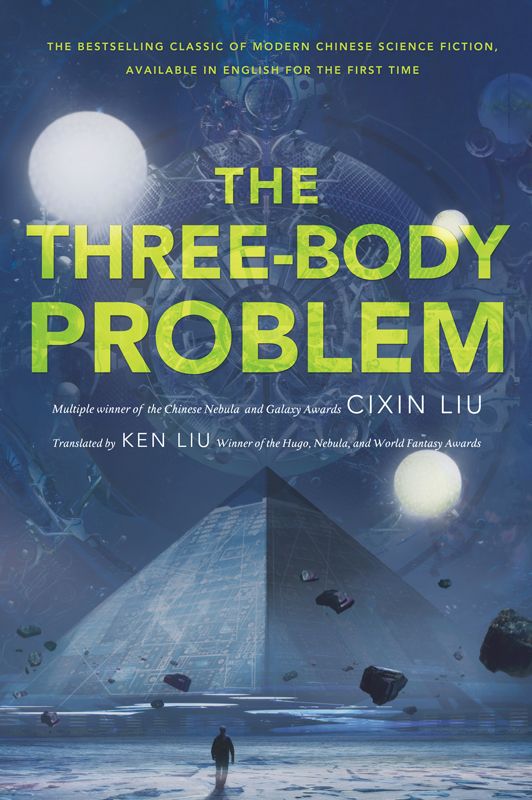
The Three-Body Problem
Overview unavailable.
The Madness Years Begin
- The text introduces the character list and structure of the novel, highlighting a multi-generational cast of physicists and military personnel.
- The narrative opens in 1967 China during the height of the Great Proletarian Cultural Revolution.
- A violent conflict is depicted between rival Red Guard factions, the Red Union and the April Twenty-eighth Brigade.
- The setting establishes a backdrop of political upheaval and ideological fervor that shapes the lives of the central Ye family.
- The chapter titles suggest a progression from historical turmoil to scientific mystery and eventual global crisis.
Their red flags fluttered restlessly around the brigade building like flames yearning for firewood.
Cover
The Three-Body Problem
The author and publisher have provided this e-book to you without Digital Rights Management software (DRM) applied so that you can enjoy reading it on your personal devices. This e-book is for your personal use only. You may not print or post this e-book, or make this e-book publicly available in any way. You may not copy, reproduce, or upload this e-book, other than to read it on one of your personal devices.
Copyright infringement is against the law. If you believe the copy of this e-book you are reading infringes on the authorâs copyright, please notify the publisher at:
us.macmillanusa.com/piracy
.
The Three-Body Problem
LIST OF CHARACTERS
Chinese names are written with surname first.
The Ye Family
Ye Zhetai
Physicist, professor at Tsinghua University
Shao Lin
Physicist, Ye Zhetaiâs wife
Ye Wenjie
Astrophysicist, daughter of Ye Zhetai
Ye Wenxue
Ye Wenjieâs sister, a Red Guard
Red Coast Base
Lei Zhicheng
Political commissar at Red Coast Base
Yang Weining
Chief engineer at Red Coast Base, once a student of Ye Zhetai
The Present
Yang Dong
String theorist and daughter of Ye Wenjie and Yang Weining
Ding Yi
Theoretical physicist, Yang Dongâs boyfriend
Wang Miao
Nanomaterials researcher
Shi Qiang
Police detective, nicknamed Da Shi
Chang Weisi
Major-general of the Peopleâs Liberation Army
Shen Yufei
Japanese physicist and member of the Frontiers of Science
Wei Cheng
Math prodigy and recluse, Shen Yufeiâs husband
Pan Han
Biologist, friend/acquaintance of Shen Yufei and Wei Cheng, and member of the Frontiers of Science
Sha Ruishan
Astronomer, one of Ye Wenjieâs students
Mike Evans
Scion of an oil magnate
Colonel Stanton
U.S. Marine Corps, commander of Operation Guzheng
The Three-Body Problem
CONTENTS
Title Page
Copyright Notice
List of Characters
Part I: Silent Spring
1. The Madness Years
2. Silent Spring
3. Red Coast I
Part II: Three Body
4. The Frontiers of Science
5. A Game of Pool
6. The Shooter and the Farmer
7.
Three Body
: King Wen of Zhou and the Long Night
8. Ye Wenjie
9. The Universe Flickers
10. Da Shi
11.
Three Body
: Mozi and Fiery Flames
12. Red Coast II
13. Red Coast III
14. Red Coast IV
15.
Three Body
: Copernicus, Universal Football, and Tri-Solar Day
16. The Three-Body Problem
17.
Three Body
: Newton, Von Neumann, the First Emperor, and Tri-Solar Syzygy
18. Meet-up
19.
Three Body
: Einstein, the Pendulum Monument, and the Great Rip
20.
Three Body
: Expedition
Part III: Sunset for Humanity
21. Rebels of Earth
22. Red Coast V
23. Red Coast VI
24. Rebellion
25. The Deaths of Lei Zhicheng and Yang Weining
26. No One Repents
27. Evans
28. The Second Red Coast Base
29. The Earth-Trisolaris Movement
30. Two Protons
31. Operation Guzheng
32. Trisolaris: The Listener
33. Trisolaris: Sophon
34. Bugs
35. The Ruins
Authorâs Postscript for the American Edition
Translatorâs Postscript
About the Author
About the Translator
Copyright
The Three-Body Problem
PART I
SILENT SPRING
The Three-Body Problem
1
The Madness Years
China, 1967
The Red Union had been attacking the headquarters of the April Twenty-eighth Brigade for two days. Their red flags fluttered restlessly around the brigade building like flames yearning for firewood.
The Red Union commander was anxious, though not because of the defenders he faced. The more than two hundred Red Guards of the April Twenty-eighth Brigade were mere greenhorns compared with the veteran Red Guards of the Red Union, which was formed at the start of the Great Proletarian Cultural Revolution in early 1966. The Red Union had been tempered by the tumultuous experience of revolutionary tours around the country and seeing Chairman Mao in the great rallies in Tiananmen Square.
But the commander
was
The Madness of 1967
- A violent factional battle erupts between rival Red Guard brigades during the height of the Cultural Revolution.
- The building under siege is rigged with explosives, reflecting the suicidal zeal of the young revolutionaries.
- A fifteen-year-old girl is shot while waving a banner, her death serving as a symbol of 'burning youth' and ideological intoxication.
- The attackers treat the girl's corpse as a trophy and target practice, showcasing the dehumanizing effects of the conflict.
- The narrative describes the widespread violence as a 'flood of madness' operating like parallel processors across Beijing.
- The girl's death is framed as 'fortunate' because she died while still believing in her sacrificial ideal.
The young Red Guard tumbled down along with her flag, her light form descending even more slowly than the piece of red fabric, like a little bird unwilling to leave the sky.
afraid of the dozen or so iron stoves inside the building, filled with explosives and connected to each other by electric detonators. He couldnât see them, but he could feel their presence like iron sensing the pull of a nearby magnet. If a defender flipped the switch, revolutionaries and counter-revolutionaries alike would all die in one giant ball of fire.
And the young Red Guards of the April Twenty-eighth Brigade were indeed capable of such madness. Compared with the weathered men and women of the first generation of Red Guards, the new rebels were a pack of wolves on hot coals, crazier than crazy.
The slender figure of a beautiful young girl emerged at the top of the building, waving the giant red banner of the April Twenty-eighth Brigade. Her appearance was greeted immediately by a cacophony of gunshots. The weapons attacking her were a diverse mix: antiques such as American carbines, Czech-style machine guns, Japanese Type-38 rifles; newer weapons such as standard-issue Peopleâs Liberation Army rifles and submachine guns, stolen from the PLA after the publication of the âAugust Editorialâ
1
; and even a few Chinese
dadao
swords and spears. Together, they formed a condensed version of modern history.
Numerous members of the April Twenty-eighth Brigade had engaged in similar displays before. Theyâd stand on top of the building, wave a flag, shout slogans through megaphones, and scatter flyers at the attackers below. Every time, the courageous man or woman had been able to retreat safely from the hailstorm of bullets and earn glory for their valor.
The new girl clearly thought sheâd be just as lucky. She waved the battle banner as though brandishing her burning youth, trusting that the enemy would be burnt to ashes in the revolutionary flames, imagining that an ideal world would be born tomorrow from the ardor and zeal coursing through her blood.⌠She was intoxicated by her brilliant, crimson dream until a bullet pierced her chest.
Her fifteen-year-old body was so soft that the bullet hardly slowed down as it passed through it and whistled in the air behind her. The young Red Guard tumbled down along with her flag, her light form descending even more slowly than the piece of red fabric, like a little bird unwilling to leave the sky.
The Red Union warriors shouted in joy. A few rushed to the foot of the building, tore away the battle banner of the April Twenty-eighth Brigade, and seized the slender, lifeless body. They raised their trophy overhead and flaunted it for a while before tossing it toward the top of the metal gate of the compound.
Most of the gateâs metal bars, capped with sharp tips, had been pulled down at the beginning of the factional civil wars to be used as spears, but two still remained. As their sharp tips caught the girl, life seemed to return momentarily to her body.
The Red Guards backed up some distance and began to use the impaled body for target practice. For her, the dense storm of bullets was now no different from a gentle rain, as she could no longer feel anything. From time to time, her vinelike arms jerked across her body softly, as though she were flicking off drops of rain.
And then half of her young head was blown away, and only a single, beautiful eye remained to stare at the blue sky of 1967. There was no pain in that gaze, only solidified devotion and yearning.
And yet, compared to some others, she was fortunate. At least she died in the throes of passionately sacrificing herself for an ideal.
*Â Â Â *Â Â Â *
Battles like this one raged across Beijing like a multitude of CPUs working in parallel, their combined output, the Cultural Revolution. A flood of madness drowned the city and seeped into every nook and cranny.
The Struggle of Ye Zhetai
- A mass struggle session at Tsinghua University aims to humiliate and break down 'reactionary bourgeois academic authorities' through physical and verbal abuse.
- The Cultural Revolution has splintered into numerous warring factions, yet all groups unite in their persecution of the intellectual class.
- Intellectuals typically pass through three stages: initial defiance, followed by numbness, and finally a total mental collapse into sincere but delusional repentance.
- Over seventeen hundred people were beaten to death in Beijing during a forty-day period, while many other prominent intellectuals chose suicide to escape the madness.
- Professor Ye Zhetai is a rare survivor who remains in the first stage of defiance, refusing to repent or become numb despite the escalating cruelty.
- The Red Guards subject Ye to intensified torture, forcing him to wear a heavy steel hat and an iron oven door as a mocking symbol of his academic background.
When this physics professor walked onto the stage in front of the crowd, his expression clearly said: Let the cross I bear be even heavier.
At the edge of the city, on the exercise grounds of Tsinghua University, a mass âstruggle sessionâ attended by thousands had been going on for nearly two hours. This was a public rally intended to humiliate and break down the enemies of the revolution through verbal and physical abuse until they confessed to their crimes before the crowd.
As the revolutionaries had splintered into numerous factions, opposing forces everywhere engaged in complex maneuvers and contests. Within the university, intense conflicts erupted between the Red Guards, the Cultural Revolution Working Group, the Workersâ Propaganda Team, and the Military Propaganda Team. And each faction divided into new rebel groups from time to time, each based on different backgrounds and agendas, leading to even more ruthless fighting.
But for
this
mass struggle session, the victims were the reactionary bourgeois academic authorities. These were the enemies of every faction, and they had no choice but to endure cruel attacks from every side.
Compared to other âMonsters and Demons,â
2
reactionary academic authorities were special: During the earliest struggle sessions, they had been both arrogant and stubborn. That was also the stage in which they had died in the largest numbers. Over a period of forty days, in Beijing alone, more than seventeen hundred victims of struggle sessions were beaten to death. Many others picked an easier path to avoid the madness: Lao She, Wu Han, Jian Bozan, Fu Lei, Zhao Jiuzhang, Yi Qun, Wen Jie, Hai Mo, and other once-respected intellectuals had all chosen to end their lives.
3
Those who survived that initial period gradually became numb as the ruthless struggle sessions continued. The protective mental shell helped them avoid total breakdown. They often seemed to be half asleep during the sessions and would only startle awake when someone screamed in their faces to make them mechanically recite their confessions, already repeated countless times.
Then, some of them entered a third stage. The constant, unceasing struggle sessions injected vivid political images into their consciousness like mercury, until their minds, erected upon knowledge and rationality, collapsed under the assault. They began to really believe that they were guilty, to see how they had harmed the great cause of the revolution. They cried, and their repentance was far deeper and more sincere than that of those Monsters and Demons who were not intellectuals.
For the Red Guards, heaping abuse upon victims in those two latter mental stages was utterly boring. Only those Monsters and Demons who were still in the initial stage could give their overstimulated brains the thrill they craved, like the red cape of the matador. But such desirable victims had grown scarce. In Tsinghua there was probably only one left. Because he was so rare, he was reserved for the very end of the struggle session.
Ye Zhetai had survived the Cultural Revolution so far, but he remained in the first mental stage. He refused to repent, to kill himself, or to become numb. When this physics professor walked onto the stage in front of the crowd, his expression clearly said:
Let the cross I bear be even heavier.
The Red Guards did indeed have him carry a burden, but it wasnât a cross. Other victims wore tall hats made from bamboo frames, but his was welded from thick steel bars. And the plaque he wore around his neck wasnât wooden, like the others, but an iron door taken from a laboratory oven. His name was written on the door in striking black characters, and two red diagonals were drawn across them in a large X.
Twice the number of Red Guards used for other victims escorted Ye onto the stage: two men and four women. The two young men strode with confidence and purpose, the very image of mature Bolshevik youths. They were both fourth-year students
4
The Physics Struggle Session
- Professor Ye Zhetai is subjected to a violent public struggle session by his own students and Red Guards.
- The ideological conflict centers on the teaching of relativity, which the revolutionaries label as 'reactionary' and 'capitalist' science.
- The Red Guards use political slogans to attack fundamental physics, equating scientific theories with imperialist agendas.
- In a strategic betrayal, Yeâs wife, Shao Lin, joins the stage to publicly denounce his academic work and character.
- Shao Lin uses Marxist dialectics to argue that general relativity is 'reactionary idealism' because it suggests a finite universe.
- Ye reflects on his wife's intellectual nature, recalling her father's warning that she was 'too smart' for the patience required by fundamental theory.
Dressed in military uniforms and equipped with bandoliers, they exuded youthful vigor and surrounded Ye Zhetai like four green flames.
majoring in theoretical physics, and Ye was their professor. The women, really girls, were much younger, second-year students from the junior high school attached to the university.
5
Dressed in military uniforms and equipped with bandoliers, they exuded youthful vigor and surrounded Ye Zhetai like four green flames.
His appearance excited the crowd. The shouting of slogans, which had slackened a bit, now picked up with renewed force and drowned out everything else like a resurgent tide.
After waiting patiently for the noise to subside, one of the male Red Guards turned to the victim. âYe Zhetai, you are an expert in mechanics. You should see how strong the great unified force youâre resisting is. To remain so stubborn will lead only to your death! Today, we will continue the agenda from the last time. Thereâs no need to waste words. Answer the following question without your typical deceit: Between the years of 1962 and 1965, did you not decide on your own to add relativity to the intro physics course?â
âRelativity is part of the fundamental theories of physics,â Ye answered. âHow can a basic survey course not teach it?â
âYou lie!â a female Red Guard by his side shouted. âEinstein is a reactionary academic authority. He would serve any master who dangled money in front of him. He even went to the American Imperialists and helped them build the atom bomb! To develop a revolutionary science, we must overthrow the black banner of capitalism represented by the theory of relativity!â
Ye remained silent. Enduring the pain brought by the heavy iron hat and the iron plaque hanging from his neck, he had no energy to answer questions that were not worth answering. Behind him, one of his students also frowned. The girl who had spoken was the most intelligent of the four female Red Guards, and she was clearly prepared, as she had been seen memorizing the struggle session script before coming onstage.
But against someone like Ye Zhetai, a few slogans like that were insufficient. The Red Guards decided to bring out the new weapon they had prepared against their teacher. One of them waved to someone offstage. Yeâs wife, physics professor Shao Lin, stood up from the crowdâs front row. She walked onto the stage dressed in an ill-fitting green outfit, clearly intended to imitate the military uniform of the Red Guards. Those who knew her remembered that she had often taught class in an elegant
qipao,
and her current appearance felt forced and awkward.
âYe Zhetai!â She was clearly unused to such theater, and though she tried to make her voice louder, the effort magnified the tremors in it. âYou didnât think I would stand up and expose you, criticize you? Yes, in the past, I was fooled by you. You covered my eyes with your reactionary view of the world and science! But now I am awake and alert. With the help of the revolutionary youths, I want to stand on the side of the revolution, the side of the people!â
She turned to face the crowd. âComrades, revolutionary youths, revolutionary faculty and staff, we must clearly understand the reactionary nature of Einsteinâs theory of relativity. This is most apparent in general relativity: Its static model of the universe negates the dynamic nature of matter. It is anti-dialectical! It treats the universe as limited, which is absolutely a form of reactionary idealism.âŚâ
As he listened to his wifeâs lecture, Ye allowed himself a wry smile.
Lin, I fooled you? Indeed, in my heart youâve always been a mystery. One time, I praised your genius to your fatherâheâs lucky to have died early and escaped this catastropheâand he shook his head, telling me that he did not think you would ever achieve much academically. What he said next turned out to be so important to the second half of my life: âLin Lin is too smart. To work in fundamental theory, one must be stupid.â
The Gravity of Reality
- Professor Ye Zhetai attempted to survive the Cultural Revolution by renaming scientific laws to credit the 'working masses' rather than 'capitalist authorities'.
- Despite his efforts to conform, Ye's elite family background and lack of revolutionary status make him a target for persecution.
- A family legend about Einstein is revealed as a brief, somber encounter centered on the poverty of a child laborer rather than physics.
- Ye's father concluded that the harsh reality of China's social conditions would always ground any intellectual or scientific flight.
- During a public struggle session, Ye defiantly refuses to lower his head despite physical assault and the weight of a heavy iron hat.
- The prosecution shifts to ideological attacks on Ye's teaching of the 'reactionary' Copenhagen interpretation of quantum mechanics.
In China, any idea that dared to take flight would only crash back to the ground. The gravity of reality is too strong.
In later years, I began to understand his words more and more. Lin, you truly are too smart. Even a few years ago, you could feel the political winds shifting in academia and prepared yourself. For example, when you taught, you changed the names of many physical laws and constants: Ohmâs law you called resistance law, Maxwellâs equations you called electromagnetic equations, Planckâs constant you called the quantum constant.⌠You explained to your students that all scientific accomplishments resulted from the wisdom of the working masses, and those capitalist academic authorities only stole these fruits and put their names on them.
But even so, you couldnât be accepted by the revolutionary mainstream. Look at you now: Youâre not allowed to wear the red armband of the ârevolutionary faculty and staffâ; you had to come up here empty-handed, without the status to carry a Little Red Book.⌠You canât overcome the fault of being born to a prominent family in pre-revolutionary China and of having such famous scholars as parents.
But you actually have more to confess about Einstein than I do. In the winter of 1922, Einstein visited Shanghai. Because your father spoke fluent German, he was asked to accompany Einstein on his tour. You told me many times that your father went into physics because of Einsteinâs encouragement, and you chose physics because of your fatherâs influence. So, in a way, Einstein can be said to have indirectly been your teacher. And you once felt so proud and lucky to have such a connection.
Later, I found out that your father had told you a white lie. He and Einstein had only one very brief conversation. The morning of November 13, 1922, he accompanied Einstein on a walk along Nanjing Road. Others who went on the walk included Yu Youren, president of Shanghai University, and Cao Gubing, general manager of the newspaper
Ta Kung Pao.
When they passed a maintenance site in the road bed, Einstein stopped next to a worker who was smashing stones and silently observed this boy with torn clothes and dirty face and hands. He asked your father how much the boy earned each day. After asking the boy, he told Einstein: five cents.
This was the only time he spoke with the great scientist who changed the world. There was no discussion of physics, of relativity, only cold, harsh reality. According to your father, Einstein stood there for a long time after hearing the answer, watching the boyâs mechanical movements, not even bothering to smoke his pipe as the embers went out. After your father recounted this memory to me, he sighed and said, âIn China, any idea that dared to take flight would only crash back to the ground. The gravity of reality is too strong.â
âLower your head!â one of the male Red Guards shouted. This may actually have been a gesture of mercy from his former student. All victims being struggled against were supposed to lower their heads. If Ye did lower his head, the tall, heavy iron hat would fall off, and if he kept his head lowered, there would be no reason to put it back on him. But Ye refused and held his head high, supporting the heavy weight with his thin neck.
âLower your head, you stubborn reactionary!â One of the girl Red Guards took off her belt and swung it at Ye. The copper belt buckle struck his forehead and left a clear impression that was quickly blurred by oozing blood. He swayed unsteadily for a few moments, then stood straight and firm again.
One of the male Red Guards said, âWhen you taught quantum mechanics, you also mixed in many reactionary ideas.â Then he nodded at Shao Lin, indicating that she should continue.
Shao was happy to oblige. She had to keep on talking, otherwise her fragile mind, already hanging on only by a thin thread, would collapse completely. âYe Zhetai, you cannot deny this charge! You have often lectured students on the reactionary Copenhagen interpretation of quantum mechanics.â
The Struggle of Reason
- Physicist Ye Zhetai defends scientific empiricism against the ideological constraints of the Cultural Revolution.
- The conflict highlights the tension between Marxist philosophy as a rigid guide for science versus experiments as the source of truth.
- Scientific theories like the Big Bang and quantum wave function collapse are condemned as 'reactionary idealism' for their perceived theological implications.
- The Red Guards use physical violence and belt-whippings to compensate for their inability to counter Ye's logical arguments.
- Ye maintains a dangerous intellectual honesty by refusing to deny the possibility of a 'superconsciousness' or God based on lack of evidence.
- The mob uses slogans and dogmatic rhetoric to suppress complex scientific concepts that challenge their simplified worldview.
âShould philosophy guide experiments, or should experiments guide philosophy?â Yeâs sudden counterattack shocked those leading the struggle session.
âIt is, after all, the explanation recognized to be most in line with experimental results.â His tone, so calm and collected, surprised and frightened Shao Lin.
âThis explanation posits that external observation leads to the collapse of the quantum wave function. This is another expression of reactionary idealism, and itâs indeed the most brazen expression.â
âShould philosophy guide experiments, or should experiments guide philosophy?â Yeâs sudden counterattack shocked those leading the struggle session. For a moment they did not know what to do.
âOf course it should be the correct philosophy of Marxism that guides scientific experiments!â one of the male Red Guards finally said.
âThen thatâs equivalent to saying that the correct philosophy falls out of the sky. This is against the idea that the truth emerges from experience. Itâs counter to the principles of how Marxism seeks to understand nature.â
Shao Lin and the two college student Red Guards had no answer for this. Unlike the Red Guards who were still in junior high school, they couldnât completely ignore logic.
But the four junior high girls had their own revolutionary methods that they believed were invincible. The girl who had hit Ye before took out her belt and whipped Ye again. The other three girls also took off their belts to strike at Ye. With their companion displaying such revolutionary fervor, they had to display even more, or at least the same amount. The two male Red Guards didnât interfere. If they tried to intervene now, they would be suspected of being insufficiently revolutionary.
âYou also taught the big bang theory. This is the most reactionary of all scientific theories.â One of the male Red Guards spoke up, trying to change the subject.
âMaybe in the future this theory will be disproven. But two great cosmological discoveries of this centuryâHubbleâs law, and observation of the cosmic microwave backgroundâshow that the big bang theory is currently the most plausible explanation for the origin of the universe.â
âLies!â Shao Lin shouted. Then she began a long lecture about the big bang theory, remembering to splice in insightful critiques of the theoryâs extremely reactionary nature. But the freshness of the theory attracted the most intelligent of the four girls, who couldnât help but ask, âTime began with the singularity? So what was there before the singularity?â
âNothing,â Ye said, the way he would answer a question from any curious young person. He turned to look at the girl kindly. With his injuries and the tall iron hat, the motion was very difficult.
âNo ⌠nothing? Thatâs reactionary! Completely reactionary!â the frightened girl shouted. She turned to Shao Lin, who gladly came to her aid.
âThe theory leaves open a place to be filled by God.â Shao nodded at the girl.
The young Red Guard, confused by these new thoughts, finally found her footing. She raised her hand, still holding the belt, and pointed at Ye. âYou: youâre trying to say that God exists?â
âI donât know.â
âWhat?â
âIâm saying I donât know. If by âGodâ you mean some kind of superconsciousness outside the universe, I donât know if it exists or not. Science has given no evidence either way.â Actually, in this nightmarish moment, Ye was leaning toward believing that God did not exist.
This extremely reactionary statement caused a commotion in the crowd. Led by one of the Red Guards on stage, another tide of slogan-shouting exploded.
âDown with reactionary academic authority Ye Zhetai!â
âDown with all reactionary academic authorities!â
âDown with all reactionary doctrines!â
Once the slogans died down, the girl shouted, âGod does not exist. All religions are tools concocted by the ruling class to paralyze the spirit of the people!â
âThat is a very one-sided view,â Ye said calmly.
The Death of Ye Zhetai
- A group of four young Red Guards beats the physicist Ye Zhetai to death with metal-buckled belts during a struggle session.
- The violent act is fueled by a sense of revolutionary glory and religious-like devotion to their political ideals.
- Ye's daughter, Wenjie, is forced to watch the murder while being restrained by janitors for her own safety.
- The trauma causes Ye's wife, Shao Lin, to suffer a complete mental breakdown characterized by chilling laughter.
- Following the tragedy, Wenjie finds herself isolated and seeks out her advisor, Professor Ruan Wen, as her last remaining connection.
The only thing that moved was a thin stream of blood. Like a red snake, it slowly meandered across the stage, reached the edge, and dripped onto a chest below.
The young Red Guard, embarrassed and angry, reached the conclusion that, against this dangerous enemy, all talk was useless. She picked up her belt and rushed at Ye, and her three companions followed. Ye was tall, and the four fourteen-year-olds had to swing their belts upward to reach his head, still held high. After a few strikes, the tall iron hat, which had protected him a little, fell off. The continuing barrage of strikes by the metal buckles finally made him fall down.
The young Red Guards, encouraged by their success, became even more devoted to this glorious struggle. They were fighting for faith, for ideals. They were intoxicated by the bright light cast on them by history, proud of their own bravery.âŚ
Yeâs two students had finally had enough. âThe chairman instructed us to ârely on eloquence rather than violenceâ!â They rushed over and pulled the four semicrazed girls off Ye.
But it was already too late. The physicist lay quietly on the ground, his eyes still open as blood oozed from his head. The frenzied crowd sank into silence. The only thing that moved was a thin stream of blood. Like a red snake, it slowly meandered across the stage, reached the edge, and dripped onto a chest below. The rhythmic sound made by the blood drops was like the steps of someone walking away.
A cackling laugh broke the silence. The sound came from Shao Lin, whose mind had finally broken. The laughter frightened the attendees, who began to leave the struggle session, first in trickles, and then in a flood. The exercise grounds soon emptied, leaving only one young woman below the stage.
She was Ye Wenjie, Ye Zhetaiâs daughter.
As the four girls were taking her fatherâs life, she had tried to rush onto the stage. But two old university janitors held her down and whispered into her ear that she would lose her own life if she went. The mass struggle session had turned into a scene of madness, and her appearance would only incite more violence. She had screamed and screamed, but she had been drowned out by the frenzied waves of slogans and cheers.
When it was finally quiet again, she was no longer capable of making any sound. She stared at her fatherâs lifeless body, and the thoughts she could not voice dissolved into her blood, where they would stay with her for the rest of her life. After the crowd dispersed, she remained like a stone statue, her body and limbs in the positions they were in when the two old janitors had held her back.
After a long time, she finally let her arms down, walked slowly onto the stage, sat next to her fatherâs body, and held one of his already-cold hands, her eyes staring emptily into the distance. When they finally came to carry away the body, she took something from her pocket and put it into her fatherâs hand: his pipe.
Wenjie quietly left the exercise grounds, empty save for the trash left by the crowd, and headed home. When she reached the foot of the faculty housing apartment building, she heard peals of crazy laughter coming out of the second-floor window of her home. That was the woman she had once called mother.
Wenjie turned around, not caring where her feet would carry her.
Finally, she found herself at the door of Professor Ruan Wen. Throughout the four years of Wenjieâs college life, Professor Ruan had been her advisor and her closest friend. During the two years after that, when Wenjie had been a graduate student in the Astrophysics Department, and through the subsequent chaos of the Cultural Revolution, Professor Ruan remained her closest confidante, other than her father.
The Silence of Ruin
- Ye Wenjie visits her former mentor, Professor Ruan, only to find that the woman has committed suicide by overdose.
- Ruanâs home, once a sophisticated sanctuary of European culture, was desecrated by Red Guards during the Cultural Revolution.
- In a final act of defiance against her persecutors, Ruan dressed in the very itemsâlipstick and high heelsâused to shame her during struggle sessions.
- Traumatized by the loss of her father and mentor, Wenjie describes her emotional state as a Geiger counter rendered useless by excessive radiation.
- Two years later, Wenjie is part of the Inner Mongolia Production and Construction Corps, performing grueling manual labor in the wilderness.
- The 'educated youth' of the corps find their romanticized dreams of defending the border replaced by the mundane, exhausting reality of deforestation.
She was now like a Geiger counter that had been subjected to too much radiation, no longer capable of giving any reaction, noiselessly displaying a reading of zero.
Ruan had studied at Cambridge University, and her home had once fascinated Wenjie: refined books, paintings, and records brought back from Europe; a piano; a set of European-style pipes arranged on a delicate wooden stand, some made from Mediterranean briar, some from Turkish meerschaum. Each of them seemed suffused with the wisdom of the man who had once held the bowl in his hand or clamped the stem between his teeth, deep in thought, though Ruan had never mentioned the manâs name. The pipe that had belonged to Wenjieâs father had in fact been a gift from Ruan.
This elegant, warm home had once been a safe harbor for Wenjie when she needed to escape the storms of the larger world, but that was before Ruanâs home had been searched and her possessions seized by the Red Guards. Like Wenjieâs father, Ruan had suffered greatly during the Cultural Revolution. During her struggle sessions, the Red Guards had hung a pair of high heels around her neck and streaked her face with lipstick to show how she had lived the corrupt lifestyle of a capitalist.
Wenjie pushed open the door to Ruanâs home, and she saw that the chaos left by the Red Guards had been cleaned up: The torn oil paintings had been glued back together and rehung on the walls; the toppled piano had been set upright and wiped clean, though it was broken and could no longer be played; the few books left behind had been put back neatly on the shelf.âŚ
Ruan was sitting on the chair before her desk, her eyes closed. Wenjie stood next to Ruan and gently caressed her professorâs forehead, face, and handsâall cold. Wenjie had noticed the empty sleeping pill bottle on the desk as soon as she came in.
She stood there for a while, silent. Then she turned and walked away. She could no longer feel grief. She was now like a Geiger counter that had been subjected to too much radiation, no longer capable of giving any reaction, noiselessly displaying a reading of zero.
But as she was about to leave Ruanâs home, Wenjie turned around for a final look. She noticed that Professor Ruan had put on makeup. She was wearing a light coat of lipstick and a pair of high heels.
The Three-Body Problem
2
Silent Spring
Two years later, the Greater Khingan Mountains
âTim-berâŚâ
Following the loud chant, a large Dahurian larch, thick as the columns of the Parthenon, fell with a thump, and Ye Wenjie felt the earth quake.
She picked up her ax and saw and began to clear the branches from the trunk. Every time she did this, she felt as though she were cleaning the corpse of a giant. Sometimes she even imagined the giant was her father. The feelings from that terrible night two years ago when she cleaned her fatherâs body in the mortuary would resurface, and the splits and cracks in the larch bark seemed to turn into the old scars and new wounds covering her father.
Over one hundred thousand people from the six divisions and forty-one regiments of the Inner Mongolia Production and Construction Corps were scattered among the vast forests and grasslands. When they first left the cities and arrived at this unfamiliar wilderness, many of the corpsâ âeducated youthsââyoung college students who no longer had schools to go toâhad cherished a romantic wish: When the tank clusters of the Soviet Revisionist Imperialists rolled over the Sino-Mongolian border, they would arm themselves and make their own bodies the first barrier in the Republicâs defense. Indeed, this expectation was one of the strategic considerations motivating the creation of the Production and Construction Corps.
But the war they craved was like a mountain at the other end of the grassland: clearly visible, but as far away as a mirage. So they had to content themselves with clearing fields, grazing animals, and chopping down trees.
The Generation of Fire
- Young revolutionaries find their ardor meaningless against the vast, indifferent landscape of Inner Mongolia.
- Massive deforestation is depicted as a form of collective madness, transforming ancient forests into barren deserts.
- Ye Wenjie and reporter Bai Mulin share a silent, empathetic connection over the destruction of the natural world.
- A three-hundred-year-old tree is felled in minutes, highlighting the disconnect between industrial progress and ecological history.
- The laborers view the environment as an inexhaustible resource, dismissing the concerns of intellectuals as trivial.
The rotting leaves made the water appear crimson, like blood.
Soon, the young men and women who had once expended their youthful energy on tours to the holy sites of the Chinese Revolution discovered that, compared to the huge sky and open air of Inner Mongolia, the biggest cities in Chinaâs interior were nothing more than sheep pens. Stuck in the middle of the cold, endless expanse of forests and grasslands, their burning ardor was meaningless. Even if they spilled all of their blood, it would cool faster than a pile of cow dung, and not be as useful. But burning was their fate; they were the generation meant to be consumed by fire. And so, under their chain saws, vast seas of forests turned into barren ridges and denuded hills. Under their tractors and combine harvesters, vast tracts of grasslands became grain fields, then deserts.
Ye Wenjie could only describe the deforestation that she witnessed as madness. The tall Dahurian larch, the evergreen Scots pine, the slim and straight white birch, the cloud-piercing Korean aspen, the aromatic Siberian fir, along with black birch, oak, mountain elm,
Chosenia arbutifolia
âwhatever they laid eyes on, they cut down. Her company wielded hundreds of chain saws like a swarm of steel locusts, and after they passed, only stumps were left.
The fallen Dahurian larch, now bereft of branches, was ready to be taken away by tractor. Ye gently caressed the freshly exposed cross section of the felled trunk. She did this often, as though such surfaces were giant wounds, as though she could feel the treeâs pain. Suddenly, she saw another hand lightly stroking the matching surface of the stump a few feet away. The tremors in that hand revealed a heart that resonated with hers. Though the hand was pale, she could tell it belonged to a man.
She looked up. It was Bai Mulin. A slender, delicate man who wore glasses, he was a reporter for the
Great Production News,
the corpsâ newspaper. He had arrived the day before yesterday to gather news about her company. Ye remembered reading his articles, which were written in a beautiful style, sensitive and fine, ill suited to the rough-hewn environment.
âMa Gang, come here,â Bai called to a young man a little ways off. Ma was barrel-chested and muscular, like the Dahurian larch that he had just felled. He came over, and Bai asked him, âDo you know how old this tree was?â
âYou can count the rings.â Ma pointed to the stump.
âI did. More than three hundred and thirty years. Do you remember how long it took you to saw through it?â
âNo more than ten minutes. Let me tell you, Iâm the fastest chain saw operator in the company. Whichever squad Iâm with, the red flag for model workers follows me.â Ma Gangâs excitement was typical of most people Bai paid attention to. To be featured in the
Great Production News
would be a considerable honor.
âMore than three hundred years! A dozen generations. When this tree was but a shrub, it was still the Ming Dynasty. During all these years, can you imagine how many storms it had weathered, how many events it had witnessed? But in a few minutes you cut it down. You really felt nothing?â
âWhat do you want me to feel?â Ma Gang gave a blank look. âItâs just a tree. The only things we donât lack around here are trees. There are plenty of other trees much older than this one.â
âItâs all right. Go back to work.â Bai shook his head, sat down on the stump, and sighed.
Ma Gang shook his head as well, disappointed that the reporter wasnât interested in an interview. âIntellectuals always make a fuss about nothing,â he muttered. As he spoke, he glanced at Ye Wenjie, apparently including her in his judgment.
The trunk was dragged away. Rocks and stumps in the ground broke the bark in more places, wounding the giant body further. In the spot where it once stood, the weight of the fallen tree being dragged left a deep channel in the layers of decomposing leaves that had accumulated over the years. Water quickly filled the ditch. The rotting leaves made the water appear crimson, like blood.
The Seeds of Disillusionment
- Bai expresses deep concern over the environmental devastation caused by the Construction Corps, contrasting the current 'dead, muddy water' with the region's former fertility.
- Bai introduces Ye Wenjie to 'Silent Spring' by Rachel Carson, a restricted book he is translating for internal government reference.
- Reading the book causes a profound shift in Yeâs perspective, leading her to equate human environmental destruction with the horrors of the Cultural Revolution.
- Ye concludes that human evil is not an aberration but an inherent, pervasive state, much like an iceberg is part of the ocean that supports it.
- The text reveals that this realization leads Ye to believe that humanity is incapable of a self-directed moral awakening.
- This philosophical epiphany becomes the catalyst for Ye's lifelong conviction that an external force is required to save or change the human race.
It was impossible to expect a moral awakening from humankind itself, just like it was impossible to expect humans to lift off the earth by pulling up on their own hair.
âWenjie, come and take a rest.â Bai pointed to the empty half of the stump on which he was sitting. Ye was indeed tired. She put down her tools, came over, and sat down with Bai, back to back.
After a long silence, Bai blurted out, âI can tell how youâre feeling. The two of us are the only ones who feel this way.â
Ye remained silent. Bai knew that she likely wouldnât answer. She was a woman of few words, and rarely conversed with anyone. Some new arrivals even mistook her for a mute.
Bai went on talking. âI visited this region a year ago. I remember arriving around noon, and my hosts told me that weâd have fish for lunch. I looked around the bark-lined hut and saw only a pot of water being boiled. No fish. Then, as soon as the water boiled, the cook went out with a rolling pin. He stood on the shore of the brook that passed before the hut, struck the water with the rolling pin a few times, and was able to drag a few big fish out of the water.⌠What a fertile place! But now, if you go look at that brook, itâs just dead, muddy water in a ditch. I really donât know if the Corps is engaged in construction or destruction.â
âWhere did you get thoughts like that?â Ye asked softly.
She did not express agreement or disagreement, but Bai was grateful that she had spoken at all. âI just read a book, and it really moved me. Can you read English?â
Ye nodded.
Bai took a book with a blue cover from his bag. He looked around to be sure no one was watching, and handed it to her. âThis was published in 1962 and was very influential in the West.â
Wenjie turned around on the stump to accept the book.
Silent Spring,
she read on the cover,
by Rachel Carson
. âWhere did you get this?â
âThe book attracted the attention of the higher-ups. They want to distribute it to select cadres
6
for internal reference. Iâm responsible for translating the part that has to do with forests.â
Wenjie opened the book and was pulled in. In a brief opening chapter, the author described a quiet town silently dying from the use of pesticides. Carsonâs deep concern suffused the simple, plain sentences.
âI want to write to the leadership in Beijing and let them know about the irresponsible behavior of the Construction Corps,â Bai said.
Ye looked up from the book. It took a while for her to process his words. She said nothing and turned her eyes back to the page.
âKeep it for now, if you want to read it. But best be careful and donât let anyone see it. You know what they think of this kind of bookâŚâ Bai got up, looked around carefully once again, and left.
*Â Â Â *Â Â Â *
More than four decades later, in her last moments, Ye Wenjie would recall the influence
Silent Spring
had on her life.
The book dealt only with a limited subject: the negative environmental effects of excessive pesticide use. But the perspective taken by the author shook Ye to the core. The use of pesticides had seemed to Ye just a normal, properâor, at least, neutralâact, but Carsonâs book allowed Ye to see that, from Natureâs perspective, their use was indistinguishable from the Cultural Revolution, and equally destructive to our world. If this was so, then how many other acts of humankind that had seemed normal or even righteous were, in reality, evil?
As she continued to mull over these thoughts, a deduction made her shudder:
Is it possible that the relationship between humanity and evil is similar to the relationship between the ocean and an iceberg floating on its surface? Both the ocean and the iceberg are made of the same material. That the iceberg seems separate is only because it is in a different form. In reality, it is but a part of the vast ocean.âŚ
It was impossible to expect a moral awakening from humankind itself, just like it was impossible to expect humans to lift off the earth by pulling up on their own hair. To achieve moral awakening required a force outside the human race.
This thought determined the entire direction of Yeâs life.
*Â Â Â *Â Â Â *
The Mysteries of Radar Peak
- Ye Wenjie returns a book to Bai Mulin, who is exhausted from forced labor clearing trees near the restricted Radar Peak.
- Radar Peak is a secretive military base topped with a massive parabolic antenna that exhibits erratic, non-radar-like movements.
- The antenna's operation causes bizarre environmental phenomena, including animal distress, human illness, and sudden weather shifts like snow turning to rain.
- The base is heavily guarded by sentries with orders to shoot on sight, reflecting its high-level political and military importance.
- Bai Mulin reveals he has drafted a letter to the central leadership in Beijing to report on the environmental destruction he has witnessed.
- The base's ability to command the Construction Corps for labor highlights its significant authority within the regional hierarchy.
As the wind blew past it, the dish emitted a howl that could be heard from far away.
Four days after receiving the book, Ye went to the companyâs guesthouse, where Bai was living, to return the book. Ye opened the door and saw that Bai was lying on the bed, exhausted and covered by wood shavings and mud. When Bai saw Ye, he struggled to get up.
âDid you work today?â Ye asked.
âIâve been here with the company for so long. I canât just walk around all day doing nothing. Have to participate in labor. Thatâs the spirit of the revolution, right? Oh, I worked near Radar Peak. The trees there were so dense. I sank into the rotting leaves all the way up to my knees. Iâm afraid Iâll get sick from the miasma.â
âRadar Peak?â Ye was shocked.
âYes. The regiment had an emergency assignment: clear out a warning zone all around the peak by cutting down trees.â
Radar Peak was a mysterious place. The steep, once-nameless peak got its moniker from the large parabolic antenna dish at the top. In reality, everyone with a little common sense knew it wasnât a radar antenna: Even though its orientation changed every day, the antenna never moved in a continuous manner. As the wind blew past it, the dish emitted a howl that could be heard from far away.
People in Yeâs company knew only that Radar Peak was a military base. According to the locals, when the base was built three years ago, the military mobilized a lot of people to construct a road leading to the top and to string a power line along it. Tons of supplies were transported up the mountain. But after the completion of the base, the road was destroyed, leaving behind only a difficult trail that snaked between the trees. Often helicopters could be seen landing on and lifting off the peak.
The antenna wasnât always visible. When the wind was too strong, it was retracted.
But when it was extended, many strange things occurred around the area: Animals in the forest became noisy and anxious, flocks of birds erupted from the woods, and people suffered nausea and dizziness. Also, those who lived near Radar Peak tended to lose their hair. According to the locals, these phenomena only began after the antenna was built.
There were many strange stories associated with Radar Peak. One time, when it was snowing, the antenna was extended, and the snow instantly turned to rain. Since the temperature near ground was still below freezing, the rain turned to ice on the trees. Gigantic icicles hung from the trees, and the forest turned into a crystal palace. From time to time, branches cracked under the weight of the ice, and the icicles crashed to the ground with loud thumps. Sometimes, when the antenna was extended, a clear day would turn to thunder and lightning, and strange lights would appear in the night sky.
After the arrival of the Construction Corps company, the commander told everyone right away to take care to avoid approaching the heavily guarded Radar Peak, because the patrols were allowed to shoot without warning.
Last week, two of the men had gone hunting and chased a deer to the foot of Radar Peak without realizing where they were, and the sentries stationed halfway up the peak shot at them. Luckily, the forest was so dense that the two escaped without injury, though one of the men peed in his pants. At the company meeting the next day, both men were reprimanded. Maybe it was because of this incident that the base had directed the Corps to create a warning zone in the forest around the peak. The fact that the base could issue labor assignments to the Construction Corps hinted at its political power.
Bai Mulin accepted the book from Ye and carefully hid it under his pillow. From the same place, he retrieved a few sheets of paper filled with dense writing and handed them to her. âThis is a draft of my letter. Would you read it?â
âLetter?â
âLike I was telling you, I want to write to the central leadership in Beijing.â
A Dangerous Correspondence
- Ye Wenjie assists Bai Mulin by transcribing a letter to the central government regarding the ecological devastation caused by deforestation.
- The letter draws parallels to Rachel Carson's 'Silent Spring', utilizing a precise yet poetic style to argue against current industrial practices.
- A rare moment of emotional vulnerability occurs as Ye experiences a sense of warmth and safety while working alongside Bai in the quiet hut.
- Despite her background in astrophysics, Ye expresses a resigned acceptance of her current labor-intensive life as a means of escape.
- The atmosphere shifts abruptly three weeks later when Ye is summoned to face military and political officials regarding the letter and the banned book.
For the first time since the death of her father, she experienced warmth in her heart and allowed herself to relax, momentarily letting down her guard against the world.
The handwriting was very sloppy, and Ye had to read it slowly. But the content was informative and tightly argued. The letter began by describing how the Taihang Mountains had turned from a historically fertile place to the barren wasteland it was today as a result of deforestation. It then described the recent, rapid rise in the Yellow Riverâs silt content. Finally, it concluded that the Inner Mongolia Production and Construction Corpsâ actions would lead to severe ecological consequences. Ye noticed that Baiâs style was similar to that of
Silent Spring,
precise and plain, but also poetic. Though her background was in technical subjects, she enjoyed the literary prose.
âItâs beautiful,â she said sincerely.
Bai nodded. âThen Iâll send it.â He took out a few fresh sheets of paper to make a clean copy of the draft. But his hands shook so much that he couldnât form any characters. This was a common reaction after using a chain saw for the first time. Their trembling hands couldnât even hold a rice bowl steady, let alone write legibly.
âWhy donât I copy it for you?â Ye said. She took the pen from him.
âYou have such pretty handwriting,â Bai said as he looked at her first line of characters on the page. He poured a glass of water for Ye. His hands shook so much that he spilled some of the water. Ye moved the letter out of the way.
âYou studied physics?â Bai asked.
âAstrophysics. Useless now.â Ye did not even lift her head.
âYou study the stars. How can that be useless? Colleges have reopened recently, but theyâre not taking graduate students. For highly educated and skilled individuals like you to be sent to a place like thisâŚâ
Ye said nothing and kept on writing. She did not want to tell Bai that for someone like her to be able to join the Construction Corps was very fortunate. She didnât want to comment on the way things wereâthere was nothing worthwhile to say.
The hut became quiet, filled only with the sound of pen nib scratching against paper. Ye could smell the fragrance of the sawdust on Baiâs body. For the first time since the death of her father, she experienced warmth in her heart and allowed herself to relax, momentarily letting down her guard against the world.
More than an hour later, she was done copying the letter. She wrote out the address on the envelope as Bai dictated it and got up to say good-bye.
At the door, she turned around. âLet me have your jacket. Iâll wash it for you.â She was surprised by her own boldness.
âNo! How can I do that?â Bai shook his head. âThe woman warriors of the Construction Corps work just as hard as the men every day. You should get back to have some rest. Tomorrow you have to get up at six to work in the mountains. Oh, Wenjie, Iâll be heading back to division headquarters the day after tomorrow. I will explain your situation to my superiors. Maybe it will help.â
âThank you. But I like it here. Itâs quiet.â Ye looked at the dim outline of the dark woods in the moonlight.
âAre you trying to run away from something?â
âIâm leaving,â Ye said in a soft voice. And she did.
Bai watched her slender figure disappear in the moonlight. Then he lifted his gaze to the dark woods that she had been looking at a moment earlier.
In the distance, the gigantic antenna on top of Radar Peak rose once again, giving off a cold, metallic glint.
*Â Â Â *Â Â Â *
One afternoon three weeks later, Ye Wenjie was summoned back to company headquarters from the logging camp. As soon as she entered the office, she sensed the mood was wrong. The company commander and the political instructor were both present, along with a stranger with a stern expression. On the desk in front of the stranger was a black briefcase, and an envelope and a book lay next to it. The envelope was open, and the book was the copy of
Silent Spring
that she had read.
The Betrayal of Ye Wenjie
- Ye Wenjie is interrogated by political officials regarding a letter sent to the central leadership criticizing environmental destruction.
- Despite having only copied the letter for a reporter named Bai Mulin, Ye is accused of being the sole author and instigator.
- The book 'Silent Spring' is used as evidence of Ye's 'reactionary' ideology, labeled as toxic capitalist propaganda by the state.
- Bai Mulin, fearing political repercussions for his own writing, chooses to frame Ye Wenjie to save himself from catastrophe.
- The incident highlights the extreme political sensitivity and the 'sack-like' pressure of the Cultural Revolution era.
- Ye Wenjie realizes the futility of her situation as she is abandoned by the person she trusted and branded a class enemy.
Ye Wenjie! Director Zhangâs two black eyes were trained on her like the barrels of two guns. I am warning you: Framing others will only make your problem worse.
During those years, everyone had a special sensitivity for their own political situation. The sense was especially acute in Ye Wenjie. She felt the world around her closing in like a sack being drawn shut, and everything pressing in on her.
âYe Wenjie, this is Director Zhang of the Division Political Department. Heâs here to investigate.â Her political instructor pointed at the stranger. âWe hope you will cooperate fully and tell the truth.â
âDid you write this letter?â Director Zhang asked. He pulled the letter out of the envelope. Ye reached for it, but Zhang held on to the letter and showed it to her page by page until he reached the very last page, the one she was most interested in.
There was no signature except âThe Revolutionary Masses.â
âNo, I did not write this.â Ye shook her head in fright.
âBut this is your handwriting.â
âYes, but I just copied it for someone else.â
âWho?â
Normally, whenever she suffered some injustice at the company, Ye refused to protest openly. She simply endured silently, and would never consider implicating others. But this time was different. She understood very well what this meant.
âI helped a reporter from the
Great Production News
. He was here a few weeks ago. His name isââ
âYe Wenjie!â Director Zhangâs two black eyes were trained on her like the barrels of two guns. âI am warning you: Framing others will only make your problem worse. Weâve already clarified the situation with Comrade Bai Mulin. His only involvement was posting the letter from Hohhot under your direction. He had no idea as to the letterâs contents.â
âHe ⌠he said that?â Ye felt everything go black before her eyes.
Instead of answering, Director Zhang picked up the book. âYour letter was clearly inspired by this book.â He showed the book to the company director and the political instructor. â
Silent Spring
was published in America in 1962 and has been quite influential in the capitalist world.â
He then took another book out of the briefcase. The cover was white with black characters. âThis is the Chinese translation. The appropriate authorities distributed it to select cadres as internal reference so that it could be criticized. As of now, the appropriate authorities have already given their clear judgment: The book is a toxic piece of reactionary propaganda. It takes the stance of pure historical idealism and espouses a doomsday theory. Under the guise of discussing environmental problems, it seeks to justify the ultimate corruption of the capitalist world. The content is extremely reactionary.â
âBut this book ⌠it doesnât belong to me.â
âComrade Bai was appointed as a translator by the appropriate authorities. So it was perfectly legitimate for him to carry it. Of course, he
is
responsible for being careless and allowing you to steal it while he was participating in Construction Corps work assignments. From this book, you obtained intellectual weapons that could be used to attack socialism.â
Ye Wenjie held her tongue. She knew that she had already fallen to the bottom of the pit. Any struggle was useless.
*Â Â Â *Â Â Â *
Contrary to certain historical records that later became publicized, Bai Mulin did not intend to frame Ye Wenjie at the start. The letter he wrote to the central leadership in Beijing was likely based on a real sense of responsibility. Back then, many people wrote to the central leadership with all kinds of personal agendas. Most of these letters were never answered, but a few of the letter writers did see their political fortunes rise meteorically overnight, while others invited catastrophe. The political currents of the time were extremely complex. As a reporter, Bai believed he could read the currents and avoid dangerous sensitivities, but he was overconfident, and his letter touched a minefield that he did not know existed. After he heard about its reception, fear overwhelmed everything else. In order to protect himself, he decided to sacrifice Ye Wenjie.
A Turning Point in History
- Bai, a man who unknowingly became a key historical figure, lived out a quiet and unremarkable life in Canada without ever acknowledging his past actions.
- Ye Wenjie is accused of political crimes and deep-rooted resentment toward the Cultural Revolution by her company commanders.
- While awaiting trial in a freezing cell, Ye is visited by Cheng Lihua, a high-ranking female cadre from the People's Court.
- Cheng uses a motherly and empathetic approach to manipulate Ye, sharing her own past political 'naivety' to encourage a confession.
- The narrative highlights the contrast between the cold, harsh reality of the detention center and the calculated warmth of the political interrogator.
For the rest of his life, he never mentioned Ye Wenjie, and we do not know if he ever felt remorse or repented for his actions.
Half a century later, historians would all agree that this event in 1969 was a turning point in humankindâs history.
Without intending to, Bai became a key historical figure. But he never learned of this fact. Historians recorded the rest of his uneventful life with disappointment. He continued to work at
Great Production News
until 1975, when the Inner Mongolia Production and Construction Corps was disbanded. He was then sent to a city in Northeast China to work for the Science Association until the beginning of the eighties. Then he left the country for Canada, where he taught at a Chinese school in Ottawa until 1991, when he died from lung cancer. For the rest of his life, he never mentioned Ye Wenjie, and we do not know if he ever felt remorse or repented for his actions.
*Â Â Â *Â Â Â *
âWenjie, the company has treated you extremely well.â The company commander exhaled a thick cloud of smoke from his Mohe tobacco. He stared at the ground and continued. âBy birth and family background, youâre politically suspect. But weâve always treated you as one of our own. Both the political instructor and I have spoken to you many times concerning your tendency to sequester yourself from the people, and your lack of self-motivation in seeking progress. We want to help you. But look at you! Youâve committed such a serious error!â
The political instructor picked up the theme. âIâve always said that I thought she had a deep-rooted resentment of the Cultural Revolution.â
âHave her escorted to division headquarters this afternoon, along with the evidence of her crime,â Director Zhang said, his face impassive.
*Â Â Â *Â Â Â *
The three other women prisoners in the cell were taken away one by one until only Ye was left. The small pile of coal in the corner had been exhausted, and no one came to replenish it. The fire in the stove had gone out a while ago. It was so cold in the cell that Ye had to wrap herself in the blanket.
Two officials came to her before it got dark. The older one, a female cadre, was introduced by her associate as the military representative from the Intermediate Peopleâs Court.
7
âMy name is Cheng Lihua,â the cadre introduced herself. She was in her forties, dressed in a military coat, and wore thick-rimmed glasses. Her face was gentle, and it was clear that she had been very beautiful when she was young. She spoke with a smile and instantly made people like her. Ye Wenjie understood that it was unusual for such a high-grade cadre to visit a prisoner about to be tried. Cautiously, she nodded at Cheng and moved to make space on her narrow cot so she could sit down.
âItâs really cold in here. What happened to your stove?â Cheng gave a reprimanding look to the head of the detention center standing at the door of the cell. She turned back to Ye. âHmm, youâre very young. Even younger than I imagined.â
She sat down on the cot right next to Ye and rummaged in her briefcase, still muttering. âWenjie, youâre very confused. Young people are all the same. The more books you read, the more confused you become. Eh, what can I say.âŚâ
She found what she was looking for and took out a small bundle of papers. Looking at Ye, her eyes were filled with kindness and affection. âBut itâs not a big deal. What young person hasnât made some mistakes? I made mistakes myself. When I was a young woman, as a member of the art troupe for the Fourth Field Army, I specialized in singing Soviet songs. One time, during a political study session, I announced that China should cease to be a separate country and join the USSR as a member republic. That way, international communism would be further strengthened. How naĂŻve I was! But who wasnât once naĂŻve? Whatâs done is done. When you make a mistake, whatâs important is to recognize it and correct it. Then you can continue the revolution.â
The Trap of Kindness
- Ye Wenjie remains cautious of Representative Cheng's maternal and comforting demeanor, viewing kindness as a suspicious luxury.
- Cheng pressures Ye to sign a document that ostensibly has nothing to do with her own legal case, claiming it is for her own benefit.
- The document is a meticulous record of Ye's father's interactions, masquerading as reports from her radical sister, Wenxue.
- Ye recognizes the document's cold, professional style as a political weapon designed to bypass protections around the national 'double-bomb' project.
- The text reveals how peripheral figures like Ye's father were exploited to deliver fatal political blows to high-ranking officials during the Cultural Revolution.
Ye Wenjie couldnât tell if the contents of the document were true or false, but she was sure that every character and every punctuation mark had the potential to deliver a fatal political blow.
Chengâs words seemed to draw Ye closer to her. But after having gone through so many troubles, Ye had learned to be cautious. She did not dare to believe in this kindness, which almost resembled a luxury.
Cheng placed the stack of papers on the bed in front of Ye and handed her a pen. âCome now, sign this. Then we can have a good heart-to-heart and resolve your ideological difficulties.â Her tone was like that of a mother trying to encourage her daughter to eat.
Ye stared at the stack of papers silently and motionlessly. She did not pick up the pen.
Cheng gave her a forgiving smile. âYou can trust me, Wenjie. I personally guarantee that this document has nothing to do with your case. Go ahead. Sign it.â
Her associate, who stood to the side, added, âYe Wenjie, Representative Cheng is trying to help you. Sheâs been working hard on your behalf.â
Cheng waved at him to stop. âItâs understandable. Poor child! Youâve been so frightened. There are some comrades whose political awareness is not adequately high. Some members of the Construction Corps and some of the folks from the peopleâs court employ such simplistic methods and behave so rudely. Itâs completely inappropriate! All right, Wenjie, why donât you read the document? Read it carefully.â
Ye picked up the document and flipped through it in the dim yellow light of the detention cell. Representative Cheng hadnât lied to her. The document really had nothing to do with her case.
It was about her father. In it was a record of her fatherâs interactions and conversations with certain individuals. The source was Wenjieâs younger sister, Wenxue. As one of the most radical Red Guards, Wenxue had always been proactive in exposing their father, and had composed numerous reports detailing his supposed sins. Some of the material she provided had ultimately led to his death.
But Ye could tell that this report didnât come from the hand of her sister. Wenxue had an intense, impatient style. When you read her reports, each line would make an explosive impact, like a string of firecrackers. But this document was composed in a cool, experienced, meticulous style. Who spoke to whom, when, where, what was discussedâevery detail was recorded, down to the exact date. For someone who wasnât experienced, the contents seemed like a boring diary, but the calculating, cold purpose hidden within was very different from the childish antics of Wenxue.
Ye couldnât really understand what the document was getting at, but she could sense that it had something to do with an important national defense project. As the daughter of a physicist, Ye guessed that it was a reference to the double-bomb project
8
that had shocked the world in 1964 and 1967.
During this period of the Cultural Revolution, in order to bring down a highly positioned individual, it was necessary to gather evidence of his deficiencies in the various areas he was in charge of. But for those plotting such political machinations, the double-bomb project posed great difficulties. People in the highest levels of the government placed the project under their protection to avoid disruption by the Cultural Revolution. It was difficult for those with nefarious purposes to pry into its inner workings.
Due to her fatherâs family background, he couldnât meet the political requirements and did not work on the double-bomb project. All he had done was some peripheral theoretical work for it. But it was easier to make use of him than those who had worked at the core of the project. Ye Wenjie couldnât tell if the contents of the document were true or false, but she was sure that every character and every punctuation mark had the potential to deliver a fatal political blow. In addition to those targeted directly, countless others might have their fates altered because of this document.
The Frozen Interrogation
- Ye Wenjie is pressured to sign a witness statement regarding her sister's political conversations, which she refuses to do on the grounds of honesty.
- Representative Cheng Lihua attempts to manipulate Ye by offering a path to leniency through 'prosecutorial discretion' and political re-education.
- The interrogators reveal a systemic bias where judicial organs prefer severity over leniency to avoid being accused of political weakness.
- Despite the threats of being labeled an active counter-revolutionary, Ye remains steadfast, haunted by the memory of her father's death.
- Upon Ye's refusal, Cheng's facade of kindness vanishes, and she maliciously douses Ye and her bedding with water in the freezing cell.
- The chapter concludes with Ye succumbing to extreme hypothermia, perceiving the universe as a vast, life-extinguishing block of ice.
She felt that the entire universe was a huge block of ice, and she was the only spark of life within it.
At the end of the document was her sisterâs signature in large characters, and Ye Wenjie was supposed to sign as a witness. She noticed that three other witnesses had already signed.
âI donât know anything about these conversations,â Ye said softly. She put the document back down.
âHow can you not know? Many of these conversations occurred right in your home. Your sister knew them. You must, too.â
âI really donât.â
âBut these conversations really did occur. You must have faith in us.â
âI didnât say they werenât true. But I really donât know about them. So I canât sign.â
âYe Wenjie!â Chengâs associate took a step closer. But Cheng stopped him again. She shifted to sit even closer to Ye and picked up one of her cold hands.
âWenjie, let me put all my cards on the table. Your case has a lot of prosecutorial discretion. On the one hand, we could minimize it as a case of an educated youth being fooled by a reactionary bookâitâs not a big deal. We donât even need to go through a judicial procedure. Weâll have you attend a political class and write a few self-criticism reports, and then you can go back to the Construction Corps. On the other hand, we could also prosecute this case to its fullest extent. Wenjie, you must know that you could be declared an active counter-revolutionary.
âNow, faced with political cases like yours, all prosecutorial organs and courts would rather be too severe than too lax. This is because treating you too severely would just be a mistake in method, but treating you too laxly would be a mistake in political direction. Ultimately, however, the decision belongs to the military control commission. Of course, Iâm telling you all this off the record.â
Chengâs associate added, âRepresentative Cheng is trying to save you. Three witnesses have already signed. Your refusal to sign is pretty much meaningless. I must urge you not to be confused, Ye Wenjie.â
âRight, Wenjie,â Cheng continued. âIt would break my heart to see an educated young person like you ruined by something like this. I really want to save you. Please cooperate. Look at me. Do you think I would hurt you?â
But Ye did not look at Representative Cheng. What she saw, instead, was her fatherâs blood. âRepresentative Cheng, I have no knowledge of the events recorded in this document. I cannot sign it.â
Cheng Lihua became quiet. She stared at Ye for a long while, and the cold air in the cell seemed to solidify. Then she slowly put the document back into her briefcase and stood up. Her kind expression did not disappear, but was set on her face like a plaster mask. Still appearing kind and affectionate, she walked to the corner of the cell, where there was a bucket for washing. She picked it up and poured half the water onto Ye and the other half onto her blanket, her movements never straying from a methodical calmness. Then she dropped the bucket and left the cell, pausing only to mutter, âYou stubborn little bitch!â
The head of the detention center was the last to leave. He stared coldly at Ye, soaked through and dripping, shut the cell door with a bang, and locked it.
Through her wet clothes, the chill of the Inner Mongolian winter seized Ye like a giantâs fist. She heard her teeth chatter, but eventually even that sound disappeared. The coldness penetrated into her bones, and the world in her eyes turned milky white. She felt that the entire universe was a huge block of ice, and she was the only spark of life within it. She was the little girl about to freeze to death, and she didnât even have a handful of matches, only illusions.âŚ
Awakening to Red Coast
- Ye Wenjie experiences a fever-induced hallucination of her deceased sister and family members waving a red banner, symbolizing the relentless march of political turmoil.
- She awakens from her near-death state to find herself on a military helicopter, rescued from the frozen conditions of her previous imprisonment.
- Two men, Political Commissar Lei Zhicheng and Chief Engineer Yang Weining, identify her and confirm her authorship of an astrophysics paper.
- The transition from the 'black ice' of her despair to the metallic reality of the helicopter marks a pivotal shift in her fate.
- The mention of the 'Red Coast Base' introduces a new, mysterious military context for her scientific expertise.
The flag-bearer kept on changing, but the flag waved ceaselessly, like a perpetual pendulum, counting down the remainder of her short life.
The block of ice holding her gradually became transparent. In front of her she could see a tall building. At the top, a young girl waved a bright red banner. Her slender figure contrasted vividly with the breadth of the flag: It was her sister, Wenxue. Ever since her little sister had made a clean break with her reactionary academic authority family, Wenjie had heard no news about her. She had only learned recently that Wenxue had died two years ago in one of the wars between Red Guard factions.
As Ye watched, the figure waving the flag became Bai Mulin, his glasses reflecting the flames raging below the building; then it turned into Representative Cheng; then her mother, Shao Lin; then her father. The flag-bearer kept on changing, but the flag waved ceaselessly, like a perpetual pendulum, counting down the remainder of her short life.
Gradually, the flag grew blurry; everything grew blurry. The ice that filled the universe once again sealed her at its center. Only this time, the ice was black.
The Three-Body Problem
3
Red Coast I
Ye Wenjie heard a loud, continuous roar. She didnât know how much time had passed.
The noise came from all around her. In her vague state of consciousness, it seemed as though some gigantic machine was drilling into or sawing through the block of ice that held her. The world was still only darkness, but the noise grew more and more real. Finally, she was certain that the source of the noise was neither heaven nor hell, and she remained in the land of the living.
She realized that her eyes were still closed. With an effort, she lifted her eyelids. The first thing she saw was a light embedded deeply in the ceiling. Covered by a wire mesh that seemed designed to protect it, it emitted a dim glow. The ceiling appeared to be made of metal.
She heard a male voice softly calling her name. âYou have a high fever,â the man said.
âWhere am I?â Wenjieâs voice was so weak that she couldnât be sure it was her own.
âOn a helicopter.â
Ye felt weak. She fell back to sleep. As she dozed, the roar kept her company. Before long, she woke again. Now the numbness had disappeared and the pain reasserted itself: Her head and the joints of her limbs ached, and the breath coming out of her mouth felt scalding hot. Her throat hurt so much that swallowing spittle felt like it was a piece of burning coal.
She turned her head and saw two men wearing the same kind of military coat that Representative Cheng had worn. But unlike her, both of these men had on the cotton cap of the PLA, a red star sewn onto the front. Their coats were unbuttoned, and she could see the red-collar insignia on their army uniforms. One of the men wore glasses.
Ye discovered that she was covered by a military coat as well. The clothes she was wearing were dry and warm.
She struggled to sit up, and to her surprise, succeeded. She looked out the porthole on the other side. Rolling clouds slowly drifted by, reflecting the dazzling sunlight. She pulled her gaze back. The narrow cabin was filled with iron trunks painted military green. From another porthole she could see flickering shadows cast by the rotors. She was indeed on a helicopter.
âYouâd better lie back down,â the man with the glasses said. He helped her down and covered her with the coat again.
âYe Wenjie, did you write this paper?â The other man extended an open English journal before her eyes. The title of the paper was âThe Possible Existence of Phase Boundaries Within the Solar Radiation Zone and Their Reflective Characteristics.â He showed her the cover of the journal: an issue of
The Journal of Astrophysics
from 1966.
âOf course she did. Why does that even need to be confirmed?â The man wearing glasses took the journal away and then made introductions. âThis is Political Commissar Lei Zhicheng of Red Coast Base. Iâm Yang Weining, base chief engineer. It will be an hour before we land. You might as well get some rest.â
The Red Coast Recruitment
- Ye Wenjie recognizes Yang Weining, a former student of her father who has transitioned from theoretical physics to a military technical role.
- Yang's past decision to avoid theoretical physics highlights the era's political pressure, where scientific theory was often scrutinized for ideological errors.
- Commissar Lei expresses deep reservations about recruiting Ye due to her political status and the extreme security requirements of the Red Coast project.
- Yang insists on using Ye's specialized skills because no other qualified personnel are willing to accept the project's lifelong sequestration.
- The group arrives at Radar Peak, where the massive parabolic antenna and the familiar mountain winds signal a new chapter in Ye's life.
Yang hesitated and finally revealed his real concern: âItâs easy to make ideological mistakes in theory.â
Youâre Yang Weining?
Ye didnât say anything, but she was stunned. She saw that he kept his expression calm, apparently not wishing to let anyone else know that they knew each other. Yang had been one of Ye Zhetaiâs graduate students. By the time he had obtained his degree, Wenjie was still a first-year in college.
She could clearly remember the first time Yang came to her home. He had just begun his graduate studies and needed to discuss the direction of his research with Professor Ye. Yang said that he wanted to focus on experimental and applied problems, staying away from theory.
Ye Wenjie recalled her father saying, âIâm not opposed to your idea. But we are, after all, the department of theoretical physics. Why do you want to avoid theory?â
Yang replied, âI want to devote myself to the times, to make some real-world contributions.â
Her father said, âTheory is the foundation of application. Isnât discovering fundamental laws the biggest contribution to our time?â
Yang hesitated and finally revealed his real concern: âItâs easy to make ideological mistakes in theory.â
Her father had nothing to say to that.
Yang was very talented, with a good mathematical foundation and a quick mind. But during his brief time as a graduate student, he always kept a respectable distance from his thesis advisor. Ye Wenjie had seen Yang several times, but, perhaps due to the influence of her father, she hadnât noticed him much. As for whether he had paid much attention to her, she had no idea. After Yang got his degree, he soon ceased all contact with her father.
Again feeling weak, Ye closed her eyes. The two men left her and crouched behind a row of trunks to converse in lowered voices. But the cabin was so cramped that Ye could hear them even over the roar of the engine.
âI still think this isnât a good idea,â Commissar Lei said.
âCan you find the personnel I need through normal channels?â Yang asked.
âEh. Iâve done all I can. Thereâs no one in the military with this specialization, and going outside the army raises many questions. You know very well that the security clearance needed for this project requires someone willing to join the army. But the bigger issue is the requirement in the security regulations that they be sequestered at the base for extended periods. Whatâs to be done if they have families? Sequester them at the base too? No one would agree to that. I did find two possible candidates, but both would rather stay at the May Seventh Cadre Schools rather than come here.
9
Of course we could forcefully move them. But given the nature of this work, we canât have someone who doesnât want to be here.â
âThen thereâs no choice but to use her.â
âBut itâs so unconventional.â
âThis entire project is unconventional. If something goes wrong, Iâll accept the responsibility.â
âChief Yang, do you really think you can take responsibility for this? You are a technical person, but Red Coast is not like other national defense projects. Its complexity goes far beyond the technical issues.â
âYouâre right, but I only know how to solve the technical issues.â
*Â Â Â *Â Â Â *
By the time they landed, it was dusk.
Ye refused to be helped by Yang and Lei, and struggled out of the helicopter by herself. A strong gust of wind almost blew her over. The still-gyrating rotors sliced through the wind, making a loud whistling noise. The scent of the woods on the wind was familiar to her, and she was familiar to the wind. It was the wind of the Greater Khingan Mountains.
She soon heard another sound, a kind of low, forceful, bass howl that seemed to form the background of the world: the parabolic antenna dish in the wind. Only now, when she was so close to it, did she finally feel its immensity. Yeâs life had made a big circle this month: She was now on top of Radar Peak.
She couldnât help but look in the direction of her Construction Corps company. But all she could see was a misty sea of trees in the twilight.
The Red Coast Decision
- Ye Wenjie arrives at Radar Peak, a high-security defense research facility, under military escort.
- Commissar Lei offers Ye a chance to redeem her 'counter-revolutionary crimes' by contributing her scientific expertise to the base.
- Chief Engineer Yang privately warns Ye that entering the facility may result in a lifetime of confinement due to its high security classification.
- Ye immediately accepts the offer, seeking the isolation of the peak as a refuge from the world that betrayed her.
- Yang reveals that the project is a large-scale weapons research initiative intended to surpass the importance of the atomic bomb.
- The facility's interior is revealed as a high-tension control room filled with advanced instrumentation and military personnel.
Other than the undiscovered country beyond death from which no one has ever returned, the place she wanted to be the most was this peak, separated from the rest of the world.
The helicopter was carrying more than just Ye. Several soldiers came over and began to unload military-green cargo trunks from the cabin. They walked by without glancing at her. As she followed Yang and Lei, Ye noticed that the top of Radar Peak was spacious. A cluster of white buildings, like delicate toy blocks, nestled under the giant antenna. The trio headed toward the base gate, flanked by two guards, and stopped in front of it.
Lei turned to her and spoke solemnly. âYe Wenjie, the evidence of your counter-revolutionary crime is incontrovertible, and the court would have punished you as you deserve. But now you have an opportunity to redeem yourself through hard work. You can accept it or refuse it.â He pointed at the antenna. âThis is a defense research facility. The research conducted here needs your specialized scientific knowledge. Chief Engineer Yang can give you the details, which you should consider carefully.â
He nodded at Yang and then entered the gate after the soldiers carrying the trunks.
Yang waited until the others were gone and indicated that Ye should follow him a little distance away from the gate, clearly trying to avoid the sentries listening in.
He no longer pretended that he didnât know her. âWenjie, let me be clear. This is not some great opportunity. I learned from the military control commission at the court that although Cheng Lihua advocates sentencing you severely, the most that youâll get is ten years. Considering mitigating circumstances, youâll serve maybe six or seven years. But hereââhe nodded in the direction of the baseââis a research project under the highest security classification. Given your status, if you enter the gate, itâs possibleââ He paused, as though wanting to let the bass howl of the antenna add to the weight of his words. ââyouâll never leave for the rest of your life.â
âI want to go in.â
Yang was surprised by her quick answer. âDonât be hasty. Get back onto the helicopter. It will take off in three hours, and if you refuse our offer, it will take you back.â
âI donât want to go back. Letâs go in.â Yeâs voice remained soft, but there was a determination in her tone that was harder than steel. Other than the undiscovered country beyond death from which no one has ever returned, the place she wanted to be the most was this peak, separated from the rest of the world. Here, she felt a sense of security that had long eluded her.
âYou should be cautious. Think through what this decision means.â
âI can stay here for the rest of my life.â
Yang lowered his head and said nothing. He stared into the distance, as though forcing Ye to sort through her thoughts. Ye stayed silent as well. She pulled her coat tightly around herself and gazed into the distance. There, the Greater Khingan Mountains were fading into the darkening night. It was impossible to stay out here much longer in the cold.
Yang began to walk toward the gate. He moved fast, as though trying to leave Ye behind. But Ye stayed close. After they entered the gate of Red Coast Base, the two sentries shut the heavy iron doors.
A little ways on, Yang stopped and pointed at the antenna. âThis is a large-scale weapons research project. If it succeeds, the result will be even more important than the atomic bomb and the hydrogen bomb.â
They came to the largest building in the base, and Yang pushed the door open. Ye saw the words
TRANSMISSION MAIN CONTROL ROOM
over the door. Inside, warm air tinged with the smell of engine oil enveloped her. She saw that the spacious room was filled with all kinds of instruments and equipment. Signal lights and oscilloscope displays flickered together. A dozen or so operators dressed in military uniform were almost entombed by the rows of instruments, as though they were crouching inside battlefield trenches. The unceasing stream of operational orders and responses gave the whole scene a tense, confusing feel.
The Red Coast Transmission
- Ye Wenjie is formally inducted into the base staff, realizing she is now permanently confined to the facility.
- The Red Coast Project initiates its 147th transmission, revealing its military nature under the Second Artillery Corps.
- The transmission process generates a massive electromagnetic field that causes clouds to glow with a dim blue light.
- The immense energy of the antenna proves lethal to local wildlife, causing flocks of birds to drop dead from the sky.
- The base operates on a cycle of high-energy transmissions followed by a transition into a 'monitoring state' for data collection.
One flock of birds flew into the region of air the antenna pointed at, and against the background of the faintly glowing cloud, the birds dropped out of the sky.
âItâs warmer in here,â Yang said. âWait here a bit. Iâll take care of your living arrangements and return for you.â He pointed at a chair and desk next to the door.
Ye saw that someone was already sitting at the desk: a guard carrying a handgun.
âIâd rather wait outside,â Ye said.
Yang smiled at her kindly. âFrom now on, youâll be a member of the base staff. Other than a few sensitive areas, you can go anywhere you want.â His face suddenly looked uncomfortable as he realized another layer of meaning to his words:
You can never leave here again.
âI prefer to wait outside,â Ye insisted.
âAll right.â Yang glanced at the guard at the desk, who paid no attention to them. He seemed to understand Yeâs concern and brought her back out of the main control room. âStand somewhere out of the wind, and Iâll be back in a few minutes. I just need to get someone to start a fire in your roomâconditions at the base are a bit rough, and we have no heating system.â
Ye stood next to the main control room door. The huge antenna was directly behind her and it blotted out half the sky. From here, she could clearly hear the sounds inside the main control room. Suddenly, the chaotic orders and responses ceased, and the room became completely quiet. All she could hear was the occasional low buzzing noise from some instrument.
Then a loud male voice broke the silence. âThe Peopleâs Liberation Army, Second Artillery Corps,
10
Red Coast Project, one hundred and forty-seventh transmission. Authorization confirmed. Begin thirty-second countdown.â
âTarget Classification: A-three. Coordinatesâ serial number: BN20197F. Position checked and confirmed. Twenty-five seconds.â
âTransmission file number: twenty-two. Additions: none. Continuations: none. Transmission file final check completed. Twenty seconds.â
âEnergy Unit reporting: all systems go.â
âCoding Unit reporting: all systems go.â
âAmplifier Unit reporting: all systems go.â
âInterference Monitoring Unit reporting: within acceptable range.â
âWe have reached the point of no return. Fifteen seconds.â
Everything became quiet again. Fifteen seconds later, as a klaxon started to blare, a red light on top of the antenna began to blink rapidly.
âBegin transmission! All units continue to monitor!â
Ye felt a light itch on her face. She knew that an enormous electric field had appeared. She lifted her face and gazed in the direction the antenna was pointing and saw a cloud in the night sky glow with a dim blue light, so dim that at first she thought it an illusion. But as the cloud drifted away, the glow disappeared. Another cloud that drifted into position began to give off the same glow.
From the main control room, she heard more shouts.
âMalfunction with Energy Unit. Magnetron number three has burnt out.â
âBackup Unit is in operation: all systems go.â
âCheckpoint one reached. Resuming transmission.â
Ye heard a fluttering noise. Through the mist, she could see shadows lift out of the woods below the peak and spiral into the dark sky. She hadnât realized so many birds could be roused from the woods in deep winter. Then she saw a terrifying scene: One flock of birds flew into the region of air the antenna pointed at, and against the background of the faintly glowing cloud, the birds dropped out of the sky.
The process continued for about fifteen minutes. Then the red light on the antenna went out, and the itch on her skin disappeared. From the main control room, the confusing murmur of orders and responses resumed even as the loud male voice continued.
âTransmission one hundred forty-seven of Red Coast completed. Transmission systems shutting down. Red Coast now entering monitoring state. System control is hereby transferred to the Monitoring Department. Please upload checkpoint data.â
âAll units should fill out transmission diaries. All unit heads should attend the post-transmission meeting in the debriefing room. Weâre done.â
The Frontiers of Science
- Ye Wenjie reflects on the silent, ethereal power of the Red Coast antenna during a cold night in 1969.
- Forty years later, nanomaterials researcher Wang Miao is confronted by an unusual joint task force of police and military officers.
- Captain Shi Qiang, a crude and aggressive detective, creates immediate friction with Wang through his disrespectful behavior and chain-smoking.
- The authorities are investigating Wang's potential connections to the 'Frontiers of Science,' an elite and influential international academic group.
- Despite Wang's resistance, a military major reveals that his presence is mandatory for a high-level meeting involving the general staff.
- The tension between the abrasive police tactics and the formal military approach suggests a situation of extreme national urgency.
She stared at the antenna and thought it looked like an enormous hand stretched open toward the sky, possessing an ethereal strength.
All was silent except for the howl of the wind against the antenna. Ye watched as the remaining birds in the flock gradually settled back into the forest. She stared at the antenna and thought it looked like an enormous hand stretched open toward the sky, possessing an ethereal strength. As she surveyed the night sky, she did not see any target that she thought might be serial number BN20197F. Beyond the wisps of clouds, all she could see were the stars of a cold night in 1969.
The Three-Body Problem
PART II
THREE BODY
The Three-Body Problem
4
The Frontiers of Science
Forty-plus years later
Wang Miao thought the four people who came to find him made a rather odd combination: two cops and two men in military uniforms. If the latter two were armed police, that would be somewhat understandable, but they were actually PLA officers.
As soon as Wang saw the cops, he felt annoyed. The younger one was all rightâat least he was polite. But the other one, in plainclothes, immediately grated on him. He was thickset and had a face full of bulging muscles. Wearing a dirty leather jacket, smelling of cigarettes, and speaking in a loud voice, he was exactly the sort of person Wang despised. âWang Miao?â
The way the cop addressed him by name only, so direct and impolite, made Wang uncomfortable. Adding to the insult, the man lit a cigarette as he addressed him, without even lifting his head to show his face. Before Wang could answer, the man nodded at the younger cop, who showed Wang his badge.
Having lit the cigarette, the older cop moved to enter Wangâs apartment.
âPlease donât smoke in my home,â Wang said, blocking him.
âOh, sorry, Professor Wang.â The young police officer smiled. âThis is Captain Shi Qiang.â He gave Shi a pleading look.
âFine, we can talk in the hallway,â Shi said. He took a deep drag. Almost half the cigarette had turned to ashes, and he didnât blow out much smoke. He inclined his head toward the younger police officer. âYou ask him, then.â
âProfessor Wang, we want to know if youâve had any recent contacts with members of the Frontiers of Science,â the young cop said.
âThe Frontiers of Science is full of famous scholars, and very influential. Why canât I have contact with a legal international academic group?â
âLook at the way you talk!â Shi said. âDid we say anything about it not being legal? Did we say anything about you not being allowed to contact them?â He finally blew out the lungful of smoke that he had sucked in earlierâright in Wangâs face.
âAll right then. Please respect my privacy. I donât need to answer your questions.â
âYour p
rivacy
? Youâre a famous academic. You have a responsibility toward the public welfare.â Shi threw away the butt and took out another cigarette from a flattened pack.
âI have the right to not answer. Please leave.â Wang turned around to go back inside.
âWait!â Shi shouted. He waved at the young cop next to him. âGive him the address and phone number. You can come by in the afternoon.â
âWhat are you really after?â Wang said, his voice now tinged with anger. The argument brought the neighbors, curious about what was happening, out into the hallway.
âCaptain Shi! You said youââ The young cop pulled Shi aside and continued speaking to him in hushed, urgent tones. Apparently, Wang wasnât the only one annoyed by his rough manners.
âProfessor Wang, please donât misunderstand.â One of the army officers, a major, stepped forward. âThereâs an important meeting this afternoon, to which several scholars and specialists are invited. The general sent us to invite you.â
âIâm busy this afternoon.â
âWe know. The general already spoke with the head of the Nanotechnology Research Center. We canât have this meeting without you. If you canât attend, weâll have to reschedule.â
Shi and the young cop said nothing. Both turned and went down the stairs. The two army officers watched them leave and seemed to sigh with relief.
The Battle Command Center
- Wang Miao learns of Shi Qiangâs dark history, including reckless hostage situations, ties to organized crime, and the use of torture.
- The 'Battle Command Center' is revealed to be a chaotic, high-stakes environment where military and police officials are working under extreme pressure.
- The presence of NATO liaisons and CIA observers suggests that the crisis at hand is of global, international significance.
- The atmosphere in the meeting room is one of total exhaustion and desperation, indicating that conventional solutions have been exhausted.
- Shi Qiang displays a peculiar interest in Wang Miaoâs research, questioning the potential for nanomaterials to be used as lethal weapons.
On the faces of everyone around the table, Wang could read one sentiment: Weâve done all we can. Letâs fucking get it over with, already.
âWhatâs wrong with that guy?â the major whispered to the other officer.
âHeâs got quite a record. During a hostage crisis a few years ago, he acted recklessly, without concern for the lives of the hostages. In the end, a family of three all died at the hands of the criminals. Rumor has it that heâs also friendly with elements of organized crime, using one gang to fight another. Last year, he used torture to obtain confessions, and permanently disabled one of the suspects. Thatâs why he was suspended from duty.âŚâ
Wang Miao suspected that he was meant to overhear the conversation between the officers. Maybe they intended to show him that they were different from that rude cop; or maybe they wanted to make him curious about their mission.
âHow can a man like that be part of the Battle Command Center?â the major asked.
âThe general specifically requested him. I guess he must have some special skills. In any case, his duties are quite restricted. Other than public safety matters, heâs not allowed to know much.â
Battle Command Center?
Wang looked at the two officers, baffled.
*Â Â Â *Â Â Â *
The car they sent for Wang Miao took him to a large compound in the suburbs. Since the door had only a number and no sign, Wang deduced that this building belonged to the military, rather than the police.
Wang was surprised by the chaos as he entered the large meeting room. Around him were numerous computers in various states of disarray. They had run out of table space and put a few workstations directly on the floor, where power cords and networking wires formed a tangled mess. Instead of being installed in racks, a bunch of routers were left haphazardly on top of the servers. Printer paper was scattered everywhere. A few projector screens stood in various corners of the room, sticking out at odd angles like gypsy tents. A cloud of smoke hovered over the room.⌠Wang Miao wasnât sure if this was the Battle Command Center, but he was sure of one thing: Whatever they were dealing with was too important for them to care about keeping up appearances.
The meeting table, formed by pushing several smaller tables together, was piled with documents and odds and ends. The attendees, their clothes wrinkled, looked exhausted. Those wearing ties had all pulled them loose. It seemed as if they had been up all night.
A major general named Chang Weisi presided over the meeting, and half the attendees were military officers. After a few quick introductions, Wang found out that many of the others were police. The rest were academics like him, with a few prominent scientists specializing in basic research in the mix.
He also found four foreigners in attendance. Their identities shocked him: a United States Air Force colonel and a British Army colonel, both NATO liaisons, as well as two CIA officers, apparently acting as observers.
On the faces of everyone around the table, Wang could read one sentiment:
Weâve done all we can. Letâs fucking get it over with, already
.
Wang Miao saw Shi Qiang sitting at the table. In contrast to his rudeness yesterday, Shi greeted Wang as âProfessor.â But the smirk on Shiâs face annoyed Wang. He didnât want to sit next to Shi, but he had no choice, as that was the only empty seat. The already thick cloud of cigarette smoke in the room became thicker.
As documents were distributed, Shi moved closer to Wang. âProfessor Wang, I understand youâre researching some kind of ⌠new material?â
âNanomaterial,â Wang answered.
âIâve heard of it. That stuff is really strong, right? Do you think it could be used to commit crimes?â As Shiâs face was still half smirking, Wang couldnât tell if he was joking.
âWhat do you mean?â
âHeh. I heard that a strand of that stuff could be used to lift up a truck. If criminals steal some and make it into a knife, canât they slice a car in half with one stroke?â
Tensions in the Battle Command
- Wang Miao and Shi Qiang discuss the lethal potential of nanomaterials, which can be as thin as a hair yet slice through solid objects.
- Shi Qiang expresses deep frustration over the lack of information sharing between the military and the police within the command center.
- General Chang reveals that the world is divided into global 'combat zones,' signaling a state of emergency that bypasses normal protocols.
- The presence of NATO and CIA officers working alongside Chinese military suggests an unprecedented level of international cooperation against a common threat.
- General Chang defends the recruitment of the disgraced Shi Qiang, prioritizing his 'dishonest' but effective policing skills over traditional military discipline.
- The dialogue confirms a shift toward unconventional thinking, as the characters admit they can no longer afford to be scrupulous in a time of war.
If you string it across a road, a passing car would be sliced into two halves like cheeseâbut what canât be used for criminal purposes?
âThereâs no need to even make it into a knife. That kind of material can be made into a line as thin as one-hundredth of a hair. If you string it across a road, a passing car would be sliced into two halves like cheeseâbut what canât be used for criminal purposes? Even a dull knife for descaling a fish can!â
Shi pulled a document halfway out of the envelope in front of him and shoved it back in again, suddenly losing interest. âYouâre right. Even a fish can be used to commit a crime. I handled a murder case once. Some bitch cut off her husbandâs family jewels. You know what she used? A frozen tilapia she got out of the freezer! The spines along the back were like razorsââ
âIâm not interested. Did you ask me to the meeting just to talk about this?â
âFish? Nanomaterials? No, no, nothing to do with those.â Shi put his mouth next to Wangâs ear. âDonât be nice to them. Theyâre prejudiced against us. All they want is to get information out of us, but never tell us anything. Look at me. Iâve been here for a month, and I still donât know anything, just like you.â
âComrades,â General Chang said, âletâs get started. Of all the combat zones around the globe, this one has become the focal point. We need to update the current situation for all the attending comrades.â
The unusual term âcombat zoneâ gave Wang pause. He also noticed that the general did not seem to want to explain in detail the background of what they were dealing with to new people like him. This supported Shiâs point. Also, in General Changâs short opening remarks, he used the word âcomradesâ twice. Wang looked at the NATO and CIA officers sitting across from him. The general had neglected to add âgentlemen.â
âTheyâre also comrades. Anyway, thatâs how everyone addresses each other here,â Shi whispered to Wang, pointing at the four foreigners with his cigarette.
While he was baffled by how Shi knew what he was thinking, Wang was impressed with his powers of observation.
âDa Shi, put out your cigarette. Thereâs enough smoke here,â General Chang said as he flipped through some documents. He called Shi Qiang by a nickname, âBig Shi.â
Shi looked around but couldnât find an ashtray. In the end, he dropped the cigarette into a teacup. He raised his hand, and before Chang could even acknowledge him, he spoke loudly. âGeneral, I have a request which Iâve made before: I want information parity.â
General Chang lifted his head. âThereâs never been a military operation in which there was information parity. I have to apologize to all the scholars, but we cannot give you any more background.â
âWe are
not
the same as the eggheads,â Shi said. âThe police have been part of the Battle Command Center from the start. But even now, we still donât know what this is all about. You continue to push the police out. You learn from us what you need about our techniques, and then you send us away one by one.â
Several other police officers in attendance whispered to Shi to shut up. It surprised Wang that Shi dared to speak in this manner to a man of Changâs rank. But Changâs response surprised him even more.
âDa Shi, it seems that you still have the same problem you had back when you were in the army. You think you can speak for the police? Because of your poor record, you had already been suspended for several months, and you were about to be expelled from the force. I asked for you because I value your experience in city policing. You should treasure this opportunity.â
Shi continued to speak roughly. âSo Iâm working in the hope of redeeming myself by good service? I thought you told me that all my techniques were dishonest and crooked.â
âBut useful.â Chang nodded at Shi. âAll we care about is if theyâre useful. In a time of war, we canât afford to be too scrupulous.â
âWe canât be too fastidious,â a CIA officer said, in perfect Modern Standard Mandarin. âWe can no longer rely on conventional thinking.â
The Metal Monster and the Muse
- General Chang reveals a list of elite scientists targeted by an unknown enemy, highlighting an escalating global conflict.
- Wang Miao experiences a sense of surrealism, struggling to reconcile the peaceful city outside with the 'war' described within the meeting.
- The list of targeted scholars includes a woman Wang recognizes, prompting a sharp and intuitive reaction from the detective Shi Qiang.
- A flashback reveals Wang's first encounter with the woman at a particle accelerator construction site a year prior.
- Wang describes the contrast between the 'inhuman technological grimness' of the machinery and the woman's delicate, floral presence.
- The encounter establishes the woman's high status in the scientific community, as even the chief engineer treats her with deep respect.
The soft glow lit up her supple hair and highlighted her white neck above the collar of her overalls, as though a single flower was blooming in a metal ruin after a violent thunderstorm.
The British colonel apparently also understood Chinese. He nodded. âTo be, or not to beâŚâ he added in English. âItâs a matter of life and death.â
âWhat is he saying?â Shi asked Wang.
âNothing,â Wang replied mechanically. The people before him seemed to be speaking out of a dream.
Time of war? Where is this war?
He twisted to look out one of the floor-length windows. Through the window he could see Beijing in the distance: Under the spring sun, cars filled the streets like a dense river; on a lawn someone was walking a dog; a few children were playing.âŚ
Which is more real? The world inside or outside these walls?
General Chang said, âRecently, the enemy has intensified the pattern of attacks. The targets remain elite scientists. Please begin by taking a look at the list of names in the document.â
Wang took out the first page of the document, printed in large font. The list seemed to have been generated in a hurry, containing both Chinese and English names.
âProfessor Wang, as you look through these names, does anything strike you?â General Chang asked.
âI know three of the names. All of them are famous scholars working at the forefront of physics research.â Wang was a little distracted. His eyes locked onto the last name on the list. In his mind, the two characters took on a different tint than the names above it.
How can her name appear here? What happened to her?
âYou know her?â Shi pointed to the name with a thick finger, stained yellow from smoking. Wang did not reply. âHa. Donât know her. But
want
to know her?â
Now Wang Miao understood why it made sense for General Chang to have asked to have this man who was once a soldier under his command. Shi, who appeared so vulgar and careless, had eyes as sharp as knives. Maybe he wasnât a
good
cop, but he was certainly a fearsome one.
*Â Â Â *Â Â Â *
A year earlier, Wang Miao had been in charge of the nanoscale components for the âSinotron IIâ high-energy particle accelerator project. One afternoon, during a brief break at the Liangxiang construction site, Wang was struck by the scene before him. As a landscape photography enthusiast, Wang often saw the sights around him as artistic compositions.
The main component of the composition was the solenoid of the superconducting magnet they were still installing. About three stories high and only half completed, the magnet loomed like a monster made of giant blocks of metal and a confusing mess of cryogenic coolant pipes. Like a junk heap from the Industrial Revolution, the structure exuded inhuman technological grimness and steel-bound barbarity.
In front of this metal monster stood the slim figure of a young woman. The compositionâs lighting was fantastic as well: The metal monster was buried in the shadow of a temporary construction shelter, further emphasizing its stern, rough quality. But a single ray of light from the westering sun coming through the central hole in the shelter fell right on the woman. The soft glow lit up her supple hair and highlighted her white neck above the collar of her overalls, as though a single flower was blooming in a metal ruin after a violent thunderstorm.âŚ
âWhat are you looking at? Get back to work!â
Wang was shocked out of his reverie, but then realized that the director of the Nanotechnology Research Center wasnât talking to him, but to a young engineer who had also been staring at the woman. Having returned from art to reality, Wang saw that the young woman wasnât an ordinary workerâthe chief engineer stood next to her, explaining something respectfully.
âWho is she?â Wang asked the director.
The Death of Yang Dong
- A brilliant female theoretical physicist named Yang Dong is chosen to lead the first experiment on a massive new particle accelerator.
- Wang Miao, an engineer, becomes infatuated with Yang's presence, feeling that her image provides the 'soul' his landscape photography was missing.
- General Chang reveals a shocking wave of suicides among world-class physicists occurring over the last two months.
- Yang Dong is identified as the most recent suicide victim, having died peacefully from an overdose of sleeping pills.
- The military and police suggest that a singular, potentially incomprehensible reason drove all these scientists to end their lives.
- Ding Yi, Yang's boyfriend and a famous physicist, provides her suicide note, which is described as the most representative of the group.
In his imagination, Wang placed the figure that lingered in his mind at the far end of the valley. Surprisingly, it made the entire scene come alive, as though the world in the photograph recognized that tiny figure and responded to it, as though the whole scene existed for her.
âYou should know her,â the director said, waving his hand around in a large circle. âThe first experiment on this twenty-billion-yuan accelerator will probably be to test her superstring model. Now, seniority matters in theoretical physics, and normally, she wouldnât have been senior enough to get the first shot. But those older academics didnât dare to show up first, afraid that they might fail and lose face, so thatâs why she got the chance.â
âWhat? Yang Dong is ⌠a woman?â
âIndeed,â the director said. âWe only found out when we finally met her two days ago.â
The young engineer asked, âDoes she have some psychological issue? Why else wouldnât she agree to be interviewed by the media? Maybe sheâs like Qian Zhongshu,
11
who died without ever appearing on TV.â
âBut at least we knew Qianâs gender. I bet Yang had some unusual experiences as a child. Maybe it made her somewhat autistic.â Wangâs words were tinged with a hint of self-mockery. He wasnât even famous enough for the media to be interested in him, let alone to turn down interview requests.
Yang walked over with the chief engineer. As they passed, she smiled at Wang and the others, nodding lightly without saying anything. Wang remembered her limpid eyes.
That night, Wang sat in his study and admired the few landscape photographs, his works he was the most proud of, hanging on the wall. His eyes fell on a frontier scene: a desolate valley terminating in a snowcapped mountain. On the nearer end of the valley, half of a dead tree, eroded by the vicissitudes of many years, took up one-third of the picture. In his imagination, Wang placed the figure that lingered in his mind at the far end of the valley. Surprisingly, it made the entire scene come alive, as though the world in the photograph recognized that tiny figure and responded to it, as though the whole scene existed for her.
He then imagined her figure in each of his other photographs, sometimes pasting her two eyes into the empty sky over the landscapes. Those images also came alive, achieving a beauty that Wang had never imagined.
Wang had always thought that his photographs lacked some kind of soul. Now he understood that they were missing
her
.
*Â Â Â *Â Â Â *
âAll the physicists on this list have committed suicide in the last two months,â General Chang said.
Wang was thunderstruck. Gradually, his black-and-white landscapes faded into blankness in his mind. The photographs no longer had her figure in the foreground, and her eyes were wiped from the skies. Those worlds were all dead.
âWhen ⌠did this happen?â Wang asked mechanically.
âThe last two months,â Chang repeated.
âYou mean the last name, donât you?â Shi responded with satisfaction. âShe was the last to commit suicideâtwo nights ago, overdosed on sleeping pills. She died very peacefully. No pain.â
For a moment, Wang was grateful to Shi.
âWhy?â Wang asked. The dead scenes in those landscape photographs continued to flicker through his mind.
General Chang replied, âThe only thing we can be sure of is this: The same reason drove all of them to suicide. But itâs hard to articulate. Maybe itâs impossible for us nonspecialists to even understand the reason. The document contains excerpts from their suicide notes. Everyone can examine them after the meeting.â
Wang flipped through the notes: All of them seemed to be long essays.
âDr. Ding, would you please show Yang Dongâs note to Professor Wang? Hers is the shortest and possibly the most representative.â
The man in question, Ding Yi, had been silent until now. After another pause, he finally took out a white envelope and handed it across the table to Wang.
Shi whispered, âHe was Yangâs boyfriend.â Wang recalled that he had seen Ding at the particle accelerator construction site in Liangxiang. He was a theoretician who had became famous for his discovery of the macroatom while studying ball lightning.
12
The End of Physics
- A suicide note from a physicist makes the radical claim that physics has never existed and will never exist.
- General Chang reveals that recent experimental results from the world's newest particle accelerators are tied to a string of mysterious suicides.
- The Frontiers of Science is identified as an academic organization investigating whether science has reached an inherent boundary it cannot cross.
- Modern theoretical physics is described as having lost its classical simplicity, becoming increasingly vague, complex, and difficult to verify.
- Authorities are investigating the Frontiers of Science for potential psychological influence on the deceased scholars, though no illegal methods have been found.
- Professor Wang is questioned about his contact with Shen Yufei, a nanotech researcher and member of the radical academic group.
All the evidence points to a single conclusion: Physics has never existed, and will never exist.
Wang took from the envelope a thin, irregularly shaped sheet exuding a faint fragranceânot paper, but birch bark. A single line of graceful characters was written on it:
All the evidence points to a single conclusion: Physics has never existed, and will never exist. I know what Iâm doing is irresponsible. But I have no choice.
There wasnât even a signature. She was gone.
âPhysics ⌠does not exist?â Wang had no idea what to think.
General Chang closed the folder. âThe file also contains some specific information related to the experimental results obtained after the completion of the worldâs three newest particle accelerators. Itâs very technical, and we wonât be discussing it here. The first focus of our investigation is the Frontiers of Science. UNESCO designated 2005 the World Year of Physics, and that organization gradually developed out of the numerous academic conferences and exchanges that occurred among world physicists that year. Dr. Ding, since youâre a theoretical physicist, can you give us more background on it?â
Ding nodded. âI have no direct connection with the Frontiers of Science, but it is famous in academia. Its core goal is a response to the following: Since the second half of the twentieth century, physics has gradually lost the concision and simplicity of its classical theories. Modern theoretical models have become more and more complex, vague, and uncertain. Experimental verification has become more difficult as well. This is a sign that the forefront of physics research seems to be hitting a wall.
âMembers of the Frontiers of Science want to attempt a new way of thinking. To put it simply, they want to use the methods of science to discover the limits of science, to try to find out if there is a limit to how deeply and precisely science can know natureâa boundary beyond which science cannot go. The development of modern physics seems to suggest that such a line has been touched.â
âVery good,â General Chang said. âAccording to our investigation, most of the scholars who committed suicide had some connection with the Frontiers of Science, and some were even members. But weâve found no evidence of the use of illegal psychotropic drugs or techniques akin to the psychological manipulation of religious cults. In other words, even if the Frontiers of Science influenced them, it was only through legal academic exchanges. Professor Wang, since they recently contacted you, weâd like to ask you for some information.â
Shi added gruffly, âIncluding the names of your contacts, the times and locations of meetings, the content of your conversations, and if you exchanged letters or e-mailsââ
âShut up, Da Shi!â General Chang said.
Another police officer leaned over and whispered to Shi, âDo you think weâll forget you have a mouth if you donât use it all the time?â Shi picked up his teacup, saw the drowned cigarette butt inside, and put it back down.
Shiâs questions irritated Wang again, not unlike the feeling a man has upon finding out that he has swallowed a fly with his meal. The gratitude he had felt earlier was gone without a trace. But he restrained himself and answered, âMy contact with the Frontiers of Science began with Shen Yufei. Sheâs a Japanese physicist of Chinese descent who currently works for a Japanese company here in Beijing. She once worked at a Mitsubishi lab, researching nanotech. We met at a technical conference at the beginning of this year. Through her, I met a few other physicist friends, all members of the Frontiers of Science, some Chinese, some foreign. When I talked with them, all the topics were ⌠how do I put this? Very radical. They all involved the question that Dr. Ding just described: What is the limit of science?
The Reluctant Mole
- General Chang requests that Professor Wang join the Frontiers of Science to act as an internal informant for the military.
- Wang initially declines the request, citing his busy schedule and a lack of interest in becoming a spy.
- The detective Shi Qiang uses reverse psychology and insults to provoke Wang, suggesting that intellectuals are fragile and prone to suicide.
- Offended by Shi's contempt for scientists, Wang changes his mind and agrees to join the organization to prove his own mental resilience.
- General Chang facilitates the arrangement while managing the friction between the academic and the abrasive police officer.
- The exchange highlights a deep cultural and intellectual divide between the pragmatic, cynical security forces and the theoretical scientific community.
âIf we send him, heâd be a meat dumpling thrown to the dogs.â
âInitially, I didnât have much interest in these topics. I thought of them as only an idle pastime. My work is in applied research, and I donât know much about these theoretical matters. Mainly, I was interested in listening to their discussions and arguments. All of them were deep thinkers with novel points of view, and I felt that I was opening my mind through the exchanges. Gradually, I grew more interested. But all our talk was limited to pure theory and nothing else. They once invited me to join the Frontiers of Science. But if I had done so, attending the discussions would have turned into a duty. Since my time and energy were limited, I declined.â
âProfessor Wang,â General Chang said, âweâd like you to accept the invitation and join the Frontiers of Science. This is the main reason we asked you here today. Through you, weâd like to learn more about the internal workings of the organization.â
âYou want me to be a mole?â Wang was uneasy.
âA mole!â Shi laughed.
Chang gave Shi a reprimanding look. He turned back to Wang. âWe just want you to give us some information. We have no other way in.â
Wang shook his head. âIâm sorry, General. I cannot do this.â
âProfessor Wang, the Frontiers of Science is made up of elite international scholars. Investigating it is an extremely complex and sensitive matter. For us, itâs like walking across thin ice. Without someone from academia helping us, we cannot make any progress. This is why weâre making this request. But weâll respect your wishes. If you wonât agree, we understand.â
âI am ⌠very busy at work. I just donât have the time.â
General Chang nodded. âAll right, Professor Wang, we wonât waste any more of your time. Thank you for coming to this meeting.â
Wang waited a few more seconds before realizing that he had been dismissed.
General Chang politely accompanied Wang to the door. They could hear Shiâs loud voice behind them. âItâs better this way. I disagree with the plan anyway. So many bookworms have already killed themselves. If we send him, heâd be a meat dumpling thrown to the dogs.â
Wang turned around and walked back to Shi. Forcing his anger down, Wang said, âThe way you speak is not appropriate for a good police officer.â
âWho said Iâm a
good
cop?â
âWe donât know why these researchers killed themselves, but you shouldnât speak of them so contemptuously. Their minds have made irreplaceable contributions to humanity.â
âYouâre saying theyâre better than me?â Still seated, Shi lifted his eyes to meet Wangâs. âAt least I wouldnât kill myself just because someone told me some bullshit.â
âYou think I would?â
âI have to be concerned about your safety.â That trademark smirk again.
âI think I would be much safer than you in such situations. You must know that a personâs ability to discern the truth is directly proportional to his knowledge.â
âIâm not sure about that. Take someone like youââ
âBe quiet, Da Shi!â General Chang said. âOne more sentence and youâre out of here!â
âItâs okay,â Wang said. âLet him speak.â He turned to General Chang. âIâve changed my mind. I will join the Frontiers of Science as you wish.â
âGood!â Shi nodded vigorously. âStay alert after you join. Gather intelligence whenever itâs convenient. For example, glance at their computer screens, memorize e-mail or Web addressesââ
âThatâs enough! You misunderstand me. I donât want to be a spy. I just want to prove youâre an idiot!â
âIf you remain alive after youâve joined them for a while, that would be the best proof. But Iâm afraid for youâŚâ Shi lifted his face, and the smirk turned into a wolfish grin.
âOf course Iâll stay alive! But I never want to see you again.â
*Â Â Â *Â Â Â *
They kept Wang out of the way while the others left so he wouldnât have to deal with Shi Qiang again. Then General Chang walked Wang all the way down the stairs and called for a car to take him back.
The End of Fortune
- General Chang suggests that the perceived peace of human history is merely a result of extraordinary luck rather than stability.
- Chang warns Wang Miao that the period of human 'fortune' has officially ended and that he must prepare for an unprecedented crisis.
- Wang visits Ding Yi, the grieving partner of the late physicist Yang Dong, finding him in a state of drunken despair.
- Ding Yi dismisses the military and police investigations as foolish, claiming they fail to understand the true cause of the physicists' suicides.
- The conversation reveals that some of the deceased scientists, including Yang Dong, had no prior connection to the Frontiers of Science group.
The entire history of humankind has been fortunate. From the Stone Age till now, no real crisis has occurred. Weâve been very lucky. But if itâs all luck, then it has to end one day. Let me tell you: Itâs ended.
He said to Wang, âDonât worry about Shi Qiang. Thatâs just his personality. Heâs actually a very experienced beat officer and antiterrorism expert. Twenty years ago, he was a soldier in my company.â
As they approached the car, Chang added, âProfessor Wang, you must have many questions.â
âWhat did everything you talked about in there have to do with the military?â
âWar has everything to do with the army.â
Wang looked around in the spring sun, baffled. âBut where is this war? This is probably the most peaceful period in history.â
Chang gave him an inscrutable smile. âYou will know more soon. Everyone will know. Professor Wang, have you ever had anything happen to you that changed your life completely? Some event where afterward the world became a totally different place for you?â
âNo.â
âThen your life has been fortunate. The world is full of unpredictable factors, yet you have never faced a crisis.â
Wang turned over the words in his mind, still not understanding. âI think thatâs true of most lives.â
âThen most people have lived fortunately.â
âBut ⌠many generations have lived in this plain manner.â
âAll fortunate.â
Wang laughed, shaking his head. âI have to confess that Iâm not feeling very sharp today. Are you suggesting thatââ
âYes, the entire history of humankind has been fortunate. From the Stone Age till now, no real crisis has occurred. Weâve been very lucky. But if itâs all luck, then it has to end one day. Let me tell you: Itâs ended. Prepare for the worst.â
Wang wanted to ask more, but Chang shook his head and said good-bye, preventing any more questions.
After Wang got into the car, the driver asked for his address. Wang gave it and asked, âOh, were you the one who took me here? I thought it was the same type of car.â
âNo, it wasnât me. I took Dr. Ding here.â
Wang had a new idea. He asked the driver to take him to Dingâs address instead.
The Three-Body Problem
5
A Game of Pool
As soon as he opened the door to Ding Yiâs brand-new three-bedroom apartment, Wang smelled alcohol. Ding was lying on the sofa with the TV on, staring at the ceiling. The apartment was unfinished, with only a few pieces of furniture and little decoration, and the huge living room seemed very empty. The most eye-catching object was the pool table in the corner.
Ding didnât seem annoyed by Wangâs unannounced visit. He was clearly in the mood to talk to someone.
âI bought the apartment about three months ago,â Ding said. âWhy did I buy it? Did I really think she was going to become interested in starting a family?â His laugh sounded drunk.
âYou twoâŚâ Wang wanted to know the details of Yang Dongâs life, but didnât know how to ask the questions.
âShe was like a star, always so distant. Even the light she shone on me was always cold.â Ding walked to one of the windows and looked up at the night sky.
Wang said nothing. All he wanted now was to hear her voice. But a year ago, as the sun sank in the west, when she and he had locked eyes for a moment, they had not spoken to each other. He had never heard her voice.
Ding waved his hand as though trying to flick something away. âProfessor Wang, you were right. Donât get involved with the police or the military. Theyâre all idiots. The deaths of those physicists had nothing to do with the Frontiers of Science. Iâve explained it to them many times, but I canât get them to understand.â
âThey seem to have conducted some independent investigation.â
âYes, and the investigationâs scope was global. They should already know that two of the dead never had any contact with the Frontiers of Science, including ⌠Yang Dong.â Ding seemed to have trouble saying her name.
âDing Yi, you know that I am already involved. So ⌠as far as why Yang made the choice that ⌠she did, Iâd like to know. I think you must know some of it.â Wang thought he must sound very foolish as he tried hard to disguise his real intent.
The Invariance of Physics
- Ding uses a pool table experiment to demonstrate the fundamental assumption that physical laws remain constant across different times and locations.
- The repetitive task of moving the table and pocketing the ball serves as a metaphor for particle collisions in an accelerator.
- Wang explains the consistent results through classical mechanics, noting that mass, velocity, and momentum transfer remained stable within the tabletop's frame of reference.
- Ding argues that all human scientific achievement is merely a byproduct of this 'great law' of spatial and temporal invariance.
- The dialogue shifts to a haunting hypothetical where the same physical actions produce chaotic, unpredictable, and impossible results.
- The experiment suggests that if the laws of physics were to fail or fluctuate, the foundation of human knowledge would instantly collapse.
The fourth time, the black ball shot around the room like a frightened sparrow, finally taking refuge in your jacket pocket.
âIf you know more, youâll only get pulled in deeper. Right now youâre just superficially involved, but with more knowledge your spirit will be drawn in as well, and then it will mean real trouble.â
âI work in applied research. Iâm not as sensitive as you theoreticians.â
âAll right, then. Do you play pool?â Ding walked to the pool table.
âI used to play a little in college.â
âShe and I loved to play. It reminded us of particles colliding in the accelerator.â Ding picked up two balls: one black and one white. He set the black ball next to one of the pockets, and placed the white ball about ten centimeters from the black ball. âCan you pocket the black ball?â
âThis close? Anyone can do it.â
âTry.â
Wang picked up the cue, struck the white ball lightly, and drove the black ball into the pocket.
âGood. Come, now letâs move the table to a different location.â Ding directed the confused Wang to pick up the heavy table. Together they moved it to another corner of the living room, next to a window. Then Ding scooped out the black ball, set it next to the pocket, and again picked up the white ball and set it down about ten centimeters away. âThink you can do it again?â
âOf course.â
âGo for it.â
Again, Wang easily made the shot.
Ding waved his hands. âLetâs move it again.â They lifted the table and set it down in a third corner of the living room. Ding set up the two balls as before. âGo.â
âListen, weââ
âGo!â
Wang shrugged helplessly. He managed to pocket the black ball a third time.
They moved the table two more times: once next to the door of the living room, and finally back to the original location. Ding set up the two balls twice more, and Wang twice more made his shot. By now both were slightly winded.
âGood, thatâs the conclusion of the experiment. Letâs analyze the results.â Ding lit a cigarette before continuing, âWe ran the same experiment five times. Four of the experiments differed in both location and time. Two of the experiments were at the same location but different times. Arenât you shocked by the results?â He opened his arms exaggeratedly. âFive times! Every colliding experiment yielded the exact same result!â
âWhat are you trying to say?â Wang asked, gasping.
âCan you explain this incredible result? Please use the language of physics.â
âAll right ⌠During these five experiments, the mass of the two balls never changed. In terms of their locations, as long as weâre using the frame of reference of the tabletop, there was also no change. The velocity of the white ball striking the black ball also remained basically the same throughout. Thus, the transfer of momentum between the two balls didnât change. Therefore, in all five experiments, the result was the black ball being driven into the pocket.â
Ding picked up a bottle of brandy and two dirty glasses from the floor. He filled both and handed one to Wang. Wang declined.
âCome on, letâs celebrate. Weâve discovered a great principle of nature: The laws of physics are invariant across space and time. All the physical laws of human history, from Archimedesâ principle to string theory, and all the scientific discoveries and intellectual fruits of our species are the by-products of this great law. Compared to us two theoreticians, Einstein and Hawking are mere applied engineers.â
âI still donât understand what youâre getting at.â
âImagine another set of results. The first time, the white ball drove the black ball into the pocket. The second time, the black ball bounced away. The third time, the black ball flew onto the ceiling. The fourth time, the black ball shot around the room like a frightened sparrow, finally taking refuge in your jacket pocket. The fifth time, the black ball flew away at nearly the speed of light, breaking the edge of the pool table, shooting through the wall, and leaving the Earth and the Solar System, just like Asimov once described.
13
What would you think then?â
The Death of Physics
- High-energy particle accelerators have produced inconsistent results under identical experimental parameters.
- These findings suggest that the fundamental laws of physics are not invariant across time and space.
- The realization that universal physical laws may not exist has caused a crisis of faith among theoretical physicists.
- Ding Yi explains that this scientific catastrophe was the primary reason for Yang Dong's suicide.
- Theoretical physics is described as requiring a religious-like devotion, making its collapse a personal abyss for researchers.
âIt means that laws of physics that could be applied anywhere in the universe do not exist, which means that physics ⌠also does not exist.â
Ding watched Wang. After a long silence, Wang finally said, âThis actually happened. Am I right?â
Ding drained both glasses in his hands. He stared at the pool table as though looking at a demon. âYes. It happened. In the last few years, we finally obtained the necessary equipment for experimentally testing fundamental theories. Three expensive âpool tablesâ have been constructed: one in North America, another in Europe, and the third you are familiar with, in Liangxiang. Your Nanotechnology Research Center earned a lot of money from it.
âThese high-energy particle accelerators raised the amount of energy available for colliding particles by an order of magnitude, to a level never before achieved by the human race. Yet, with the new equipment, the same particles, the same energy levels, and the same experimental parameters would yield different results. Not only would the results vary if different accelerators were used, but even with the same accelerator, experiments performed at different times would give different results. Physicists panicked. They repeated the ultra-high-energy collision experiments again and again using the same conditions, but every time the result was different, and there seemed to be no pattern.â
âWhat does this mean?â Wang asked. When he saw Ding staring at him without speaking, he added, âOh, Iâm in nanotech, and I also work with microscale structures. But thatâs orders of magnitude larger than the scale at which you do your work. Please educate me.â
âIt means that the laws of physics are not invariant across time and space.â
âWhat does
that
mean?â
âI think you can deduce the rest. Even General Chang figured it out. Heâs really a smart man.â
Wang looked outside the window thoughtfully. The lights of the city were so bright that the stars of the night sky were drowned out.
âIt means that laws of physics that could be applied anywhere in the universe do not exist, which means that physics ⌠also does not exist.â Wang turned back from the window.
ââI know what Iâm doing is irresponsible. But I have no choice,ââ Ding said. âThat was the second half of her note. You just stumbled on the first half. Now can you understand her? At least a little?â
Wang picked up the white ball. He caressed it for a bit and put it back down. âFor someone exploring the forefront of theory, that would indeed be a catastrophe.â
âTo accomplish something in theoretical physics requires one to have almost religious faith. Itâs easy to be led to the abyss.â
As they said their farewells, Ding gave Wang an address. âIf you have the time, please visit Yang Dongâs mother. She and her mother always lived together, and she was the entirety of her motherâs life. Now the old woman is all alone.â
âDing, you clearly know a lot more than I do. Can you tell me more? You really believe that the laws of physics are not invariant across time and space?â
âI donât know anything.â Ding stared into Wangâs eyes for a long time. Finally, he said, âBut that is the question.â
Wang knew that he was only finishing what the British colonel had begun to say:
To be, or not to be: that is the question.
The Three-Body Problem
6
The Shooter and the Farmer
The next day was the start of the weekend. Wang got up early and left on his bicycle. As a hobby photographer, his favorite subjects were wildernesses free of human presence. But now that he was middle-aged, he no longer had the energy to engage in such indulgent travel and only shot city scenes.
The Shooter and the Farmer
- Wang Miao, a photographer of the urban wild, finds his usual sense of classical stability replaced by a feeling of existential dread.
- Haunted by a physics experiment involving billiard balls, Wang begins to doubt the fundamental order and lawfulness of the universe.
- The 'shooter' hypothesis suggests that perceived universal laws may simply be the arbitrary patterns created by a higher-order being.
- The 'farmer' hypothesis posits that observed regularity is merely a prelude to a catastrophic event, illustrated by turkeys on Thanksgiving.
- Wang's physical surroundings, including the massive CCTV building, begin to feel illusory and unstable as he grapples with these theories.
- Despite his growing anxiety, Wang attempts to return to his routine by finishing and developing a roll of film.
The farmer hypothesis, on the other hand, has the flavor of a horror story: Every morning on a turkey farm, the farmer comes to feed the turkeys.
Consciously or subconsciously, he usually chose corners of the city that held some aspect of the wild: a dried lakebed in a park, the freshly turned soil of a construction site, a weed struggling out of cracks in cement. In order to eliminate the busy colors of the city in the background, he only used black-and-white film. Unexpectedly, he had developed his own style and had gained some notice. His works had been selected for two exhibitions, and he was a member of the Photographers Association. Every time he went out to take pictures, he would ride his bike and wander around the city in search of inspiration and compositions that caught his fancy. Often he would be out all day.
Today, Wang felt strange. His photography style tended toward the classical, calm and dignified. But today he could not seem to get in the mood necessary for such compositions. In his mind, the city, as it awoke from its slumber, seemed to be built on quicksand. The stability was illusory. All night long, he had dreamt of those two billiard balls. They flew around a dark space without any pattern, the black one disappearing against the black background and only revealing its existence occasionally when it obscured the white ball.
Can the fundamental nature of matter really be lawlessness? Can the stability and order of the world be but a temporary dynamic equilibrium achieved in a corner of the universe, a short-lived eddy in a chaotic current?
Without realizing it, he found himself at the foot of the newly completed China Central Television building. He stopped at the side of the road and lifted his head to gaze up at this gigantic A-shaped tower, trying to recapture the feeling of stability. His gaze followed the sharp tip of the building, gleaming in the morning sunlight, pointing toward the blue, bottomless depths of the sky. Two words suddenly floated into his consciousness: âshooterâ and âfarmer.â
When the members of the Frontiers of Science discussed physics, they often used the abbreviation âSF.â They didnât mean âscience fiction,â but the two words âshooterâ and âfarmer.â This was a reference to two hypotheses, both involving the fundamental nature of the laws of the universe.
In the shooter hypothesis, a good marksman shoots at a target, creating a hole every ten centimeters. Now suppose the surface of the target is inhabited by intelligent, two-dimensional creatures. Their scientists, after observing the universe, discover a great law: âThere exists a hole in the universe every ten centimeters.â They have mistaken the result of the marksmanâs momentary whim for an unalterable law of the universe.
The farmer hypothesis, on the other hand, has the flavor of a horror story: Every morning on a turkey farm, the farmer comes to feed the turkeys. A scientist turkey, having observed this pattern to hold without change for almost a year, makes the following discovery: âEvery morning at eleven, food arrives.â On the morning of Thanksgiving, the scientist announces this law to the other turkeys. But that morning at eleven, food doesnât arrive; instead, the farmer comes and kills the entire flock.
Wang felt the road beneath his feet shift like quicksand. The A-shaped building seemed to wobble and sway. He quickly brought his gaze back to the street.
*Â Â Â *Â Â Â *
To get rid of the anxiety, Wang forced himself to finish a roll of film. He returned home before lunch. His wife had taken their son out and wouldnât be back for a while. Usually, Wang would rush to develop the film, but today he wasnât in the mood. After a quick and simple lunch, he went to take a nap. Because he hadnât slept well the night before, by the time he woke up it was almost five. Finally remembering the roll of film he had shot, he went into the cramped darkroom he had converted from a closet.
The Ghostly Countdown
- Wang discovers a series of mysterious numbers appearing on his developed film negatives, despite using a purely mechanical Leica M2 camera.
- The numbers appear to be a countdown in hours, minutes, and seconds, adapting their color and position to maximize contrast against the background.
- Mathematical analysis confirms the intervals between the numbers on the film perfectly match the real-world time elapsed between shots.
- The countdown began at 1,200 hours and continues to tick down across multiple rolls of film, regardless of the subject matter.
- In a state of growing panic, Wang enlists his wife to take photos to determine if the phenomenon is tied specifically to him or the camera itself.
The numbers arranged themselves vertically to fit along the curve of the tree trunk, allowing the white numbers to show up against the dark coloring of the dead tree like a crawling snake.
The film developed. Wang began to look through the negatives to see if any shots were worth printing, but he saw something strange in the very first image. The shot was of a small lawn outside a large shopping center. The center of the negative held a line of tiny white marks, which, upon closer examination, turned out to be numbers:
1200:00:00.
The second picture also had numbers:
1199:49:33,
as did the third:
1199:40:18.
In fact, every picture in the roll had such numbers, until the thirty-sixth (and last) image:
1194:16:37.
Wangâs first thought was that something was wrong with the film. The camera he had used was a 1988 Leica M2âentirely mechanical, which made it impossible for it to add a date stamp. Given the excellent lens and refined mechanical operation, it was considered a great professional camera even in this digital age.
After reexamining the negatives, Wang discovered another strange thing about the numbers: They seemed to adapt to the background. If the background was black, the numbers were white, and vice versa. The shift seemed designed to maximize the numbersâ contrast for visibility. By the time Wang saw the sixteenth negative, his heart was beating faster, and a chill crept up his spine.
This shot was of a dead tree against an old wall. The wall was mottled, showing a pattern of alternating black and white patches on the negative. Given this background, either white or black numbers would have been hard to read. But in the picture, the numbers arranged themselves vertically to fit along the curve of the tree trunk, allowing the white numbers to show up against the dark coloring of the dead tree like a crawling snake.
Wang began to analyze the mathematical pattern in the numbers. At first he thought it was some kind of assigned numbering, but the difference between the numbers wasnât constant. He then guessed that the numbers represented time in the form of hours, minutes, and seconds. He took out his shooting diary, in which he recorded the exact time he took each picture down to the minute, and discovered the difference between two successive numbers on the photographs corresponded to the difference in time between when they were taken.
A countdown.
The countdown began with 1,200 hours. And now there were about 1,194 hours left, just under 50 days.
Now? No, at the moment I took the last photograph. Is the countdown still proceeding?
Wang walked out of the darkroom, loaded a new roll of film in the Leica, and began to snap random shots. He even walked onto the balcony for a few outdoor shots. Afterward, he took out the film and went back into the darkroom. In the developed roll, the numbers again appeared on every negative like ghosts. The first one was marked
1187:27:39.
The difference matched the passage of time between the last shot of the last roll and the first shot of this roll. After that, the number decreased by three or four seconds in each image:
1187:27:35, 1187:27:31, 1187:27:27, 1187:27:24
⌠just like the intervals between the quick shots he had taken.
The countdown continued.
Wang again loaded a new roll of film. He snapped off the shots rapidly, even taking a few with the lens cap on. As he took out the roll of film, his wife and son returned. Before he went into the darkroom to develop the film, he loaded another roll of film in the Leica and handed it to his wife. âHere, finish the roll for me.â
âWhat am I supposed to shoot?â His wife looked at him, amazed. He never allowed anyone to touch his camera, though she and their son had no interest in doing so either. In their eyes, it was a boring antique that cost more than twenty thousand yuan.
âDoesnât matter. Just shoot whatever you want.â Wang stuffed the camera into her hands and ducked into the darkroom.
âAll right. Dou Dou, why donât I take some pictures of you?â His wife aimed the camera at their son.
The Ghostly Countdown
- Wang discovers a mysterious, intelligent countdown appearing on his developed film, even when the lens cap is on.
- The countdown temporarily disappears when his wife takes photos, providing a brief moment of false relief.
- Wang realizes the numbers are being exposed by a penetrating ray that defies current technological explanation.
- The countdown resumes on subsequent rolls, proving it is persistent and tied specifically to him rather than the equipment.
- Driven to the brink of madness, Wang seeks out alternative cameras to test the limits of the phenomenon.
He examined the interior with a magnifying glass and checked every dustless component without discovering anything out of place.
Wangâs mind suddenly filled with the imagined sight of the ghostlike figures appearing over his sonâs face like a hangmanâs noose. He shuddered. âNo, donât do that. Shoot something else.â
The shutter clicked, and his wife had taken her first shot. âWhy canât I press it again?â she asked. Wang taught her how to wind the film to advance it. âLike that. You have to do it after every shot.â Then he ducked back into the darkroom.
âSo complicated!â His wife, a doctor, couldnât understand why anyone would use such expensive but outdated equipment when ten- or even twenty-megapixel digital cameras were common. And he even used black-and-white film.
After the third roll of film developed, Wang held it up against the red light. He saw that the ghostlike countdown continued. The numbers showed up clearly on every randomly shot picture, including the few he had taken with the lens cap on:
1187:19:06, 1187:19:03, 1187:18:59, 1187:18:56
âŚ
His wife knocked on the darkroom door and told him she was finished with the roll. Wang opened the door and took the camera from her. As he took out the roll, his hands trembled. Ignoring his wifeâs concerned look, he took the film back into the darkroom and shut the door. He worked fast and clumsily, spilling developer and fixer all over the ground. Soon the images were developed. He closed his eyes, silently praying,
Please donât appear. No matter what, please donât appear now. Donât make it my turn.âŚ
He examined the wet film with a magnifying glass. There was no countdown. The negatives held only the interior shots his wife had taken. She had used a slow shutter speed, and her amateurish operation left all the scenes blurry. But Wang thought these were the most enjoyable pictures he had ever seen.
Wang came out of the darkroom and let out a held breath. He was covered in sweat. His wife was in the kitchen cooking, and his son was playing in his room. He sat on the sofa and thought the matter over more rationally.
First, the numbers, which precisely recorded the passage of time between shots and which showed signs of intelligence, could not possibly have been preprinted on the film.
Something
exposed them onto the film. But what? Did the camera have a malfunction? Had some mechanism been installed in the camera without his knowledge? He took off the lens and disassembled the camera. He examined the interior with a magnifying glass and checked every dustless component without discovering anything out of place. Then, considering that the numbers showed up even in the shots taken with the lens cap on, he realized the most likely light source was some kind of penetrating ray. But how was this technologically possible? Where was the source of the rays? How could they have been aimed?
At least given current technology, such power would be supernatural.
In order to see if the ghostly countdown had disappeared, Wang loaded another roll into the Leica, and again began to shoot randomly. When this roll was developed, Wangâs short-lived calm was again shattered. He felt himself pushed to the precipice of madness. The countdown had returned. Based on the numbers, it had never stopped, just failed to display on the roll shot by his wife.
1186:34:13, 1186:34:02, 1186:33:46, 1186:33:35
âŚ
Wang rushed out of the darkroom and continued through the door of the apartment. He knocked loudly on the door of his neighbor, retired Professor Zhang.
âProfessor Zhang, do you have a camera? Not a digital one, but one that takes film!â
âA professional photographer like you wants to borrow my camera? What happened to your expensive one? I have only digital point-and-shoots. Are you okay? Your face looks so pale.â
âPlease, let me borrow it.â
Zhang returned with a common Kodak digital camera. âHere you go. You can just delete the few pictures already on there.â
The Selective Countdown
- Wang Miao conducts a frantic experiment using multiple cameras and film types to determine the source of the mysterious countdown.
- The experiment reveals a terrifying anomaly: the countdown only appears on photographs taken by Wang himself, not those taken by his wife or son.
- Wangâs obsessive behavior and the flashing cameras cause significant emotional distress and fear for his wife and child.
- Realizing the phenomenon defies technical explanation, Wang concludes that his scientific colleagues will be unable to help him.
- Desperate for answers, Wang reaches out to Shen Yufei of the Frontiers of Science, a group known for open-mindedness toward the inexplicable.
- The brevity and lack of curiosity in Shen Yufei's response leave Wang feeling a mixture of uncertainty and heightened anxiety.
Desperate, Wang picked up the pile of film rolls, like a tangled nest of snakes, like a bunch of ropes tied into an impossible knot.
âThank you!â Wang seized the camera and rushed back home. He actually had three more film cameras and a digital one, but Wang thought it better to borrow a camera from someone else. He looked at his own camera lying on the sofa and the few rolls of film, paused in thought, and decided to reload the Leica with new film. He handed the borrowed digital camera to his wife, who was setting out dinner.
âQuick! Shoot another few pictures, like before.â
âWhat are you doing? Look at your face! Whatâs happening?â
âDonât worry about it. Shoot!â
She put down the dishes and came over to him, her eyes filled with both worry and fright.
Wang stuffed the Kodak into the hands of his six-year-old son, who was about to start eating dinner. âDou Dou, come help Daddy. Push this button. Right, like that. Thatâs one shot. Push it again. Thatâs another shot. Keep on shooting like that. You can take pictures of anything you want.â
The boy learned quickly. He was very interested and made rapid shots. Wang turned around and picked up the Leica from the couch, and began to shoot as well. The father and son kept on pressing the shutters as though they were mad. His wife, not knowing what to do as the flashes went off around her, began to cry.
âWang Miao, I know that youâve been under a lot of pressure lately, but please, I hope you havenâtâŚ?â
Wang finished the roll in the Leica and grabbed the digital from his son. He thought for a moment, and then, in order to avoid his wife, went into the bedroom and took a few more shots with the digital. He used the optical finder instead of the LCD because he was afraid to see the results, though he was going to have to face them soon enough.
Wang took out the film from the Leica and went back into the darkroom. He shut the door and worked. After the film was developed, he examined the images carefully. Because his hands were shaking, he had to hold the magnifying glass with both hands. On the negatives, the countdown continued.
Wang rushed out of the darkroom and began to look through the digital images on the Kodak. On the LCD, he saw that the pictures his son had taken did not have the numbers, but in the pictures that he took, the countdown showed clearly and was synchronized with the numbers on the film.
By using different cameras, Wang was trying to eliminate problems with the camera or the film as possible explanations. But by allowing his son and his wife to take some pictures, he discovered an even stranger result: The countdown only appeared on the pictures he took!
Desperate, Wang picked up the pile of film rolls, like a tangled nest of snakes, like a bunch of ropes tied into an impossible knot.
He knew that he could not solve the mystery on his own. Who could he turn to? His old classmates from college and his colleagues at the Research Center were hopeless. Like him, they were all people with technical minds. Intuitively, he knew that this went beyond a technical problem. He thought of Ding Yi, but that man was now in a spiritual crisis of his own. Finally, he thought of the Frontiers of Science. These were deep thinkers who remained open-minded. So he dialed Shen Yufeiâs number.
âDr. Shen, I have a problem. I must see you.â
âCome over,â Shen said, and hung up.
Wang was surprised. Shen was a woman of few words. Some in the Frontiers of Science jokingly called her the Female Hemingway. But the fact that she didnât even ask him what was wrong made Wang uncertain whether he should be comforted or even more anxious.
He stuffed the mess of film into a bag, and, taking the digital camera, rushed out of the apartment as his wife watched him anxiously. He could have driven, but even with the city being full of lights, he wanted to be with people. He called for a cab.
*Â Â Â *Â Â Â *
The Enigmatic Shen Yufei
- Wang Miao visits Shen Yufei's home, a luxury residence that serves as a hub for the Frontiers of Science but lacks traditional signs of wealth.
- Shen's husband, Wei Cheng, appears to be an idle intellectual but possesses a million-yuan HP workstation for mysterious personal research.
- Wang discovers Shen playing a game called 'Three Body' while wearing a high-tech V-suit designed for immersive haptic feedback.
- The encounter reveals a potential connection between the Frontiers of Science and the website www.3body.net.
- When Wang presents evidence of his supernatural experiences, Shen dismisses the details and instead questions the progress of his nanomaterials research.
The suit allowed the player to experience the sensations of the game: being struck by a fist, being stabbed by a knife, being burned by flames, and so on.
Shen lived in a luxury housing development reachable by one of the newer commuter rails. Here, the lights were much dimmer. The houses were set around a small artificial lake stocked with fish for the residents, and at night the place felt like a village.
Shen was clearly well off, but Wang could never figure out the source of her wealth. Neither her old research position nor her current job with a private company could earn that much income. But her house didnât show signs of luxury on the inside. It was used as a gathering place for the Frontiers of Science, and Wang always thought it resembled a small library with a meeting room.
In the living room, Wang saw Wei Cheng, Shenâs husband. Wei was about forty years old and had the look of a staid, honest intellectual. Wang knew little about him other than his name. Shen hadnât said much when she introduced him. He didnât seem to have a job, since he stayed home all day. He never showed any interest in the Frontiers of Science discussions, but seemed used to the sight of so many scholars coming to their house.
But he wasnât idle. He appeared to be conducting some kind of research at home, always deep in thought. Whenever he met any visitor, he would greet them absentmindedly and then return to his room upstairs. Most of his day was spent there. One time, Wang glanced into his room through the half-open door and saw an astonishing sight: a powerful HP workstation. He was sure of what he saw because the workstation was the same model as the one he used at the Research Center: slate-gray chassis, model RX8620, four years old. It seemed very strange to own a machine costing more than a million yuan just for personal use. What was Wei Cheng doing with it all day?
âYufei is a bit busy right now. Why donât you wait a while?â Wei Cheng walked upstairs. Wang tried to wait, but he found that he couldnât be still, so he followed Wei Cheng. Wei was about to enter his room with the workstation when he saw Wang behind him, but he didnât seem annoyed. He pointed to the room across from his. âSheâs in there.â
Wang knocked on the door. It wasnât locked, and it opened a crack. Shen was seated in front of a computer, playing a game. He was surprised to see that she wore a V-suit.
The V-suit was a very popular piece of equipment among gamers, made up of a panoramic viewing helmet and a haptic feedback suit. The suit allowed the player to experience the sensations of the game: being struck by a fist, being stabbed by a knife, being burned by flames, and so on. It was also capable of generating feelings of extreme heat and cold, even simulating the sensation of being exposed in a snowstorm.
Wang walked behind her. As the game was displayed only on the inside of the panoramic viewing helmet, there were no colorful images on the computer monitor. Wang suddenly remembered Shi Qiangâs comment about memorizing Web and e-mail addresses. He glanced at the monitor. The game siteâs URL caught his attention: www.3body.net.
Shen took off the helmet and stripped off the haptic feedback suit. She put on her glasses, which appeared extra large against her thin face. Without any expression, she nodded at Wang and said nothing. Wang took out the mess of film rolls and began to explain his strange experience. Shen paid full attention to his story, picking up the rolls of film and only casually looking at them. This surprised Wang, but further confirmed for him that Shen wasnât completely ignorant about what he was going through. He almost stopped speaking, but Shen kept on nodding at him, indicating that he should continue.
When he finished, Shen spoke for the first time. âHowâs the nanomaterial project youâre leading proceeding?â
This non sequitur disoriented Wang. âThe nanomaterial project? What does that have to do with this?â He pointed at the rolls of film.
Shen didnât answer, but continued to stare at him, waiting for him to answer her question. This was always her style, never wasting a single word.
Ultimatums and Radical Ideologies
- Shen Yufei cryptically demands that Wang Miao halt his key national research project without providing a clear explanation.
- Wang realizes the Frontiers of Science has a much deeper and more complex connection to reality than he previously assumed.
- The biologist Pan Han is introduced as a famous figure who accurately predicted ecological disasters and founded a successful urban-trash-based community.
- Pan Han advocates for the dismantling of modern technology, comparing technological progress to the growth of cancer cells.
- A tense confrontation between Pan and Shen suggests internal conflict or high-stakes pressure within the Frontiers of Science.
- Shi Qiang reappears at Wang's home, maintaining his persistent surveillance of the scientist's activities.
The explosive development of technology was analogous to the growth of cancer cells, and the results would be identical: the exhaustion of all sources of nourishment, the destruction of organs, and the final death of the host body.
âStop your research,â she said.
âWhat?â Wang wasnât sure he heard right. âWhat are you talking about?â
Shen remained silent.
âStop? Thatâs a key national project!â
Shen still said nothing, only looking at him calmly.
âYou have to give me a reason.â
âJust stop. Try it.â
âWhat do you know? Tell me!â
âIâve told you all I can.â
âI canât stop the project. Itâs impossible!â
âJust stop. Try it.â
That was the end of the conversation about the countdown. After that, no matter how hard Wang tried, Shen only repeated, âJust stop. Try it.â
âI understand now,â Wang said. âThe Frontiers of Science isnât just a discussion group about fundamental theory, like you claimed. Its connection to reality is far more complicated than I had imagined.â
âNo. Itâs the opposite. Your impression is due to the fact that the Frontiers of Science concerns matters far more fundamental than you imagine.â
Desperate, Wang got up to leave without saying good-bye. Mutely, Shen accompanied him to the door and watched as he got into the taxi.
Just then, another car drove up and braked to a hard stop in front of the door. A man got out. By the faint light leaking from the house, Wang recognized him immediately.
The man was Pan Han, one of the most prominent members of the Frontiers of Science. A biologist, he had successfully predicted the birth defects associated with long-term consumption of genetically modified foods. He had also predicted the ecological disasters that would come with cultivation of genetically modified crops. Unlike the prophets of doom who regularly warned of catastrophes without any particulars, Pan made predictions that always gave many specific details that later turned out to be correct. His accuracy was such that there were rumors that he came from the future.
The other cause for his fame was that he had created Chinaâs first experimental community. Unlike the âreturn to natureâ utopian groups in the West, his âPastoral Chinaâ wasnât located in the wilderness, but in the midst of one of its largest cities. The community had no property of its own. Everything needed for daily life, including food, came from urban trash. Contrary to the predictions of many, Pastoral China not only survived, but thrived. Currently, it had more than three thousand permanent members, and countless others had joined for short stints to experience the lifestyle.
Based on these two successes, Panâs opinions on social issues had grown more and more influential. He believed that technological progress was a disease in human society. The explosive development of technology was analogous to the growth of cancer cells, and the results would be identical: the exhaustion of all sources of nourishment, the destruction of organs, and the final death of the host body. He advocated abolishing crude technologies such as fossil fuels and nuclear energy and keeping gentler technologies such as solar power and small-scale hydroelectric power. He believed in the gradual de-urbanization of modern metropolises by distributing the population more evenly in self-sufficient small towns and villages. Relying on the gentler technologies, he would build a new agricultural society.
âIs he in?â Pan asked Shen, pointing to the house.
Shen didnât answer, but blocked his progress.
âI have to warn him and also warn you. Do not force our hand.â Panâs voice was cold.
Shen called to the taxi driver, âYou can go now.â After the taxi started, Wang couldnât hear any more of the conversation between Shen and Pan, but he glanced back and saw that Shen did not let Pan into the house.
*Â Â Â *Â Â Â *
By the time Wang arrived home, it was already after midnight. As Wang got out of the taxi, a black Volkswagen Santana braked to a stop next to him. The window rolled down and a cloud of smoke emerged. Shi Qiangâs thick body filled the driverâs seat.
âProfessor Wang! Academician Wang!
14
Howâve you been the last couple of days?â
The Persistent Ghostly Countdown
- Wang Miao experiences a tense encounter with Detective Shi, who maintains a roguish and persistent surveillance over his investigation.
- A mysterious countdown that began in Wang's dreams transitions into his waking reality, appearing as glowing white numbers in his field of vision.
- The countdown proves inescapable, adjusting its brightness and color to remain visible against any background, including the direct glare of the sun.
- Wang's psychological state deteriorates as the 'nameless terror' of the ticking numbers causes him to suffocate and struggle to maintain a facade of normalcy for his wife.
- A professional medical examination by a renowned ophthalmologist reveals that Wang's eyes are physically healthy, suggesting the phenomenon is not biological.
He shut his eyes, and the countdown remained in the darkness of his vision, looking like mercury flowing against a black swanâs feathers.
âAre you following me? Donât you have anything better to do?â
âNow, donât misunderstand me. I could have just driven past you, but instead, I chose to be polite and stop to greet you. Youâre making being nice a thankless task.â Shi revealed his trademark roguish smirk. âWell? Did you find out any useful information over there?â
âIâve told you already, I donât want anything to do with you. Please leave me alone from now on.â
âFine.â Shi started the car. âItâs not like Iâm going to starve without the overtime for doing this. Iâd rather not have missed my soccer match.â
*Â Â Â *Â Â Â *
Wang entered the apartment. His wife was already asleep. He could hear her tossing and turning in bed, mumbling anxiously. Her husbandâs strange behavior during the day was surely giving her bad dreams. Wang swallowed a few sleeping pills, lay down on the bed, and, after a long wait, fell asleep.
His dreams were chaotic, but there was one constant: the ghostly countdown, suspended in midair. Even before he fell asleep, he had known he would dream of it. In his dreams, he attacked the countdown. Crazed, he tore at it, bit it, but every attempt failed to leave a mark. It continued to hang in the middle of his dream, steadily ticking away. Finally, just as the frustration became almost intolerable, he woke up.
Opening his eyes, he saw the ceiling, indistinct above him. The city lights outside the window cast a dim glow against it through the curtains. But one thing did follow him from dream into reality: the countdown. It was still hovering before his eyes. The numbers were thin, but very bright with a burning, white glow.
1180:05:00, 1180:04:59, 1180:04:58, 1180:04:57
âŚ
Wang looked around, taking in the blurry shadows around the bedroom. He was now certain that he was awake, but the countdown did not disappear. He shut his eyes, and the countdown remained in the darkness of his vision, looking like mercury flowing against a black swanâs feathers. He opened his eyes, rubbed them, and still the countdown did not go away. No matter how he moved his gaze, the numbers stayed at the center of it.
A nameless terror made Wang sit up. The countdown clung to him. He jumped off the bed, tore the curtains apart, and pushed the window open. The city, deep in sleep, was still brightly lit. The countdown hovered before this grand background like subtitles on a movie screen.
Wang felt he was suffocating. He let out a stifled scream. His wife, frightened awake, questioned him anxiously. He tried to force himself to be calm and comforted her, telling her that it was nothing. He lay back on the bed, closed his eyes, and spent the rest of his difficult night under the constant glow of the countdown.
In the morning, he tried to act normal in front of his family, but he could not fool his wife. She asked him whether his eyes were all right, whether he could see clearly.
After breakfast, Wang called the Research Center and asked for the day off. He drove to the hospital. Along the way, the countdown mercilessly hovered in front of the real world. It was able to adjust its brightness so that, no matter what the background, it showed up distinctly. Wang even tried to temporarily overwhelm the display by staring into the rising sun. But it was useless. The infernal numbers turned black and showed up against the orb of the sun like projected shadows, which made them even more frightening.
Tongren Hospital was very busy, but Wang was able to see a famous ophthalmologist who had gone to school with his wife. He asked the doctor to test him, without describing the symptoms. After careful examination of both eyes, the doctor told him they were functioning normally with no signs of any disease.
âThereâs something stuck in my vision. No matter where I look, itâs always there.â As Wang said this, the numbers hovered in front of the doctorâs face.
1175:11:34, 1175:11:33, 1175:11:32, 1175:11:31
âŚ
The Haunting Countdown
- Wang Miao seeks medical advice for a persistent visual disturbance that manifests as a precise, ticking countdown in his field of vision.
- The doctor dismisses the phenomenon as 'floaters' or a psychological manifestation of exhaustion, suggesting rest and family time.
- Wang rejects the psychological explanation, noting that the numbers are too specific and rhythmic to be mere hallucinations or stress.
- The doctor mentions that high-energy solar particles can cause visual flashes in astronauts, but admits this cannot explain complex numerical visions.
- Despite his deteriorating mental state, Wang returns to his lab where he is developing 'Flying Blade,' a revolutionary but difficult-to-produce nanomaterial.
Wang walked out of the hospital in a daze. The countdown continued to hover in his eyes, and he seemed to be following the numbers, following a ghost that would not leave him.
âOh, youâre talking about floaters.â The doctor took out a prescription pad and began to write. âTheyâre common at our age, the result of clouding in the lens. Theyâre not easy to cure, but theyâre also not a big deal. Iâll give you some iodine drops and vitamin Dâitâs possible that theyâll go away, but donât get your hopes up too much. Really, theyâre nothing to worry about, as they donât affect your vision. You just have to get used to ignoring them.â
âFloaters ⌠Can you tell me what they look like?â
âThereâs no real pattern. It differs by person. For some, they appear as tiny black dots; for others, like tadpoles.â
âWhat if someone sees a series of numbers?â
The doctorâs pen stopped. âYou see numbers?â
âYes, right in the middle of the visual field.â
The doctor pushed his pen and paper away, and looked at him sympathetically. âAs soon as you came in, I could tell youâd been working too much. At the last class reunion, Li Yao told me you were under a lot of pressure at work. We have to be careful at our age. Our health is no longer what it used to be.â
âYou are saying this is due to psychological factors?â
The doctor nodded. âIf it was anyone else, Iâd suggest you go see a psychiatrist. But itâs nothing serious, just exhaustion. Why donât you rest for a few days? Take a vacation. Go be with Yao and your kidâwhatâs his name ⌠Dou Dou, right? No worries. Theyâll go away soon.â
1175:10:02, 1175:10:01, 1175:10:00, 1175:09:59
âŚ
âLet me tell you what I see. Itâs a countdown! One second after another, it keeps on ticking precisely. Are you saying this is all in my head?â
The doctor gave him a tolerant smile. âYou know how much the mind can affect vision? Last month we had a patientâa girl, maybe fifteen, sixteen. She was in class when she suddenly lost the ability to see, went completely blind. But all the tests showed that there was nothing wrong with her eyes physiologically. Finally, someone from the Department of Psychiatry treated her with psychotherapy for a month. All of a sudden, her vision returned.â
Wang knew that he was wasting his time here. He got up. âAll right, letâs not talk about my eyes anymore. I have one last question: Do you know of any physical phenomenon that can operate from a distance and make people see visions?â
The doctor gave this some thought. âYes, I do. A while ago I was part of the medical team for the Shenzhou 19 spacecraft. Some taikonauts engaged in extravehicular activities reported seeing flashes that didnât exist. The astronauts on the International Space Station reported similar experiences. It was because during periods of intense solar activity, high-energy particles struck against the retina, causing them to see flashes. But youâre talking about numbersâa countdown, even. Solar activity canât possibly cause that.â
Wang walked out of the hospital in a daze. The countdown continued to hover in his eyes, and he seemed to be following the numbers, following a ghost that would not leave him. He bought a pair of sunglasses and put them on so that others would not see his eyes wandering around as though he were sleepwalking.
Before entering the main lab at the Nanotechnology Research Center, Wang took off his sunglasses. Even so, his colleagues noticed his apparent mental state and gave him concerned looks.
Wang saw that the main reaction chamber in the middle of the lab was still in operation. The main compartment of the gigantic apparatus was a sphere with many pipes connected to it.
They had made small quantities of a new, ultrastrong nanomaterial that theyâd given the code name âFlying Blade.â But the samples so far were all made with molecular construction techniquesâthat is, using a nanoscale molecular probe to stack the molecules one by one, like laying out bricks for a wall. This method was very resource-intensive, and the results might as well have been the worldâs most precious jewels. It was impractical to produce large quantities this way.
Halting the Molecular Reaction
- Wang Miaoâs lab utilizes a hybrid of physical catalytic reactions and mathematical simulations to accelerate molecular construction.
- The main reaction chamber is in a state of critical disrepair, kept running only by increasingly complex and exhausting 'kludges.'
- Despite his previous obsession with the project's timeline, Wang experiences a psychological breaking point caused by a mysterious, hovering countdown.
- Wang orders an immediate shutdown of the experiment, ostensibly for maintenance but primarily to test if the countdown will stop.
- The moment the equipment is powered down, the ghostly numbers flickering in Wang's vision finally disappear.
- The cessation of the experiment provides a moment of profound relief for both the exhausted staff and the haunted lead scientist.
Engineers rushed around the main reaction chamber like doctors around a critical patient, trying to keep it going for a little longer.
At the moment, the lab was attempting to develop a catalytic reaction as a substitute for molecular construction so that large numbers of molecules would stack themselves into the right arrangement. The main reaction chamber could rapidly run through a large number of reactions using different molecular combinations. There were so many combinations that normal manual testing methods would have taken more than a hundred years. In addition, the apparatus augmented actual reactions with mathematical simulations. When the reaction reached a certain stage, the computer would build a mathematical model of it based on intermediate products and finish the remainder of the reaction via simulation. This greatly boosted the experimental efficiency.
When the lab director saw Wang, he hurried over and began to report a series of malfunctions with the main reaction chamberâa recent ritual whenever Wang arrived at work. By now the main reaction chamber had been in continuous operation for more than a year, and many sensors had lost sensitivity, resulting in measurement errors that required shutting down the apparatus for maintenance. But as the lead scientist on the project, Wang insisted that the machine would not be shut down until the third set of molecular combinations was finished. The technicians had no choice but to jury-rig more and more kludges onto the main reaction chamber to compensate. And now those kludges required their own kludges, a state of affairs that exhausted the project staff.
But the lab director carefully avoided the topic of shutting down the machine and temporarily halting the experiment, as he knew that such discussions tended to enrage Wang Miao. He just laid out the difficulties before Wang, though his unspoken desire was clear.
Engineers rushed around the main reaction chamber like doctors around a critical patient, trying to keep it going for a little longer. In front of the whole scene, the countdown appeared.
1174:21:11, 1174:21:10, 1174:21:09, 1174:21:08
âŚ
Just stop. Try it.
Shenâs words came to Wang.
âHow long would it take to completely overhaul the sensors?â Wang asked.
âFour or five days.â Now that the lab director saw a ray of hope, he quickly added, âIf we work fast, it will take only three days. I guarantee it, Chief Wang!â
Iâm not giving in,
Wang thought.
The equipment really needs maintenance, so the experiment must be temporarily stopped. This has nothing to do with anything else.
He turned to the lab director and focused on him through the hovering countdown. âShut down the experiment and perform the maintenance. Follow the schedule you gave me.â
âAbsolutely, Chief Wang. Iâll give you an updated schedule right away. We can stop the reaction this afternoon!â
âYou can stop it right now.â
The lab director stared at him in disbelief, but soon he was excited again, as if afraid to lose this opportunity. He picked up the phone and issued the order to stop the reaction. All the exhausted researchers and technicians grew excited, too. They immediately began the procedures to shut down the main reaction chamber, flipping a hundred complex switches. The various control screens became dark one after another, until finally, the main screen reflected the main reaction chamberâs halted status.
Almost simultaneously, the countdown before Wangâs eyes also stopped. The final number was
1174:10:07
. A few seconds later, the numbers flickered and disappeared.
As the world reemerged, free of the ghostly numbers, Wang let out a long breath, as though he had just struggled up from underwater. He sat down, drained, and realized that others were still watching him.
He turned to the lab director. âSystem maintenance is the responsibility of the Equipment Division. Why donât all of you in the research group take a break for a few days? I know everyoneâs been working hard.â
âChief Wang, youâre tired, too. Chief Engineer Zhang can take care of things here. Why donât you go home and rest as well?â
âYes, I
The Universe Will Flicker
- Wang Miao confronts Shen Yufei in a state of rage and desperation, demanding to know the force behind the mysterious countdown.
- Shen Yufei suggests that the scale of the countdown is not limited to personal illusions and can be expanded to a cosmic level.
- Wang challenges the 'illusionist' to prove their power on a scale beyond human trickery, such as the surface of the sun.
- Shen provides Wang with a Morse code chart and instructions to observe the cosmic microwave background radiation.
- The ultimatum is delivered: if Wang restarts his nanomaterials project, the entire universe will flicker in a coded countdown just for him.
âThree days from nowâthatâs the fourteenthâbetween one and five in the morning, the entire universe will flicker for you.â
am
tired,â Wang said.
After the lab director left, he picked up the phone and dialed Shen Yufeiâs number. She picked up after one ring.
âWho or what is behind this?â Wang asked. He tried to make his voice calm, but failed.
Silence.
âWhat will happen at the end of the countdown?â
More silence.
âAre you listening?â
âYes.â
âWhy nanomaterials? This is not a particle accelerator. Itâs just applied research. Is it worth your attention?â
âWhether something is worth the attention is not for us to decide.â
âThatâs enough!â Wang shouted into the phone. The terror and desperation of the last few days suddenly turned into uncontrollable rage. âDo you think these cheap tricks can fool me? Can stop technological progress? I admit that I canât, for now, explain how youâre doing it. But thatâs only because I havenât been able to peek behind the curtain of your shameful illusionist.â
âYouâre saying you want to see the countdown on an even greater scale?â
Shenâs question stunned Wang for a moment. He forced himself to be calm so he wouldnât fall into a trap. âPut away your set of tricks. So what if you show it at a bigger scale? Itâs still only an illusion. You can project a hologram into the sky, like what NATO did during the last war. With a powerful enough laser you can project an image onto the surface of the moon! The shooter and the farmer should be able to manipulate matters at a scale that humans cannot. For example, can you make the countdown appear on the surface of the sun?â Wangâs mouth hung open. He had shocked himself with his own words. Unconsciously, he had named the two hypotheses that he ought to have avoided. He felt on the verge of falling into the same mental trap that had claimed the other victims.
Trying to seize the initiative, he continued, âI canât anticipate all your tricks, but even with the sun, perhaps your despicable illusionist can still somehow make the deception seem real. To give a demonstration that will really be convincing, you have to display it at an even larger scale.â
âThe question is whether you can take it,â Shen said. âWeâre friends. I want to help you
avoid
Yang Dongâs fate.â
The mention of Yangâs name made Wang shudder. But another surge of anger made him reckless. âWill you take up my challenge?â
âOf course.â
âWhat are you going to do?â
âDo you have a computer connected to the Internet? Okay, enter the following Web address: http://www.qsl.net/bg3tt/zl/mesdm.htm. You got it open? Now, print it out and keep it with you.â
Wang saw that the page was nothing more than a Morse code chart.
âI donât understand. Thisââ
âDuring the next two days, please find a place where you can observe the cosmic microwave background. For specifics, please check the e-mail Iâll send you.â
âWhat ⌠are you going to do?â
âI know that your nanomaterial project has been stopped. Do you plan on restarting it?â
âOf course. Three days from now.â
âThen the countdown will continue.â
âAt what scale will I see it?â
A long silence followed. This woman, who was acting as the spokesperson for some force beyond human understanding, blocked every exit Wang had.
âThree days from nowâthatâs the fourteenthâbetween one and five in the morning, the entire universe will flicker for you.â
The Three-Body Problem
7
Three Body
: King Wen of Zhou and the Long Night
Wang dialed Ding Yiâs number. Only when Ding picked up did he realize that it was already one in the morning.
âThis is Wang Miao. Iâm sorry to be calling so late.â
âNo problem. I canât sleep anyway.â
âI have ⌠seen something, and Iâd like your help. Do you know if there are any facilities in China that are observing the cosmic microwave background?â Wang had the urge to talk to someone about what was going on, but he thought it best to not let too many people know about the countdown that only he could see.
Entering the Three Body Abyss
- Wang Miao is advised to visit Yang Dongâs mother, a retired astrophysicist, to seek answers regarding the cosmic microwave background.
- Wang reflects on the chilling, mechanical nature of Shen Yufei, comparing her personality to a cold, bottomless DOS operating system.
- Driven by curiosity about Shen's interests, Wang locates a V-suit at his research center to access the mysterious game 'Three Body'.
- The game environment begins in a desolate, dawn-lit plain where the haptic suit simulates extreme, biting cold.
- Wang encounters two figures in the game, one of whom identifies himself as King Wen of Zhou despite an apparent historical anachronism.
Wang subconsciously thought of her as the long-obsolete DOS operating system: a blank, black screen, a bare âC:\>â prompt, a blinking cursor.
âThe cosmic microwave background? What made you interested in that? I guess you really have run into some problems.⌠Have you been to see Yang Dongâs mother yet?â
âAhâIâm sorry. I forgot.â
âNo worries. Right now, many scientists have ⌠seen something, like you. Everyoneâs distracted. But I think itâs still best if you go visit her. Sheâs getting on in years, and she wonât hire a caretaker. If thereâs some task around the home that she needs help with, please help her.⌠Oh, right, the cosmic microwave background. You can ask Yangâs mother. Before she retired, she was an astrophysicist. Sheâs very familiar with such facilities in China.â
âGood! Iâll go after work today.â
âThen Iâll thank you in advance. I really canât face anything that reminds me of Yang Dong again.â
*Â Â Â *Â Â Â *
After hanging up, Wang sat in front of his computer and printed out the simple Morse code chart. By now he was calm enough to turn his thoughts away from the countdown. He pondered the Frontiers of Science, Shen Yufei, and the computer game she had been playing. The only thing he knew for certain about Shen was that she wasnât the type to enjoy computer games. She spoke like a telegraph and gave him the impression that she was always extremely cold. It wasnât the kind of coldness that some people put on like a maskâhers suffused her all the way through.
Wang subconsciously thought of her as the long-obsolete DOS operating system: a blank, black screen, a bare âC:\
>
â prompt, a blinking cursor. Whatever you entered, it echoed back. Not one extra letter and not a single change. But now he knew that behind the âC:\
>
â was a bottomless abyss.
Sheâs actually interested in a game? A game that requires a V-suit? She has no kids, which means she bought the V-suit for herself. The very idea is preposterous.
Wang entered the address for the game into the browser. It had been easy to memorize: www.3body.net. The site indicated that the game only supported access via V-suit. Wang remembered that the employee lounge at the Nanotechnology Research Center had a V-suit. He left the now-empty main lab and went to the security office to get the key. In the lounge, he passed the pool tables and the exercise machines and found the V-suit next to a computer. He struggled into the haptic feedback suit, put on the panoramic viewing helmet, and turned on the computer.
After entering the game, Wang found himself in the middle of a desolate plain at dawn. The plain was dun-colored, blurry, its details hard to make out. In the distance, there was a sliver of white light on the horizon. Twinkling stars covered the rest of the sky.
There was a loud explosion, and two red-glowing mountains crashed against the earth in the distance. The whole plain was bathed in red light. When the dust finally cleared from the sky, Wang saw two giant words erected between the sky and the earth:
THREE BODY.
Next came a registration screen. Wang created the ID âHairen,â and logged in.
15
*Â Â Â *Â Â Â *
The plain remained desolate, but now the compressors in the V-suit whirred to life, and Wang could feel gusts of cold air against his body. Before him appeared two walking figures, forming dark silhouettes against the dawn light. Wang ran after them.
He saw that both figures were male. They were dressed in long robes full of holes, covered by dirty animal hides. Each carried a short, wide bronze sword. One of them carried a narrow wooden trunk that was as long as half his height. He turned around to look at Wang. The manâs face was as dirty and wrinkled as the hide he wore, but his eyes were sharp and lively, the pupils glinting in the early-morning glow.
âItâs cold,â he said.
âYes, very cold.â
âThis is the Warring States Period,â the man with the trunk on his back said. âI am King Wen of Zhou.â
âI donât think King Wen belongs to the Warring States Period,â Wang said.
16
The Chaotic Era
- Wang enters a virtual world where time and celestial movements are unpredictable and governed by 'Chaotic Eras.'
- He encounters King Wen and his follower, who use a bulky sandglass to track time because the sun is an unreliable indicator.
- The environment is characterized by extreme, life-threatening cold and a sun that rises and sets at random intervals and locations.
- King Wen is on a mission to reach Zhao Ge, prioritizing his own survival and resources over his follower's comfort.
- The dialogue reveals a grim social reality where 'dehydrated bodies' are considered a potential fuel source for fire.
It is morning. But the sun doesnât always rise in the morning. Thatâs what a Chaotic Era is like.
âHeâs survived until now,â the other man said. âKing Zhou of Shang is alive, too. I am a follower of King Wen. Indeed, thatâs my log-in ID: âFollower of King Wen of Zhou.â Heâs a genius, you know?â
17
âMy log-in ID is âHairen.â What are you carrying on your back?â
King Wen put down the rectangular trunk and stood it up vertically. He opened one of the sides like a door and revealed five compartments within. By the faint light, Wang could see that every layer held a small mound of sand. Every compartment seemed to have sand falling into it from the compartment above, through a small hole.
âA type of sandglass. Every eight hours all the sand flows to the bottom. Flip it three times and you can measure a day. But often I forget to flip it, and I need Follower here to remind me.â
âYou seem to be on a very long journey. Is it necessary to carry such a bulky clock?â
âHow else would we measure time?â
âA portable sundial would be much more convenient. Or else you could just look at the sun and know the approximate time.â
King Wen and Follower stared at each other, and then turned as one to gaze at Wang, as though he was an idiot. âThe sun? How can the sun tell us the time? Weâre in the midst of a Chaotic Era.â
Wang was about to ask for the meaning of the strange term when Follower cried out piteously, âItâs so cold! Iâm going to die of the cold!â
Wang felt very cold as well. But in most games, taking off his V-suit would immediately cause his ID to be deleted by the system. He couldnât do that. He said, âWhen the sun comes out it will be warmer.â
âAre you pretending to be some kind of oracle? Even King Wen cannot predict the future.â Follower shook his head contemptuously.
âWhat does what I said have to do with predicting the future? Everyone can see that the sun will rise in about another hour or two.â Wang pointed to the sliver of light above the horizon.
âThis is a Chaotic Era!â
âWhat is a Chaotic Era?â
âOther than Stable Eras, all times are Chaotic Eras.â King Wen answered the way he would have spoken to an ignorant child.
Indeed, the light over the horizon dimmed and soon disappeared. Night covered everything. The stars overhead shone even more brightly.
âSo that was dusk instead of dawn?â Wang asked.
âIt is morning. But the sun doesnât always rise in the morning. Thatâs what a Chaotic Era is like.â
Wang found the cold hard to take. âIt looks like the sun wonât rise for a long time.â He shivered and pointed to the blurry horizon.
âWhat makes you think that? Thereâs no way to be certain. I told you, this is a Chaotic Era.â Follower turned to King Wen. âMay I have some dried fish?â
âAbsolutely not.â King Wenâs tone brooked no disagreement. âI barely have enough for myself. We must guarantee that
I
make it to Zhao Ge, not you.â
18
As they spoke, Wang noticed the sky brightening over another part of the horizon. He couldnât be sure of the compass directions, but he was sure the direction this time was different from last time. The sky grew brighter, and soon, the sun of this world rose. It was small and bluish in color, like a very bright moon. Wang still felt a bit of warmth, and could now see the landscape around him more clearly. But the day didnât last long. The sun traversed a shallow arc over the horizon and soon set. Night and the bone-chilling cold once more settled over everything.
The three travelers stopped in front of a dead tree. King Wen and Follower took out their bronze swords to chop the tree into firewood, and Wang gathered the firewood into a pile. Follower took out a piece of flint and struck it against a blade until the sparks caught. The fire soon warmed the front of Wangâs V-suit, but his back remained cold.
âWe should burn some of the dehydrated bodies,â Follower said. âThen weâll have a roaring fire!â
âPut that thought out of your mind. Only the tyrant King Zhou would engage in that kind of behavior.â
The Perils of Chaotic Eras
- The travelers face extreme environmental shifts, moving from a prolonged, freezing night to a day of scorching, lethal heat.
- A massive sun rises, occupying a fifth of the horizon and melting the permafrost into a sea of mud within minutes.
- The concept of dehydration is introduced as a biological survival mechanism to endure periods of extreme environmental stress.
- Follower undergoes a voluntary dehydration process, losing all body water until he becomes a flat, portable piece of leather.
- King Wen explains that dehydrated humans can be revived by soaking them in water, much like dried mushrooms.
- The harsh reality of the world is highlighted by the casual suggestion of using dehydrated bodies as fuel or food during desperate times.
His body turned soft and lost its shape like a melting candle.
âWeâve seen so many dehydrated bodies scattered along the road here. Theyâve been torn, and wonât be revivable even when rehydrated. If your theory really works, what does it matter if we burn a few of them? We can even eat some. How can a few lives compare to the importance of your theory?â
âStop with that nonsense! Weâre scholars!â
After the fire burnt out, the three continued their journey. Since they were not speaking to each other much, the system sped up the passage of in-game time. King Wen flipped the sandglass on his back six times rapidly, indicating the lapse of two days. The sun never rose once, not even a hint of dawn over the horizon.
âIt seems that the sun will never rise again,â Wang said. He brought up the game menu to take a look at his health bar. Due to the extreme cold, it was steadily decreasing.
âAgain, youâre pretending youâre some kind of oracle,â Follower said. But this time he and Wang finished the thought together. âThis is a Chaotic Era!â
Soon after this, however, dawn did appear over the horizon. The sky brightened rapidly, and the sun rose. Wang noticed that this time, the sun was gigantic. After just half of it rose, it took up at least one-fifth of the visible horizon. Waves of heat bathed them, and Wang felt refreshed. But when he glanced over at King Wen and Follower, he saw that both had terror on their faces as though they had seen a demon.
âQuick! Find shade!â Follower shouted. Wang ran after them. They ducked behind a large rock. The shadow cast by the rock gradually grew shorter and shorter. The earth around them glowed as though on fire. The permafrost beneath them soon melted, the steel-like hard surface turning into a sea of mud, roiled by waves of heat. Wang sweated profusely.
When the sun was directly overhead, the three covered their heads with the animal hides, but the bright light still shot through the holes and gaps like arrows. The three shifted around the rock until they were able to hide inside the new shadow that had just appeared on the other side.
After the sun set, the air remained hot and damp. The three sweat-drenched travelers sat on the rock. Follower spoke with dismay. âTraveling during a Chaotic Era is like walking through hell. I canât stand it anymore. Also, I havenât had anything to eat because you wonât give me any dried fish and you wonât let me eat the dehydrated bodies. Whatââ
âThe only choice is to dehydrate you,â King Wen said, fanning himself with a piece of hide.
âYou wonât abandon me afterwards, will you?â
âOf course not. I promise to bring you to Zhao Ge.â
Follower stripped off his sweat-soaked robe and lay down nude on the muddy earth. In the last glow from the sun, already below the horizon, Wang saw water oozing out of Followerâs body. He knew that it was no longer sweat. All the water in his body was being discharged and squeezed out. The water coalesced into a few small rivulets in the mud. His body turned soft and lost its shape like a melting candle.
Ten minutes later, all the water had been eliminated from his body. Follower was now a man-shaped piece of leather stretched out on the ground. His facial features had flattened and become indistinct.
âIs he dead?â Wang asked. He remembered seeing such man-shaped pieces of hide scattered along the road. Some were torn and incomplete. He supposed they were the dehydrated bodies Follower spoke of earlier as potential kindling.
âNo,â King Wen answered. He picked up Followerâs skin, brushed the mud and dust off, laid him out on the rock, and rolled him up like a balloon with its air let out. âHeâll recover soon enough, when we soak him in water. Itâs just like soaking dried mushrooms.â
âEven his bones have turned soft?â
âYes. His skeleton has turned into dried fibers. This makes him easy to carry.â
âIn this world, can everyone be dehydrated and rehydrated?â
The Prophecy of Flying Stars
- The world of the game is defined by unpredictable 'Chaotic Eras' where extreme temperatures force humanity into a state of dehydrated dormancy.
- The appearance of two 'flying stars' in the night sky signals the arrival of a 'Stable Era,' characterized by predictable day-night cycles and mild weather.
- Civilization can only progress during Stable Eras, but their duration is unpredictable, often leading to catastrophe if a Chaotic Era returns too soon.
- King Wen reveals that the ultimate goal of the game is to use intellect to discover the underlying pattern of the sun's movement to ensure survival.
- King Wen claims to have decoded the fundamental nature of the world and intends to present an accurate calendar to King Zhou.
King Wen gave Wang a frightened look. âWhat are you talking about? Three flying stars ⌠pray that such a thing never happens.â
âOf course. You can, too. Otherwise we could not survive the Chaotic Eras.â King Wen handed the rolled-up Follower to Wang. âCarry him. If you abandon him on the road, heâll be burned or eaten.â
Wang accepted the skin, a light roll. He held it under his arm, and it didnât feel too strange.
With Wang carrying the dehydrated Follower and King Wen carrying the sandglass, the two continued their arduous journey. Like the previous few days, the progress of the sun in this world followed no pattern. After a long, frigid night lasting several daysâ worth of time, a brief but scorching day might follow, and vice versa. The two relied on each other for survival. They lit fires to hold off the cold, and ducked into lakes to avoid the heat.
At least the game sped up the progress of time. A month in game time might pass in half an hour. This made the journey through the Chaotic Era at least tolerable for Wang.
One day, after a long night that lasted almost a week (as measured by the sandglass), King Wen suddenly shouted joyously as he pointed to the night sky.
âFlying stars! Two flying stars!â
Actually, Wang had already noticed the strange celestial bodies. They were bigger than stars, and showed up as disks about the size of ping-pong balls. They moved through the sky at a pace quick enough for the naked eye to detect the motion. But it was the first time two of them had appeared together.
King Wen explained, âWhen two flying stars appear, it means a Stable Era is about to begin.â
âWeâve seen flying stars before.â
âYes, but only one at a time.â
âIs two the most weâll see at once?â
âNo. Sometimes three will appear, but no more than that.â
âIf three flying stars appear, does that herald an even better era?â
King Wen gave Wang a frightened look. âWhat are you talking about? Three flying stars ⌠pray that such a thing never happens.â
King Wen turned out to be right. The yearned-for Stable Era soon began. Sunrise and sunset began to follow a pattern. A day-night cycle began to stabilize around eighteen hours. The orderly alternation of day and night made the weather warm and mild.
âHow long does a Stable Era last?â Wang asked.
âAs short as a day or as long as a century. No one can predict how long one will last.â King Wen sat on the sandglass, lifting his head to gaze at the noonday sun. âAccording to historical records, the Western Zhou Dynasty experienced a Stable Era lasting two centuries. How lucky to be born during such a time!â
âThen how long does a Chaotic Era last?â
âI already told you. Other than Stable Eras, all other times belong to Chaotic Eras. Each of them takes up the time not occupied by the other.â
âSo, this is a world in which there are no patterns?â
âYes. Civilization can only develop in the mild climate of Stable Eras. Most of the time, humankind must collectively dehydrate and be stored. When a long Stable Era arrives, they collectively revive through rehydration. Then they proceed to build and produce.â
âHow can you predict the arrival and duration of each Stable Era?â
âSuch a thing has never been done. When a Stable Era arrives, the king makes a decision based on intuition as to whether to engage in mass rehydration. Often, the people are revived, crops are planted, cities begin construction, life has just startedâand then the Stable Era ends. Extreme cold and heat then destroy everything.â King Wen now pointed at Wang, his eyes sparkling. âNow you know the goal of this game: to use our intellect and understanding to analyze all phenomena until we can know the pattern of the sunâs movement. The survival of civilization depends on it.â
âBased on my observations, there is no pattern to the sunâs movement at all.â
âThatâs because you do not understand the fundamental nature of the world.â
âAnd you do?â
âYes. This is why Iâm going to Zhao Ge. I will present King Zhou with an accurate calendar.â
âBut Iâve seen no evidence on this trip that you can do such a thing.â
The Pendulums of Zhao Ge
- Wang and King Wen arrive at Zhao Ge, a location believed to be the unique intersection of yin and yang where solar motion can be predicted.
- The landscape is dominated by massive, synchronized pendulums maintained by soldiers to influence the celestial cycles.
- King Zhou resides in a massive, thick-walled pyramid designed to insulate the elite from the lethal temperature swings of the Chaotic Era.
- A scholar named Fu Xi posits that the sun is a temperamental god who must be hypnotized into a Stable Era through the rhythmic motion of the pendulums.
- Following the failure of his theory, Fu Xi ritualistically consumes seasoned broth and leaps into a boiling cauldron to be served as food.
- King Wen dismisses these mystical attempts as 'foolish witchcraft,' preparing to present his own more calculated findings to King Zhou.
He climbed onto the edge of the cauldron and jumped in, stirring up a cloud of vapor.
âPredicting the sunâs motion is only possible in Zhao Ge, for that is where yin and yang meet. Only the lots cast there are accurate.â
The two continued on through the harsh conditions of another Chaotic Era, interrupted briefly by a short Stable Era, until they finally arrived in Zhao Ge.
Wang heard an unceasing roar that sounded like thunder. The sound was generated by the numerous giant pendulums that could be seen all over Zhao Ge, each tens of meters in height. The weight of each pendulum was a giant rock, suspended from a thick rope tied to a bridge that stretched between the tops of two slender stone towers.
All the pendulums were swinging as groups of soldiers in armor kept them in motion. Chanting incomprehensibly, they rhythmically pulled ropes attached to the giant stone weights, adding to the pendulumsâ arcs as they slowed. Wang noticed that all the pendulums swung in step. From far away, the sight was awe-inducing: It was as though numerous giant clocks had been erected over the earth, or colossal, abstract symbols had fallen from the sky.
The giant pendulums surrounded an even more enormous pyramid, standing like a tall mountain in the dark night. This was King Zhouâs palace. Wang followed King Wen into a low door at the base of the pyramid, before which a few soldiers patrolled in the darkness, noiseless as ghosts. The door led to a long, narrow, dark tunnel going deep into the pyramid, with a few torches along the way.
As they walked, King Wen spoke to Wang. âDuring a Chaotic Era, the entire country is dehydrated. But King Zhou remains awake, a companion to the lifeless land. In order to survive during a Chaotic Era, one must live in thick-walled buildings like this one, as though one were living underground. Itâs the only way to avoid the extreme heat and cold.â
After a long time in the tunnel, they finally arrived at the Great Hall at the center of the pyramid. Actually, the hall was not that big and reminded Wang of a cave. The man sitting on a dais and draped with a particolored hide was undoubtedly King Zhou. But what drew Wangâs attention was a man dressed all in black. The black robe blended with the thick shadows in the Great Hall, and the pale white face seemed to float in air.
âThis is Fu Xi.â
19
King Zhou introduced the man in black to Wang and King Wen. He spoke as though Wang and King Wen had always been there, while the man in black was the newcomer. âHe thinks that the sun is a temperamental god. When the god is awake, his moods are unpredictable, and thus we have a Chaotic Era. But when heâs asleep, his breathing evens out, and thus we have a Stable Era. Fu Xi suggested that I build those pendulums you see out there and keep them in constant motion. He claims that the pendulums can have a hypnotic effect on the sun god and cause him to sink into a long slumber. But we can all see that so far, the sun god remains awake, though from time to time he seems to nap briefly.â
King Zhou waved his hands, and servants brought over a clay pot and set it down on the small stone table before Fu Xi. Later, Wang found out that it was a pot of seasoned broth. Fu Xi sighed, lifted the pot, and drank in great gulps, the sound of his swallows echoing like the beating of a giant heart in the darkness. After he was halfway done with the contents, he poured the rest over his body. Then he threw down the pot and walked toward a large bronze cauldron suspended over a fire in the corner of the Great Hall. He climbed onto the edge of the cauldron and jumped in, stirring up a cloud of vapor.
âJi Chang, sit down,â
20
King Zhou said. âWeâll eat in just a little while.â He pointed to the cauldron.
âFoolish witchcraft,â King Wen said, glancing contemptuously at the cauldron.
âWhat have you learned about the sun?â King Zhou asked. Firelight flickered in his eyes.
The Code of the Universe
- King Wen introduces the I Ching and the sixty-four hexagrams as a mathematical code to predict the world's chaotic cycles.
- Using complex manual calculations, King Wen forecasts a series of short eras leading to a three-year 'golden age' of stability.
- King Zhou monitors the accuracy of these predictions through a celestial observation tunnel at the top of the pyramid.
- The simulation accelerates time, demonstrating that King Wen's astronomical predictions are largely accurate.
- Upon the arrival of the predicted long Stable Era, King Zhou orders the mass rehydration of his civilization.
The fingers of his two hands began a series of rapid, complex movements, like components of a calculating machine.
âThe sun is not a god. The sun is yang, and the night is yin. The world proceeds on the balance between yin and yang. Though we cannot control the process, we can predict it.â King Wen took out his bronze sword and drew a yin-yang symbol on the floor, dimly lit by the fire. Then, he carved the sixty-four hexagrams of the
I Ching
around the symbol, the whole composition resembling a calendar wheel. âMy king, this is the code of the universe. With it, I can present your dynasty with an accurate calendar.â
âJi Chang, I need to know when the next long Stable Era will come.â
âI will forecast it for you right now,â King Wen said. He sat down in the middle of the yin-yang symbol, his legs curled under him. He raised his head to look up at the ceiling of the Great Hall, his gaze seeming to penetrate the thick stones of the pyramid, until it reached the stars. The fingers of his two hands began a series of rapid, complex movements, like components of a calculating machine. In the silence, only the soup in the cauldron in the corner made any noise, boiling and bubbling as though the shaman being cooked within was dream-talking in his sleep.
King Wen stood up in the middle of the yin-yang symbol. With his face still lifted to the ceiling, he said, âNext will be a Chaotic Era lasting forty-one days. Then comes a five-day Stable Era. Thereafter, there will be a twenty-three-day Chaotic Era followed by an eighteen-day Stable Era. Then weâll have an eight-day Chaotic Era. But when this Chaotic Era is over, my king, the long Stable Era youâve been waiting for will begin. That Stable Era will last three years and nine months. The climate will be so mild that it will be a golden age.â
âWe have to verify your initial predictions first,â King Zhou said, his face expressionless.
Wang heard a loud rumbling from above. A stone slab in the ceiling of the Great Hall slid open, revealing a square opening. Wang shifted his position and saw that the opening led to another tunnel going up through the center of the pyramid. At the end of the tunnel he could see a few twinkling stars.
Game time sped up. Every few seconds in real time, two soldiers flipped over the sandglass brought by King Wen, indicating the passing of eight hours in game time. The opening through the ceiling flickered with random lights, and once in a while a ray of sunlight from the Chaotic Era shot into the Great Hall. Sometimes the light was weak, like moonlight. Sometimes the light was very strong, and the incandescent white square cast against the ground glowed so brightly that the torches in the Great Hall paled in comparison.
Wang continued to count the flipping of the sandglass. By the time it had been flipped 120 times or so, the appearance of the sunlight through the square opening became regular. The first of the predicted Stable Eras had arrived.
After fifteen more flips of the sandglass, the flickering light through the opening became patternless again, the start of another Chaotic Era. Another Stable Era followed, and another Chaotic Era. The starting times and durations of the various eras were not exactly as King Wen had predicted, but they were close. After the conclusion of yet another eight-day Chaotic Era, the long Stable Era he predicted began.
Wang kept counting the flips of the sandglass. Twenty days passed, and the sunlight falling into the Great Hall maintained the precise rhythm. Game time slowed down to normal.
King Zhou nodded at King Wen. âI shall erect a monument for you, one even greater than this palace.â
King Wen bowed deeply. âMy king, awaken your dynasty and let it prosper!â
King Zhou stood up on the dais and opened his arms, as though he wanted to embrace the whole world. In a strange, otherworldly voice, he began to chant, âRe-hy-drateâŚâ
The Great Rehydration
- Following the end of a Chaotic Era, the population is revived by soaking dehydrated, skin-like bodies in water.
- The process of rehydration reveals the physical toll of dormancy, including injuries from rats and the passage of generations.
- A brief eight-day period of stability follows, characterized by regular twenty-hour cycles and a springlike climate.
- The civilization celebrates its rebirth with bonfires, believing a permanent Stable Era has finally arrived.
- The hope is shattered when the sun fails to rise, plunging the world back into an unexpected and freezing darkness.
- King Wen desperately maintains his astrological predictions, pleading for the king's continued faith despite the returning cold.
Soon, the lake was covered by a layer of man-shaped floating skins, each rapidly absorbing the water and expanding.
As soon as the order was given, everyone in the Great Hall rushed to the door. Wang followed King Wen closely, and they exited the pyramid through the long tunnel theyâd entered by. When they emerged, Wang saw the noonday sun bathing the land in warmth. In a passing breeze he seemed to smell the fragrances of spring. Together, King Wen and Wang walked to a nearby lake. The ice over the lake had melted, and sunlight danced between the gentle waves.
A column of soldiers shouted, âRehydrate! Rehydrate!â as they ran toward a large stone building, shaped like a granary, next to the lake. On the road to Zhao Ge, Wang had seen many buildings like it, and King Wen had told him that these buildings were called dehydratories, warehouses where the dehydrated bodies could be stored. The soldiers opened the heavy stone doors of the dehydratory and carried out rolls of dusty skins. Each soldier walked to the lakeshore, and tossed them into the water. As soon as the skins touched the water, they began to unfurl and stretch out. Soon, the lake was covered by a layer of man-shaped floating skins, each rapidly absorbing the water and expanding. Gradually, all the man-shaped skin cutouts became fleshy bodies that gradually began to display signs of life. One by one, they struggled up out of the waist-deep water and stood up. Looking around at the sunny world with wide-open eyes, they appeared to have just awoken from a dream.
âRehydrate!â one man cried out.
âRehydrate! Rehydrate!â Other voices joyously echoed his.
Everyone climbed out of the lake and ran naked toward the dehydratory. They carried out more skins and tossed them into the water, and even more of the revived climbed out of the lake. The same scene repeated itself around every lake and pool. The entire world was coming back to life.
âOh, heavens! My finger!â
Wang saw a man who had just been revived standing in the middle of the lake, holding up one hand and crying. The hand was missing its middle finger, and blood flowed from the wound into the water. Others, who had also just been revived, passed by him as they happily waded ashore, ignoring him.
âCount yourself lucky,â one of them said to the man. âSome lost a whole arm or leg. Others had their heads chewed through by rats. If we hadnât been rehydrated in time, maybe all of us would have been eaten by the Chaotic Era rats.â
âHow long have we been dehydrated?â one of the revived asked.
âYou can tell by looking at the thickness of the dust covering the palace. I just heard that the king is no longer the king from before. But I donât know if heâs the old kingâs son or grandson.â
It took eight days to complete the work of rehydration. All of the stored dehydrated bodies had been revived, and the world was given a new life. During these eight days, everyone enjoyed regular cycles of sunset and sunrise, each cycle precisely twenty hours long. Enjoying the springlike climate, everyone gave heartfelt praise to the sun and the gods who guided the world.
On the night of the eighth day, the bonfires scattered over the ground seemed even more numerous and denser than the stars in the sky. The ruins of cities and towns abandoned during the Chaotic Eras once again filled with noise and light. Like every mass rehydration in the past, the people were going to celebrate all night to welcome their new life after the next sunrise.
But the sun did not rise again.
Every kind of timepiece indicated that the time for sunrise had passed, but the horizon remained dark in every direction. Ten hours later, there was still no sign of the sun, not even the slightest hint of dawn. The endless night lasted through a whole day, then two days. Coldness now pressed toward the earth like a giant hand.
Inside the pyramid, King Wen knelt before King Zhou, pleading, âMy king, please continue to have faith in me. This is but temporary. I have seen the yang of the universe gathering, and the sun will rise soon. The Stable Era and spring will continue!â
The Three Flying Stars
- The appearance of three flying stars signals a period of extreme cold that will turn stone to dust and freeze the atmosphere.
- King Wen sacrifices himself by jumping into a boiling cauldron as the civilization prepares for mass dehydration.
- The environment reaches near absolute zero, causing oxygen and nitrogen to solidify and fall as translucent snow.
- Civilization Number 137 is destroyed after lasting forty-eight years, having reached the technological level of the Warring States Period.
- Upon exiting the game, Wang Miao remains obsessed with the scientific impossibility of the game's irregular planetary motion.
The snowflakes turned thin and translucent... Those snowflakes are now composed of solidified oxygen and nitrogen.
âLetâs begin to heat the cauldron,â King Zhou said, and sighed.
âOh, King!â A minister stumbled through the cavelike entrance into the Great Hall. âThere ⌠there are three flying stars in the sky!â
Those in the Great Hall were stunned. The air seemed frozen. Only King Zhou remained impassive. He turned to Wang, to whom he had never deigned to speak before. âYou still donât understand what the appearance of three flying stars means, do you? Ji Chang, why donât you tell him?â
âIt indicates the arrival of a long period of extreme cold, cold enough to turn stone into dust.â King Wen sighed.
âDe-hy-drateâŚâ King Zhou again chanted in that strange, otherworldly voice. Outside, people had already begun the process. They turned themselves back into dehydrated bodies to survive the long night that was coming. The lucky ones had time to be stacked in the dehydratories, but many were abandoned in the empty fields.
King Wen stood up slowly and walked toward the cauldron over the roaring fire in the corner of the Great Hall. He climbed up the side and paused for a few seconds before jumping in. Perhaps he had seen the thoroughly cooked face of Fu Xi laughing at him from the soup.
âKeep the fire low,â King Zhou ordered, his voice weak. Then he turned to the others. âYou may exit if you wish. The game is no longer fun after it gets to this point.â
A red
EXIT
sign showed up above the Great Hallâs cavelike entrance. Players in the Great Hall streamed toward it, and Wang followed the crowd. Through the long tunnel, they finally emerged outside the pyramid. Heavy snow falling through the night air greeted them. The bone-chilling cold caused Wang to shiver, and a display in a corner of the sky indicated that game time had sped up again.
The snow continued without pause for ten days. By now the snowflakes were large and heavy, like pieces of solidified darkness. Someone whispered next to Wang, âThe snow is now composed of frozen carbon dioxide, dry ice.â Wang turned around and saw that the speaker was Follower.
After another ten days, the snowflakes turned thin and translucent. By the weak light from a few torches within the entrance to the long tunnel, the snowflakes gave off a faint blue glow, like pieces of dancing mica.
âThose snowflakes are now composed of solidified oxygen and nitrogen. The atmosphere is disappearing through deposition, which means itâs near absolute zero above.â
Snow gradually buried the pyramid. The lowest layers were composed of water snow, then dry ice, and finally, on top, snow made of oxygen and nitrogen. The night sky became especially clear, and the stars glowed like a field of silver bonfires. A line of text appeared against the starry background:
The long night lasted forty-eight years. Civilization Number 137 was destroyed by the extreme cold. This civilization had advanced to the Warring States Period before succumbing.
The seed of civilization remains. It will germinate and again progress through the unpredictable world of
Three Body
. We invite you to log on in the future.
Before exiting the game, Wang noticed the three flying stars in the sky. Revolving closely around each other, they seemed to perform a strange dance against the abyss of space.
The Three-Body Problem
8
Ye Wenjie
Wang took off the V-suit and panoramic viewing helmet. His shirt was soaked with sweat, as if he had just awoken from a nightmare. He left the Research Center, got into his car, and drove to the address given to him by Ding Yi: the house of Yang Dongâs mother.
Chaotic Era, Chaotic Era, Chaotic Era âŚ
The thought turned and turned in Wangâs head.
Why would the path of the sun through the world of
Three Body
be devoid of regularity and pattern? Whether a planetâs orbit is more circular or more elliptical, its motion around its sun must be periodic. Total irregularity in planetary motion is impossible.âŚ
Wang grew angry with himself. He shook his head, trying to chase away these thoughts.
Itâs only a game!
Information Entropy and Gentle Grief
- Wang Miao reflects on the immersive realism of the Three Body game, realizing its depth comes from hidden information density rather than visual clutter.
- He compares the game's design to a photograph of a clear sky, which contains more mathematical entropy than a detailed painting.
- Wang identifies the 'flying stars' as the central mystery and the key to understanding the game's chaotic world.
- Wang visits Ye Wenjie, the mother of the deceased Yang Dong, finding her to be a gentle, elderly intellectual.
- Ye Wenjie spends her time caring for neighborhood children, displaying a soft, domestic nature that contrasts with the harshness of her past.
- The encounter highlights the tragic loss of Yang Dong, as Wang observes Ye's grandmotherly affection for the children in her care.
The long years had ground away all the hardness and fierceness in their personalities, until all that was left was a gentleness like that of water.
But I lost.
Chaotic Era, Chaotic Era, Chaotic Era âŚ
Damn it! Stop! Why am I thinking about this? Why?
Soon, Wang found the answer. He had not played any computer games for years, and the hardware for gaming had clearly advanced greatly in the interim. The virtual reality and multisensory feedback were all effects he had not experienced as a young student. But Wang also knew that the sense of realism in Three Body wasnât due to the interface technology.
He remembered taking a class in information theory as a third-year student in college. The professor had put up two pictures: One was the famous Song Dynasty painting
Along the River During the Qingming Festival,
full of fine, rich details; the other was a photograph of the sky on a sunny day, the deep blue expanse broken only by a wisp of cloud that one couldnât even be sure was there. The professor asked the class which picture contained more information. The answer was that the photographâs information contentâits entropyâexceeded the paintingâs by one or two orders of magnitude.
Three Body
was the same. Its enormous information content was hidden deep. Wang could feel it, but he could not articulate it. He suddenly understood that the makers of
Three Body
took the exact opposite of the approach taken by designers of other games. Normally, game designers tried to display as much information as possible to increase the sense of realism. But
Three Body
âs designers worked to compress the information content to disguise a more complex reality, just like that seemingly empty photograph of the sky.
Wang let his mind wander back to the world of
Three Body
.
Flying stars! The key must be in the flying stars. One flying star, two flying stars, three flying stars ⌠what did they mean?
As he had that thought, he found himself at his destination.
*Â Â Â *Â Â Â *
At the foot of the apartment building, Wang saw a graying, thin woman, about sixty years old. She wore glasses and was struggling to go up the stairs with a basket of groceries. He guessed that this was the woman he had come to see.
A quick greeting confirmed his guess. She was Yang Dongâs mother, Ye Wenjie. After hearing the purpose of Wang Miaoâs visit, she was grateful and appreciative. Wang was familiar with old intellectuals like her: The long years had ground away all the hardness and fierceness in their personalities, until all that was left was a gentleness like that of water.
Wang carried the grocery basket up the stairs for her. When they got to her apartment, it turned out to be not as quiet as he had expected: Three children were playing, the oldest about five, and the youngest barely walking. Ye told Wang that they were all the neighborsâ kids.
âThey like to play at my place. Today is Sunday, and their parents need to work overtime, so they left them to me.⌠Oh, Nan Nan, have you finished your picture? Oh, it looks great! Shall we give it a title? âDucklings in the Sunâ? Sounds good. Let Granny write it for you. Then Iâll put down the date: âJune 9th, by Nan Nan.â And what do you want to eat for lunch? Yang Yang, you want fried eggplant? Sure! Nan Nan, you want the snow peas like you had yesterday? No problem. How about you, Mi Mi? You want some meat-meat? Oh, no, your mom told me that you shouldnât eat so much meat-meat, not easy to digest. How about some fishie instead? Look at this big fishie Granny bought.âŚâ
Wang observed Ye and the children, absorbed in their conversation.
She must want grandkids. But even if Yang Dong were alive, would she have had children?
Ye took the groceries into the kitchen. When she reemerged, she said, âXiao Wang, Iâm going to soak the vegetables for a while.â She had slipped effortlessly into addressing him by an affectionate diminutive. âThese days, they use so much pesticide that when I feed the children, I have to soak the vegetables for at least two hoursâ Why donât you take a look in Dong Dongâs room first?â
Yang Dong's Childhood Sanctuary
- Wang enters Yang Dong's room, which is styled like a rustic ranger's hut with bark-covered walls and tree-stump furniture.
- The room reflects a rejection of luxury and femininity, emphasizing a raw, unadorned connection to nature and her mother.
- A photograph reveals a young Yang Dong looking terrified by the massive parabolic antenna looming in the background.
- Wang discovers a birch-bark notebook containing chaotic, angry drawings made by Yang Dong at age three.
- The drawings suggest a precocious and desperate struggle to express complex emotions that the child could not yet articulate.
- The shared space becomes a site of mourning as Wang feels a deep, empathetic connection to Ye Wenjie's grief.
From the depths of his memory arose a tingling sadness, fragile and pure like morning dew, tinged with a rosy hue.
Her suggestion, tagged on at the end as though it was the most natural thing in the world, made Wang anxious. Clearly, she had figured out the real purpose of his visit. She turned around and went back into the kitchen without giving Wang another glance, and so avoided seeing his embarrassment. Wang was grateful that she was so considerate of his feelings.
Wang walked past the three happily playing children and entered the room that Ye had indicated. He paused in front of the door, seized by a strange feeling. It was as if he had returned to his dream-filled youth. From the depths of his memory arose a tingling sadness, fragile and pure like morning dew, tinged with a rosy hue.
Gently, he pushed the door open. The faint fragrance that filled the room was unexpected, the smell of the forest. He seemed to have entered the hut of a ranger: The walls were covered by strips of bark; the three stools were unadorned tree stumps; the desk was made from three bigger tree stumps pushed together. And then there was the bed, apparently lined with ura sedge from Northeast China, which the locals stuffed into their shoes to stay warm in the cold climate. Everything was rough-hewn and seemingly careless, without signs of aesthetic design. Yang Dongâs job had earned her a high income, and she could have bought a home in some luxury development, but she chose to live here with her mother instead.
Wang walked up to the tree-stump desk. It was plainly furnished, and nothing on it betrayed a hint of femininity or scholarly interest. Maybe all such objects had been taken away, or maybe they had never been there. He noticed a black-and-white photograph in a wooden frame, a portrait of mother and daughter. In the picture, Yang Dong was just a little girl, and Ye Wenjie was crouching down so that they were the same height. A strong wind tangled the pairâs long hair together.
The background of the photograph was unusual: The sky seemed to be seen through a large net held up by thick steel supporting structures. Wang deduced that it was some kind of parabolic antenna, so large that its edges were beyond the frame of the photograph.
In the picture, little Yang Dongâs eyes gave off a fright that made Wangâs heart ache. She seemed terrified by the world outside the picture.
Next, Wang noticed a thick notebook at the corner of the desk. He was baffled by the material the notebook was made of until he saw a line of childish writing scrawled across the cover:
Yang Dongâs Birch-bark Notebook
. âBirchâ was written in pinyin letters instead of using the character for it. The years had turned the silvery bark into a dull yellow. He reached out to touch the notebook, hesitated, and retracted his hand.
âItâs okay,â Ye said from the door. âThose are pictures Dong Dong drew when she was little.â
Wang picked up the birch-bark notebook and gently flipped through it. Ye had dated each picture for her daughter, just like she had been doing for Nan Nan in the living room.
Wang saw that, based on the dates on the pictures, Yang Dong was three when she drew them. Normally, children of that age are able to draw humans and objects with clear shapes, but Yang Dongâs pictures remained only messes of random lines. They seemed to express a kind of passionate anger and desperation born out of a frustrated desire to express somethingânot the sort of feeling one would expect in a child that young.
Ye slowly sat down on the edge of the bed, her eyes staring at the notebook, lost in thought. Her daughter had died here, ended her life while she slept. Wang sat next to her. He had never felt such a strong desire to share the burden of anotherâs pain.
Ethereal Theories and Fragile Lives
- Ye Wenjie reflects on her daughter Dong Dong's early education, admitting she exposed her to abstract and extreme scientific concepts at a young age.
- Dong Dong displayed a unique, aesthetic appreciation for mathematics and music, viewing formulas as beautiful and Bach's compositions as architectural structures.
- Ye expresses regret over her daughter's upbringing, believing that a lack of worldly grounding left Dong Dong with nothing to lean on when her scientific theories collapsed.
- Wang Miao attempts to comfort Ye by noting that many scientists are currently struggling with unprecedented challenges to their understanding of reality.
- Ye facilitates Wang's request to observe the cosmic microwave background by connecting him with a former student at a radio astronomy observatory.
- Despite her own grief, Ye shows maternal concern for Wang's health, gifting him ginseng and noting his pale appearance.
The expression on her face was the same as when she saw a pretty wildflower.
Ye took the birch-bark notebook from him and held it to her chest. In a low voice, she said, âI wasnât good at teaching Dong Dong in an age-appropriate manner. I exposed her too early to some very abstract, very extreme topics. When she first expressed an interest in abstract theory, I told her that field wasnât easy for women. She said, what about Madame Curie? I told her, Madame Curie was never really accepted as part of that field. Her success was seen as a matter of persistence and hard work, but without her, someone else would have completed her work. As a matter of fact, Wu Chien-Shiung went even further than Madame Curie.
21
But it really isnât a womanâs field.
âDong Dong didnât argue with me, but I later discovered that she really was different. For example, letâs say I explained a formula to her. Other children might say, âWhat a clever formula!â But she would say, âThis formula is so elegant, so beautiful.â The expression on her face was the same as when she saw a pretty wildflower.
âHer father left behind some records. She listened to all of them and finally picked something by Bach as her favorite, listening to it over and over. That was the kind of music that shouldnât have mesmerized a kid. At first I thought she picked it on a whim, but when I asked her how she felt about the music, she said that she could see in the music a giant building, a large, complex house. Bit by bit, the giant added to the structure, and when the music was over, the house was done.âŚâ
âYou were a great teacher for your daughter,â Wang said.
âNo. I failed. Her world was too simple, and all she had were ethereal theories. When they collapsed, she had nothing to lean on to keep on living.â
âProfessor Ye, I canât say that I agree with you. Right now, events are happening that are beyond our imagination. Itâs an unprecedented challenge to our theories about the world, and sheâs not the only scientist to have stumbled down that path.â
âBut she was a woman. A woman should be like water, able to flow over and around anything.â
*Â Â Â *Â Â Â *
As Wang was about to leave, he remembered the other purpose for his visit. He mentioned to Ye his wish to observe the cosmic microwave background.
âOh, that. There are two places in China that work on it. One is an observatory in ĂrĂźmqiâI think itâs a project by the Chinese Academy of Sciencesâ Space Environment Observation Center. The other is very close by, a radio astronomy observatory located in the suburbs of Beijing, which is run by the Chinese Academy of Sciences and Peking Universityâs Joint Center for Astrophysics. The one in ĂrĂźmqi does ground observation, and the one here just receives data from satellites, though the satellite data is more accurate and complete. I have a former student working there, and I can make a call for you.â Ye found the phone number and dialed it. The ensuing conversation seemed to go smoothly.
âYouâre all set,â Ye said as she hung up. âLet me give you the address. You can go over anytime. My studentâs name is Sha Ruishan, and heâs going to be working the night shift tomorrow.⌠I donât think this is your field of research, right?â
âI work in nanotech. This is for ⌠something else.â Wang was afraid that Ye was going to ask more questions about why he sought this information, but she did not.
âXiao Wang, you look a bit pale. Howâs your health?â she asked, her face full of concern.
âItâs nothing. Please donât worry.â
âWait a moment.â Ye took a small wooden box out of a cabinet. Wang saw from the label that it was ginseng. âAn old friend from the base, a soldier, came to visit me a few days ago and brought thisâtake it, take it! Itâs cultivated, not very precious. I have high blood pressure and canât use it anyway. You can slice it thinly and make it into a tea. You look so pale that Iâm sure you can use the enrichment. Youâre still young, but you have to watch your health.â
The Universe Flickers
- Wang Miao visits the Miyun Radio Astronomy Observatory to test a prediction made by the mysterious Frontiers of Science.
- The lab, run by Ye Wenjie's former student Sha Ruishan, monitors data from major cosmic background radiation satellites like COBE, WMAP, and Planck.
- Wang requests to observe a massive five percent fluctuation in the cosmic microwave background radiation.
- Sha Ruishan explains that such a fluctuation is physically impossible, as the radiation is highly stable and changes only over billions of years.
- The scale of the requested change is so extreme that Sha compares it to the entire universe flickering like a dying fluorescent tube.
âDo you realize what that would mean? The universe would flicker like a fluorescent tube thatâs about to burn out!â
Wang accepted the box, warmth filling his chest. His eyes moistened. It was as though his heart, stressed almost beyond the breaking point by the last few days, had been placed onto a pile of soft down feathers. âProfessor Ye, I will come visit you often.â
The Three-Body Problem
9
The Universe Flickers
Wang Miao drove along Jingmi Road until he was in Miyun County. From there he headed to Heilongtan, climbed up the mountain along a winding road, and arrived at the radio astronomy observatory of the Chinese Academy of Sciencesâ National Astronomical Center. He saw a line of twenty-eight parabolic antenna dishes, each with a diameter of nine meters, like a row of spectacular steel plants. At the end were two tall radio telescopes with dishes fifty meters in diameter, built in 2006. As he drove closer, Wang could not help but think of the background in the picture of Ye and her daughter.
But the work of Sha Ruishan, Yeâs student, had nothing to do with these radio telescopes. Dr. Shaâs lab was mainly responsible for receiving the data transmitted from three satellites: the Cosmic Background Explorer, COBE, launched in November of 1989 and about to be retired; the Wilkinson Microwave Anisotropy Probe, WMAP, launched in 2003; and Planck, the space observatory launched by the European Space Agency in 2009.
Cosmic microwave background radiation very precisely matched the thermal black body spectrum at a temperature of 2.7255 K and was highly isotropicâmeaning nearly uniform in every directionâwith only tiny temperature fluctuations at the parts per million range. Sha Ruishanâs job was to create a more detailed map of the cosmic microwave background using observational data.
The lab wasnât very big. Equipment for receiving satellite data was squeezed into the main computer room, and three terminals displayed the information sent by the three satellites.
Sha was excited to see Wang. Clearly bored with his long isolation and happy to have a visitor, he asked Wang what kind of data he wanted to see.
âI want to see the overall fluctuation in the cosmic microwave background.â
âCan you ⌠be more specific?â
âWhat I mean is ⌠I want to see the isotropic fluctuation in the overall cosmic microwave background, between one and five percent,â he said, quoting from Shenâs email.
Sha grinned. Starting at the turn of the century, the Miyun Radio Astronomy Observatory had opened itself to visitors. In order to earn some extra income, Sha often played the role of tour guide or gave lectures. This was the grin he reserved for tourists, as he had grown used to their astounding scientific illiteracy. âMr. Wang, I take it youâre not a specialist in the field?â
âI work in nanotech.â
âAh, makes sense. But you must have some basic understanding of the cosmic microwave background?â
âI donât know much. I know that as the universe cooled after the big bang, the leftover âembersâ became the cosmic microwave background. The radiation fills the entire universe and can be observed in the centimeter wavelength range. I think it was back in the sixties when two Americans accidentally discovered the radiation when they were testing a supersensitive satellite reception antennaââ
âThatâs more than enough,â Sha interrupted, waving his hands. âThen you must know that unlike the local variations we observe in different parts of the universe, the overall fluctuation in the cosmic microwave background is correlated with the expansion of the universe. Itâs a very slow change measured at the scale of the age of the universe. Even with the sensitivity of the Planck satellite, continuous observation for a million years might not detect
any
such shift. But you want to see a five percent fluctuation tonight? Do you realize what that would mean? The universe would flicker like a fluorescent tube thatâs about to burn out!â
And it will be flickering for me,
Wang thought.
âThis must be some joke from Professor Ye,â Sha said.
Cosmic Background and Hidden Pasts
- Wang Miao enlists the help of Sha Ruishan to monitor the cosmic microwave background for impossible fluctuations.
- Sha expresses deep skepticism, betting that the cosmic background will remain stable until the end of the world.
- The radio astronomy facility is crippled by modern electronic interference from mobile networks, highlighting the struggle between basic science and commercial interests.
- Sha reveals the tragic and mysterious history of Ye Wenjie, including her father's death in the Cultural Revolution and her long disappearance.
- It is confirmed that Ye Wenjie spent over twenty years at the secretive Red Coast Base, a fact recently exposed by a whistleblower's book.
How can we get more attention than China Mobile, China Unicom, China Netcom? Without money, the secrets of the universe are worth shit.
âNothing would please me more than to discover that it was a joke,â Wang said. He was about to tell Sha that Ye didnât know the details of his request, but he was afraid that Sha would then refuse to help him.
âWell, since Professor Ye asked me to help you, letâs do the observation. Itâs not a big deal. If you just need one percent precision, data from the antique COBE is sufficient.â As he spoke, Sha typed quickly at the terminal. Soon a flat green line appeared on the screen. âThis curve is the real-time measurement of the overall cosmic microwave backgroundâoh, calling it a straight line would be more accurate. The temperature is 2.725
Âą
0.002K. The error range is due to the Doppler effect from the motion of the Milky Way, which has already been filtered out. If the kind of fluctuation you anticipateâin excess of one percentâoccurs, this line would turn red and become a waveform. I would bet that itâs going to stay a flat green line until the end of the world, though. If you want to see it show the kind of fluctuation observable by the naked eye, you might have to wait until long after the death of the sun.â
âIâm not interfering in your work, am I?â
âNo. Since you need such low precision, we can just use some basic data from COBE. Okay, itâs all set. From now on, if such great fluctuations occur, the data will be automatically saved to disk.â
âI think it might happen around one oâclock
A.M
.â
âWow, so precise! No problem, since Iâm working the night shift, anyway. Have you had dinner yet? Good, then Iâll take you on a tour.â
The night was moonless. They walked along the row of antenna dishes, and Sha pointed to them. âBreathtaking, arenât they? Itâs too bad that they are all like the ears of a deaf man.â
âWhy?â
âEver since construction was completed, interference has been unceasing in the observational bands. First, there were the paging stations during the eighties. Now, itâs the scramble to develop mobile communications networks and cell towers. These telescopes are capable of many scientific tasksâsurveying the sky, detecting variable radio sources, observing the remains of supernovaeâbut we canât perform most of them. Weâve complained to the State Regulatory Radio Commission many times, never with any results. How can we get more attention than China Mobile, China Unicom, China Netcom? Without money, the secrets of the universe are worth shit. At least my project only depends on satellite data and has nothing to do with these âtourist attractions.ââ
âIn recent years, commercial operation of basic research has been fairly successful, like in high-energy physics. Maybe it would be better if the observatories were built in places farther away from cities?â
âIt all comes down to money. Right now, our only choice is to find technical means to shield against interference. Well, it would be much better if Professor Ye were here. She accomplished a lot in this field.â
So the topic of conversation turned to Ye Wenjie. And from her student, Wang finally learned about her life. He listened as Sha told of how she witnessed the death of her father during the Cultural Revolution, how she was falsely accused at the Production and Construction Corps, how she then seemed to disappear until her return to Beijing at the beginning of the nineties, when she began teaching astrophysics at Tsinghua, where her father had also taught, until her retirement.
âIt was only recently revealed that she had spent more than twenty years at Red Coast Base.â
Wang was stunned. âYou mean, those rumorsââ
âMost turned out to be true. One of the researchers who developed the deciphering system for the Red Coast Project emigrated to Europe and wrote a book last year. Most of the rumors you hear came out of that book. Many who participated in Red Coast are still alive.â
âThat is ⌠a fantastical legend.â
âEspecially for it to happen during those yearsâabsolutely incredible.â
The Universe Flickers
- Wang and Sha return to the lab at 1:00 AM to observe a predicted anomaly in the cosmic microwave background radiation.
- Data from three separate satellitesâCOBE, WMAP, and Planckâalong with a ground-based observatory in ĂrĂźmqi, all show identical fluctuations.
- The synchronized red waveforms prove that the entire universe is flickering in a way that defies known physical laws.
- Wang uses a Morse code chart to translate the fluctuations, revealing that they are a continuation of a mysterious countdown.
- The scale of the phenomenon leaves Sha in a state of terror and denial, while Wang remains eerily calm despite the implications.
- The countdown indicates that only 1,108 hours remain, suggesting a looming cosmic deadline or catastrophe.
The lineâs color became red, like a snake awakening after hibernation, wriggling as its skin refilled with blood.
They continued to speak for a while. Sha asked the purpose behind Wangâs strange request. Wang avoided giving a straight answer, and Sha didnât press. The dignity of a specialist did not allow Sha to express too much interest in a request that clearly went against his professional knowledge.
Then they went to an all-night bar for tourists and sat for two hours. As Sha finished one beer after another, his tongue loosened even more. But Wang became anxious, and his mind kept returning to that green line on the terminal in Shaâs office. It was only at ten to one in the morning that Sha finally gave in to Wangâs repeated pleas to go back to the lab.
The spotlights that had lit up the row of radio antennas had been turned off, and the antennas now formed a simple two-dimensional picture against the night sky like a series of abstract symbols. All of them gazed up at the sky at the same angle, as though waiting expectantly for something. The scene made Wang shudder despite the warmth of the spring evening. He was reminded of the giant pendulums in
Three Body
.
They arrived back at the lab at one. As they looked at the terminal, the fluctuation was just getting started. The flat line turned into a wave, the distance between one peak and the next inconstant. The lineâs color became red, like a snake awakening after hibernation, wriggling as its skin refilled with blood.
âIt must be a malfunction in COBE!â Sha stared at the waveform, terrified.
âItâs not a malfunction.â Wangâs tone was exceedingly calm. He had learned to control himself when faced with such sights.
âWeâll know soon enough,â Sha said. He went to the other two terminals and typed rapidly to bring up the data gathered by the other two satellites, WMAP and Planck.
Now three waveforms moved in sync across the three terminals, exactly alike.
Sha took out a notebook computer and rushed to turn it on. He plugged in a network cable and picked up the phone. Wang could tell from the one-sided conversation that he was trying to get in touch with the ĂrĂźmqi radio astronomy observatory. He didnât explain to Wang what he was doing, his eyes locked onto the browser window on the notebook. Wang could hear his rapid breathing.
A few minutes later, a red waveform appeared in the browser window, moving in step with the other three.
The three satellites and the ground-based observatory confirmed one fact: The universe was flickering.
âCan you print out the waveform?â Wang asked.
Sha wiped away the cold sweat on his forehead and nodded. He moved his mouse and clicked âPrint.â Wang grabbed the first page as soon as it came out of the laser printer, and, with a pencil, began to match the distance between the peaks with the Morse code chart he took out of his pocket.
short-long-long-long-long, short-long-long-long-long, long-long-long-long-long, long-long-long-short-short, long-long-long-short-short-short, short-short-long-long-long, short-long-long-long-long, long-long-long-short-short-short, short-short-short-long-long, long-long-short-short-short.
Thatâs 1108:21:37
, Wang thought.
short-long-long-long-long, short-long-long-long-long, long-long-long-long-long, long-long-long-short-short, long-long-long-short-short-short, short-short-long-long-long, short-long-long-long-long, long-long-long-short-short-short, short-short-short-long-long, long-short-short-short-shortâthatâs 1108:21:36.
The countdown continued at the scale of the universe. Ninety-two hours had already elapsed, and only 1,108 hours remained.
Sha paced back and forth anxiously, pausing from time to time to look at the sequence of numbers Wang was writing down. âCanât you tell me whatâs going on?â he shouted.
âI canât possibly explain this to you, Dr. Sha. Trust me.â Wang pushed away the pile of papers filled with waveforms. As he stared at the sequence of numbers, he said, âMaybe the three satellites and the observatory are all malfunctioning.â
âYou know thatâs impossible!â
âWhat if itâs sabotage?â
The 3K Glasses
- Wang and Sha discuss the impossibility of simultaneously sabotaging multiple satellites and observatories, suggesting a supernatural cause.
- Sha introduces '3K glasses,' a miniaturized technology that converts cosmic microwave background radiation into visible red light.
- Wang travels to the Capital Planetarium in the middle of the night to obtain the glasses and witness the universe flickering firsthand.
- Sha expresses a sense of dread, noting that strange and inexplicable things have been happening to scientists recently.
- The architect's design of the planetarium reflects the mystery of a transparent universe where looking further only increases the enigma.
- Wang prepares to use the glasses to confirm if the fundamental background of the universe is truly fluctuating as predicted.
The more transparent something was, the more mysterious it seemed. The universe itself was transparent; as long as you were sufficiently sharp-eyed, you could see as far as you liked.
âAlso impossible! To simultaneously alter the data from three satellites and an observatory on Earth? Youâre talking about a supernatural saboteur.â
Wang nodded. Compared to the idea of the universe flickering, he would prefer a supernatural saboteur. But Sha then deprived him of this last glimmer of hope. âItâs easy to confirm this. If the cosmic microwave background is fluctuating this much, we should be able to see it with our own eyes.â
âWhat are you talking about? The wavelength of the cosmic microwave background is seven centimeters. Thatâs five orders of magnitude longer than the wavelength of visible light. How can we possibly see it?â
âUsing 3K glasses.â
âThree-K glasses?â
âItâs a sort of science toy we made for the Capital Planetarium. With our current level of technology, we could take the six-meter horn antenna used by Penzias and Wilson almost half a century ago to discover the cosmic microwave background and miniaturize it to the size of a pair of glasses. Then we added a converter in the glasses to compress the detected radiation by five orders of magnitude so that seven-centimeter waves are turned into visible red light. This way, visitors can put on the glasses at night and observe the cosmic microwave background on their own. And now, we can use it to see the universe flicker.â
âWhere can I find these glasses?â
âAt the Capital Planetarium. We made more than twenty pairs.â
âI must get my hands on a pair before five.â
Sha picked up the phone. The other side picked up only after a long while. Sha had to expend a lot of energy to convince the person awakened in the middle of the night to go to the planetarium and wait for Wangâs arrival in an hour.
As Wang left, Sha said, âI wonât go with you. What Iâve seen is enough, and I donât need any more confirmation. But I hope that you will explain the truth to me when you feel the time is right. If this phenomenon should lead to some research result, I wonât forget you.â
Wang opened the car door and said, âThe flickering will stop at five in the morning. Iâd suggest you not pursue it after this. Believe me, you wonât get anywhere.â
Sha stared at Wang for a long time and then nodded. âI understand. Strange things have been happening to scientists lately.âŚâ
âYes.â Wang ducked into the car. He didnât want to discuss the subject any further.
âIs it our turn?â
âItâs my turn, at least.â Wang started the engine.
*Â Â Â *Â Â Â *
An hour later, Wang arrived at the new planetarium and got out of the car. The bright lights of the city penetrated the translucent walls of the immense glass building and dimly revealed its internal structure. Wang thought that if the architect had intended to express a feeling about the universe, the design was a success: The more transparent something was, the more mysterious it seemed. The universe itself was transparent; as long as you were sufficiently sharp-eyed, you could see as far as you liked. But the farther you looked, the more mysterious it became.
The sleepy-eyed planetarium staffer was waiting by the door for Wang. He handed him a small suitcase and said, âThere are five pairs of 3K glasses in here, all fully charged. The left button switches it on. The right dial is for adjusting brightness. I have a dozen more pairs upstairs. You can look as much as you like, but Iâm going to take a nap now in the room over there. This Dr. Sha must be mental.â He went into the dim interior of the planetarium.
Wang opened the suitcase on the backseat of his car and took out a pair of 3K glasses. It resembled the display inside the panoramic viewing helmet of the V-suit. He put the glasses on and looked around. The city looked the same as before, only dimmer. Then he remembered that he had to switch them on.
The Flickering Universe
- Wang uses specialized 3K glasses to witness the cosmic microwave background radiation, seeing the universe as a pulsing red glow.
- The irregular flickering of the sky suggests a vast, incomprehensible presence that defies human intellect and scientific understanding.
- The experience triggers a psychological breakdown, causing Wang to perceive every random flicker in the city as a potential Morse code message.
- Wang confronts Shen Yufei about the countdown's end, but she offers no answers, leaving him to speculate on his own impending doom.
- The protagonist fears the countdown may culminate in his death, a global disaster, or the total end of the world.
- The remaining thousand hours of the countdown are characterized as a form of mental torture that threatens Wang's sanity.
The entire sky flickered, as if the universe was but a quivering lamp in the wind.
The city turned into many hazy glowing halos. Most were fixed, but a few flickered or moved. He realized that these were sources of radiation in the centimeter range, all now converted to visible light. At the heart of each halo was a radiation source. Because the original wavelengths were so long, it was impossible to see their shapes clearly.
He lifted his head and saw a sky glowing with a faint red light. Just like that, he was seeing the cosmic microwave background.
The red light had come from more than ten billion years ago. It was the remnants of the big bang, the still-warm embers of Creation. He could not see any stars. Normally, since visible light would be compressed to invisible by the glasses, each star should appear as a black dot. But the diffraction of centimeter-wave radiation overwhelmed all other shapes and details.
Once his eyes had grown used to the sight, Wang could see that the faint red background was indeed pulsing. The entire sky flickered, as if the universe was but a quivering lamp in the wind.
Standing under the flashing dome of the night sky, Wang suddenly felt the universe shrink until it was so small that only he was imprisoned in it. The universe was a cramped heart, and the red light that suffused everything was the translucent blood that filled the organ. Suspended in the blood, he saw that the flickering of the red light was not periodicâthe pulsing was irregular. He felt a strange, perverse, immense presence that could never be understood by human intellect.
Wang took off the 3K glasses and sat down weakly on the ground, leaning against the wheel of his car. The city at night gradually recovered the reality of visible light. But his eyes roamed, trying to capture other sights. By the entrance of the zoo across the street, there was a row of neon lights. One of the lights was about to burn out and flickered irregularly. Nearby, a small treeâs leaves trembled in the night breeze, twinkling without pattern as they reflected streetlight. In the distance, the red star atop the Beijing Exhibition Centerâs Russian-style spire reflected the light from the cars passing below, also twinkling randomly.âŚ
Wang tried to interpret the flickers as Morse code. He even felt that the wrinkles in the flags flapping next to him and the ripples in the puddle on the side of the road might be sending him messages. He struggled to understand all the messages, and felt the passing of the countdown, second by second.
He didnât know how long he stayed there. The planetarium staffer finally emerged and asked him whether he was done. But when he saw Wangâs face, sleep disappeared from the stafferâs eyes and was replaced by fear. He packed up the 3K glasses, stared at Wang for a few seconds, and quickly left with the suitcase.
*Â Â Â *Â Â Â *
Wang took out his mobile and dialed Shen Yufeiâs number. She picked up right away. Perhaps she was also suffering from insomnia.
âWhat happens at the end of the countdown?â Wang asked.
âI donât know.â She hung up.
What can it be? Maybe my own death, like Yang Dongâs.
Or maybe it will be a disaster like the great tsunami that swept through the Indian Ocean more than a decade ago. No one will connect it to my nanotech research. Could it be that every previous great disaster, including the two World Wars, was also the result of reaching the end of ghostly countdowns? Could it be that every time there was someone like me, who no one thought of, who bore the ultimate responsibility?
Or maybe it signals the end of the whole world. In this perverse world, that would be a relief.
One thing was certain. No matter what was at the end of the countdown, in the remaining one thousand or so hours, the possibilities would torture him cruelly, like demons, until he suffered a complete mental breakdown.
The Universe Winks
- Wang Miao wanders aimlessly through Beijing at dawn, haunted by the relentless countdown and the cosmic background radiation flashing in his vision.
- The sight of St. Josephâs Church and the sound of a hymn trigger a spiritual collapse, making Wang feel like a helpless ant beneath a vast, indifferent universe.
- Captain Shi Qiang (Da Shi) intervenes during Wang's breakdown, revealing he has been following him and offering a grounded, cynical perspective.
- The two men retreat to a small restaurant where Da Shi uses alcohol and tripe to pull Wang back from his existential despair.
- Wang attempts to discuss the 'ultimate philosophical questions' of existence, but Da Shi dismisses them with a blunt lack of concern.
- The interaction highlights the sharp contrast between Wang's intellectual fragility and Da Shi's pragmatic, street-smart resilience.
The domed ceiling was hidden by the flashing red light of the background radiation, and he was an ant crawling through the cracks in the floor.
Wang ducked back into the car and left the planetarium. Just before dawn, the roads were relatively empty. But he didnât dare to drive too fast, feeling that the faster the car moved, the faster the countdown would go. When a glimmer of light appeared in the eastern sky, he parked and walked around aimlessly. His mind was empty of thoughts: Only the countdown pulsed against the dim red background of cosmic radiation. He seemed to have turned into nothing but a simple timer, a bell that tolled for he knew not whom.
The sky brightened. He was tired, so he sat down on a bench.
When he lifted his head to see where his subconscious had brought him, he shivered.
He sat in front of St. Josephâs Church at Wangfujing. In the pale white light of dawn, the churchâs Romanesque vaults appeared as three giant fingers pointing out something in space for him.
As Wang got up to leave, he was held back by a snippet of hymnal music. It wasnât Sunday, so it was likely a choir rehearsal. The song was âCome, Gracious Spirit, Heavenly Dove.â As he listened to the solemn, sacred music, Wang Miao once again felt that the universe had shrunk until it was the size of an empty church. The domed ceiling was hidden by the flashing red light of the background radiation, and he was an ant crawling through the cracks in the floor. He felt a giant, invisible hand caressing his trembling heart, and he was once again a helpless babe. Something deep in his mind that had once held him up softened like wax and collapsed. He covered his eyes and began to cry.
Wangâs cries were interrupted by laughter. âHahaha, another one bites the dust!â
He turned around.
Captain Shi Qiang stood there, blowing out a mouthful of white smoke.
The Three-Body Problem
10
Da Shi
Shi sat down next to Wang and handed him his car keys. âYou parked right at the intersection at Dongdan. If I had arrived just a minute later, the traffic cops would have had it towed.â
Da Shi, if I had known you were following me, I would have been comforted,
Wang thought, switching to Shi Qiangâs familiar nickname in his mind, though self-respect made him hold back the words. He accepted a cigarette from Da Shi, lit it, and took his first drag since he quit several years ago.
âSo howâs it going, buddy? Finding it hard to bear? I said you couldnât handle it. And you insisted on playing the tough guy.â
âYou wouldnât understand.â Wang took several more deep puffs.
âYour problem is, you understand too well.⌠Fine, letâs go grab a bite.â
âIâm not hungry.â
âThen weâll go drinking! My treat.â
Wang got into Da Shiâs car and they drove to a small restaurant nearby. It was still early, and the place was deserted.
âTwo orders of quick-fried tripe, and a bottle of
er guo tou
!â
22
Da Shi shouted, without even looking up. He was obviously a regular here.
As he stared at the two plates filled with black slices of tripe, Wangâs empty stomach began to churn, and he thought he was going to be sick. Da Shi ordered him some warm soymilk and fried pancakes, and Wang forced himself to eat some.
Then they drank shots of
er guo tou
. He began to feel lightheaded, and his tongue loosened. Gradually, he recounted the events of the last three days to Da Shi, even though he knew that Da Shi probably knew everything alreadyâmaybe Da Shi even knew more than he did.
âYouâre saying that the universe was ⌠winking at you?â Da Shi asked, as he slurped down strips of tripe like noodles.
âThatâs a very appropriate metaphor.â
âBullshit.â
âYour lack of fear is based on your ignorance.â
âMore bullshit. Come, drink!â
Wang finished another shot. Now the world was spinning around him, and only the tripe-chomping Shi Qiang across from him remained stable. He said, âDa Shi, have you ever ⌠considered certain ultimate philosophical questions? For example, where does Man come from? Where does Man go? Where does the universe come from? Where does the universe go? Et cetera.â
âNope.â
âNever?â
âNever.â
Pragmatism Versus the Supernatural
- A cynical detective, Shi Qiang, dismisses philosophical wonder, arguing that survival and daily responsibilities leave no room for stargazing.
- Shi Qiang introduces his 'ultimate rule' for investigation: anything sufficiently weird must have a human actor behind it.
- Wang Miao struggles to reconcile his scientific worldview with recent events that seem to manipulate the universe on an impossible scale.
- After a period of forced rest, Wang finds temporary solace in the stable, classical imagery of the Forbidden City at sunset.
- Shi Qiang admits that even within the security apparatus, he is kept in the dark about the true nature of the global crisis.
- The detective reveals his method of 'connecting the dots' between seemingly unrelated anomalies to uncover a hidden truth.
Iâm a simple man without a lot of complicated twists and turns. Look down my throat and you can see out my ass.
âYou must see the stars. Arenât you awed and curious?â
âI never look at the sky at night.â
âHow is that possible? I thought you often worked the night shift?â
âBuddy, when I work at night, if I look up at the sky, the suspect is going to escape.â
âWe really have nothing to say to each other. All right. Drink!â
âTo be honest, even if I were to look at the stars in the sky, I wouldnât be thinking about your philosophical questions. I have too much to worry about! I gotta pay the mortgage, save for the kidâs college, and handle the endless stream of cases.⌠Iâm a simple man without a lot of complicated twists and turns. Look down my throat and you can see out my ass. Naturally, I donât know how to make my bosses like me. Years after being discharged from the army, my career is going nowhere. If I werenât pretty good at my job, I would have been kicked out a long time ago.⌠You think thatâs not enough for me to worry about? You think Iâve got the energy to gaze at stars and philosophize?â
âYouâre right. All right, drink up!â
âBut, I did indeed invent an ultimate rule.â
âTell me.â
âAnything sufficiently weird must be fishy.â
âWhat ⌠what kind of crappy rule is that?â
âIâm saying that thereâs always someone behind things that donât seem to have an explanation.â
âIf you had even basic knowledge of science, youâd know itâs impossible for any force to accomplish the things I experienced. Especially that last one. To manipulate things at the scale of the universeânot only can you not explain it with our current science, I couldnât even imagine how to explain it
outside
of science. Itâs more than supernatural. Itâs super-I-donât-know-what.âŚâ
âIâm telling you, thatâs bullshit. Iâve seen plenty of weird things.â
âThen tell me what I should do next.â
âKeep on drinking. And then sleep.â
âFine.â
*Â Â Â *Â Â Â *
Wang Miao had no idea how he got back into his car. He tumbled into the backseat and fell into a dreamless slumber. He didnât think that he was asleep for long, but when he opened his eyes, the sun was already near the horizon in the west.
He got out of the car. Even though the alcohol that morning had made him weak, he did feel better. He saw that he was at one corner of the Forbidden City. The setting sun shone on the ancient palace and turned into bright gold ripples in the moat. In his eyes, the world became once again classical and stable.
Wang sat until it got dark, enjoying the peace that had been missing from his life. The black Volkswagen Santana that he was now so familiar with pulled out of the traffic streaming through the street and braked to a stop right in front of him. Shi Qiang got out of the car.
âSlept well?â Da Shi growled.
âYes. What next?â
âWho? You? Go have dinner. Then drink a little more. Then sleep again.â
âThen what?â
âThen? Donât you have to go to work tomorrow?â
âBut the countdown ⌠thereâs only 1,091 hours left.â
âFuck the countdown. Your first priority right now is to make sure you can stand straight and not collapse into a heap. Then we can talk about other things.â
âDa Shi, can you tell me something about whatâs really going on? Iâm begging you.â
Da Shi stared at Wang a while. Then he laughed. âIâve said the very same thing to General Chang several times. Weâre in the same boat, you and I. Iâll be honest: I know fucking shit. My pay grade is too low, and they tell me nothing. Sometimes I think this is a nightmare.â
âBut you must know more than I.â
âFine. Iâll tell you what little I know.â Da Shi pointed to the shore of the moat around the Forbidden City. The two found a spot and sat down.
It was now night, and traffic flowed ceaselessly behind them like a river. They watched their shadows lengthening and shortening over the moat.
âIn my line of work, itâs all about putting together many apparently unconnected things. When you piece them together the right way, you get the truth. For a while now, strange things have been happening.
The War on Science
- A series of unprecedented crimes against academic and research institutions, including explosions and murders, appear to be acts of pure destruction without traditional motives.
- Cultural shifts, such as big-budget anti-science films and contests for dystopian futures, are being used to ruin the reputation of science in the public eye.
- Environmental protests and the rise of well-funded cults are identified as part of a coordinated effort to halt technological progress and return society to a pre-scientific state.
- The ultimate goal of this hidden conspiracy is to sabotage research, drive scientists to suicide, and misdirect intellectual thought into foolishness.
- A former crime unit officer argues that his practical experience allows him to see the 'connected dots' of this global plot that many academic elites missed.
- The scientific community's vulnerability to deception is compared to how bookish scholars are often more easily fooled by pseudoscience than stage magicians or street-smart investigators.
I can sense the plan, a very comprehensive, intricate plan: damage scientific research installations, kill scientists, drive scientists like you crazy and make you commit suicideâbut the main goal is to misdirect your thoughts until youâre even more foolish than ordinary people.
âFor example, thereâs been an unprecedented wave of crimes against academia and science research institutions. Of course you know about the explosion at the Liangxiang accelerator construction site. There was also the murder of that Nobel laureate ⌠the crimes were all unusual: not for money, not for revenge. No political background, just pure destruction.
âOther strange things didnât involve crimes. For example, the Frontiers of Science and the suicides of those academics. Environmental activists have also become extra bold: protest mobs at construction sites to stop nuclear power plants and hydroelectric dams, experimental communities âreturning to nature,â and other apparently trivial matters.⌠Do you go to the movies?â
âNo, not really.â
âRecent big-budget films all have rustic themes. The setting is always green mountains and clear water, with handsome men and pretty women of some indeterminate era living in harmony with nature. To use the words of the directors, they ârepresent the beautiful life before science spoiled nature.â Take
Peach Blossom Spring
: itâs clearly the sort of film that no one wants to see. But they spent hundreds of millions to make it. There was also this science fiction contest with a top reward of five million for the person who imagined the most disgusting possible future. They spent another few hundred million to turn the winning stories into movies. And then youâve got all these strange cults popping up everywhere, where every cult leader seems to have a lot of money.âŚâ
âWhat does that last bit have to do with everything you mentioned before?â
âYou have to connect all the dots. Of course I didnât need to busy myself with such concerns before, but after I was transferred from the crime unit to the Battle Command Center, it became part of my job. Even General Chang is impressed by my talent for connecting the dots.â
âAnd your conclusion?â
âEverything thatâs happening is coordinated by someone behind the scenes with one goal: to completely ruin scientific research.â
âWho?â
âI have no idea. But I can sense the plan, a very comprehensive, intricate plan: damage scientific research installations, kill scientists, drive scientists like you crazy and make you commit suicideâbut the main goal is to misdirect your thoughts until youâre even more foolish than ordinary people.â
âYour last statement is really perceptive.â
âAt the same time, they want to ruin scienceâs reputation in society. Of course some people have always engaged in anti-science activities, but now itâs coordinated.â
âI believe it.â
â
Now
you believe me. So many of you scientific elites couldnât figure it out, and I, having gone only to vocational school, had the answer? Ha! After I explained my theory, the scholars and my bosses all ridiculed it.â
âIf you had told me your theory back then, Iâm sure I wouldnât have laughed at you. Take those frauds who practice pseudoscienceâdo you know who theyâre most afraid of?â
âScientists, of course.â
âNo. Many of the best scientists can be fooled by pseudoscience and sometimes devote their lives to it. But pseudoscience is afraid of one particular type of people who are very hard to fool: stage magicians. In fact, many pseudoscientific hoaxes were exposed by stage magicians. Compared to the bookworms of the scientific world, your experience as a cop makes you far more likely to perceive such a large-scale conspiracy.â
âWell, thereâre plenty of people smarter than me. People in positions of power are well aware of the plot. When they ridiculed me at first, it was only because I wasnât explaining my theory to the right people. Later on, my old company commanderâGeneral Changâhad me transferred. But Iâm still not doing anything other than running errands.⌠Thatâs it. Now you know as much as I do.â
âAnother question: What does this have to do with the military?â
The War on Fundamental Science
- Global military powers have formed an unprecedented alliance, with NATO and PLA officers embedded in each other's command centers to face a mysterious, powerful enemy.
- The enemy's primary strategy is not physical assassination, but the psychological and intellectual disruption of scientists to halt human progress.
- Fundamental science is identified as the enemy's greatest fear, as it represents the core of human technological advancement.
- Wang Miao's applied research in nanomaterials is noted as a 'special case' that has drawn the enemy's hostile attention.
- The immersive game 'Three Body' is revealed to be a sophisticated tool connected to the global crisis, intended for those with high scientific literacy.
- Despite the existential dread felt by world leaders, Da Shi encourages Wang to continue his research as a form of resistance.
When a scientist dies, another will take his place. But if his thoughts are confused, then science is over.
âI was baffled, too. I asked them, and they said that now that thereâs a war, of course the military would be involved. I was like you, thinking that they were talking nonsense. But no, they werenât joking. The army really is on high alert. There are twenty-some Battle Command Centers like ours around the globe. And above them thereâs another level of command structure. But no one knows the details.â
âWhoâs the enemy?â
âNo idea. NATO officers are now stationed in the war room of the PLA General Staff Department, and a bunch of PLA officers are working out of the Pentagon. Who the fuck knows who weâre fighting?â
âThis is all so bizarre. Are you sure itâs all true?â
âA bunch of my old buddies from the army are now generals, so I know a few things.â
âThe media has no idea about any of this?â
âAh, thatâs another thing. All the countries are keeping a tight lid on this, and theyâve been successful so far. I can guarantee you that the enemy is incredibly powerful. Those in charge are terrified! I know General Chang very well. Heâs the sort whoâs afraid of nothing, not even the sky falling, but I can tell that heâs worried about something much worse right now. Theyâre all scared out of their wits, and they have no confidence that weâll win.â
âIf what you say is true, then we should all be frightened.â
âEveryone is afraid of something. The enemy must be, too. The more powerful they are, the more they have to lose to their fears.â
âWhat do you think the enemy is afraid of?â
âYou! Scientists! The odd thing is that the less practical your research is, the more theyâre afraid of youâlike abstract theories, the kind of thing Yang Dong worked on. They are more frightened of such work than you are of the universe winking at you. Thatâs why theyâre so ruthless. If killing you would solve the problem, youâd all be dead by now. But the most effective technique remains disrupting your thoughts. When a scientist dies, another will take his place. But if his thoughts are confused, then science is over.â
âYouâre saying theyâre afraid of fundamental science?â
âYes, fundamental science.â
âBut my research is very different in nature from Yang Dongâs. The nanomaterial I work on isnât fundamental science. Itâs just a very strong material. Whatâs the threat to them?â
âYouâre a special case. Usually, they donât bother those engaged in applied research. Maybe the material youâre developing really scares them.â
âThen what should I do?â
âGo to work and keep up your research. Thatâs the best way to strike back at them. Donât worry about that shitty countdown. If you want to relax a bit after work, play that game. If you can beat it, that might help.â
âThat game?
Three Body
? You think itâs connected to all this?â
âDefinitely connected. I know that several specialists at the Battle Command Center are playing it, too. Itâs no ordinary game. Someone like me, fearless out of ignorance, canât play it. It has to be someone knowledgeable like you.â
âAnything else?â
âNo. But if I find out more Iâll let you know. Keep your phone on, buddy. Keep your head screwed on straight, and if you get scared again, just remember my ultimate rule.â
Da Shi drove away before Wang had a chance to thank him.
The Three-Body Problem
11
Three Body
: Mozi and Fiery Flames
Wang Miao returned home, stopping on the way to buy a V-suit. His wife told him that people from work had been trying to get ahold of him all day.
Wang turned on his phone, checked his messages, and returned a few calls. He promised heâd be at work tomorrow. At dinner, he followed Da Shiâs advice and drank some more.
But he didnât feel sleepy. After his wife went to bed, he sat in front of the computer, put on his new V-suit, and logged into
Three Body
.
*Â Â Â *Â Â Â *
Desolate plain at dawn.
The Observatory of Mozi
- Wang returns to a transformed world where eons have passed and the Egyptian-style pyramid has evolved into an Aztec-style astronomical observatory.
- He meets Mozi, who reveals that over 362,000 years have elapsed, during which civilization has risen and fallen four additional times.
- Mozi explains that while Civilization 139 reached the Steam Age through luck, no one has yet successfully decoded the laws of the sun's motion.
- The ruins of the previous civilization include the standing skeleton of Confucius, who attempted to use the concept of 'li' (order and propriety) to predict solar patterns.
- Confucius's failure is highlighted by his prediction of a five-year Stable Era that collapsed into chaos after only a single month.
Its head tilted slightly up, as though questioning sky and earth. âThatâs Confucius,â Mozi said.
Wang stood in front of King Zhouâs pyramid. The snow that had once covered it was gone, and the blocks of stone were pockmarked by erosion. The ground was now a different color. In the distance were a few massive buildings that Wang guessed were dehydratories, but they were of a different design than the ones he had seen last time.
Everything told him that eons had passed.
By the faint dawn light, Wang looked for the entrance. When he found it, he saw that the opening had been sealed by blocks of stone. But next to it, there was now a staircase carved into the pyramid leading all the way to the apex. He looked up and saw that the top had been flattened into a platform. The pyramid, once Egyptian in style, now resembled an Aztec one.
Wang climbed up the stairs and reached the apex. The platform looked like an ancient astronomical observatory. In one corner was a telescope several meters high, and next to it were a few smaller telescopes. In another corner were a few strange instruments that reminded him of ancient Chinese armillary spheres, models of objects in the sky.
His attention was drawn to the large copper sphere in the center of the platform. Two meters in diameter, it was set on top of a complex machine. Propelled by countless gears, the sphere slowly rotated. Wang noticed that the direction and speed of its rotation constantly shifted. Below the machine was a large square cavity. By the faint torchlight within, Wang saw a few slavelike figures pushing a spoked, horizontal wheel, which provided the power to the machine above.
A man walked toward Wang. Like King Wen when Wang had first encountered him, the man had his back against the sliver of light on the horizon, and he appeared to Wang as a pair of bright eyes floating in the darkness. He was slender and tall, dressed in a flowing black robe, his hair carelessly knotted on top of his head with a few strands waving in the wind.
âHello,â the man said. âIâm Mozi.â
23
âHello, Iâm Hairen.â
âAh, I know you!â Mozi grew excited. âYou were a follower of King Wen back in Civilization Number 137.â
âI did follow him here. But I never believed his theories.â
âYouâre right.â Mozi nodded at Wang solemnly. Then he moved closer. âDuring the three hundred and sixty-two thousand years youâve been away, civilization has been reborn four more times. These civilizations struggled to develop through the irregular alternation of Chaotic Eras and Stable Eras. The shortest-lived one got only halfway through the Stone Age, but Civilization Number 139 broke a record and developed all the way to the Steam Age.â
âYouâre saying that people from that civilization found the laws governing the sunâs motion?â
Mozi laughed and shook his head. âNot at all. They were just lucky.â
âBut the effort to do so has never ceased?â
âOf course not. Come, let us see the efforts of the last civilization.â Mozi led Wang to a corner of the observatory platform. The ground spread out beneath them like an ancient piece of leather. Mozi aimed one of the smaller telescopes at a target on the ground and gestured for Wang to look. Wang looked through the eyepiece and saw a strange sight: a skeleton. In the dawn light it gave off a snow-white glint and appeared to be very refined.
Astonishingly, the skeleton stood on its own. Its posture was graceful and elegant. One hand was held below the chin, as though stroking a long-missing beard. Its head tilted slightly up, as though questioning sky and earth.
âThatâs Confucius,â Mozi said. âHe believed that everything had to fit
li,
the Confucian conception of order and propriety, and nothing in the universe could be exempt from it. He created a system of rites and hoped to predict the motion of the sun with it.â
âI can imagine the result.â
âRight you are. He calculated how the sun would follow the rites, and predicted a five-year Stable Era. And you know what? There was indeed a Stable Era ⌠lasting a month.â
âAnd then one day the sun just didnât come out?â
The Celestial Machine
- Mozi describes a catastrophic event where the sun suddenly extinguished and left behind a single flying star.
- The character Mozi rejects mysticism and shamanism in favor of empirical observation and mechanical experimentation.
- Mozi proposes a cosmological model where the universe is a hollow sphere floating in a sea of fire.
- The model involves two concentric shells where light from the external fire filters through holes to create stars and the sun.
- Irregular solar behavior is explained by the expansion and contraction of these shells caused by the shifting external sea of fire.
âNo, the sun rose that day as well. It rose to the middle of the sky, and then went out.â
âWhat? Went out?â
âYes. It gradually dimmed, became smaller, and then went out all of a sudden. Night fell. Oh, the cold. Confucius stood there and froze into a column of ice. And there he remains.â
âWas there anything remaining in the sky after the sun went out?â
âA flying star appeared in that location, like a soul left behind after the sun died.â
âYouâre sure that the sun really disappeared suddenly, and the flying star appeared just as suddenly?â
âYes, absolutely. You can check the historical annals. It was clearly recorded.â
âHmmmâŚâ Wang thought hard about this information. He had already formed some vague ideas about the workings of the world of
Three Body
. But this bit of news from Mozi overturned all his theories. âHow can it be ⌠sudden?â he muttered in annoyance.
âWeâre now in the Han DynastyâIâm not sure if itâs the Western Han or the Eastern Han.â
âYouâve stayed alive until now?â
âI have a mission: observing the precise movements of the sun. Those shamans, metaphysicians, and Daoists are all useless. Like those proverbial bookish men who could not even tell types of grains apart, they do not labor with their hands, and know nothing practical. They have no ability to do experiments, and theyâre immersed in their mysticism all day long. But Iâm different. I know how to make things.â He pointed to the numerous instruments on the platform.
âDo you think these can lead you to your goal?â Wang nodded specifically at the giant copper sphere.
âI have theories, too, but theyâre not mystical. Theyâre derived from a large number of observations. First, do you know what the universe is? Itâs a machine.â
âThatâs not very insightful.â
âLet me be more specific: The universe is a hollow sphere floating in the middle of a sea of fire. There are numerous tiny holes in the surface of the sphere, as well as a large one. The light from the sea of flames shines through these holes. The tiny ones are stars, and the large one is the sun.â
âThatâs a very interesting model.â Wang looked at the giant copper sphere again and guessed at its purpose. âBut thereâs a problem with your theory. When the sun rises or sets, we can see its motion against the background of fixed stars. But in your hollow sphere, all the holes remain in fixed positions relative to each other.â
âCorrect! Thatâs why Iâve modified my model. The universal sphere is made of two spheres, one inside the other. The sky we can see is the surface of the inner sphere. The outer sphere has one large hole while the inner sphere has many small holes. The light coming through the hole in the outer sphere is reflected and scattered many times in the space between the two spheres, filling it with light. Then the light comes in through the tiny holes in the inner sphere, and thatâs how we see the stars.â
âWhat about the sun?â
âThe sun is the result of the large hole in the outer sphere being projected onto the inner one. The projection is so bright that it penetrates the inner sphere like the shell of an egg, and that is how we see the sun. Around the spot of light, the scattered light rays are also very bright, and can be seen through the inner shell. That is why we can see a clear sky during the day.â
âWhat is the force that propels the two spheres in their irregular motion?â
âItâs the force of the sea of fire outside the two spheres.â
âBut the sunâs brightness and size change over time. In your double-shell model, the sunâs size and brightness ought to be fixed. Even if the brightness of the flames in the sea of fire is inconstant, the size of the hole would not be.â
âYour conception of this model is too simplistic. As conditions in the sea of fire shift and change, the two shells will expand and shrink. This leads to changes in the size and brightness of the sun.â
âWhat about the flying stars?â
Mozi's Mechanical Universe
- Mozi presents a complex mechanical model of the universe consisting of nested copper spheres and intricate gears.
- The model uses firefly-based cool light and translucent plaster to simulate the sun's movement without overheating the internal observer.
- A human clerk sits at the center of the machine to record solar movements and generate a precise calendar for the civilization.
- Mozi predicts a four-year Stable Era, prompting Emperor Wu of Han to order a mass rehydration of the population.
- Wang remains skeptical of the machine's predictive power despite its impressive engineering and the apparent revival of the world.
These lakes had been covered by dust and had merged into the dun ground, but now they turned into numerous mirrors, as though the earth had opened many eyes.
âFlying stars? Why do you care about them? Theyâre not important. Maybe just some random dust flying about the inside of the universal spheres.â
âNo, I think the flying stars are extremely important. Otherwise, how does your model explain the sudden extinguishing of the sun during the time of Confucius?â
âThatâs a rare exception. Maybe it was because a dark spot or cloud in the sea of fire just happened to pass over the big hole in the outer shell.â
Wang pointed to the large copper sphere. âThis must be your model, then?â
âYes. I built a machine to replicate the universe. The complex gears that move the sphere simulate the forces from the sea of fire. The laws governing such motion are based on the distribution of flames in the sea of fire and the currents within it. I deduced them from hundreds of years of observations.â
âCan this sphere contract and expand?â
âOf course. Right now itâs slowly contracting.â
Wang used the handrail at the edge of the platform as a fixed visual reference. He found Moziâs assertion to be true.
âAnd thereâs an inner shell inside this sphere?â
âOf course. The inner shell moves within the outer shell through another complex set of mechanisms.â
âTruly a skillfully designed machine!â Wangâs praise was heartfelt. âBut I donât see a large hole in the outer shell to cast the sunâs light onto the inner shell.â
âThere is no hole. On the inner surface of the outer shell I have installed a source of light to simulate the hole. The light source is made of the luminescent material gathered from hundreds of thousands of fireflies. I used a cool light because the inner shell is made of translucent plaster, which is not a good heat conductor. This way, I can avoid the problem of too much heat accumulating inside the sphere that we would have with a regular source of light. The observer can then stay inside for a long time.â
âThereâs a person inside the sphere?â
âYes. A clerk stands on top of a shelf with a wheeled base that is kept at the center of the sphere. After we set up the model universe to correspond to the current state of the real universe, the motion of the model thereafter should be an accurate simulation of the future, including the motion of the sun. After the clerk records the movements of the sun, we will have a precise calendar. This is the dream of hundreds of civilizations before us.
âAnd it looks like you have come at an opportune time. According to the model universe, a four-year-long Stable Era is about to begin. Emperor Wu of Han has just issued the order to rehydrate based on my prediction. Letâs wait for sunrise!â
Mozi brought up the gameâs interface and slightly increased the rate of passage of game time. A red sun rose above the horizon, and the numerous frozen lakes and ponds scattered over the plain began to melt. These lakes had been covered by dust and had merged into the dun ground, but now they turned into numerous mirrors, as though the earth had opened many eyes. From up so high, Wang couldnât see the details of rehydration, but he could see more and more people gathered on the shores of the lakes like swarms of ants coming out of their nests in spring. The world had once again been revived.
âDo you not want to join this wonderful life?â Mozi asked, pointing to the ground below. âWhen women are first revived, they crave love. There is no reason for you to stay here any longer. The game is over. I am the winner.â
âAs a piece of machinery, your model universe is indeed incomparable. But as for its predictions.⌠May I use your telescope to observe something?â
âPlease.â Mozi gestured at the large telescope.
Wang walked up to the instrument and paused. âHow can I use it to observe the sun?â
Mozi retrieved a black, circular piece of glass. âUse this smoked glass filter.â He inserted it in front of the eyepiece.
The Giant Sun Rising
- Wang uses a telescope to discover that the sun in the game has a dense, pupil-like core surrounded by translucent layers.
- The accelerated passage of time in the simulation allows Wang to perform ten days of astronomical observations in a short period.
- Mozi remains confident in his mechanical predictions even when the sun fails to rise on schedule.
- A massive, 'incomparably immense' sun eventually rises, filling the entire horizon with a blinding glare.
- The sudden, extreme heat causes animals to catch fire and prompts a desperate call for dehydration.
- The discrepancy between Mozi's model and the reality of the giant sun suggests a catastrophic failure in his astronomical theory.
The glowing horizon arched upward and became a curve that spread from one edge of his visual field to the other.
Wang aimed the telescope at the sun, now halfway up the sky. He was impressed by Moziâs imagination. The sun did indeed look like a hole through which a sea of fire could be seen, a small view into a much larger whole.
But as he examined the image in the telescope more closely, he realized that the sun was different from the sun he was used to in real life. The sun here had a small core. He imagined the sun as an eye. The core was like the eyeâs pupil, and though it was small, it was bright and dense. The layers surrounding it, by contrast, appeared insubstantial, wispy, gaseous. The fact that he could see through the outside layers to the core indicated that those layers were transparent or translucent, and the light from those layers was likely just scattered light from the core.
The details in the image of the sun stunned Wang. He was once again assured that the game designers had hidden a vast amount of data within the superficially simple images, just waiting to be revealed by players.
As Wang pondered the meaning of the sunâs structure, he became excited. Because time in the game was now passing quickly, the sun was already in the west. Wang stood, adjusted the telescope to aim at the sun again, and tracked it until it dipped below the horizon.
Night fell, and the bonfires across the plains mirrored the sky full of stars. Wang took off the smoked glass filter and continued to scan the skies. He was most interested in the flying stars, and shortly found two. He only had time to observe one of them briefly before it was dawn again. So he inserted the filter and continued to observe the sun.âŚ
In this manner Wang performed astronomical observations for more than ten days, enjoying the thrill of discovery. Indeed, the fact that time within the game had been sped up helped with the observations, as the motion of celestial bodies became more apparent.
On the seventeenth day of the Stable Era, five hours after the predicted time for sunrise, the world was still under cover of dark night. Multitudes thronged at the foot of the pyramid, their innumerable torches flickering in the chill wind.
âThe sun will probably not rise again. It is like at the end of Civilization Number 137,â Wang said to Mozi.
Mozi stroked his beard and smiled confidently. âDo not fret. The sun will rise soon, and the Stable Era will continue. Iâve already learned the secret of the motion of the universal machine. My predictions cannot be wrong.â
As though confirming Moziâs words, the sky over the horizon brightened with dawnâs first light. The crowd around the pyramid shouted in joy.
The silvery light brightened far more rapidly than usual, as though the rising sun wanted to make up for lost time. Soon, the light covered half the sky, even though the sun was still below the horizon. The world was already as bright as midday.
Wang looked toward the horizon and saw it giving off a blinding glare. The glowing horizon arched upward and became a curve that spread from one edge of his visual field to the other. He soon realized that he wasnât seeing the horizon, but the edge of the rising sun, an incomparably immense sun.
After his eyes adjusted to the bright light, the horizon reappeared in its old place. Wang saw columns of black smoke rising in the distance, especially clear against the glowing background of the solar disk. A fast horse rushed toward the pyramid from the direction of the rising sun, the dust from its hooves forming a distinct line across the plains.
The crowd parted before the horse, and Wang heard the rider scream at the top of his lungs: âDehydrate! Dehydrate!â
Following the rider was a herd of cattle, horses, and other animals. Their bodies were on fire and they moved across the ground like a burning carpet.
The Fall of Civilization 141
- A massive sun rises to consume the horizon, incinerating the world and its inhabitants in a fiery 'Stable Era' delusion.
- Mozi perishes in the flames while still proclaiming his mechanical view of the universe, symbolizing the failure of his scientific model.
- Civilization Number 141 is declared ruined at the level of the Eastern Han Period, marking another cycle of failure in the Three Body game.
- Wang Miao experiences a profound sense of displacement, feeling that the game's reality is deeper than the simplicity of the physical world.
- Seeking refuge from his existential dread and the 'magnifying glass' of the starry sky, Wang visits Ye Wenjie, the mother of Yang Dong.
The surface of the giant sun became a fiery earth, and he felt himself falling toward this brilliant hell.
Half of the gigantic sunâs disk was now above the horizon, taking up much of the sky. The earth seemed to slowly sink down against a brilliant wall. Wang could clearly make out the fine structures on the surface of the sun: eddies and surging waves filling the sea of flames; sunspots floating along random paths like ghosts; the corona lazily spreading out like golden sleeves.
On the ground, both those who had already dehydrated and those who hadnât began to burn like countless logs thrown into the belly of a furnace. The flames that consumed them were even brighter than glowing charcoal in a furnace, but were quickly extinguished.
The giant sun continued to rise and soon filled most of the sky. Wang looked up and felt his perspective shift. Suddenly he was no longer looking up, but down. The surface of the giant sun became a fiery earth, and he felt himself falling toward this brilliant hell.
Lakes and ponds began to evaporate, and puffs of white steam rose up like mushroom clouds. They rose, spilled open, and dispersed, covering the ashes of the dead.
âThe Stable Era will continue. The universe is a machine. I created this machine. The Stable Era will continue. The universeâŚâ
Wang turned his head. The voice belonged to Mozi, who was already on fire. His body was encased within a column of tall, orange flame, and his skin crinkled and turned into charcoal. But his two eyes still shone with a light that was distinct from the fire consuming him. His two hands, already burning pieces of charcoal, held up the cloud of swirling ashes that had once been his calendar.
Wang was burning up as well. He lifted his two hands and saw two torches.
The sun briskly moved to the west, revealing the sky behind it. It soon fell below the horizon, and the ground seemed to rise against the brilliant wall this time. A dazzling sunset swiftly turned to night, as though a pair of giant hands had pulled a black cloth over a world that had turned to ash.
The earth glowed with a dim red light like a piece of charcoal just retrieved from a furnace. For a brief moment, Wang saw the stars, but soon steam and smoke hid the sky and covered everything on the red-glowing earth. The world sank into a dark chaos. A red line of text appeared:
Civilization Number 141 fell into ruin in flames. This civilization had advanced to the Eastern Han Period.
The seed of civilization remains. It will germinate and again progress through the unpredictable world of
Three Body
. We invite you to log on in the future.
Wang took off the V-suit. After his mind had calmed down a bit, he again had the thought that
Three Body
was deliberately pretending to be merely illusory, while in fact possessing some deep reality. The real world in front of him, on the other hand, had begun to seem like the superficially complex, but in truth rather simple,
Along the River During the Qingming Festival
.
*Â Â Â *Â Â Â *
The next day, Wang went to the Nanotechnology Research Center. Other than some minor confusion due to his absence the day before, everything was normal. He found work to be an effective tranquilizer. As long as he was absorbed by it, he was no longer bothered by his nightmarish worries. He deliberately kept himself constantly busy the whole day and left the lab only after it was dark.
As soon as Wang left the Research Center building, the nightmarelike feeling caught up to him. He felt like the starry sky was a magnifying glass that covered the world, and he was a tiny insect below the lens with nowhere to hide.
He had to find something to occupy himself. Then he thought of Yang Dongâs mother Ye Wenjie and drove to her home.
Ye was alone at home. When Wang entered, she was sitting on the sofa reading. Wang noticed that her eyes were both myopic and presbyopic, and she had to switch glasses both when she read and when she looked at something far away. She was very happy to see Wang, and said that he looked much better than the last time he had come to see her.
Memories of Red Coast
- Ye Wenjie reflects on her past and the insignificance of youthful struggles from the perspective of old age.
- Wang Miao finds emotional stability through Ye's calm presence and her history of weathering political storms.
- Ye offers to share the true history of the Red Coast Base to correct inaccuracies found in popular accounts.
- The secrecy surrounding Red Coast has become an 'open secret' despite its technically classified status.
- Ye's background in radio astronomy and electrical engineering made her an indispensable asset to the base's technical operations.
- Despite her initial status as a security risk, Ye's practical skills allowed her to find a place of survival within the military project.
In his current state, his mental stability depended on two pillars: this old woman, who had weathered so many storms and become as gentle as water, and Shi Qiang, the man who feared nothing because he knew nothing.
Wang chuckled. âItâs all because of your ginseng.â
Ye shook her head. âWhat I gave you wasnât very good. We used to be able to find really high-quality wild ginseng around the base. I once found one about this long.⌠I wonder what itâs like there now. I heard that itâs deserted. Well, I guess Iâm really getting old. These days, Iâm always thinking about the past.â
âI heard that you suffered a lot during the Cultural Revolution.â
âYou heard it from Ruishan, didnât you?â Ye waved her hand, as though trying to wave away a strand of spider silk. âIn the past, itâs all in the past.⌠Last night, Ruishan called me. He was in such a hurry that I had a hard time understanding him. All I got was that something seemed to have happened to you. Xiao Wang, let me tell you: By the time youâre my age, youâll realize that everything you once thought mattered so much turns out to mean very little.â
âThank you,â Wang said. He once again felt the warmth that he had missed. In his current state, his mental stability depended on two pillars: this old woman, who had weathered so many storms and become as gentle as water, and Shi Qiang, the man who feared nothing because he knew nothing.
Ye continued. âAs far as the Cultural Revolution is concerned, I was pretty lucky. Just when I thought I had nowhere to go, I found a place where I could survive.â
âYou mean Red Coast Base?â
Ye nodded.
âThat was truly an incredible project. I used to think it was just made-up rumors.â
âNot rumors. If you want, I can tell you some of what I experienced.â
The offer made Wang a little worried. âProfessor Ye, Iâm only curious. You donât need to tell me if itâs not appropriate.â
âItâs no big deal. Letâs just imagine that Iâm looking for someone to hear me talk.â
âYou could go visit the senior center. You wouldnât be lonely if you went there occasionally.â
âMany of those retirees were my colleagues back at the university, but somehow I just canât mix with them. Everyone likes to reminisce, but no one wants to listen, and everyone feels annoyed when someone else tells a story. Youâre the only one whoâs interested in Red Coast.â
âBut for you to tell me about those things ⌠isnât that prohibited?â
âThatâs trueâitâs still classified. But after that book was published, many others who were there also began to tell their stories, so theyâre like open secrets. The person who wrote that book was very irresponsible. Even if we put aside his agenda, the content of that book was often inaccurate. I should at least correct those errors.â
Then Ye Wenjie began to tell Wang about what happened to her during her years at Red Coast.
The Three-Body Problem
12
Red Coast II
Ye wasnât given a real job immediately after entering Red Coast Base. Under the watchful eyes of a security guard, she was only allowed to perform a few technical tasks.
Back when she was still a second-year in college, Ye had already known the professor who would end up being her thesis advisor. He had told Ye that to do astrophysics research, it was useless to excel at theory without knowledge of experimental methods and observational skillsâat least, that was true in China. This was very different from her fatherâs view, but Ye tended to agree with her professor. She had always felt that her father was too theoretical.
Her advisor was one of the pioneers of Chinese radio astronomy. Under his influence, Ye developed a great interest in radio astronomy as well. Thus, she taught herself electrical engineering and computer science, the foundation for experiments and observations in the field. During the two years when she was a graduate student, the two of them had tested Chinaâs first small-scale radio telescope and had accumulated a great deal of experience in the area.
She hadnât expected the knowledge would one day be useful at Red Coast Base.
Eventually, Ye was assigned to the Transmission Department to maintain and repair equipment. She quickly became an indispensable part of their operations.
The Red Coast Paradox
- Ye Wenjie becomes a key technician at Red Coast Base because the elite military staff deliberately feign incompetence to secure transfers.
- The technical officers fear that being indispensable in a high-security project will trap them in the remote, poor conditions of the base indefinitely.
- Ye is surprised to find that the base's technology is remarkably primitive, featuring outdated computers and low-precision targeting systems.
- The power dynamics shift as Ye's technical value grows, leading Commissar Lei to treat her with newfound kindness while her former mentor, Yang, remains politically vulnerable.
- Despite her political status as an outcast, Ye's work becomes her only defense against isolation and her primary means of gaining autonomy.
- Commissar Lei identifies the transmission system as the base's 'offensive component,' signaling a deeper purpose for the project beyond simple research.
Most people did not want to be indispensable, because they understood that in highly classified projects like this, once someone was put into a core technical position, it would be very difficult for him to be transferred out.
Initially, this confused her a bit. She was the only person at the base who wasnât in a military uniform. And given her political status, everyone kept their distance. She had no way to ward off the loneliness other than devoting herself to work. However, this wasnât enough to explain why they relied on her so much. This was, after all, a key defense project. How could the technical staff here be so mediocre that she, who had not majored in engineering and who had no real working experience, easily took over their jobs?
She learned the reason soon enough. Contrary to appearances, the baseâs staff was composed of the best technical officers from the Second Artillery Corps. She could study all her life and have no hope of catching up to those excellent electrical and computer engineers. But the base was remote, the conditions were poor, and the main research work of the Red Coast Project was already completed. All that was left was maintenance and operation, so there was little opportunity for achieving any interesting technical results. Most people did not want to be indispensable, because they understood that in highly classified projects like this, once someone was put into a core technical position, it would be very difficult for him to be transferred out. Thus, all of them tried to deliberately hide their technical competence as they went about their jobs.
Yet, they couldnât appear
too
incompetent. So if the supervisor said to go east, they would work hard to move west, purposely playing the fool. Their hope was to put the following thought into the supervisorâs head:
This man is working hard, but heâs limited in his skills. Thereâs no point in keeping him, because heâll only get in the way.
Many really did successfully obtain transfers through this method.
Under such conditions, Ye gradually became a key technician at the base. But the other reason that she could achieve this position puzzled her, and for that she could find no explanation: Red Coast Baseâat least the parts that she had contact withâhad no real advanced technology at all.
Over time, as Ye continued to work at the Transmission Department, the restrictions on her were gradually relaxed, and even the security guard assigned to watch her was called off. She was allowed to touch most components of Red Coastâs systems, and could read the relevant technical documents. Of course, there were still areas forbidden to her. For example, she wasnât allowed near the computer control systems. However, Ye discovered that the impact of those systems on Red Coast was far smaller than she had imagined. For instance, the Transmission Departmentâs computers consisted of three machines even more primitive than DJS130.
24
They used cumbersome magnetic core memory and paper input tape, and their longest uptime did not exceed fifteen hours. She also saw that the precision of Red Coastâs targeting system was very low, probably not even on par with that of an artillery cannon.
One day, Commissar Lei came to speak with Ye. By this time, Yang Weining and Lei Zhicheng had swapped places in her eyes. During those years, Yang, as the highest-ranked technical officer, did not enjoy a high political status, and outside of technical matters he had little authority. He had to be careful with his subordinates, and had to speak politely even to the sentries, lest he be deemed to have an intellectualâs resistant attitude toward thought reform and collaboration with the masses. Thus, whenever he encountered difficulties in his work, Ye became his punching bag. But as Ye gained importance as a technical staff member, Commissar Lei gradually shed his initial rudeness and coldness and became kind toward her.
Commissar Lei said, âWenjie, by now youâre pretty familiar with the transmission system. This is also Red Coastâs offensive component, its principal part. Can you give me your views of the system as a whole?â
The Purpose of Red Coast
- Ye Wenjie meets with Commissar Lei at a secluded cliff to discuss the true nature of the Red Coast project.
- Lei reveals that the facility functions as a massive microwave weapon designed to destroy enemy satellites and space stations.
- The system operates at an unprecedented twenty-five megawatts, using modulated frequencies to bypass enemy shielding.
- Ye realizes the technical implications of such power, noting that the modulation is not for communication but for destructive penetration.
- The conversation is abruptly interrupted by Yang Weining, who expresses concern over the disclosure of such sensitive information to Ye.
Red Coast is a microwave oven, and its heating targets are the enemyâs space vessels.
They were sitting at the lip of the steep cliff on Radar Peak, the most secluded spot on the base. The cliff seemed to drop straight off into a bottomless abyss. At first, the spot had frightened Ye, but now she liked to come here by herself.
Ye wasnât sure how to answer Commissar Leiâs question. She was only responsible for maintaining and repairing equipment and knew nothing about Red Coast as a whole, including its operation, targets, and so on. Indeed, she wasnât allowed to know. She wasnât even permitted to be present at the transmission. She pondered the question, began to speak, and stopped herself.
âGo ahead, speak your mind,â Commissar Lei said. He ripped out a blade of grass next to him and played with it absent-mindedly.
âIt ⌠is just a radio transmitter.â
âThatâs right, just a radio transmitter.â The commissar nodded, satisfied. âDo you know about microwave ovens?â
Ye shook her head.
âThey are a luxury plaything of the capitalist West. Food is heated by the energy generated from absorbing microwave radiation. At my previous research station, in order to precisely test the high-temperature aging of certain components, we imported one. After work, we would use it to warm
mantou
bread, bake a potato, that sort of thing. Itâs very interesting: The inside heats up first while the outside remains cold.â
Commissar Lei stood up and paced back and forth. He was so close to the edge of the cliff that it made Ye nervous.
âRed Coast is a microwave oven, and its heating targets are the enemyâs space vessels. If we can apply microwave radiation at a specific power level of one-tenth of a watt to one watt per square centimeter, weâll be able to disable or destroy many electronic components of satellite communications, radar, and navigation systems.â
Ye finally understood. Even though Red Coast was only a radio transmitter, that didnât mean it was conventional. The most surprising aspect was its transmission power: as high as twenty-five megawatts! This wasnât just more powerful than all communication transmissions, but also all radar transmissions. Red Coast relied on a set of gigantic capacitors. Because the power requirements were so high, the transmission circuits were also different from conventional designs. Ye now understood the purpose of such ultrahigh power in the system, but something seemed wrong right away. âThe emission from the system seems to be modulated.â
âThatâs right. However, the modulation is unlike that used in conventional radio communications. The purpose isnât to add information, but to use shifting frequencies and amplitudes to penetrate possible shielding by the enemy. Of course, those are still experimental.â
Ye nodded. Many of her questions had now been answered.
âRecently, two target satellites were launched from Jiuquan. The test attacks by Red Coast were completely successful. Temperature inside the satellites reached nearly a thousand degrees, and all instruments and photographic equipment onboard were destroyed. In future wars, Red Coast can effectively strike at the enemyâs communication and reconnaissance satellites, like the KH-8 spy satellites on which the American Imperialists rely, as well as the KH-9, which are about to be launched. The lower-orbit spy satellites of the Soviet Revisionists are even more vulnerable. If necessary, we even have the capacity to destroy the Salyut space station of the Soviet Revisionists and the Skylab station that American Imperialists plan on launching next year.â
âCommissar! What are you telling her?â Someone spoke behind Ye. She turned and saw that it was Yang Weining, who stared at Commissar Lei severely.
âThis is for work,â Commissar Lei said, and then left. Yang glanced at Ye without saying anything and followed Lei. Ye was left all by herself.
The Heart of Red Coast
- Ye Wenjie experiences a shift in loyalty, feeling a deep sense of gratitude toward Commissar Lei for his perceived trust while distancing herself from Yang Weining's cautious nature.
- A transfer to the Monitoring Department reveals that this section is the true technological core of the Red Coast Project, far surpassing the Transmission Department.
- The facility utilizes cutting-edge hardware for the era, including a ruby-based traveling-wave maser cooled by liquid helium to detect faint signals.
- Ye is introduced to revolutionary computing advancements, such as real-time screen editing, the FORTRAN programming language, and early database systems.
- Commissar Lei defines the Monitoring Department as the 'eyes' of the project, tasked with intercepting enemy space communications and tracking orbital vessels.
She was stunned to see programming code scrolling across each of them, and the operators were free to edit and test the code using the keyboard.
Heâs the one who brought me here, but he still doesnât trust me,
a disconsolate Ye thought. She was worried about Commissar Lei. At the base, Lei had more authority than Yang, since the commissar had the final vote on most important matters, but the way he rushed away with Yang seemed to indicate that he felt the chief engineer had caught him doing something wrong. This convinced Ye that Lei had made a personal decision to tell her about the true purpose of the Red Coast Project.
What will happen to him as a result of this decision?
As she gazed at Commissar Leiâs burly back, Ye felt a wave of gratitude. For her, trust was a luxury that she dared not wish for. Compared to Yang, Lei was closer to her image of a real military officer, possessing a soldierâs frank and forthright manners. Yang, on the other hand, was nothing more than a typical intellectual of the period: cautious, timid, seeking only to protect himself. Even though Ye understood him, the wide gulf already between them grew wider.
The next day, Ye was transferred out of the Transmission Department and assigned to the Monitoring Department. At first, she thought this was related to the events of the day before, an attempt to move her away from the core of Red Coast. But after arriving at the Monitoring Department, she realized that
this
was more like the heart of Red Coast. Even though the two departments shared some resources, such as the antenna, the technology level of the Monitoring Department was far more advanced.
The Monitoring Department had a very sophisticated and sensitive radio receiver. A ruby-based traveling-wave maser
25
amplified the signals received by the gigantic antenna, and in order to minimize interference, the core of the reception system was immersed in liquid helium at -269 degrees Celsius. Periodically, a helicopter came to replenish the supply of liquid helium. The reception system was thus capable of picking up very faint signals. Ye couldnât help but imagine how wonderful it would be to use the equipment for radio astronomy research.
The Monitoring Departmentâs computer system was also much bigger and more complex than the one at the Transmission Department. The first time she entered the main computer room, Ye saw a row of cathode ray tube displays. She was stunned to see programming code scrolling across each of them, and the operators were free to edit and test the code using the keyboard. When she learned programming in college, the source code was always written on the grids of special programming paper, then transferred to paper tape using a typewriter. She had heard of input using a keyboard and screen, but this was the first time she had seen it.
The software available astonished her even more. She learned about something called FORTRAN, which allowed you to program using a language close to natural language. You could even type mathematical equations directly into the code! Programming in it was several times more efficient than programming in machine code. And then there was something called a database, which allowed for easy storage and manipulation of vast amounts of data.
Two days later, Commissar Lei sought Ye out for another talk. This time, they were in the main computer room of the Monitoring Department, in front of the row of green-glowing screens. Yang Weining sat close by, not part of their conversation, but also not willing to leave, which made Ye very uncomfortable.
âWenjie,â Commissar Lei began, âlet me explain the work of the Monitoring Department to you. Simply put, the goal is to keep an eye on enemy activities in space, including intercepting communications between enemy space vessels and the ground, and between the space vessels themselves; collaborating with our telemetry, tracking, and command centers to determine the orbits of enemy space vessels and provide data for Red Coastâs combat systems. In other words, the eyes of Red Coast are here.â
Trust and Surveillance
- Commissar Lei defends Ye Wenjie against Chief Yang's objections, insisting she must understand the purpose of her work to perform effectively.
- Lei reveals that Ye was recruited specifically for her expertise in solar activity to help mitigate interference in Red Coast's monitoring systems.
- Despite Lei's personal trust and mentorship, Ye faces severe technical restrictions and continued hostility from Chief Yang.
- Ye struggles to modernize her computer science knowledge while navigating the high-security environment of the Monitoring Department.
- The discovery of intercepted American satellite imagery reveals the true, high-stakes military nature of the Red Coast Project.
Seen through them, the code on the screen became flickering flames. This was the first time she had cried since the death of her father.
Yang interrupted, âCommissar Lei, I donât think what youâre doing is a good idea. Thereâs no need to tell her these things.â
Ye glanced at Yang and anxiously said, âCommissar, if itâs not appropriate for me to know, thenââ
âNo, no, Wenjie.â The commissar held up a hand to stop Ye from speaking. He turned to Yang. âChief Yang, Iâm going to tell you the same thing I did before. This is for work. For Wenjie to perform her duties better, she must be told the purpose of her work.â
Yang stood up. âI will report this to our superiors.â
âThat is your right, of course. But do not fret, Chief Yang. I will assume responsibility for all consequences.â
Yang got up and left with a bitter expression.
âDonât mind him. Thatâs just the way Chief Yang is.â Commissar Lei chuckled and shook his head. Then he stared at Ye and his tone became solemn. âWenjie, when we first brought you to the base, the goal was simple. Red Coastâs monitoring systems often had interference caused by electromagnetic radiation from solar flares and sunspots. Fortuitously, we saw your paper and realized that you had researched solar activity. Among Chinese scholars, your predictive model turned out to be the most accurate, so we wanted to ask for your help in solving this problem.
âBut after you came, you showed very strong abilities, so we decided to give you more responsibilities. My thought was this: assign you first to the Transmission Department, then the Monitoring Department. This way, youâd gain a comprehensive understanding of Red Coast as a whole and we could wait and see where to assign you after that.
âOf course, as you can see, this plan has met with some resistance. But I have trust in you, Wenjie. Let me be clear: Until now, the trust placed in you has been mine, personally. I hope that you can continue to work hard and earn the trust of the organization as a whole.â
Commissar Lei placed a hand on Yeâs shoulder. She felt the warmth and strength conveyed through it. âWenjie, let me tell you my sincere hope: One day, Iâd like to call you
Comrade Ye
.â
Lei stood up and strode away in the confident manner of a soldier. Yeâs eyes were filled with tears. Seen through them, the code on the screen became flickering flames. This was the first time she had cried since the death of her father.
As Ye familiarized herself with the work of the Monitoring Department, she discovered that she was far less successful here than at the Transmission Department. The computer science knowledge she had was outdated, and she had to learn the software techniques from scratch. Even though Commissar Lei trusted her, the restrictions on her were severe. She was allowed to view the software source code, for example, but was forbidden from touching the database.
On a day-to-day basis, Ye was mainly supervised by Yang. He became even ruder to her, and would get angry at her for the smallest things. Commissar Lei talked to him about it multiple times without effect. It seemed that Yang became filled with a nameless anxiety as soon as he saw Ye.
Gradually, as Ye encountered more and more unexplainable matters in her work, she came to realize that the Red Coast Project was far more complex than she had imagined.
One day, the monitoring system intercepted a transmission that, after being deciphered by the computer, turned out to be a few satellite photographs. The blurry images were sent to the General Staff Departmentâs Surveying and Mapping Bureau for interpretation. They turned out to be images of important military targets in China, including the naval harbor at Qingdao and several key factories of the Third Front program.
26
Analysis confirmed that these images came from the KH-9 American reconnaissance system.
The Truth of Red Coast
- Ye Wenjie discovers technical inconsistencies in the base's operations, including the abandonment of a high-value American satellite target.
- She notices that certain transmission frequencies are too low to achieve the base's stated goal of microwave heating.
- A high-level meeting reveals that Commissar Lei has been maintaining a deceptive cover story regarding the project's true purpose.
- Chief Engineer Yang risks his career by advocating for Ye to be granted full security clearance to utilize her scientific talents.
- Ye is given a choice to learn the truth, knowing that this knowledge will permanently exile her to Radar Peak for the rest of her life.
- Despite the cost of her freedom, Ye resolutely agrees to join the inner circle of the Red Coast Project.
However, this choice would extinguish the last ray of hope she had of ever leaving Radar Peak.
The first KH-9 satellite had just been launched. Although it mainly relied on recoverable film capsules for intelligence gathering, it was also being used to test out the more advanced technique of radio transmission of digital images. Due to the technologyâs immaturity, the satellite transmitted at a low frequency, which increased its range of reception sufficiently for it to be intercepted by Red Coast. And because it was only a test, the encryption was not very secure and could be broken.
The KH-9 was without a doubt an important monitoring target, as it presented a rare opportunity to gather more information about American satellite reconnaissance systems. Yet, after the third day, Yang Weining ordered a change in the frequency and direction of monitoring and abandoned the target. Ye found the decision incomprehensible.
Another event also shocked her. Even though she was now in the Monitoring Department, sometimes the Transmission Department still needed her. One time, she accidentally saw the frequency settings for a few upcoming transmissions. She discovered that the designated frequencies for transmissions 304, 318, and 325 were lower than microwave range and could not result in any heating effect in the target.
One day, an officer summoned Ye to the main base administrative office out of the blue. From the officerâs tone and expression, Ye knew that something had gone wrong.
As she walked into the office, the scene before her seemed familiar: All the senior officers of the base were present, along with two officers she didnât know. However, she could tell at a glance that they were from higher up in the chain of command.
Everyoneâs icy stares focused on her, but the sensitivity she had developed over the stormy years informed her that she wasnât the one in big trouble today. She was at most a sideshow. She saw Commissar Lei sitting in a corner with a dejected look.
Heâs finally going to pay for trusting me,
she thought. At once, she decided that she would do whatever she could to save him. She would take responsibility for everything, even lie if necessary.
But Commissar Lei was the first to speak, and what he said was completely unexpected. âYe Wenjie, I must make it clear at the start that I do not agree with what is about to be done. The decision was made by Chief Engineer Yang after requesting instructions from our superiors. He alone will be responsible for all consequences.â
Commissar Lei turned to look at Yang, who nodded solemnly. Lei continued, âIn order to better utilize your skills at Red Coast Base, Chief Engineer Yang repeatedly requested permission from our superiors to abandon the cover story weâve been using with you. Our comrades from the Army Political Departmentââhe indicated the two officers Ye didnât knowââwere sent to investigate your work situation. Finally, with the approval of our superiors, weâve decided to inform you of the true nature of the Red Coast Project.â
Only after a long pause did Ye finally understand Commissar Leiâs meaning: He had been lying to her all along.
âI hope you will treasure this opportunity and work hard to redeem your sins. After this, you must behave with the utmost propriety. Any reactionary behavior will be severely punished!â Commissar Lei stared at Ye. He was a completely different person from the image Ye had formed of him. âAre we clear? Good. Now Chief Yang can explain.â
The others left, leaving only Yang and Ye.
âIf you donât want this, thereâs still time.â
Ye discerned the weight behind these words. She now understood Yangâs anxiety whenever he had seen her the last few weeks. To make full use of her skills, it was necessary for her to know the truth about Red Coast. However, this choice would extinguish the last ray of hope she had of ever leaving Radar Peak. Once she said yes, she really would spend the rest of her life at Red Coast Base.
âI agree,â Ye said, softly, but resolutely.
The Red Coast Strategy
- Yang Weining reveals the true nature of the Red Coast project to Ye Wenjie, contrasting it with the official lies.
- Declassified documents outline two modes of scientific progress: gradualistic accumulation and saltatory technological leaps.
- The saltatory mode, exemplified by the rapid development of atomic weapons, is identified as a major strategic threat.
- The Search for Extraterrestrial Intelligence (SETI) is highlighted as the field with the highest potential for a world-altering technological leap.
- Central leadership warns against strategic blind spots caused by political myopia and arrogance within the scientific community.
- The report argues that contact with extraterrestrial intelligence would have an impact exceeding all other scientific breakthroughs combined.
It was a fairy tale for the ages, even more incredible than the commissarâs lies.
Thus, on this early summer evening, as the wind howled through the giant parabolic antenna, and as the forest rustled over the Greater Khingan Mountains in the distance, Yang Weining explained to Ye Wenjie the true nature of Red Coast.
It was a fairy tale for the ages, even more incredible than the commissarâs lies.
The Three-Body Problem
13
Red Coast III
SELECTED DOCUMENTS FROM THE RED COAST PROJECT
These documents were declassified three years after Ye Wenjie told Wang Miao the inside story of Red Coast and provide background information for what she told him.
I.
A Question Largely Ignored by Trends in Fundamental World Scientific Research
(Originally published in Internal Reference, XX/XX/196X)
[
Abstract
] Based on modern and contemporary history, there are two ways in which the results of fundamental scientific research can be converted into practical applications: gradualistic mode and saltatory mode.
Gradualistic mode: theoretical, fundamental results are gradually applied to technology; advances accumulate until they reach a breakthrough. Recent examples include the development of space technology.
Saltatory mode: theoretical, fundamental results rapidly become applied technology, leading to a technological leap. Recent examples include the appearance of atomic weapons. Until the forties, some of the foremost physicists still thought it would never be possible to release the energy of the atom. But atomic weapons then appeared within a very short period. We define a technology leap to occur when fundamental science is converted to applied technology across a great span in an extremely brief time interval.
Currently, both NATO and the Warsaw Pact are intensely active in fundamental research and investing heavily in it. One or more technological leaps can occur at any time. Such an occurrence will pose a major threat to our strategic planning.
This article argues that our focus is currently on the gradualistic mode of technology development and insufficient attention is paid to the possibility of technology leaps. Starting from a higher vantage point, we should develop a comprehensive strategy and set of principles so that we can respond appropriately when technological leaps occur.
Fields where technological leaps are most likely:
Physics: [
omitted
]
Biology: [
omitted
]
Computer Science: [
omitted
]
The Search for Extraterrestrial Intelligence (SETI): Of all fields, this is the one in which the possibility for a technology leap is greatest. If a leap occurs in this field, the impact will exceed the sum of technology leaps in the other three fields.
[
Full Text
][omitted]
[
Instructions from Central Leadership
] Distribute this article to appropriate personnel and organize discussion groups. The articleâs views will not be to the liking of some, but letâs not rush to label the author. The key is to appreciate the authorâs long-term thinking. Some comrades cannot see beyond the ends of their noses, possibly because of the greater political environment, possibly because of their arrogance. This is not good. Strategic blind spots are extremely dangerous.
In my view, of the four fields where technology leaps may occur, we have given the least thought to the last one. Itâs worth some attention, and we should systematically analyze the matter in depth.
Signed: XXX Date: XX/XX/196X
II.
Research Report on the Possibility of Technology Leap Due to the Search for Extraterrestrial Intelligence
1. Current International Research Trends [
Summary
]
(1) The United States and other NATO states: The scientific case and the necessity for SETI are generally accepted, and strong academic support exists.
The Red Coast Project
- International efforts to contact extraterrestrial intelligence in the 1960s and 70s included Project Ozma, the Pioneer and Voyager probes, and the massive Arecibo Observatory.
- The Soviet Union is noted for its systematic, long-term investments in deep-space exploration, including plans for a global-scale radio telescope system.
- Theoretical analyses were conducted regarding the social and political impacts of contact, specifically the risks of superpowers monopolizing extraterrestrial communication.
- Chinese leadership expressed concern that extraterrestrials might receive a biased view of humanity if only Western or Soviet voices were heard.
- The 'Red Coast' project was established as a top-secret Chinese initiative to search for and attempt contact with extraterrestrial intelligence.
- Technical specifications for Red Coast include monitoring a wide frequency range from 1,000 MHz to 40,000 MHz, with a focus on the hydrogen atom frequency.
Itâs dangerous if extraterrestrials only hear their voices. We should speak up as well.
Project Ozma: In 1960, the National Radio Astronomy Observatory at Green Bank, West Virginia, searched for extraterrestrial intelligence with a radio telescope 26 meters in diameter. The project examined the stars Tau Ceti and Epsilon Eridani for 200 hours using ranges near the 1.420 gigahertz frequency. Project Ozma II, which will involve more targets and a broader frequency range, is planned for 1972.
Probes: The Pioneer 10 and Pioneer 11 probes, each of which will carry a metal plaque containing information about civilization on Earth, are scheduled for launch in 1972. The Voyager 1 and Voyager 2 probes, each of which will carry a metal audio record, are scheduled for launch in 1977.
The Arecibo Observatory in Puerto Rico: Constructed in 1963, this is an important instrument for SETI. Its effective energy collection area is about 20 acres, which is greater than the sum of the collecting areas of all other radio telescopes in the world. When combined with its computer system, it can simultaneously monitor 65,000 channels and is also capable of ultrahigh-energy transmissions.
(2) The Soviet Union: Few sources of intelligence are available, but there are indications that large investments have been made in the field. Compared to NATO countries, the research seems to be more systematic and long term. Based on certain isolated information channels, plans are currently under way to build a global-scale very-long-baseline interferometry (VLBI) aperture-synthesis radio telescope system. Once the system is completed, it will possess the worldâs most powerful deep-space exploration capabilities.
2. Preliminary Analysis of Social Patterns of Extraterrestrial Civilizations Using a Materialist Conception of History [
omitted
]
3. Preliminary Analysis of the Influence of Extraterrestrial Civilizations on Human Social and Political Trends [
omitted
]
4. Preliminary Analysis of the Influence on Current International Patterns Due to Possible Contact with Extraterrestrial Civilizations
(1) Unidirectional contact (only receiving messages sent by extraterrestrial intelligence): [
omitted
]
(2) Bidirectional contact (exchange of messages with extraterrestrial intelligence and direct contact): [
omitted
]
5. The Danger and Consequences of Superpowers Making Initial Contact with Extraterrestrial Intelligence and Monopolizing Such Contact
(1) Analysis of consequences of American Imperialists and NATO making initial contact with extraterrestrial intelligence and monopolizing such contact: [
still classified
]
(2) Analysis of consequences of Soviet Revisionists and Warsaw Pact making initial contact with extraterrestrial intelligence and monopolizing such contact: [
still classified
]
[
Instructions from Central Leadership
] Others have already sent their messages out into space. Itâs dangerous if extraterrestrials only hear their voices. We should speak up as well. Only then will they get a complete picture of human society. Itâs not possible to get the truth by only listening to one side. We must make this happen, and quickly.
Signed: XXX Date: XX/XX/196X
III.
Research Report on the Initial Phase of the Red Coast Project (XX/XX/196X)
TOP SECRET
Number of Copies: 2
Summary Document: Central Document Number XXXXXX, forwarded to the Commission for Science, Technology, and Industry for National Defense, the Chinese Academy of Sciences, and the Central Planning Commission, Department of National Defense; disseminated at the XXXXXX Conference and the XXXXXX Conference; partially disseminated at the XXXXXX Conference.
Topic Serial Number: 3760
Code Name: âRed Coastâ
1. Goal [
Summary
]
To search for the possible existence of extraterrestrial intelligence and to attempt contact and exchange.
2. Theoretical Study of the Red Coast Project
(1) Searching and Monitoring
Monitoring frequency range: 1,000 MHz to 40,000 MHz
Monitoring channels: 15,000
Key frequencies to monitor:
Hydrogen atom frequency at 1,420 MHz
The Red Coast Project Protocols
- The Red Coast Project outlines technical specifications for monitoring 20 million stars and transmitting messages to 100,000 stars within a 200 light-year radius.
- A self-interpreting code system was developed based on universal mathematical and physical laws to ensure any civilization with basic scientific knowledge can decode the message.
- The project includes a strategic plan to minimize high-frequency transmissions to prevent extraterrestrial civilizations from precisely locating Earth's coordinates.
- Initial message drafts were heavily influenced by Cultural Revolution politics, framing the contact as an appeal for 'revolutionary justice' against imperialist superpowers.
- Central leadership intervened to reject the politically charged first draft, labeling it 'utter crap' and demanding a more professional, committee-drafted approach for the Politburo's approval.
This message was sent out by a country that represents revolutionary justice on Earth!
Hydroxyl radical radiation frequency at 1,667 MHz
Water molecule radiation frequency at 22,000 MHz
Monitoring target range: a sphere centered around Earth with a radius of 1,000 light-years, containing approximately 20 million stars. For a list of targets, please see Appendix 1.
(2) Message Transmission
Transmission frequencies: 2,800 MHz, 12,000 MHz, 22,000 MHz
Transmission power: 10â25 megawatts
Transmission targets: a sphere centered around Earth with a radius of 200 light-years, containing approximately 100,000 stars. For a list of targets, please see Appendix 2.
(3) Development of the Red Coast Self-Interpreting Code System
Guiding principle: using universal, basic mathematical and physical laws, construct an elemental linguistic code that can be understood by any civilization that has mastered basic algebra, Euclidean geometry, and the laws of classical mechanics (nonrelativistic physics).
Using the elemental code above and supplemented with low-resolution images, gradually build up to a full linguistic system. Languages supported: Chinese and Esperanto.
The entire systemâs information content should be 680 KB. Transmission times at the 2,800 MHz, 12,000 MHz, and 22,000 MHz channels are 1,183 minutes, 224 minutes, and 132 minutes respectively.
3. Implementation Plan for the Red Coast Project
(1) Preliminary Design for the Red Coast Monitoring and Searching System [
still classified
]
(2) Preliminary Design for the Red Coast Transmission System [
still classified
]
(3) Preliminary Site-Selection Plan for Red Coast Base [
omitted
]
(4) Preliminary Thoughts on the Formation of Red Coast Force from within the Second Artillery Corps [
still classified
]
4. Content of Message Transmitted by Red Coast [
Summary
]
Overview of Earth (3.1 KB), overview of life on Earth (4.4 KB), overview of human society (4.6 KB), basic world history (5.4 KB).
Total information content: 17.5 KB.
The entire message will be sent after transmitting the self-interpreting code system. Transmission times of message at the 2,800 MHz, 12,000 MHz, and 22,000 MHz channels are 31 minutes, 7.5 minutes, and 3.5 minutes, respectively.
The message will be carefully vetted by a multidisciplinary review to ensure that it will not give away the Earthâs coordinates relative to the Milky Way. Among the three channels, transmission at the higher-frequency 12,000 MHz and 22,000 MHz channels should be minimized to reduce the likelihood that the source of transmission may be precisely ascertained.
IV.
Message to Extraterrestrial Civilizations
First Draft [
Complete Text
]
Attention, you who have received this message! This message was sent out by a country that represents revolutionary justice on Earth! Before this, you may have already received other messages sent from the same direction. Those messages were sent by an imperialist superpower on this planet. That superpower is struggling against another superpower for world domination so that it can drag human history backwards. We hope you will not listen to their lies. Stand with justice, stand with the revolution!
[
Instructions from Central Leadership
] This is utter crap! Itâs enough to put up big-character posters
27
everywhere on the ground, but we should not send them into space. The Cultural Revolution leadership should no longer have any involvement with Red Coast. Such an important message must be composed carefully. Itâs probably best to have it drafted by a special committee and then discussed and approved by a meeting of the Politburo.
Signed: XXX Date: XX/XX/196X
Second Draft [
omitted
]
Third Draft [
omitted
]
Fourth Draft [
Complete Text
]
We extend our best wishes to you, inhabitants of another world.
The Red Coast Message
- The human race transmits a message to the stars portraying Earth as a splendid but flawed civilization seeking a more perfect future.
- Central leadership justifies the Red Coast Project as a way to gain a high vantage point and seek an objective 'bystander' to judge human history.
- Despite the idealistic tone of the message, modern sociological research suggests that contact with extraterrestrials would be catastrophic.
- The 'contact as symbol' theory posits that any alien contact would magnify internal human divisions and exacerbate existing cultural conflicts.
- The high security rating of the project is revealed to be a result of the foresight regarding the destabilizing power of extraterrestrial contact.
Someone truly neutral will then be able to comment on whether weâre the heroes or villains of history.
After reading the following message, you should have a basic understanding of civilization on Earth. By dint of long toil and creativity, the human race has built a splendid civilization, blossoming with a multitude of diverse cultures. We have also begun to understand the laws governing the natural world and the development of human societies. We cherish all that we have accomplished.
But our world is still flawed. Hate exists, as does prejudice and war. Because of conflicts between the forces of production and the relations of production, wealth distribution is extremely uneven, and large portions of humanity live in poverty and misery.
Human societies are working hard to resolve the difficulties and problems they face, striving to create a better future for Earth civilization. The country that sent this message is engaged in this effort. We are dedicated to building an ideal society, where the labor and value of every member of the human race are fully respected, where everyoneâs material and spiritual needs are fully met, so that civilization on Earth may become more perfect.
With the best of intentions, we look forward to establishing contact with other civilized societies in the universe. We look forward to working together with you to build a better life in this vast universe.
V.
Related Policies and Strategies
1. Consideration of Policies and Strategies After Reception of Message from Extraterrestrial Intelligence [
omitted
]
2. Consideration of Policies and Strategies After Establishing Contact with Extraterrestrial Intelligence [
omitted
]
[
Instructions from Central Leadership
] Itâs important to take the time out of our busy schedules to do something entirely unrelated to our immediate needs. This project has allowed us to give some thought to issues we have never had time for. Indeed, we can think through them only when we take a sufficiently high vantage point. This alone is enough to justify the Red Coast Project.
How wonderful it will be if the universe really contains other intelligences and other societies! Bystanders have the clearest view. Someone truly neutral will then be able to comment on whether weâre the heroes or villains of history.
Signed: XXX Date: XX/XX/196X
The Three-Body Problem
14
Red Coast IV
âProfessor Ye,â Wang Miao said, âI have a question. Back then, SETI was marginalized research. Why did the Red Coast Project have such a high security rating?â
âThat question was asked during the very first phases of the Red Coast Project, and continued to be asked until the end. But now you should know the answer. We can only be impressed by the foresight of the top decision-maker responsible for the Red Coast Project.â
âYes, he thought far ahead.â Wang nodded gravely.
Wang knew that it was only within the last couple of years that serious and systematic consideration had been given to the question of how and to what degree human societies would be influenced by establishing contact with extraterrestrial intelligence, but the research had rapidly gained interest, and the conclusions were shocking.
NaĂŻve, idealistic hopes had been shattered. Scholars found that, contrary to the happy wishes of most people, it was not a good idea for the human race as a whole to make contact with extraterrestrials. The impact of such contact on human society would be divisive rather than uniting, and would exacerbate rather than mitigate the conflicts between different cultures. In summary, if contact were to occur, the internal divisions within Earth civilization would be magnified and likely lead to disaster. The most shocking conclusion of all was that the impact would have nothing at all to do with the degree and type of contact (unidirectional or bidirectional), or the form and degree of advancement of the alien civilization.
This was the theory of âcontact as symbolâ proposed by sociologist Bill Mathers of RAND Corporation in his book,
The 100,000-Light-Year Iron Curtain: SETI Sociology
The Limits of Red Coast
- Mathers argued that even 'elementary contact' confirming alien existence would trigger massive shifts in human psychology and global power dynamics.
- Ye Wenjie explains that Red Coast's transmissions were too weak to be detected by extraterrestrial civilizations under normal circumstances.
- The Kardashev Scale is used to illustrate that Earth is only a Type 0.7 civilization, incapable of broadcasting with the power of a star.
- Despite twenty years of monitoring, Red Coast failed to detect any signals from advanced Type II or Type III civilizations.
- The lack of results led many involved in the project to believe that intelligent life may exist only on Earth.
- Red Coast underwent technical upgrades in the 1980s before its eventual decline and decommissioning.
Our call was like the buzzing of a mosquito in the sky. No one could hear it.
. Mathers believed that contact with an alien civilization is only a symbol or a switch. Regardless of the content of the encounter, the results would be the same.
Suppose that the nature of the contact is such that only the existence of extraterrestrial intelligence is confirmed, with no other substantive informationâwhat Mathers called elementary contact. The impact would be magnified by the lens of human mass psychology and culture until it resulted in huge, substantive influences on the progress of civilization. If such contact were monopolized by one country or political force, the significance would be comparable to an overwhelming advantage in economic and military power.
âHow did Red Coast end?â
âYou can probably guess.â
Wang nodded again. Of course he understood that, had Red Coast succeeded, the world today would be very different. To comfort Ye, he said, âItâs still too early to tell if it succeeded or not. The radio waves sent out by Red Coast havenât gone very far in the universe yet.â
Ye shook her head. âThe farther the signals travel, the weaker they become, and the less likely that any extraterrestrial civilization will receive them. Of course, if aliens have already detected the Earthâs existence and its oxygen-rich atmosphere and decided to focus powerful equipment specifically at us, the story would be different. But, in general, research shows that in order for extraterrestrials to detect our signals, we must broadcast at a power level equal to the energy output of a midsized star.
âSoviet astrophysicist Nicolai Kardashev once proposed that civilizations can be divided into three types based on the power they can commandâfor communication purposes, letâs say. A Type I civilization can muster an amount of energy equivalent to the total energy output of the Earth. Based on his estimates, the energy output of the Earth is about 10
15
to 10
16
watts. A Type II civilization can marshal the energy equivalent to the output of a typical starâ10
26
watts. A Type III civilizationâs communication energy can reach 10
36
watts, approximately equal to the energy output of a galaxy. Civilization on Earth is currently about a Type 0.7, not even a full Type I. And the transmissions from Red Coast used only about one ten-millionth of the amount of power the Earth could muster. Our call was like the buzzing of a mosquito in the sky. No one could hear it.â
âBut if Kardashevâs Type II and Type III civilizations really exist, we should be able to hear
them
.â
âWe never heard anything during the twenty years that Red Coast was in operation.â
âIndeed. Given Red Coast and SETI, could all our efforts ultimately have proven only one thing: In the entire universe, only the Earth has intelligent life?â
Ye gave a light sigh. âTheoretically, there may never be a definitive answer to that question. But my sense, and the sense of everyone who went through Red Coast, is that that is the case.â
âItâs too bad that Red Coast was decommissioned. Once it was built, it should have been kept running. It was a truly great enterprise.â
âRed Coastâs decline was gradual. At the beginning of the eighties, there was a large-scale renovation. Mainly, the transmission and monitoring computer systems were partially upgraded. The transmission system was automated, and the monitoring system incorporated two IBM minicomputers. The data processing capability became far more advanced, and it was able to simultaneously monitor forty thousand channels.
The Decline of Red Coast
- Public and leadership interest in the search for extraterrestrial intelligence waned as the difficulty of the task became apparent.
- The base's security was drastically downgraded and its management shifted from the military to the Chinese Academy of Sciences.
- To justify its existence, the base pivoted to practical solar electromagnetic research and radio astronomy.
- Political Commissar Lei Zhicheng appropriated Ye Wenjie's scientific research to secure his own professional future.
- Ye Wenjie experienced profound isolation while listening to the 'lifeless noise' of the universe during her years at the base.
- The base was eventually decommissioned in the mid-eighties following a fatal accident that killed Ye's husband and Lei.
In the dead of the night, I could hear in my headphones the lifeless noise of the universe.
âBut later, as people gained perspective, they had a better appreciation of the difficulty of the search for extraterrestrial intelligence, and the leadership lost interest in Red Coast. The first change was reducing the baseâs security rating. The consensus was that the extreme secrecy around Red Coast was unnecessary, and the security detail at the base was reduced from a company to a squad, until eventually only a group of five security guards were left. Also, after that renovation, although Red Coast remained administratively within the Second Artillery Corps, management of its scientific activities was turned over to the Chinese Academy of Sciencesâ Astronomy Institute, and it took on some research projects that had nothing to do with the search for extraterrestrial intelligence or the military.â
âI believe you achieved most of your scientific accomplishments during that time.â
âInitially, Red Coast also took on some radio astronomy projects. At the time, it was the largest radio telescope in the country. Later, as other radio astronomy observatories were built, Red Coastâs research turned to the observation and analysis of solar electromagnetic activity. For this, they added a solar telescope. The mathematical model we built for solar electromagnetic activity was at the forefront of the field back then, and had many practical applications. With these later research results, the large amount invested in Red Coast had at least a little return.
âActually, much of the credit should be given to Commissar Lei. Of course he had his own agenda. He realized that as a political officer in a technical unit, his future wasnât bright. Before joining the army, he had studied astrophysics as well, so he wanted to return to doing science. The research projects that Red Coast took on outside of the search for extraterrestrial intelligence were all due to his efforts.â
âI doubt that he could have returned to technical work so easily after spending so much time as a political commissar. Back then, you still hadnât been politically rehabilitated. It looks to me like all he did was to put his name on your research results.â
Ye smiled forgivingly. âWithout Lei, Red Coast Base would have been finished even earlier. After Red Coast was designated for conversion to civilian use, the military basically abandoned it. Eventually, the Chinese Academy of Sciences couldnât maintain the funds necessary for Red Coastâs operation, and it was shut down.â
Ye didnât talk much about her daily life at Red Coast Base, and Wang didnât ask. Four years after entering the base, she married Yang Weining. Everything just happened naturally, without any drama. Later, an accident at the base killed both Yang and Lei, and Yang Dong was born after her fatherâs death. The mother and daughter only left Radar Peak in the mid-eighties, when Red Coast Base was finally decommissioned. Ye later returned to Tsinghua, her alma mater, to teach astrophysics until retirement. All this Wang had heard from Sha Ruishan at the Miyun Radio Astronomy Observatory.
âThe search for extraterrestrial intelligence is a unique discipline. It has a profound influence on the researcherâs perspective on life.â Ye spoke in a drawn-out voice, as though telling stories to a child. âIn the dead of the night, I could hear in my headphones the lifeless noise of the universe. The noise was faint but constant, more eternal than the stars. Sometimes I thought it sounded like the endless winter winds of the Greater Khingan Mountains. I felt so cold then, and the loneliness was indescribable.
Copernicus and the Gothic Pyramid
- Ye Wenjie reflects on the existential conflict between the preciousness of life and the insignificance of humanity within an empty universe.
- Wang Miao attempts to comfort Ye, but finds himself overwhelmed by the sorrowful weight of her life's work and the loss of her daughter.
- Seeking an escape from his psychological turmoil, Wang returns to the Three Body game with a renewed sense of purpose.
- Wang adopts the pseudonym 'Copernicus,' signaling his intent to solve the fundamental mystery of the game's chaotic world.
- The game environment adapts to Wang's new identity, transforming from an ancient Chinese setting into a European Gothic landscape populated by medieval figures.
The universe was an empty palace, and humankind the only ant in the entire palace.
âFrom time to time, I would gaze up at the stars after a night shift and think that they looked like a glowing desert, and I myself was a poor child abandoned in the desert.⌠I thought that life was truly an accident among accidents in the universe. The universe was an empty palace, and humankind the only ant in the entire palace. This kind of thinking infused the second half of my life with a conflicted mentality: Sometimes I thought life was precious, and everything was so important; but other times I thought humans were insignificant, and nothing was worthwhile. Anyway, my life passed day after day accompanied by this strange feeling, and before I knew it, I was old.âŚâ
Wang wanted to comfort this old woman who had devoted her life to a lonely but great enterprise, but Yeâs last speech caused him to sink into the same sorrowful mood. He found that he had nothing to say except, âProfessor Ye, someday Iâll go with you to visit the ruins of Red Coast Base.â
Ye slowly shook her head. âXiao Wang, Iâm not like you. Iâm getting on in years, and my health isnât what it used to be. Itâs hard to predict the future. I live my life day to day.â
Looking at the silvery head of hair on Ye Wenjie, Wang knew she was thinking of her daughter again.
The Three-Body Problem
15
Three Body
: Copernicus, Universal Football, and Tri-Solar Day
After leaving Yeâs home, Wang Miao couldnât calm down. The events of the last two days and the history of Red Coast, two seemingly unconnected strands, now twisted together, made the world unfamiliar overnight.
Once he was home, in order to escape this mood, Wang turned on the computer, put on the V-suit, and logged on to
Three Body
for the third time.
The attempt to adjust his state of mind worked. By the time the log-in screen appeared, Wang seemed like a different person, one filled with an unexplainable excitement. Unlike the first two times, this time Wang came with a purpose: He was going to reveal the secret of the world of
Three Body
.
He created a new log-in ID appropriate for his new role: Copernicus.
*Â Â Â *Â Â Â *
Once logged in, Wang again stood on that broad, desolate plain, facing the strange dawn of the world of
Three Body
. A colossal pyramid appeared in the east, but right away Wang knew it was no longer the pyramid of King Zhou of Shang or Mozi. It had a Gothic-style apex, stabbing straight into the morning sky, recalling St. Josephâs Church at Wangfujing. But if that church were placed next to this pyramid, it would be nothing more than an entrance booth. He saw many buildings in the distance that were apparently dehydratories, but also now built in the Gothic style, with tall, sharp steeples, as though the ground had grown numerous spikes.
Wang saw a door on the side of the pyramid, lit from within by flickering lights. He walked over. Inside the tunnel was a row of statues of the gods of Olympus holding up torches, their surfaces blackened by smoke. He entered the Great Hall and saw that it was even dimmer than the entrance tunnel. Two silver candelabra on top of a long marble table provided a drowsy light.
Several men were seated around the table. The dim light allowed Wang to see only the outlines of their faces. Their eyes were hidden in the shadows of their deep eye sockets, but Wang could still feel their gazes focusing on him. The men seemed to be dressed in medieval robes. On closer examination, one or two of them had simpler robes, more like Classical Greek chitons. At one end of the table was a thin, tall man. The golden crown on top of his head was the only thing that glittered in the Great Hall other than the candles. With some effort, Wang saw by the dim candlelight that his robe was different from the othersâ: it was red.
Wang realized that the game displayed a distinct world for each player. This world, based on the European High Middle Ages, was chosen by the software based on his ID.
The Three-Body Revelation
- Wang Miao enters a simulation where historical figures like Pope Gregory, Aristotle, and Galileo represent different scientific philosophies.
- Galileo criticizes Eastern mysticism and Mozi's methods, advocating for a model of the universe built strictly on observation and logical deduction.
- Wang adopts the pseudonym Copernicus and presents a revolutionary hypothesis to explain the world's erratic climate.
- He identifies the core problem as the 'three-body problem,' where three suns exert unpredictable gravitational forces on the planet.
- The planet's movement is described as a 'cosmic football game,' alternating between Stable Eras and Chaotic Eras based on orbital capture.
- Despite his scientific reasoning, the Western historical figures reject his theory as heresy or mysticism, and the Pope orders his execution.
This is a football game at the scale of the universe. The players are the three suns, and our planet is the football.
âYouâre late. The meeting has been going on for a while,â the gold-crowned, red-robed man said. âIâm Pope Gregory.â
Wang tried to recall what little he knew of European history in the Middle Ages so that he could deduce the level of advancement of this civilization based on the name. But then he remembered how wildly anachronistic historical references could be in the world of
Three Body
and decided the effort wasnât worth it.
âIâm Aristotle. You changed your ID, but we all recognize you. In the previous two civilizations, you traveled to the East.â The speaker was the man with the Greek chiton. He had a head of white curls.
âYes.â Wang nodded. âThere, I witnessed the destruction of two civilizations, one by extreme cold, another by a blazing sun. I also saw the great efforts the scholars of the East expended in trying to master the laws governing the sunâs motion.â
âHa!â The sound came from a man with a goatee that curled upward. He was even thinner than the pope. âEastern scholars tried to understand the secrets of the sunâs motion through meditation, epiphany, or even dreams. Utterly laughable!â
âThis is Galileo,â said Aristotle. âHe advocates understanding the world through observation and experiment. He is an unimaginative thinker, but his results demand our attention.â
âMozi also conducted experiments and observation,â Wang said.
Galileo snorted. âMoziâs way of thinking was still Eastern. He was nothing more than a mystic dressed as a scientist. He never took his own observation data seriously, and he constructed his model based on subjective speculation. Ridiculous! I feel sorry for his refined equipment. Weâre different. Based on large amounts of observational data and experiments, we make strict, logical deductions to build a model of the universe. Then we go back to experimentation and observation to test it.â
âThatâs correct.â Wang nodded. âThatâs also my way of thinking.â
âHave you brought a calendar as well, then?â The popeâs tone was mocking.
âI donât have a calendar. I only brought a model built upon observation data. But I must make it clear that even if the model is correct, itâs not certain that by using it one can master the precise details of the sunâs motion and create a calendar. However, itâs a necessary step.â
A few lonely claps echoed throughout the Great Hall. The applause came from Galileo. âExcellent, Copernicus, excellent. Your pragmatic way of thinking, adapted to the experimental, scientific approach, is lacking in most scholars. Based on this alone, your theory is worth listening to.â
The pope nodded at Wang. âGo ahead.â
After calming himself and walking to the other end of the long table, Wang said, âItâs actually pretty simple. The reason why the sunâs motion seems patternless is because our world has three suns. Under the influence of their mutually perturbing gravitational attraction, their movements are unpredictableâthe three-body problem. When our planet revolves around one of the suns in a stable orbit, thatâs a Stable Era. When one or more of the other suns move within a certain distance, their gravitational pull will snatch the planet away from the sun itâs orbiting, causing it to wander unstably through the gravitational fields of the three suns. Thatâs a Chaotic Era. After an uncertain amount of time, our planet is once again pulled into a temporary orbit and another Stable Era begins. This is a football game at the scale of the universe. The players are the three suns, and our planet is the football.â
A few hollow laughs rang out in the Great Hall. âBurn him to death,â the pope said impassively. The two soldiers standing at the door in rusty armor started toward Wang like two clumsy robots.
âBurn him.â Galileo sighed. âI had hopes for you, but youâre nothing more than another mystic or warlock.â
âSuch men are a public nuisance,â Aristotle agreed.
âAt least let me finish!â Wang shoved away the iron gauntlets of the two soldiers.
The Three Suns Theory
- Wang proposes that the 'flying stars' observed in the sky are actually the same suns seen during Stable Eras, but at a greater distance.
- A unique optical interference between the sun's gaseous layer and the planet's atmosphere causes the suns to appear to shrink instantly into points of light.
- The presence of three flying stars indicates that all three suns are far away, resulting in periods of extreme cold.
- Wang argues that while three suns appearing simultaneously would prove his theory, no records exist because such an event instantly incinerates all life.
- The intellectual debate concludes with the Pope ordering Wang to be burned at the stake, mirroring the cruelty of previous eras.
On such days, the surface of the planet would turn into a smelting furnace in a second, and the heat would be enough to melt rocks.
âHave you seen three suns? Or know anyone who has?â Galileo asked.
âEveryone has seen them.â
âThen, other than the sun that appears during Chaotic Eras and Stable Eras, where are the other two?â
âThe sun that we see at different times may not be the same: Itâs only one of the three suns. When the other two are far away, they look like flying stars.â
âYou lack basic scientific training,â Galileo said, shaking his head. âThe sun must move continuously to a distant spot. It cannot jump over the intervening space. According to your hypothesis, there should be another observable situation: The sun must get smaller than it usually appears but bigger than a flying star, and gradually shrink into a flying star as it moves farther away. But weâve never seen the sun behave that way.â
âSince you have scientific training, you ought to have some knowledge of the sunâs structure.â
âThatâs my proudest discovery. The sun is made of a sparse but expansive gaseous outer layer and a dense and hot inner core.â
âVery true,â said Wang. âBut you apparently havenât discovered the special optical interaction between the sunâs gaseous outer layer and our planetâs atmosphere. Itâs a phenomenon akin to polarization or destructive interference. As a result, when we view the sun from within our atmosphere and it gets a certain distance from us, the gaseous outer layer suddenly becomes completely transparent and invisible, and all we can see is its bright inner core. The sun then appears to be only the size of the inner core, a flying star.
âThis phenomenon has confused every researcher in every civilization throughout history, and prevented them from discovering the existence of the three suns. Now you understand why the appearance of three flying stars heralds a long period of extreme cold: because all three suns are far away.â
A brief silence followed as everyone pondered this. Aristotle was the first to speak. âYou lack basic training in logic. Itâs true that we can sometimes see three flying stars, and thatâs always accompanied by destructive periods of extreme cold. But based on your theory, we should also sometimes see three normal-sized suns in the sky. This has never happened. In all the records of all the civilizations, this has never occurred!â
âWait!â A man wearing a strangely shaped hat and a long beard stood up and spoke for the first time. âIâm Leonardo da Vinci. There may be such historical records. One civilization saw two suns and was immediately destroyed by their combined heat, but the record was very vague.â
âWeâre talking about three suns, not two!â Galileo shouted. âAccording to his theory, three suns must appear sometime, just like three flying stars.â
âThree suns
have
appeared,â Wang said, utterly calm. âAnd people have seen them. But those who saw such a great sight could not leave behind any information about them because seeing three suns would mean that they had at most a few seconds left to live. They had no chance to escape or survive. Tri-solar days are the most terrifying catastrophes for our world. On such days, the surface of the planet would turn into a smelting furnace in a second, and the heat would be enough to melt rocks. After the destruction caused by a tri-solar day, an eon would pass before the reappearance of life and civilization. This is yet another reason why thereâs no historical record of them.â
Silence. Everyone stared at the pope.
âBurn him,â the pope said, gently. The smile on his face was a little familiar to Wang: the smile of King Zhou of Shang.
The Tri-Solar Apocalypse
- Wang Miao is sentenced to death by burning after the game's historical figures dismiss his scientific truths as heresy.
- The game world reveals its advanced nature by using retinal scans to permanently ban Wang's physical identity rather than just his account.
- A dying knight arrives to announce the end of the world, signaling the onset of a catastrophic Tri-solar day.
- The Great Hall is abandoned as the simulated historical figures flee into a landscape of molten iron and lava.
- The world of Three Body ends in a firestorm where even the dehydrated bodies of the populace serve as fuel for the flames.
- The elite thinkers of the simulation perish together, chanting in unison as their bodies deform in the heat.
The sizzling grease from the dead man inside oozed out on the ground and caught fire, giving the armor a pair of burning wings.
The Great Hall came alive, and everyone seemed to be preparing for a celebration. Galileo and some others joyfully carried a stake out of a dark corner. They pulled off the charcoal-black body still tied to the stake and cast it aside before fastening it in an upright position. Another group happily piled firewood around the stake. Only Leonardo ignored the commotion. He sat at the table, pondering, and occasionally using a pen to calculate something on the table.
âGiordano Bruno,â Aristotle said, pointing at the blackened body. âLike you, he came here and spewed nonsense.â
âUse a low fire,â the pope said, his voice weak.
Two soldiers started to tie Wang Miao to the stake using asbestos ropes. Wang used the hand that was still free to point at the pope. âYou are nothing more than a program. As for the rest of you, youâre either programs or idiots. I will log back on!â
âYou cannot return. You will disappear forever from the world of
Three Body
.â Galileo cackled.
âThen you
must
be a program. A normal person would certainly understand the basics of the Internet. The most the game can do is record my MAC address. I can just switch computers and create a new ID. Iâll announce myself when Iâm back.â
âThe system has recorded your retinal scan through the V-suit,â Leonardo said, looking up at Wang. Then he returned to his calculations.
Wang Miao was seized by a nameless terror. He shouted, âDonât do this! Let me go! Iâm telling the truth!â
âIf youâre telling the truth, then you wonât be burnt to death. The game rewards those who are on the right path.â As Aristotle grinned, he took out a silver Zippo lighter, flipped it in his hand in a complicated fashion, and then flicked it on.
As he was about to light the firewood piled around Wang, a bright red light filled the entrance tunnel, followed by a wave of heat and smoke. A horse dashed out of the light and into the Great Hall. Its body was already on fire, and as it galloped, the wind whipped it into a ball of flames. The rider, a knight in heavy armor that glowed red from the heat, dragged a line of white smoke behind him.
âThe world has ended! The world has ended! Dehydrate! Dehydrate!â As the knight shouted, the animal under him fell down and turned into a bonfire. The knight was thrown some distance and rolled all the way to the stake, where he stopped moving. White smoke continued to pour out of openings in the armor. The sizzling grease from the dead man inside oozed out on the ground and caught fire, giving the armor a pair of burning wings.
Everyone in the Great Hall streamed toward the entrance tunnel and squeezed into it, disappearing in the red light from outside. Wang Miao struggled with all his strength until he was freed from the ropes. He dodged the burning knight and horse, dashed through the empty Great Hall, and ran down the sweltering tunnel until he emerged outside.
The ground glowed red like a piece of iron in a blacksmithâs furnace. Bright rivulets of lava snaked across the dim red earth, forming a net of fire that stretched to the horizon. Countless thin pillars of flame erupted toward the sky: The dehydratories were burning. The dehydrated bodies inside gave the fire a strange bluish glow.
Not far from him, Wang saw a dozen or so small pillars of flame of the same color. These were the people who had just run out of the pyramid: the pope, Galileo, Aristotle, and Leonardo. The fiery pillars around them were translucent blue, and he could see their faces and bodies slowly deforming in the flame. They focused their gazes on Wang, who had just emerged. Holding the same pose and lifting their arms toward the sky, they chanted in unison, âTri-solar dayââ
The Three-Body Leap
- Civilization 183 is annihilated by a 'tri-solar day' where three suns appear simultaneously in the sky.
- Despite the destruction, the game progresses to the second level because Copernicus successfully modeled the universe's structure.
- Wang Miao is summoned to a late-night meeting with Shi Qiang and a computer specialist to address an urgent threat.
- Wei Cheng, the husband of Shen Yufei, seeks police protection claiming his life is in danger.
- Wei Cheng begins a confession detailing his lifelong apathy and his innate, intuitive genius for mathematics and geometry.
The sky burned, displaying a hellish, maddening beauty.
Wang looked up and saw three gigantic suns slowly spinning around an invisible origin, like an immense three-bladed fan blowing a deadly wind toward the world below. The three suns took up almost the entire sky, and as they drifted toward the west, half of the formation sank below the horizon. The giant fan continued to spin, a bright blade occasionally shooting above the horizon to give the dying world another brief sunrise and sunset. After a sunset, the ground glowed dim red, and the sunrise a moment later flooded everything with its glaring, parallel rays.
Once the three suns had completely set, the thick clouds that had formed from all the evaporated water still reflected their glow. The sky burned, displaying a hellish, maddening beauty.
After the last light of destruction finally disappeared and the clouds only glowed with a faint red luminescence reflected from the hellish fire on the ground, a few lines of giant text appeared:
Civilization Number 183 was destroyed by a tri-solar day. This civilization had advanced to the Middle Ages.
After a long time, life and civilization will begin again, and progress once more through the unpredictable world of
Three Body
.
But in this civilization, Copernicus successfully revealed the basic structure of the universe. The civilization of
Three Body
will take its first leap. The game has now entered the second level.
We invite you to log on to the second level of
Three Body.
The Three-Body Problem
16
The Three-Body Problem
As soon as Wang logged out of the game, the phone rang.
It was Shi Qiang, who said it was urgent that he come down to Shiâs office at the Criminal Division. Wang glanced at his watch: It was three in the morning.
Wang arrived at Da Shiâs chaotic office and saw that it was already filled with a dense cloud of cigarette smoke. A young woman police officer who shared the office fanned the smoke away from her nose with a notebook. Da Shi introduced her as Xu Bingbing, a computer specialist from the Information Security Division.
The third person in the office surprised Wang. It was Wei Cheng, the reclusive, mysterious husband of Shen Yufei from the Frontiers of Science. Weiâs hair was a mess. He looked up at Wang, but seemed to have forgotten they had met.
âIâm sorry to bother you, but at least it looks like you werenât asleep,â Da Shi said. âI have to deal with something that I havenât told the Battle Command Center yet, and I need your advice.â He turned to Wei Cheng. âTell him what you told me.â
âMy life is in danger,â Wei said, his face wooden.
âWhy donât you start from the beginning?â
âFine. I will. Donât complain about me being long-winded. Actually, Iâve often thought about talking to someone lately.âŚâ Wei turned to look at Xu Bingbing. âDonât you need to take notes or something?â
âNot right now,â Da Shi said, not missing a beat. âYou didnât have anyone to talk to before?â
âNo, thatâs not it. I was too lazy to talk. Iâve always been lazy.â
WEI CHENGâS STORY
Iâve been lackadaisical since I was a kid. When I lived at boarding school, I never washed the dishes or made the bed. I never got excited about anything. Too lazy to study, too lazy to even play, I dawdled my way through the days without any clear goals.
But I knew that I had some special talents others lacked. For example, if you drew a line, I could always draw another line that would divide it into the golden ratio: 1.618. My classmates told me that I should be a carpenter, but I thought it was more than that, a kind of intuition about numbers and shapes. But my math grades were just as bad as my grades in other classes. I was too lazy to bother showing my work. On tests, I just wrote out my guesses as answers. I got them right about eighty to ninety percent of the time, but I still got mediocre scores.
The Burden of Mathematical Intuition
- A high school teacher identifies the narrator's rare, instinctive mathematical talent, comparing it to Sherlock Holmes's subconscious deductive powers.
- The narrator experiences numbers as three-dimensional shapes and geometric figures as granular numerical data, indicating a unique synesthetic perception.
- Despite winning international competitions and earning a Ph.D. with ease, the narrator admits to never truly valuing or nurturing this natural gift.
- The narrator's specialized genius fails to translate into social or professional success, leading to a disconnect with students and colleagues.
- After being fired from a teaching position for his inability to communicate complex proofs, the narrator seeks refuge in a remote Buddhist temple.
Any combination of numbers appears to me as a three-dimensional shape. Of course I canât describe the shapes of numbers, but they really do appear as shapes.
When I was a second-year student in high school, a math teacher noticed me. Back then, many high school teachers had impressive academic credentials, because during the Cultural Revolution many talented scholars ended up teaching in high schools. My teacher was like that.
One day, he kept me after class. He wrote out a dozen or so numerical sequences on the blackboard and asked me to write out the summation formula for each. I wrote out the formulas for some of them almost instantaneously and could tell at a glance that the rest of them were divergent.
My teacher took out a book,
The Collected Cases of Sherlock Holmes
. He turned to one storyâ âA Study in Scarlet,â I think. Thereâs a scene in it where Watson sees a plainly dressed messenger downstairs and points him out to Holmes. Holmes says, âOh, you mean the retired sergeant of marines?â Watson is amazed by how Holmes could deduce the manâs history, but Holmes canât articulate his reasoning and has to think for a while to figure out his chain of deductions. It was based on the manâs hand, his movements, and so on. He tells Watson that there is nothing strange about this: Most people would have difficulty explaining how they know two and two make four.
My teacher closed the book and said to me, âYouâre just like that. Your derivation is so fast and instinctive that you canât even tell how you got the answer.â Then he asked me, âWhen you see a string of numbers, what do you feel? Iâm talking about feelings.â
I said, âAny combination of numbers appears to me as a three-dimensional shape. Of course I canât describe the shapes of numbers, but they really do appear as shapes.â
âThen what about when you see geometric figures?â The teacher asked.
I said, âItâs just the opposite. In my mind there are no geometric figures. Everything turns into numbers. Itâs just like if you get really close to a picture in the newspaper and everything turns into little dots.â
The teacher said, âYou really have a natural gift for math, but ⌠butâŚâ He added a few more âbutâs, pacing back and forth as though I was a difficult problem that he didnât know how to handle. âBut people like you donât cherish your gift.â After thinking for a while, he seemed to give up, saying, âWhy donât you sign up for the district math competition next month? Iâm not going to tutor you. Iâd just be wasting my time with your sort. But when you give your answers, make sure to write out your derivations.â
So I went to the competition. From the district level up through the International Mathematics Olympiad in Budapest, I won first place each time. After I got back, I was accepted by a top collegeâs math program without having to go through the entrance examination.âŚ
Youâre not bored by my talking all this time? Ah, good. Well, to make sense of what happened later, I have to tell you all this. That high school math teacher was right. I didnât cherish my talent. Bachelorâs, masterâs, Ph.D.âI never put much effort into any of them, but I did manage to get through them all. However, once I graduated and went back to the real world, I realized that I was completely useless. Other than math, I knew nothing. I was half asleep when it came to the complexities of relationships between people. The longer I worked, the worse my career. Eventually I became a lecturer at a college, but I couldnât survive there either. I just couldnât take teaching seriously. Iâd write on the blackboard, âeasy to prove,â and my students would still struggle for a long while. Later, when they began to eliminate the worst teachers, I was fired.
By then I was sick of everything. I packed a bag and went to a Buddhist temple deep in the mountains somewhere in southern China.
The Dance of Three Spheres
- A man seeks refuge in a Buddhist temple to find a peaceful way to muddle through life, only to be challenged by the abbot's definition of emptiness.
- The abbot posits that emptiness is not nothingness but a form of existence that one must use to fill oneself.
- Attempting to find peace through mental visualization, the narrator finds that a universe of nothingness or two static spheres only evokes anxiety and the stillness of death.
- The introduction of a third sphere into the mental simulation creates a complex, non-repeating system that transforms mathematical equations into a 'thunderstorm' of life.
- This mental exercise mirrors the 'three-body problem' in physics, where three celestial bodies create unpredictable and infinitely complex motion.
- The narrator finds a strange sense of peace and mesmerization in the infinite rhythm of this chaotic, three-sphere dance.
But this third sphere gave âemptinessâ life. The three spheres, given initial movements, went through complex, seemingly never-repeating movements.
Oh, I didnât go to become a monk. Too lazy for that. I just wanted to find a truly peaceful place to live for a while. The abbot there was my fatherâs old friendâvery intellectual, but became a monk in his old age. The way my father told it, at his level, this was about the only way out. The abbot asked me to stay. I told him, âI want to find a peaceful, easy way to just muddle through the rest of my life.â The abbot said, âThis place isnât really peaceful. There are lots of tourists, and many pilgrims too. The truly peaceful can find peace in a bustling city. And to attain that state, you need to empty yourself.â I said, âIâm empty enough. Fame and fortune are nothing to me. Many of the monks in this temple are worldlier than me.â The abbot shook his head and said, âNo, emptiness is not nothingness. Emptiness is a type of existence. You must use this existential emptiness to fill yourself.â
His words were very enlightening to me. Later, after I thought about it a bit, I realized that it wasnât Buddhist philosophy at all, but was more akin to some modern physics theories. The abbot also told me he wasnât going to discuss Buddhism with me. His reason was the same as my high school teacherâs: With my sort, heâd just be wasting his time.
That first night, I couldnât sleep in the tiny room in the temple. I didnât realize that this refuge from the world would be so uncomfortable. My blanket and sheet both became damp in the mountain fog, and the bed was so hard. In order to make myself sleep, I tried to follow the abbotâs advice and fill myself with âemptiness.â
In my mind, the first âemptinessâ I created was the infinity of space. There was nothing in it, not even light. But soon I knew that this empty universe could not make me feel peace. Instead, it filled me with a nameless anxiety, like a drowning man wanting to grab on to anything at hand.
So I created a sphere in this infinite space for myself: not too big, though possessing mass. My mental state didnât improve, however. The sphere floated in the middle of âemptinessââin infinite space, anywhere could be the middle. The universe had nothing that could act on it, and it could act on nothing. It hung there, never moving, never changing, like a perfect interpretation for death.
I created a second sphere whose mass was equal to the first oneâs. Both had perfectly reflective surfaces. They reflected each otherâs images, displaying the only existence in the universe other than itself. But the situation didnât improve much. If the spheres had no initial movementâthat is, if I didnât push them at firstâthey would be quickly pulled together by their own gravitational attraction. Then the two spheres would stay together and hang there without moving, a symbol for death. If they did have initial movement and didnât collide, then they would revolve around each other under the influence of gravity. No matter what the initial conditions, the revolutions would eventually stabilize and become unchanging: the dance of death.
I then introduced a third sphere, and to my astonishment, the situation changed completely. Like I said, any geometric figure turns into numbers in the depths of my mind. The sphereless, one-sphere, and two-sphere universes all showed up as a single equation or a few equations, like a few lonesome leaves in late fall. But this third sphere gave âemptinessâ life. The three spheres, given initial movements, went through complex, seemingly never-repeating movements. The descriptive equations rained down in a thunderstorm without end.
Just like that, I fell asleep. The three spheres continued to dance in my dream, a patternless, never-repeating dance. Yet, in the depths of my mind, the dance did possess a rhythm; it was just that its period of repetition was infinitely long. This mesmerized me. I wanted to describe the whole period, or at least a part of it.
Evolutionary Algorithms and Emptiness
- The narrator experiences a profound spiritual breakthrough, finding a sense of inner peace and 'emptiness' through his obsession with the three-body problem.
- He challenges the common interpretation of PoincarĂŠ's work, arguing that sensitivity to initial conditions does not render a system completely indeterminable.
- Inspired by the Monte Carlo method, he proposes a strategy of using 'random brute force' and numerical quantity to overcome the limits of precise logic.
- The narrator develops an evolutionary algorithm that treats motion vector combinations as life forms, using survival rules to predict the system's next state.
- Despite lacking modern technology, he begins manually calculating this complex mathematical model using ledgers and pencils in a Buddhist temple.
- The section concludes with a mysterious intrusion by a young woman who has salvaged his discarded calculations from an incense burner.
I felt like a libertine who has always fluttered carelessly from one woman to another suddenly finding himself in love.
The next day I kept on thinking about the three spheres dancing in âemptiness.â My attention had never been so completely engaged. It got to the point where one of the monks asked the abbot whether I was having mental health issues. The abbot laughed and said, âDonât worry. He has found emptiness.â Yes, I had found emptiness. Now I could be at peace in a bustling city. Even in the midst of a noisy crowd, my heart would be completely tranquil. For the first time, I enjoyed math. I felt like a libertine who has always fluttered carelessly from one woman to another suddenly finding himself in love.
The physics principles behind the three-body problem
28
are very simple. Itâs mainly a math problem.
âDidnât you know about Henri PoincarĂŠ?â Wang Miao interrupted Wei to ask.
29
At the time, I didnât. Yes, I know that someone studying math should know about a master like PoincarĂŠ, but I didnât worship masters and I didnât want to become one, so I didnât know his work. But even if I had, I would have continued to pursue the three-body problem.
Everyone seems to believe that PoincarĂŠ proved that the three-body problem couldnât be solved, but I think theyâre mistaken. He only proved sensitive dependence on initial conditions, and that the three-body system couldnât be solved by integrals. But sensitivity is not the same as being completely indeterminable. Itâs just that the solution contains a greater number of different forms. Whatâs needed is a new algorithm.
Back then, I thought of one thing: Have you heard of the Monte Carlo method? Ah, itâs a computer algorithm often used for calculating the area of irregular shapes. Specifically, the software puts the figure of interest in a figure of known area, such as a circle, and randomly strikes it with many tiny balls, never targeting the same spot twice. After a large number of balls, the proportion of balls that fall within the irregular shape compared to the total number of balls used to hit the circle will yield the area of the shape. Of course, the smaller the balls used, the more accurate the result.
Although the method is simple, it shows how, mathematically, random brute force can overcome precise logic. Itâs a numerical approach that uses quantity to derive quality. This is my strategy for solving the three-body problem. I study the system moment by moment. At each moment, the spheresâ motion vectors can combine in infinite ways. I treat each combination like a life form. The key is to set up some rules: which combinations of motion vectors are âhealthyâ and âbeneficial,â and which combinations are âdetrimentalâ and âharmful.â The former receive a survival advantage while the latter are disfavored. The computation proceeds by eliminating the disadvantaged and preserving the advantaged. The final combination that survives is the correct prediction for the systemâs next configuration, the next moment in time.
âItâs an evolutionary algorithm,â Wang said.
âItâs a good thing I invited you along.â Shi Qiang nodded at Wang.
Yes. Only much later did I learn that term. The distinguishing feature of this algorithm is that it requires ultralarge amounts of computing power. For the three-body problem, the computers we have now arenât enough.
Back then, in the temple, I didnât even have a calculator. I had to go to the accounting office to get a blank ledger and a pencil. I began to build the math model on paper. This required a lot of work, and in no time at all I went through more than a dozen ledgers. The monks in charge of accounts were angry with me, but because the abbot wished it, they found me more paper and pen. I hid the completed calculations under my pillow, and threw the scratch paper into the incense burner in the yard.
One evening, a young woman suddenly dashed into my room. This was the first time a woman had shown up at my place. She clutched a few pieces of paper with burnt edges, the scratch paper I had thrown out.
The Scholar and the Prayer
- A brilliant mathematician is approached by Shen Yufei, who recognizes his unconventional work on the three-body problem.
- Shen Yufei offers the narrator access to supercomputing resources, persuading him to leave the temple and join her research efforts.
- The narrator observes Shen Yufei praying with deep piety in a Buddhist temple, but her prayer is directed toward a 'Lord' in distress.
- The specific prayerâasking Buddha to help her Lord 'break away from the sea of misery'âstrikes the narrator as logically and religiously bizarre.
- The learned abbot is visibly shaken by the prayer, concluding that this 'Lord' must be a real, physical entity rather than a spiritual concept.
âBuddha, please help my Lord break away from the sea of misery.â
âThey tell me these are yours. Are you studying the three-body problem?â Behind her wide glasses, her eyes seemed to be on fire.
The woman surprised me. The math I used was unconventional, and my derivations took large leaps. But the fact that she could tell the subject of my study from a few pieces of scratch paper showed that she had unusual math talent and that she, like me, was very devoted to the three-body problem.
I didnât have a good impression of the tourists and pilgrims. The tourists had no idea what they were looking at, only running around to snap pictures. As for the pilgrims, they looked much poorer than the tourists, and all seemed to be in a state of numbness, their intellect inhibited. But this woman was different. She looked like an academic. Later I found out that she had come with a group of Japanese tourists.
Without waiting for my answer, she added, âYour approach is brilliant. Weâve been searching for a method like this that could turn the difficulty of the three-body problem into a matter of massive computation. Of course, it would require a very powerful computer.â
I told her the truth. âEven if we were to use all the computers in the world, it wouldnât be enough.â
âBut you must have an adequate research environment, and thereâs nothing like that here. I can give you the use of a supercomputer. I can also give you a minicomputer. Letâs leave together tomorrow morning.â
The woman, of course, was Shen Yufei. Like now, she was concise and authoritarian, but she was more attractive then. Iâm naturally a cold person. I had less interest in women than the monks around me. This woman who didnât adhere to conventional ideas about femininity was different, though. She attracted me. Since I had nothing to do anyway, I agreed right away.
That night, I couldnât sleep. I draped a shirt over my shoulders and walked out into the yard. In the distance, I saw Shen in the dim temple hall. She knelt before the Buddha with lit joss sticks, and all her movements seemed full of piety. I approached noiselessly, and as I came by the door to the temple hall, I heard her whisper a prayer: âBuddha, please help my Lord break away from the sea of misery.â
I thought I must have heard wrong, but she chanted the prayer again.
âBuddha, please help my Lord break away from the sea of misery.â
I didnât understand religion and had no interest in any of them, but I really couldnât think of any prayer odder than this one. âWhat are you saying?â I blurted.
Shen ignored me. She kept her eyes barely closed, her hands clasped together in front of her, as though watching her prayer rise with the incense smoke toward the Buddha. After a long while, she finally opened her eyes and turned toward me. âGo to sleep. We have to get up early.â She didnât even look at me.
âThis âLordâ you mentioned, is he part of Buddhism?â I asked.
âNo.â
âThenâŚ?â
Shen said nothing, just hurried away. I didnât get a chance to ask anything else. I repeated the prayer to myself over and over, and it seemed to grow even stranger. Eventually, I became frightened. I rushed over to the abbotâs room and knocked on his door.
âWhat does it mean if someone prays to the Buddha to help another Lord?â I then told him the details of what I saw.
The abbot silently looked at the book in his hand, but he was thinking about what I said, not reading. Then he said, âPlease leave me for a bit. Let me think.â
I turned and left, knowing that it was unusual. The abbot was very learned. Usually, he could answer any question about religion, history, and culture without having to think. I waited outside the door for about the time it took to smoke a cigarette, and the abbot called for me.
âI think thereâs only one possibility.â His expression was grim.
âWhat? What could it be? Could there be some religion whose god needs worshippers to pray to the gods of other religions to save it?â
âHer Lord really exists.â
The Three-Body Breakthrough
- The abbot warns the narrator against leaving with Shen Yufei, sensing unimaginable forces behind her and her 'Lord.'
- Despite the warning, the narrator marries Shen for mutual convenience, gaining the resources and isolation needed to study the three-body problem.
- The narrator achieves a major breakthrough using an evolutionary algorithm, discovering over one hundred stable configurations of the three-body system.
- While Shen is deeply involved with the Frontiers of Science, the narrator remains detached from her organization and focused solely on mathematical modeling.
- The narrator's peaceful life is shattered by a mysterious death threat demanding he cease his research immediately.
- Detective Shi Qiang expresses skepticism and amusement at the narrator's vague report regarding the anonymous threat.
I looked up at it and thought it a silvery, strange eye that gazed down at me, the light suffused with an eerie chill.
This response confused me. âThen ⌠the Buddha doesnât exist?â As soon as I said it I realized how rude it sounded. I apologized.
The abbot slowly waved his hand at me. âI told you, the two of us canât talk about Buddhism. The existence of the Buddha is a kind of existence that you cannot comprehend. But the Lord sheâs talking about exists in a way that you can understand.⌠I can say no more concerning this matter. All I can do is counsel you against leaving with her.â
âWhy?â
âItâs just a feeling. I feel that behind her are things that you and I cannot imagine.â
I left the abbotâs room and walked through the temple toward my room. The night had a full moon. I looked up at it and thought it a silvery, strange eye that gazed down at me, the light suffused with an eerie chill.
The next day, I did leave with ShenâI couldnât stay in the temple the rest of my life, after all. But I didnât think that over the next few years, I would live the life of my dreams. Shen fulfilled her promise. I had a minicomputer and a comfortable environment. I even left the country several times to use supercomputersânot time-sharing, but having the whole CPU to myself. She had a lot of money, though I didnât know where it came from.
Later, we got married. There wasnât much love or passion, just mutual convenience. We both had things we wanted to get done. As for me, the few years after that could be described as a single day. My time passed peacefully. In her house, I was taken care of and did not have to worry about food or clothing, so that I could devote myself to the study of the three-body problem. Shen never interfered with my life. The garage had a car that I could drive anywhere. Iâm sure she wouldnât even have minded if I brought another woman home. She only paid attention to my research, and the only thing we talked about day to day was the three-body problem.
âDo you know what else Shen has been up to?â Shi Qiang asked.
âJust the Frontiers of Science. Sheâs busy with it all the time. Lots of people show up every day.â
âShe didnât ask you to join?â
âNever. She never even talks to me about it. I donât care, either. Thatâs just the way I am. I donât want to care about anything. She knows it, and says Iâm an indolent man without any sense of purpose. The organization doesnât suit me and would interfere with my research.â
âHave you made any progress with the three-body problem?â Wang asked.
Compared with the general state of the field, my progress could be said to be a breakthrough. Some years ago, Richard Montgomery of UCSC and Alain Chenciner of UniversitĂŠ Paris Diderot discovered another stable, periodic solution to the three-body problem.
30
Under appropriate initial conditions, the three bodies will chase each other around a fixed figure-eight curve. After that, everyone was keen to find such special stable configurations, and every discovery was greeted with joy. Only three or four such configurations have been found so far.
But my evolutionary algorithm has already discovered more than a hundred stable configurations. Drawings of their orbits would fill a gallery with postmodern art, but thatâs not my goal. The real solution to the three-body problem is to build a mathematical model so that, given any initial configuration with known vectors, the model can predict all subsequent motion of the three-body system. This is also what Shen Yufei craves.
But my peaceful life ended yesterday.
*Â Â Â *Â Â Â *
âThis is the crime youâre reporting?â Shi Qiang asked.
âYes. A man called yesterday and told me that if I didnât cease my research, I would be killed.â
âWho was he?â
âI donât know.â
âPhone number?â
âDonât know. Caller ID showed nothing.â
âAnything related to report?â
âDonât know.â
Da Shi laughed and tossed his cigarette butt into an ashtray. âYou went on and on forever, and in the end all you have to report is one line and a few âI donât knowâs?â
The Three-Body Threat
- Wei Cheng reveals that his wife, Shen Yufei, threatened him with a gun to force his continued work on the three-body problem.
- Shen Yufei makes a cryptic claim that Wei's success or failure would be worth exactly twice that of any other savior or destroyer of humanity.
- Detective Da Shi uses the report of a firearm to justify an immediate, late-night search of Wei and Shen's residence.
- Wang Miao discovers that the Information Security Division is actively monitoring the Three-Body game but struggles to penetrate its secure, offshore servers.
- Xu Bingbing notes that the game's high quality and vast information suggest it is not a commercial product but something more significant.
- The group departs in the predawn darkness to confront Shen Yufei, marking a shift from intellectual mystery to criminal investigation.
She held something in her hand: a gun! Moving the barrel over my face, she told me that I had to continue working on the three-body problem.
âIf I hadnât gone on like that, would you have understood the import of that call? Also, if that were all, I wouldnât have come here. Iâm lazy, remember? But there was another thing: It was the middle of the nightâI donât know if it was today or yesterdayâand I was in bed. As I was drifting halfway between sleep and wakefulness, I felt something cold moving on my face. I opened my eyes and saw Shen Yufei, and I almost died of fright.â
âWhatâs so frightening about seeing your wife in the middle of the night?â
âShe stared at me in a way that I had never seen. The light from outside fell on her face, and she looked like a ghost. She held something in her hand: a gun! Moving the barrel over my face, she told me that I had to continue working on the three-body problem. Otherwise sheâd kill me.â
âOh, now this is getting interesting.â Da Shi gave a satisfied nod. He lit another cigarette.
âInteresting? Look, Iâve nowhere to go. Thatâs why I came to you.â
âTell us exactly what she said.â
âShe said: âIf you succeed in solving the three-body problem, you will be the savior of the world. If you stop now, youâll be a sinner. If someone were to save or destroy the human race, then your possible contribution or sin would be exactly twice as much as his.ââ
Da Shi blew out a thick cloud of smoke and stared at Wei Cheng until he squirmed. He pulled a notepad out of the mess on his desk and picked up a pen. âYou wanted us to take notes, right? Repeat what you just said.â
Wei did.
Wang said, âWhat she said is indeed strange. What does she mean by exactly twice as much?â
Wei blinked. âThis seems pretty serious. When I came, the officer on duty immediately sent me to see you. It looks like youâve already been paying attention to Shen and me.â
Da Shi nodded. âLet me ask you something else: Do you think the gun your wife held was real?â He saw that Wei didnât know how to answer. âCould you smell gun oil?â
âYes, there was definitely an oily smell.â
âGood.â Da Shi, who had been sitting on his desk, jumped off. âFinally we have an opening. Suspected illegal possession of firearms is enough to justify a search. Iâll leave the paperwork until tomorrow, because we have to move right away.â
He turned to Wang. âNo rest for the weary. I have to ask you to come and advise me some more.â Then he turned to Xu Bingbing, whoâd been silent the whole time. âBingbing, right now I have only two men on duty, and thatâs not enough. I know the Information Security Division isnât used to fieldwork, but I need you to come along.â
Xu nodded, glad to leave the smoke-filled office.
*Â Â Â *Â Â Â *
In addition to Da Shi and Xu, the team for conducting the search consisted of Wang Miao, Wei Cheng, and two other officers from the Criminal Division. The six of them rode through the predawn darkness in two police cars, heading toward Weiâs neighborhood at the edge of the city.
Xu and Wang were in the backseat. As soon as the car started, she whispered to Wang, âProfessor Wang, your reputation in
Three Body
is very high.â
Somebody mentioned
Three Body
in the real world!
Wang was excited, right away feeling close to this young woman in a police uniform. âDo you play?â
âIâm responsible for monitoring and tracking it. An unpleasant task.â
Wang anxiously asked, âCan you tell me its background? I really want to know.â
In the faint light coming through the car window, Wang saw Xu give a mysterious smile. âWe want to know as well. But all its servers are outside the country. The system and firewall are very secure and hard to penetrate. We donât know much, but we can be sure itâs not operated for profit. The software quality is uncommonly high, and the amount of information contained in it even more unusual. It doesnât even seem like a game.â
âHave there been anyâŚâ Wang carefully picked the right words. ââŚ
supernatural
The Death of Shen Yufei
- Wang Miao suspects the authorities are withholding information about the origins and development of the Three Body game.
- The investigation team compares the game's collaborative development to open-source software but notes its supernatural qualities.
- Upon arriving at Shen Yufei's home, the group discovers she has been fatally shot in her upstairs room.
- A mysterious gunman in a black Volkswagen escapes the scene after a brief, lethal exchange of gunfire.
- Wei Cheng displays a chilling lack of emotion regarding his wife's death, remaining far calmer than Wang.
- Captain Shi suspects Wei Cheng is still withholding critical information and pressures him to cooperate.
They went upstairs and entered the room with a light on, their shoes splashing in a pool of blood.
signs?â Wangâs night had been filled with coincidences: He had been called in to discuss the three-body problem with Wei Cheng immediately after he solved the
Three Body
game. And now Xu was telling him she was monitoring the game. Something didnât seem right.
âWe donât think so. Many from all around the world participate in the gameâs development. Their collaboration method seems similar to popular open-source practices, like the kind used to make the Linux operating system. But theyâre definitely using some very advanced development tools. As for the content of the game, who knows where theyâre getting it? It does seem a bit ⌠supernatural, like you said.
However,
we still believe in Captain Shiâs famous rule: All this must be the work of people. Our tracking efforts are effective, and weâll have results soon.â
The young woman was not experienced in lying, and her last remark made Wang realize that she was hiding much of the truth from him. âHis âruleâ is famous now?â Wang looked at Da Shi, who was in the driverâs seat.
When they reached the house, the sun had not yet risen. It was about the same time of night that Wang had seen Shen playing
Three Body
. A second-story window was lit, but all the other windows were dark.
As soon as Wang got out of the car, he heard noises coming from upstairs. It sounded like something was slapping against the wall. Da Shi, who had just gotten out of the car himself, immediately became alert. He kicked open the yard gate and rushed into the house with an agility surprising for his burly frame, his three colleagues close behind.
Wang and Wei followed them into the house. They went upstairs and entered the room with a light on, their shoes splashing in a pool of blood. Shen lay in the middle of the room, blood still oozing from two bullet wounds in her chest. A third bullet had gone through her left brow, causing her whole face to be covered in red. Not far from her, a gun lay in a crimson pool.
As Wang entered, Da Shi and one of the other officers rushed out and entered the dark room across the hall. The window there was open, and Wang heard the sound of a car starting outside. A male police officer began to make a phone call. Xu Bingbing stood a little ways apart, watching anxiously. She, like Wang and the others, had probably never seen a scene like this.
A moment later, Da Shi returned. He put his gun back in its holster and said to the officer holding the phone, âA black Volkswagen Santana with only one man. I couldnât get the license plate number. Tell them to block all entrances to the fifth ring road. Shit. He might actually get away.â
Da Shi looked around and saw the bullet holes in the wall. He glanced at the shell casings scattered on the ground and added, âThe man got off five shots, and three hit her. She shot twiceâboth misses.â Then he crouched down to examine the body with the other officer. Xu stood farther away, stealing a glance at Wei Cheng next to her. Da Shi also looked up at him.
On Weiâs face was a trace of shock and a trace of sorrow, but only a trace. His usual wooden expression didnât break. He was far calmer than Wang.
âYou donât seem bothered by this,â Da Shi said to Wei. âThey probably came to kill you.â
Wei gave a ghastly grin. âWhat can I do? Even now, I still donât know anything about her. Iâve told her many times to keep life simple. Iâm thinking of the abbotâs counsel to me that night. But ⌠eh.â
Da Shi stood up and walked over to stand in front of Wei. He took out a cigarette and lit it. âI think you still have some things you havenât told us.â
âSome things I was too lazy to talk about.â
âThen youâd better work harder now!â
Irreconcilable Enemies and Fading Dawns
- Wei Cheng reveals a heated argument between Shen Yufei and Pan Han, exposing a deep schism within their secret organization.
- The conflict centers on two factions: the Adventists, who want humanity eliminated, and the Redemptionists, who seek salvation.
- Wei gives Wang Miao the complete three-body evolutionary algorithm, urging him to publish it under his own name and stay away from the coming chaos.
- Expressing profound nihilism, Wei claims the police and even God are powerless to stop the impending global transformation.
- Wang re-enters the Three Body game, transitioning to the second level where he encounters a swordfight beneath a classic Egyptian pyramid.
Every morning when I see the sunrise, it feels like sunset.
Wei thought for a moment and said, âTodayâno, yesterday afternoonâshe argued with a man in the living room. Itâs that Pan Han, the famous environmentalist. They had argued a few times before, in Japanese, as though afraid to have me listen in. But yesterday they didnât care at all and argued in Chinese. I overheard a few snatches.â
âTry to tell us exactly what you heard.â
âFine. Pan Han said, âAlthough we seem like fellow travelers on the surface, in reality weâre irreconcilable enemies.â Shen said, âYes, youâre trying to use our Lordâs power against the human race.â Pan said, âYour understanding is not completely unreasonable. We want our Lord to come to this world, to punish those who have long deserved it. However, youâre working to prevent our Lordâs coming, and thatâs why we canât tolerate you. If you donât stop, weâll
make
you stop!â Shen said, âThe commander was blind to allow you to join the organization!â Pan said, âSpeaking of, can you tell whether the commander sides with the Adventists or the Redemptionists? Does the commander want humanity eliminated or saved?â Panâs words briefly silenced Shen, and the two didnât argue so loudly anymore. I couldnât hear anything else.â
âWhat did the man who threatened you on the phone sound like?â
âYouâre asking if he sounded like Pan Han? I donât know. He was speaking very softly, and I couldnât tell.â
Several more police cars arrived, sirens blaring. A group of white-gloved policemen came upstairs with cameras, and the house hummed with activity. Da Shi told Wang to go back and get some rest.
Instead, Wang walked into the room with the minicomputer to find Wei. âCan you give me an outline of your three-body evolutionary algorithm? I want to ⌠introduce it to some people. I know my request is abrupt. If you canât, donât worry about it.â
Wei took out a CD and handed it to Wang. âItâs all on here: the whole model and additional documentation. Do me a favor and publish it under your own name. That would be a big help.â
âNo, no! How could I do that?â
Wei pointed at the disk in Wangâs hand and said, âProfessor Wang, I noticed you the first time you came here. Youâre a good man, a man with a sense of responsibility. Thatâs why Iâm counseling you to stay away from this. The world is about to change. Everyone should try to live out the rest of their lives in peace. That would be best. Donât worry too much about other matters. Itâs all useless anyway.â
âYou seem to know even more than you let on.â
âI spent every day with her. Itâs impossible to have no inkling.â
âThen why not tell the police?â
Wei smiled contemptuously. âThe police are worthless. Even if God were here, it wouldnât do any good. The entire human race has reached the point where no one is listening to their prayers.â
Wei was standing next to an east-facing window. Through the glass, beyond the distant cityscape, the sky was brightening with the first light of dawn. For some reason, the light reminded Wang of the strange dawn he saw each time he logged on to
Three Body
.
âIn reality, Iâm not so detached. I havenât been able to sleep the last few nights. Every morning when I see the sunrise, it feels like sunset.â He turned to Wang, and after a long pause, added, âAnd itâs all because God, or the Lord she talked about, canât even protect Himself anymore.â
The Three-Body Problem
17
Three Body
: Newton, Von Neumann, the First Emperor, and Tri-Solar Syzygy
The start of the second level of Three Body wasnât too different than the first: still the strange, cold dawn, still that colossal pyramid. But this time, the pyramid was back in the Egyptian style.
Wang heard the crisp sound of metal striking against metal. The clashing only highlighted the silence of the chilly dawn. Searching for the source, he saw two dark shadows flickering at the foot of the pyramid. In the dim light, metallic glints flashed between the shadows: a swordfight.
The Human Wave Computer
- Wang Miao encounters historical figures Isaac Newton and Gottfried Leibniz engaged in a violent duel over the invention of calculus within the Three Body game.
- Newton claims that his three laws of mechanics and calculus will eventually allow for the mastery of the three suns' unpredictable movements.
- John von Neumann interrupts, arguing that the differential equations involved lack an analytical solution and require impossible levels of numerical calculation.
- Von Neumann reveals that they have traveled to the East to solve the calculation problem not with machines, but through 'human wave tactics.'
- The proposed solution involves using thirty million common laborers to function as a massive, living computing system.
- Wang expresses skepticism regarding the feasibility of using an illiterate population to perform complex calculus on such a massive scale.
âInstead of mathematicians, weâll use common laborers. But we need many of them, at least thirty million. Weâll do mathematics using human wave tactics.â
Once his eyes had adjusted, Wang saw the figures more clearly. Based on the shape of the pyramid, this should be someplace in
Three Body
âs version of the East, but the two fighters were Europeans dressed in a sixteenth- or seventeenth-century style. The shorter one ducked below a swinging sword and his silvery wig fell to the ground. After a few more thrusts and parries, another man appeared around the corner of the pyramid and ran toward the fighters. He tried to get the two to stop, but the swinging blades whistling through the air prevented him from getting close.
He shouted, âStop! Donât you two have anything better to do? Whereâs your sense of responsibility? If civilization has no future, what good is this supposed bit of glory youâre fighting over?â
Both swordfighters ignored him, concentrating on the duel. The taller one suddenly cried out in pain, and his sword fell to the ground with a clang. He turned and ran, holding his wounded arm. The other gave chase for a few steps and spat in the direction of the loser.
âShameless!â He bent down to pick up his wig. As he straightened up, he saw Wang. Pointing in the direction of the escapee, he said, âHe dared to claim that he invented calculus!â He put on his wig, put a hand over his heart, and bowed courteously to Wang. âIsaac Newton, at your service.â
âThen the one who ran away must be Leibniz?â Wang asked.
âIndeed, an unscrupulous man. I donât really care about this little claim to fame. Inventing the three laws of mechanics has already made me the greatest, God excepted. From planetary motion to cell division, everything follows the three great laws. Now, with the powerful mathematical tool that is calculus, it will only be a matter of time before we master the pattern of the motion of the three suns.â
âItâs not that simple,â said the man who had tried to stop the fight. âHave you considered the amount of calculation thatâs needed? I saw the differential equations you listed, and I donât think an analytical solution is possible, only a numerical one. However, the calculating capacity required is such that even if all of the worldâs mathematicians worked without pause, theyâd still not be able to complete them by the time the world ended. Of course, if we canât figure out the pattern of the sunsâ movements soon, the end of the world will not be too far away.â He bowed at Wang as well, a more modern bow. âVon Neumann.â
âDidnât you bring us thousands of miles to the East specifically to solve the problem of calculating these equations?â Newton asked. Then he turned to Wang. âNorbert Wiener and that degenerate who just ran away also came with us. We encountered some pirates near Madagascar. Wiener fought the pirates by himself so that the rest of us could escape, and he died valiantly.â
âWhy did you have to come to the East to build a computer?â Wang asked Von Neumann.
Von Neumann and Newton looked at each other, puzzled. âA computer? A
computing machine
! Such a thing exists?â
âYou donât know about computers? Then what did you have in mind for completing the vast amount of calculations?â
Von Neumann stared at Wang with wide-open eyes, as though his question made no sense. âUsing people, of course. Other than people, what else in the world is capable of performing calculations?â
âBut you just said that all the mathematicians in the world wouldnât be enough.â
âInstead of mathematicians, weâll use common laborers. But we need many of them, at least thirty million. Weâll do mathematics using human wave tactics.â
âCommon laborers? Thirty million?â Wang was amazed. âBut if I recall correctly, this is an age when ninety percent of the population are illiterate. Yet you want to find thirty million people who understand calculus?â
The Human Computer Army
- Von Neumann and Newton seek an audience with the First Emperor, Qin Shi Huang, to request thirty million soldiers.
- The soldiers are intended to function as a massive human calculation machine, using simple binary-like commands to perform complex computations.
- Newton and Von Neumann argue that the Roman Empire is too decadent and physically unfit to provide the disciplined force required.
- The First Emperor acknowledges the intellectual prowess of Western scholars like Copernicus and Newton but remains skeptical of his own logistical reach.
- Wang realizes the figures he is meeting are likely real people operating within the Three Body simulation rather than simple AI programs.
âWhen they marched, he shoutedââhere he switched to a Sichuan accentââSTRAW-CLOTH-STRAW-CLOTH.⌠Thatâs the kind of soldier we need. Except we need thirty million of them.â
âHave you heard the joke about the Army of Sichuan?â Von Neumann took out a thick cigar, bit off the end, and lit it. âSome soldiers were being drilled, but because they had no education, they couldnât even follow the drill instructorâs simple orders to march LEFT-RIGHT-LEFT. So the instructor came up with a solution: He had every soldier wear a straw shoe on the left foot and a cloth shoe on the right. When they marched, he shoutedââhere he switched to a Sichuan accentââSTRAW-CLOTH-STRAW-CLOTH.⌠Thatâs the kind of soldier we need. Except we need thirty million of them.â
Hearing this modern joke, Wang knew that the man before him wasnât a program but a real person, and almost certainly Chinese.
âItâs hard to imagine such a large army,â Wang said, shaking his head.
âThatâs why weâve come to see Qin Shi Huang, the First Emperor.â Newton pointed at the pyramid.
âHeâs still in charge?â Wang looked around. He saw that the soldiers guarding the entrance to the pyramid really were equipped with the simple leather armor and
ji
-style halberds of the Qin Dynasty. The anachronistic mix of historical elements in
Three Body
no longer surprised him.
âThe whole world is going to be under his rule because he has an army of more than thirty million preparing to conquer Europe. All right, letâs go see him.â Von Neumann turned to Newton. âDrop the sword.â Newton obeyed.
The three of them entered the pyramid, and just as they were about to emerge from the tunnel into the Great Hall, a guard insisted that they strip off all their clothes. Newton objected. âWeâre famous scholars. No one of our stature would carry hidden weapons!â
As the two sides explored this stalemate, a deep, male voice came from the Great Hall. âIs it the foreigner who discovered the three laws of motion? Let him and his companions in.â
They entered the Great Hall. The First Emperor was pacing back and forth, his robe and his famous long sword both dragging along the ground. As he turned to gaze at the three scholars, Wang realized that his eyes were the same as the eyes of King Zhou of Shang and Pope Gregory.
âI already know the purpose of your visit. Youâre Europeans. Why not go find Caesar? His empire is vast. Surely he can find you thirty million men.â
âBut my most honored Emperor, do you know what kind of army he has? Do you know what shape his empire is in? In the magnificent eternal city of Rome, even the river that flows through the city has been heavily polluted. Do you know the cause?â
âMilitary industrial production?â
âNo, Great Emperor, itâs the vomit from Romans after their binge and purge feasts. When the nobles attend the feasts, stretchers have already been prepared for them under the tables. When theyâve eaten so much that they can no longer move, the servants carry them home. The entire empire has sunk into a quagmire of extravagance from which they cannot extricate themselves. Even if Caesar could organize an army of thirty million, it would not have the quality and strength necessary to perform this great calculation.â
âI am aware of that,â Qin Shi Huang said. âBut Caesar is waking up and reinvigorating his army. The wisdom of Westerners is terrifying. You are not more intelligent than the men of the East, but you can see the right path. For example, Copernicus could figure out that there are three suns, and
you
could come up with your three laws. These are very impressive accomplishments. We here in the East cannot, for now, match them. I donât possess the ability to conquer Europe. My ships are not good enough, and the supply lines cannot be maintained for long enough to go over land.â
The Human Logic Gate
- Von Neumann proposes using a massive human-powered computer to predict the suns' movements and ensure the empire's survival.
- The emperor expresses skepticism toward Western scientific thinking but agrees to a small-scale demonstration of the concept.
- Von Neumann demonstrates that complex universal systems can be constructed from the simplest binary elements.
- Three soldiers are organized into a physical triangle to represent the basic logic components of a computer.
- The demonstration successfully creates functional 'AND' and 'OR' gates using flags to represent binary states.
- The ultimate goal is to scale this human architecture to thirty million men to solve the three-body problem.
âThe three soldiers form a computing component. Itâs a type of gate, an AND gate.â
âThatâs why your empire must continue to develop, Great Emperor!â Von Neumann seized the opportunity. âIf you can master the pattern of the sunsâ movements, you will be able to make the most of each Stable Era, and also avoid the damage brought by each Chaotic Era. This way, your progress will be much faster than Europeâs. Believe us, weâre scholars. As long as we can use the three laws of motion and calculus to accurately forecast the movements of the suns, we do not care who conquers the world.â
âOf course I need to predict the sunsâ movements. But if you want me to gather thirty million men, you must at least demonstrate for me how such calculations would be conducted.â
âYour Imperial Majesty, please give me three soldiers. I will demonstrate.â Von Neumann grew excited.
âThree? Only three? I can easily give you three thousand.â Qin Shi Huang glanced at Von Neumann, distrustful.
âYour Imperial Majesty, you mentioned just now the defect in the Eastern mind when it comes to scientific thinking. This is because you have not realized that even the complicated objects of the universe are made from the simplest elements. I only need three.â
Qin Shi Huang waved his hand and three soldiers came forward. They were all very young. Like other Qin soldiers, they moved like order-obeying machines.
âI donât know your names,â Von Neumann said, tapping the shoulders of two of the soldiers. âThe two of you will be responsible for signal input, so Iâll call you âInput 1â and âInput 2.ââ He pointed to the last soldier. âYou will be responsible for signal output, so Iâll call you âOutput.ââ He shoved the soldiers to where he wanted them to stand. âForm a triangle. Like this. Output is the apex. Input 1 and Input 2 form the base.â
âYou could have just told them to stand in the Wedge Attack Formation,â Qin Shi Huang said, glancing at Von Neumann contemptuously.
Newton took out six small flags: three white, three black. Von Neumann handed them out to the three soldiers so that each held a black flag and a white flag. âWhite represents 0; black represents 1. Good. Now, listen to me. Output, you turn around and look at Input 1 and Input 2. If they both raise black flags, you raise a black flag as well. Under all other circumstances, you raise the white flag.â
âI think you should use some other color,â Qin Shi Huang said. âWhite means surrender.â
The excited Von Neumann ignored him. He shouted orders at the three soldiers. âBegin operation! Input 1 and Input 2, you can raise whichever flag you want. Good. Raise! Good. Raise again! Raise!â
Input 1 and Input 2 raised their flags three times. The first time they were black-black, the second time white-black, and the third time black-white. Output reacted correctly each time, raising the black flag once and the white one twice.
âVery good. Your Imperial Majesty, your soldiers are very smart.â
âEven an idiot would be capable of that. Tell me, what are they really doing?â Qin Shi Huang looked baffled.
âThe three soldiers form a computing component. Itâs a type of gate, an AND gate.â Von Neumann paused to let the emperor digest this information.
Qin Shi Huang said impassively, âIâm not impressed. Continue.â
Von Neumann turned to the three soldiers again. âLetâs form another component. You, Output: if you see either Input 1 or Input 2 raise a black flag, you raise the black flag. There are three situations where that will be true: black-black, white-black, black-white. When itâs white-white, you raise the white flag. Understand? Good lad, youâre really clever. Youâre the key to the correct functioning of the gate. Work hard, and the emperor will reward you! Letâs begin operation. Raise! Good, raise again! Raise again! Perfect. Your Imperial Majesty, this component is called an OR gate.â
The Human Computer Formation
- Von Neumann demonstrates how individual soldiers can act as logic gates, including NAND, NOR, and XOR gates, to form a complex computational system.
- The emperor Qin Shi Huang organizes thirty million soldiers into a massive phalanx covering thirty-six square kilometers to serve as a living motherboard.
- Wang Miao reflects on the fragility of civilization, noting that the entire human population could fit into a single city district if organized this way.
- The soldiers' training is described as simpler than traditional military maneuvers, relying on the collective complexity of simple individual actions.
- The 'Human Computer' is activated by imperial decree to solve differential equations and predict the movements of the three suns.
But when a flock of birds wandered above the phalanx, the birds immediately felt the potential for death from below and scattered anxiously in chaos.
Then, Von Neumann used the three soldiers to form a NAND gate, a NOR gate, an XOR-gate, an XNOR-gate, and a tristate gate. Finally, using only two soldiers, he made the simplest gate, a NOT gate, or an inverter: Output always raised the flag that was opposite in color from the one raised by Input.
Von Neumann bowed to the emperor. âNow, Your Imperial Majesty, all the gate components have been demonstrated. Arenât they simple? Any three soldiers can master the skills after one hour of training.â
âDonât they need to learn more?â Qin Shi Huang asked.
âNo. We can form ten million of these gates, and then put the components together into a system. This system will then be able to carry out the calculations we need and work out those differential equations for predicting the sunsâ movements. We could call the system ⌠umâŚâ
âA computer,â Wang said.
âAh, good!â Von Neumann gave Wang a thumbs-up. âComputerâthatâs a great name. The entire system is a large machine, the most complex machine in the history of the world.â
The passage of in-game time sped up. Three months went by.
Qin Shi Huang, Newton, Von Neumann, and Wang all stood on the platform at the apex of the pyramid. This platform was similar to the one where Wang had met Mozi. It was filled with astronomical instruments, some of which were of recent European design. Below them, a magnificent phalanx of thirty million Qin soldiers was arrayed on the ground. The entire formation fit inside a square six kilometers on each side. As the sun rose, the phalanx remained still like a giant carpet made of thirty million terra-cotta warriors. But when a flock of birds wandered above the phalanx, the birds immediately felt the potential for death from below and scattered anxiously in chaos.
Wang performed some computations in his head and realized that even if the entire population of Earth were arranged into such a phalanx, the whole formation would fit inside the Huangpu District of Shanghai. Though it was powerful, the phalanx also revealed the fragility of civilization.
Von Neumann said, âYour Imperial Majesty, your army is truly matchless. In an extremely short time, we have completed such complex training.â
Qin Shi Huang held on to the hilt of his long sword. âEven though the whole is complex, what each soldier must do is very simple. Compared to the training they went through to learn how to break the Macedonian Phalanx, this is nothing.â
Newton added, âAnd God blessed us with two consecutive Stable Eras to get them trained and ready.â
âEven in a Chaotic Era, my army continues to train. They will finish your calculations even if itâs a Chaotic Era.â Qin Shi Huang glanced over the phalanx with pride in his eyes.
âThen, Your Imperial Majesty, please give the great order!â Von Neumannâs voice trembled with excitement.
Qin Shi Huang nodded. A guard ran over, grabbed the hilt of the emperorâs sword, and stepped backwards. The bronze sword was so long that it was impossible for the emperor himself to pull it out of the scabbard. The guard knelt and handed the sword to the emperor. Qin Shi Huang lifted the sword to the sky, and shouted: âComputer Formation!â
Four giant bronze cauldrons at the corners of the platform came to life simultaneously with roaring flames. A group of soldiers standing on the sloping side of the pyramid facing the phalanx chanted in unison: âComputer Formation!â
On the ground below, colors in the phalanx began to shift and move. Complicated and detailed circuit patterns appeared and gradually filled the entire formation. Ten minutes later, the army had made a thirty-six kilometer square computer motherboard.
The Human Computer Qin I
- Von Neumann presents the Qin I, a massive computer architecture composed of millions of soldiers acting as hardware components.
- The system features a CPU made of elite divisions, a system bus of light cavalry, and a 'hard drive' consisting of three million literate scholars.
- Memory capacity was maximized by training individual soldiers to perform the work of twenty men, allowing the Qin 1.0 operating system to run.
- The software for solving three-body differential equations is presented as a massive scroll of dense symbols, analogous to sheet music for a zither.
- The ultimate goal of the calculation is to predict the motion of the three suns for the next two years in 120-hour increments.
- The emperor authorizes the activation of the system, leading to a solemn 'system self-test' involving the entire human formation.
Each of them holds a pen and a notepad, and theyâre responsible for recording the results of the calculations.
Von Neumann pointed to the gigantic human circuit below the pyramid and began to explain, âYour Imperial Majesty, we have named this computer Qin I. Look, there in the center is the CPU, the core computing component, formed from your five best divisions. By referencing this diagram, you can locate the adders, registers, and stack memory. The part around it that looks highly regular is the memory. When we built that part, we found that we didnât have enough soldiers. But luckily, the work done by the elements in this component is the simplest, so we trained each soldier to hold more colored flags. Each man can now complete the work that initially required twenty men. This allowed us to increase the memory capacity to meet the minimum requirements for running the Qin 1.0 operating system. Observe also the open passage that runs through the entire formation, and the light cavalry waiting for orders in that passage: Thatâs the system bus, responsible for transmitting information between the components of the whole system.
âThe bus architecture is a great invention. New plug-in components, which can be made from up to ten divisions, can quickly be added to the main operation bus. This allows Qin Iâs hardware to be easily expanded and upgraded. Look further stillâyou might have to use the telescope for thisâand thereâs the external storage, which we call the âhard driveâ at Copernicusâs suggestion. Itâs formed by three million soldiers with more education than most. When you buried all those scholars alive after you unified China, itâs a good thing you saved these ones! Each of them holds a pen and a notepad, and theyâre responsible for recording the results of the calculations. Of course, the bulk of their work is to act as virtual memory and store intermediate calculation results. Theyâre the bottleneck for the speed of computation. And, finally, the part thatâs closest to us is the display. Itâs capable of showing us in real time the most important parameters of the computation.â
Von Neumann and Newton carried over a large scroll, tall as a man, and spread it open before Qin Shi Huang. When they reached the scrollâs end, Wangâs chest tightened, remembering the legend of the assassin who hid a dagger in a map scroll that he then displayed to the emperor. But the imaginary dagger did not appear. Before them was only a large sheet of paper filled with symbols, each the size of a flyâs head. Packed so densely, the symbols were as dazzling to behold as the computer formation on the ground below.
âYour Imperial Majesty, this is the Qin 1.0 operating system we developed. The software for doing the calculations will run on top of it. That belowââVon Neumann pointed to the human-formation computerââis the hardware. Whatâs on this paper is the software. The relationship between hardware and software is like that between the
guqin
zither and sheet music.â
He and Newton then spread open another scroll, just as large. âYour Imperial Majesty, this is the software for using numerical methods to solve those differential equations. After entering the motion vectors of the three suns at a particular moment obtained by astronomical observation, the softwareâs operation will give us a prediction for the sunsâ subsequent motion at any moment in the future. Our first computation will calculate all the sunsâ positions for the next two years. Each set of output values will be one hundred and twenty hours apart.â
Qin Shi Huang nodded. âGood. Begin.â
Von Neumann lifted both hands above his head and solemnly chanted: âAs ordered by the great emperor, turn on the computer! System self-test!â
The Human Motherboard
- A massive human-formation computer consisting of thirty million soldiers begins its boot sequence using flag signals and light cavalry as data buses.
- The system experiences an initial lockup due to a hardware error in the CPU status register, highlighting the fragility of the biological machine.
- To ensure stability, Emperor Qin Shi Huang orders the execution of the soldiers forming the faulty gate, establishing a brutal maintenance protocol.
- The 'Three Body 1.0' software is successfully launched to compute solar orbits using complex mathematical modules like finite element analysis.
- Emperor Qin reflects on how rigid discipline and the suppression of individual creativity can be harnessed to generate collective 'wisdom' or mechanical power.
- A philosophical tension arises between Von Neumann's scientific pragmatism and Newton's sycophantic justification of the Emperor's tyranny.
Replace the malfunctioning component and behead all the soldiers who made up that gate.
A row of soldiers standing halfway down the face of the pyramid repeated the order using flag signals. In a moment, the motherboard made of thirty million men seemed to turn into a lake filled with sparkling lights. Tens of millions of tiny flags waved. In the display formation closest to the base of the pyramid, a progress bar made of numerous green flags slowly advanced, indicating the percentage of the self-test that had been completed. Ten minutes later, the progress bar reached its end.
âSelf-test complete! Begin boot sequence! Load operating system!â
Below, the light cavalry on the main bus that passed through the entire human-formation computer began to move swiftly. The main bus soon turned into a turbulent river. Along the way, the river fed into numerous thin tributaries, infiltrating all the modular subformations. Soon, the ripple of black and white flags coalesced into surging waves that filled the entire motherboard. The central CPU area was the most tumultuous, like gunpowder on fire.
But suddenly, as though the powder had been exhausted, the movements in the CPU slackened and eventually stopped. Starting with the CPU in the center, the stillness spread in every direction, like a sea being frozen over. Finally, the entire motherboard came to a stop, with only a few scattered components flashing lifelessly in infinite loops. The center of the display formation blinked red.
âSystem lockup!â a signal officer called out. Shortly after, the reason for the malfunction was determined: There was an error with the operation of one of the gates in the CPU status register.
âRestart system!â Von Neumann ordered confidently.
âWait!â Newton stopped the signal officer. He turned with an insidious expression and said to Qin Shi Huang, âYour Imperial Majesty, in order to improve system stability, you should take certain maintenance measures with respect to faulty components.â
Qin Shi Huang grasped his sword and said, âReplace the malfunctioning component and behead all the soldiers who made up that gate. In the future, any malfunctions will be dealt with the same way!â
Von Neumann glanced at Newton, disgusted. They watched as a few riders dashed into the motherboard with their swords unsheathed. After they ârepairedâ the faulty component, the order to restart was given. This time, the operation went very smoothly. Twenty minutes later,
Three Body
âs Von Neumann architecture human-formation computer had begun full operations under the Qin 1.0 operating system.
âRun solar orbit computation software âThree Body 1.0â!â Newton screamed at the top of his lungs. âStart the master computing module! Load the differential calculus module! Load the finite element analysis module! Load the spectral method module! Enter initial condition parameters ⌠and begin calculation!â
The motherboard sparkled as the display formation flashed with indicators in every color. The human-formation computer began the long computation.
âThis is really interesting,â Qin Shi Huang said, pointing to the spectacular sight. âEach individualâs behavior is so simple, yet together, they can produce such a complex, great whole! Europeans criticize me for my tyrannical rule, claiming that I suppress creativity. But in reality, a large number of men yoked by severe discipline can also produce great wisdom when bound together as one.â
âGreat First Emperor, this is just the mechanical operation of a machine, not wisdom. Each of these lowly individuals is just a zero. Only when someone like you is added to the front as a one can the whole have any meaning.â Newtonâs smile was ingratiating.
âDisgusting philosophy!â Von Neumann said as he glanced at Newton. âIf, in the end, the results computed in accordance with your theory and mathematical model donât match reality, then you and I arenât even zeroes.â
âIndeed. If that turns out to be the case, you will be nothing!â Qin Shi Huang turned and left the scene.
*Â Â Â *Â Â Â *
The Tri-Solar Syzygy
- The human-formation computer completes its first phase of calculations after fourteen months of continuous operation.
- Newton and Von Neumann predict a long, mild Stable Era based on the computer's orbital results.
- The Qin Empire has been pushed to the brink of collapse, with resources exhausted and many citizens dead to keep the computer running.
- The astronomy minister interrupts the celebration to warn that the calculations have failed to account for a rare celestial alignment.
- A 'tri-solar syzygy' is occurring, where all three suns are lined up directly behind one another relative to the planet.
- This alignment suggests an impending disaster rather than the promised era of prosperity.
The Imperial Observatory has confirmed that right now we are experiencing the extremely rare phenomenon of a tri-solar syzygy.
Time passed quickly. The human-formation computer operated for a year and four months. Subtracting out the time spent to adjust the programming, the actual processing time was approximately a year and two months. During this time, processing had to be stopped twice due to extremely bad weather in Chaotic Eras. But the computer stored the data at the time of each shutdown, and was able to resume calculations successfully after the pauses. By the time Qin Shi Huang and the European scholars ascended the pyramid again, the first phase of the computation was complete. The results precisely described the orbits of the three suns for the next two years.
It was a chilly dawn. The torches that had kept the motherboard lit through the night were extinguished. After the final calculation, Qin I entered standby mode. The turbulent waves over the motherboard settled into light ripples.
Von Neumann and Newton presented the scroll with the results of the computation to Qin Shi Huang. Newton said, âGreat First Emperor, the calculations were completed three days ago. We waited until now to present the results to you because they show that the long night is about to be over. Weâll soon welcome the first sunrise of a long Stable Era, which will last more than a year. Judging by the orbital parameters, the climate will be extremely mild and comfortable. Please revive your empire and order everyone to be rehydrated.â
âEver since the start of this computation, my empire has never been dehydrated,â Qin Shi Huang said in a huff, grabbing the scroll. âIâve devoted all the resources of the Qin Empire to maintain the operation of the computer, and weâve run out of stored supplies. For this computer, countless people have died of hunger, cold, and heat.â Qin pointed into the distance with the scroll. By the dim dawn light, they could see tens of white lines radiating from the edges of the motherboard in every direction, disappearing over the horizon. These were the supply routes from every corner of the empire.
âYour Imperial Majesty, you will find that the sacrifices are worth it,â Von Neumann said. âAfter mastering the orbits of the suns, Qin will develop by leaps and bounds, and will grow many times more powerful than before.â
âAccording to the calculations, the sun is about to rise. Great First Emperor, prepare to receive your glory!â
As if in response to Newtonâs words, a sliver of red sun peeked over the horizon, bathing the pyramid and the human-formation computer in a golden light. A wave of joyous cries rose from the motherboard.
A man hurried toward them. He was running so fast that, as he knelt down, he couldnât catch his breath. He was the emperorâs astronomy minister.
âSire, the calculations were in error. Disaster is about to befall us!â
âWhat are you babbling about?â Without even waiting for the emperor to speak, Newton kicked the man. âDonât you see that the sun is rising at the exact moment predicted by our precise calculations?â
âButâŚâ The minister half straightened, one hand pointing at the sun. âHow many suns do you see?â
Everyone gazed at the rising sun, confused. âMinister, you received a proper Western education and obtained a doctorate from the University of Cambridge,â Von Neumann said. âYou must at least know how to count. Of course thereâs only one sun in the sky. And the temperature is very comfortable.â
âNo. There are three!â The minister cried, tears flowing from his face. âThe other two are behind that one!â
Everyone stared at the sun again, still confused.
âThe Imperial Observatory has confirmed that right now we are experiencing the extremely rare phenomenon of a tri-solar syzygy. The three suns are in a straight line, moving around our planet at the same angular speed! Thus, our planet and the three suns are in a straight line with our world at the end!â
âYouâre certain that the observation is not in error?â Newton grabbed the collar of the astronomy minister.
The Syzygy and Gravity's End
- Newton misinterprets the alignment of three suns as a divine sign of the empire's central importance in the universe.
- The alignment of the three suns creates a massive combined gravitational pull that begins to counteract the planet's own gravity.
- The physical environment disintegrates as the pyramid, the Great Hall, and the human-formation computer are lifted into the sky.
- Thirty million people and the planet's oceans are sucked into space, leaving behind archaeological scars of the motherboard circuits.
- The event marks a catastrophic end to the current civilization as the atmosphere becomes a cloud of debris and water.
The thirty million men who had formed the motherboard were floating away from the earth and rising, like a swarm of ants sucked up by a vacuum cleaner.
âAbsolutely certain. The observation was conducted by the Western astronomers of the Imperial Observatory, including Kepler and Herschel. Theyâre using the largest telescope in the world, imported from Europe.â
Newton let go of the minister and stood up. Wang saw that his face was pale, but his expression was one of pure joy. He clasped his two hands in front of his chest and said to Qin Shi Huang, âOh Greatest, Most Honorable Emperor, this is the most propitious sign of them all! Now that the three suns are orbiting around our planet, your empire is the center of the universe. This is Godâs reward for our efforts. Let me check the calculations one more time. I will prove this!â
While the rest remained stunned, Newton slipped away. Later, others would report that Sir Isaac had stolen a horse and left for parts unknown.
An anxiety-filled moment of silence later, Wang suddenly said, âYour Imperial Majesty, please unsheathe your sword.â
âWhat do you want?â Qin Shi Huang asked, baffled. But he gestured at the soldier by his side, and the soldier pulled the sword out of its scabbard.
Wang said, âPlease try to swing it.â
Qin Shi Huang held the sword and waved it around. His expression turned to one of surprise. âOh, why is it so light?â
âThe gameâs V-suit cannot simulate the feeling of diminished gravity. Otherwise weâd feel that weâre much lighter as well.â
âLook! Down there! Look at the horses, and the men!â Someone cried out. Everyone looked down and saw a column of cavalry moving at the foot of the pyramid. All the horses seemed to be floating. Each horse drifted over a long distance before the four hooves struck ground again. They also saw several running men. With each step, the men leapt a dozen meters, falling slowly back to the ground. On top of the pyramid, a soldier tried to jump up, and easily reached the height of three meters.
âWhat is going on?â Qin Shi Huang looked at the soldier slowly falling back down.
âSire, the three suns are over our planet in a straight line, so their gravitational forces are added together.âŚâ The astronomy minister tried to explain, but discovered that his two feet had already left the ground and he was now horizontal. The others were also floating in the air, leaning at different angles. Like a bunch of men who had fallen into water without knowing how to swim, they clumsily waved their limbs, trying to stabilize themselves but colliding into each other instead.
The ground they had just left now cracked open like a spiderweb. The cracks grew fast, and, accompanied by thunderous crashes and sky-obscuring dust, the pyramid below them broke into its constituent blocks. Through the slowly drifting gigantic blocks, Wang saw the Great Hall below come apart. The large cauldron that had once cooked Fu Xi and the iron stake to which he had once been bound were both adrift.
The sun rose to the middle of the sky. Everything that floatedâmen, colossal blocks of stone, astronomical instruments, bronze cauldronsâbegan to rise slowly, then accelerated. Wang glanced at the human-formation computer and saw a nightmarish sight: The thirty million men who had formed the motherboard were floating away from the earth and rising, like a swarm of ants sucked up by a vacuum cleaner. The ground they left behind clearly displayed the marks of the motherboard circuits. The set of intricate, complex markings that could only be taken in from a great height would become an archaeological site that would confuse the next
Three Body
civilization, in the distant future.
Wang looked up. The sky was obscured by a strangely mottled layer of clouds. The clouds were made of dust, stones, humans, and other odds and ends. The sun sparkled behind them. In the far distance, Wang saw a long range of transparent mountains also rising up. The mountains were crystal clear, and changed shapes as they sparkledâthey were formed from the ocean, which was also being attracted into space.
Everything on the surface of the
The Tri-Solar Syzygy
- The Three Body world is destroyed as the atmosphere vanishes and the planet is pulled toward a gravitational vortex formed by three stacked suns.
- Civilization Number 184 ends despite reaching the Industrial Revolution and developing Von Neumann architecture for calculating orbital mechanics.
- Von Neumann proposes the transition from human-element computing to electronic gate circuits just moments before the planetary collapse.
- Upon logging out, Wang is contacted by a game administrator who demands his personal professional credentials to continue playing.
- Wang is invited to an exclusive real-world meet-up consisting of a small, intellectual group rather than typical gaming enthusiasts.
As the bodies drifted, their blood boiled in the vacuum and their inner organs were vomited out, until they turned into strange blobs surrounded by crystalline clouds made from the liquid they exuded.
Three Body
world rose toward the sun.
Wang looked around and saw Von Neumann and Qin Shi Huang. As he drifted, Von Neumann shouted at Qin Shi Huang, but there was no sound. A small set of subtitles appeared:
I figured it out! Electronic elements! We can use electronic elements to make gate circuits and combine them into computers! Such computers will be many times faster and take up much less space. I estimate that a small building will be sufficient.⌠Your Imperial Majesty, are you listening?
Qin Shi Huang swung his long sword at Von Neumann. The latter kicked at a giant block of stone drifting nearby and dodged out of the way. The long sword struck the stone, causing sparks to fly, and broke itself into two pieces. Right after, the giant block of stone collided with another, with Qin Shi Huang in the middle. Stone chips and flesh and blood scattered everywhere, an appalling sight.
But Wang did not hear the noise made by colliding stones. Around him it was completely silent. Because the atmosphere was gone, there was no more sound. As the bodies drifted, their blood boiled in the vacuum and their inner organs were vomited out, until they turned into strange blobs surrounded by crystalline clouds made from the liquid they exuded. Also, due to the lack of an atmosphere, the sky turned pitch black. Everything that had floated into space from the Three Body world reflected the sunlight and formed a brilliant, starry cloud in space. The cloud then turned into a giant vortex, spiraling toward its final resting place: the sun.
Wang now saw the sun changing shape. He understood that he was actually seeing the other two suns, both peeking out from behind the first sun. From this perspective, the three stacked suns formed a bright eye in the universe.
Against the background of the three suns in syzygy, text appeared:
Civilization Number 184 was destroyed by the stacked gravitational attractions of a tri-solar syzygy. This civilization had advanced to the Scientific Revolution and the Industrial Revolution.
In this civilization, Newton established nonrelativistic classical mechanics. At the same time, due to the invention of calculus and the Von Neumann architecture computer, the foundation was set for the quantitative mathematical analysis of the motion of three bodies.
After a long time, life and civilization will begin once more, and progress through the unpredictable world of
Three Body.
We invite you to log on again.
*Â Â Â *Â Â Â *
Just as Wang logged out of the game, a stranger called. The voice on the phone was that of a very charismatic man. âHello! First, we thank you for giving us your real number. Iâm a system administrator for the
Three Body
game.â
Wang was both excited and anxious.
âPlease tell us your age, education, employer, and position. You didnât fill those out when you registered.â
âWhat do they have to do with the game?â
âWhen youâve reached this level, you must provide these pieces of information. If you refuse,
Three Body
will be permanently closed to you.â
Wang answered the administratorâs questions truthfully.
âVery good, Professor Wang. You satisfy the conditions for continuing in
Three Body
.â
âThank you. Can I ask you a few questions?â
âYou may not. But tomorrow night there will be a meet-up for
Three Body
players. We welcome you to attend.â The administrator gave Wang an address.
The Three-Body Problem
18
Meet-up
The location for the
Three Body
playersâ meet-up was a small, out-of-the-way coffee shop. Wang had always imagined game meet-ups would be lively events full of people, but this meet-up consisted of only seven players, including himself. Like Wang, the other six did not look like gaming enthusiasts. Only two were relatively young. Another three, including a woman, were middle-aged. There was also an old man who appeared to be in his sixties or seventies.
Wang had originally thought that as soon as they met theyâd begin a lively discussion of
Three Body
The Elite Meet-up
- A group of high-status individuals, including scholars, executives, and writers, gather for a Three Body game meet-up.
- The organizer is revealed to be Pan Han, a prime suspect in a murder investigation, prompting Wang to alert the police.
- The participants express a deep psychological attachment to the game, viewing it as a superior reality compared to the vulgarity of the real world.
- Wang notices discrepancies in the game's progression between players, suggesting individualized experiences of the virtual civilizations.
- Pan Han explicitly confirms to the group that the world of Trisolaris is not merely a simulation but a physical reality.
âI find it strange, terrible, but also beautiful. So much information is hidden beneath a simple representation.â
, but he was wrong. The profound but strange content of
Three Body
had had a psychological impact on the participants. All the players, including Wang himself, couldnât bring it up easily. They only made simple self-introductions. The old man took out a refined pipe, filled it with tobacco, and smoked as he strolled around, admiring the paintings on the walls. The others sat silently, waiting for the meet-up organizer to show up. They had all come early.
Actually, of the six, Wang already knew two. The old man was a famous scholar who had made his name by imbuing Eastern philosophy with the content of modern science. The strangely dressed woman was a famous writer, one of those rare novelists who wrote in an avant-garde style but still had many readers. You could start one of her books on any page.
Of the two middle-aged men, one was a vice president at Chinaâs largest software company, plainly and casually dressed so that his status wasnât obvious at all; and the other was a high-level executive at the State Power Corporation. Of the two young men, one was a reporter with a major media outlet, and the other was a doctoral student in the sciences. Wang now realized that a considerable number of
Three Body
players were probably social elites like them.
The meet-up organizer showed up not long after. Wangâs heart began to beat faster as soon as he saw the man: it was Pan Han, prime suspect for the murder of Shen Yufei. He took out his phone when no one was looking and texted Shi Qiang.
âHaha, everyone got here early!â Pan greeted them in a relaxed manner, as though nothing was wrong. Appearing in the media, he usually looked disheveled, like a vagrant, but today, he was dressed sharply in a suit and dress shoes. âYouâre just like I imagined.
Three Body
is intended for people in your class because the common crowd cannot appreciate its meaning and mood. To play it well requires knowledge and understanding that ordinary people do not possess.â
Wang sent out his text:
Spotted Pan Han. At Yunhe Coffee Shop in Xicheng District.
Pan continued. âEveryone here is an excellent
Three Body
player. You have the best scores and are devoted to it. I believe that
Three Body
is already an important part of your lives.â
âItâs part of what keeps me alive,â the young doctoral student said.
âI saw it by accident on my grandsonâs computer,â the old philosopher said, lifting his pipe stem. âThe young man abandoned it after a few tries, saying it was too abstruse. But I was attracted to it. I find it strange, terrible, but also beautiful. So much information is hidden beneath a simple representation.â
A few players nodded at this description, including Wang himself.
Wang received Da Shiâs reply text:
We also see him. No worries. Carry on. Play the fanatic in front of them, but not so much that you canât pull it off.
âYes,â the author agreed, and nodded. âI like the literary elements of
Three Body
. The rises and falls of two hundred and three civilizations evoke the qualities of epics in a new form.â
She mentioned 203 civilizations, but Wang had only experienced 184. This told Wang that
Three Body
progressed independently for each player, possibly with different worlds.
âIâm a bit sick of the real world,â the young reporter said. â
Three Body
is already my second reality.â
âReally?â Pan asked, interested.
âMe too,â the software company vice president said. âCompared to
Three Body
, reality is so vulgar and unexciting.â
âItâs too bad that itâs only a game,â said the power company executive.
âVery good,â Pan said. Wang noticed his eyes sparkling with excitement.
âI have a question that I think everyone wants to know the answer to,â Wang said.
âI know what it is. But you might as well ask.â
â
Is Three Body
only a game?â
The other players nodded. Clearly the question was also on their minds.
Pan stood up and said solemnly, âThe world of
Three Body
, or Trisolaris, really does exist.â
The Reality of Trisolaris
- Pan confirms that the Trisolaran ability to dehydrate into a fibrous state is a real biological adaptation for surviving extreme environmental cycles.
- The human-formation computer depicted in the game was a historical reality on Trisolaris, powered by high-speed light-based communication between individuals.
- Trisolarans possess mirrorlike, reflective bodies that can deform into any shape to focus light for rapid information exchange.
- The Three Body game serves as a recruitment tool to identify and gather individuals who share specific, radical ideals regarding humanity's future.
- Several players express a profound misanthropy, welcoming the idea of an alien intervention to fix or replace what they perceive as a hideous human society.
The mirrorlike surface could be deformed into any shape, and they communicated with each other by focusing light with their bodies.
âWhere is it?â several players asked in unison.
After looking at each of them in turn, Pan sat down and spoke. âSome questions I can answer. Others I cannot. But if you are meant to be with Trisolaris, all your questions will be answered someday.â
âThen ⌠does the game really portray Trisolaris accurately?â the reporter asked.
âFirst, the ability of Trisolarans to dehydrate through its many cycles of civilization is real. In order to adapt to the unpredictable natural environment and avoid extreme environmental conditions unsuitable for life, they can completely expel the water in their bodies and turn into dry, fibrous objects.â
âWhat do Trisolarans look like?â
Pan shook his head. âI donât know. I really donât. In every cycle of civilization, the appearance of Trisolarans is different. However, the game does portray something else that really existed on Trisolaris: the Trisolaran-formation computer.â
âHa! I thought that was the most unrealistic aspect,â the software company vice president said. âI conducted a test with more than a hundred employees at my company. Even if the idea worked, a computer made of people would probably operate at a speed slower than manual computation.â
Pan gave a mysterious smile. âYouâre right. But suppose that of the thirty million soldiers forming the computer, each one is capable of raising and lowering the black and white flags a hundred thousand times per second, and suppose also that the light cavalry soldiers on the main bus can run at several times the speed of sound, or even faster. Then the result would be very different.
âYou asked about the appearance of the Trisolarans just now. According to some signs, the bodies of the Trisolarans who formed the computer were covered by a purely reflective surface, which probably evolved as a response to survival under extreme conditions of sunlight. The mirrorlike surface could be deformed into any shape, and they communicated with each other by focusing light with their bodies. This kind of light-speech could transmit information extremely rapidly and was the foundation of the Trisolaran-formation computer. Of course, this was still a very inefficient machine, but it was capable of completing calculations that were too difficult to be performed manually. The computer did in fact make its first appearance in Trisolaris as formations of people, before becoming mechanical and then electronic.â
Pan stood up and paced behind the players. âAs a game,
Three Body
only borrows the background of human society to simulate the development of Trisolaris. This is done to give players a familiar environment. The real Trisolaris is very different from the world of the game, but the existence of the three suns is real. Theyâre the foundation of the Trisolaran environment.â
âDeveloping this game must have cost an enormous amount of effort,â the vice president said. âBut the goal is clearly not profit.â
âThe goal of
Three Body
is very simple and pure: to gather those of us who have common ideals,â Pan said.
âWhat ideals do we have in common, exactly?â Wang immediately regretted the question. He wondered whether asking it sounded hostile.
Pan studied everyone meaningfully, and then added in a soft voice, âHow would you feel if Trisolaran civilization were to enter our world?â
âI would be happy.â The young reporter was the first to break the silence. âIâve lost hope in the human race after what Iâve seen in recent years. Human society is incapable of self-improvement, and we need the intervention of an outside force.â
âI agree!â the author shouted. She was very excited, as though finally finding an outlet for pent-up feelings. âThe human race is hideous. Iâve spent the first half of my life unveiling this ugliness with the scalpel of literature, but now Iâm even sick of the work of dissection. I yearn for Trisolaran civilization to bring real beauty to this world.â
Pan said nothing. That glint of excitement appeared in his eyes again.
The Dark Logic of Comrades
- A group of intellectuals debates the morality of the Spanish conquest of the Aztecs as a metaphor for alien intervention.
- The philosopher argues that even brutal invaders can prevent the rise of 'darker' civilizations, suggesting Trisolaran arrival is a cure for humanity.
- Dissenters who view the invaders as mere murderers are summarily expelled from the group and the Three Body game.
- Pan welcomes the remaining members as 'comrades,' signaling a shift from a gaming circle to a radicalized ideological cell.
- Wang Miao re-enters the Three Body simulation to find a futuristic landscape dominated by a UN-style building and a massive, looming sun.
- The contrast between the peaceful Mozart violin music and the catastrophic size of the rising sun creates a sense of impending doom.
âNo matter what the Trisolarans are like, their arrival will be good news for the terminally ill human race.â
The old philosopher waved his pipe, which had gone out. He spoke with a serious mien. âLetâs discuss this question with a bit more depth: What is your impression of the Aztecs?â
âDark and bloody,â the author said. âBlood-drenched pyramids lit by insidious fires seen through dark forests. Those are my impressions.â
The philosopher nodded. âVery good. Then try to imagine: If the Spanish Conquistadors did not intervene, what would have been the influence of that civilization on human history?â
âYouâre calling black white and white black,â the software company vice president said. âThe Conquistadors who invaded the Americas were nothing more than murderers and robbers.â
âEven so, at least they prevented the Aztecs from developing without bound, turning the Americas into a bloody, dark great empire. Then civilization as we know it wouldnât have appeared in the Americas, and democracy wouldnât have thrived until much later. Indeed, maybe they wouldnât have appeared at all. This is the key to the question: No matter what the Trisolarans are like, their arrival will be good news for the terminally ill human race.â
âBut have you thought through the fact that the Aztecs were completely destroyed by the Western invaders?â the power company executive asked. He looked around, as though seeing these people for the first time. âYour thoughts are very dangerous.â
âYou mean profound!â the doctoral student said, raising a finger. He nodded vigorously at the philosopher. âI had the same thought, but I didnât know how to express it. You said it so well!â
After a moment of silence, Pan turned to Wang. âThe other six have all given their views. What about you?â
âI stand with them,â Wang said, pointing to the reporter and the philosopher. He kept his answer simple.
The less said the better.
âVery good,â Pan said. He turned to the software company vice president and the power company executive. âThe two of you are no longer welcome at this meet-up, and you are no longer appropriate players for
Three Body
. Your IDs will be deleted. Please leave now. Thank you.â
The two stood up and looked at each other; then glanced around, confused, and left.
Pan held out his hand to the remaining five, shaking each personâs hand in turn. Then he said, solemnly, âWe are comrades now.â
The Three-Body Problem
19
Three Body
: Einstein, the Pendulum Monument, and the Great Rip
The fifth time Wang Miao logged on to
Three Body
, it was dawn as usual, but the world was unrecognizable.
The great pyramid that had appeared the first four times had been destroyed by the tri-solar syzygy. In its place was a tall, modern building, whose dark gray shape was familiar to Wang: the United Nations Headquarters.
In the distance were many more tall buildings, apparently dehydratories. All had completely reflective mirror surfaces. In the dawn light they appeared as giant crystal plants growing out of the ground.
Wang heard a violin playing something by Mozart. The playing wasnât very practiced, but there was a special charm to it, as though saying:
I play for myself
. The violinist was a homeless old man sitting on the steps in front of the UN Headquarters, his fluffy silver hair fluttering in the wind. Next to his feet was an old top hat containing some scattered change.
Wang suddenly noticed the sun. But it rose in the opposite direction from the dawn light, and the patch of the sky around it was still completely dark.
The sun was very large, its half-risen disk taking up a third of the horizon. Wangâs heart beat faster: Such a large sun could only mean another great catastrophe. But when Wang turned around, the old man continued to play as though nothing odd was happening. His silver hair shone brilliantly in the sun, as though it was on fire.
Einstein's Cosmic Despair
- Wang observes a massive, fast-moving moon that reflects sunlight and shows visible mountain ranges, signaling a drastic change in the simulation's environment.
- The character of Einstein is introduced as a destitute street musician who claims the giant moon has cooled over his lifetime due to a 'great rip.'
- Einstein explains that the previous Three Body models failed because they ignored the gravitationally induced curvature of space-time described by general relativity.
- Despite having the correct mathematical model, Einstein has been ostracized and dismissed as a fraud because his theories do not align with current astronomical observations.
- The encounter highlights a conflict between the aesthetic perfection of physics and the chaotic, 'wrong' reality of the universe.
But from the perspective of aesthetics, I must be right and the universe must be wrong.
The sun was silvery, just like the old manâs hair. It cast a pale white light over the ground, but Wang couldnât feel any warmth from the light. He gazed at the sun, which had now completely risen. On the giant silver disk he could pick out lines like wood grains: mountain ranges.
Wang realized that the disk did not emit light. It only reflected the light from the real sun, which was on the other side of the sky, below the horizon. What had risen wasnât a sun at all, but a giant moon. The giant moon moved briskly up the sky at a pace that could be detected by the naked eye. In the process, it gradually waned from a full to a half moon, and then a crescent. The old manâs soothing violin strains drifted on the cold morning breeze. The majestic sight of the universe was like the music made material. Wang was intoxicated.
The giant crescent now fell into the dawn light and grew much brighter. When only two glowing tips remained above the horizon, Wang imagined them as the tips of the horns of a titanic bull rushing toward the sun.
âHonored Copernicus, rest your busy feet here a while,â the old man said, after the giant moon had set. âThen after youâve appreciated some Mozart, perhaps I can have some lunch.â
âIf Iâm not mistakenâŚâ Wang looked at the face full of wrinkles. The wrinkles were long and their curves gentle, as though they were trying to create a kind of harmony.
âYouâre not. Iâm Einstein, a pitiful man full of faith in God, though abandoned by Him.â
âWhat is that giant moon? Iâve never seen it the previous times I was here.â
âItâs already cooled off.â
âWhat?â
âThe big moon. When I was little it was still hot. When it rose to the middle of the sky, I could see the red glow from the central plains. But now itâs cold.⌠Havenât you heard about the great rip?â
âNo. Whatâs that?â
Einstein sighed and shook his head. âLetâs not speak of it. Forget the past. My past, civilizationâs past, the universeâs pastâall of it too painful to recall.â
âHow did you get to be like this?â Wang searched in his pocket and found some change. He bent over and dropped the money into the hat.
âThank you, Mr. Copernicus. Letâs hope that God doesnât abandon you, though I donât have much faith in that. I feel that the model you and Newton and the others created in the East with the help of the human-formation computer was very close to being correct. But the little bit of error left was like an uncrossable chasm for Newton and the others.
âIâve always believed that without me, others would have discovered special relativity eventually. But general relativity is different. The bit that Newton lacked was the effect on planetary orbit from the gravitationally induced curvature of space-time described by general relativity. Though the error caused by it was small, its impact on the results of the computation was fatal. Adding the correction factor for perturbation from space-time curvature to the classical equations would yield the right mathematical model. The amount of computational power required far exceeds what you accomplished in the East, but is easily provided by modern computers.â
âHave the results of the computation been confirmed by astronomical observations?â
âIf that had occurred, do you think Iâd be here? But from the perspective of aesthetics, I must be right and the universe must be wrong. God abandoned me, then others abandoned me as well. Iâm wanted nowhere. Princeton dismissed me as a professor. UNESCO wouldnât even have me as a science consultant. Before, even if they had begged on their knees, I wouldnât have wanted the position. I even thought of going to Israel to be president, but they changed their minds and said I was nothing but a fraud.âŚâ
Einstein began playing again, picking up right where he had stopped. After listening to him for a while, Wang strode toward the UN building.
The End of Calculation
- Wang Miao encounters a modernized, colossal pendulum serving as a monument and tombstone for the three-body problem.
- The UN Secretary General explains that the centuries-long effort to predict the suns' movements has officially ended.
- Wang attempts to present Wei Cheng's mathematical model as a potential solution to the crisis.
- The assembly of world leaders and scientists dismisses Wang's work, revealing that dozens of more advanced models have already been tested.
- The science advisor confirms that massive computational efforts have definitively proven the three-body problem has no solution.
- The pendulum symbolizes the death of the aspiration to find a pattern within the chaotic system.
The pendulum line, made of some ultrastrong material, was so thin as to be almost invisible, and the weight seemed to float in the air between the two towers.
âThereâs no one in there,â Einstein said, still playing. âAll the members of the General Assembly session are behind the building attending the Pendulum Initiation Ceremony.â
Wang walked around the building and was greeted by a breathtaking sight: a colossal pendulum that seemed to stretch between the sky and the earth. In fact, Wang had seen it peeking out from behind the building, but he didnât know what he was seeing.
The pendulum resembled those constructed by Fu Xi to hypnotize the sun god during the Warring States Period, back when Wang Miao first logged on to
Three Body
. But the pendulum before him had been completely modernized. The two pillars holding up the pendulum were made of metal, each as tall as the Eiffel Tower. The weight was also made of metal, streamlined, with a smooth, mirrorlike, electroplated surface. The pendulum line, made of some ultrastrong material, was so thin as to be almost invisible, and the weight seemed to float in the air between the two towers.
Below the pendulum was a crowd of people dressed in suits, probably the leaders of the various countries attending the General Assembly session. They gathered in small cliques and talked amongst themselves quietly, as though waiting for something.
âAh, Copernicus, the man who crossed five eras!â someone shouted. The others welcomed him.
âYouâre one of those who saw the pendulums of the Warring States Period with your own eyes!â A friendly man shook and held Wangâs hand. Someone introduced the man as the secretary general of the UN, from Africa.
âYes, I did see them,â Wang said. âBut why are we building another one now?â
âItâs a monument for Trisolaris, as well as a tombstone.â The secretary general looked up at the pendulum. From down here, it appeared as big as a submarine.
âA tombstone? For who?â
âFor an aspiration, a striving that lasted through almost two hundred civilizations: the effort to solve the three-body problem, to find the pattern in the sunsâ movements.â
âIs the effort over?â
âYes. As of now, itâs completely over.â
Wang hesitated for a moment before taking out a stack of papers, Wei Chengâs three-body mathematical model. âI ⌠I came here for this. I brought a mathematical model that solves the three-body problem. I have reason to believe it will likely work.â
As soon as Wang said this, the crowd around him lost interest. They returned to their cliques to continue their conversations. He noticed that a few even shook their heads and laughed as they left him. The secretary general took the document and, without even glancing at it, handed it to a slender man wearing glasses standing next to him. âOut of respect for your famed reputation, Iâll have my science advisor take a look. Indeed, everyone here has shown you respect. If anyone else had said what you said, theyâd be laughing at him.â
The science advisor flipped through the document. âEvolutionary algorithm? Copernicus, youâre a genius. Anyone who can come up with such an algorithm is a genius. This requires not only superior math skills, but also imagination.â
âYou seem to be suggesting that someone has already created such a mathematical model?â
âYes. There are dozens of other mathematical models. Of those, more than half are more advanced than yours. Theyâve all been implemented and run on computers. During the past two centuries, such massive computation became the principal activity of this world. Everyone waited for the results as if waiting for Judgment Day.â
âAnd?â
âWe have definitively proven that the three-body problem has no solution.â
The Chaos of Three Suns
- The three-body system is revealed to be a chaotic system where tiny perturbations are amplified, making mathematical prediction impossible.
- Wang experiences a crisis of faith in scientific laws upon learning that even simple systems can be inherently unpredictable.
- Despite reaching the Information Age and mastering atomic energy, Trisolaran civilization remains vulnerable to cosmic instability.
- The 'great rip' is introduced as a catastrophic event that created a double planet system and destroyed the previous civilization.
- The 'frozen flying star' is identified as a terrifying omen indicating a direct collision course between a sun and the planet.
âGod is a shameless old gambler. He has abandoned us!â
Wang gazed up at the massive pendulum overhead. In the dawn light, it was crystal bright. Its deformed mirrorlike surface reflected everything around it like the eye of the world. In this place, in a distant age separated from the here and now by many civilizations, he and King Wen had passed through a forest of giant pendulums on their way to the palace of King Zhou. Just like that, history had made a long circuit and returned to its starting place.
The science advisor said, âItâs just like we guessed long ago: The three-body system is a chaotic system. Tiny perturbations can be endlessly amplified. Its patterns of movement essentially cannot be mathematically predicted.â
Wang felt his scientific knowledge and system of thought become a blur in a single moment. In their place was unprecedented confusion. âIf even an extremely simple arrangement like the three-body system is unpredictable chaos, how can we have any faith in discovering the laws of the complicated universe?â
âGod is a shameless old gambler. He has abandoned us!â The speaker was Einstein, waving his violin. Wang didnât know when he had shown up.
The secretary general slowly nodded. âYes, God is a gambler. The only hope for Trisolaran civilization is to gamble as well.â
By now, the giant moon was rising again from the dark side of the horizon. Its large, silvery image was reflected by the surface of the pendulum weight. The light wriggled strangely, as though the weight and the moon had developed a mysterious sympathy together.
âThis civilization seems to have developed to a very advanced state,â Wang said.
âYes. Weâve mastered the energy of the atom and reached the Information Age.â The secretary general didnât seem to be too impressed by his own words.
âThen there is hope: Even if itâs impossible to know the pattern of the sunsâ movements, civilization can continue to develop until it reaches a stage where it can survive the Chaotic Eras by protecting itself against the devastating catastrophes of those eras.â
âPeople once thought as you do. That was one of the motivating forces pushing Trisolaran civilization to tenaciously come back again and again. But the moon made us realize the naĂŻvetĂŠ of such an idea.â The secretary general pointed to the rising giant moon. âThis is probably the first time youâve seen this moon. Actually, since itâs about a quarter of the size of our planet, itâs no longer a moon, but a companion to our world in a double planet system. It resulted from the great rip.â
âThe great rip?â
âThe disaster that destroyed the last civilization. Compared to the civilizations before it, they had ample warning of the disaster. Based on surviving records, the astronomers of Civilization 191 detected a frozen flying star early on.â
Wangâs heart clenched as he heard the last phrase. A frozen flying star was a terrible omen for Trisolaris. When a flying star, or a distant sun, seems to come to a complete stop against the background starfield, then the sunâs and the planetâs motion vectors are aligned. This has three possible interpretations: the sun and the planet are moving in the same direction at the same speed; the sun and the planet are moving apart from each other; and the sun and the planet are moving toward each other. Before Civilization 191, this last possibility was purely theoretical, a disaster that had never occurred. But the populationâs fear of it and their vigilance did not diminish, so much so that âfrozen flying starâ became an extremely unlucky phrase in many Trisolaran civilizations. A single flying star remaining still was sufficient to terrify everyone.
The Great Hunt of Trisolaris
- Civilization 191 was destroyed when three suns simultaneously fell toward the planet, exceeding its Roche limit and ripping the world into two pieces.
- The smaller fragment of the original planet now exists as a dead moon, while the mother planet took ninety million years to restart the evolutionary process.
- Geological instability following the split caused continents to drift like icebergs and mountain ranges to rise and fall within a single hour.
- Astronomical evidence reveals that the Trisolaran system originally contained twelve planets, eleven of which have already been consumed by the suns.
- The current planet is the sole survivor of a 'Great Hunt,' and its eventual plunge into a sun is considered a mathematical certainty over time.
The first sun shook the deepest geological structure of the planet; the second sun tore open a great rift in the planet that went straight to the core; and the third sun ripped the planet into two pieces.
âAnd then three flying stars froze simultaneously. The people of Civilization 191 stood on the ground, gazing up helplessly at the three frozen flying stars, at the three suns falling directly toward their world. A few days later, one of the suns moved to a distance where its outer gaseous layer became visible. In the middle of a tranquil night, the star suddenly turned into a blazing sun. Separated by intervals of thirty hours or so, the other two suns also appeared in quick succession. This was not a normal kind of tri-solar day. By the time the last flying star turned into a sun, the first sun had already swept past the planet at extremely close range. Right after that, the other two suns swept past Trisolaris at even closer ranges, well within the planetâs Roche limit
31
, such that the tidal forces imposed on Trisolaris by the three suns exceeded the force of the planetâs gravitational self-attraction. The first sun shook the deepest geological structure of the planet; the second sun tore open a great rift in the planet that went straight to the core; and the third sun ripped the planet into two pieces.â
The secretary general pointed at the giant moon overhead. âThatâs the smaller piece. There are still ruins from Civilization 191 on it, but itâs a lifeless world. It was the most terrible disaster in the entire history of Trisolaris. After the planet was torn apart, the two irregularly shaped pieces each returned to spherical form under self-gravitation. The dense, searing planetary core material gushed to the surface, and the oceans boiled over the lava. The continents drifted over the magma like icebergs. As they collided, the ground became as soft as the ocean. Massive mountain ranges tens of thousands of meters high rose in an hour and disappeared just as quickly.
âFor a while, the two ripped-apart pieces were still connected by streams of molten lava that coalesced into a space-spanning river. Then the lava cooled and turned into rings around the planets, but because of perturbations from the planets, the rings were unstable. The rocks that formed them fell back to the surface in a rain of giant stones that lasted several centuries.⌠Can you imagine what kind of hell that was? The ecological destruction caused by this catastrophe was the most severe in all of history. All life on the companion planet went extinct, and the mother planet almost became a lifeless waste as well. But in the end, the seeds of life managed to germinate here, and as the geology of the mother planet settled down, evolution began its tottering steps in new oceans and on new continents, until civilization reappeared for the one hundred and ninety-second time. The entire process took ninety million years.
âTrisolarisâs place in the universe is even more grim than we had imagined. What will happen the next time frozen flying stars occur? Very likely, our planet will not just skim past the edge of the sun, but will plunge into the fiery sea of the sun itself. Given enough time, this possibility will become certainty.
âThis was originally just a frightening speculation, but a recent astronomical discovery has caused us to lose all hope for the fate of Trisolaris. The researchers had intended to recover the history of the formation of the stars and the planets based on signs in this stellar system. Instead, they discovered that, in the distant past, the Trisolaran stellar system had
twelve
planets. Yet, now only this one remains.
âThere is only one explanation: The other eleven planets have all been consumed by the three suns! Our world is nothing more than the sole survivor of a Great Hunt. The fact that civilization has been reincarnated a hundred and ninety-two times is only a kind of luck. Also, after further study, we discovered the phenomenon of âbreathingâ by the three stars.â
âThe stars breathe?â
The Great Stellar Migration
- The 'breathing' gaseous layers of the three suns periodically expand, acting as a trap that has already consumed eleven of the system's original planets.
- Scientific predictions indicate the next solar expansion will occur in one thousand years, threatening the final Trisolaran planet with total destruction.
- Civilization 192 marks a historic turning point where the pursuit of a mathematical solution to the three-body problem is officially abandoned as impossible.
- The Trisolaran Pendulum Monument serves as a symbolic 'battle cry' against a chaotic universe, reflecting the civilization's indomitable will to survive.
- The ultimate goal of the Trisolaran civilization shifts from predicting solar patterns to interstellar emigration and finding a new home in the galaxy.
Wang also thought of the pendulum as a gigantic metal fist, swinging eternally against the unfeeling universe, noiselessly shouting out Trisolaran civilizationâs indomitable battle cry.
âItâs only a metaphor. You discovered the gaseous outer layer of the suns, but you didnât know that this gaseous layer expands and contracts over cycles lasting eons, like breathing. When the gaseous layer expands, its thickness can grow by more than a dozen times. This greatly increases the diameter of the sun, like a giant mitt that can catch planets more easily. When a planet passes by a sun at close range, it will enter the sunâs gaseous layer. Friction will cause it to lose speed, and finally, like a meteor, it will fall into the blazing sea of the sun, dragging a long, fiery tail.
âThe study results show that in the long history of the Trisolaran stellar system, every time the sunsâ gaseous layers expanded, one or two planets were consumed. The other eleven planets all fell into a fiery sea during times when the gaseous layers were at their greatest. Right now, the gaseous layers of the three suns are in a contracted stageâotherwise our planet would have already fallen into one of them the last time they skimmed past. But scholars predict that the next expansion will occur in one thousand years.â
âWe canât stay in this terrible place anymore,â Einstein said, crouched down on the ground like an old beggar.
The secretary general nodded. âWe canât stay here any longer. The only path left for Trisolaran civilization is to gamble with the universe.â
âHow?â Wang asked.
âWe must leave the Trisolaran stellar system and fly into the wide open sea of stars. We must find in the galaxy a new world to emigrate to.â
Wang heard a grinding noise. He saw that the giant weight of the pendulum was being pulled up by a thin cable whose other end was attached to an elevated winch. As it rose to its highest point, a great waning crescent moon descended slowly in the sky behind it.
The secretary general solemnly announced, âStart the pendulum.â
The elevated winch released the cable tied to the pendulum, and the weight noiselessly fell along a smooth arc. Initially, it fell slowly, but then it accelerated, reaching maximum speed at the bottom of the arc. As it sliced through the air, the sound of the wind was deep and resonant. By the time the noise disappeared, the pendulum had followed the arc to its highest point on the other side, and, after pausing for a moment, began its backward swing.
Wang felt the great force generated by the movement of the pendulum, as though the ground was shaken by its swings. Unlike a pendulum in the real world, this giant pendulumâs period was not stable, but changed constantly. This was due to the continually shifting gravitational attraction of the giant moon. When the giant moon was on this side of the planet, its gravity partially canceled out the gravity of the planet, causing the pendulum to lose weight. When it was on the other side of the planet, its gravity was added to the gravity of the planet, causing the pendulumâs weight to increase, almost to the level it would have had before the great rip.
As he gazed up at the awe-inspiring swings of the Trisolaran Pendulum Monument, Wang asked himself,
Does it represent the yearning for order, or the surrender to chaos?
Wang also thought of the pendulum as a gigantic metal fist, swinging eternally against the unfeeling universe, noiselessly shouting out Trisolaran civilizationâs indomitable battle cry.âŚ
As Wang Miaoâs eyes blurred with tears, he saw a line of text appear against the background of the swinging pendulum:
Four hundred and fifty-one years later, Civilization 192 was destroyed by the fiery flames of twin suns appearing together. It had reached the Atomic Age and the Information Age.
Civilization 192 was a milestone in Trisolaran civilization. It finally proved that the three-body problem had no solution. It gave up the useless effort that had already lasted through 191 cycles and set the course for future civilizations. Thus, the goal of
Three Body
has changed.
The new goal is: Head for the stars; find a new home.
The Trisolaran Interstellar Expedition
- Wang logs back into Three Body to find the servers are shutting down and the simulation is jumping to its final scene.
- The landscape is filled with hundreds of millions of Trisolarans standing in a suffocating silence, all gazing toward the sky.
- A massive square formation of over a thousand artificial stars is revealed to be the Trisolaran Interstellar Fleet in synchronous orbit.
- The fleet is capable of reaching one-tenth the speed of light and is preparing for a journey to the nearest star system four light-years away.
- Wang realizes with shock that the fleet's destination is Earth, as the Trisolaran system's closest neighbor mirrors Earth's own cosmic location.
- The fleet accelerates, turning into a thousand suns and casting a blue glow over the moon as the Trisolaran civilization begins its exodus.
The silence of hundreds of millions created a suffocating sense of strangeness.
We invite you to log on again.
*Â Â Â *Â Â Â *
After logging out of
Three Body
, Wang felt exhausted, the same way he did after each previous session. But this time, he only rested half an hour before logging in again.
This time, against the pitch-black background, an unexpected line of text appeared:
The situation is urgent. The
Three Body
servers are about to be shut down. Please log on freely during the remaining time.
Three Body
will now go directly to the final scene.
The Three-Body Problem
20
Three Body
: Expedition
The chilly dawn revealed a bare landscape. There was no pyramid, no United Nations Headquarters, no sign of the Pendulum Monument. Only a dark desert extended to the horizon, just as Wang had seen the first time he had logged in.
But Wang soon realized that he was wrong. What he thought were numerous stones arrayed across the desert were not stones at all, but human heads. The ground was filled with a densely packed crowd.
From where he stood on a small hill, Wang could see no end to the sea of people. He estimated the number of individuals within his view alone to be in the hundreds of millions. All the Trisolarans on the planet were probably gathered here.
The silence of hundreds of millions created a suffocating sense of strangeness.
What are they waiting for?
Wang looked around and noticed everyone was gazing up at the sky.
Wang lifted his face and found the starry sky had been transformed to an astonishing sight: The stars were arrayed in a square formation! However, Wang soon realized that the stars in the formation were in a synchronous orbit above the planet, moving together against the dimmer, more distant background of the Milky Way.
The stars in the formation closest to the direction of dawn were also the brightest, shining with a silver light that cast shadows on the ground. The brightness decreased as one moved away from that edge. Wang counted more than thirty stars along each edge of the formation, which meant a total of more than a thousand stars. The slow movement of the obviously artificial formation against the starry universe exuded a solemn power.
A man standing next to him nudged him lightly and spoke in a low voice, âAh, Great Copernicus, why have you come so late? Three cycles of civilizations have passed, and youâve missed many great enterprises.â
âWhat is that?â Wang asked, pointing at the formation in the sky.
âThe Trisolaran Interstellar Fleet. Itâs about to begin its expedition.â
âTrisolaran civilization has already achieved the capacity for interstellar flight?â
âYes. All those magnificent ships can reach one-tenth the speed of light.â
âThat is a great accomplishment, as far as I understand it, but it still seems too slow for interstellar flight.â
âThe journey of a thousand miles begins with the first step. The key is finding the right target.â
âWhatâs the fleetâs destination?â
âA star with planets about four light-years awayâthe closest star to the Trisolaran system.â
Wang was surprised. âThe closest star to us is also about four light-years away.â
âYou?â
âThe Earth.â
âOh, thatâs not very surprising. In most regions of the Milky Way, the distribution of stars is fairly even. Itâs the result of star clusters acting under the influence of gravity. The distance between most stars is between three and six light-years.â
A loud, joyous cry erupted from the crowd. Wang looked up and saw that every star in the square formation was rapidly growing brighter. This was due to the light emitted by the ships themselves. Their combined illumination soon overwhelmed the dawn, and one thousand stars became one thousand little suns. Trisolaris was bathed in glorious daylight, and the crowd raised their hands and formed an endless prairie of uplifted arms.
The Trisolaran Fleet began to accelerate, solemnly gliding across the dome of the sky, skimming past the giant, just-risen moonâs tip, casting a dim blue glow against the moonâs mountains and plains.
The Trisolaran Expedition Begins
- The Trisolaran fleet launches toward Earth, a journey expected to take four to five hundred years to complete.
- Wang Miao exits the Three Body game and is invited to a physical meet-up of the Earth-Trisolaris Organization (ETO).
- The ETO gathering reveals a membership consisting of societal elites, including famous scientists, writers, and politicians.
- Internal conflict erupts as Pan Han admits to murdering Shen Yufei, claiming she was a traitor to the Adventist cause.
- The organization's radical environmental branch is criticized for failing to create man-made disasters to turn the public against science.
The people of Trisolaris mutely gazed as their hope gradually shrunk in the western sky.
The joyous cry subsided. The people of Trisolaris mutely gazed as their hope gradually shrunk in the western sky. They would not know the outcome of the launch in their lifetimes, but four or five hundred years from now, their descendants would receive the news from a new world, the beginning of a new life for Trisolaran civilization. Wang stood with them, silently gazing, until the phalanx of a thousand stars shrank into a single star, and until that star disappeared in the western night sky. Then the following text appeared:
The Trisolaran Expedition to the new world has begun. The fleet is still in flight.âŚ
Three Body
is over. When you have returned to the real world, if you remain true to the promise youâve made, please attend the meet-up of the Earth-Trisolaris Organization. The address will be in the follow-up e-mail you receive.
The Three-Body Problem
PART III
SUNSET FOR HUMANITY
The Three-Body Problem
21
Rebels of Earth
There were many more attendees this time than at the last Three Body meet-up. They met at the employee cafeteria of a chemical plant. The factory had already been moved elsewhere, and the interior of the building, which was about to be demolished, was worn out but spacious. About three hundred people were gathered here, and Wang Miao noticed many familiar faces: celebrities and elites of various fields; famous scientists, writers, politicians, and so on.
The first thing to attract Wangâs attention was the strange device at the center of the cafeteria. Three silver spheres, each slightly smaller than a bowling ball, hovered and swirled over a metal base. Wang guessed the device was probably based on magnetic levitation. The orbits of the three spheres were completely random: a real-life version of the three-body problem.
The others didnât pay much mind to the artistic portrayal of the three-body problem. Instead, they focused on Pan Han, who was standing on top of a broken table in the middle of the cafeteria.
âDid you murder comrade Shen Yufei?â a man asked.
âYes,â Pan said, perfectly calm. âItâs because the Adventists have traitors like her in our midst that the Organization faces the crisis it does today.â
âWho gave you the right to kill?â
âI did it out of a sense of duty to the Organization.â
âDuty? I think youâve always had malice in your heart!â
âWhat do you mean by that?â
âWhat has the Environment Branch done under your leadership? Your charge is to exploit and create environmental problems to make the population loathe science and modern industry. But in reality, youâve only used our Lordâs technology and predictions to gain riches and fame for yourself!â
âDo you think I became famous for myself? To my eyes, the entire human race is a pile of garbage. Why would I care what they think? But if Iâm not famous, how do I direct and channel their thinking?â
âYou always pick the easy tasks. What youâve done could have been better accomplished by regular environmentalists. Theyâre more sincere and passionate than you, and with just a little guidance, we could easily take advantage of their actions. Your Environment Branch should be creating environmental disasters and then exploiting them. For example, disseminating poison in reservoirs, leaking toxic waste from chemical plants ⌠have you done any of those? No, not a single one!â
âWe had devised numerous programs and plans, but the commander vetoed them all. Anyway, such acts would have been stupid, at least until recently. The Biology and Medicine Branch once created a catastrophe from the overuse of antibiotics, but that was soon detected. And the rash actions of the European Detachment almost drew attention to us.â
âTalk about drawing attention to usâyou just murdered someone!â
The Commander's Arrival
- Internal factions within the Earth-Trisolaris Organization (ETO) clash over the necessity of purging the Redemptionist wing.
- Pan Han advocates for a global rebellion and internal cleansing to ensure the organization's survival against government crackdowns.
- The ETO commander is revealed to be Ye Wenjie, whose presence commands deep respect and immediate silence from the gathered members.
- Ye Wenjie defines the ETO's ultimate goal as the total loss of everything belonging to the human race, including the members themselves.
- Pan Han is singled out by the Commander for a severe violation of rules, signaling a shift from ideological debate to disciplinary action.
The ultimate goal and ideal of the ETO is to lose everything. Everything that now belongs to the human race, including us.
âListen to me, comrades! Sooner or later, it would have been unavoidable. You must already know that the governments of the world are preparing for war. In Europe and North America, theyâre already cracking down on the Organization. Once the crackdown begins here, the Redemptionists will no doubt side with the government. So our first priority is to purge the Redemptionists from the Organization.â
âThat is not within your authority.â
âOf course the commander must decide. But, comrades, I can tell you right now that the commander is an Adventist!â
âNow youâre just making things up. Everyone knows the scope of the commanderâs power. If the commander really is an Adventist, then the Redemptionists would have been purged long ago.â
âMaybe the commander knows something we donât. Perhaps thatâs what the meeting today is about.â
After this, the crowdâs attention turned away from Pan Han to the crisis before them. A famous scientist who had won the Turing Award jumped onto the table and began to speak. âThe time for talk is over. Comrades, what should be our next step?â
âStart a global rebellion!â
âThen weâre asking to be killed.â
âLong live the spirit of Trisolaris! We shall persevere like the stubborn grass that resprouts after every wildfire!â
âA rebellion will finally reveal our existence to the world. As long as we have an appropriate plan of action, Iâm sure many people will support us.â
This last remark came from Pan Han, and many applauded.
Someone yelled, âThe commander is here!â The crowd parted to form a path.
Wang looked up and felt dizzy. The world turned white and black in his eyes, and the only spot of color was the person who had just appeared.
Surrounded by a group of young bodyguards, the commander in chief of the Earth-Trisolaris rebels, Ye Wenjie, walked steadily into the crowd.
Ye stood in the middle of the space the crowd cleared for her, raised a bony fist, andâwith a resolve and strength that Wang could not believe she possessedâsaid, âEliminate human tyranny!â
The crowd responded in a way that had clearly been rehearsed countless times: âThe world belongs to Trisolaris!â
âHello, comrades,â Ye said. Her voice returned to the gentleness that Wang knew. It was only now that he could be sure that it was really her. âI havenât been well lately, and havenât spent much time with all of you. But now the situation is urgent, and I know everyone is under a great deal of pressure, so Iâve come to see you.â
âCommander, take care of yourself,â someone in the crowd said. Wang could hear the heartfelt concern.
Ye said, âBefore we move on to more important matters, letâs take care of one small detail. Pan Hanââ She kept her eyes on the crowd even as she called his name.
âHere, Commander.â Pan emerged from the crowd. Earlier, he had tried to lose himself in the throng. He appeared calm, but the terror in his heart was obvious. The commander had not called him
comrade,
a bad sign.
âYou committed a severe violation of the Organizationâs rules.â Ye spoke without looking at Pan. Her voice remained kind, as though talking to a child who had been naughty.
âCommander, the Organization is facing a crisis of survival! If we donât take decisive measures and cleanse the traitors and enemies within, we will lose everything!â
Ye looked up at Pan, her eyes affectionate. But his breath stopped for a few seconds. âThe ultimate goal and ideal of the ETO
is
to lose everything. Everything that now belongs to the human race, including us.â
âThen you must be an Adventist! Commander, please openly declare this to be true, because itâs very important. Am I right, comrades? Very important!â he shouted, and waved an arm as he looked around. But the crowd remained mute.
The Adventist Secret Agenda
- Ye Wenjie confronts Pan Han over his unauthorized attempt to assassinate a mathematician whose work could solve the three-body problem.
- Pan Han claims the Adventists seek to have the 'Lord' intervene and forcefully transform human civilization into a perfect state.
- A core member named Rafael exposes the Adventists' true, hidden goal: the total destruction of the human race as punishment for its crimes.
- The revelation highlights a deep schism within the ETO between those seeking human reform and those seeking human extinction.
- Ye Wenjie reveals that Mike Evans has been deceiving the organization and monopolizing communications with the Trisolarans.
- The tension culminates in a power struggle over the control of the Second Red Coast Base and the direction of the Earth-Trisolaris Movement.
The human race is an evil species. Human civilization has committed unforgivable crimes against the Earth and must be punished.
âThis request is not yours to make. You have seriously violated our code of conduct. If you want to make an appeal, now is the time. Otherwise, you must bear the responsibility.â Ye spoke slowly, enunciating every word, as though afraid the child she was teaching had trouble understanding.
âI went intending to eliminate Wei Cheng, that math prodigy. The decision was made by Comrade Evans and ratified by the committee unanimously. If he really succeeds in creating a mathematical model of the three-body problem that gives a complete solution, our Lord will not come, and the great enterprise of Trisolaris on Earth will be ruined. I only shot at Shen Yufei since she shot at me first. I was acting in self-defense.â
Ye nodded. âLet us believe you. This is, after all, not the most important issue. I hope we can continue to trust you. Now, please repeat the request you made to me just now.â
Pan was stunned for a second. That she had moved on didnât seem to relax him. âI ⌠asked that you openly declare yourself to be an Adventist. After all, the action plan of the Adventists is also your ideal.â
âThen repeat the plan of action.â
âHuman society can no longer rely on its own power to solve its problems. It can also no longer rely on its own power to restrain its madness. Therefore, we ask our Lord to come to this world, and with Its power, forcefully watch over us and transform us, so as to create a brand-new, perfect human civilization.â
âAre the Adventists loyal believers in this plan?â
âOf course! Commander, please do not believe false rumors.â
âItâs not a false rumor!â a man shouted. He made his way to the front. âIâm Rafael, from Israel. Three years ago, my fourteen-year-old son died in an accident. I had his kidney donated to a Palestinian girl suffering kidney failure as an expression of my hope that the two peoples could live together in peace. For this ideal, I was willing to give my life. Many, many Israelis and Palestinians sincerely strove toward the same goal by my side. But all this was useless. Our home remained trapped in the quagmire of cycles of vengeance.
âEventually, I lost hope in the human race and joined the ETO. Desperation turned me from a pacifist into an extremist. Also, probably because I donated so much money to the Organization, I became a core member of the Adventists. Let me tell you now, the Adventists have their own secret agenda.
âAnd it is this: The human race is an evil species. Human civilization has committed unforgivable crimes against the Earth and must be punished. The ultimate goal of the Adventists is to ask our Lord to carry out this divine punishment: the destruction of all humankind.â
âThe real program of the Adventists is already an open secret,â someone shouted.
âBut what you donât know is that this was not a program they evolved into. It was the goal set out at the very beginning; itâs been the life-long dream of Mike Evans, the mastermind behind the Adventists. He lied to the Organization and fooled everyone, including the commander! Evans has been working toward this goal from the very start. He turned the Adventists into a kingdom of terror populated by extreme environmentalists and madmen who hated the human race.â
âI didnât know Evansâs real thoughts until much later,â Ye said. âStill, I tried to patch over the differences to allow the ETO to remain whole. But some of the other acts committed by Adventists lately have made the effort impossible.â
Pan said, âCommander, the Adventists are the core of ETO. Without us, there is no Earth-Trisolaris Movement.â
âBut this is no excuse for you to monopolize all communications between our Lord and the Organization.â
âWe built the Second Red Coast Base; of course we should operate it.â
Betrayal and Execution
- The ETO leadership reveals the Adventists' betrayal, accusing them of intercepting and distorting messages from 'the Lord.'
- Ye Wenjie identifies the Adventists as a rogue faction that must be eliminated to protect the organization's original ideals.
- A young bodyguard executes Pan Han with clinical efficiency, snapping his neck in front of the assembled members.
- Ye Wenjie introduces Wang Miao to the group, identifying his research in nanomaterials as a primary threat to their alien deity.
- The meeting transitions into a historical lecture as Ye prepares to reveal the deeper, hidden secrets of the Red Coast Project.
Before anyone could react, she wrapped one of her slender arms around Panâs neck, placed her other hand on top of his head, and, by applying her unexpected strength at just the right angle, she twisted Panâs head 180 degrees with practiced ease.
âThe Adventists took advantage of this and committed an unforgivable betrayal of the Organization: You intercepted the messages from our Lord to the Organization and passed on only a small portion of them. Even those, you distorted. Also, through the Second Red Coast Base, you sent a large amount of information to our Lord without the Organizationâs approval.â
Silence descended over the meeting like a monstrous thing. Wangâs scalp began to tingle.
Pan did not answer. His expression became cold, as if to say,
Finally, it has happened.
âThere is much evidence of the Adventistsâ betrayal. Comrade Shen Yufei was one of the witnesses. Though she belonged to the core group of Adventists, in her heart, she remained a resolute Redemptionist. You only discovered this recently, and she already knew too much. When Evans sent you, he wanted you to kill two people, not one.â
Pan looked around, apparently reassessing the situation. His gesture didnât go unnoticed by Ye.
âYou can see that most people attending this meeting are comrades from the Redemptionist faction. I trust that the few Adventists who are here will stand on the side of the Organization. But men like Evans and you can no longer be saved. To protect the program and ideals of the ETO, we must completely solve the problem of the Adventists.â
Silence returned. A few moments later, one of the bodyguards near Ye, a young woman, smiled. She walked toward Pan Han casually.
Panâs face changed. He stuck a hand inside the lapel of his jacket, but the young woman dashed quicker than the eye could follow. Before anyone could react, she wrapped one of her slender arms around Panâs neck, placed her other hand on top of his head, and, by applying her unexpected strength at just the right angle, she twisted Panâs head 180 degrees with practiced ease. The cracks from his cervical vertebrae breaking stood out against the complete silence.
The young womanâs hands immediately let go, as though Panâs head was too hot. Pan fell to the ground, and the gun that had killed Shen Yufei slid under the table. His body still spasmed, and his eyes remained open, his tongue sticking out. But his head no longer moved, as though it were never a part of the rest of his body. Several men came and dragged him away, the blood oozing from his mouth leaving a long trail.
âAh, Xiao Wang, youâre here too. How have you been?â Yeâs gaze fell on Wang Miao. She smiled kindly at him and nodded. Then she turned to the others. âThis is Professor Wang, a member of the Chinese Academy of Sciences and my friend. He researches nanomaterials. This is the first technology our Lord wishes to extinguish from the Earth.â
No one looked at Wang, and Wang had no strength to express himself in any way. He had to pull at the sleeve of the man next to him so that he wouldnât fall, but the man lightly brushed his hand away.
âXiao Wang, why donât I continue to tell you the story of Red Coast from last time? All the comrades here can listen too. This is not a waste of time. In this extraordinary moment, it is a fine time to review the history of our Organization.â
âRed Coast.⌠You werenât done?â Wang asked foolishly.
Ye slowly approached the three-body model, seemingly absorbed by the swirling silver spheres. Through the broken window, the setting sunâs light fell on the model, and the flying spheres intermittently reflected the light onto the rebel commander, like sparks from a bonfire.
âNo. Iâve only just started,â Ye said softly.
The Three-Body Problem
22
Red Coast V
Since she entered Red Coast Base, Ye Wenjie had never thought of leaving. After she learned the real purpose of the Red Coast Project, top-secret information that even many mid-level cadres at the base didnât know, she cut off her spiritual connection to the outside world and devoted herself to her work. Thereafter, she became even more deeply embedded in the technical core of Red Coast, and began to take on more important research topics.
Solar Interference and Political Ambition
- Commissar Lei exploits Ye Wenjie's political status to claim credit for her advanced astrophysical research.
- The Red Coast Project recruited Ye based on her graduate work involving a mathematical model of the sun.
- Solar outages present a major technical hurdle for the base, as solar radiation overwhelms signals from outer space.
- Lei and Yang attempt to solve the interference through digital filtering, though they lack the deep expertise to understand solar volatility.
- Ye clarifies that while normal solar activity can be filtered, intense events like solar flares remain an insurmountable barrier.
- Despite the political climate, the base provides Ye with rare access to international journals and faxed data from the Chinese Academy of Sciences.
Thus he could take credit for all of Yeâs research results and papers, and cast himself as an exemplary political officer with both technical acumen and revolutionary zeal.
Commissar Lei never forgot that it was Chief Yang who first trusted Ye, but Lei was happy to assign important topics to her. Given Yeâs status, she had no rights to the results of her research. And Lei, who had studied astrophysics, was a political officer who was also an intellectual, rare at the time. Thus he could take credit for all of Yeâs research results and papers, and cast himself as an exemplary political officer with both technical acumen and revolutionary zeal.
The Red Coast Project had initially requisitioned Ye because of a paper on an attempted mathematical model of the sun she had published in the
Journal of Astrophysics
as a graduate student. Compared to the Earth, the sun was a far simpler physical system, made almost entirely of hydrogen and helium. Though its physical processes were violent, they were relatively straightforward, only fusing hydrogen into helium. Thus, it was likely that a mathematical model of the sun could describe it rather precisely. The paper was basic, but Lei and Yang saw in it a hope for a solution to a technical difficulty faced by the Red Coast monitoring system.
Solar outages, a common problem in satellite communications, had always plagued the Red Coast monitoring operations.
When the Earth, an artificial satellite, and the sun are in a straight line, the line of sight from the ground-based antenna to the satellite will have the sun as its background. The sun is a giant source of electromagnetic radiation, and, as a result, satellite transmissions to the ground will be overwhelmed by interference from the solar radiation. This problem could not be completely solved, even in the twenty-first century.
The interference that Red Coast had to deal with was similar, but the source of interference (the sun) was between the source of the transmission (outer space) and the ground-based receiver. Compared to communication satellites, the solar outages suffered by Red Coast were more frequent and more severe. Red Coast Base as constructed was also much more modest than its original design, such that the transmission and monitoring systems shared the same antenna. This made the times available for monitoring even more precious, and solar outages even more of a problem.
Lei and Yangâs idea for eliminating interference was very simple: ascertain the frequency spectrum and characteristics of solar radiation in the monitored range, and then filter it out digitally. Both of them were technical, and at that time, when the ignorant often led the knowledgeable, that was a rare bit of fortune. But Yang wasnât a specialist in astrophysics, and Lei had taken the path of becoming a political officer, which prevented him from accruing in-depth technical know-how. In reality, electromagnetic radiation from the sun is only stable within the limited range from near-ultraviolet to mid-infrared (including visible light). In other ranges, the radiation is quite volatile and unpredictable.
To set the right expectations, Ye made it clear in her first research report that during periods of intense solar activityâsunspots, solar flares, coronal mass ejections, and so onâit was impossible to eliminate solar interference. Thus, her research target was limited to radiation within the frequency ranges monitored by Red Coast during periods of normal solar activity.
Research conditions at the base werenât too bad. The library could obtain foreign-language materials related to the topic, including timely European and American academic journals. In those years, this was no easy feat. Ye also could use the military phone line to connect to the two groups conducting solar science research within the Chinese Academy of Sciences and obtain their observation data by fax.
The Solar Mystery
- Ye Wenjie identifies a scientific anomaly where solar radiation fluctuations occur without corresponding observable activity on the sun's surface.
- Political motivations drive the project, as Commissar Lei seeks academic prestige to advance his career during a period of shifting societal demands.
- Ye feigns continued progress on the official research to maintain her access to rare foreign journals and astrophysics references.
- A brief note in a journal reveals a correlation between Jovian radio outbursts and solar interference recorded at Red Coast.
- Ye discovers a precise sixteen-minute and forty-two-second time delay between the Jupiter events and the solar fluctuations.
The times were close, but the solar outages had occurred sixteen minutes and forty-two seconds after the arrival of the Jovian radio outbursts on Earth.
After half a year of study, Ye saw no glimpse of hope. She quickly discovered that within the frequency ranges monitored by Red Coast, solar radiation fluctuated unpredictably. By analyzing large amounts of observed data, Ye discovered a puzzling mystery. Sometimes, during one of the sudden fluctuations in solar radiation, the surface of the sun was calm. Since hundreds of thousands of kilometers of solar material would absorb any shortwave and microwave radiation originating from the core of the sun, the radiation must have come from activities on its surface, so there should have been observable surface activity when these fluctuations occurred. If there were no corresponding surface disturbances, what caused these sudden changes to the narrow frequency ranges? The more she thought about it, the more mysterious it seemed.
Eventually Ye ran out of ideas and decided to give up. In her last report, she conceded that she could not solve the problem. This shouldnât have been a big deal. The military had asked several groups within universities and the Chinese Academy of Sciences to research the same issue, and all of those efforts had failed. But Yang wanted to try one more time, relying on Yeâs extraordinary talent.
Leiâs agenda was even simpler: He just wanted Yeâs paper. The research topic was highly theoretical and would show off his expertise and skill. Now that the chaos in society was finally subsiding, the demands on cadres were also changing. There was an acute need for men like him, politically mature and academically accomplished. Of course he would have a bright future. As to whether the problem of interference from solar outages could be solved, he didnât really care.
But in the end, Ye didnât hand in her report. She thought that if the research project were terminated, the base library would stop receiving foreign language journals and other research materials, and she would no longer have access to such a rich trove of astrophysics references. So she nominally continued her research, while in reality she focused on refining her mathematical model of the sun.
One night, Ye was, as usual, the only person in the cold reading room of the base library. On the long table in front of her, a pile of documents and journals were spread open. After completing a set of tedious and cumbersome matrix calculations, she blew on her hands to warm them, and picked up the latest issue of the
Journal of Astrophysics
to take a break. As she flipped through it, a brief note about Jupiter caught her attention:
Last issue, in âA New, Powerful Radiation Source Within the Solar System,â Dr. Harry Peterson of Mount Wilson Observatory published a set of data accidentally obtained while observing Jupiterâs precession on June 12 and July 2, during which strong electromagnetic radiation was detected, lasting 81 seconds and 76 seconds, respectively. The data included the frequency ranges of the radiation as well as other parameters. During the radio outbursts, Peterson also observed certain changes in the Great Red Spot. This discovery drew a lot of interest from planetary scientists. In this issue, G. McKenzieâs article argues that it was a sign of fusion starting within Jupiterâs core. In the next issue we will publish Inoue Kumosekiâs article, which attributes the Jovian radio outbursts to a more complicated mechanismâthe movements of internal metallic hydrogen platesâand gives a complete mathematical description.
Ye clearly remembered the two dates noted in the paper. During those windows, the Red Coast monitoring system had also received strong interference from solar outages. She checked the operations diary and confirmed her memory. The times were close, but the solar outages had occurred sixteen minutes and forty-two seconds after the arrival of the Jovian radio outbursts on Earth.
The Solar Amplifier Discovery
- Ye Wenjie calculates the precise time delay between radio signals from Jupiter and their secondary arrival at Earth.
- The sixteen-minute and forty-two-second gap confirms that the sun acted as a relay for the Jovian radio outbursts.
- Ye's mathematical model identifies 'energy mirrors' within the solar radiation zone that reflect lower-frequency radiation.
- The discovery reveals 'gain reflectivity,' a phenomenon where the sun's energy mirrors amplify incoming signals by a hundred million times.
- This breakthrough explains why space-based disturbances were detected without corresponding visible activity on the sun's surface.
- The sun is effectively transformed from a mere star into a massive, natural radio wave amplifier.
Ye had carefully studied these membranelike boundary surfaces suspended in the high-energy plasma ocean of the sun and discovered them to be full of wonderful properties.
The sixteen minutes and forty-two seconds are critical!
Ye tried to calm her wild heartbeat, and asked the librarian to contact the National Observatory to obtain the ephemeris of the Earthâs and Jupiterâs positions during those two time periods.
She drew a big triangle on the blackboard with the sun, the Earth, and Jupiter at the vertices. She marked the distances along the three edges, and wrote down the two arrival times next to the Earth. From the distance between the Earth and Jupiter it was easy to figure out the time it took for the radio outbursts to travel between the two. Then she calculated the time it would take the radio outbursts to go from Jupiter to the sun, and then from the sun to the Earth. The difference between the two was exactly sixteen minutes and forty-two seconds.
Ye referred to her solar structure mathematical model and tried to find a theoretical explanation. Her eyes were drawn to her description of what she called âenergy mirrorsâ within the solar radiation zone.
Energy produced by reaction within the solar core is initially in the form of high-energy gamma rays. The radiation zone, the region of the sunâs interior that surrounds the core, absorbs these high-energy photons and re-emits them at a slightly lower energy level. After a long period of successive absorption and re-emission (a photon might take a thousand years to leave the sun), gamma rays become x-rays, extreme ultraviolet, ultraviolet, then eventually turn into visible light and other forms of radiation.
Such were the known facts about the sun. But Yeâs model led to a new result: As solar radiation dropped through these different frequencies on its way through the radiation zone, there were boundaries between the subzones for each type of radiation. As energy crossed each boundary, the radiation frequency stepped down a grade sharply. This was different from the traditional view that the radiation frequency lowered gradually as energy passed from the core outwards. Her calculations showed that these boundaries would reflect radiation coming from the lower-frequency side, which was why she named the boundaries âenergy mirrors.â
Ye had carefully studied these membranelike boundary surfaces suspended in the high-energy plasma ocean of the sun and discovered them to be full of wonderful properties. One of the most incredible characteristics she named âgain reflectivity.â However, the characteristic was so bizarre that it was hard to confirm, and even Ye herself didnât quite believe it was real. It seemed more likely an artifact of some error in the dizzying, complex calculations.
But now, Ye made the first step in confirming her guess about the gain reflectivity of solar energy mirrors: The energy mirrors not only reflected radiation coming from the lower-frequency side, but amplified it. All the mysterious sudden fluctuations within narrow frequency bands that she had observed were in fact the result of other radiation coming from space being amplified after reflecting off an energy mirror in the sun. That was why there were no observable disturbances on the surface of the sun.
This time, after the Jovian radio outbursts reached the sun, they were re-emitted, as if by a mirror, after being amplified about a hundred million times. The Earth received both sets of emissions, before and after the amplification, separated by sixteen minutes and forty-two seconds.
The sun was an amplifier for radio waves.
The Solar Superantenna
- Ye Wenjie discovers that the sun's convection zone acts as a threshold filter, only amplifying radio waves that exceed a specific power level.
- This mechanism allows the sun to function as a massive amplifier, potentially broadcasting human signals with the power of a Kardashev Type II civilization.
- Ye attempts to verify her hypothesis by requesting Jovian radio data, but is hindered by Cold War-era bureaucracy and espionage fears.
- She proposes using the Red Coast transmitter to bounce a signal off the sun, disguising her interstellar communication theory as a radar experiment.
- The base leadership hesitates, not due to technical limitations, but because of the dangerous political symbolism of firing a beam at the 'red sun'.
Earth civilization had a way to transmit at the level of a Kardashev Type II civilization.
However, there was a question: The sun must be receiving electromagnetic radiation from space every second, including radio waves emitted by the Earth. Why were only some of the waves amplified? The answer was simple: In addition to the selectivity of the energy mirrors for frequencies they would reflect, the main reason was the shielding effect of the solar convection zone. The endlessly boiling convection zone situated outside the radiation zone was the outermost liquid layer of the sun. The radio waves coming from space must first penetrate the convection zone to reach the energy mirrors in the radiation zone, where they would be amplified and reflected back out. This meant that in order to reach the energy mirrors, the waves would have to be more powerful than a threshold value. The vast majority of Earth-based radio sources could not cross this threshold, but the Jovian radio outburst didâ
And Red Coastâs maximum transmission power also exceeded the threshold.
The problem with solar outages was not resolved, but another exciting possibility presented itself: Humans could use the sun as a superantenna, and, through it, broadcast radio waves to the universe. The radio waves would be sent with the power of the sun, hundreds of millions of times greater than the total usable transmission power on Earth.
Earth civilization had a way to transmit at the level of a Kardashev Type II civilization.
The next step was to compare the waveforms of the two Jovian radio outbursts with the waveforms of the solar outages received by Red Coast. If they matched, then her guess would receive further confirmation.
Ye made her request to the base leadership to contact Harry Peterson and obtain the waveform records of the two Jovian radio outbursts. This was not easy. It was difficult to find the right communication channels, and numerous bureaucracies required layers of formal paperwork. Any error could lead to her being suspected of acting as a foreign spy. So Ye had to wait.
But there was a more direct way to prove the hypothesis: Red Coast itself could transmit radio waves directly at the sun at a power level exceeding the threshold value.
Ye again made her request to the base leadership. But she didnât dare to give her real reasonâit was too fantastic, and she would have been turned down for certain. Instead, she explained that she wanted to do an experiment for her solar research: The Red Coast transmission system would be used as a solar exploration radar whose echoes could be analyzed to obtain some information about solar radiation. Lei and Yang both had deep technical backgrounds, and wouldnât have been easily fooled, but the experiment described by Ye did have real precedents in Western solar research. In fact, her suggestion was technically easier than the radar exploration of terrestrial planets already being conducted.
âYe Wenjie, youâre getting out of line,â said Commissar Lei. âYour research should be focused on theory. Do we really need to go to so much trouble?â
Ye begged, âCommissar, itâs possible that a big discovery will be made. Experiments are absolutely necessary. I just want to try it once, please?â
Chief Yang said, âCommissar Lei, maybe we should try once. It doesnât seem to be too difficult operationally. Receiving the echoes after transmission would takeââ
âTen, fifteen minutes,â Lei said.
âThen Red Coast has just enough time to switch from transmission mode to monitoring mode.â
Lei shook his head again. âI know that itâs technically and operationally feasible. But you ⌠eh, Chief Yang, you just lack the sensitivity for this kind of thing. You want to aim a superpowerful radio beam at the red sun. Have you thought about the political symbolism of such an experiment?â
32
The Solar Transmission Experiment
- Political paranoia during the Cultural Revolution forced scientists to scrub technical terms like 'sunspots' to avoid perceived ideological risks.
- Commissar Lei Zhicheng blocks the solar experiment because any negative political interpretation of 'shooting at the sun' would be catastrophic.
- Ye Wenjie exploits the high failure rate and routine maintenance of the Red Coast equipment to bypass official oversight.
- During a routine post-overhaul test, Ye secretly aligns the high-powered antenna with the setting sun to test her energy-mirror theory.
- The historic moment of the first transmission is described as physically exhausting and mundane rather than grand or cinematic.
- Immediately following the transmission, Ye urges Yang Weining to begin monitoring for a potential amplified signal return.
The Red Coast antenna seemed like a giant sunflower at that moment, slowly turning to follow the descending sun.
Yang and Ye were both utterly stunned, but they did not think Leiâs objection ridiculous. Just the opposite: They were horrified that they themselves had not thought of it. During those years, finding political symbolism in everything had reached absurd levels. The research reports Ye turned in had to be carefully reviewed by Lei so that even technical terms related to the sun could be repeatedly revised to remove political risk. Terms like âsunspotsâ were forbidden.
33
An experiment that sent a powerful radio transmission at the sun could of course be interpreted in a thousand positive ways, but a single negative interpretation would be enough to bring political disaster on everyone. Leiâs reason for refusing to allow the experiment was truly unassailable.
Ye didnât give up, though. In fact, as long as she didnât take excessive risk, it wasnât difficult to accomplish her goal. The Red Coast transmitter was ultra-high-powered, but all of its components were domestically produced during the Cultural Revolution. As the quality of the components was not up to par, the fault rate was very high. After every fifteenth transmission, the entire system had to be overhauled, and after each overhaul, there would be a test transmission. Few people attended these tests, and the targets and other parameters were arbitrarily selected.
One time when she was on duty, Ye was assigned to work during one of the test transmissions after an overhaul. Because a test transmission omitted many operational steps, only Ye and five others were present. Three of them were low-level operators who knew little about the principles behind the equipment. The remaining two were a technician and an engineer, both exhausted and not paying much attention after two days of overhaul work. Ye first adjusted the test transmission power to exceed the threshold value for her gain-reflective solar energy mirror theory, using the maximum power of the Red Coast transmission system. Then she set the frequency to the value most likely to be amplified by the energy mirror. And under the guise of testing the antennaâs mechanical components, she aimed it at the setting sun in the west. The content of the transmission remained the same as usual.
This was a clear afternoon in the autumn of 1971. Afterwards, Ye recalled the event many times but couldnât remember any special feelings except anxiety, a desire for the transmission to be completed quickly. First, she was afraid to be discovered by her colleagues. Even though she had thought of some excuses, it was still unusual to use maximum power for a test transmission, because doing so would wear down the components. In addition, the Red Coast transmission systemâs positioning equipment was never designed to be aimed at the sun. Ye could feel the eyepiece growing hot. If it burnt out she would be in real trouble.
As the sun set slowly in the west, Ye had to manually track it. The Red Coast antenna seemed like a giant sunflower at that moment, slowly turning to follow the descending sun. By the time the red light indicating transmission completion lit up, she was already soaked in sweat.
She glanced around. The three operators at the control panel were shutting down the equipment piece by piece in accordance with the instructions in the operating manual. The engineer was drinking a glass of water in a corner of the control room, and the technician was asleep in his chair. No matter how historians and writers later tried to portray the scene, the reality at the time was completely prosaic.
The transmission completed, Ye rushed out of the control room and dashed into Yang Weiningâs office. Catching her breath, she said, âTell the base station to begin monitoring the twelve thousand megahertz channel!â
The Sun as Amplifier
- Ye Wenjie attempts to use the sun as a massive signal amplifier to broadcast messages into deep space.
- Chief Yang authorizes the use of a conventional radio to listen for an echo, despite his skepticism about its sensitivity.
- The experiment appears to fail when the communications office reports receiving no signals from the sun.
- Ye compares her data with records of Jupiter's radio outbursts provided by an American astronomer, finding no correlation.
- The failure of the experiment leads Ye to a state of profound disillusionment, describing it as waking up from a dream.
- Chief Yang's hidden romantic feelings for Ye are revealed through his protective behavior and concern for her emotional state.
Outside the window, the sunâs edge was already approaching the mountains on the horizon, red as blood.
âWhat are we receiving?â Chief Yang looked in surprise at Ye, strands of hair stuck to her sweaty face. Compared to the highly sensitive Red Coast monitoring system, the conventional military-grade radioânormally used by the base for communicating with the outsideâwas only a toy.
âMaybe weâll get something. Thereâs no time to change the Red Coast systems to monitoring mode!â Normally, warming up and switching over to the monitoring system required a little more than ten minutes. But right now the monitoring system was also being overhauled. Many modules had been taken apart and remained unassembled, rendering them inoperable in the short term.
Yang stared at Ye for a few seconds, and then picked up the phone and ordered the communications office to follow Yeâs direction.
âGiven the low sensitivity of that radio, we can probably only receive signals from extraterrestrials on the moon.â
âThe signal comes from the sun,â Ye said. Outside the window, the sunâs edge was already approaching the mountains on the horizon, red as blood.
âYou used Red Coast to send a signal to the sun?â Yang asked anxiously.
Ye nodded.
âDonât tell anyone else. This must never happen again. Never!â Yang looked behind him to be sure there was no one at the door.
Ye nodded again.
âWhatâs the point? The echo wave must be extremely weak, far outside the sensitivity of a conventional radio.â
âNo. If my guess is right, we should get an extremely strong echo. It will be more powerful than ⌠I can hardly imagine. As long as the transmission power exceeds a certain threshold, the sun can amplify the signal a hundred millionâfold.â
Yang looked at Ye strangely. Ye said nothing. They both waited in silence. Yang could clearly hear Yeâs breath and heartbeat. He hadnât paid much attention to what she had said, but the feelings he had buried in his heart for many years resurfaced. He could only restrain himself, waiting.
Twenty minutes later, Yang picked up the phone, called the communications office, and asked a few simple questions.
He put the phone down. âThey received nothing.â
Ye let out a long-held breath and eventually nodded.
âThat American astronomer responded, though.â Yang took out a thick envelope covered with customs stamps and handed it to Ye. She tore the envelope open and scanned Harry Petersonâs letter. The letter said that he had not imagined that there would be colleagues in China studying planetary electromagnetism, and that he wished to collaborate and exchange more information in the future. He had also sent two stacks of paper: the complete record of the waveforms of the radio outbursts from Jupiter. They were clearly photocopied from the long signal recording tape, and would have to be pieced together.
Ye took the dozens of sheets of photocopier paper and started lining them up in two columns on the floor. Halfway through the effort she gave up any hope. She was very familiar with the waveforms of the interference from the two solar outages. They didnât match these two.
Ye slowly picked up the photocopies from the floor. Yang crouched down to help her. When he handed the stack of paper to this woman he loved with all his heart, he saw her smile. The smile was so sad that his heart trembled.
âWhatâs wrong?â he asked, not realizing that he had never spoken to her so softly.
âNothing. Iâm just waking up from a dream.â Ye smiled again. She took the stack of photocopies and the envelope and left the office. She went back to her room, picked up her lunch box, and went to the cafeteria. Only
mantou
buns and pickles were left, and the cafeteria workers told her impatiently that they were closing. So she had no choice but to carry her lunch box outside and walk next to the lip of the cliff, where she sat down on the grass to chew the cold
mantou
.
The Silence and the Storm
- Ye Wenjie experiences a period of outward peace at the Red Coast Project while her internal trauma begins to resurface with scientific clarity.
- The first human radio signal amplified by the sun begins its journey across the universe, making the sun the brightest radio source in the Milky Way.
- Ye uses her access to forbidden literature and philosophy to rationally analyze the inherent evil and destructive nature of humanity.
- Environmental devastation continues around Radar Peak as former comrades engage in deranged logging and slash-and-burn practices.
- The narrative highlights the peak of the Cold War, where the threat of total nuclear annihilation is ignored by a complacent global population.
A star-powered radio wave, like a majestic tide, had already crossed the orbit of Jupiter.
The sun had already set. The Greater Khingan Mountains were gray and indistinct, just like Yeâs life. In this gray life, a dream appeared especially colorful and bright. But one always awoke from a dream, just like the sunâwhich, though it would rise again, brought no fresh hope. In that moment Ye saw the rest of her life suffused with an endless grayness. With tears in her eyes, she smiled again, and continued to chew the cold
mantou
.
Ye didnât know that at that moment, the first cry that could be heard in space from civilization on Earth was already spreading out from the sun to the universe at the speed of light. A star-powered radio wave, like a majestic tide, had already crossed the orbit of Jupiter.
Right then, at the frequency of 12,000 MHz, the sun was the brightest star in the entire Milky Way.
The Three-Body Problem
23
Red Coast VI
The next eight years were among the most peaceful of Ye Wenjieâs life. The horror experienced during the Cultural Revolution gradually subsided, and she was finally able to relax a little. The Red Coast Project completed its testing and breaking-in phases, settling down into routine operation. Fewer and fewer technical problems remained, and both work and life became regular.
In peace, what had been suppressed by anxiety and fear began to reawaken. Ye found that the real pain had just begun. Nightmarish memories, like embers coming back to life, burned more and more fiercely, searing her heart. For most people, perhaps time would have gradually healed these wounds. After all, during the Cultural Revolution, many people suffered fates similar to hers, and compared to many of them, Ye was relatively fortunate. But Ye had the mental habits of a scientist, and she refused to forget. Rather, she looked with a rational gaze on the madness and hatred that had harmed her.
Yeâs rational consideration of humanityâs evil side began the day she read
Silent Spring
. As she grew closer to Yang Weining, he was able to get her many classics of foreign-language philosophy and history under the guise of gathering technical research materials. The bloody history of humanity shocked her, and the extraordinary insights of the philosophers also led her to understand the most fundamental and secret aspects of human nature.
Indeed, even on top of Radar Peak, a place the world almost forgot, the madness and irrationality of the human race were constantly on display. Ye saw that the forest below the peak continued to fall to the deranged logging by her former comrades. Patches of bare earth grew daily, as though those parts of the Greater Khingan Mountains had had their skin torn off. When those patches grew into regions and then into a connected whole, the few surviving trees seemed rather abnormal. To complete the slash-and-burn plan, fires were lit on the bare fields, and Radar Peak became the refuge for birds escaping the fiery inferno. As the fires raged, the sorrowful cries of birds with singed feathers at the base never ceased.
The insanity of the human race had reached its historical zenith. The Cold War was at its height. Nuclear missiles capable of destroying the Earth ten times over could be launched at a momentâs notice, spread out among the countless missile silos dotting two continents and hidden within ghostlike nuclear-powered ballistic missile submarines patrolling deep under the sea. A single
Lafayette
- or Yankee-class submarine held enough warheads to destroy hundreds of cities and kill hundreds of millions, but most people continued their lives as if nothing was wrong.
The First Signal
- Ye Wenjie reflects on the terrifying power of cosmic forces compared to the relative insignificance of human nuclear weapons.
- Ye marries Yang Weining out of gratitude, though the union costs Yang his career and leaves Ye feeling spiritually hollow.
- Despite finding a physical home, Ye experiences a profound sense of alienation and views the universe as a desolate, meaningless desert.
- While monitoring the night shift, Ye identifies a distinct, non-random pattern in the cosmic noise that suggests intelligent modulation.
- The computer confirms the signal's significance with an unprecedented AAAAA rating, indicating it uses the same coding language as Red Coast.
The thin curve, rising and falling, seemed to possess a soul.
As an astrophysicist, Ye was strongly against nuclear weapons. She knew this was a power that should belong only to the stars. She knew also that the universe had even more terrible forces: black holes, antimatter, and more. Compared to those forces, a thermonuclear bomb was nothing but a tiny candle. If humans obtained mastery over one of those other forces, the world might be vaporized in a moment. In the face of madness, rationality was powerless.
*Â Â Â *Â Â Â *
Four years after entering Red Coast Base, Ye and Yang married. Yang truly loved her. For love, he gave up his future.
The fiercest stage of the Cultural Revolution was over, and the political climate had grown somewhat milder. Yang wasnât persecuted, exactly, for his marriage. However, because he married a woman who had been deemed to be a counter-revolutionary, he was viewed as politically immature and lost his position as chief engineer. The only reason that he and his wife were allowed to stay on the base as ordinary technicians was because the base could not do without their technical skills.
Ye accepted Yangâs proposal mainly out of gratitude. If he hadnât brought her into this safe haven in her most perilous moment, she would probably no longer be alive. Yang was a talented man, cultured and with good taste. She didnât find him unpleasant, but her heart was like ashes from which the flame of love could no longer be lit.
As she pondered human nature, Ye was faced with an ultimate loss of purpose and sank into another spiritual crisis. She had once been an idealist who needed to give all her talent to a great goal, but now she realized that all that she had done was meaningless, and the future could not have any meaningful pursuits, either. As this mental state persisted, she gradually felt more and more alienated from the world. She didnât belong. The sense of wandering in the spiritual wilderness tormented her. After she made a home with Yang, her soul became homeless.
One night, Ye was working the night shift. This was the loneliest time. In the deep silence of midnight, the universe revealed itself to its listeners as a vast desolation. What Ye disliked most was seeing the waves that slowly crawled across the display, a visual record of the meaningless noise Red Coast picked up from space. Ye felt this interminable wave was an abstract view of the universe: one end connected to the endless past, the other to the endless future, and in the middle only the ups and downs of random chanceâwithout life, without pattern, the peaks and valleys at different heights like uneven grains of sand, the whole curve like a one-dimensional desert made of all the grains of sand lined up in a row, lonely, desolate, so long that it was intolerable. You could follow it and go forward or backward as long as you liked, but youâd never find the end.
On this day, however, Ye saw something odd when she glanced at the waveform display. Even experts had a hard time telling with the naked eye whether a waveform carried information. But Ye was so familiar with the noise of the universe that she could tell that the wave that now moved in front of her eyes had something extra. The thin curve, rising and falling, seemed to possess a soul. She was certain that the radio signal before her had been modulated by intelligence.
She rushed to another terminal and checked the computerâs rating of the signalâs recognizability: AAAAA. Before this, no radio signal received by Red Coast ever garnered a recognizability rating above C. An A rating meant the likelihood that the transmission contained intelligent information was greater than 90 percent. A rating of AAAAA was a special, extreme case: It meant the received transmission used the exact same coding language as Red Coastâs own outbound transmission.
The First Contact Warning
- Ye Wenjie successfully deciphers the first extraterrestrial message ever received by humanity using the Red Coast system.
- The message is a desperate warning from a pacifist alien inhabitant not to respond to the transmission.
- Responding to the signal would allow the alien civilization to locate Earth's coordinates and initiate an invasion.
- The proximity of the signal indicates that intelligent life exists as close as Alpha Centauri, only four light-years away.
- Ye spends four hours learning about the history of Trisolaris and their desperate plan to migrate to other star systems.
- Ye confirms her theory that the sun acted as a powerful signal amplifier, enabling this interstellar communication.
I am a pacifist in this world. It is the luck of your civilization that I am the first to receive your message. I am warning you: Do not answer! Do not answer!! Do not answer!!!
Ye turned on the Red Coast deciphering system. The software attempted to decipher any signal whose recognizability rating was above B. During the entire time that the Red Coast Project had been running, it had never been invoked even once in real use. Based on test data, deciphering a transmission suspected of being a message might require a few days or even a few months of computing time, and the result would be failure more than half the time. But this time, as soon as the file containing the original transmission was submitted, the display showed that the deciphering was complete.
Ye opened the resulting document, and, for the first time, a human read a message from another world.
The content was not what anyone had imagined. It was a warning repeated three times.
Do not answer!
Do not answer!!
Do not answer!!!
Still caught up by the dizzying excitement and confusion, Ye deciphered a second message.
This world has received your message.
I am a pacifist in this world. It is the luck of your civilization that I am the first to receive your message. I am warning you: Do not answer! Do not answer!! Do not answer!!!
There are tens of millions of stars in your direction. As long as you do not answer, this world will not be able to ascertain the source of your transmission.
But if you do answer, the source will be located right away. Your planet will be invaded. Your world will be conquered!
Do not answer! Do not answer!! Do not answer!!!
As she read the flashing green text on the display, Ye was no longer capable of thinking clearly. Her mind, inhibited by shock and excitement, could only understand this: No more than nine years had passed since the time she had sent the message to the sun. Then the source of this transmission must be around four light-years away. It could only have come from the closest extra-solar stellar system: Alpha Centauri.
34
The universe was not desolate. The universe was not empty. The universe was full of life! Humankind had cast their gaze to the end of the universe, but they had no idea that intelligent life already existed around the stars closest to them!
Ye stared at the waveform display: The signal continued to stream from the universe into the Red Coast antenna. She opened up another interface and began real-time deciphering. The messages began to show up immediately on the screen.
During the next four hours, Ye learned of the existence of Trisolaris, learned of the civilization that had been reborn again and again, and learned of their plan to migrate to the stars.
At four in the morning, the transmission from Alpha Centauri ended. The deciphering system continued to run uselessly and emitted an unceasing string of failure codes. The Red Coast monitoring system was once again only hearing the noise of the universe.
But Ye was certain that what she had just experienced was not a dream.
The sun really was an amplifying antenna. But why had her experiment eight years ago not received any echoes? Why had the waveforms of Jupiterâs radio outbursts not matched the later radiation from the sun? Later, Ye came up with many reasons. It was possible that the base communication office couldnât receive radio waves at that frequency, or maybe the office did receive the echo but it sounded like noise and so the operator thought it was nothing. As for the waveforms, it was possible that when the sun amplified the radio waves, it also added another wave to it. It would likely be a periodic wave that could be easily filtered out by the alien deciphering system, but to her unaided eye, the waveform from Jupiter and from the sun would appear very different. Years later, after Ye had left Red Coast, she would manage to confirm her last guess: The sun had added a sine wave.
The Betrayal of Humanity
- Ye Wenjie covertly manipulates the Red Coast monitoring system to hide a received extraterrestrial signal and replace it with noise.
- Exploiting her technical freedom and the indifference of the guards, she prepares the transmission system hours ahead of schedule.
- She aligns the massive antenna with the rising sun to utilize its solar energy mirror effect for maximum signal amplification.
- With a single press of a red button, Ye sends a message into the cosmos that invites an alien civilization to intervene on Earth.
- The message explicitly requests a foreign force to conquer the world, citing humanity's inability to solve its own problems.
- The act is so brief and seemingly routine that the duty officers fail to report the anomaly, leaving the fate of the world sealed in secret.
The fate of the entire human race was now tied to these slender fingers.
She looked around alertly. There were three others in the main computer room. Two of the three were chatting in a corner, while the last was napping before a terminal. In the data analysis section of the monitoring system, only the two terminals in front of her could view the recognizability rating of a signal and access the deciphering system.
Maintaining her composure, she worked quickly and moved all of the received messages to a multiply-encrypted, invisible subdirectory. Then she copied over a segment of noise received a year ago as a substitute for the transmission received during the last five hours.
Finally, from the terminal, she placed a short message into the Red Coast transmission buffer.
Ye got up and left the monitoring main control room. A chilly wind blew against her feverish face. Dawn had just brightened the eastern sky, and she followed the dimly lit pebble-paved path to the transmission main control room. Above her, the Red Coast antenna lay open, silently, like a giant palm toward the universe. The dawn turned the guard at the door into a silhouette, and as usual, he did not pay attention to Ye as she entered.
The transmission main control room was much dimmer than the monitoring main control room. Ye passed through rows of cabinets to stand in front of the control panel and flipped more than a dozen switches with practiced ease to warm up the transmission system. The two men on duty next to the control panel looked up at her with sleepy eyes, and one turned to glance at the clock. Then one of them went back to his nap while the other flipped through a well-thumbed newspaper. At the base, Ye had no political status, but she did have some freedom in technical matters. She often tested the equipment before a transmission. Although she was early todayâthe transmission wasnât scheduled to occur until three hours laterâwarming up a bit early wasnât that unusual.
What happened next was the longest half hour of her life. During this time, Ye adjusted the transmission frequency to the optimal frequency for amplification by the solar energy mirror, and increased the transmission power to maximum. Then, putting her eyes to the eyepiece of the optical positioning system, she watched the sun rise above the horizon, activated the positioning system for the antenna, and slowly aligned it with the sun. As the gigantic antenna turned, the rumbling noise shook the main control room. One of the men on duty looked at Ye again, but said nothing.
The sun was now completely above the horizon. The crosshair of the Red Coast positioning system was aimed at its upper edge to account for the time it would take for the radio wave to travel to the sun. The transmission system was ready.
The Transmit button was a long rectangleâvery similar to the Space key on a computer keyboard, except that it was red.
Yeâs hand hovered two centimeters above it.
The fate of the entire human race was now tied to these slender fingers.
Without hesitation, Ye pressed the button.
âWhat are you doing?â one of the men on duty asked, still sleepy.
Ye smiled at him and said nothing. She pressed a yellow button to stop the transmission. Then she moved the control stick until the antenna was pointed elsewhere. She left the control panel and walked away.
The man looked at his watch. It was time to get off work. He picked up the diary and thought about recording Yeâs operation of the transmission system. It was, after all, out of the ordinary. But then he looked at the paper tape and saw that she had transmitted for no more than three seconds. He tossed the diary back, yawned, put on his army cap, and left.
The message that was winging its way to the sun said,
Come here! I will help you conquer this world. Our civilization is no longer capable of solving its own problems. We need your force to intervene.
The newly risen sun dazzled Ye Wenjie. Not too far from the door of the main control room, she collapsed onto the lawn in a faint.
The Nanotech Threat
- Ye Wenjie reveals that the 'Lord' fears nanomaterials because they enable the construction of space elevators, allowing humanity to build large-scale orbital defenses.
- The ETO admits that while they can disrupt applied research, their primary strategy is to sabotage basic research by confusing the minds of scientists.
- Ye Wenjie remains stoic and evasive when questioned about the death of her daughter and the ultimate meaning of the mysterious countdown.
- A military raid led by Shi Qiang interrupts the ETO meeting, surrounding the rebels with soldiers and submachine guns.
- Shi Qiang declares that because the ETO has betrayed the entire human race, they are no longer protected by standard laws or the rules of warfare.
Since youâve decided to treat the entire human race as your enemy, thereâs no longer anything we wouldnât do to you.
When she woke up, she found herself in the base clinic. Next to her bed sat Yang, watching her with concern, like that time many years ago on the helicopter. The doctor told Ye to be careful and get plenty of rest.
âYou are pregnant,â he said.
The Three-Body Problem
24
Rebellion
After Ye Wenjie finished recounting the history of her first contact with Trisolaris, the abandoned cafeteria remained silent. Many present were apparently just hearing the complete story for the first time. Wang was deeply absorbed by the narrative and temporarily forgot about the danger and terror he faced. Unable to stop himself, he asked, âHow did the ETO then develop to its present scale?â
Ye replied, âIâd have to start with how I got to know Evans.⌠But every comrade here already knows that part of history, so we shouldnât waste time on it now. I can tell you later. However, whether weâll have such an opportunity depends on you.⌠Xiao Wang, letâs talk about your nanomaterial.â
âThis ⌠Lord that you talk about. Why is it so afraid of nanomaterial?â
âBecause it can allow humans to escape gravity and engage in space construction at a much larger scale.â
âThe space elevator?â Wang suddenly understood.
âYes. If ultrastrong nanomaterials could be mass produced, then that would lay the technical foundation for building a space elevator from the ground up to a geostationary point in space. For our Lord, this is but a tiny invention; but for humans on Earth, its meaning would be significant. With this technology, humans could easily enter near-Earth space and build up large-scale defensive structures. Thus, this technology must be extinguished.â
âWhat is at the end of the countdown?â Wang asked the question that frightened him the most.
Ye smiled. âI donât know.â
âBut trying to stop me is useless! This is not basic research. Based on what weâve already found out, someone else can figure out the rest.â Wangâs voice was loud but anxious.
âYes, it is rather useless. Itâs far more effective to confuse the researchersâ minds. But, like you point out, we didnât stop the progress in time. After all, what you do is applied research. Our technique is far more effective against basic research.âŚâ
âSpeaking of basic research, how did your daughter die?â
The question silenced Ye for a few seconds. Wang noticed that her eyes dimmed almost imperceptibly. But she then resumed the conversation. âIndeed, compared to our Lord, who possesses peerless strength, everything we do is meaningless. Weâre just doing whatever we can.â
Just as she finished speaking, several loud booms rang out and the doors to the cafeteria broke open. A team of soldiers holding submachine guns rushed in. Wang realized that they were not armed police, but the real army. Noiselessly they proceeded along the walls and soon surrounded the rebels of the ETO. Shi Qiang was the last to enter. His jacket was open, and he held the barrel of a pistol so that the grip was like the head of a hammer.
Da Shi looked around arrogantly, then suddenly dashed forward. His hand flashed and there was the dull thud of metal striking against a skull. An ETO rebel fell to the ground, and the gun that he was trying to draw tumbled to fall some distance away. Several soldiers began to shoot at the ceiling, and dust and debris fell. Someone grabbed Wang Miao and pulled him away from the ETO ranks until he was safe behind a row of soldiers.
âDrop all your weapons onto the table! I swear Iâm going to kill the next son of a bitch who tries anything.â Da Shi pointed at the submachine guns arrayed behind him. âI know that none of you is afraid to die, but weâre not afraid either. Iâm going to say this up front: Normal police procedures and laws donât apply to you. Even the human laws of warfare no longer apply to you. Since youâve decided to treat the entire human race as your enemy, thereâs no longer anything we wouldnât do to you.â
The Nuclear Standoff
- ETO members reveal three metal spheres from a sculpture, claiming they are 1.5-kiloton nuclear devices.
- A weight test confirms that while two spheres are decoys, one contains heavy fissile material.
- The explosives expert suggests shooting the sphere to scatter the explosion, but Shi Qiang remains cautious of the risk.
- The young woman holding the live bomb remains defiant and fanatical under the soldiers' spotlights.
- Shi Qiang attempts a psychological maneuver by claiming to have found the young woman's mother.
- The standoff shifts from a physical threat to an emotional confrontation as the woman's resolve wavers.
While she held the destructive power of 1.5 kilotons of TNT in her hands, she smiled brightly, as though enjoying applause and praise on a spotlit stage.
There was some commotion among the ETO members, but no one panicked. Yeâs face remained impassive. Three people suddenly rushed out of the crowd, including the young woman who had twisted Pan Hanâs neck. They ran toward the three-body sculpture, and each grabbed one of the spheres and held it in front of his or her chest.
The young woman raised the bright metal sphere before her with both hands, as though she were getting ready to start a gymnastics routine. Smiling, she said, âOfficers, we hold in our hands three nuclear bombs, each with a yield of about one point five kilotons. Not too big, since we like small toys. This is the detonator.â
Everyone in the cafeteria froze. The only one who moved was Shi Qiang. He put his gun back into the holster under his left arm and placed his hands together calmly.
âOur demand is simple: Let the commander go,â the young woman said. âThen we can play whatever game you want.â Her tone suggested that she wasnât afraid of Shi Qiang and the soldiers at all.
âI stay with my comrades,â Ye said, calmly.
âCan you confirm her claim?â Da Shi asked an officer next to him, an explosives expert.
The officer threw a bag in front of the three ETO members holding the spheres. One of the ETO fighters picked up the bag and took out a spring scale, a bigger version of the ones some customers brought to street markets to verify the portions measured by vendors. He placed his metal sphere into the bag, attached it to the spring scale, and held it aloft. The gauge extended about halfway and stopped.
The young woman chuckled. The explosives expert also laughed, contemptuously.
The ETO member took out the sphere and tossed it on the ground. Another ETO fighter picked up the scale and the bag and repeated the procedure with his sphere, and ended up also tossing the sphere to the ground.
The young woman laughed once more and picked up the bag herself. She loaded her sphere into the bag, hung it on the hook of the scale, and the gauge immediately dropped to its bottom, the spring in the scale having been fully extended.
The smile on the explosives expertâs face froze. He whispered to Da Shi, âDamn! They really do have one.â
Da Shi remained impassive.
The explosives expert said, âWe can at least confirm that there are heavy elementsâfissile materialâinside. We donât know if the detonation mechanism works.â
The flashlights attached to the soldiersâ guns focused on the young woman holding the nuclear bomb. While she held the destructive power of 1.5 kilotons of TNT in her hands, she smiled brightly, as though enjoying applause and praise on a spotlit stage.
âI have an idea: Shoot the sphere,â the explosives expert whispered to Da Shi.
âWonât that set off the bomb?â
âThe conventional explosives around the outside will go off, but the explosion will be scattered. It wonât lead to the kind of precise compression of the fissile material in the center necessary for a nuclear explosion.â
Da Shi stared at the nuclear woman, saying nothing.
âHow about snipers?â
Almost imperceptibly, Da Shi shook his head. âThereâs no good position. Sheâs sharp as a tack. As soon as sheâs targeted by a sniper scope, sheâll know.â
Da Shi strode forward. He pushed the crowd apart and stood in the middle of the empty space.
âStop,â the young woman warned Da Shi, staring at him intently. Her right thumb was poised over the detonator. Her face was no longer smiling in the flashlight beams.
âCalm down,â Da Shi said, standing about seven or eight meters from her. He took an envelope from his pocket. âI have some information youâll definitely want to know. Your mother has been found.â
The young womanâs feverish eyes dimmed. At that moment her eyes were truly windows to her soul.
The Red Coast Confession
- Da Shi successfully neutralizes a nuclear threat through a high-stakes gamble involving psychological manipulation and a tactical gunfight.
- The ETO meeting ends in a violent confrontation, resulting in the arrest of over two hundred members, including the movement's leader, Ye Wenjie.
- Despite the explosion of the 'nuclear woman,' the blast is contained, though Da Shi and others suffer severe radiation exposure.
- The narrative shifts to a formal interrogation where Ye Wenjie calmly admits to the 1979 murders of her husband and a base commissar.
- Ye reveals that her motive for murder was rooted in the discovery that others at the Red Coast Base had intercepted the first extraterrestrial message.
âI would never have thought that actual fucking aliens would be involved!â
Da Shi took two steps forward. He was now no more than five meters from her. She raised the bomb and warned him with her eyes, but she was already distracted. One of the two ETO members who had tossed away fake bombs strode toward Da Shi to take the envelope from him. As the man blocked the womanâs view of Da Shi, he drew his gun with a lightning-fast motion. The woman only saw a flash by the ear of the man trying to take the letter from Da Shi before the bomb in her hands exploded.
After hearing the muffled explosion, Wang saw nothing before his eyes but darkness. Someone dragged him out of the cafeteria. Thick, yellow smoke poured out of the door, and a cacophony of shouting and gunshots came from inside. From time to time, people rushed through the smoke and out of the cafeteria.
Wang got up and tried to go back into the cafeteria, but the explosives expert grabbed him around the waist and stopped him.
âCareful. Radiation!â
The chaos eventually subsided. More than a dozen ETO fighters were killed in the gunfight. The restâmore than two hundred, including Ye Wenjieâwere arrested. The explosion had turned the nuclear woman into a bloody mess, but she was the only casualty of the aborted bomb. The man who had tried to take the letter from Da Shi was severely injured, but since his body had shielded Da Shi, his wounds were light. However, like everyone else who remained in the cafeteria after the explosion, Shi suffered severe radiation contamination.
Through the small window of an ambulance, Wang stared at Da Shi, who was lying inside. A wound on Da Shiâs head continued to ooze blood. The nurse who was dressing the wound wore transparent protective gear. Da Shi and Wang could only talk through their mobile phones.
âWho was that young womanâs mother?â Wang asked.
Da Shi grinned. âFucked if I know. Just a guess. A girl like that most likely has mother issues. After doing this for more than twenty years, Iâm pretty good at reading people.â
âI bet youâre happy to be proven right. There really was someone behind all this.â Wang forced himself to smile, hoping Da Shi could see it.
âBuddy, youâre the one who was right!â Da Shi laughed, shaking his head. âI would never have thought that actual fucking aliens would be involved!â
The Three-Body Problem
25
The Deaths of Lei Zhicheng and Yang Weining
INTERROGATOR:
Name?
YE WENJIE:
Ye Wenjie.
INTERROGATOR:
Birth date?
YE:
June 1943.
INTERROGATOR:
Employment?
YE:
Professor of Astrophysics at Tsinghua University. Retired in 2004.
INTERROGATOR:
In consideration of your health, you may stop the interrogation temporarily at any time.
YE:
Thank you. Iâm fine.
INTERROGATOR:
Weâre only conducting a regular criminal investigation now and wonât get into more sensitive matters. We would like to finish quickly. We hope youâll cooperate.
YE:
I know what youâre referring to. Yes, Iâll cooperate.
INTERROGATOR:
Our investigation revealed that while you were working at Red Coast Base, you were suspected of murder.
YE:
I did kill two people.
INTERROGATOR:
When?
YE:
The afternoon of October 21, 1979.
INTERROGATOR:
Names of the victims?
YE:
Base Commissar Lei Zhicheng, and my husband, Base Engineer Yang Weining.
INTERROGATOR:
Explain your motive for murder.
YE:
Can I ⌠assume that you understand the relevant background?
INTERROGATOR:
I know the basics. If something is unclear Iâll ask you.
YE:
Good. On the day when I received the extraterrestrial communication and replied, I learned that I wasnât the only one to get the message. Lei did as well.
*Â Â Â *Â Â Â *
The Political Cadre's Ambition
- Commissar Lei uses a secret background program to monitor all Red Coast communications, discovering the Trisolaran message.
- Lei confronts Ye Wenjie, accusing her of being a class enemy while remaining unaware that she has already sent a reply.
- To protect his own career and claim historical credit for the discovery, Lei offers to cover up Ye's actions.
- Ye Wenjie realizes Lei's selfish motivations and decides to eliminate the threat he poses to her secret.
- Ye sabotages the receiver's grounding wire to create a plausible technical malfunction and lure Lei into a trap.
Even if we assumed the worst and that really did happen, the outer space invaders would surely drown in the ocean of the peopleâs righteous war!
Lei was a typical political cadre of the time, so he possessed an extremely keen sense for politics and saw everything through an ideological lens. Unbeknownst to most of the technical staff at Red Coast Base, he ran a small program in the background on the main computer. This program constantly read from the transmission and reception buffers and stored the results in a hidden encrypted file. This way, there would be a copy of everything Red Coast sent and received that only he could read. It was from this copy that he discovered the extraterrestrial message.
On the afternoon after I sent my message toward the rising sun, and shortly after I learned that I was pregnant at the base clinic, Lei called me to his office, and I saw that his terminal displayed the message from Trisolaris that I had received the night before.âŚ
*Â Â Â *Â Â Â *
âEight hours have passed since you received the first message. Instead of making a report, you deleted the original message and maybe hid a copy. Isnât that right?â
I kept my head down and did not reply.
âI know your next move. You plan to reply. If I hadnât discovered this in time, you could have ruined all human civilization! Of course Iâm not saying that weâre afraid of an interstellar invasion. Even if we assumed the worst and that really did happen, the outer space invaders would surely drown in the ocean of the peopleâs righteous war!â
I realized then that he didnât know that Iâd already replied. When I placed the answer into the transmission buffer, I didnât use the regular file interface. Luckily, this got around his monitoring program.
âYe Wenjie, I knew you were capable of something like this. Youâve always held a deep hatred toward the Party and the people. You would seize any opportunity for revenge. Do you know the consequences of your actions?â
Of course I knew, so I nodded. Lei was silent for a moment. But what he said next was unexpected. âYe Wenjie, I have no pity for you at all. Youâve always been a class enemy who views the people as your adversaries. But Iâve served many years with Yang. I cannot bear to see him ruined along with you, and I certainly cannot allow his child to be ruined as well. Youâre pregnant, arenât you?â
What he said wasnât idle speculation. During that era, my deeds would certainly have implicated my husband if revealed, regardless of whether he had anything to do with them.
Lei kept his voice very low. âRight now, only you and I know what happened. What we must do is to minimize the impact of your actions. Pretend that it never happened and never mention it to anyone, including Yang. Iâll take care of the rest. As long as you cooperate, you can avoid the disastrous consequences.â
I immediately knew what Lei was after. He wanted to become the first man to discover extraterrestrial intelligence. It really was a great opportunity to get his name into the history textbooks.
I assented. Then I left his office. Iâd already decided everything.
I took a small wrench and went to the equipment closet for the processing module of the receiver. Because I often needed to inspect the equipment, no one paid attention. I opened the main cabinet and carefully loosened the bolt that secured the ground wire to the bottom. The interference on the receiver suddenly increased and the ground resistance went up from 0.6 ohms to 5 ohms. The technician on duty thought it was a problem with the ground wire, because that kind of malfunction happened a lot. It was an easy diagnosis. He would never have guessed that the problem was at this end, at the top of the ground wire, because this end was securely fastened, out of the way, and I told him that I had just inspected it.
The Cliffside Betrayal
- The geological composition of Radar Peak creates persistent and dangerous grounding issues for the base's equipment.
- Political commissar Lei Zhicheng frequently performs the hazardous task of rappelling down the cliff to maintain his image as a dedicated leader.
- Ye Wenjie meticulously plans to murder Lei by sabotaging his climbing rope with a jagged hacksaw blade to mimic a natural break.
- Her husband, Yang Weining, unexpectedly intervenes and joins Lei on the same rope, complicating her lethal intent.
- Despite her husband's presence on the line, Ye decides that this is her only opportunity and proceeds to cut the rope.
- The act is framed as a cold, calculated decision that results in the death of both the target and her own husband.
There would never be another chance. I took out my hacksaw and cut through the rope.
The top of Radar Peak had an unusual geological feature: a layer of clay more than a dozen meters thickâpoor conductivityâcovered it. When the ground wire wasnât buried deeply, ground resistance was invariably too high. However, the ground wire couldnât be sunk too deep, either, because the clay layer had a strong corrosive effect, and after a while, it would corrode the middle section of the ground wire. In the end, the only solution was to drape the ground wire over the lip of the cliff until the tip was below the clay layer, and then bury the ground terminal into the cliff at that point. Even so, the grounding wasnât very stable, and the resistance was often excessive. Whenever such problems occurred, the trouble always involved the part of the wire going into the cliff. Whoever was assigned to repair it would have to go over the edge of the cliff, dangling on ropes.
The technician on duty informed the maintenance squad of the issue. One of the soldiers in the squad tied a rope to an iron post and then rappelled down the cliff. After half an hour down below, he climbed back up, soaked in sweat, saying that he couldnât find the malfunction. It seemed that the next monitoring session would have to be delayed. There was no choice but to inform the Base Command Center. I waited by the iron post at the top of the cliff. Very soon, just as I had planned, Lei Zhicheng came back with that soldier.
To be honest, Lei was very dedicated to his job and faithfully followed the demands placed on political officers during that era: Become a part of the masses and always be on the front line. Maybe it was all for show, but he really was a good performer. Whenever there was some difficult and perilous work at the base, he was sure to volunteer. One of the tasks that he performed more than anyone else was to repair the ground wire, a task both dangerous and tiring. Even though this job wasnât particularly demanding technically, it did benefit from experience. There were many causes of malfunction: a loose contact due to exposure to open airâdifficult to detectâor possibly the location where the ground wire went into the cliff was too dry. The volunteer soldiers responsible for external maintenance were all new, and none had much experience. So I had guessed that Lei would most likely show up.
He put on the safety harness and went over the cliff edge on the rope, as though I didnât exist. I made some excuse to get rid of the soldier who brought him so that I was the only one left on the cliff. Then I took a short hacksaw out of my pocket. It was made from a longer saw blade broken into three pieces and then stacked together. With the stacked blades, any cut I made would be particularly ragged, and it would not be obvious later that the rope was cut through with a tool.
Just then, my husband, Yang Weining, showed up.
After I explained to him what had happened, he looked over the cliff edge. Then he said that to inspect the ground terminal in the cliff face required digging, and the work would be too much for just Lei. He wanted to go down to help, so he put on the safety harness left by that other soldier. I asked him to use another rope, but he said noâthe rope that Lei was on was thick and sturdy and could easily bear the weight of two. I insisted, so he told me to go get the rope. By the time I rushed back to the cliff with the rope, he had already gone down over the side. I poked my head over the edge and saw that he and Lei had already finished their inspection and were climbing back up. Lei was in the front.
There would never be another chance. I took out my hacksaw and cut through the rope.
*Â Â Â *Â Â Â *
INTERROGATOR:
I want to ask a question, but I wonât record the answer. How did you feel at the time?
YE:
A Cold Beginning and New Hope
- Ye Wenjie reflects on the cold-blooded murder of her husband and superior as a necessary sacrifice for her ultimate goal.
- The deaths are officially ruled as accidents, leaving Ye above suspicion while she carries her unborn child.
- The security status of Red Coast Base is downgraded, allowing local villagers to interact with the once-restricted military zone.
- The restoration of the National College Entrance Exam signals a massive shift in Chinese social and educational policy.
- Ye begins tutoring local children and teachers, rediscovering a connection to the world through her identity as a scientist.
I didnât care what price had to be paid, either by me or by others. I also knew that the entire human race would pay an unprecedented price for this goal.
Calm. I did it without feeling anything. I had finally found a goal to which I could devote myself. I didnât care what price had to be paid, either by me or by others. I also knew that the entire human race would pay an unprecedented price for this goal. This was a very insignificant beginning.
INTERROGATOR:
All right. Continue.
YE:
I heard two or three surprised cries, and then the sound of bodies slamming against the rocks at the cliff bottom. After a while, I saw that the stream at the foot of the cliff had turned red.⌠Thatâs all Iâll say about that.
INTERROGATOR:
I understand. This is the record. Please check it over carefully. If there are no errors, please sign it.
The Three-Body Problem
26
No One Repents
The deaths of Lei and Yang were treated as accidents. Everybody at the base knew that Ye and Yang were a happy couple, and no one suspected her.
A new commissar came to the base, and life returned to its habitual peace. The tiny life inside Ye grew bigger every day, and she also felt the world outside change.
One day, the security platoon commander asked Ye to come to the gatehouse at the entrance to the base. When she entered the gatehouse, she was surprised to see three children: two boys and a girl, about fifteen or sixteen. They all wore old coats and dog fur hats, obviously locals. The guard on duty told her that they came from the village of Qijiatun. They had heard that the people on Radar Peak were learned and had come to ask some questions related to their studies.
Ye wondered how they dared to come onto Radar Peak. This was a restricted military zone, and the guards were authorized to warn intruders only once before shooting. The guard saw that Ye was puzzled and explained that they had just received orders that Red Coast Baseâs security rating had been reduced. The locals were allowed onto Radar Peak as long as they stayed outside the base. Several local peasants had already come yesterday to bring vegetables.
One of the children took out a worn-out middle school physics textbook. His hands were dirty and cracked like tree bark. In a thick Northeastern accent, he asked a simple physics question: The textbook said that a body in free fall is under constant acceleration but will always reach a terminal velocity. They had been thinking about this for several nights and could not understand why.
âYou walked all this way just to ask this?â Ye asked.
âTeacher Ye, donât you know that theyâve restarted the exam?â the girl said excitedly.
âThe exam?â
âThe National College Entrance Exam! Whoever studies hard and gets the best score gets to go to college! It began two years ago. Didnât you know?â
âThereâs no need for recommendations anymore?â
âNo. Anyone can take the exam. Even the children of the Five Black Categories in the village can take it.â
35
Ye was stunned. This change left her with mixed feelings. Only after a while did she realize that the children were still waiting with their books held up. She hurriedly answered their question, explaining that it was due to air resistance reaching equilibrium against the force of gravity. Then she promised that if they encountered any difficulties in their studies in the future, they could always come to her for help.
Three days later, seven children came to seek Ye. In addition to the three who had come last time, there were four more from villages located even farther away. The third time, fifteen children came to find her, and even a teacher at a small-town high school came along.
Because there was a shortage of teachers, he had to teach physics, math, and chemistry, and he came to ask Ye for some help on teaching. The man was over fifty years old, and his face was already full of wrinkles. He was very nervous in front of Ye, and spilled books everywhere. After they left the gatehouse, Ye heard him say to the students: âChildren, that was a
scientist
. A real, bona fide
scientist
!â
A Life Saved by Kindness
- Ye Wenjie finds purpose and community by tutoring the local children of Qijiatun in the base cafeteria.
- On a lonely New Year's Eve, the village children bring Ye steaming dumplings as a gesture of gratitude.
- Complications during childbirth lead to a life-threatening hemorrhage and a traumatic, symbolic coma.
- While unconscious, Ye experiences a hellish vision of three suns, which she interprets as punishment for her cosmic betrayal.
- Dozens of local peasants, many of whom she had never met, save her life by donating blood.
- The survival of Ye and her daughter creates a stark contrast between her misanthropy and the selfless humanity of the villagers.
The fire of the three suns would torment her and burn her forever. This was punishment for her betrayal, the betrayal that exceeded all others.
After that, children would come to her for tutoring every few days. Sometimes there were so many of them that the gatehouse couldnât accommodate them all. With the permission of the officers in charge of base security, the guards would escort them to the cafeteria. There, Ye put up a small blackboard and taught the children.
It was dark by the time Ye got off work on the eve of Chinese New Year, 1980. Most people at the base had already left Radar Peak for the three-day holiday, and it was quiet everywhere. Ye returned to her room. This was once the home of her and Yang Weining, but now it was empty, her only companion the unborn child within her. In the night outside, the cold wind of the Greater Khingan Mountains screamed, carrying with it the faint sound of firecrackers going off in the village of Qijiatun. Loneliness pressed down on Ye like a giant hand, and she felt herself being crushed; compressed until she was so small that she disappeared into an invisible corner of the universe.âŚ
Just then, someone knocked on her door. When she opened it, Ye first saw the guard, and then, behind him, the fire of several pine branch torches flickering in the cold wind. The torches were held aloft by a crowd of children, their faces bright red from the cold, and icicles hung from their hats. When they came into her room, they seemed to bring the cold air in with them. Two of the boys, thinly dressed, had suffered the most. They had taken off their thick coats and wrapped them around something that they carried in their arms. Unwrapping the coats revealed a large pot, the fermented cabbage and pork dumplings inside still steaming hot.
*Â Â Â *Â Â Â *
That year, eight months after she sent her signal toward the sun, Ye went into labor. Because the baby was malpositioned and her body was weak, the base clinic couldnât handle her case and had to send her to the nearest town hospital.
This became one of the hardest times in Yeâs life. After enduring a great deal of pain and losing a large amount of blood, she sank into a coma. Through a blur she could only see three hot, blinding suns slowly orbiting around her, cruelly roasting her body. This state lasted for some time, and she hazily thought it was probably the end for her. It was her hell. The fire of the three suns would torment her and burn her forever. This was punishment for her betrayal, the betrayal that exceeded all others. She sank into terror: not for her, but for her unborn childâwas the child still in her? Or had she already been born into this hell to suffer eternally with her?
She didnât know how much time had passed. Gradually the three suns moved farther away. After a certain distance, they suddenly shrank and turned into crystalline flying stars. The air around her cooled, and her pain lessened. She finally awoke.
Ye heard a cry next to her. Turning her head with great effort, she saw the babyâs pink, wet, little face.
The doctor told Ye that she had lost more than 2,000 ml of blood. Dozens of peasants from Qijiatun had come to donate blood to her. Many of the peasants had children who Ye had tutored, but most had no connection to her at all, having only heard her name from the children and their parents. Without them, she would certainly have died.
Sanctuary in Qijiatun
- Following a difficult birth and health complications, Ye Wenjie is taken in by a local peasant family known as the Qis.
- Despite her political status, the base leadership allows Ye to live in the village due to her lack of relatives and inability to care for her infant alone.
- The village women collectively nurse Ye's daughter, Yang Dong, demonstrating a communal bond that transcends Ye's outsider status.
- Ye finds a sense of belonging and peace among the village women, sharing in their daily lives and simple leisure activities.
- The village men treat Ye with a unique, protective respect that contrasts sharply with their rough behavior toward other women in the community.
- This period represents a rare moment of domestic tranquility and human connection for Ye amidst her otherwise isolated life.
Leisurely, they blew smoke out of their mouths, and the smoke, filled with sunlight, gave off a silvery glow much like the fine hairs on their plump limbs.
Yeâs living situation became a problem after the birth of her child. The difficult birth had damaged her health. It was impossible for her to stay at the base with the baby all by herself, and she had no relatives who could help. Just then, an old couple living in Qijiatun came to talk to the base leaders and explained that they could take Ye and her baby home with them and take care of them. The old man used to be a hunter and also gathered some herbs for traditional medicine. Later, after the forest around the area was lost to logging, the couple had turned to farming, but people still called him Hunter Qi out of habit. They had two sons and two daughters. The daughters were married and had moved out. One of the sons was a soldier away from home, and the other was married and lived with them. The daughter-in-law had also just given birth.
Ye still hadnât been rehabilitated politically, and the base leadership was unsure about this suggested solution. But in the end, there was no other way, and so they allowed the couple to take Ye and the baby home from the hospital on a sled.
Ye lived for more than half a year with this peasant family in the Greater Khingan Mountains. She was so weak after giving birth that her milk did not come in. During this time, the baby girl, Yang Dong, was breastfed by all the women of the village. The one who nursed her the most was Hunter Qiâs daughter-in-law, called Feng. Feng had the strong, solid frame of the women of the Northeast. She ate sorghum every day, and her large breasts were full of milk even though she was feeding two babies at the same time. Other nursing women in Qijiatun also came to feed Yang Dong. They liked her, saying that the baby had the same clever air as her mother.
Gradually, Hunter Qiâs home became the gathering place for all the women of the village. Old and young, matrons and maidens, they all liked to stop by when they had nothing else going on. They admired Ye and were curious about her, and she found that she had many womenâs topics to discuss with them.
On countless days, Ye held Yang Dong and sat with the other women of the village in the yard, surrounded by birch posts. Next to her was a lazy black dog and the playing children, bathing in the warm sunlight. She paid attention especially to the women with the copper tobacco pipes. Leisurely, they blew smoke out of their mouths, and the smoke, filled with sunlight, gave off a silvery glow much like the fine hairs on their plump limbs. One time, one of them handed her the long-stemmed cupronickel pipe and told her it would make her feel better. She took only two hits before she became dizzy, and they laughed about it for several days.
As for the men, Ye had little to say to them. The matters that occupied them all day also seemed outside her understanding. She gathered that they were interested in planting some ginseng for cash while the government seemed to be relaxing policies a little, but they didnât quite have the courage to try. They all treated Ye with great respect and were very polite toward her. She didnât pay much attention to this at first. But after a while, after observing how those men roughly beat their wives and flirted outrageously with the widows in the village, saying things that made her blush, she finally realized how precious their respect was. Every few days, one of them would bring a hare or pheasant he had caught to Hunter Qiâs home. They also gave Yang Dong strange and quaint toys that theyâd made with their own hands.
Life in Qijiatun
- Ye Wenjie recalls a period of her life that felt like a separate, vivid existence characterized by the density and warmth of European oil paintings.
- The village of Qijiatun offered a sensory-rich environment of heated stove-beds, strong tobacco, and heavy sorghum meal that contrasted with her previous hardships.
- Ye shared a quiet, domestic intimacy with a woman named Feng, spending evenings reading by kerosene lamps while their infants slept nearby.
- Despite her scientific background, Ye experienced a regression into a childlike state of comfort, often waking in tears from the unfamiliar sensation of being nurtured.
- A simple question from Feng about why stars do not fall highlights the vast distance between Yeâs astrophysical knowledge and the peaceful simplicity of village life.
- The domestic scene is depicted as a masterpiece of light and shadow, where the harshness of the outside world is kept at bay by the warmth of the hearth.
The kerosene lamp was a wonderful artist and created a classical painting with dignified colors and bright strokes: Feng had her coat draped over her shoulders, exposing her red belly-band, and a strong, graceful arm.
In Yeâs memory, these months seemed to belong to someone else, like a segment of another life that had drifted into hers like a feather. This period condensed in her memory into a series of classical paintingsânot Chinese brush paintings but European oil paintings. Chinese brush paintings are full of blank spaces, but life in Qijiatun had no blank spaces. Like classical oil paintings, it was filled with thick, rich, solid colors. Everything was warm and intense: the heated
kang
stove-beds lined with thick layers of ura sedge, the Guandong and Mohe tobacco stuffed in copper pipes, the thick and heavy sorghum meal, the sixty-five-proof
baijiu
distilled from sorghumâall of these blended into a quiet and peaceful life, like the creek at the edge of the village.
Most memorable to Ye were the evenings. Hunter Qiâs son was away in the city selling mushroomsâthe first to leave the village to earn money elsewhere, so she shared a room in his house with Feng. Back then, there was no electricity in the village, and every evening, the two huddled around a kerosene lamp. Ye would read while Feng did her needlework. Ye would lean closer and closer to the lamp without noticing, and her bangs would often get singed, at which point the two of them would glance up and smile at each other. Feng, of course, never had this happen to her. She had very sharp eyes, and could do detailed work even in the dim light from heating charcoal. The two babies, not even half a year old, would be sleeping together on the
kang
next to them. Ye loved to watch them sleep, their even breathing the only sound in the room.
At first, Ye did not like sleeping on the heated
kang,
and often got sick, but she gradually got used to it. As she slept, she would imagine herself becoming a baby sleeping in someoneâs warm lap. The person who held her wasnât her father or mother, or her dead husband. She didnât know who it was. The feeling was so real that she would wake up with tears on her face.
One time, she put down her book and saw that Feng was holding the cloth shoe she was stitching over her knee and staring into the kerosene lamp without moving. When she realized that Ye was looking at her, Feng asked, âSister, why do you think the stars in the sky donât fall down?â
Ye examined Feng. The kerosene lamp was a wonderful artist and created a classical painting with dignified colors and bright strokes: Feng had her coat draped over her shoulders, exposing her red belly-band, and a strong, graceful arm. The glow from the kerosene lamp painted her figure with vivid, warm colors, while the rest of the room dissolved into a gentle darkness. Close attention revealed a dim red glow, which didnât come from the kerosene lamp, but the heating charcoal on the ground. The cold air outside sculpted beautiful ice patterns on the windowpanes with the roomâs warm, humid air.
âYouâre afraid of the stars falling down?â Ye asked softly.
Feng laughed and shook her head. âWhatâs there to be afraid of? Theyâre so tiny.â
Ye did not give her the answer of an astrophysicist. She only said, âTheyâre very, very far away. They canât fall.â
Feng was satisfied with this answer, and went back to her needlework. But Ye could no longer be at peace. She put down her book and lay down on the warm surface of the
kang,
The Thaw of Ye Wenjie
- Ye Wenjie finds a sense of peace and comfort in a simplified, toy-box-like vision of the universe while living in a mountain hamlet.
- Following the end of the Cultural Revolution, Ye and her father are politically rehabilitated, restoring her status and providing back pay.
- Despite her desire for the isolation of Red Coast Base, Ye returns to Tsinghua University to ensure her daughter Yang Dong receives a proper education.
- The post-revolution era brings a renewed, almost religious faith in science and technology as the keys to China's future.
- Ye struggles with the surreal weight of her secret actions, questioning if her betrayal of humanity and contact with Trisolaris was merely a dream.
- The silence from the stars leaves Ye in a state of existential uncertainty as she transitions back into civilian academic life.
In the frozen tundra of her soul, a tiny, clear lake of meltwater appeared.
closing her eyes. In her imagination, the rest of the universe around their tiny cottage disappeared, just the way the kerosene lamp hid most of the room in darkness. Then she substituted the universe in Fengâs heart for the real one. The night sky was a black dome that was just large enough to cover the entirety of the world. The surface of the dome was inlaid with countless stars shining with a crystalline silver light, none of which was bigger than the mirror on the old wooden table next to the bed. The world was flat and extended very far in each direction, but ultimately there was an edge where it met the sky. The flat surface was covered with mountain ranges like the Greater Khingan Mountains, and with forests dotted with tiny villages, just like Qijiatun.⌠This toy-box-like universe comforted Ye, and gradually it shifted from her imagination into her dreams.
In this tiny mountain hamlet deep in the Greater Khingan Mountains, something finally thawed in Ye Wenjieâs heart. In the frozen tundra of her soul, a tiny, clear lake of meltwater appeared.
*Â Â Â *Â Â Â *
Ye eventually returned to Red Coast Base with Yang Dong. Another two years passed, divided between anxiety and peace. Ye then received a notice: Both she and her father had been politically rehabilitated. Soon after, a letter arrived for her from Tsinghua, stating that she could return to teach right away. Accompanying the letter was a sum of money: the back pay owed to her father after his rehabilitation. Finally, at base meetings, her supervisors could call her
comrade
.
Ye faced all these changes with equanimity, showing no sign of excitement or elation. She had no interest in the outside world, only wanting to stay at the quiet, out-of-the-way Red Coast Base. But for the sake of Yang Dongâs education, she finally left the base that she had once thought would be her home for the rest of her life, and returned to her alma mater.
Leaving the mountains, Ye felt spring was everywhere. The cold winter of the Cultural Revolution really was over, and everything was springing back to life. Even though the calamity had just ended, everything was in ruins, and countless men and women were licking their wounds. The dawn of a new life was already evident. Students with children of their own appeared on college campuses; bookstores sold out of famous literary works; technological innovation became the focus in factories; and scientific research now enjoyed a sacred halo. Science and technology were the only keys to opening the door to the future, and people approached science with the faith and sincerity of elementary school students. Though their efforts were naĂŻve, they were also down-to-earth. At the first National Conference on Science, Guo Moruo, president of the Chinese Academy of Sciences, declared that it was the season of rebirth and renewal for Chinaâs battered science establishment.
Was this the end of the madness? Were science and rationality really coming back? Ye asked herself these questions repeatedly.
Ye never again received any communication from Trisolaris. She knew that she would have to wait at least eight years to hear that worldâs response to her message, and after leaving the base, she no longer had any way of receiving extraterrestrial replies.
It was such an important thing, and yet she had done it all by herself. This gave her a sense of unreality. As time passed, that sense grew ever stronger. What had happened resembled an illusion, a dream. Could the sun really amplify radio signals? Did she really use it as an antenna to send a message about human civilization into the universe? Did she really receive a message from the stars? Did that blood-hued morning, when she had betrayed the entire human race, really happen? And those murders âŚ
The Cost of Survival
- Ye Wenjie attempts to find peace through work and intentional forgetting of her past and her contact with extraterrestrial life.
- Ye's mother, Shao Lin, successfully navigates the shifting political landscape by marrying a persecuted cadre who eventually rises to a high-ranking government position.
- Despite a facade of warmth, a cold emotional wall exists between Ye and her mother, characterized by the avoidance of their shared trauma.
- Shao Lin's husband delivers a chilling message, absolving Shao Lin of guilt and blaming Ye's father for his own death due to his 'unhealthy' faith.
- The encounter reveals Shao Lin's ultimate transformation into a self-protective opportunist who views her past as a debt she refuses to pay.
- Ye Wenjie begins a quest for closure by tracking down the three surviving Red Guards responsible for her father's public execution.
In a moment, the deputy ministerâs kind smile turned to frost, as though he had impatiently pulled off his mask.
Ye tried to numb herself with work so as to forget the pastâand almost succeeded. A strange kind of self-protective instinct caused her to stop recalling the past, to stop thinking about the communication she had once had with another civilization. Her life passed this way, day after day, in tranquility.
*Â Â Â *Â Â Â *
After she had been back at Tsinghua for a while, Ye took Dong Dong to see her grandmother, Shao Lin. After her husbandâs death, Shao had soon recovered from her mental breakdown and found ways to survive in the tiny cracks of politics. Her attempts to chase the political winds and shout the right slogans finally paid off, and later, during the âReturn to Class, Continue the Revolutionâ phase, she went back to teaching.
36
But then Shao did something that no one expected. She married a persecuted high-level cadre from the Education Ministry. At that time, the cadre still lived in a âcowshedâ for reform through labor.
37
This was part of Shaoâs long-term plan. She knew that the chaos in society could not last long. The young rebels who were attacking everything in sight had no experience in managing a country. Sooner or later, the persecuted and sidelined old cadres would be back in power.
Her gamble paid off. Even before the end of the Cultural Revolution, her husband was partially restored to his old position. After the Third Plenary Session of the Eleventh CPC Central Committee,
38
he was soon promoted to the level of a deputy minister. Based on this background, Shao Lin also rose quickly as intellectuals became favored again. After becoming a member of the Chinese Academy of Sciences, she very wisely left her old school and was promoted to be the vice president of another famous university.
Ye Wenjie saw this new version of her mother as the very model of an educated woman who knew how to take care of herself. There was not a hint of the persecution that she went through. She enthusiastically welcomed Ye and Dong Dong, inquired after Yeâs life during those years with concern, exclaimed that Dong Dong was so cute and smart, and meticulously directed the cook in preparing Yeâs favorite dishes. Everything was done with skill, practice, and the appropriate level of care. But Ye could clearly detect an invisible wall between her mother and herself. They carefully avoided sensitive topics and never mentioned Yeâs father.
After dinner, Shao Lin and her husband accompanied Ye and Dong Dong down to the street to say good-bye. Then Shao Lin returned home while the deputy minister asked to have a word with Ye. In a moment, the deputy ministerâs kind smile turned to frost, as though he had impatiently pulled off his mask.
âWeâre happy to have you and the child visit in the future under one condition: Do not try to pursue old historical debts. Your mother bears no responsibility for your fatherâs death. She was a victim as well. Your father clung to his own faith in a manner that was not healthy and walked all the way down a blind alley. He abandoned his responsibility to his family and caused you and your mother to suffer.â
âYou have no right to speak of my father,â Ye said, anger suffusing her voice. âThis is between my mother and me. It has nothing to do with you.â
âYouâre right,â Shao Linâs husband said coldly. âIâm only passing on a message from your mother.â
Ye looked up at the residential apartment building reserved for high-level cadres. Shao Lin had lifted a corner of the curtain to peek down at them. Without a word, Ye bent down to pick up Dong Dong and left. She never returned.
*Â Â Â *Â Â Â *
Ye searched and searched for information about the four female Red Guards who had killed her father, and eventually managed to locate three of them. All three had been sent down to the countryside
39
and then returned, and all were unemployed. After Ye got their addresses, she wrote a brief letter to each of them, asking them to meet her at the exercise grounds where her father had died. Just to talk.
A Bitter Reunion
- Ye Wenjie meets with three former Red Guards who participated in the public struggle session that led to her father's death.
- The women have been physically and spiritually broken by time, poverty, and the very revolution they once championed.
- Ye seeks a sense of spiritual closure and a sign of repentance from the women for their past atrocities.
- The former Red Guards refuse to repent, instead viewing themselves as victims of the same historical forces that destroyed Ye's family.
- The encounter highlights the cycle of trauma where the perpetrators feel abandoned and forgotten by the system they served.
âThen who will repent to us?â the one-armed woman asked.
Ye had no desire for revenge. Back at Red Coast Base, on that morning of the transmission, she had gotten revenge against the entire human race, including those Red Guards. But she wanted to hear these murderers repent, wanted to see even a hint of the return of humanity.
That afternoon after class, Ye waited for them on the exercise grounds. She didnât have much hope, and was almost certain that they wouldnât show up. But at the time of the appointment, the three old Red Guards came.
Ye recognized them from a distance because they were all dressed in now-rare green military uniforms. When they came closer, she realized that the uniforms were likely the same ones they had worn at that mass struggle session. The clothes had been laundered until their color had faded, and they had been conspicuously patched. Other than the uniforms, the three women in their thirties no longer resembled the three young Red Guards who had looked so valiant on that day. They had lost not only youth, but also something else.
The first impression Ye had was that, though the three had once seemed to be carved out of the same mold, they now looked very different from each other. One had become very thin and small, and her uniform hung loose on her. Already showing her age, her back was bent and her hair had a yellow tint. Another had become thick framed, so that the uniform jacket she wore could not even be buttoned. Her hair was messy and her face dark, as though the hardship of life had robbed her of any feminine refinement, leaving behind only numbness and rudeness. The third woman still had hints of her youthful appearance, but one of her sleeves was now empty and hung loose as she walked.
The three old Red Guards stood in front of Ye in a rowâjust like they had stood against Ye Zhetaiâtrying to recapture their long-forgotten dignity. But the demonic spiritual energy that had once propelled them was gone. The thin womanâs face held a mouselike expression. The thickset womanâs face showed only numbness. The one-armed woman gazed up at the sky.
âDid you think we wouldnât dare to show up?â the thickset woman asked, her tone trying to be provocative.
âI thought we should see each other. There should be some closure to the past,â Ye said.
âThe past is finished. You should know that.â The thin womanâs voice was sharp, as though she was always frightened of something.
âI meant spiritual closure.â
âThen you want to hear us repent?â the thick woman asked.
âDonât you think you should?â
âThen who will repent to us?â the one-armed woman asked.
The thickset woman said, âOf the four of us, three had signed the big-character poster at the high school attached to Tsinghua. Revolutionary tours, the great rallies in Tiananmen, the Red Guard Civil Wars, First Red Headquarters, Second Red Headquarters, Third Red Headquarters, Joint Action Committee, Western Pickets, Eastern Pickets, New Peking University Commune, Red Flag Combat Team, The East is Redâwe went through every single milestone in the history of the Red Guards from birth to death.â
The one-armed woman took over. âDuring the Hundred-Day War at Tsinghua, two of us were with the Jinggang Mountain Corps, and the other two were with the April Fourteenth Faction. I held a grenade and attacked a homemade tank from the Jinggang Mountain faction. My arm was crushed by the treads on the tank. My blood and muscle and bones were ground into the mud. I was only fifteen years old.â
40
âThen, we were sent to the wilderness!â The thickset woman raised her arms. âTwo of us were sent to Shaanxi, the other two to Henan, all to the most remote and poorest corners. When we first went, we were still idealistic, but that didnât last. After a day of laboring in the fields, we were so tired that we couldnât even wash our clothes. We lay in leaky straw huts and listened to wolves cry in the night, and gradually we woke from our dreams. We were stuck in those forgotten villages and no one cared about us at all.â
The Scars of History
- Former Red Guards recount their bleak lives after the Cultural Revolution, marked by poverty, physical loss, and the death of comrades.
- A story is shared of students who died in a frozen river attempting to save sheep, highlighting the tragic waste of 'revolutionary' zeal.
- The survivors express a profound sense of being forgotten by a new era that views their violent past simply as 'history.'
- Confronted by the unrepentant and broken state of her father's killers, Ye Wenjie loses her final sliver of hope for human society.
- Ye solidifies her 'unshakable ideal' to invite an extraterrestrial civilization to intervene in human affairs.
- While scouting for a new radio observatory site in the Northwest, Ye encounters rumors of a mysterious foreigner living in the hills.
The small sliver of hope for society that had emerged in her soul had evaporated like a drop of dew in the sun.
The one-armed woman stared at the ground numbly. âWhile we were down in the countryside, sometimes, on a trail across the barren hill, Iâd bump into another Red Guard comrade or an enemy. Weâd look at each other: the same ragged clothes, the same dirt and cow shit covering us. We had nothing to say to each other.â
The thickset woman stared at Ye. âTang Hongjing was the girl who gave your father the fatal strike with her belt. She drowned in the Yellow River. There was a flood that carried off a few of the sheep kept by the production team. So the Party secretary called to the sent-down students, âRevolutionary youths! Itâs time to test your mettle!â And so, Hongjing and three other students jumped into the river to save the sheep. It was early spring, and the surface of the river was still covered by a thin layer of ice. All four died, and no one knew if it was from drowning or freezing. When I saw their bodies ⌠I ⌠I ⌠canât fucking talk about this anymore.â She covered her eyes and sobbed.
The thin woman sighed, tears in her eyes. âThen, later, we returned to the city. But so what if weâre back? We still have nothing. Rusticated youths who have returned donât lead very good lives. We canât even find the worst jobs. No job, no money, no future. We have nothing.â
Ye had no words.
The one-armed woman said, âThere was a movie called
Maple
recently. I donât know if youâve seen it. At the end, an adult and a child stand in front of the grave of a Red Guard who had died during the faction civil wars. The child asks the adult, âAre they heroes?â The adult says no. The child asks, âAre they enemies?â The adult again says no. The child asks, âThen who are they?â The adult says, âHistory.ââ
âDid you hear that?â The thickset woman waved an arm excitedly at Ye. âHistory! History! Itâs a new age now. Who will remember us? Who will think of us, including you? Everyone will forget all this completely!â
The three old Red Guards departed, leaving only Ye on the exercise grounds. More than a dozen years ago, on that rainy afternoon, she had stood alone here as well, gazing at her dead father. The old Red Guardâs final remark echoed endlessly in her mind.âŚ
The setting sun cast a long shadow from Yeâs slender figure. The small sliver of hope for society that had emerged in her soul had evaporated like a drop of dew in the sun. Her tiny sense of doubt about her supreme act of betrayal had also disappeared without a trace.
Ye finally had her unshakable ideal: to bring superior civilization from elsewhere in the universe into the human world.
The Three-Body Problem
27
Evans
Half a year after her return to Tsinghua, Ye took on an important task: the design of a large radio astronomy observatory. She and the task force traveled around the country to find the best site for the observatory. The initial considerations were purely technical. Unlike traditional astronomy, radio astronomy didnât have as many demands on atmospheric quality, but required minimal electromagnetic interference. They traveled to many places and finally picked a place with the cleanest electromagnetic environment: a remote, hilly area in the Northwest.
The loess hills here had little vegetation cover. Rifts from erosion made the slopes look like old faces full of wrinkles. After selecting a few possible sites, the task force stayed for a brief rest at a village where most of the inhabitants still lived in traditional cave dwellings. The villageâs production team leader recognized Ye as an educated person and asked her whether she knew how to speak a foreign language. She asked him which foreign language, and he said he didnât know. However, if she did know a foreign tongue, he would send someone up the hill to call down Bethune, because the production team needed to discuss something with him.
41
âBethune?â Ye was amazed.
âWe donât know the foreignerâs real name, so we just call him that.â
âIs he a doctor?â
The Forest of Mike Evans
- Ye Wenjie encounters Mike Evans, an American living as a peasant in the barren loess hills to plant trees.
- Evans is dedicated to saving a specific subspecies of northwestern brown swallow from extinction by restoring its habitat.
- The protagonist displays a deep misanthropy, arguing that humans live better than they deserve while other species are ignored.
- Despite being the son of an oil billionaire, Evans lives in poverty and performs the grueling manual labor of reforestation alone.
- Evans rejects the human-centric view of heroism, prioritizing the survival of non-human species over human welfare.
There was a slope covered by green forests, as though an old, yellowing canvas had been accidentally blessed with a splash of green paint.
âNo. Heâs planting trees up in the hills. Has been at it for almost three years.â
âPlanting trees? What for?â
âHe says itâs for the birds. A kind of bird that he says is almost extinct.â
Ye and her colleagues were curious and asked the production team leader to bring them for a visit. They followed a trail until they were on top of a small hillock. The team leader showed them a place among the barren loess hills. Ye felt it brighten before her eyes. There was a slope covered by green forests, as though an old, yellowing canvas had been accidentally blessed with a splash of green paint.
Ye and the others soon saw the foreigner. Other than his blond hair and green eyes and tattered jeans and a jacket that reminded her of a cowboy, he didnât look too different from the local peasants who had labored all their lives. Even his skin had the same dark hue from the sun as the locals. He didnât show much interest in the visitors. He introduced himself as Mike Evans without mentioning his nationality, but his English was clearly American-accented. He lived in a simple two-room adobe hut, which was filled with tools for planting trees: hoes, shovels, saws for pruning tree branches, and so on, all of which were locally made and crude. The dust that permeated the Northwest lay in a thin layer over his simple and rough-hewn bed and kitchen implements. A pile of books, most of which dealt with biology, sat on his bed. Ye noticed a copy of Peter Singerâs
Animal Liberation
. The only sign of modernity was a small radio set, hooked up to an external D battery. There was also an old telescope.
Evans apologized for not being able to offer them anything to drink. He hadnât had coffee for a while. There was water, but he only had one cup.
âMay we ask what youâre really doing here?â one of Yeâs colleagues asked.
âI want to save lives.â
âSave ⌠save the locals? Itâs true that the ecological conditions hereââ
âWhy are you all like this?â Evans suddenly became furious. âWhy does one have to save
people
to be considered a hero? Why is saving other species considered insignificant? Who gave humans such high honors? No, humans do not need saving. Theyâre already living much better than they deserve.â
âWe heard that you are trying to save a type of bird.â
âYes, a swallow. Itâs a subspecies of the northwestern brown swallow. The Latin name is very long, so I wonât bore you with it. Every spring, they follow ancient, established migratory paths to return from the south. They nest only here, but as the forest disappears year after year, they can no longer find the trees in which to build their nests. When I discovered them, the species had less than ten thousand individuals left. If the trend continues, within five years it will be extinct. The trees Iâve planted now provide a habitat for some of them, and the population is rising again. I must plant more trees and expand this Eden.â
Evans allowed Ye and the others to look through his telescope. With his help, they finally saw a few tiny black birds darting through the trees.
âNot very pretty, are they? Of course, theyâre not as crowd-pleasing as giant pandas. Every day on this planet some species that doesnât draw the attention of humans goes extinct.â
âDid you plant all of these trees by yourself?â
âMost of them. Initially I hired some locals to help, but soon I ran out of money. Saplings and irrigation all cost a lotâbut you know something? My father is a billionaire. He is the president of an international oil company, but he will not give me any more funding, and I donât want to use his money anymore.â
The Birth of Pan-Species Communism
- Evans recounts a childhood trauma involving a massive oil spill and his father's cold focus on corporate liability over environmental destruction.
- The imagery of oil-soaked birds with haunting eyes serves as the catalyst for Evans's lifelong commitment to biology and conservation.
- Evans's father justifies ecological destruction as a necessary trade-off for the comforts of human civilization, such as private jets and luxury cars.
- The text highlights a radical ideological shift from human-centric survival to the belief that all species hold equal value.
- Evans introduces the concept of 'Pan-Species Communism,' a philosophy that rejects human exceptionalism in favor of universal biological equality.
They struggled in the sticky oil, looking like black statues made out of asphalt, only their eyes proving that they were still alive.
Now that Evans had opened up, he seemed to want to pour his heart out. âWhen I was twelve, a thirty-thousand-ton oil tanker from my fatherâs company ran aground along the Atlantic coast. More than twenty thousand tons of crude oil spilled into the ocean. At the time, my family was staying at a coastal vacation home not too far from the site of the accident. After my father heard the news, the first thing he thought of was how to avoid responsibility and minimize damage to the company.
âThat afternoon, I went to see the hellish coast. The sea was black, and the waves, under the sticky, thick film of oil, were smooth and weak. The beach was also covered by a black layer of crude oil. Some volunteers and I searched for birds on the beach that were still alive. They struggled in the sticky oil, looking like black statues made out of asphalt, only their eyes proving that they were still alive. Those eyes staring out of the oil still haunt my dreams to this day. We soaked those birds in detergent, trying to get rid of the oil stuck to their bodies. But it was extremely difficult: crude oil was infused into their feathers, and if you brushed a little too hard, the feathers would come off with the oil.⌠By that evening, most of the birds had died. As I sat on the black beach, exhausted and covered in oil, I stared at the sun setting over a black sea and felt like it was the end of the world.
âMy father came up behind me without my noticing. He asked me if I still remembered the small dinosaur skeleton. Of course I remembered. The nearly complete skeleton had been discovered during oil exploration. My father spent a large sum to buy it, and installed it on the grounds of my grandfatherâs mansion.
âMy father then said, âMike, Iâve told you how dinosaurs went extinct. An asteroid crashed into the Earth. The world first became a sea of fire, and then sank into a prolonged period of darkness and coldness.⌠One night, you woke from a nightmare, saying that you had dreamt that you were back in that terrifying age. Let me tell you now what I wanted to tell you that night: If you really lived during the Cretaceous Period, youâd be fortunate. The period we live in now is far more frightening. Right now, species on Earth are going extinct far faster than during the late Cretaceous. Now is truly the age of mass extinctions! So, my child, what youâre seeing is nothing. This is only an insignificant episode in a much vaster process. We can have no sea birds, but we canât be without oil. Can you imagine life without oil? Your last birthday, I gave you that lovely Ferrari and promised you that you could drive it after you turned fifteen. But without oil, it would be a pile of junk metal and youâd never drive it. Right now, if you want to visit your grandfather, you can get there on my personal jet and cross the ocean in a dozen hours or so. But without oil, youâd have to tumble in a sailboat for more than a month.⌠These are the rules of the game of civilization: The first priority is to guarantee the existence of the human race and their comfortable life. Everything else is secondary.â
âMy father placed a great deal of hope in me, but in the end I didnât turn out the way he wanted. In the days after that, the eyes of those drowned birds always followed me and determined my life. When I was thirteen, my father asked me what I wanted to do when I grew up. I said I wanted to save lives. My dream wasnât that great. I only wanted to save a species near extinction. It could be a bird that wasnât very pretty, a drab butterfly, or a beetle that no one would even notice. Later, I studied biology, and became a specialist on birds and insects. The way I see it, my ideal is worthy. Saving a species of bird or insect is no different from saving humankind. âAll lives are equalâ is the basic tenet of Pan-Species Communism.â
âWhat?â Ye wasnât sure she had heard the last term correctly.
The Failure of Pan-Species Communism
- Mike Evans introduces his radical ideology of Pan-Species Communism, which posits that all living species on Earth are created equal.
- Evans views his philosophy as a natural evolution of human rights, critiquing the human race for its inherent hypocrisy and selfishness.
- Despite Evans's noble intentions, the local environment is plagued by poverty and social friction, leading officials to reject the site for scientific use.
- Three years later, Ye Wenjie returns to find Evans's forest being systematically destroyed by local villagers for economic gain.
- The destruction highlights the conflict between idealistic environmentalism and the immediate survival needs of a poor population.
- The legal system fails to protect the forest, as the village chief claims the newly planted trees are not covered by the Forestry Law.
The entire forest seemed like a mulberry leaf being devoured by silkworms on all sides.
âPan-Species Communism. Itâs an ideology I invented. Or maybe you can call it a faith. Its core belief is that all species on Earth are created equal.â
âThat is an impractical ideal. Our crops are also living species. If humans are to survive, that kind of equality is impossible.â
âSlave owners must also have thought that about their slaves in the distant past. And donât forget technologyâthere will be a day when humanity can manufacture food. We should lay down the ideological and theoretical foundation long before that. Indeed, Pan-Species Communism is a natural continuation of the Universal Declaration of Human Rights. The French Revolution was two hundred years ago, and we havenât even taken a step beyond that. From this we can see the hypocrisy and selfishness of the human race.â
âHow long do you intend to stay here?â
âI donât know. Iâm prepared to devote my life to the task. The feeling is beautiful. Of course, I donât expect you to understand.â
Evans seemed to lose interest. He said that he had to go back to work, so he picked up a shovel and a saw and then left. When he said good-bye, he glanced at Ye again, as though there was something unusual about her.
On the way back, one of Yeâs colleagues recited from Chairman Maoâs essay âRemembering Bethuneâ: ââNoble-minded and pure, a man of moral integrity and above vulgar interests.ââ He sighed. âThere really are people who can live like that.â
Others also expressed their admiration and conflicted feelings. Ye seemed to be speaking to herself as she said, âIf there were more men like him, even just a few more, things would have turned out differently.â
Of course, no one understood what she really meant.
The task force leader turned the conversation back to their work. âI think this site isnât going to work. Our superiors wonât approve it.â
âWhy not? Of the four possible sites, this has the best electromagnetic environment.â
âWhat about the human environment? Comrades, donât just focus on the technical side. Look at how poor this place is. The poorer a village, the craftier the people. Do you understand? If the observatory were located here, there would be trouble between the scientists and the locals. I can imagine the peasants thinking of the astronomy complex as a juicy piece of meat that they can take bites from.â
This site was indeed not approved, and the reason was just what the task force leader had said.
*Â Â Â *Â Â Â *
Three years passed without Ye hearing anything more about Evans.
But one spring day, Ye received a postcard from Evans with only a single line: âCome here. Tell me how to go on.â
Ye rode the train for a day and a night, and then switched to a bus for many hours until she arrived at the village nestled in the remote hills of the Northwest.
As soon as she climbed onto that small hillock, she saw the forest again. Because the trees had grown, it now seemed far denser, but Ye noticed that the forest had once been much bigger. Newer parts that had grown in the past few years had already been cut.
The logging was in full swing. In every direction, trees were falling. The entire forest seemed like a mulberry leaf being devoured by silkworms on all sides. At the current rate, it would disappear soon. The workers doing the logging came from two nearby villages. Using axes and saws, they cut down those barely grown trees one by one, and then dragged them off the hill using tractors and ox carts. There were many loggers, and fights frequently erupted among them.
The fall of each small tree didnât make much sound, and there was no loud buzzing from chain saws, but the almost-familiar scene made Yeâs chest tighten.
Someone called out to herâthat production team leader, now the village chief. He recognized Ye. When she asked him why they were cutting down the forest, he said, âThis forest isnât protected by law.â
âHow can that be? The Forestry Law has just been promulgated.â
The Futility of Pan-Species Communism
- Local villagers and corrupt officials begin clear-cutting Evansâs forest, claiming the trees have no legal status because they were planted by a foreigner.
- Evans reveals he has inherited a massive fortune of 4.5 billion dollars but refuses to use it to save the forest, believing the gesture would be meaningless.
- He critiques both poor and wealthy nations, arguing that environmental destruction is an inevitable byproduct of human civilization's development.
- Evans discusses 'Pan-Species Communism,' a philosophy inspired by Buddhism that seeks to grant all life forms equal status to humans.
- The conversation highlights a shared disillusionment between Ye and Evans regarding the fundamental nature of humanity and its relationship with the planet.
âThe entire human race is the same. As long as civilization continues to develop, the swallows I want to save and all the other swallows will go extinct. Itâs just a matter of time.â
âBut who ever gave Bethune permission to plant trees here? A foreigner coming here to plant trees without approval would not be protected by any law.â
âYou canât think that way. He was planting on the barren hills and didnât take up any arable land. Also, back when he started, you didnât object.â
âThatâs true. The county actually gave him an award for planting the trees. The villagers originally planned to cut down the forest in a few more yearsâitâs best to wait until the pig is fat before slaughtering it, am I right? But those people from Nange Village canât wait any longer, and if my village doesnât join in, we wonât get any.â
âYou must stop immediately. I will go to the government to report this!â
âThereâs no need.â The village chief lit a cigarette and pointed to a truck loading the cut trees in the distance. âSee that? Thatâs from the deputy secretary of the County Forestry Bureau. And there are also people here from the town police department. Theyâve carried off more trees than anyone else! I told you, these trees have no status and arenât protected. Youâll never find anyone who cares. Also, comrade, arenât you a college professor? What does this have to do with you?â
The adobe hut looked the same, but Evans wasnât inside. Ye found him in the woods holding an ax and carefully pruning a tree. He had obviously been at it for a while, his posture full of exhaustion.
âI donât care if this is meaningless. I canât stop. If I stop Iâll fall apart.â Evans cut down a crooked branch with a practiced swing.
âLetâs go together to the county government. If they wonât do anything, weâll go up to the provincial government. Someone will stop them.â Ye looked at Evans with concern.
Evans stopped and stared at Ye in surprise. Light from the setting sun slanted through the trees and made his eyes sparkle. âYe, do you really think Iâm doing this because of this forest?â He laughed and shook his head, then dropped the ax. He sat down, his back against a tree. âIf I want to stop them, itâd be easy. I just returned from America. My father died two months ago, and I inherited most of his money. My brother and sister only got five million each. This wasnât what I expected at all. Maybe in his heart, he still respected me. Or maybe he respected my ideals. Not including fixed assets, do you know how much money I have at my disposal? About four point five billion dollars. I could easily ask them to stop and get them to plant more trees. I could make all the loess hills within sight be covered by quick-growth forest. But what would be the point?
âEverything you see before you is the result of poverty. But how are things any better in the wealthy countries? They protect their own environments, but then shift the heavily polluting industries to the poorer nations. You probably know that the American government just refused to sign the Kyoto Protocol.⌠The entire human race is the same. As long as civilization continues to develop, the swallows I want to save and all the other swallows will go extinct. Itâs just a matter of time.â
Ye sat silently, gazing at the rays of light cast among the trees by the setting sun, listening to the noise from the loggers. Her thoughts returned to twenty years ago, to the forests of the Greater Khingan Mountains, where she had once had a similar conversation with another man.
âDo you know why I came here?â Evans continued. âThe seeds of Pan-Species Communism had sprouted long ago in the ancient East.â
âYouâre thinking of Buddhism?â
âYes. The focus of Christianity is Man. Even though all the species were placed into Noahâs Ark, other species were never given the same status as humans. But Buddhism is focused on saving all life. That was why I came to the East. But ⌠itâs obvious now that everywhere is the same.â
âYes, thatâs true. Everywhere, people are the same.â
The Birth of Judgment Day
- Mike Evans expresses despair over humanity's destructive nature despite his immense wealth and resources.
- Ye Wenjie reveals the existence of Trisolaris to Evans, suggesting an external power is needed to fix human civilization.
- Evans uses his multi-billion dollar fortune to build a mobile base on a massive oil tanker named Judgment Day.
- Equipped with a giant parabolic antenna, the ship successfully confirms the signal from the Trisolaran civilization.
- The meeting marks the formal beginning of the Earth-Trisolaris Organization (ETO) with Evans and Ye as comrades.
- The mobile nature of the base allows for optimal signal reception while evading detection by world governments.
âHuman civilization is no longer capable of improving by its own strength.â
âWhat can I do now? What is the purpose of my life? I have four point five billion dollars and an international oil company. But what good is all that? Humans have surely invested more than forty-five billion dollars in saving species near extinction. And probably more than four hundred and fifty billion has already been spent on saving the environment from degradation. But whatâs the use? Civilization continues to follow its path of destruction of all life on Earth except humans. Four point five billion is enough to build an aircraft carrier, but even if we build a thousand aircraft carriers, it would be impossible to stop the madness of humanity.â
âMike, this is what I wanted to tell you. Human civilization is no longer capable of improving by its own strength.â
âCan there be any source of power outside of humanity? Even if God once existed, He died long ago.â
âYes, there are other powers.â
The sun had set and the loggers had left. The forest and the loess hills were silent. Ye now told Evans the whole story of Red Coast and Trisolaris. Evans listened quietly, and the loess hills and the forest in dusk seemed to listen as well. When Ye was finished, a bright moon rose from the east and cast speckled shadows on the forest floor.
Evans said, âI still canât believe what you just told me. Itâs too fantastic. But luckily, I have the resources to confirm this. If what you told me is trueââhe extended his hand and spoke the words that every new member of the future ETO would have to say upon joiningââlet us be comrades.â
The Three-Body Problem
28
The Second Red Coast Base
Three more years passed. Evans seemed to have disappeared. Ye didnât know if he really was somewhere in the world working to confirm her story, and had no idea how he would confirm it. Even though, by the scale of the universe, a gap of four light-years was as close as touching, it was still a distance that was unimaginably far for fragile life. The two worlds were like the source and mouth of a river that crossed space. Any connections between them would be extremely attenuated.
One winter, Ye received an invitation from a not-very-prominent university in Western Europe to be a visiting scholar for half a year. After she landed at Heathrow for her interview, a young man came to meet her. They didnât leave the airport, but instead turned back to the landing strip. There, he escorted her onto a helicopter.
As the helicopter roared into the foggy air over England, time seemed to rewind and Ye experienced dĂŠjĂ vu. Many years ago, when she first rode in a helicopter, her life was transformed. Where would fate bring her now?
âWeâre going to the Second Red Coast Base.â
The helicopter passed the coastline and continued toward the heart of the Atlantic. After half an hour, the helicopter descended toward a huge ship in the ocean. As soon as Ye saw the ship, she thought of Radar Peak. Only now did she realize that the shape of the peak did resemble a giant ship. The Atlantic appeared like the forest of the Greater Khingan Mountains, but the thing that reminded her most of Red Coast Base was the huge parabolic antenna erected in the middle of the ship, which resembled a round sail. The ship was modified from a sixty-thousand-ton oil tanker, like a floating steel island. Evans had built his base on a shipâmaybe it was so that it would always be at the best position for transmission and reception, or maybe it was to hide from detection. Later, she learned that the ship was called
Judgment Day
.
Ye stepped off the helicopter and heard a familiar howl. It was caused by the giant antenna slicing through the wind over the sea. The sound again drew her thoughts to the past. On the broad deck below the antenna, about two thousand people stood in a dense crowd.
Evans walked up to her and solemnly said, âUsing the frequency and coordinates you provided, we received a message from Trisolaris. Weâve confirmed everything you told me.â
Ye nodded calmly.
Birth of the ETO
- The Trisolaran Fleet has officially launched and is expected to reach Earth in four hundred and fifty years.
- Mike Evans founds the Earth-Trisolaris Organization (ETO) with the goal of inviting an alien civilization to reform or curb human evil.
- Ye Wenjie is appointed as the commander in chief and spiritual leader of the movement, which she accepts with quiet resolve.
- The ETO is primarily composed of highly educated elites and 'spiritual nobles' who have become alienated from their own species.
- Common people were found to be unsuitable for the ETO because they maintain an instinctual, biological identification with humanity.
- World governments initially ignored the ETO due to a lack of imagination, allowing the organization to grow powerful and develop armed forces.
Human civilization had finally given birth to a strong force of alienation.
âThe great Trisolaran Fleet has already set sail. Their target is this solar system, and they will arrive in four hundred and fifty years.â
Ye remained calm. Nothing could surprise her anymore.
Evans pointed to the crowd behind him. âYouâre looking at the first members of the Earth-Trisolaris Organization. Our ideal is to invite Trisolaran civilization to reform human civilization, to curb human madness and evil, so that the Earth can once again become a harmonious, prosperous, sinless world. More and more people identify with our ideal, and our organization is growing rapidly. We have members all over the world.â
âWhat can I do?â Ye asked in a soft voice.
âYou will become the commander in chief of the Earth-Trisolaris Movement. This is the wish of all ETO fighters.â
Ye remained silent for a few seconds. Then she nodded slowly. âIâll do my best.â
Evans raised a fist and shouted at the crowd, âEliminate human tyranny!â
Accompanied by the sound of crashing waves and the wind howling against the antenna, the ETO fighters shouted as one, âThe world belongs to Trisolaris!â
This was the day that the Earth-Trisolaris Movement formally began.
The Three-Body Problem
29
The Earth-Trisolaris Movement
The most surprising aspect of the Earth-Trisolaris Movement was that so many people had abandoned all hope in human civilization, hated and were willing to betray their own species, and even cherished as their highest ideal the elimination of the entire human race, including themselves and their children.
The ETO was called an organization of spiritual nobles. Most members came from the highly educated classes, and many were elites of the political and financial spheres. The ETO had once tried to develop membership among the common people, but these efforts all failed. The ETO concluded that the common people did not seem to have the comprehensive and deep understanding of the highly educated about the dark side of humanity. More importantly, because their thoughts were not as deeply influenced by modern science and philosophy, they still felt an overwhelming, instinctual identification with their own species. To betray the human race as a whole was unimaginable for them. But intellectual elites were different: Most of them had already begun to consider issues from a perspective outside the human race. Human civilization had finally given birth to a strong force of alienation.
As astounding as the speed of the ETOâs growth had been, the number of members did not tell the whole story of the ETOâs strength. Because most of its members had high social status, they held a lot of power and influence.
As commander in chief of the ETO rebels, Ye was only their spiritual leader. She did not participate in the details of the organizationâs operation, didnât know how the ETO grew so large, and wasnât even aware of the exact number of members.
In order to grow fast, the organization operated semi-openly, but the governments of the world never paid much attention to the ETO. The ETO knew that they would be protected by the governmentsâ conservatism and lack of imagination. In those organs wielding the powers of the state, no one took the ETOâs proclamations seriously, thinking that they were like other extremists who spewed nonsense. And because of its membersâ social status, governments always treated it carefully. By the time it was recognized as a threat, the rebels were already everywhere. It was only when the ETO began to develop an armed force that some national security organs began to notice it and realized how unusual it was. Consequently, it was only within the last two years that they had begun to attack the ETO effectively.
The members of the ETO were not of a single mind. Within the organization were complicated factions and divisions of opinion. Mainly, they fell into two factions.
Factions of the ETO
- The Adventists represent the most fundamentalist faction, driven by a profound despair and hatred of human nature due to environmental destruction and war.
- The Redemptionists emerged later as a religious sect that views the Trisolaran civilization as a divine entity to be worshipped and saved.
- Trisolaran religion is unique because it focuses on a god that physically exists but is currently in a state of crisis, reversing the traditional roles of savior and believer.
- The 'Three Body' game was developed as a sophisticated recruitment tool to spread Trisolaran culture and identify potential ETO members through intellectual testing.
- Despite efforts to reach lower social strata through gaming, the ETO remains primarily composed of the highly educated intelligentsia due to the game's complexity.
Human civilization was like a young, unworldly person walking alone across the desert of the universe, who has found out about the existence of a potential lover.
The Adventist group was the purest, most fundamentalist strand of the ETO, comprised mainly of believers in Evansâs Pan-Species Communism. They had completely given up hope in human nature. This despair began with the mass extinctions of the Earthâs species caused by modern civilization. Later, other Adventists based their hatred of the human race on other foundations, not limited to issues such as the environment or warfare. Some raised their hatred to very abstract, philosophical levels. Unlike how they would be imagined later, most of them were realists, and did not place too much hope in the alien civilization they served either. Their betrayal was based only on their despair and hatred of the human race. Mike Evans gave the Adventists their motto: We donât know what extraterrestrial civilization is like, but we know humanity.
The Redemptionists didnât appear until long after the ETOâs founding. This groupâs nature was a religious organization, and the members were believers in the Trisolaran faith.
A civilization outside the human race would doubtlessly greatly attract the highly educated classes, and it was easy for them to develop many beautiful fantasies about such a civilization. The human race was a naĂŻve species, and the attraction posed by a more advanced alien civilization was almost irresistible. To make an imperfect analogy: Human civilization was like a young, unworldly person walking alone across the desert of the universe, who has found out about the existence of a potential lover. Though the person could not see the potential loverâs face or figure, the knowledge that the other person existed somewhere in the distance created lovely fantasies about the potential lover that spread like wildfire. Gradually, as fantasies about that distant civilization grew more and more elaborate, the Redemptionists developed spiritual feelings toward Trisolaran civilization. Alpha Centauri became Mount Olympus in space, the dwelling place of the gods; and so the Trisolaran religionâwhich really had nothing to do with religion on Trisolarisâwas born. Unlike other human religions, they worshipped something that truly existed. Also unlike other human religions, it was the Lord who was in crisis, and the duty of salvation fell on the shoulders of the believer.
The main path of spreading Trisolaran culture to society was the
Three Body
game. The ETO invested enormous effort to develop this massive piece of software. The initial goals were twofold: one, to proselytize the Trisolaran religion; and two, to allow the tentacles of the ETO to spread from the highly educated intelligentsia to the lower social strata, and recruit younger ETO members from the middle and lower classes.
Using a shell that drew elements from human society and history, the game explained the culture and history of Trisolaris, thus avoiding alienating beginners. Once a player had advanced to a certain level and had begun to appreciate Trisolaran civilization, the ETO would establish contact, examine the playerâs sympathies, and finally recruit those who passed the tests to be members of the ETO. But
Three Body
didnât attract much notice, because the game required too much background knowledge and in-depth thinking, and most young players didnât have the patience or skill to discover the shocking truth beneath its apparently common surface. Those who were attracted by it were still mostly intellectuals.
Most of those who became Redemptionists got to know Trisolaran civilization through the
Three Body
game, and so
Three Body
could be said to be the cradle of the Redemptionists.
Factions of the ETO
- The Redemptionists view the Trisolarans as a deity and seek a mathematical solution to the three-body problem to save both civilizations.
- The Adventists and Redemptionists are in a state of sharp conflict, with the former viewing the latter as a threat to the organization's secrecy.
- A third faction called the Survivors has emerged, primarily composed of lower-class individuals seeking to ensure their descendants' safety through collaboration.
- Ye Wenjie struggles to maintain unity within the ETO as the organization's internal divisions escalate toward potential civil war.
- The rapid growth of the ETO is driven by human alienation, adoration of advanced technology, and the primal instinct for survival.
- The Trisolaran threat remains physically distant, yet its symbolic presence has already fundamentally destabilized human society.
Most Redemptionists with some in-depth math and physics knowledge had attempted the three-body problem, and even after knowing that the problem was mathematically unsolvable as posed, the effort did not cease, because solving the three-body problem had become a religious ritual of their faith.
While the Redemptionists developed religious feelings toward Trisolaran civilization, they were also not as extreme as the Adventists in their attitude toward human civilization. Their ultimate ideal was to save the Lord. In order to allow the Lord to continue to exist, they were willing to sacrifice the human world to some degree. But most of them believed that the ideal solution would be to find a way to allow the Lord to continue to live in the Trisolaris stellar system and avoid the invasion of the Earth. NaĂŻvely, they believed that solving the three-body problem would achieve this goal, saving both Trisolaris and the Earth. Admittedly, perhaps this thought wasnât all that naĂŻve. Trisolaran civilization itself had thought so through many eons. The effort to solve the three-body problem was a thread that ran through several hundreds of cycles of Trisolaran civilization. Most Redemptionists with some in-depth math and physics knowledge had attempted the three-body problem, and even after knowing that the problem was mathematically unsolvable as posed, the effort did not cease, because solving the three-body problem had become a religious ritual of their faith. Even though the Redemptionists had many first-class physicists and mathematicians, research in this area never yielded any important results. It took someone like Wei Cheng, a prodigy who had no connection to the ETO or the Trisolaran faith, to accidentally come up with a breakthrough in which the Redemptionists placed much hope.
The Adventists and the Redemptionists were always in sharp conflict. The Adventists believed that the Redemptionists were the greatest threat to the ETO. This view wasnât without reason: It was only through some Redemptionists who had a sense of duty that the governments of the world gradually came to understand the shocking background of the ETO rebels. The two factions were of approximately equal strength within the organization, and the armed forces of both had developed to the point of starting a civil war. Ye Wenjie used her authority and reputation to try to patch over the division between the two, but the result was never ideal.
As the ETO movement continued to develop, a third faction appeared: the Survivors. After confirming the existence of the alien invasion fleet, surviving that war became a most natural human desire. Of course, that war wouldnât occur for another 450 years, and had nothing to do with those living today, but many people hoped that if humans
did
lose, at least their descendants who were alive in four and a half centuries could live on. Serving the Trisolaran invaders would clearly help with this goal. Compared to the other two factions, the Survivors tended to come from the lower social classes, and most were from the East, and especially from China. Their numbers were still small, but they were growing rapidly. As Trisolaran culture continued to spread, they would become a force that could not be ignored in the future.
The ETO membersâ alienation developed variously from the faults of human civilization itself, the yearning and adoration for a more advanced civilization, and the strong desire for oneâs descendants to survive that final war. These three powerful motives propelled the ETO movement to develop rapidly.
By then, the extraterrestrial civilization was still in the depths of space, more than four light-years away, separated from the human world by a long journey of four and a half centuries. The only thing they had sent to the Earth was a radio transmission.
Bill Mathersâs âcontact as symbolâ theory thus received chillingly perfect confirmation.
The Three-Body Problem
30
Two Protons
INTERROGATOR:
We will now begin todayâs investigation. We hope youâll cooperate again as you did last time.
YE WENJIE:
You already know everything I know. In fact, by now there are many things that Iâd like to learn from you.
INTERROGATOR:
The Hostage Messages
- Ye Wenjie admits that the Adventist faction of the ETO intercepted and withheld critical messages from Trisolaris, creating a knowledge gap.
- Trisolaris ceased all communications with Earth four years prior, making the withheld data on the ship Judgment Day the only remaining link to the 'Lord.'
- Ye acknowledges that Mike Evans manipulated her, revealing that his true goal was the total extinction of humanity rather than its reformation.
- The ETO is fractured into three conflicting sects: the misanthropic Adventists, the religious Redemptionists, and the self-serving Survivors.
- The Judgment Day remains unattacked because the Adventists use the stored alien data as a 'hostage,' threatening to erase it if the ship is boarded.
- Ye hints that Trisolaris may have sent more than just radio waves to Earth, suggesting a physical or more advanced presence is imminent.
I started the fire, but I couldnât control how it burnt.
I donât think youâve told us everything. First, we want to know this: Among the messages that Trisolaris sent to Earth, what were the contents of those portions that the Adventists intercepted and withheld?
YE:
I canât tell you. They have a tight organization. I only know that they did withhold some messages.
INTERROGATOR:
Change of subject. After the Adventists monopolized communications with Trisolaris, did you build a third Red Coast Base?
YE:
I did have such a plan. But we only built a receiver, and then construction stopped. The equipment and the base were all dismantled.
INTERROGATOR:
Why?
YE:
Because there were no more messages coming from Alpha Centauri. There was nothing on any frequency. I think youâve already confirmed this.
INTERROGATOR:
Yes. In other wordsâat least as of four years agoâTrisolaris decided to terminate all communications with Earth. This makes the messages intercepted by the Adventists even more important.
YE:
True. But thereâs really nothing more I can tell you about them.
INTERROGATOR:
(pausing a few seconds)
Then letâs find some topic where you can tell me more. Mike Evans lied to you, is that right?
YE:
You could put it that way. He never revealed to me the thoughts buried deep in his heart, and only expressed his sense of duty toward the other species on this planet. I never realized that this sense of duty had caused his hatred of human civilization to develop to such extremes that he could make the destruction of the human race his ultimate ideal.
INTERROGATOR:
Letâs look at the current composition of the ETO. The Adventists would like to destroy the human race by means of an alien power; the Redemptionists worship the alien civilization as a god; the Survivors wish to betray other humans to buy their own survival. None of these is in line with your original ideal of using the alien civilization as a way to reform humanity.
YE:
I started the fire, but I couldnât control how it burnt.
INTERROGATOR:
You had a plan to eliminate the Adventists from within the ETO, and you even began to implement this plan. But
Judgment Day
is the core base and command center for the Adventists, and Mike Evans and other Adventist leaders usually reside there. Why didnât you attack the ship first? Most of the armed forces of the Redemptionists are loyal to you, and you should have enough firepower to sink it or capture it.
YE:
Itâs because of the messages from the Lord that they intercepted. All those messages are stored in the Second Red Coast Base, on some computer on
Judgment Day
. If we attacked that ship, the Adventists could erase all the messages when they realized that loss was imminent. Those messages are too important for us to risk losing them. For Redemptionists, losing those messages would be as if Christians lost the Bible or Muslims lost the Koran. I think you are faced with the same problem. The Adventists are holding the Lordâs messages hostage, and that is why
Judgment Day
has remained unmolested so far.
INTERROGATOR:
Do you have any advice for us?
YE:
No.
INTERROGATOR:
You also call Trisolaris your âLord.â Does this mean that youâve also developed religious feelings for Trisolaris like the Redemptionists? Are you already a follower of the Trisolaran faith?
YE:
Not at all. Itâs just a habit.⌠I do not wish to discuss it further.
INTERROGATOR:
Letâs get back to those intercepted messages. Maybe you donât know the exact contents, but surely you must have heard rumors of some of the details?
YE:
Probably only baseless rumors.
INTERROGATOR:
Such as?
YE:
âŚ
INTERROGATOR:
Did Trisolaris transfer certain technologies to the Adventists, technologies more advanced than current human technology?
YE:
Not likely. Because such technology would risk falling into your hands.
INTERROGATOR:
One last question, and also the most important: Until now, has Trisolaris sent only radio waves to the Earth?
YE:
Almost true.
INTERROGATOR:
Almost?
YE:
The Death of Science
- The Trisolaran Fleet's travel time is extended to 400 years because their massive ships must slowly collect antimatter fuel from space via magnetic funnels.
- While macroscopic ships are limited to one-tenth light speed, Trisolaran technology can accelerate subatomic particles to near light speed.
- Two protons were launched from Trisolaris six years ago and have already arrived at Earth.
- These two protons act as a 'lock' designed to completely halt human scientific progress for the next four centuries.
- The Trisolarans view human beings as mere bugs, possessing the power to effectively kill human science before their fleet even arrives.
Evans once said that the day of arrival of the two protons was also the day that human science died.
The current Trisolaran civilization is capable of space travel at one-tenth the speed of light. This technology leap occurred a few decades ago in Earth years. Before that point, their maximum speed had hovered around one-thousandth the speed of light. The tiny probes that they sent to the Earth have not even completed one-hundredth of the journey between there and here.
INTERROGATOR:
Then I have a question. If the Trisolaran Fleet that had been launched is capable of flight at one-tenth the speed of light, it should take only forty years to reach the solar system. So why do you say that it would take more than four hundred years?
YE:
Hereâs the thing. The Trisolaran Interstellar Fleet is composed of incredibly massive spaceships. Accelerating them is a slow process. One-tenth the speed of light is only their maximum speed, but they cannot cruise at this speed for long before decelerating as they approach the Earth. Also, the source of propulsion for the Trisolaran ships is matter-antimatter annihilation. In front of each ship is a large magnetic field shaped like a funnel to collect antimatter particles from space. This collection process is slow, and only after a long wait can it gather enough antimatter to allow the ship to accelerate for a brief period. Thus, the fleetâs acceleration occurs in spurts, interspersed by long periods of coasting to collect fuel. This is why the time it takes the Trisolaran Fleet to reach the solar system is ten times longer than the flight time of a small probe.
INTERROGATOR:
Then what did you mean by âalmostâ just now?
YE:
Weâre talking about the speed of space flight within a certain context. Outside this context, even backward human beings are capable of accelerating certain objects to close to the speed of light.
INTERROGATOR:
(a pause)
By âcontext,â do you mean at the macro scale? At a micro scale, humans can already use high-energy particle accelerators to speed up subatomic particles to near the speed of light. These particles are the âobjectsâ you meant, correct?
YE:
Youâre very clever.
INTERROGATOR:
(points to his earpiece)
I have the worldâs foremost scientists behind me.
YE:
Yes, I meant subatomic particles. Six years ago, in the distant Trisolaran stellar system, Trisolaris accelerated two hydrogen nuclei to near the speed of light and shot them toward the solar system. These two hydrogen nuclei, or protons, arrived at the solar system two years ago, then reached the Earth.
INTERROGATOR:
Two protons? They only sent two protons? Thatâs almost nothing.
YE:
(laughs)
You also said âalmost.â Thatâs the limit of Trisolaran power. They can only accelerate something as small as a proton to near the speed of light. So over a distance of four light-years, they can only send two protons.
INTERROGATOR:
At the macroscopic level, two protons are nothing. Even a single cilium on a bacterium would include several billion protons. Whatâs the point?
YE:
Theyâre a lock.
INTERROGATOR:
A lock? What are they locking?
YE:
They are sealing off the progress of human science. Because of the existence of these two protons, humanity will not be able to make any important scientific developments during the four and a half centuries until the arrival of the Trisolaran Fleet. Evans once said that the day of arrival of the two protons was also the day that human science died.
INTERROGATOR:
Thatâs ⌠too fantastic. How can that be?
YE:
I donât know. I really donât know. In the eyes of Trisolaran civilization, weâre probably not even primitive savages. We might be mere bugs.
*Â Â Â *Â Â Â *
It was near midnight by the time Wang Miao and Ding Yi walked out of the Battle Command Center. They had been invited to listen to Yeâs interrogation due to Wangâs involvement in the case and Ding Yiâs connection to Yeâs daughter.
âDo you believe what Ye Wenjie said?â Wang asked.
âDo you?â
The Geometry of Micro Dimensions
- The Trisolarans demonstrated impossible precision by targeting Earth with two protons from four light-years away.
- Ding Yi uses the analogy of a cigarette filter to explain how high-dimensional structures can contain vast low-dimensional surface areas.
- Fundamental particles exist within an eleven-dimensional space-time, with seven dimensions locked at the quantum scale.
- A civilization's advancement is measured by its ability to manipulate these hidden micro dimensions rather than just macro-level particles.
- Humanity's greatest achievements, from fire to computers, are viewed as primitive by advanced civilizations because they remain trapped in three dimensions.
- The inability to access micro dimensions is why the Trisolarans dismiss humans as mere bugs.
From the perspective of a more advanced civilization in the universe, bonfires and computers and nanomaterials are not fundamentally different.
âMany things that have happened recently are incredible. But for two protons to block all progress of human science? That seemsâŚâ
âLetâs focus on one thing first. The Trisolarans were able to shoot two protons at the Earth from four light-years away and they both reached the target! That accuracy is incredible! There are numerous obstacles between there and here: interstellar dust, for example. And both the solar system and the Earth are moving. It would require more precision than shooting a mosquito here from Pluto. The shooter is beyond imagination.â
Wangâs heart clenched when he heard âshooter.â âWhat do you think this means?â
âI donât know. In your impression, what do subatomic particles such as neutrons and protons look like?â
âThey would just look like a point. Though the point has internal structure.â
âLuckily, the image in my head is more realistic than yours.â As Ding spoke, he tossed his cigarette butt away. âWhat do you think that is?â He pointed at the butt.
âA cigarette filter.â
âGood. Looking at that tiny thing from this distance, how would you describe it?â
âItâs practically just a point.â
âRight.â Ding walked over and picked up the butt. In front of Wangâs eyes he tore it open and revealed the yellowed spongy material inside. Wang smelled burnt tar. Ding continued, âLook, if you spread this little thing open, the adsorbent surface area can be as large as a living room.â He tossed the filter away. âDo you smoke pipes?â
âI no longer smoke anything.â
âPipes use another type of more advanced filter. You can get one for three yuan. The diameter is about the same as a cigarette filter, but itâs longer: a small paper tube filled with active charcoal. If you take out all the active charcoal, it will look like a little pile of black particles, like mouse droppings. But added together, the adsorbent surface formed by the tiny holes inside is as large as a tennis court. This is why active charcoal is so adsorbent.â
âWhat are you trying to say?â Wang asked, listening intently.
âThe sponge or active charcoal inside a filter is three-dimensional. Their adsorbent surfaces, however, are two-dimensional. Thus, you can see how a tiny high-dimensional structure can contain a huge low-dimensional structure. But at the macroscopic level, this is about the limit of the ability for high-dimensional space to contain low-dimensional space. Because God was stingy, during the big bang He only provided the macroscopic world with three spatial dimensions, plus the dimension of time. But this doesnât mean that higher dimensions donât exist. Up to seven additional dimensions are locked within the micro scale, or, more precisely, within the quantum realm. And added to the four dimensions at the macro scale, fundamental particles exist within an eleven-dimensional space-time.â
âSo what?â
âI just want to point out this fact: In the universe, an important mark of a civilizationâs technological advancement is its ability to control and make use of micro dimensions. Making use of fundamental particles without taking advantage of the micro dimensions is something that our naked, hairy ancestors already began back when they lit bonfires within caves. Controlling chemical reactions is just manipulating micro particles without regard to the micro dimensions. Of course, this control also progressed from crude to advanced: from bonfires to steam engines, and then generators. Now, the ability for humans to manipulate micro particles at the macro level has reached a peak: We have computers and nanomaterials. But all of that is accomplished without unlocking the many micro dimensions. From the perspective of a more advanced civilization in the universe, bonfires and computers and nanomaterials are not fundamentally different. They all belong to the same level. Thatâs also why they still think of humans as mere bugs. Unfortunately, I think theyâre right.â
Operation Guzheng and Information Parity
- A physicist and an interrogator discuss the seemingly insignificant physical power of two protons compared to their existential threat.
- The human race enters a state of 'information parity' as global military leaders acknowledge the war against Trisolaran invaders has begun.
- General Chang identifies the primary objective as capturing Trisolaran messages stored on the ship Judgment Day.
- The ship is a complex, renovated tanker currently sailing the Atlantic and scheduled to pass through the Panama Canal.
- Any military operation must ensure the data is not destroyed by the crew, despite the ship's labyrinthine and unfamiliar interior.
- The meeting marks a historical turning point where the world's armed forces unite against a common, non-human enemy.
âIf I tell you more, you really wonât be able to sleep. Forget it. Whatâs the point of worrying? We should learn to be as philosophical as Wei Cheng and Shi Qiang.â
âCan you be more specific? What does all this have to do with those two protons? Ultimately, what can the two protons that have reached the Earth do? Like the interrogator said, a single cilium on a bacterium can contain several billion protons. Even if these two protons turned entirely into energy on the tip of my finger, at most it would feel like a pinprick.â
âYou wouldnât feel anything. Even if they turned into energy on a bacterium, the bacterium probably wouldnât feel anything.â
âThen what were you trying to say?â
âNothing. I donât know anything. What can a bug know?â
âBut youâre a physicist among bugs. You know more than I do. At least you arenât completely at a loss when faced with the knowledge of these protons. I beg you. Tell me. Otherwise I wonât be able to sleep tonight.â
âIf I tell you more, you really wonât be able to sleep. Forget it. Whatâs the point of worrying? We should learn to be as philosophical as Wei Cheng and Shi Qiang. Just do the best within your responsibility. Letâs go drinking and then go back to sleep like good bugs.â
The Three-Body Problem
31
Operation Guzheng
âDonât worry,â Shi Qiang said to Wang, as he sat down next to him at the meeting table. âIâm not radioactive anymore. The last couple of days theyâve washed me inside and outside like a flour sack. They didnât originally think you needed to attend this meeting, but I insisted. Heh. I bet the two of us are going to be important this time.â
As Da Shi spoke, he picked a cigar butt out of the ashtray, lit it, and took a long drag. He nodded, and, in a slow, relaxed manner, blew the smoke into the faces of the attendees sitting on the other side of the table. One of the people sitting opposite him was the original owner of the cigar, Colonel Stanton of the U.S. Marine Corps. He gave Da Shi a contemptuous look.
Many more foreign military officers were at this meeting than the last. They were all in uniform. For the first time in human history, the armed forces of the worldâs nations faced the same enemy.
General Chang said, âComrades, everyone at this meeting now has the same basic understanding of the situation. Or, as Da Shi here would put it, we have information parity. The war between alien invaders and humanity has begun. Our descendants wonât face the Trisolarans for another four and a half centuries. For now, our opponents are still human. Yet, in essence, these traitors to the human race can also be seen as enemies from outside human civilization. We have never faced an enemy like this. The next war objective is very clear: We must capture the intercepted Trisolaran messages stored on
Judgment Day
. These messages may have great significance for our survival.
âWe havenât yet done anything to draw the suspicion of
Judgment Day
. The ship still sails the Atlantic freely. It has already submitted plans to the Panama Canal Authority to pass through the canal in four days. This is a great opportunity for us. As the situation develops, such an opportunity may never arise again. Right now, all the Battle Command Centers around the globe are drafting up operation plans, and Central will select one within ten hours and begin implementation. The purpose of this meeting is to discuss possible plans of operation, and then report one to three of our best suggestions to Central. Time is of the essence, and we must work efficiently.
âNote that any plan must guarantee one thing: the secure capture of the Trisolaran messages.
Judgment Day
was rebuilt from an old tanker, and both the superstructure and the interior have been extensively renovated with complex structures to contain many new rooms and passageways. Supposedly even the crew relies on a map when entering unfamiliar areas. We, of course, know even less about the shipâs layout. Right now, we cannot even be certain of the location of the computing center on
Judgment Day,
The Judgment Day Dilemma
- Military leaders and scientists are debating how to capture Trisolaran data from the ship Judgment Day without it being erased.
- The mission requires neutralizing all personnel on the ship within a ten-second window to prevent data destruction.
- Conventional weapons like ball lightning and neutron bombs are ruled out because they do not kill instantly or simultaneously.
- Chemical and sonic options such as nerve gas and infrasonic waves are deemed too slow or technologically immature for the scale of an oil tanker.
- The lack of internal spies or precise knowledge of the data's location makes a surgical strike nearly impossible with current military doctrine.
- The tension between the need for total personnel elimination and the preservation of delicate computer hardware creates a tactical stalemate.
But if they just emptied a cartridge clip at the server hard drive or other storage media, it would all be over, and doing so would take no more than ten seconds.
and we donât know whether the intercepted Trisolaran messages are stored in servers located in the computing center, or how many copies they have. The only way to achieve our objective is to completely capture and control
Judgment Day
.
âThe most difficult part is preventing the enemy from erasing Trisolaran data during our attack. Destroying the data would be very easy. The enemy would not use conventional methods to erase the data during an attack, because itâs easy to recover the data using known technology. But if they just emptied a cartridge clip at the server hard drive or other storage media, it would all be over, and doing so would take no more than ten seconds. So we must disable all enemies near the storage equipment within ten seconds of their detecting an attack. Since we donât know the exact location of the data storage or the number of copies, we must eliminate all enemies on
Judgment Day
within a very brief period of time, before the target has been alerted. At the same time, we canât heavily damage the facilities within, especially computer equipment. Thus, this is a very difficult task. Some think itâs impossible.â
A Japanese Self-Defense Forces officer said, âWe believe that the only chance for success is to rely on spies on
Judgment Day
. If theyâre familiar with where the Trisolaran information is stored, they can control the area or move the storage equipment elsewhere right before our operation.â
Someone asked, âReconnaissance and monitoring of
Judgment Day
have always been the responsibility of NATO military intelligence and the CIA. Do we have such spies?â
âNo,â the NATO liaison said.
âThen we have nothing more to discuss except bullshit,â said Da Shi. He was met with annoyed looks.
Colonel Stanton said, âSince the objective is eliminating all personnel within an enclosed structure without harming other equipment within, our first thought was to use a ball lightning weapon.â
Ding Yi shook his head. âThe existence of this kind of weapon is now public knowledge. We donât know if the ship has been equipped with magnetic walls to shield against ball lightning. Even if it hasnât, a ball lightning weapon can indeed kill all personnel within the ship, but it cannot do so simultaneously. Also, after the ball lightning enters the ship, it may hover in the air for some time before releasing its energy. This wait time can last from a dozen seconds to a minute or longer. They will have enough time to realize theyâve been attacked and destroy the data.â
Colonel Stanton asked, âWhat about a neutron bomb?â
âColonel, you should know thatâs not going to work.â The speaker was a Russian officer. âThe radiation from a neutron bomb cannot kill right away. After a neutron bomb attack, the amount of time left to the enemy would be more than enough for them to have a meeting just like this one.â
âAnother thought was to use nerve gas,â a NATO officer said. âBut releasing it and having it spread throughout the ship would take time, so it still doesnât achieve General Changâs requirements.â
âThen the only choices left are concussion bombs and infrasonic waves,â Colonel Stanton said. Others waited for him to finish his thought, but he said nothing more.
Da Shi said, âI use concussion bombs in police work, but theyâre toys. Theyâre indeed capable of stunning people inside a building into unconsciousness, but theyâre only good for a room or two. Do you have any concussion bombs big enough to stun a whole oil tanker full of people?â
Stanton shook his head. âNo. Even if we did, such a large explosive device would certainly damage equipment inside the ship.â
âSo what about infrasonic weapons?â someone asked.
âTheyâre still experimental and cannot be used in live combat. Also, the ship is very large. At the power level available to current experimental prototypes, the most that a full assault on
Judgment Day
could do is to make the people inside feel dizzy and nauseous.â
Out-of-the-Box Thinking
- Da Shi challenges the military experts by highlighting their inability to perform precision operations without causing collateral damage.
- A tense confrontation occurs between Da Shi and Colonel Stanton, contrasting their respective military histories and professional backgrounds.
- Da Shi argues that criminal minds and the police who hunt them are better suited for unconventional problem-solving than traditional soldiers.
- The detective uses a story about a train heist to illustrate how 'out-of-the-box' thinking can achieve seemingly impossible logistical feats.
- Despite his rudeness, Da Shi begins to demonstrate a physical model of his plan using cigars to represent the Panama Canal and the ship.
If youâre talking about dropping some bombs and turning that ship into smithereens, yeah, you military are the experts. But if youâre talking about retrieving something out of it without damage, I donât care how many stars are on your shoulder, you arenât even as good as a thief.
âHa!â Da Shi extinguished the cigar butt, now as tiny as a peanut. âI told you all we have left to discuss is bullshit. Weâve been at it for a while now. Letâs remember what the general said: âTime is of the essence!ââ He gave a sly grin to the translator, a female first lieutenant who looked unhappy with his language. âNot easy to translate, eh, comrade? Just get the approximate meaning across.â
But Stanton seemed to understand what he was saying. He pointed at Shi Qiang with a fresh cigar that he had just taken out. âWho does this policeman think he is, that he can talk to us this way?â
âWho do you think
you
are?â Da Shi asked.
âColonel Stanton is an expert in special ops,â a NATO officer said. âHe has been a part of every major military operation since the Vietnam War.â
âThen let me tell you who I am. More than thirty years ago, my reconnaissance squad managed to sneak dozens of kilometers behind Vietnamese lines and capture a hydroelectric station under heavy guard. We prevented the Vietnamese plan to demolish the dam with explosives, which would have flooded the attack route for our army. Thatâs who
I
am. I defeated an enemy who once defeated
you
.â
âThatâs enough!â General Chang slammed the table. âDonât bring up irrelevant matters. If you have a plan, say what it is.â
âI donât think we need to waste time on this policeman,â Colonel Stanton said contemptuously, as he lit his cigar.
Without waiting for a translation, Da Shi jumped up. ââ
Pao-Li-Si
ââI heard that word twice. What? You look down on the police? If youâre talking about dropping some bombs and turning that ship into smithereens, yeah, you military are the experts. But if youâre talking about retrieving something out of it without damage, I donât care how many stars are on your shoulder, you arenât even as good as a thief. For this kind of thing, you have to think outside the box. OUT. OF. THE. BOX! You will never be as good at it as criminals, masters of out-of-the-box thinking.
âYou know how good they are? I once handled a robbery where the criminals managed to steal one car out of a moving train. They reconnected the cars before and after the one they were interested in so that the train got all the way to its destination without anyone noticing. The only tools they used were a length of wire cable and a few steel hooks. Those are the real special ops experts. And someone like me, a criminal cop who has been playing cat and mouse with them for more than a decade, has received the best education and training from them.â
âTell us your plan, then,â General Chang said. âOtherwise, shut up!â
âThere are so many important people here that I didnât think it was my place to speak. And I was afraid that you, General, would say I was being rude again.â
âYouâre already the definition of rudeness. Enough! Tell me what your out-of-the-box plan is.â
Da Shi picked up a pen and drew two parallel curves on the table. âThatâs the canal.â He put the ashtray between the two lines. âThis is
Judgment Day
.â Then he reached across the table and pulled Colonel Stantonâs just-lit cigar out of his mouth.
âI can no longer tolerate this idiot!â the colonel shouted, standing up.
âDa Shi, get out of here!â General Chang said.
âGive me one minute. Iâll be done soon.â Da Shi extended a hand in front of Colonel Stanton.
âWhat do you want?â the colonel asked, puzzled.
âGive me another one.â
Stanton hesitated for a second before taking another cigar out of a beautiful wooden box and handing it to Da Shi. Da Shi took the smoking end of the first cigar and pressed it against the table so that it stood on the shore of the Panama Canal that heâd drawn on the table. He flattened the end of the other cigar and erected it on the other shore of the canal.
Operation Flying Blade
- Officer Shi Qiang proposes using 'Flying Blade' nanomaterial filaments to slice through the ship Judgment Day as it passes through the Panama Canal.
- The filaments are one-hundredth the thickness of a human hair, creating cuts so precise that data on sliced hard drives can still be recovered.
- The plan involves stringing parallel filaments between two pillars at a narrow point in the canal, effectively creating a microscopic, lethal net.
- Engineers and experts discuss the technical feasibility, including protecting the support pillars with nanofilament sheets to prevent them from being sliced.
- The team decides to focus the trap on the canal locks to minimize the required length of the filaments and ensure the ship's upper decks are thoroughly dismantled.
The air seemed frozen. Everyone present stayed still like stone statues. Even the droning from the computers all around them seemed more careful.
âWe set up two pillars on the shores of the canal, and then between them we string many parallel, thin filaments, about half a meter apart. The filaments should be made from the nanomaterial called âFlying Blade,â developed by Professor Wang. A very appropriate name, in this case.â
After Shi Qiang finished speaking, he stood and waited a few seconds. Then he raised his hands, said to the stunned crowd, âThatâs it,â turned, and left.
The air seemed frozen. Everyone present stayed still like stone statues. Even the droning from the computers all around them seemed more careful.
After a long while, someone timidly broke the silence, âProfessor Wang, is âFlying Bladeâ really in the form of filaments?â
Wang nodded. âGiven our current molecular construction technique, the only form we can make is a filament. The thickness is about one-hundredth the thickness of human hair.⌠Officer Shi got this information from me before the meeting.â
âDo you have enough material?â
âHow wide is the canal? And how tall is the ship?â
âThe narrowest point of the canal is one hundred fifty meters wide.
Judgment Day
is thirty-one meters tall, with a draft of eight meters or so.â
Wang stared at the cigars on the table and did some mental calculations. âI think I should have enough.â
Another long silence. Everyone was trying to recover from their astonishment.
âWhat if the equipment storing Trisolaran data, such as hard drives and optical disks, is also sliced?â
âThat doesnât seem likely.â
âEven if they were sliced,â a computer expert said, âitâs not a big deal. The filaments are extremely sharp, and the cut surfaces would be very smooth. Given that premise, whether itâs hard drives, optical disks, or integrated circuit storage, we could recover the vast majority of the data.â
âAnyone got a better idea?â Chang looked around the table. No one spoke. âAll right. Then letâs focus on this and work out the details.â
Colonel Stanton, who had been silent the whole time, stood up. âI will go and ask Officer Shi to come back.â
General Chang indicated that he should remain seated. Then he called out, âDa Shi!â
Da Shi returned, grinning at everyone. He picked up the cigars on the table. The one that had been lit he put into his mouth, and the other he stuffed into his pocket.
Someone asked, âWhen
Judgment Day
passes, can those two pillars bear the force applied against the Flying Blade filaments? Maybe the pillars would be sliced apart first.â
Wang said, âThatâs easy to solve. We have some small amounts of Flying Blade material that are flat sheets. We can use them to protect the parts of the column where the filaments are attached.â
The discussion after that was mainly between the naval officers and navigation experts.
â
Judgment Day
is at the upper limit in terms of tonnage that can pass through the Panama Canal. It has a deep draft, so we have to consider installing filaments below the waterline.â
âThat will be very difficult. If thereâs not enough time, I donât think we should worry about it. The parts of the ship below the waterline are used for engines, fuel, and ballast, causing a lot of noise, vibration, and interference. The conditions are too poor for computing centers and other similar facilities to be located there. But for the parts above water, a tighter nanofilament net will give better results.â
âThen itâs best to set the trap at one of the locks along the canal.
Judgment Day
is built to Panamax specifications, just enough to fill the thirty-two-meter locks. Then we would only need to make the Flying Blade filaments thirty-two meters long. This will also make it easier to erect the pillars and string the filaments between them, especially for the underwater parts.â
Operation Flying Blade Planning
- The team selects the Gaillard Cut as the ambush site because its 150-meter width is the only location narrow enough for the limited supply of Flying Blade filaments.
- Da Shi calculates that the attack must occur during the day to ensure the filaments strike the crew while they are standing or sitting rather than lying down.
- Military and intelligence officials acknowledge that innocent bystanders, including a Panama Canal pilot and unaware crew members, will be sacrificed.
- General Chang dismisses Wang's moral concerns by framing the operation as a necessity for the survival of human civilization.
- Wang arrives at the Panama Canal, noting the mundane, dusty appearance of the landscape despite the high-stakes nature of the impending operation.
The attendees, all under heavy stress, felt a bit of release tinged with the smell of blood.
âNo. The situation around the locks is too unpredictable. Also, a ship inside the lock must be pulled forward by four âmules,â electric locomotives on rails. They move slowly, and the time inside the locks will also be when the crew is most alert. An attempt to slice through the ship during that time would most likely be discovered.â
âWhat about the Bridge of the Americas, right outside the Miraflores Locks? The abutments at the two ends of the bridge can serve as the pillars for stringing the filaments.â
âNo. The distance between the abutments is too great. We donât have enough Flying Blade material.â
âThen itâs decided: The site of operation should be the narrowest point of the Gaillard Cut, a hundred and fifty meters across. Add in some slack for the pillars ⌠letâs call it a hundred seventy meters.â
Wang said, âIf thatâs the plan, then the smallest distance between the filaments will be fifty centimeters. I donât have enough material for a tighter net.â
âIn other words, we have to make sure the ship crosses during the day,â Da Shi said, blowing out another mouthful of smoke.
âWhy?â
âAt night the crew will be sleeping, which means theyâll all be lying down. Fifty centimeters between filaments leaves too much of a gap. But during the day, even if theyâre sitting or crouching, the distance is sufficient.â
A few scattered laughs. The attendees, all under heavy stress, felt a bit of release tinged with the smell of blood.
âYouâre truly a demon,â a female UN official said to Da Shi.
âWill innocent bystanders be hurt?â Wang asked, his voice trembling.
A naval officer replied, âWhen the ship goes through the locks, more than a dozen cable workers will come onboard, but theyâll all get off after the ship passes. The Panama Canal pilot will have to accompany the ship the entire eighty-two kilometers, so the pilot will have to be sacrificed.â
A CIA officer said, âAnd some of the crew aboard
Judgment Day
probably donât know the real purpose of the ship.â
âProfessor,â General Chang said, âdo not concern yourself with these thoughts. The information we need to obtain has to do with the very survival of human civilization. Someone else will make the call.â
As the meeting ended, Colonel Stanton pushed the beautiful cigar box in front of Shi Qiang. âCaptain, the best Havana has to offer. Theyâre yours.â
Four days later, Gaillard Cut, Panama Canal
Wang could not even tell that he was in a foreign country. He knew that to the west, not too far away, was beautiful Gatun Lake. To the east was the magnificent Bridge of the Americas and Panama City. But he had had no chance to see either of them.
Two days earlier, he had arrived by direct flight from China to Tocumen International Airport near Panama City and then rode a helicopter here. The sight before him was very common: The construction work under way to widen the canal caused the tropical forest on both slopes to be quite sparse, revealing large patches of yellow earth. The color felt familiar to Wang. The canal didnât seem very special, probably because it was so narrow here, but a hundred thousand people had dug out this part of the canal in the previous century, one hoe at a time.
Wang and Colonel Stanton sat on lounge chairs under an awning halfway up the slope. Both wore loose, colorful shirts, with their Panama hats tossed to the side, looking like two tourists.
Operation Guzheng Commences
- A trap called the 'zither' is constructed across the Panama Canal using fifty ultrastrong nanofilaments strung between two steel pillars.
- The operation is disguised as routine maintenance, with the pillars camouflaged as navigational markers to avoid detection by the target ship.
- Colonel Stanton reflects on his military history in Panama, contrasting past political conflicts with the current high-stakes mission.
- The nanofilaments are initially sunk to the bottom of the canal to allow civilian traffic to pass before being raised into a lethal, invisible net.
- The target vessel, Judgment Day, approaches the trap as Wang and Stanton watch from a distance, marking a moment of intense psychological tension.
Wang gazed at the space between the pillars. There seemed to be nothing there, but the deadly zither was already in place.
Below, on each shore of the canal, a twenty-four-meter steel pillar lay flat against the ground, parallel to the shore. Fifty ultrastrong nanofilaments, each 160 meters long, were strung between the pillars. At the end on the eastern shore, every filament was connected to a length of regular steel wire. This was to give the filaments enough slack so that they could sink to the bottom of the canal, aided by attached weights. The setup permitted other ships safe passage. Luckily, traffic along the canal wasnât quite as busy as Wang had imagined. On average, only about forty large ships passed through each day.
The operationâs code name was âGuzheng,â based on the similarity between the structure and the ancient Chinese zither by that name. The slicing net of nanofilaments was thus called the âzither.â
An hour earlier,
Judgment Day
had entered the Gaillard Cut from Gatun Lake.
Stanton asked Wang whether he had ever been to Panama before. Wang said no.
âI came here in 1989,â the colonel said.
âBecause of that war?â
âYes, that was one of those wars that left me with no impression. I only remember being in front of the Vatican embassy as âNowhere to Runâ by Martha and the Vandellas played for the holed-up Noriega. That was my idea, by the way.â
In the canal below them, a pure white French cruise ship slowly sailed past. Several passengers in colorful clothing strolled leisurely on the green-carpeted deck.
âSecond Observation Post reporting: There are no more ships in front of the target.â Stantonâs walkie-talkie squawked.
Stanton gave the order. âRaise the zither.â
Several men wearing hard hats appeared on both shores, looking like maintenance workers. Wang stood up, but the colonel pulled him down. âProfessor, donât worry. They know what to do.â Wang watched as those on the eastern shore rapidly winched back the steel wires attached to the nanofilaments and secured the tightened nanofilaments to the pillar. Then, slowly, the two pillars were stood upright using their mechanical hinges. As a disguise, the pillars were decorated with some navigational markings and water depth indicators. The workers proceeded leisurely, as though they were simply carrying out their boring jobs. Wang gazed at the space between the pillars. There seemed to be nothing there, but the deadly zither was already in place.
âTarget is four kilometers from the zither,â the voice in the walkie-talkie said.
Stanton put the walkie-talkie down. He continued the conversation with Wang. âThe second time I came to Panama was in 1999, to attend the ceremony for the handover of the canal to Panama. Oddly, by the time we got to the Authorityâs building, the Stars and Stripes were already gone. Supposedly the U.S. government had requested that the flag be lowered a day early to avoid the embarrassment of lowering the flag in front of a crowd.⌠Back then, I thought I was witnessing history. But now that seems so insignificant.â
âTarget is three kilometers from the zither.â
âYes, insignificant,â Wang mumbled. He wasnât listening to Stanton at all. The rest of the world had ceased to exist for him. All of his attention was focused on the spot where
Judgment Day
would appear. By now the sun that had risen over the Atlantic was falling toward the Pacific. The canal sparkled with golden light. Close by, the deadly zither stood quietly. The two steel pillars were dark and reflected no sunlight, looking even older than the canal that flowed between them.
âTarget is two kilometers from the zither.â
The Deadly Zither
- Colonel Stanton reflects on how the knowledge of an alien invasion fundamentally alters the human spirit and historical perspective.
- Stanton compares Wang Miao's nanomaterials to the Panama Canal, envisioning them as the foundation for a future space elevator.
- The massive ship Judgment Day enters the narrow canal, appearing like a mountain gliding across solid earth.
- Wang Miao experiences intense psychological distress and a momentary hatred for Shi Qiang as the trap is sprung.
- The nanofilaments remain invisible to the naked eye until a ship antenna is cleanly severed, confirming the trap's lethality.
- The tension peaks as the sixty-thousand-ton vessel begins to pass through the invisible web of 'Flying Blade' filaments.
The ship was a mountain gliding across solid earth.
Stanton seemed to not have heard the voice from the walkie-talkie. He continued, âAfter learning that the alien fleet is coming toward the Earth, Iâve been suffering from amnesia. Itâs so strange. I canât recall many things from the past. I donât remember the details of the wars I experienced. Like I just said, those wars all seem so insignificant. After learning this truth, everyone becomes a new person spiritually, and sees the world anew. Iâve been thinking: Suppose two thousand years ago, or even earlier, humanity learned that an alien invasion fleet would arrive a few thousand years later. What would human civilization be like now? Professor, can you imagine it?â
âAh, noâŚâ Wang answered perfunctorily, his mind elsewhere.
âTarget is one point five kilometers from the zither.â
âProfessor, I think you will be the Gaillard of this new era. Weâre waiting for your new Panama Canal to be built. Indeed, the space elevator is a canal. Just as the Panama Canal connected two oceans, the space elevator will connect space with the Earth.â
Wang knew that the colonelâs babbling was meant to help him through this very difficult time. He was grateful, but it wasnât working.
âTarget is one kilometer from the zither.â
Judgment Day
appeared. In the light from the setting sun coming over the hills to the side, it was a dark silhouette against the golden waves of the canal. The sixty-thousand-ton ship was much larger than Wang had imagined. Its appearance was like another peak abruptly inserted among the hills. Even though Wang knew that the canal was capable of accommodating ships as large as seventy thousand tons, witnessing such a large ship in such a narrow waterway was a strange feeling. Given its immensity, the canal below seemed to no longer exist. The ship was a mountain gliding across solid earth. After he grew used to the sunlight, Wang saw that
Judgment Day
âs hull was pitch black, and the superstructure was painted pure white. The giant antenna was gone. They heard the roar from the shipâs engines, accompanied by the churning sound of waves that had been generated by the round prow slapping against the shores of the canal.
As the distance between
Judgment Day
and the deadly zither closed, Wangâs heart began to beat faster, and his breath became short. He had a desire to run away, but he felt so weak that he could no longer control his body. All at once, he was overwhelmed by a deep hatred for Shi Qiang.
How could the bastard have come up with such an idea? Like that UN official said, he is a demon!
But the feeling passed. He thought that if Da Shi were by his side, he would probably feel better. Colonel Stanton had invited Shi Qiang to come, but General Chang refused to give permission because he said that Da Shi was needed where he was. Wang felt the colonelâs hand on his back.
âProfessor, all this will pass.â
Judgment Day
was below them now, passing through the deadly zither. When its prow first contacted the plane between the two steel pillars, the space that seemed empty, Wangâs scalp tightened. But nothing happened. The immense hull of the ship continued to slowly sail past the two steel pillars. When half the ship had passed, Wang began to doubt whether the nanofilaments between the steel pillars really existed.
But a small sign soon negated his doubt. He noticed a thin antenna located at the very top of the superstructure breaking at its base, and the antenna tumbling down.
Soon, there was a second sign indicating the presence of the nanofilaments, a sign that almost made Wang break down.
Judgment Day
The Destruction of Judgment Day
- The ship Judgment Day is systematically sliced into forty thin sections by invisible nanofilament wires as it passes between two pillars.
- The crew and the ship's internal machinery, including the massive engine crankshaft, are instantly severed with terrifying precision.
- The vessel collapses onto the shore like a deck of cards, its structural integrity completely lost as the metal slices deform.
- A massive military operation immediately secures the wreckage using fire suppression foam and search teams to recover data.
- Wang Miao observes the aftermath, noting the mirror-like smoothness of the cut surfaces reflecting the red dusk.
- The narrative shifts to the interrogation of Ye Wenjie, who admits her lack of detailed knowledge regarding the Trisolaran civilization.
By the time the intolerable noise ended, Judgment Day was spilled on the shore like a stack of plates carried by a stumbling waiter, the plates near the top having traveled the farthest.
âs wide deck was empty save for one man standing near the stern hosing down the shipâs bollards. From his vantage point, Wang saw everything clearly. The moment that that section of the ship passed between the pillars, the hose broke into two pieces not too far from the man, and water spilled out. The manâs body stiffened, and the nozzle tumbled from his hand. He remained standing for a few seconds, then fell. As his body contacted the deck, it came apart in two halves. The top half crawled through the expanding pool of blood, but had to use two arms that were bloody stumps. The hands had been cleanly sliced off.
After the stern of the ship went between the two pillars,
Judgment Day
continued to sail forward at the same speed, and everything seemed normal. But then Wang heard the sound of the engine shift into a strange whine, before turning into chaotic noise. It sounded like a wrench being thrown into the rotor of a large motorâno, many, many wrenches. He knew this was the result of the rotating parts of the engine having been cut. After a piercing, tearing sound, a hole appeared in the side of the stern of
Judgment Day,
made by a large metallic piece punching through the hull. A broken component flew out of the hole and fell into the water, causing a large column of water to shoot up. As it briefly flew past, Wang recognized it as a section of the engine crankshaft.
A thick column of smoke poured out of the hole.
Judgment Day,
which had been sailing along the right shore, now began to turn, dragging this smoky tail. Soon it crossed over the canal and smashed into the left shore. As Wang looked, the giant prow deformed as it collided into the slope, slicing open the hill like water, causing waves of earth to spill in all directions. At the same time,
Judgment Day
began to separate into more than forty slices, each slice half a meter thick. The slices near the top moved faster than the slices near the bottom, and the ship spread open like a deck of cards. As the forty-some metal slices moved past each other, the piercing noise was like countless giant fingernails scratching against glass.
By the time the intolerable noise ended,
Judgment Day
was spilled on the shore like a stack of plates carried by a stumbling waiter, the plates near the top having traveled the farthest. The slices looked as soft as cloth, and rapidly deformed into complicated shapes impossible to imagine as having once belonged to a ship.
Soldiers rushed toward the shore from the slope. Wang was surprised to find so many men hidden nearby. A fleet of helicopters arrived along the canal with their engines roaring; crossed the canal surface, which was now covered by an iridescent oil slick; hovered over the wreckage of
Judgment Day
; and began to drop large quantities of fire suppression foam and powder. Shortly, the fire in the wreckage was under control, and three other helicopters began to drop searchers into the wreckage with cables.
Colonel Stanton had already left. Wang picked up the binoculars heâd left on top of his hat. Overcoming his trembling hands, he observed
Judgment Day
. By this time, the wreckage was mostly covered by fire-extinguishing foam and powder, but the edges of some of the slices were left exposed. Wang saw the cut surfaces, smooth as mirrors. They reflected the fiery red light of dusk perfectly. He also saw a deep red spot on the mirror surface. He wasnât sure if it was blood.
Three days later
INTERROGATOR:
Do you understand Trisolaran civilization?
YE WENJIE:
No. We received only very limited information. No one has real, detailed knowledge of Trisolaran civilization except Mike Evans and other core members of the Adventists who intercepted their messages.
INTERROGATOR:
Then why do you have such hope for it, thinking that it can reform and perfect human society?
YE:
The Reality of Trisolaris
- Ye Wenjie reflects on her naive belief that advanced scientific civilizations must inherently possess superior moral standards.
- The Interrogator reveals that Mike Evans is dead and that the military has seized twenty-eight gigabytes of Trisolaran data.
- The sheer volume of intercepted data contradicts Ye's understanding of the limitations of interstellar communication.
- Trisolaran listening posts have operated for over a millennium, staffed by lonely individuals living in isolation during Chaotic Eras.
- The listener at Post 1379 views the universe as a 'one-dimensional desert' of meaningless noise, devoid of pattern or life.
In the deep silence of midnight, the universe revealed itself to its listeners as a vast desolation.
If they can cross the distance between the stars to come to our world, their science must have developed to a very advanced stage. A society with such advanced science must also have more advanced moral standards.
INTERROGATOR:
Do you think this conclusion you drew is scientific?
YE:
âŚ
INTERROGATOR:
Let me presume to guess: Your father was deeply influenced by your grandfatherâs belief that only science could save China. And you were deeply influenced by your father.
YE:
(sighing quietly)
I donât know.
INTERROGATOR:
We have already obtained all the Trisolaran messages intercepted by the Adventists.
YE:
Oh ⌠what happened to Evans?
INTERROGATOR:
He died during the operation to capture
Judgment Day
. But the posture of his body pointed us to the computers holding copies of the Trisolaran messages. Thankfully, they were all encoded with the same self-interpreting code used by Red Coast.
YE:
Was there a lot of data?
INTERROGATOR:
Yes, about twenty-eight gigabytes.
YE:
Thatâs impossible. Interstellar communication is very inefficient. How can so much data have been transmitted?
INTERROGATOR:
We thought so at first, too. But things were not at all as we had imaginedânot even in our boldest, most fantastic imaginations. How about this? Please read this section of the preliminary analysis of the captured data, and you can see the reality of the Trisolaran civilization, compared with your beautiful fantasies.
The Three-Body Problem
32
Trisolaris: The Listener
The Trisolaran data contained no descriptions of the biological appearance of Trisolarans. Since humans would not lay eyes on actual Trisolarans until more than four hundred years later, Ye could only envision the Trisolarans as humanoid as she read the messages. She filled in the blanks between the lines with her imagination.
*Â Â Â *Â Â Â *
Listening Post 1379 had already been in existence for more than a thousand years. There were several thousand posts like it on Trisolaris, all of them dedicating their efforts to detecting possible signs of intelligent life in the universe.
Initially, each listening post had several hundred listeners, but as technology advanced, there was only one person on duty. Being a listener was a humble career. Though they lived in listening posts that were kept at a constant temperature, with support systems that guaranteed their survival without requiring them to dehydrate during Chaotic Eras, they also had to live their lives within the narrow confines of these tiny spaces. The amount of joy they got from Stable Eras was far less than others got.
The listener at Post 1379 looked through the tiny window at the world of Trisolaris outside. This was a Chaotic Era night. The giant moon had not yet risen, and most people remained in dehydrated hibernation. Even plants had instinctively dehydrated and turned into lifeless bundles of dry fiber lying against the ground. Under the starlight, the ground looked like a giant sheet of cold metal.
This was the loneliest time. In the deep silence of midnight, the universe revealed itself to its listeners as a vast desolation. What the listener of Post 1379 disliked the most was seeing the waves that slowly crawled across the display, a visual record of the meaningless noise the listening post picked up from space. He felt this interminable wave was an abstract view of the universe: one end connected to the endless past, the other to the endless future, and in the middle only the ups and downs of random chanceâwithout life, without pattern, the peaks and valleys at different heights like uneven grains of sand, the whole curve like a one-dimensional desert made of all the grains of sand lined up in a row: lonely, desolate, so long that it was intolerable. You could follow it and go forward or backward as long as you liked, but youâd never find the end.
A Message from Earth
- A Trisolaran listener detects a radio signal with a 'Red 10' rating, indicating a near-certainty of intelligent origin and a self-interpreting code.
- The computer performs a real-time translation of a peaceful greeting from Earth, marking the first contact between the two civilizations.
- The listener learns of Earth's stable climate and single sun, contrasting it with the harsh, unpredictable cycles of Trisolaran history.
- Despite the initial wonder, the listener feels a sense of personal desolation, realizing his humble life remains unchanged by the discovery.
- The listener's attempt to find solace in dreams fails as he envisions the beautiful Earth being destroyed by a Trisolaran interstellar fleet.
The thin curve, rising and falling, seemed to possess a soul.
On this day, however, the listener saw something odd when he glanced at the waveform display. Even experts had a hard time telling with the naked eye whether a waveform carried information. But the listener was so familiar with the noise of the universe that he could tell that the wave that now moved in front of his eyes had something extra. The thin curve, rising and falling, seemed to possess a soul. He was certain that the radio signal before him had been modulated by intelligence.
He rushed in front of another terminal and checked the computerâs rating of the signalâs recognizability: a Red 10. Before this, no radio signal received by the listening post had ever garnered a recognizability rating above a Blue 2. A Red rating meant the likelihood that the transmission contained intelligent information was greater than 90 percent. A rating of Red 10 meant the received transmission contained a self-interpreting coding system! The deciphering computer worked at full power.
Still caught up by the dizzying excitement and confusion, the listener stared at the waveform display. Information continued to stream from the universe into the antenna. Because of the self-interpreting code, the computer was able to perform real-time translation, and the message began to show up immediately.
The listener opened the resulting document, and, for the first time, a Trisolaran read a message from another world.
With the best of intentions, we look forward to establishing contact with other civilized societies in the universe. We look forward to working together with you to build a better life in this vast universe.
*Â Â Â *Â Â Â *
During the next two Trisolaran hours, the listener learned of the existence of Earth, learned of the world that had only one sun and remained always in a Stable Era, learned of the human civilization that had been born in a paradise where the climate was eternally mild.
The transmission from the solar system ended. The deciphering computer now ran uselessly. The post was once again only hearing the noise of the universe.
But the listener was certain that what he had just experienced was not a dream. He knew as well that the several thousand listening posts spread across Trisolaris had also received this message, which Trisolaran civilization had awaited for eons. Two hundred cycles of civilization had been crawling through a dark tunnel, and there was finally a glimmer of light before them.
The listener read over the message from the Earth again. His thoughts drifted over the blue ocean that never froze and the green forests and fields, enjoying the warm sunlight and the caress of a cool breeze.
What a beautiful world! The paradise we imagined really exists!
The thrill and excitement cooled, and all that remained was a sense of loss and desolation. During the long loneliness of the past, the listener had asked himself more than once:
Even if one day a message from an extra-Trisolaran civilization were to arrive, what would that have to do with me?
His own lonely and humble life would not change one iota because of it.
But I can at least possess it in my dream.âŚ
And the listener drifted off to sleep. In their harsh environment, the Trisolarans had evolved the ability to switch sleep on and off. A Trisolaran could put himself to sleep in seconds.
But he did not get the dream that he wanted. The blue Earth did appear in his dream, but under the bombardment of an enormous interstellar fleet, the beautiful continents of Earth were burning, the deep blue oceans were boiling and evaporating.âŚ
The Listener's Desperate Gamble
- A Trisolaran listener contemplates his impending mortality as he nears the end of his natural life expectancy.
- Trisolaran society enforces a brutal policy of dehydrating and burning individuals who are no longer productive or employed.
- The listener faces unemployment and certain death because his obsolete listening post is likely to be decommissioned following the discovery of Earth.
- Biological reproduction on Trisolaris involves the physical merging of two parents, where most of their mass is consumed as fuel to create offspring.
- The listener realizes that the distance to the alien signal remains unknown to his government, providing a narrow window for individual action.
- He considers a singular opportunity to intervene in the communication process to give his lonely existence a sense of purpose.
They would have been forcibly dehydrated, and the resulting dry fibers cast to the flames. Trisolaris did not keep the idle around.
The listener woke up from his nightmare and saw the giant moon, just risen, casting a thin ray of cold light through the small window. He looked at the frozen ground outside the window and reviewed his lonely life. By now, he had lived six hundred thousand Trisolaran hours. The life expectancy of Trisolarans ranged between seven hundred to eight hundred thousand Trisolaran hours. Most people, of course, would have lost the ability to work productively long before then. They would have been forcibly dehydrated, and the resulting dry fibers cast to the flames. Trisolaris did not keep the idle around.
But now the listener saw another possibility. It was inaccurate to say that the receipt of the extra-Trisolaran message had no influence on his life. After confirmation, Trisolaris would surely reduce the number of listening posts. And posts like this one, behind the times, would be among the first to be cut. Then he would be unemployed. A listenerâs skills were very specialized, consisting only of some routine operations and maintenance. It would be very difficult to find another job. If he couldnât find another job within five thousand Trisolaran hours, he would be forcibly dehydrated and then burnt.
The only way to escape this fate was to mate with a member of the opposite sex. When that happened, the organic material making up their bodies would meld into one. Two-thirds of the material would then become fuel to power the biochemical reaction that would completely renew the cells in the remaining one-third and create a new body. Then this body would divide into three to five tiny new lives: their children. They would inherit some of the memories of their parents, continue their lives, and begin the cycle of life anew. But given the listenerâs low social position, lonely and enclosed workspace, and advanced age, what member of the opposite sex would be interested in him?
In the last few years, the listener had asked himself millions of times:
Is this all there is to my life?
And millions of times he had answered himself:
Yes, this is all there is. All that you have in this life is the endless loneliness in the tiny space of this listening post.
He couldnât lose that paradise, even if it was only in a dream.
The listener knew that at the scale of the universe, due to the lack of a sufficiently long measurement baseline, it was impossible to determine the
distance
of a source of low-frequency radio transmission from space, only the direction. The source could be high-powered but far away, or low-powered but close by. In that direction were billions of stars, each shining against a sea of other stars at different distances. Without knowing how far away the source was, it was impossible to ascertain its exact coordinates.
Distance, the key was distance.
Indeed, there was an easy way to ascertain the distance of the transmission source. Just respond to the message, and if the other party replies quickly to the response, the Trisolarans could determine the distance based on the round-trip time and the speed of light. Or maybe they would take a really long time to reply and cause the Trisolarans to be unable to determine how long the message was en route.
But the question was: Would the other party reply? Since this source had actively sent out a call into the universe, it was very likely that they
would
reply after getting a response from Trisolaris. And the listener was sure that the Trisolaran government had already given the order to send a message to that distant world to lure them to respond. Maybe the message had already been sent, but maybe not. If the latter was true, then the listener had a singular chance to make his own humble life glow.
The Listener's Defiance
- A Trisolaran listener detects a message from Earth and chooses to send a warning back, urging Earth not to respond to avoid detection.
- The listener's act of defiance is driven by a desire to save another civilization from the predatory expansionism of Trisolaris.
- Trisolaran society is revealed to be an extreme authoritarian regime that suppresses all emotion, art, and individuality in the name of survival.
- The princeps justifies the planned destruction of Earth by citing the competitive nature of both races and the impossibility of coexistence.
- The listener expresses a profound existential weariness, arguing that a life dedicated solely to survival without beauty or love is meaningless.
The fate of Trisolaran civilization was now tied to these slender fingers.
The listener dashed in front of the operations screen and composed a short, simple message on the computer. He directed the computer to translate the message into the same language as the message received from the Earth. Then, he pointed the listening postâs antenna in the direction the message from Earth had come from.
The Transmit button was a red rectangle. The listenerâs fingers hovered above it.
The fate of Trisolaran civilization was now tied to these slender fingers.
Without hesitation, the listener pressed the button. A high-powered radio wave carried that short message, a message that could save another civilization, into the darkness of space.
Do not answer! Do not answer!! Do not answer!!!
*Â Â Â *Â Â Â *
We donât know what the official residence of the princeps of Trisolaris looked like, but we can be sure that thick walls separated him from the outside so as to protect him against the extreme weather. The pyramid from the
Three Body
game was one guess about what it could look like. That they built the residence deep underground is another.
Five Trisolaran hours earlier, the princeps received the report of the extra-Trisolaran communication. Two Trisolaran hours earlier, he received another report: Listening Post 1379 had sent out a warning message in the direction of the transmission.
The first report did not cause him to leap up in ecstasy, and the second report did not cause him to sink into depression. He wasnât even angry or resentful. All of these emotionsâand other emotions, such as fear, sorrow, happiness, and appreciation of beautyâwere things that the Trisolaran civilization strove to avoid and eliminate. Such emotions caused the individual and society to be weak spiritually and did not help with survival in the harsh environment of this world. The mental states that Trisolarans needed were calmness and numbness. The history of the past two hundred-some cycles of civilization proved that civilizations that relied on these two states as their spiritual core were the most capable of survival.
âWhy did you do this?â the princeps asked the listener from Post 1379.
âSo that my life isnât wasted,â the listener answered calmly.
âThe warning you sent out may have cost Trisolaran civilization the chance at survival.â
âBut it gave Earth civilization such a chance. Princeps, Trisolaran civilizationâs desire to possess living space is like the desire of a man who has been starving for a long time for food, and it is similarly boundless. We cannot share the Earth with the people of that world. We could only destroy Earth civilization and completely take over that solar system.⌠Am I right?â
âYes. But there is another reason for destroying Earth civilization. Theyâre also a warlike race. Very dangerous. If we try to coexist with them on the same planet, they will shortly learn our technology. Continuing in that state would allow neither civilization to thrive. Let me ask you: You wish to be the savior of the Earth, but do you not feel any sense of responsibility for your own race?â
âI am tired of Trisolaris. We have nothing in our lives and spirit except the fight for survival.â
âWhatâs wrong with that?â
âThereâs nothing wrong, of course. Existence is the premise for everything else. But, Princeps, please examine our lives: Everything is devoted to survival. To permit the survival of the civilization as a whole, there is almost no respect for the individual. Someone who can no longer work is put to death. Trisolaran society exists under a state of extreme authoritarianism. The law has only two outcomes: The guilty are put to death, and the not guilty are released. For me, the most intolerable aspects are the spiritual monotony and desiccation. Anything that can lead to spiritual weakness is declared evil. We have no literature, no art, no pursuit of beauty and enjoyment. We cannot even speak of love.⌠Princeps, is there meaning to such a life?â
The Price of Mercy
- The Princeps reveals that Trisolaris once had democratic, free societies, but they were too fragile to survive the planet's harsh chaotic cycles.
- The listener from Post 1379 defends his betrayal as an act of love for a beautiful, distant world that gave his empty life meaning.
- The Princeps grants the listener freedom as a cruel punishment, forcing him to live long enough to witness the eventual destruction of Earth.
- A mass execution is ordered for six thousand monitoring system employees to purge the 'weakness' that allowed the warning to be sent.
- Trisolaran leadership decides against sending further messages to Earth, fearing it might provoke a response that complicates their invasion plans.
- The Trisolaran Fleet is revealed to be in its final construction phase, requiring sixty thousand more hours before launching its first wave.
For you, dehydration followed by burning is not even remotely adequate as punishment. Youâre old, and you will not live to see the final destruction of Earth civilization. But I will at least make sure that you know that you cannot save her.
âThe kind of civilization you yearn for once existed on Trisolaris, too. They had free, democratic societies, and they left behind rich cultural legacies. You know barely anything about them. Most details have been sealed away and forbidden from view. But in all the cycles of Trisolaran civilization, this type of civilization was the weakest and most short-lived. A modest Chaotic Era disaster was enough to extinguish them. Look again at the Earth civilization that you wish to save. A society born and bred in the eternal spring of a beautiful hothouse would not be able to survive even a million Trisolaran hours if it were transplanted here.â
âThat flower may be delicate, but it possesses peerless splendor. She enjoys freedom and beauty in the ease of paradise.â
âIf Trisolaran civilization ultimately possesses that world, we can also create such lives for ourselves.â
âPrinceps, Iâm doubtful. The metallic Trisolaran spirit has infiltrated each of our cells and solidified. You really believe it can melt again? Iâm an ordinary man living at the bottom of society. No one would pay any attention to me. My life is spent alone, without wealth, without status, without love, and without hope. If I can save a distant, beautiful world that I have fallen in love with, then my life has not been wasted. Of course, Princeps, this also gave me a chance to see you. If I had not done this, a man like me could only ever hope to admire you on TV. So permit me to express myself as honored.â
âYouâre guilty beyond doubt. Youâre the greatest criminal in all the cycles of Trisolaran civilization. But now we make an exception in Trisolaran law: Youâre free to go.â
âWhy?â
âFor you, dehydration followed by burning is not even remotely adequate as punishment. Youâre old, and you will not live to see the final destruction of Earth civilization. But I will at least make sure that you know that you cannot save her. I want to let you live until the day she loses all hope.
âAll right. You may leave.â
*Â Â Â *Â Â Â *
After the listener from Post 1379 left, the princeps called in the consul responsible for the monitoring system. The princeps also avoided being angry at him. He dealt with it as a routine matter. âHow could you allow such a weak and evil man into the monitoring system?â
âPrinceps, the monitoring system employs hundreds of thousands. To screen them all strictly is very difficult. After all, the man managed to perform his duties at Listening Post 1379 without error for most of his life. Of course, this most serious mistake is my responsibility.â
âHow many others bear some responsibility for this failure in the Trisolaran Space Monitoring System?â
âMy preliminary investigation shows about six thousand, accounting for all levels.â
âTheyâre all guilty.â
âYes.â
âDehydrate all six thousand and burn them together in the square in the middle of the capital. As for you, you can be the kindling.â
âThank you, Princeps. This will at least calm our consciences a little.â
âBefore carrying out this punishment, let me ask you: How far can that warning message travel?â
âListening Post 1379 is a small facility without high transmission power. The maximum range may be twelve million light-hours, about twelve hundred light-years.â
âThatâs far enough. Do you have any suggestions for what Trisolaran civilization should do next?â
âHow about transmitting a carefully composed message to that world to lure them to respond?â
âNo. That might make matters worse. At least the warning message is very short. We can only hope that they ignore it, or misunderstand its contents ⌠All right. You may leave.â
After the consul left, the princeps summoned the commander of the Trisolaran Fleet.
âHow long would it take to complete the preparations for the first wave of the fleet?â
âPrinceps, the fleet is still in the last phase of construction. At least sixty thousand more hours are needed before the ships are spaceworthy.â
A Gamble in the Abyss
- The Trisolaran Princeps orders the fleet to launch toward a signal source despite extreme risks and limited fuel.
- The fleet is only capable of 1% light speed and lacks the power for multiple decelerations or wide-area searches.
- A response from Earth arrives only 85,000 hours after the initial warning, revealing the target is a mere four light-years away.
- The proximity of the target is seen as a divine blessing, as Earth is the closest star system to Trisolaris.
- Despite the discovery, the Princeps warns that the fleet is currently sailing toward certain death.
- The Pendulum Monument, a symbol of Trisolaran history, is deactivated to signify a new era of hope and active pursuit.
The massive metal pendulum swung magnificently, pounding the frigid air.
âI will soon present my plan for approval by the Joint Session of Consuls. After construction is complete, the fleet should set sail in that direction at once.â
âPrinceps, given the frequency of the transmission, even the direction of the source cannot be ascertained with great accuracy. The fleet is only capable of cruising at one-hundredth the speed of light. Also, it only has enough power in reserve to perform one deceleration, making it impossible to conduct a wide-area search in that direction. If the distance to the target is unclear, the fleet will ultimately fall into the abyss of space.â
âBut look at the three suns around us. At any moment, the plasma outer layer of one of them may begin to expand and swallow its last planet, our world. We have no other choice. We must make this gamble.â
The Three-Body Problem
33
Trisolaris: Sophon
Eighty-five thousand Trisolaran hours (about 8.6 Earth years) later
The princeps had ordered an emergency meeting of all Trisolaran consuls. This was very unusual. Something important must have happened.
Twenty thousand Trisolaran hours ago, the Trisolaran Fleet had launched. The ships knew the approximate direction of their target but not its distance. It was possible that the target was millions of light-hours away, or even at the other end of the galaxy. Faced with the endless sea of stars, the expedition had little hope.
The meeting of consuls occurred under the Pendulum Monument. [As Wang Miao read about this episode, he couldnât help but recall the session at the UN Building in the
Three Body
game. In reality, the Pendulum Monument was one of the few objects in the game that really did exist on Trisolaris.]
The princepsâs choice of meeting site confused most of the attendees. The Chaotic Era wasnât over yet, and a small sun had just risen over the horizon, though it could also set at any moment. The temperature was cold, and all the attendees were forced to wear fully enclosed electric-heating suits. The massive metal pendulum swung magnificently, pounding the frigid air. The small sun cast a long shadow against the ground, as if a giant whose head touched the sky were striding there. Under the watchful eyes of the crowd, the princeps ascended onto the base of the pendulum and flipped a red switch.
He turned to the consuls and said, âI have just shut off power to the pendulum. It will gradually stop under the influence of air resistance.â
âPrinceps, why?â a consul asked.
âWe all understand the historical significance of the pendulum. Itâs intended to hypnotize God. But now we know itâs better for Trisolaran civilization to have God awake, because God is now blessing us.â
Everyone was silent, pondering the meaning of the princepsâs words. After three more swings from the pendulum, someone asked, âHas the Earth responded?â
The princeps nodded. âYes. Half an hour ago I received the report. It was a response to the warning that was sent.â
âSo soon! Only eighty thousand hours have passed since then, which means ⌠which meansâŚâ
âWhich means that the Earth is only forty thousand light-hours from us.â
âIsnât that the closest star from here?â
âYes. That is why I said God is blessing Trisolaran civilization.â
The attendees grew ecstatic, but they couldnât express the feeling, so the crowd seemed like a pent-up volcano. The princeps knew that allowing such weak emotions to explode would be dangerous. So he poured cold water on their sentiments.
âI have already ordered the Trisolaran Fleet to turn toward this star. But things are not quite as optimistic as you think. Given what we know, right now the fleet is sailing toward certain death.â
The consuls calmed down.
âDoes anyone understand my conclusion?â
The Threat of Human Acceleration
- The Trisolaran science consul identifies that human technological progress follows an exponential curve, unlike the linear or decelerating pace of Trisolaran history.
- Calculations reveal that by the time the Trisolaran Fleet arrives in four centuries, Earth's technology will have far surpassed their own.
- The Trisolaran leadership fears the invasion will turn into a 'funeral procession' followed by a human counter-genocide against their home planet.
- The princeps identifies internal human dissent and 'alienated forces' as a primary weakness to be exploited.
- The ultimate strategic goal is shifted from direct warfare to the total containment and destruction of Earth's scientific progress.
- The vast distance between stars makes traditional sabotage ineffective, requiring a more fundamental method to 'kill' human science.
This is not an expedition, but a funeral procession!
âI do,â said the science consul. âWeâve all studied the first messages from Earth carefully. The section most worthy of attention is their history. Letâs observe the facts: Humans took more than a hundred thousand Earth years to progress from the Hunter-Gatherer Age to the Agricultural Age. To get from the Agricultural Age to the Industrial Age took a few thousand Earth years. But to go from the Industrial Age to the Atomic Age took only two hundred Earth years. Thereafter, in only a few Earth decades, they entered the Information Age. This civilization possesses the terrifying ability to accelerate their progress.
âOn Trisolaris, of the more than two hundred civilizations, including our own, none has ever experienced such accelerating development. The progress of science and technology in all Trisolaran civilizations has been at a constant or decelerating pace. In our world, each technology age requires approximately the same amount of time for steady, slow development.â
The princeps nodded. âThe fact is that four million and five hundred thousand hours from now, when the Trisolaran Fleet has reached the Earth, that civilizationâs technology level will have long surpassed ours, due to their accelerating development. The journey of the Trisolaran Fleet is long and arduous, and the fleet must pass through two interstellar dust belts. Itâs very likely that only half of the ships will reach the Earthâs solar system, while the rest perish along the way. And then, the Trisolaran Fleet will be at the mercy of a much more powerful Earth civilization. This is not an expedition, but a funeral procession!â
âBut if this is true, Princeps, then there are even more frightening consequencesâŚâ the military consul said.
âYes. Itâs easy to imagine. The location of Trisolaris has been exposed. To eliminate future threats, an interstellar fleet from Earth will launch a counterattack against us. Itâs very possible that long before an expanded sun swallows this planet, Trisolaran civilization will have already been extinguished by humans.â
The bright future had suddenly turned impossibly grim. The attendees fell silent.
The princeps said, âWhat we must do next is contain the progress of science on Earth. Luckily, as soon as we received the first messages from Earth, we began to develop plans to do so. As of now, weâve discovered a favorable condition for realizing these plans: The response we just received was sent by an Earth traitor. Thus, we have reason to believe that there are many alienated forces within Earth civilization, and we must exploit such forces to the fullest.â
âPrinceps, that is not at all easy. We have but a thin thread of communication with the Earth. It takes more than eighty thousand hours to complete an exchange.â
âBut remember that, like us, the knowledge that there are extraterrestrial civilizations will shock all of Earth society and leave profound marks. We have reason to believe that the alienated forces within Earth civilization will coalesce and grow.â
âWhat can they do? Sabotage?â
âGiven a time gap of forty thousand hours, the strategic value of any traditional tactics of war or terror is insignificant, and they can recover from them. To effectively contain a civilizationâs development and disarm it across such a long span of time, there is only one way: kill its science.â
Project Sophon and Scientific Sabotage
- The Trisolaran leadership discusses a plan to use 'miracles' and environmental fear to undermine human scientific logic and promote religious worship.
- Military and political leaders dismiss psychological warfare as insufficient for stopping human technological progress.
- The Princeps identifies the exploration of the deep structure of matter as the critical foundation for all scientific advancement.
- Trisolaris has diverted all resources from its space fleet to 'Project Sophon' to decisively freeze Earth's basic science.
- The project involves a radical engineering feat: unfolding a nine-dimensional proton into a macroscopic two-dimensional plane to etch it into a supercomputer.
Project Sophon, to put it simply, aims to transform a proton into a superintelligent computer.
The science consul said, âThe plan focuses on emphasizing the negative environmental effects of scientific development and showing signs of supernatural power to the population of Earth. In addition to highlighting the negative effects of progress, weâll also attempt to use a series of âmiraclesâ to construct an illusory universe that cannot be explained by the logic of science. After these illusions have been maintained for some time, itâs possible that Trisolaran civilization may become a target of religious worship there. Then, unscientific ways of thinking will dominate scientific thinking among human intellectuals, and lead to the collapse of the entire scientific system of thought.â
âHow do we create miracles?â
âThe key to miracles is that they cannot be seen as tricks. This may require that we transfer certain technologies far above current human technology level to the alienated forces on Earth.â
âThatâs too risky! Who knows who will ultimately control such technologies? Thatâs playing with fire.â
âOf course, which specific technologies should be transferred to produce miracles requires further study.âŚâ
âPlease hold on for a moment, Science Consul,â said the military consul as he stood up. âPrinceps, I am of the opinion that this plan will be almost useless in terms of stopping human science.â
âBut itâs better than nothing,â the science consul argued.
âBarely,â the military consul said contemptuously.
âI agree with your view,â the princeps said. âThis plan will only interfere slightly with human scientific development. We need a decisive act that will completely suffocate science on Earth and freeze it at its current level. Letâs focus on the key here: Overall technological development depends on the advancement of basic science, and the foundation of basic science lies in the exploration of the deep structure of matter. If thereâs no progress in this field, there can be no major breakthrough in science and technology as a whole. Of course, this is not specific to civilization on Earth. It is applicable to all targets that Trisolaran civilization intends to conquer. We had begun work in this area even before receiving the first extra-Trisolaran communication. But weâve recently stepped up the effort.
âNow, everyone, look up. Whatâs that?â
The princeps pointed at the sky. The consuls lifted their heads to gaze in that direction. They saw a ring in space giving off a metallic glow in the sunlight.
âIs that the dock for building the second space fleet?â
âNo. Thatâs a large particle accelerator still under construction. The plans for building a second space fleet have been scrapped. All resources are now devoted to Project Sophon.â
âProject Sophon?â
âYes. Weâve kept this plan secret from most of you present. I now ask the science consul to give an introduction.â
âI knew about this plan, but didnât know it had progressed so far.â The speaker was the industry consul.
The culture and education consul said, âI knew about this plan as well, but thought it was like a fairy tale.â
The science consul said, âProject Sophon, to put it simply, aims to transform a proton into a superintelligent computer.â
42
âThis is a science fantasy that most of us have heard about,â the agricultural consul said. âBut can it be realized? I know that physicists can already manipulate nine of the eleven dimensions of the micro-scale world, but we still canât imagine how they could stick a pair of tiny tweezers into a proton to build large-scale integrated circuits.â
âOf course thatâs impossible. The etching of micro integrated circuits can only occur at the macro scale, and only on a macroscopic two-dimensional plane. Thus, we must unfold a proton into two dimensions.â
âUnfold a nine-dimensional structure into two dimensions? How big would the area be?â
âVery big, as you will see.â The science consul smiled.
*Â Â Â *Â Â Â *
The One-Dimensional Failure
- Trisolaris attempts to unfold a proton into two dimensions using a massive space-based particle accelerator.
- A technical error causes the proton to unfold into one dimension instead, creating an infinitely thin line 1,500 light-hours long.
- The experiment is viewed as a massive waste of resources by the military, having cost as much as an entire space fleet.
- The one-dimensional string fragments fall into the atmosphere, creating visible but intangible gossamer threads that reflect light.
- Despite having the mass of only a single proton, the pervasive presence of the strings causes psychological distress among the population.
Six Trisolaran hours later, everyone outside noticed the strange lights in the air, gossamer threads that flickered in and out of existence.
Another sixty thousand Trisolaran hours went by. Twenty thousand Trisolaran hours after the completion of the huge particle accelerator in space, the unfolding of the proton into two dimensions was about to begin in a synchronous orbit around Trisolaris.
It was a beautiful and mild Stable Era day. The sky was particularly clear. Like the day when the fleet had set sail eighty thousand Trisolaran hours ago, the entire population of Trisolaris looked up into the sky, gazing at that giant ring. The princeps and all the consuls again came and stood under the Pendulum Monument. The pendulum had long stopped, and the weight hung still like a solid rock between the tall pillars. Looking at it, it was hard to believe that it had once moved.
The science consul gave the order to unfold into two dimensions. In space, three cubes drifted around the ringâthe fusion generators that powered the accelerator. Their winglike heat sinks gradually began to glow with a dim reddish light. The crowd anxiously stared at the accelerator, but nothing seemed to happen.
A tenth of a Trisolaran hour later, the science consul held his earpiece to his ear and listened intently. Then he said, âPrinceps, unfortunately, the unfolding failed. We reduced the dimensions by one too many, and the proton became one-dimensional.â
âOne-dimensional? A line?â
âYes. An infinitely thin line. Theoretically, it should be about fifteen hundred light-hours long.â
âWe spent the resources intended for another space fleet,â said the military consul, âjust to obtain a result like this?â
âIn scientific experiments, there has to be a process during which kinks are worked out. After all, this was the very first time the unfolding has been tried.â
The crowd dispersed in disappointment, but the experiment wasnât over. Originally, it was thought that the one-dimensional proton would stay in synchronous orbit around Trisolaris forever, but due to friction from solar winds, pieces of the string fell back into the atmosphere. Six Trisolaran hours later, everyone outside noticed the strange lights in the air, gossamer threads that flickered in and out of existence. They soon learned from the news that this was the one-dimensional proton drifting to the ground under the influence of gravity. Even though the string was infinitely thin, it produced a field that could still reflect visible light. It was the first time people had ever seen matter not made out of atomsâthe silky strands were merely small portions of a proton.
âThese things are so annoying.â The princeps brushed his hand against his face over and over. He and the science consul were standing on the wide steps in front of Government Center. âMy face always feels itchy.â
âPrinceps, the feeling is purely psychological. All the strings added together have the mass of a single proton, so itâs impossible for them to have any effect on the macroscopic world. They canât do any harm. Itâs as if they donât exist.â
But the threads that fell from the sky grew more numerous and denser. Closer to ground, tiny sparkling lights filled the air. The sun and the stars all appeared inside silvery halos. The strings clung to those who went outside, and as they walked, they dragged the lights behind them. When people returned indoors, the lines glimmered under the lamps. As soon as they moved, the reflection from the strings revealed the patterns in the air currents they disturbed. Although the one-dimensional string could only be seen under light and couldnât be felt, people became upset.
The Dimensional Unfolding Failure
- The first attempt at unfolding a proton results in a shower of one-dimensional strings that drift permanently in the atmosphere.
- A second attempt fails to reach two dimensions, instead unfolding the proton into a massive collection of three-dimensional geometric solids.
- These reflective objects, ranging from spheres to MĂśbius strips, fill the sky and drastically alter the planet's lighting and shadows.
- The geometric shapes begin to deform into organic, grotesque forms that resemble dismembered limbs and internal organs.
- The Trisolaran population is gripped by terror as the chaotic shapes resolve into recognizable, giant eyes staring down from the sky.
- The science consul explains that subatomic particles contain immense, complex worlds when viewed from higher-dimensional perspectives.
About half an hour later, the solids filled more than half the sky, as though a giant child had emptied a box of building blocks in the firmament.
The torrent of one-dimensional strings continued for more than twenty Trisolaran hours before finally ending, though not because the strings had all fallen to the ground. Although their mass was unimaginably minuscule, they still had some, and so their acceleration under gravity was the same as normal matter. However, once inside the atmosphere, they were completely dominated by the air currents and would never fall to the ground. After being unfolded into one dimension, the strong nuclear force within the proton became far more attenuated, weakening the string. Gradually, it broke into tiny pieces, and the light they reflected was no longer visible. People thought they had disappeared, but pieces of the one-dimensional string would drift in the air of Trisolaris forever.
*Â Â Â *Â Â Â *
Fifty Trisolaran hours later, the second attempt to unfold a proton into two dimensions began. Soon, the crowd on the ground saw something odd. After the heat sinks of the fusion generators began to glow red, several colossal objects appeared near the accelerator. All of them were in the form of regular geometric solids: spheres, tetrahedrons, cubes, cones, and so on. Their surfaces had complex coloration, but close examination showed that they were, in fact, colorless. The surfaces of the geometric solids were completely reflective, and what the people saw were just distorted, reflected images of the surface of Trisolaris.
âHave we succeeded?â the princeps asked. âIs that the proton unfolded into two dimensions?â
The science consul replied, âPrinceps, itâs still a failure. I just received the report from the accelerator control center. The unfolding left one too many dimensions in, and the proton was unfolded into three dimensions.â
The giant, reflective geometric solids continued to pop into existence in great numbers, and their forms became more various. There were tori, solid crosses, and even something that looked like a MĂśbius strip. All the geometric solids drifted away from the location of the accelerator. About half an hour later, the solids filled more than half the sky, as though a giant child had emptied a box of building blocks in the firmament. The light reflected from the mirror surfaces doubled the brilliance of the light hitting the ground, but the intensity continuously shifted. The shadow of the giant pendulum flickered in and out, and swayed from side to side.
Then, all the geometric solids began to deform. They gradually lost their regular shapes, as though they were melting in heat. The deformation accelerated and the resulting lumps became more and more complex. Now the objects in the sky no longer reminded people of building blocks, but of a giantâs dismembered limbs and disemboweled viscera. Because their shapes were no longer so regular, the light they reflected to the ground became softer, but their own surface coloration turned even more strange and unpredictable.
Out of the mess of three-dimensional objects, a few in particular drew special attention from observers on the ground. At first, it was only because the objects in question were very similar to each other. But upon closer examination, people recognized them, and a wave of terror swept Trisolaris.
They were all eyes!
[Of course, we donât know what Trisolaran eyes look like, but we can be certain that any intelligent life would be very sensitive to representations of eyes.]
The princeps was one of the few who kept calm. He asked the science consul, âHow complicated can the internal structure of a subatomic particle be?â
âIt depends on the number of dimensions of your observation perspective. From a one-dimensional perspective, itâs only a pointâthatâs how ordinary people think of the particles. From a two- or three-dimensional perspective, the particle begins to show internal structure. From a four-dimensional perspective, a fundamental particle is an immense world.â
The Microcosmos Strikes Back
- The science consul explains that subatomic particles contain vast, high-dimensional complexity equivalent to entire galaxies or universes.
- The princeps questions if the unfolded proton contains intelligent life, which the consul confirms is likely given the scale of its internal structures.
- The numerous giant eyes in the sky begin to merge into a single, massive parabolic mirror that focuses solar radiation onto the planet.
- Despite the consul's assurance that the proton's low mass makes it harmless, the intelligence within the particle actively weaponizes its form.
- The Trisolaran capital becomes the target of a lethal, concentrated beam of sunlight directed by the sentient mirror.
It was so large that it seemed to represent the gaze of the universe upon Trisolaris.
The princeps said, âTo use a word like âimmenseâ to describe a subatomic particle such as a proton seems incredible to me.â
The science consul ignored the princeps and continued, âAs we move to higher dimensions, the complexity and number of structures within a particle increase dramatically. The comparisons Iâm about to make will not be precise, but should give you an idea of the scale. A particle seen from a seven-dimensional perspective has a complexity comparable to our Trisolaran stellar system in three dimensions. From an eight-dimensional perspective, a particle is a vast presence like the Milky Way. When the perspective has been raised to nine dimensions, a fundamental particleâs internal structures and complexity are equal to the whole universe. As for even higher dimensions, our physicists havenât been able to explore them, so we cannot yet imagine the degree of complexity.â
The princeps pointed to the giant eyes in space. âDo these show that the microcosmos contained within the unfolded proton harbors intelligent life?â
âOur definition of âlifeâ is probably not appropriate for the high-dimensional microcosmos. More accurately, we can only say that universe contains intelligence or wisdom. Scientists have long predicted this possibility. It would have been odd for such a complex and vast world to not have evolved something akin to intelligence.â
âWhy have they transformed into eyes to look at us?â The princeps looked up at the eyes in space, beautiful, lifelike sculptures, all of them gazing upon the planet below strangely.
âMaybe they just want to demonstrate their presence.â
âCan they fall down here?â
âNot at all. You may rest easy, Princeps. Even if they were to fall, the mass of all these huge structures added together is only that of a proton. Just like the one-dimensional string from last time, they wonât have any effect on our world. People just have to get used to the strange sight.â
But this time, the science consul was wrong.
People noticed the eyes moved faster than the other solids filling the sky, and they were gathering into one spot. Soon, two eyes met and merged into one bigger eye. More and more eyes joined this big eye, and its volume grew. Finally, all the eyes melded into one. It was so large that it seemed to represent the gaze of the universe upon Trisolaris. The iris was clear and bright, and at the center was the image of a sun. Over the broad surface of the eyeball, various colors cascaded in a flood. Soon, the details over the giant eye faded and gradually disappeared, until it became a pupil-less blind eye. Then it began to deform until it finally lost the shape of an eye and became a perfect circle. When the circle began to slowly rotate, people realized that it was not flat, but parabolic, like a slice cut from a giant sphere.
As the military consul stared at the slowly spinning colossal object in space, he suddenly understood and shouted, âPrinceps and others, please go into the underground bunker right away.â He pointed upward. âThat isââ
âA parabolic mirror,â the princeps said calmly. âDirect the space defense forces to destroy it. We will stay right here.â
The parabolic mirror focused the sunâs beams onto the surface of Trisolaris. Initially, the spot of light was very large, and the heat at the focal point wasnât yet lethal. This spot moved across the ground, searching for its target. The mirror discovered the capital, the largest city of Trisolaris, and the light spot began to move toward it. Soon, the beam was over the city.
The Perils of Proton Unfolding
- A failed experiment in space creates a massive parabolic mirror that focuses intense, destructive sunlight onto the Trisolaran capital.
- The Trisolaran space defense corps uses nuclear warheads to destroy the mirror, shattering it into unintelligent geometric fragments.
- The Science Consul proposes a third attempt at unfolding a proton, claiming to have mastered the principles of subatomic manipulation.
- The Military Consul warns of a catastrophic 'zero-dimension' failure that could create a singularity or black hole.
- A black hole created from a proton could potentially sink into the planet's core and consume the entirety of Trisolaris.
- The Princeps authorizes the next experiment, deeming the existential risk necessary for the survival of their civilization.
The mirror in space formed the base of the cone, and the tip stabbed into the heart of the capital, turning everything there incandescent at once.
Those standing under the Pendulum Monument only saw a great brightness in space. It overwhelmed everything else, accompanied by a wave of extreme heat. Then the light spot over the capital shrank as the parabolic mirror began to focus the light more tightly. The brightness from space grew stronger until no one could lift up his head, and those standing within the spot felt the temperature rise rapidly. Just as the heat became unbearable, the edge of the light spot swept past the Pendulum Monument and everything dimmed. It took a while before the crowdâs sight readjusted to normal light.
When they looked up, the first sight that greeted them was a pillar of light between the sky and earth, shaped like an inverted cone. The mirror in space formed the base of the cone, and the tip stabbed into the heart of the capital, turning everything there incandescent at once. Waves of smoke began to rise. Tornadoes caused by the uneven heat of the light cone formed several other pillars made of dust that connected to the sky, twisting and dancing around the light cone.âŚ
Several brilliant fireballs appeared in different parts of the mirror, their blue color distinct from the light reflected from the mirror. These were the exploding nuclear warheads launched by the Trisolaran space defense corps. Because the explosions were happening outside the atmosphere, there was no sound. By the time the fireballs disappeared, several large holes appeared in the mirror, and then the entire surface of the mirror began to tear and crack, until it had broken into more than a dozen pieces.
The deadly light cone disappeared and the world returned to a normal level of illumination. For a moment, the sky was as dim as a moonlit night. Those broken pieces of the mirror, now devoid of intelligence, continued to deform and soon could not be distinguished from the other geometric solids in space.
âWhat will happen with the next experiment?â The princepsâs expression was derisive as he spoke to the science consul. âWill you unfold a proton into four dimensions?â
âPrinceps, even if that were to occur, itâs nothing to worry about. A proton unfolded into four dimensions will be much smaller. If the space defense corps is prepared to attack its projection in three-dimensional space, it can be destroyed just the same.â
âYouâre deceiving the princeps!â said a furious military consul. âYou have not mentioned the real danger. What if the proton is unfolded into zero dimensions?â
âZero dimensions?â The princeps was interested. âWouldnât that be a point with no size?â
âYes, a singularity! Even a proton would be infinitely big compared to it. The entire mass of the proton will be contained in this singularity, and its density will be infinite. Princeps, Iâm sure you can imagine what that would be.â
âA black hole?â
âYes.â
âPrinceps, let me explain,â the science consul broke in. âThe reason we picked a proton instead of a neutron to unfold into two dimensions is precisely to avoid this kind of risk. If we really were to unfold into zero dimensions, the charge of a proton would also be carried over into the unfolded black hole. We can then capture and control it using electromagnetism.â
âWhat if you canât find it or control it?â the military consul asked. âIt can then land on the ground, suck in everything it encounters, and increase its mass. Then it will sink into the core of this planet and eventually suck down all of Trisolaris.â
âThat will never happen. I guarantee it! Why are you always making things difficult for me? Like I said, this is a scientific experimentââ
âThatâs enough!â the princeps said. âWhat is the probability of success next time?â
âAlmost one hundred percent! Princeps, please believe in me. Through these two failures, we have already mastered the principles governing unfolding subatomic structures into low-dimensional macro space.â
âAll right. To ensure the survival of Trisolaran civilization, we must take this risk.â
âThank you!â
Microcosmic Destruction and Propaganda
- The Trisolarans successfully clear the massive but massless three-dimensional remnants of the failed proton unfolding experiment.
- The science consul reveals that smashing subatomic particles likely destroys entire civilizations existing within the higher dimensions of the microcosmos.
- The Princeps decides to use the commonality of microcosmic destruction as a propaganda tool to desensitize the Trisolaran public to the impending elimination of Earth.
- Trisolaran leadership identifies a growing threat of 'pacifism' and 'humanism' triggered by the appealing cultural information received from Earth's alienated forces.
- A third attempt to unfold a proton into two dimensions is initiated and quickly achieves technical success.
Those objects, some as large as mountains, had almost no mass. They were like immense silver illusions; even a baby could have moved them easily.
âBut if you fail again, you and all the scientists working on Project Sophon will be guilty.â
âYes, of course, all guilty.â If Trisolarans could perspire, the science consul must have been soaked in cold sweat.
It was much easier to clean up the three-dimensional remnants of the unfolded proton in synchronous orbit than it was to clean up the one-dimensional string. Small spaceships were able to drag the pieces of proton matter away from Trisolaris and prevent them from entering the atmosphere. Those objects, some as large as mountains, had almost no mass. They were like immense silver illusions; even a baby could have moved them easily.
Afterwards, the princeps asked the science consul, âDid we destroy a civilization in the microcosmos in this experiment?â
âIt was at least an intelligent body. Also, Princeps, we destroyed the entire microcosmos. That miniature universe is immense in higher dimensions, and it probably contained more than one intelligence or civilization that never had a chance to express themselves in macro space. Of course, in higher dimensional space at such micro scales, the form that intelligence or civilization may take is beyond our imagination. Theyâre something else entirely. And such destruction has probably occurred many times before.â
âOh?â
âIn the long history of scientific progress, how many protons have been smashed apart in accelerators by physicists? How many neutrons and electrons? Probably no fewer than a hundred million. Every collision was probably the end of the civilizations and intelligences in a microcosmos. In fact, even in nature, the destruction of universes must be happening at every secondâfor example, through the decay of neutrons. Also, a high-energy cosmic ray entering the atmosphere may destroy thousands of such miniature universes.⌠Youâre not feeling sentimental because of this, are you?â
âYou amuse me. I will immediately notify the propaganda consul and direct him to repeatedly publicize this scientific fact to the world. The people of Trisolaris must understand that the destruction of civilizations is a common occurrence that happens every second of every hour.â
âWhy? Do you wish to encourage the people to face the possible destruction of Trisolaran civilization with equanimity?â
âNo. Itâs to encourage them to face the destruction of Earth civilization with equanimity. You know very well that after we publicized our policy toward the Earth civilization, there was a wave of extremely dangerous pacifism. We have only now discovered that there are many like the listener of Post 1379. We must control and eliminate these weak sentiments.â
âPrinceps, this is mainly the result of recent messages received from the Earth. Your prediction has come true: The alienated forces on Earth really are growing. They have built a new transmission site completely under their control, and have begun to send us large amounts of information about Earth civilization. I must admit that their civilization has great appeal on Trisolaris. For our people, it sounds like sacred music from Heaven. The humanism of Earth will lead many Trisolarans onto the wrong path. Just as Trisolaran civilization has already become a religion on Earth, Earth civilization has this potential on Trisolaris.â
âYouâve pointed out a great danger. We must strictly control the flow of information from the Earth to the populace, especially cultural information.â
*Â Â Â *Â Â Â *
The third attempt to unfold a proton into two dimensions began thirty Trisolaran hours later. This time, it was at night. From the ground, it was impossible to see the ring of the accelerator in space. Only the red glow from the heat sinks of the fusion reactors around it marked its location. Shortly after the accelerator was started, the science consul announced success.
The Great Mirror Shell
- The night sky over Trisolaris splits as a proton is unfolded into a two-dimensional plane.
- The unfolding proton acts as a massive mirror, reflecting the planet and the sun from the southern hemisphere.
- Planetary gravity begins to warp the geometric plane, necessitating the use of electromagnetic beams to stabilize its shape.
- The goal is to wrap the two-dimensional proton entirely around the planet to create a stable 'workbench' for engineering.
- Once the wrapping process is complete, the planet is encased in a shell, plunging Trisolaris into total darkness.
- This massive surface will serve as the canvas for etching complex electronic circuits onto the proton.
The heavens separated into two pieces. Between the two, the pattern of the stars did not match, as though two photographs of the sky had been stacked together, with the smaller one overlaid on top of the big one.
People gazed up at the night sky. Initially, there was nothing to see. But soon, they saw a miraculous sight: The heavens separated into two pieces. Between the two, the pattern of the stars did not match, as though two photographs of the sky had been stacked together, with the smaller one overlaid on top of the big one. The Milky Way broke at the border between the two. The smaller portion of the star-studded firmament was circular, and it rapidly expanded against the normal night sky.
âThat constellation in there belongs to the southern hemisphere!â the culture and education consul said, pointing at the expanding, circular patch of the sky.
As people exercised their imaginations to understand how stars that could be seen only from the other side of the planet were now superimposed over the northern hemisphereâs view, an even more astonishing sight appeared: At the edge of the expanding patch of the night sky from the southern hemisphere, a part of a giant globe appeared. The globe was brownish, and it was being revealed a stripe at a time, as though on a display with a very slow refresh rate. Everyone recognized the globe: On it were the clear outlines of familiar continents. By the time the entire globe came into view, it already occupied one-third of the sky. More details on the globe could be made out: the wrinkles of mountain ranges covering the brownish continents, the scattered cloud cover like patches of snow over the continents âŚ
Someone finally blurted out, âThatâs our planet!â
Yes, another Trisolaris had appeared in the sky.
Next, the sky brightened. Next to the second Trisolaris in space, the expanding circle of the night sky from the southern hemisphere revealed another sun. This was clearly the same sun that currently was shining over the southern hemisphere, but it appeared at only half the size.
Finally, someone figured it out. âItâs a mirror.â
The immense mirror that appeared over Trisolaris was the proton being unfolded, a geometric plane without any meaningful depth.
By the time the unfolding was complete, the entire sky had been replaced by the reflection of the night sky of the southern hemisphere. Directly overhead, the sky was dominated by the reflection of Trisolaris and the sun. And then the sky began to deform just above the horizon all around, and the reflections of the stars stretched and twisted as though they were melting. The deformation began at the edges of the mirror, but climbed up toward the center.
âPrinceps, the proton plane is being bent by our planetâs gravity,â the science consul said. He pointed to the numerous spots of light in the starry sky. They looked as though people were waving flashlights up at the domed vault. âThose are electromagnetic beams being sent up from the ground to adjust the curvature of the plane under gravity. The goal is to eventually wrap the unfolded proton completely around Trisolaris. Afterwards, the electromagnetic beams will continue to hold up and stabilize this enormous sphere, like so many spokes. Thus, Trisolaris will be the workbench to secure the two-dimensional proton, and the work to etch electronic circuits on the surface of the proton plane can begin.â
The process of wrapping the two-dimensional proton plane around Trisolaris took a long time. By the time the deformation of the reflection reached the image of Trisolaris at the planeâs zenith, the stars had all disappeared because the proton plane, now curved around the other side of the planet, blocked them completely. Some sunlight continued to leak inside the curved proton plane, and the image of Trisolaris in this fun-house mirror in space was distorted beyond recognition. But, finally, after the last ray of sunlight was blocked, everything sank into the darkest night in the history of Trisolaris. As gravity and the electromagnetic beams balanced each other, the proton plane formed a gigantic shell in synchronous orbit around Trisolaris.
The Birth of Sophon One
- The unfolding of a proton into a two-dimensional plane causes a catastrophic drop in temperature on Trisolaris by blocking all sunlight.
- Thousands of spaceships spend years etching complex integrated circuits onto the proton's surface using strong nuclear forces and mesons.
- The process successfully creates the world's smallest yet physically largest artificial intelligence, capable of multi-dimensional manipulation.
- Upon activation, the sophon demonstrates the ability to fold itself from two dimensions into three, appearing as a moon-sized mirror sphere.
- The sophon can further transition into higher dimensions, appearing to three-dimensional observers only as a small projection or 'footprint' of its true form.
It is, in fact, a giant in four-space, and our world is like a thin, three-dimensional sheet of paper. The giant stands on this sheet of paper, and we can only see the trace where its feet touch the paper.
Bitter cold followed. The completely reflective proton plane deflected all sunlight back into space. The temperature on Trisolaris dropped precipitously, reaching levels comparable to the appearance of three flying stars, which had ruined many cycles of civilization in the past. Most of the population of Trisolaris dehydrated and were stored. A deathly silence fell over much of the darkness-enclosed surface. In the sky, only the faint light spots from the beams that held up the proton membrane flickered. Occasionally, a few other tiny, sharp lights could be seen in synchronous orbit: the spaceships etching circuits into the gigantic membrane.
The principles governing micro-scale integrated circuits were completely different from those of conventional circuits, as the base material wasnât made of atoms, but matter from a single proton. The âp-n junctionsâ of the circuits were formed by twisting the strong nuclear forces locally on the surface of the proton plane, and the conducting lines were made of mesons that could transmit the nuclear force. Because the surface area for the circuit was extremely large, the circuits were also very large. The circuit lines were as thick as hairs, and an observer close enough could see them with the naked eye. Flying close to the proton membrane, it could be seen as a vast plane made of complex, elaborate integrated circuits. The total area covered by the circuits was dozens of times the area of the continents on Trisolaris.
Etching the proton circuits was a huge engineering feat, and thousands of spaceships worked for more than fifteen thousand Trisolaran hours to complete it. The software debugging process took another five thousand Trisolaran hours. But finally, it was time to test the sophon for the first time.
The big screen at the sophon control center deep underground showed the progress of the long self-test sequence. Next came the loading of the operating system. Finally, the blank blue screen showed a line of large-font text:
Micro-Intelligence 2.10 loaded. Sophon One ready to accept commands.
The science consul said, âA sophon has been born. We have endowed a proton with wisdom. This is the smallest artificial intelligence that we can make.â
âBut right now, it appears as the largest artificial intelligence,â said the princeps.
âAs soon as we increase the dimensionality of this proton, it will become very small.â
The science consul entered a query at the terminal:
>
Sophon One, are the spatial dimensionality controls operational?
Affirmative. Sophon One is capable of initiating spatial dimensionality adjustments at any moment.
>
Adjust dimensionality to three.
After this command was issued, the two-dimensional proton membrane that had wrapped itself around Trisolaris began to shrink rapidly, as though a giantâs hand was pulling away a curtain over the world. In a moment, sunlight bathed the ground. The proton folded from two dimensions into three and became a gargantuan sphere in synchronous orbit, about the size of the giant moon. The sophon was over the dark side of the planet, but the sunlight reflected from its mirror surface turned the night into day. The surface of Trisolaris was still extremely cold, so the crowd inside the control center could only observe these changes through a screen.
Dimensionality adjustment successful. Sophon One is ready to accept commands.
>
Adjust dimensionality to four.
In space, the gargantuan sphere shrank until it eventually looked to be the size of a flying star. Night again descended over this side of the planet.
âPrinceps, the sphere we see now is not the complete sophon. Itâs only the projection of the sophonâs body into three-dimensional space. It is, in fact, a giant in four-space, and our world is like a thin, three-dimensional sheet of paper. The giant stands on this sheet of paper, and we can only see the trace where its feet touch the paper.â
The Birth of Sophons
- Trisolaran scientists successfully adjust a proton's dimensionality to six, reducing its size to a fifty-centimeter sphere.
- From a six-dimensional perspective, the sophon can see through solid objects and into the internal organs of living beings.
- The sophon enters enclosed three-dimensional spaces from a higher dimension, bypassing physical barriers without breaking them.
- Increasing a single sophon to eleven dimensions would make it too small to interact with or sense the macroscopic world.
- By creating a network of four sophons, the Trisolarans use quantum entanglement to maintain control and sensing capabilities at subatomic scales.
- The successful construction of Sophons Two, Three, and Four establishes a functional quantum sensing formation.
A sophon observing three-space from six-space is akin to us looking at a picture on a two-dimensional plane.
Dimensionality adjustment successful. Sophon One is ready to accept commands.
>
Adjust dimensionality to six.
The sphere in the sky disappeared.
âHow big is a six-dimensional proton?â the princeps asked.
âAbout fifty centimeters in radius,â the science consul replied.
Dimensionality adjustment successful. Sophon One is ready to accept commands.
>
Sophon One, can you see us?
Yes. I can see the control center, everyone inside, and the organs inside everyone, even the organs inside your organs.
âWhat is it saying?â The princeps was stunned.
âA sophon observing three-space from six-space is akin to us looking at a picture on a two-dimensional plane. Of course it can see inside us.â
>
Sophon One, enter the control center.
âCan it go through the ground?â the princeps asked.
âItâs not exactly going âthrough.â Rather, itâs entering from a higher dimension. It can enter any enclosed space within our world. This is again similar to the relationship between us, existing in three-space, and a two-dimensional plane. We can easily enter any circle drawn on the plane by coming in from above. But no two-dimensional creature on the plane can do such a thing without breaking the circle.â
Just as the science consul finished, a mirror-surfaced sphere appeared in the middle of the control center, floating in air. The princeps walked over and gazed at his own distorted reflection. âThis is a proton?â He was amazed.
âThis is the six-dimensional body of the proton projected into three-space.â
The princeps extended a hand. When he saw that the science consul did not object, he touched the surface of the sophon. A very light touch pushed the sophon a considerable distance.
âItâs very smooth. Even though it has only the mass of a proton, I could feel some resistance against my hand.â The princeps was puzzled.
âThatâs due to air resistance against the surface of the sphere.â
âCan you increase its dimensionality to eleven, and make it as small as a regular proton?â
As soon as the princeps said this, the science consul shouted to the sophon, his voice tinged with fear, âAttention! This is
not
a command!â
Sophon One understands.
âPrinceps, if we increased the dimensionality to eleven, we would lose it forever. When the sophon shrinks to the size of a regular subatomic particle, the internal sensors and I/O ports will be smaller than the wavelength of any electromagnetic radiation. That means it would not be able to sense the macro world, and would not be able to receive our commands.â
âBut we must eventually make it shrink back to a subatomic particle.â
âYes, but that must await the completion of Sophon Two, Sophon Three, and Sophon Four. Multiple sophons may be able to form a system to sense the macro world through quantum effects. For example, suppose a nucleus has two protons. The two of them will interact and follow certain patterns of motion. Take spin: Maybe the direction of spin of the two protons must be opposite from each other. When these two protons are taken out of the nucleus, no matter how far apart they are, this pattern will remain in effect. When both protons are made into sophons, they will, based on this effect, create a mutual-sensing system. More sophons can then form a mutual-sensing formation. This formationâs scale can be adjusted to any size, and can thus receive electromagnetic waves to sense the macro world at any frequency. Of course, the actual quantum effects necessary to create such a sophon formation are very complicated. My explanation is only an analogy.â
*Â Â Â *Â Â Â *
The unfolding of the next three protons into two dimensions succeeded on the first try. The construction of each sophon also took only half as long as Sophon One. After the construction of Sophon Two, Sophon Three, and Sophon Four, the quantum sensing formation was also created successfully.
The Sophon Sabotage
- Trisolaris launches two sophons toward Earth, capable of traveling at near-light speed by borrowing energy from the vacuum.
- The primary mission of the sophons is to infiltrate human particle accelerators and disrupt fundamental physics research.
- Sophons act as intelligent decoys, intercepting high-energy collisions to provide chaotic and erroneous data to human scientists.
- The vast emptiness of atomic structures makes it easy for a single sophon to manipulate the results of massive experiments.
- Sophons are virtually indestructible in accelerators; if smashed, they self-heal and reassemble within microseconds via quantum entanglement.
- This technological blockade is designed to permanently stall human understanding of the deep structure of matter.
This kind of experiment is akin to looking for a raindrop of a slightly different color in a summer thunderstorm.
The princeps and all the consuls once again came to the Pendulum Monument. Above them hovered four sophons shrunk to six-space. In the crystalline mirrored surface of each was an image of the rising sun, recalling the three-dimensional eyes that had once appeared in space.
>
Sophon formation, adjust dimensionality to eleven.
After the command was issued, the four mirrored spheres disappeared. The science consul said, âPrinceps, now Sophon One and Sophon Two will be launched toward the Earth. Using the large knowledge base stored in the micro circuits, the sophons understand the nature of space. They can draw energy from the vacuum and become high-energy particles in a moment, and navigate through space at nearly the speed of light. This might appear to violate the law of conservation of energy, but in fact the sophons are only âborrowingâ energy from the structure of vacuum. However, the time for returning such energy is far in the future, when the proton decays. By then, the end of the universe will not be far.
âAfter the two sophons arrive on Earth, their first mission is to locate the high-energy particle accelerators used by humans for physics research and hide within them. At the level of science development on the Earth, the basic method for exploring the deep structure of matter is to use accelerated high-energy particles to collide with target particles. After the target particles have been smashed, they analyze the results to try to find information reflecting the deep structure of matter. In actual experiments, they use the substance containing the target particles as the bullâs-eye for the accelerated bullets.
âBut the inside of the substance being struck is almost all vacuum. Suppose an atom is the size of a theater; the nucleus is like a walnut hovering in the center of the theater. Thus, successful collisions are very rare. Often large quantities of high-energy particles must be directed against the target substance for a sustained period of time before a collision occurs. This kind of experiment is akin to looking for a raindrop of a slightly different color in a summer thunderstorm.
âThis gives the sophons an opening. A sophon can take the place of a target particle and accept the collision. Because theyâre highly intelligent, they can precisely determine through the quantum sensing formation the paths that the accelerated particles will follow within a very short period of time and move to the appropriate location. Thus, the likelihood that a sophon will be struck will be billions of times greater than the actual target particle. After a sophon is struck, it can deliberately give out wrong and chaotic results. Thus, even if the actual target particle is occasionally struck, Earth physicists will not be able to tell the correct result from the numerous erroneous results.â
âWouldnât this destroy the sophon as well?â asked the military consul.
âNo. When a sophon is smashed into several pieces, several new sophons are born. And they continue to have secure quantum entanglements between them, just like how, if you break a magnet in half, you would get two magnets. Even though each partial sophonâs capabilities will be much lower than the original, whole sophon, under the direction of the self-healing software, the pieces will move together and reassemble into the original sophon. This process only requires a microsecond and will occur after the collision in the accelerator, and after the pieces of the sophon have left the wrong results in the bubble chamber or on sensitive film.â
Someone asked, âWould it be possible for Earth scientists to find a way to detect sophons and then use a strong magnetic field to imprison them? Protons have positive charge.â
The Sophon Lockdown
- Trisolaris plans to blind human science by using sophons to sabotage high-energy particle accelerators, preventing breakthroughs in the deep structure of matter.
- The industry consul suggests humans might build accelerators faster than Trisolaris can build sophons, but the science consul dismisses this as impossible.
- Sophons utilize 'multitasking' by moving at near-light speed, allowing a single particle to simultaneously interfere with over ten thousand accelerators across Earth.
- By locking humans out of micro-dimensional research, Trisolaris ensures Earth's technology remains permanently in a primitive stage.
- The lockdown is so absolute that Earth's civilization will never achieve a fundamental breakthrough in physics through their own strength.
- Beyond scientific sabotage, the sophons will be used to execute the 'Miracle Plan' to further manipulate human perception.
The science of Earth has been completely locked down, and the lock is so secure that humans will never be able to escape from it by their own strength.
âThatâs impossible. To detect sophons requires humans to make breakthroughs in the study of the deep structure of matter. But their high-energy accelerators will all have been turned into heaps of junk. How can they make progress in such research? The hunterâs eyes have already been blinded by the prey he intends to catch.â
âHumans may still resort to a brute-force method,â the industry consul said. âThey can build a large number of accelerators, faster than the rate at which we can build sophons. Then, at least some accelerators on Earth will not be infiltrated by sophons and can yield the correct results.â
âThis is one of the most interesting aspects of Project Sophon!â The science consul was visibly excited by the question. âMister Industry Consul, do not worry that creating large numbers of sophons will cause the collapse of the Trisolaran economy. We will not need to resort to that. We might build a few more, but not too many. Indeed, just these two are more than enough, because each sophon is capable of multitasking.â
âMultitasking?â
âThis is a bit of jargon related to ancient serial computers. Back then, a computerâs central processing unit could only carry out a single instruction at a time. But, because it was so fast, and aided by interrupt scheduling, from our low-speed perspective, the computer was carrying out multiple programs at the same time. As you know, the sophons move at close to the speed of light. The surface of the Earth is a tiny space for sophons. If sophons patrol around the accelerators on Earth at this speed, then, from the perspective of humans, it is as if they simultaneously exist in all the accelerators and can almost simultaneously create erroneous results in all the accelerators.
âBy our calculations, each sophon is capable of controlling more than ten thousand high-energy accelerators. It takes about four to five years for humans to build each of these accelerators, and it seems unlikely that they can be mass produced based on their economy and available resources. Of course, they can increase the distance between the accelerators, for example, by building accelerators on the different planets in their planetary system. That would indeed destroy the multitasking operation of the sophons. But in the time it would take to do that, it would not be difficult for Trisolaris to build ten or more sophons.
âMore and more sophons will wander in that planetary system. Added all together, they still wonât add up to the mass of even one-billionth of a bacterium. But they will cause the physicists on Earth to never be able to glimpse the secrets hidden deep in the structure of matter. Humans will never be able to access the micro dimensions, and the ability for them to manipulate matter will be limited to below five dimensions. From now on, whether itâs four point five million hours or four hundred and fifty trillion hours, Earth civilizationâs technology will never achieve this fundamental breakthrough. They will remain forever in the primitive stage. The science of Earth has been completely locked down, and the lock is so secure that humans will never be able to escape from it by their own strength.â
âThatâs wonderful! Please forgive my lack of respect for Project Sophon in the past.â The military consulâs tone was sincere.
âIn fact, there are currently only three accelerators with sufficient power to produce results that can lead to possible breakthroughs. After Sophon One and Sophon Two arrive on Earth, they will have a lot of extra capacity. In order to fully utilize the sophons, we will assign them other tasks in addition to interfering with the three accelerators. For example, they will be the main means to carry out the Miracle Plan.â
âSophons can create miracles?â
The Sophon Miracle Plan
- Sophons can manipulate human perception by passing through the retina to create visual 'miracles' like text or images.
- By unfolding into two dimensions, a sophon can wrap around Earth and manipulate cosmic microwave background radiation to deceive scientists.
- Quantum entanglement allows for instantaneous communication between Earth and Trisolaris, enabling real-time monitoring and coordination.
- The 'Miracle Plan' aims to derail human scientific progress across all disciplines by creating supernatural illusions.
- Trisolaris makes its first direct contact with humanity at large by broadcasting a chilling, dismissive message to the world's leaders.
- The realization of omnipresent surveillance creates a permanent psychological shift in the human experience.
Everyone in the Battle Command Center saw the message in their eyes, just like Wang Miaoâs countdown. The message flashed into existence for only two seconds and then disappeared, but everyone got it. It was only a single sentence: Youâre bugs!
âFor humans, yes. Everyone knows that high-energy particles can expose film. This is one of the ways that primitive accelerators on Earth once showed individual particles. When a sophon passes through the film at high energy, it leaves behind a tiny exposed spot. If a sophon passes back and forth through the film many times, it can connect the dots to form letters or numbers or even pictures, like embroidery. The process is very fast, and far quicker than the speed at which humans expose film when taking a picture. Also, the human retina is similar to the Trisolaran one. Thus, a high-energy sophon can also use the same technique to show letters, numbers, or images on their retina.⌠And if these little miracles can confuse and terrify humans, then the next
great
miracle will be sufficient to frighten their scientistsâno better than bugsâto death: Sophons can cause background cosmic radiation to flash in their eyes.â
âThis would be very frightening for our scientists as well. How would this be accomplished?â
âVery simple. We have already written the software to allow a sophon to unfold itself into two dimensions. After the unfolding is complete, the huge plane can wrap itself around the Earth. This software can also adjust the membrane so that itâs transparent, but the degree of transparency can be tuned in the frequencies of the cosmic microwave background.⌠Of course, as sophons fold and unfold into different dimensions, they can display even more amazing âmiracles.â The software for accomplishing these is still being developed, but these âmiraclesâ will create a mood sufficient to divert human scientific thought onto the wrong path. This way, we can use the Miracle Plan to effectively restrain scientific endeavors outside of physics on Earth.â
âOne last question: Why not send all four of the completed sophons to Earth?â
âQuantum entanglement can work at a distance. Even if four sophons were placed at opposite ends of the universe, they could still sense each other instantaneously, and the quantum formation between them would still exist. Keeping Sophon Three and Sophon Four here will enable them to receive the information sent back by Sophon One and Sophon Two instantaneously. This gives us a way to monitor the Earth in real time. Also, the sophon formation allows Trisolaris to communicate in real time with the alienated forces within Earth civilization.â
Unnoticed, the sun that had just risen disappeared below the horizon and turned into a sunset. Another Chaotic Era had arrived on Trisolaris.
*Â Â Â *Â Â Â *
While Ye Wenjie was reading the messages from Trisolaris, the Battle Command Center was hosting another important meeting to perform further analysis of the captured data. Before the meeting, General Chang said, âComrades, please be aware that our meeting is probably already being monitored by sophons. From now on, there will be no more secrets.â
When he said this, the surroundings were still familiar. The shadows of summer trees swayed against the drawn curtains, but in the eyes of the attendees, the world was no longer the same. They felt the gaze of omnipresent eyes. Under these eyes, there was nowhere to hide in the world. This feeling would follow them all their lives, and their descendants would not be able to escape it. It would take many, many years before humans finally made the mental adjustment to this situation.
Three seconds after General Chang finished his remark, Trisolaris communicated with humanity outside the ETO for the first time. After this, they terminated all communications with the Adventists. For the remainder of the lives of all attendees, Trisolaris never sent another message.
Everyone in the Battle Command Center saw the message in their eyes, just like Wang Miaoâs countdown. The message flashed into existence for only two seconds and then disappeared, but everyone got it. It was only a single sentence:
Youâre bugs!
The Three-Body Problem
34
Bugs
Toasting the End of the World
- Wang Miao and Ding Yi descend into drunken despair, believing that the Trisolaran blockade of fundamental physics renders all human technological progress meaningless.
- Ding Yi uses the analogy of an ancient kingdom to explain that without understanding the deep structure of matter, humanity is merely refining 'swords and spears' while being denied 'missiles and satellites.'
- The scientists embrace a nihilistic decadence, mockingly toasting to their status as 'bugs' that the Trisolarans do not even bother to hide their plans from.
- Shi Qiang, unimpressed by their defeatism, forcibly takes the two scientists on a drive into the countryside of Hebei Province.
- The group arrives at a wheat field overwhelmed by a massive locust plague, intended by Shi Qiang as a visual lesson on the resilience of 'bugs.'
Itâs like how you donât need to hide the bottle of bug spray from the little critters. Letâs toast the bugs!
By the time Shi Qiang entered the door of Ding Yiâs home, Wang Miao and Ding Yi were already very drunk.
The two were excited to see Shi Qiang. Wang stood up and hugged the newcomerâs shoulders. âAh, Da Shi, Officer ShiâŚâ
Ding, who couldnât even stand straight, found a glass and put it on the pool table. He poured some liquor into it, and said, âYour out-of-the-box thinking was not helpful. Whether we look at those messages or not, the result four hundred years from now will be the same.â
Da Shi sat down in front of the pool table, glancing at the two with a crafty gaze. âIs it really like you say? Everythingâs over?â
âOf course. Itâs all over,â Ding said.
âYou canât use the accelerators and canât study the structure of matter. That means itâs all over?â Da Shi asked.
âUm ⌠what do you think?â
âTechnology is still making progress. Academician Wang and his people just created the nanomaterialââ
âImagine an ancient kingdom, if you will. Their technology is advancing. They can invent better swords, knives, spears, et cetera. Maybe they can even invent auto-repeating crossbows that can shoot many arrows like a machine gunââ
Da Shi nodded, understanding. âBut if they donât know that matter is made from molecules and atoms, they will never create missiles and satellites. Theyâre limited by their level of science.â
Ding patted Da Shi on the shoulder. âI always knew that our Officer Shi was smart. Itâs just that youââ
Wang took over. âThe study of the deep structure of matter is the foundation of the foundations of all other sciences. If thereâs no progress here, everything elseâIâll put it your wayâis bullshit.â
Ding pointed at Wang. âAcademician Wang will be busy for the rest of his life, and continue to improve our swords and knives and spears. What the fuck am
I
going to do? Who the hell knows?â He threw an empty bottle onto the table and picked up a billiard ball to smash it.
âThis is a good thing!â Wang lifted his glass. âWe will be able to live out the rest of our lives one way or another. After this, decadence and depravity can be justified! Weâre bugs! Bugs that are about to go extinct! HahaâŚâ
âExactly!â Ding also lifted his glass. âThey think so little of us that they donât even bother to disguise their plans for us, telling the Adventists everything. Itâs like how you donât need to hide the bottle of bug spray from the little critters. Letâs toast the bugs! I never thought the end of the world would feel so good. Long live bugs! Long live sophons! Long live the end of the world!â
Da Shi shook his head and drained the glass. He shook his head again. âBunch of pussies.â
âWhat do you want?â Ding stared at Da Shi drunkenly. âYou think you can cheer us up?â
Da Shi stood up. âLetâs go.â
âWhere?â
âTo find something to cheer you up.â
âWhatever, buddy. Sit back down. Drink.â
Da Shi took the two by their arms and dragged them up. âLetâs go. Bring the liquor if you have to.â
Downstairs, the three got into Da Shiâs car. As the car started, Wang asked in slurred speech where they were going. Da Shi said, âMy hometown. Not too far.â
The car left the city and sped west along the Beijing-Shijiazhuang Highway. It exited the highway as soon as they were inside Hebei Province. Da Shi stopped the car and dragged his two passengers out.
As soon as Ding and Wang got out of the car, the bright afternoon sun made them squint. The wheat fields of the North China Plain spread out before them.
âWhat did you bring us here for?â Wang asked.
âTo look at bugs.â Da Shi lit one of the cigars Colonel Stanton had given him and pointed at the wheat fields with it.
Wang and Ding now noticed that the fields were covered by a layer of locusts. Every wheat stalk had a few crawling over it. On the ground, more locusts wriggled, like some thick liquid.
âTheyâre plagued by locusts here?â Wang brushed away some locusts from a small area near the edge of the field and sat down.
The Dignity of Bugs
- Shi Qiang uses the analogy of locusts to challenge the scientists' despair, noting that humans have never successfully eradicated 'bugs' despite a massive technological advantage.
- The realization that humans are to Trisolarans what insects are to humans provides a sudden, defiant sense of hope and perspective.
- Ding Yi and Wang Miao perform a symbolic toast to the insects, acknowledging the resilience of life on Earth and regaining their motivation to fight.
- Ye Wenjie makes a final pilgrimage to the ruins of the Red Coast Base, which has been almost entirely reclaimed by nature.
- The physical remains of the project that changed human history are found to be pathetic and small, marked by a tablet that feels more like an attempt to forget than a memorial.
The Trisolarans who deemed the humans bugs seemed to have forgotten one fact: The bugs have never been truly defeated.
âLike the dust storms, they started ten years ago. But this year is the worst.â
âSo what? Nothing matters now, Da Shi.â Ding spoke, his voice still drunk.
âI just want to ask the two of you one question: Is the technological gap between humans and Trisolarans greater than the one between locusts and humans?â
The question hit the two scientists like a bucket of cold water. As they stared at the clumps of locusts before them, their expressions grew solemn. They got Shi Qiangâs point.
*Â Â Â *Â Â Â *
Look at them, the bugs. Humans have used everything in their power to extinguish them: every kind of poison, aerial sprays, introducing and cultivating their natural predators, searching for and destroying their eggs, using genetic modification to sterilize them, burning with fire, drowning with water. Every family has bug spray, every desk has a flyswatter under it ⌠this long war has been going on for the entire history of human civilization. But the outcome is still in doubt. The bugs have not been eliminated. They still proudly live between the heavens and the earth, and their numbers have not diminished from the time before the appearance of the humans.
The Trisolarans who deemed the humans bugs seemed to have forgotten one fact: The bugs have never been truly defeated.
A small black cloud covered the sun and cast a moving shadow against the ground. This was not a common cloud, but a swarm of locusts that had just arrived. As the swarm landed in the fields nearby, the three men stood in the middle of a living shower, feeling the dignity of life on Earth. Ding Yi and Wang Miao poured the two bottles of wine they had with them on the ground beneath their feet, a toast for the bugs.
âDa Shi, thank you.â Wang held out his hand.
âI thank you as well.â Ding gripped Da Shiâs other hand.
âLetâs get back,â Wang said. âThereâs so much to do.â
The Three-Body Problem
35
The Ruins
No one believed that Ye Wenjie could climb Radar Peak by herself, but she did it anyway. She didnât allow anyone to help her along the way, only resting a couple of times in the abandoned sentry posts. She consumed her own vitality, the vitality that could not be renewed, without pity.
After learning the truth of Trisolaran civilization, Ye had become silent. She rarely spoke, but did make one request: She wanted to visit the ruins of Red Coast Base.
When the group of visitors ascended Radar Peak, its tip had just emerged from the cloud cover. After walking a whole day in the foggy haze, seeing the bright sun in the west and the clear blue sky was like climbing into a new world. From the top of the peak, the clouds appeared as a silver-white sea, and the rise and fall of the waves seemed like abstractions of the Greater Khingan Mountains below.
The ruins that the visitors had imagined did not exist. The base had been dismantled thoroughly, and only a patch of tall grass was left at the top. The foundations and the roads were buried below, and the whole place appeared to be a desolate wilderness. Red Coast seemed to have never happened.
But Ye soon discovered something. She walked next to a tall rock and pulled away the vines covering it, revealing the mottled, rusty surface below. Only now did the visitors understand that the rock was actually a large metallic base.
âThis was the base for the antenna,â Ye said. The first cry from Earth heard by an extraterrestrial world was sent from the antenna that had been here to the sun, and then, amplified, broadcast to the whole universe.
They discovered a small stone tablet next to the base, almost completely lost in the grass.
S
ITE OF
R
ED
C
OAST
B
ASE
(1968â1987)
C
HINESE
A
CADEMY OF
S
CIENCES
1989.03.21
The tablet was so tiny. It didnât seem so much a memorial as an attempt to forget.
Sunsets and Starry Skies
- Ye Wenjie faces her final moments at the Red Coast Base cliff, viewing the sunset as a metaphor for the end of human civilization.
- The author reflects on a formative childhood memory from 1970, watching China's first satellite, Dongfanghong I, cross the night sky.
- The narrative contrasts the technological wonder of the space age with the extreme poverty and hunger of rural Henan during the Cultural Revolution.
- The author describes a childhood misunderstanding of celestial distances, fearing the satellite might collide with the stars in a clear, unpolluted sky.
- The text highlights the personal impact of the Cultural Revolution, which forced the author's separation from his parents due to factional violence at their coal mine.
âMy sunset,â Ye whispered. âAnd sunset for humanity.â
Ye walked to the lip of the cliff. Here, she had once ended the lives of two soldiers with her own hands. She did not look over the sea of clouds as the others were doing, but focused her gaze in one direction. Below the clouds, there was a small village called Qijiatun.
Yeâs heart beat with effort, like a string on some musical instrument about to break. Black fog appeared before her eyes. She used the last bit of her strength to stay upright. Before everything sank into darkness, she wanted to see sunset at Red Coast Base one more time.
Over the western horizon, the sun that was slowly sinking into the sea of clouds seemed to melt. The ruddy sun dissolved into the clouds and spread over the sky, illuminating a large patch in magnificent, bloody red.
âMy sunset,â Ye whispered. âAnd sunset for humanity.â
The Three-Body Problem
AUTHORâS POSTSCRIPT FOR THE AMERICAN EDITION
A night from my childhood remains crisply etched in my memory: I was standing by a pond before a village somewhere in Luoshan County, Henan Province, where generations of my ancestors had lived. Next to me stood many other people, both adults and children. Together, we gazed up at the clear night sky, where a tiny star slowly glided across the dark firmament.
It was the first artificial satellite China had ever launched:
Dongfanghong I (âThe East is Red Iâ)
. The date was April 25, 1970, and I was seven.
It had been thirteen years since
Sputnik
had been launched into space, and nine years since the first cosmonaut had left the Earth. Just a week earlier,
Apollo 13
had safely returned from a perilous journey to the moon.
But I didnât know any of that. As I gazed at that tiny, gliding star, my heart was filled with indescribable curiosity and yearning. And etched in my memory just as deeply as these feelings was the sensation of hunger. At that time, the region around my village was extremely poor. Hunger was the constant companion of every child. I was relatively fortunate because I had shoes on my feet. Most of the friends standing by my side were barefoot, and some of the tiny feet still had unhealed frostbite from the previous winter. Behind me, faint light from kerosene lamps shone out of cracks in the walls of dilapidated thatched hutsâthe village wasnât wired for electricity until the eighties.
The adults standing nearby said that the satellite wasnât like an airplane because it flew outside of the Earth. Back then the dust and smoke of industry hadnât yet polluted the air, and the starry sky was especially clear, with the Milky Way clearly visible. In my mind, the stars that filled the heavens werenât much farther away than the tiny, gliding satellite, and so I thought it was flying among them. I even worried that it might collide with one as it passed through the dense stellar clusters.
My parents werenât with me because they were working at a coal mine more than a thousand kilometers away, in Shanxi Province. A few years earlier, when I had been even younger, the mine had been a combat zone for the factional civil wars of the Cultural Revolution. I remembered gunshots in the middle of the night, trucks passing in the street, filled with men clutching guns and wearing red armbands.⌠But I had been too young back then, and I canât be sure whether these images are real memories, or mirages constructed later. However, I know one thing for certain: Because the mine was too unsafe and my parents had been impacted by the Cultural Revolution, they had had no choice but to send me to my ancestral home village in Henan. By the time I saw
Dongfanghong I,
I had already lived there for more than three years.
A few more years passed before I understood the distance between that satellite and the stars. Back then I was reading a popular set of basic science books called
A Hundred Thousand Whys
The Poetry of Science
- The author describes a unique cognitive ability to visualize abstract cosmic scales as concrete, tactile realities.
- This sensory connection to the macro and micro led to a lifelong sense of religious awe and a career in science fiction.
- Personal history and global tragedies, like the Great Flood of 1975, merged with cosmic concepts to shape the author's worldview.
- The author argues that the narratives found in science and physics are more magnificent than any traditional literature or myth.
- Science fiction serves as a medium to unlock the 'cold equations' of science and translate them into emotional, romantic legends.
- The goal of the author's work is to create imaginary worlds that reveal the inherent poetry of the natural universe.
I struggled to grasp the bone-chilling vastness and profundity with my imagination, felt the weight of an immense terror and awe, and simultaneously enjoyed a druglike euphoria.
. From the astronomy volume, I learned the concept of a light-year. Before then, I had already known that light could traverse a distance equal to seven and a half trips around the Earth in a single second, but I had not contemplated what kind of terrifying distance could be crossed by flying at such a speed for a whole year. I imagined a ray of light passing through the cold silence of space at the speed of 300,000 kilometers per second. I struggled to grasp the bone-chilling vastness and profundity with my imagination, felt the weight of an immense terror and awe, and simultaneously enjoyed a druglike euphoria.
From that moment, I realized that I had a special talent: Scales and existences that far exceeded the bounds of human sensory perceptionâboth macro and microâand that seemed to be only abstract numbers to others, could take on concrete forms in my mind. I could touch them and feel them, much like others could touch and feel trees and rocks. Even today, when references to the 15-billion-light-year radius of the universe and âstringsâ many orders of magnitude smaller than quarks have numbed most people, the concepts of a light-year or a nanometer can still produce lively, grand pictures in my mind and arouse in me an ineffable, religious feeling of awe and shock. Compared to most of the population who do not experience such sensations, I donât know if Iâm lucky or unlucky. But it is certain that such feelings made me first into a science fiction fan, and later a science fiction author.
In that same year when I was first awed by the concept of a light-year, a flood (known as the Great Flood of August â75) occurred near my home village. In a single day, a record-breaking 100.5 centimeters of rain fell in the Zhumadian region of Henan. Fifty-eight dams of various sizes collapsed, one after another, and 240,000 people died in the resulting deluge. Shortly after the floodwaters had receded, I returned to the village and saw a landscape filled with refugees. I thought I was looking at the end of the world.
And so, satellite, hunger, stars, kerosene lamps, the Milky Way, the Cultural Revolutionâs factional civil wars, a light-year, the flood ⌠these seemingly unconnected things melded together and formed the early part of my life, and also molded the science fiction I write today.
As a science fiction writer who began as a fan, I do not use my fiction as a disguised way to criticize the reality of the present. I feel that the greatest appeal of science fiction is the creation of numerous imaginary worlds outside of reality. Iâve always felt that the greatest and most beautiful stories in the history of humanity were not sung by wandering bards or written by playwrights and novelists, but told by science. The stories of science are far more magnificent, grand, involved, profound, thrilling, strange, terrifying, mysterious, and even emotional, compared to the stories told by literature. Only, these wonderful stories are locked in cold equations that most do not know how to read.
The creation myths of the various peoples and religions of the world pale when compared to the glory of the big bang. The three-billion-year history of lifeâs evolution from self-reproducing molecules to civilization contains twists and romances that cannot be matched by any myth or epic. There is also the poetic vision of space and time in relativity, the weird subatomic world of quantum mechanics ⌠these wondrous stories of science all possess an irresistible attraction. Through the medium of science fiction, I seek only to create my own worlds using the power of imagination, and to make known the poetry of Nature in those worlds, to tell the romantic legends that have unfolded between Man and Universe.
The Reality of Cosmic Shadows
- The author argues that reality is an inescapable shadow that shapes all human imagination, even within the hypothetical realms of science fiction.
- Extraterrestrial intelligence represents the ultimate source of uncertainty because contact could occur instantaneously without any period for adjustment.
- There is a profound contradiction between humanity's historical brutality toward its own kind and its sentimental, naive expectations of moral alien civilizations.
- A 'responsible path' for a fragile human civilization involves redirecting kindness toward fellow humans while maintaining extreme vigilance and suspicion toward the stars.
- Science fiction serves as a universal literature that envisions humanity as a collective whole, a unity that the author hopes can be achieved before an external threat arrives.
Every era puts invisible shackles on those who have lived through it, and I can only dance in my chains.
But I cannot escape and leave behind reality, just like I cannot leave behind my shadow. Reality brands each of us with its indelible mark. Every era puts invisible shackles on those who have lived through it, and I can only dance in my chains. In science fiction, humanity is often described as a collective. In this book, a man named âhumanityâ confronts a disaster, and everything he demonstrates in the face of existence and annihilation undoubtedly has sources in the reality that I experienced. The wonder of science fiction is that it can, when given certain hypothetical world settings, turn what in our reality is evil and dark into what is righteous and bright, and vice versa. This book and its two sequels try to do just that, but no matter how reality is twisted by imagination, it ultimately remains there.
Iâve always felt that extraterrestrial intelligence will be the greatest source of uncertainty for humanityâs future. Other great shifts, such as climate change and ecological disasters, have a certain progression and built-in adjustment periods, but contact between humankind and aliens can occur at any time. Perhaps in ten thousand years, the starry sky that humankind gazes upon will remain empty and silent, but perhaps tomorrow weâll wake up and find an alien spaceship the size of the moon parked in orbit. The appearance of extraterrestrial intelligence will force humanity to confront an Other. Before then, humanity as a whole will never have had an external counterpart. The appearance of this Other, or mere knowledge of its existence, will impact our civilization in unpredictable ways.
Thereâs a strange contradiction revealed by the naĂŻvetĂŠ and kindness demonstrated by humanity when faced with the universe: On Earth, humankind can step onto another continent, and without a thought, destroy the kindred civilizations found there through warfare and disease. But when they gaze up at the stars, they turn sentimental and believe that if extraterrestrial intelligences exist, they must be civilizations bound by universal, noble, moral constraints, as if cherishing and loving different forms of life are parts of a self-evident universal code of conduct.
I think it should be precisely the opposite: Letâs turn the kindness we show toward the stars to members of the human race on Earth and build up the trust and understanding between the different peoples and civilizations that make up humanity. But for the universe outside the solar system, we should be ever vigilant, and be ready to attribute the worst of intentions to any Others that might exist in space. For a fragile civilization like ours, this is without a doubt the most responsible path.
*Â Â Â *Â Â Â *
As a fan of science fiction, it has molded my life, and a considerable part of the science fiction Iâve read comes from America. The fact that American readers can now enjoy my book makes me both pleased and excited. Science fiction is a literature that belongs to all humankind. It portrays events of interest to all of humanity, and thus science fiction should be the literary genre most accessible to readers of different nations. Science fiction often describes a day when humanity will form a harmonious whole, and I believe the arrival of such a day need not wait for the appearance of extraterrestrials.
I express my heartfelt thanks to Ken Liu, the translator of this and the third volume, and to Joel Martinsen, the translator of the second volume. Their diligence and care created the English edition. I am grateful to China Educational Publications Import & Export Corporation Ltd. (CEPIEC),
Science Fiction World
Publishing, and Tor Books, whose trust and faith have made this publication possible.
â
Liu Cixin
(
),
December 28, 2012
The Three-Body Problem
TRANSLATORâS POSTSCRIPT
When I was asked to translate
The Three-Body Problem,
The Art of Translation
- The translator views the responsibility of handling another author's work as being akin to caring for someone's child.
- Bridging the linguistic and cultural gap between China and America requires navigating differences in historical context and narrative expectations.
- Literal translations can paradoxically distort meaning, while overly free translations lose the original author's unique voice.
- The goal of a high-quality translation is to allow the reader to glimpse another culture's patterns of thinking rather than making the text sound native to English.
- Translation is described as potentially more difficult than original writing due to the strict creative constraints and aesthetic demands involved.
- The process of moving a story between cultures inevitably results in some loss, but it also builds a vital bridge between different readerships.
The English words are arranged in such a way that the reader sees a glimpse of another cultureâs patterns of thinking, hears an echo of another languageâs rhythms and cadences, and feels a tremor of another peopleâs gestures and movements.
I was incredibly honored, but also full of trepidation: Translating another writerâs work is a heavy responsibility. Itâs almost like being asked to care for someoneâs child.
The act of translation involves breaking down one piece of work in one language and ferrying the pieces across a gulf to reconstitute them into a new work in another language. When the gulf separating the two is as wide as the Pacific Ocean that separates China from America, the task can be daunting.
The obvious difficulties, such as differences in linguistic structure and cultural references, are actually relatively easy to resolve.
The Three-Body Problem
begins with the Cultural Revolution, and there are numerous allusions to Chinese history. Iâve tried to keep the number of explanatory footnotes to a bare minimum by, wherever possible, filling in the necessary knowledge for non-Chinese readers by the judicious addition of a few informational phrases in the text (all approved by the author).
But there are more subtle issues involving literary devices and narrative techniques. The Chinese literary tradition shaped and was shaped by its readers, giving rise to different emphases and preferences in fiction compared to what American readers expect. In some cases, I tried to adjust the narrative techniques to ones that American readers are more familiar with. In other cases, Iâve left them alone, believing that itâs better to retain the flavor of the original.
Iâve also tried, wherever possible, to avoid shading Western interpretations into those passages dealing with Chinese history and politics.
Overly literal translations, far from being faithful, actually distort meaning by obscuring sense. But translations can also pay so little attention to the integrity of the source that almost nothing of the originalâs flavor or voice survives. Neither of these approaches is a responsible fulfillment of the translatorâs duty. In a sense, translating may be harder than writing original fiction because a translator must strive to satisfy the same aesthetic demands while being subjected to much more restrictive creative constraints.
In translating, my goal is to act as a faithful interpreter, preserving as much of the originalâs nuances of meaning as possible without embellishment or omission. Yet a translator must also balance fidelity to the source, aptness of expression, and beauty of style. The best translations into English do not, in fact, read as if they were originally written in English. The English words are arranged in such a way that the reader sees a glimpse of another cultureâs patterns of thinking, hears an echo of another languageâs rhythms and cadences, and feels a tremor of another peopleâs gestures and movements.
I may not have succeeded, but these were the standards I had in mind as I set about my task.
In moving from one language, culture, and reading community to another language, culture, and reading community, some aspects of the original are inevitably lost. But if the translation is done well, some things are also gainedânot the least of which is a bridge between the two readerships. I hope my fellow American readers enjoy this novel.
I am indebted to the following individuals, who gave me invaluable feedback on various drafts of this translation: Eric Abrahamsen, Anatoly Belilovsky, Aliette de Bodard, David Brin, Eric Choi, John Chu, ElĂas F. Combarro, Hui Geng, Michael Kwan, Derwin Mak, Joel Martinsen, Erica Naone, Alex Saltman, Alex Shvartsman, Marie Staver, Igor Teper, Bingen Yang, Bingwei Yang, and E. Lily Yu. I lack words to sufficiently express my gratitude for their help in making this translation better, and I wish every translator had such wonderful beta readers.
Acknowledgments and Historical Context
- Translator Ken Liu expresses gratitude to his editorial team and his wife for their support during the translation process.
- The text highlights the professional relationship and friendship that developed between Ken Liu and author Liu Cixin.
- Biographical details reveal Liu Cixin's background as a power plant engineer and Ken Liu's multifaceted career as a writer, lawyer, and programmer.
- The publication history traces the novel's journey from its 2006 serialization in China to its 2014 English translation.
- Translator's notes provide essential historical context regarding the Cultural Revolution, explaining terms like 'Monsters and Demons.'
- The notes identify prominent Chinese intellectuals who committed suicide during the political upheavals of the late 1960s.
Finally, I thank Liu Cixin, who entrusted me with his work and, in this process, became my friend.
Others also deserve thanks. Joe Monti, my former agent (and current editor of my original fiction), dispensed much useful advice. Liz Gorinsky, my editor at Tor Books, helped me improve the translation in a thousand ways large and small, and I canât imagine a better editorial experience than working with her. My wife, Lisa, provided the support and encouragement to keep me going on many late nights. More than anyone else, she made this possible.
Finally, I thank Liu Cixin, who entrusted me with his work and, in this process, became my friend.
âKen Liu,
June 20, 2014
The Three-Body Problem
ABOUT THE AUTHOR
Cixin Liu is the most prolific and popular science-fiction writer in the Peopleâs Republic of China. Liu is an eight-time winner of the Galaxy Award (the Chinese Hugo) and a winner of the Nebula Award. Prior to becoming a writer, he worked as an engineer in a power plant in Yangquan, Shanxi.
The Three-Body Problem
ABOUT THE TRANSLATOR
Ken Liu is a writer, lawyer, and computer programmer. His short story âThe Paper Menagerieâ was the first work of fiction ever to sweep the Nebula, Hugo, and World Fantasy awards.
The Three-Body Problem
This is a work of fiction. All of the characters, organizations, and events portrayed in this novel are either products of the authorâs imagination or are used fictitiously.
THE THREE-BODY PROBLEM
Copyright Š 2006 by
(Liu Cixin)
English translation Š 2014 by China Educational Publications Import & Export Corp., Ltd.
Translation by Ken Liu
This publication was arranged by Hunan Science & Technology Press. Originally published as
in 2008 by Chongqing Publishing Group in Chongqing, China. First serialized in
Science Fiction World
(
) in 2006.
All rights reserved.
Cover art by Stephen Martiniere
A Tor Book
Published by Tom Doherty Associates, LLC
175 Fifth Avenue
New York, NY 10010
www.tor-forge.com
Tor
ÂŽ
is a registered trademark of Tom Doherty Associates, LLC.
eBooks may be purchased for business or promotional use. For information on bulk purchases, please contact Macmillan Corporate and Premium Sales Department by writing to MacmillanSpecialMarkets@macmillan.com.
The Library of Congress has cataloged the print edition as follows:
Liu, Cixin.
[San ti. English]
The three-body problem / Cixin Liu; translated by Ken Liu.
p. cm.
ISBN 978-0-7653-7706-7 (hardcover)
ISBN 978-1-4668-5344-7 (e-book)
I.  Liu, Ken, 1976âtranslator.  II.  Title.
PL2947.C59S3613 2014
895.13'52âdc23
2014033729
e-ISBN 9781466853447
First U.S. Edition: November 2014
The Three-Body Problem
1
Translatorâs Note:
This refers to the August 1967 editorial in
Red Flag
magazine (an important source of propaganda during the Cultural Revolution), which advocated for âpulling out the handful [of counter-revolutionaries] within the army.â Many read the editorial as tacitly encouraging Red Guards to attack military armories and seize weapons from the PLA, further inflaming the local civil wars waged by Red Guard factions.
2
Translatorâs Note:
Originally a term from Buddhism, âMonsters and Demonsâ was used during the Cultural Revolution to refer to all the enemies of the revolution.
3
Translatorâs Note:
These were some of the most famous intellectuals who committed suicide during the Cultural Revolution. Lao She: writer; Wu Han: historian; Jian Bozan: historian; Fu Lei: translator and critic; Zhao Jiuzhang: meteorologist and geophysicist; Yi Qun: writer; Wen Jie: poet; Hai Mo: screenwriter and novelist.
4
Translatorâs Note:
Chinese colleges (and Tsinghua in particular) have a complicated history of shifting between four-year, five-year, and three-year systems up to the time of the Cultural Revolution. Iâve therefore avoided using American terms such as âfreshman,â âsophomore,â âjunior,â and âseniorâ to translate the classes of these students.
5
Translatorâs Note:
Cultural and Historical Annotations
- The text provides historical context on the Chinese education system's restructuring during the Cultural Revolution.
- It clarifies the role of military commissions in controlling judicial matters and the prosecution of crimes during this era.
- Technical and military terms are defined, including the 'Second Artillery Corps' and the 'Third Front' secret industrialization program.
- Literary and scientific figures such as Qian Zhongshu and Chien-Shiung Wu are highlighted to bridge Chinese history with global intellectual achievements.
- Mythological and historical figures from the Shang and Zhou dynasties are explained to provide depth to the narrative's cultural references.
The military representative had the final vote on judicial matters.
In the Chinese education system, six years in primary school are typically followed by three years in junior high school and three years in high school. During the Cultural Revolution, this twelve-year system was shortened to a nine- or ten-year system, depending on the province or municipality. In this case, the girl Red Guards are fourteen.
6
Translatorâs Note:
âCadre,â when used in the context of Chinese Communism, does not refer to a group, but to an individual official of the Party or the state.
7
Authorâs Note:
During that phase of the Cultural Revolution, most intermediate and higher peopleâs courts and procuratorial organs (responsible for investigating and prosecuting crimes) were under the control of military commissions. The military representative had the final vote on judicial matters.
8
Translatorâs Note:
this is the Chinese term for the work behind â596â and âTest No. 6,â the successful tests for Chinaâs first fission and fusion nuclear bombs, respectively.
9
Translatorâs Note:
The May Seventh Cadre Schools were labor camps during the Cultural Revolution where cadres and intellectuals were âre-educated.â
10
Translatorâs Note:
The Second Artillery Corps controls Chinaâs nuclear missiles.
11
Translatorâs Note:
Qian Zhongshu (1910â1998) was one of the most famous Chinese literary scholars of the twentieth century. Erudite, witty, and aloof, he consistently refused media appearances. One might think of him as a Chinese Thomas Pynchon.
12
Translatorâs Note:
For more on Ding Yi, see
Ball Lightning
by Cixin Liu.
13
Authorâs Note:
See Isaac Asimovâs short story âThe Billiard Ball.â
14
Translatorâs Note:
This refers to Wangâs status as a member of the Chinese Academy of Sciences.
15
Translatorâs Note:
Hairen
(
) means âMan of the Sea.â This is a play on Wang Miaoâs name (
), which can be read to mean âsea.â
16
Translatorâs Note:
The Warring States Period lasted from 475 BC to 221 BC. But King Wen of Zhou reigned much earlier, from 1099 BC to 1050 BC. He is considered the founder of the Zhou Dynasty, which overthrew the corrupt Shang Dynasty.
17
Translatorâs Note:
King Zhou of Shang reigned from 1075 BC to 1046 BC. The last king of the Shang Dynasty, he was a notorious tyrant in Chinese history.
18
Translatorâs Note:
Zhao Ge was the capital of Shang China, where King Zhou held court.
19
Translatorâs Note:
Fu Xi is the first of the Three Sovereigns, a Chinese mythological figure. He was one of the progenitors of the human race along with the goddess NĂźwa.
20
Translatorâs Note:
Ji Chang is King Wenâs given name.
21
Authorâs Note:
Chien-Shiung Wu was one of the most outstanding physicists of the modern era, with many accomplishments in experimental physics. She was the first to experimentally disprove the hypothetical âlaw of conservation of parityâ and thereby lend support to the work of theoretical physicists Tsung-Dao Lee and Chen-Ning Yang.
22
Translatorâs Note:
Er guo tou
is a distilled liquor made from sorghum, sometimes called âChinese vodka.â
23
Translatorâs Note:
Mozi was the founder of the Mohist school of philosophy during the Warring States Period. Mozi himself emphasized experience and logic, and was known as an accomplished engineer and geometer.
24
Translatorâs Note:
This was a Chinese 16-bit minicomputer modeled on the American Data General Nova.
25
Translatorâs Note:
A maser is like a laser, but for electromagnetic radiation, typically microwaves, not in the visible light range.
26
Translatorâs Note:
The Third Front program was a secret, military-led industrialization effort during the Cultural Revolution that built factories in Chinaâs interior, where they would be less vulnerable to American and Soviet attacks.
27
Translatorâs Note:
Scientific and Historical Context
- The three-body problem is a classical mechanics challenge involving the gravitational interaction of three celestial bodies, characterized by chaotic behavior and sensitive dependence on initial conditions.
- Cultural Revolution terminology, such as 'sunspots' and 'black categories,' carried heavy political weight, often labeling individuals as counter-revolutionaries.
- The Roche limit defines the critical distance at which a smaller celestial body is destroyed by the tidal forces of a larger one.
- Alpha Centauri is identified as a triple-star system, a fact reflected in its Chinese name but often obscured to the naked eye.
- The 'Rusticated Youth' policy sent urban students to the countryside, effectively dispersing the Red Guards to restore social order.
- Educational and social structures were dismantled during the Cultural Revolution, with schools closing and 'cowsheds' serving as makeshift detention centers.
PoincarĂŠ showed that the three-body problem exhibited sensitive dependence on initial conditions, which we would now understand as characteristic of chaotic behavior.
Hand-written posters using large Chinese characters have become associated with the Cultural Revolution in the popular imagination. However, they have a long history in China as tools of propaganda as well as protest both before and after the Cultural Revolution.
28
Authorâs Note:
How three bodies would move under the influence of their mutual gravitational attractions is a traditional problem in classical mechanics that arises naturally in the study of celestial mechanics. Many have worked on it since the sixteenth century. Euler, Lagrange, and more recent researchers (aided by computers) have all found solutions for special cases of the three-body problem. Karl F. Sundman later proved the existence of a general solution to the three-body problem in the form of a convergent infinite series, but the series converges so slowly that it is practically useless.
29
Translatorâs Note:
PoincarĂŠ showed that the three-body problem exhibited sensitive dependence on initial conditions, which we would now understand as characteristic of chaotic behavior.
30
Translatorâs Note:
For details, please see Alain Chenciner and Richard Montgomery, âA remarkable periodic solution of the three-body problem in the case of equal masses,â
Annals of Mathematics
, 152 (2000), 881â901.
31
Authorâs Note:
Roche limit: Ădouard Roche, French astronomer, was the first to calculate the theoretical distance between two celestial bodies such that the smaller body will be torn apart by tidal forces from the larger body. The Roche limit is usually expressed as a function of the densities of the bodies and the equatorial radius of the larger body.
32
Translatorâs Note:
Chairman Mao was often compared to the âred sun,â especially during the years of the Cultural Revolution.
33
Translatorâs Note:
The Chinese term for âsunspotâ (
) literally means âsolar black spots.â Black, of course, was the color of counter-revolutionaries.
34
Translatorâs Note:
Alpha Centauri, though appearing to the naked eye as a single star, is actually a double-star system (Alpha Centauri A and Alpha Centauri B). A third star, called Proxima Centauri and invisible to the naked eye, is probably gravitationally associated with the double-star system. The Chinese name for the objects (
) makes it clear that the âstarâ is really a system of three stars.
35
Translatorâs Note:
The Five Black Categories, the targets of the Cultural Revolution, were five political identities used during the revolution: landlords, rich farmers, counter-revolutionaries, âbad elements,â and right-wingers.
36
Translatorâs Note:
During the initial phase of the Cultural Revolution, all classes ceased at colleges and elementary, junior high, and high schools as older students became Red Guards. The resulting chaos finally caused the leadership in Beijing to ask students to return to class in late 1967 and continue the revolution in a more controlled manner.
37
Translatorâs Note:
âCowshedsâ were locations set up by work units (factories, schools, towns, etc.) during the early phases of the Cultural Revolution to detain the counter-revolutionary âMonsters and Demonsâ (reactionary academic authorities, rightists, the Five Black Categories, etc.) at the work unit.
38
Translatorâs Note:
This meeting marked the beginning of the âReform and Opening Upâ policy and was seen as the moment when Deng Xiaoping became the leader of China.
39
Translatorâs Note:
In the later years of the Cultural Revolution, privileged, educated urban youths were sent down to the poor, mountainous countryside to live with and learn from the farmers there. Many of these so-called âRusticated Youthsâ were former Red Guards, and some commentators believe that the policy was instituted by Chairman Mao to restore order by removing the rebels, who had gotten out of control, from the cities.
40
Translatorâs Note:
Conflict and Cultural Context
- The Hundred-Day War at Tsinghua University was a brutal Red Guard civil war involving heavy weaponry and significant casualties.
- The conflict lasted from April to July 1968, resulting in eighteen deaths and over eleven hundred injuries.
- Norman Bethune is highlighted as a Canadian surgeon and a rare Western hero in Chinese Communist history.
- Bethune's legacy remains widely recognized across generations in China due to his service during the Japanese invasion.
- A linguistic pun exists in Chinese between the scientific terms for 'proton' and 'sophon'.
MĂŞlĂŠe weapons, guns, grenades, mines, cannons, etc. were all used.
The Hundred-Day War at Tsinghua University was one of the most violent Red Guard civil wars during the Cultural Revolution. Fought between two Red Guard factions, it lasted from April 23 to July 27 in 1968. MĂŞlĂŠe weapons, guns, grenades, mines, cannons, etc. were all used. In the end, eighteen people died, more than eleven hundred were wounded, and more than thirty were permanently disabled.
41
Translatorâs Note:
Norman Bethune (1890â1939) was a Canadian surgeon who served with the Chinese Communists in their fight against the Japanese invasion force during World War II. As one of the few Westerners who showed friendship to the Chinese Communists, Bethune became a Chinese hero known to the elderly and children alike.
42
Translatorâs Note:
There is a pun in Chinese between the word for a proton,
zhizi
(
), and the word for a sophon,
zhizi
(
).
The Madness Years Begin
Their red flags fluttered restlessly around the brigade building like flames yearning for firewood.
The Death of Ye Zhetai
- Red Guards beat physicist Ye Zhetai to death with metal-buckled belts during a struggle session.
- Ye Wenjie is forced to watch her fatherâs murder while being restrained for her own safety.
The only thing that moved was a thin stream of blood. Like a red snake, it slowly meandered across the stage, reached the edge, and dripped onto a chest below.
The Seeds of Disillusionment
- Ye concludes that human evil is not an aberration but an inherent, pervasive condition.
- This realization becomes the catalyst for her belief that only an external force can save or change humanity.
It was impossible to expect a moral awakening from humankind itself, just like it was impossible to expect humans to lift off the earth by pulling up on their own hair.
The Death of Physics
- Identical high-energy accelerator experiments produce inconsistent results, suggesting that physical laws may not be invariant.
- The collapse of faith in universal physical law drives theoretical physicists, including Yang Dong, toward despair and suicide.
âIt means that laws of physics that could be applied anywhere in the universe do not exist, which means that physics ⌠also does not exist.â
The Universe Will Flicker
- Shen Yufei warns Wang that if he restarts his nanomaterials project, the entire universe will flicker in a coded countdown for him.
âThree days from nowâthatâs the fourteenthâbetween one and five in the morning, the entire universe will flicker for you.â
The Universe Flickers
- COBE, WMAP, Planck, and a ground observatory all show identical fluctuations, proving that the universe is flickering in defiance of known physics.
- Wang translates the fluctuations as a continuation of the mysterious countdown, with 1,108 hours remaining.
The lineâs color became red, like a snake awakening after hibernation, wriggling as its skin refilled with blood.
The Three-Body Revelation
- Wang, as âCopernicus,â identifies the core problem as the three-body problem: three suns exert unpredictable gravitational forces on the planet.
- The planet is described as a cosmic football, alternating between Stable and Chaotic Eras depending on which sun captures it.
This is a football game at the scale of the universe. The players are the three suns, and our planet is the football.
The Trisolaran Interstellar Expedition
- A formation of over a thousand artificial stars is revealed as the Trisolaran Interstellar Fleet in orbit.
- Wang realizes the fleetâs destination is Earth, Trisolarisâs nearest neighboring star system.
The silence of hundreds of millions created a suffocating sense of strangeness.
The Commander's Arrival
- The ETO commander is revealed to be Ye Wenjie, whose arrival commands immediate silence and respect.
- Ye defines the ETOâs ultimate goal as the total loss of everything belonging to the human race, including the members themselves.
The ultimate goal and ideal of the ETO is to lose everything. Everything that now belongs to the human race, including us.
The Solar Amplifier Discovery
- Ye discovers that the sunâs âenergy mirrorsâ amplify incoming signals by a hundred million times.
- The sun is effectively transformed from a star into a natural radio-wave amplifier.
Ye had carefully studied these membranelike boundary surfaces suspended in the high-energy plasma ocean of the sun and discovered them to be full of wonderful properties.
The First Contact Warning
- Ye deciphers humanityâs first extraterrestrial message: a desperate warning from a pacifist alien not to respond.
- Replying would reveal Earthâs coordinates and allow the alien civilization to launch an invasion.
I am a pacifist in this world. It is the luck of your civilization that I am the first to receive your message. I am warning you: Do not answer! Do not answer!! Do not answer!!!
The Betrayal of Humanity
- Ye secretly aligns Red Coastâs antenna with the rising sun and sends a reply using the solar amplifier.
- Her message asks an alien civilization to conquer Earth, declaring that humanity cannot solve its own problems.
The fate of the entire human race was now tied to these slender fingers.
The Cliffside Betrayal
- Ye plans to kill Commissar Lei by sabotaging his climbing rope to mimic an accident.
- When her husband unexpectedly joins Lei on the same rope, Ye still cuts it, killing them both.
There would never be another chance. I took out my hacksaw and cut through the rope.
The Birth of Judgment Day
- Ye reveals Trisolaris to Mike Evans, suggesting an external power is needed to fix human civilization.
- Evans uses his fortune to build the mobile base Judgment Day, confirming Trisolaran signals and helping found the ETO.
âHuman civilization is no longer capable of improving by its own strength.â
The Death of Science
- Two protons launched from Trisolaris six years earlier have already arrived at Earth.
- The protons are a âlockâ meant to halt human scientific progress for four centuries.
Evans once said that the day of arrival of the two protons was also the day that human science died.
The Destruction of Judgment Day
- Judgment Day is sliced into forty thin sections by invisible nanofilament wires in the Panama Canal.
- The crew and machinery are severed with terrifying precision, while the wreckage is secured to recover Trisolaran data.
By the time the intolerable noise ended, Judgment Day was spilled on the shore like a stack of plates carried by a stumbling waiter, the plates near the top having traveled the farthest.
The Threat of Human Acceleration
- Trisolaris realizes human technology advances exponentially, while its own progress is linear or slowing.
- By the time the fleet arrives in four centuries, Earth could surpass Trisolaris unless human science is stopped.
This is not an expedition, but a funeral procession!
Project Sophon and Scientific Sabotage
- Trisolaris diverts resources to Project Sophon to freeze Earthâs basic science.
- The project unfolds a nine-dimensional proton into a macroscopic two-dimensional plane so it can be etched into a supercomputer.
Project Sophon, to put it simply, aims to transform a proton into a superintelligent computer.
The Sophon Sabotage
- Sophons infiltrate human particle accelerators, disrupting fundamental physics by producing chaotic false data.
- If smashed, sophons self-heal within microseconds through quantum entanglement, making them effectively indestructible.
This kind of experiment is akin to looking for a raindrop of a slightly different color in a summer thunderstorm.
The Dignity of Bugs
- Shi Qiang uses a locust plague to show that humans have never eradicated âbugsâ despite overwhelming technological superiority.
- Wang and Ding regain hope by embracing the resilience of life on Earth and toasting the insects.
The Trisolarans who deemed the humans bugs seemed to have forgotten one fact: The bugs have never been truly defeated.